Article Contents:
- Short Answer: What Exactly the Buyer Orders via the IKN-007 Card
- Five Sizes of IKN-007 — Five Different Installation Scenarios
- 110 × 110 × 9 mm: Compactness Doesn't Cancel Checking the Reverse Side
- 145 × 145 × 11 mm: A Visible Cross for a Small Composition
- 185 × 185 × 15 mm: Medium Format Requires a Full Specification
- 255 × 255 × 20 mm: Adhesive Can No Longer Be Chosen by the 'It's in the Recommendations' Principle
- 310 × 310 × 24 mm: A Large Cross Must Not Be Turned into an Installer's Experiment
- Why the color on the screen cannot be transferred into an agreement
- Why threads cannot be painted like a flat board
- Beech for covering enamel
- Oak for visible texture
- One composition — one logic of materials
- The presence of a hinge cannot be assumed
- Why you cannot drill a cross "approximately in the center"
- Glue consumption cannot be calculated only by the width of the cross
- Glue and mechanical safety do not exclude each other
- One item IKN-007
- Finishing
- Wall mounting
- Construction Adhesive
- Design and layout
- Consecration
- Scenario 1. A small cross above a home icon shelf
- Scenario 2. An oak cross as part of a home iconostasis
- Scenario 3. A large cross for a church or public space
- Do you need a spare copy
- Why it's better to order all units in one batch
- Cross and crucifix are not the same name
- Wall cross and pectoral cross refer to different requests
- Installer access
- Counting light wood as finished white coating
- Choose "Prestige" and decide that finishing is no longer needed
- Put glue in the cart and forget about the wall
- Assume the presence of a loop
- Drill after painting
- Order size based on a photo of the room
- Do not check the thickness
- Paint the cross separately from the adjacent decor without a sample
- Receive the product and immediately hand it over to the installer
- Article and size
- Material
- Quality of sanding
- Thread and geometry
- Reverse side
- Completeness
- Party color
- Suitable
- Better to look at another cross
- Need not a cross, but a full composition
- Outdoor use not confirmed
- Cannot be used as a load-bearing element
- The size of IKN-007 has changed
- The wall material has changed
- The cross finish has changed
- The installation location has changed
- The quantity has changed
- First inspection after installation
- Regular Cleaning
- Wall control
- Relocation to another place
- Storage until reinstallation
- What is included in one IKN-007 item?
- Is IKN-007 supplied painted?
- Can I order a white cross?
- What to choose: beech or oak?
- How does "Standard" differ from "Prestige"?
- Is the loop included in the set?
- Can the cross be hung immediately after delivery?
- Can I glue IKN-007 to the wall?
- What glue is indicated next to the cross?
- How much glue is needed for one cross?
- How to attach IKN-007 to drywall?
- Can I drill a cross myself?
- What size should I choose for a home iconostasis?
- Can I install IKN-007 above the door?
- Is the cross suitable for outdoor use?
- Can I order a different size?
- Do I need a spare cross?
- When Is a Design Project Needed?
- Do I need to finish the back side?
- How do I check the product upon delivery?
- Can I order just one cross?
- Where can I buy a wooden Orthodox cross?
- Do I need to consecrate the product?

The wooden Orthodox cross IKN-007 has already been selected, the size seems suitable, the product photo is satisfactory — and it is at this moment that it is easy to submit an incomplete request. The buyer puts the cross in the cart and mentally sees the finished item on the wall. After delivery, it turns out that the natural wooden part still requires agreed finishing, the mounting point on the back needs to be checked, and the fastener for concrete, brick, or drywall could not have been chosen without information about the wall.
Therefore, the question "what is included in the IKN-007 order" is not formal. It determines whether you can install the cross immediately after delivery or whether the work will stop due to missing coating, unsuitable glue, an unaccounted-for loop, or incorrectly selected mounting. Before payment, it is not enough buy carved cross IKN-007 of the required size. You need to assemble a complete request: specific execution, wood species, sanding quality, future finish, placement scheme, and mounting assembly.
IKN-007 is produced in five versions. The most compact option has a size of 110 × 110 × 9 mm, the largest — 310 × 310 × 24 mm. Between them, not only the visible scale differs, but also the thickness, contact area with the wall, mass of the wooden part, access to the reverse side, and mounting requirements. A universal answer "just glue it" cannot exist here. The more accurately the request is formed before production and delivery, the fewer random decisions will have to be made near the finished wall.
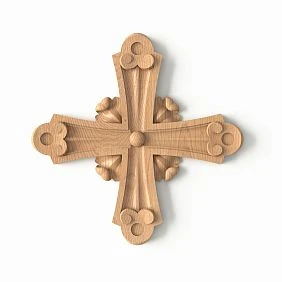
Short answer: what exactly the buyer orders from the IKN-007 card
One product item IKN-007 means one carved wooden cross of the selected size, material, and sanding quality. The card allows you to choose beech or oak, "Standard" or "Prestige", as well as a specific size line. These parameters determine the wooden part itself, but do not prove the presence of a finished finish color and do not confirm a complete wall mounting kit.
Before placing an order, separately check five points:
-
Is a ready-made factory finish required, or are you purchasing a wooden blank for subsequent coating?
-
Is there a loop, hole, groove, or mounting plate on the back side?
-
Is any fastening hardware included with the selected configuration?
-
Is adhesive mounting acceptable on your wall, and is mechanical backup needed?
-
Who selects the dowel, screw, hanger, or other system based on the base material?
Light beech wood, neat sanding, and the "for enamel" marking do not equal a finished white cross. Oak does not mean the surface is already coated with oil or varnish. The accompanying glue in the product card does not make it mandatory or the only mounting method. Even the exact size 185 × 185 × 15 mm says nothing about where exactly to screw in the fastener until the back side or the current drawing is checked.
If you need not just one item but a well-thought-out design for a prayer corner, it is useful to first view the entire church decor made of wood. This helps coordinate the cross with icons, carved frames, columns, and other details by wood type, scale, and future coating. However, each element is still recorded in the specification as a separate line: proximity in the catalog does not mean automatic completeness.




Five sizes of IKN-007 are five different mounting situations
The IKN-007 size range allows you to choose a cross for a small home composition, a separate wall, or a larger architectural design. But the article is not limited to the question of "which size is more beautiful." Here, size is considered as the initial condition for ordering finishing and mounting.
| IKN-007 size | Thickness | What changes when preparing an order | What to be sure to clarify |
|---|---|---|---|
| 110 × 110 mm | 9 мм | Compact piece, small contact area, limited space for hidden mounting | Is there a factory suspension point and is the chosen adhesive acceptable |
| 145 × 145 mm | 11 мм | The cross is more noticeable in a small wall composition but remains relatively thin | Will the fasteners be visible at the edges and is the thickness sufficient for the chosen assembly |
| 185 × 185 mm | 15 мм | Medium format for standalone placement or home iconostasis | How is the suspension point located, what is the wall base, and is insurance needed |
| 255 × 255 mm | 20 мм | The distance from the wall, area, and marking accuracy requirements increase | Can you rely only on glue, how to hold the product until strength is achieved |
| 310 × 310 mm | 24 мм | A large cross requires a pre-designed position and a reliable mounting solution | What mechanical assembly is provided, who is responsible for installation, and is the reverse side accessible |
The table does not assign fasteners by size. It shows why the phrase “the cross is attached to the wall” is insufficient. Two products with the same design but thicknesses of 9 and 24 mm behave as different mounting objects. The large version has more visible area and protrusion from the base. A small cross is harder to equip with a large hidden plate without the fasteners extending beyond the contour. The decision is made after checking the specific modification.
Our factory also produces:
110 × 110 × 9 mm: compactness does not cancel checking the reverse side
The small IKN-007 is convenient where free space is limited: above a small shelf for icons, inside a narrow frame, as part of a wall-mounted composition. The mistake occurs when compactness is automatically perceived as ease of installation. The small thickness of 9 mm, on the contrary, reduces space for deep routing, a large screw, or a massive hanger.
Before ordering, you need to find out whether a factory loop or another mounting point is provided. If not, you cannot drill into a thin carved piece at a random location without approval. The hole may hit a weakened area of the pattern, come out on the front surface, or disrupt the symmetry of the installation.
Get Consultation
145 × 145 × 11 mm: a visible cross for a small composition
This size is already easier to read on the wall, but remains moderate. It can be considered for a home prayer corner where small icons and a shelf are nearby. When ordering, it is important not only to check the width of the free space, but also to understand how the cross will stand relative to neighboring items: separately on the wall, inside a decorative field, or above the top line of the composition.
If the cross will be painted to match the color of a neighboring wooden frame, it is better to coordinate the materials in one request. If it should retain the natural texture of oak, a test paint sample is needed before processing the entire product. The small format does not forgive a too thick layer: the finish should not visually clog the fine recesses of the carving.
185 × 185 × 15 mm: the medium format requires a full specification
The 185 × 185 × 15 mm version is often perceived as a universal middle ground, but "medium" does not mean "ready for any wall." On concrete, solid brick, hollow block, and drywall, the same cross is mounted differently. If the location is prepared in advance, the mounting assembly can be coordinated before finishing. If the wall is already painted and renovation is complete, you need to especially carefully check what trace the fastening will leave and whether temporary fixation will be required.
For a home iconostasis, it is useful to read in advance the material about how to arrange a home iconostasisand then transfer the selected cross position to the dimensional scheme. The general article helps determine the composition, but does not replace checking the completeness of a specific IKN-007.
255 × 255 × 20 mm: the adhesive can no longer be chosen based on the principle "it's in the recommendations"
The enlarged cross protrudes more from the plane and reacts more noticeably to wall unevenness. If the base has local bumps or depressions, the actual contact area may be smaller than the visible one. A thick adhesive layer should not become a way to fix geometry without checking the instructions and the condition of the base.
In the card nearby you can see TYTAN mounting adhesive for IKN-007, however, the very fact of product recommendation does not confirm that the large version can be held only on an adhesive joint. First, determine the wall material, coating condition, presence of a factory suspension, and the need for mechanical safety.
310 × 310 × 24 mm: a large cross cannot be turned into an installer's experiment
The 310 × 310 × 24 mm version requires full design anchoring. Its position noticeably affects the entire wall: height relative to icons, composition axis, distance to ceiling, cornice, lamp, and furniture become part of the solution. Here it is especially dangerous to leave the mounting question "for later."
Before payment, the following must be clear:
-
the selected wall and its material;
-
exact center mark;
-
free space around the cross;
-
method of access to the reverse side;
-
presence of factory mounting point;
-
admissibility of adhesive;
-
mechanical safety backup;
-
sequence of finishing and installation.
For a complex composition, you can order a church composition project, attaching a photo of the wall, dimensions, and article IKN-007. The project is useful not as a pretty picture, but as a document that links the cross, adjacent decor, axes, offsets, and specification.
Characteristics that are confirmed, and questions that remain open
Buyer safety begins with separating facts from assumptions. Dimensions, wood species, and sanding options are published in the product card. Finished coating, specific suspension, and a complete fastener set cannot be declared part of the delivery without separate confirmation.
| Parameter | Confirmed value | How to use when ordering |
| Article number | IKN-007 | Write without abbreviations and similar numbers |
| Type | Carved wooden cross | Do not confuse with a crucifix, icon, pectoral, or street cross |
| Dimensions | 110 × 110 × 9; 145 × 145 × 11; 185 × 185 × 15; 255 × 255 × 20; 310 × 310 × 24 mm | Select one specific line |
| Material | Beech or oak | Link to future finishing and adjacent decor |
| Sanding | "Standard" or "Prestige" | Specify in each order item |
| Preparation of the selected configuration | "Under enamel" | Do not accept as a finished painted finish |
| Quantity | Determined by the buyer | One piece item does not mean a set of the iconostasis |
| Ready color | Not confirmed as a mandatory part | Finish to be agreed separately |
| Loop, hole, plate | Require verification | Request a photo of the reverse side, drawing, or written confirmation |
| Wall mounting | Requires selection based on the base | Not to be considered universally included |
| Construction adhesive | Presented as an accompanying product | Check suitability for a specific wall and size |
After the table, it is easy to see why the question of completeness cannot be closed with a single phrase to the manager: "Need a cross on the wall." The request must include the size, wood species, sanding quality, future finish, wall type, and required hanging method. The larger the execution and the more complex the environment, the more detailed the entry should be.
"Under enamel" is not a ready white finish
The phrase "under enamel" describes the preparation of a wooden blank for an opaque finishing system, but does not confirm the presence of a final white, gold, dark, or other color. The buyer receives the selected wooden part with the agreed processing quality. The finished paint must be explicitly stated in the order, invoice, or production specification.
Why the color on the screen cannot be transferred into an agreement
A photo of the product depends on lighting, white balance, screen, and image processing. Even untreated beech can look almost white, cream, or light pink in different shots. Oak changes its shade after oil, varnish, stain, and tinting compound. Therefore, the words "I want it like in the photo" are not enough.
For an accurate finish, you need:
-
name of the coating system;
-
color or sample;
-
degree of hiding power;
-
matteness or gloss;
-
decision on texture preservation;
-
test application, if matching is critical;
-
coordination with adjacent wooden elements.
A buyer planning to do their own finishing can in advance purchase materials for finishing a wooden cross. But the material category does not assign the system automatically. Primer, enamel, oil, varnish, and brush must be compatible with each other, the wood, and the room conditions.
Why carving cannot be painted like a flat board
On a flat surface, an extra layer is noticeable as a run or orange peel. On a carved cross, it can fill recesses, soften sharp lines, and change the readability of the pattern. Be especially careful with small sizes, where every millimeter of relief is noticeable relative to the total area.
Before applying the finish, the product is cleaned of dust, edges and recesses are checked, and a test of the system is performed on a sample or an inconspicuous area. General recommendations for finishing wooden decor help build the sequence, but the application mode and drying time are taken from the documents of the selected composition.
"Standard" and "Prestige": the difference is not decorative, but production-related
The quality of sanding affects the amount of preparation before finishing. "Standard" is designed for a situation where the workshop is ready to independently bring the surface to its own system. "Prestige" involves more detailed manual sanding and reduces the amount of rework on the buyer's side. These are not two colors and not two types of varnish.
Details compare sanding "Standard" or "Prestige" useful before calculating the budget. A low price for the workpiece may lose its meaning if the finishing workshop spends a lot of time on hard-to-reach recesses. On the other hand, a professional painter sometimes deliberately chooses "Standard" because they still perform their own preparation according to the project's technology.
| Situation | "Standard" | «Prestige» |
| Self-painting without experience | May require complex rework of carving | Reduces the amount of manual preparation, but control before finishing is still needed |
| Professional painting workshop | Suitable if preparation is included in the production process | Suitable when you need to reduce finishing time |
| One pass for a finished interior | Requires estimating labor costs in advance | More convenient when a neatly prepared element is needed |
| A series of identical items | Economics are calculated together with grinding hours | Economics are calculated together with the cost of higher preparation |
| Transparent oak finish | Any traces of processing are more visible | Detailed preparation is especially valuable, but a test finish is mandatory |
It cannot be promised that "Prestige" completely eliminates any preparation. Before coating, the surface is still inspected, dusted, and checked under side lighting. After storage or transportation, local actions may be required. The correct wording: the chosen quality determines the initial level of sanding, and the final readiness is confirmed by the craftsman who applies the coating.
Beech or oak: the choice begins with what should remain visible
Both species are available for IKN-007, but the buyer does not choose abstractly "which wood is better," but rather a material for a specific visual result. For dense opaque enamel, beech is often considered. For translucent finishes where the wood grain matters, oak is usually chosen. This is not a strict prohibition on other combinations, but a practical starting point.
Beech under covering enamel
Beech has a relatively even visual field. If the cross is to become white, graphite, burgundy, or painted in another dense color, the key is to coordinate the preparation and coating system. Opaque enamel hides the natural tone of the wood but does not automatically correct an uneven surface or dust in recesses.
In the request, it is better to write not just "beech," but the full result: "IKN-007, size 185 × 185 × 15 mm, beech, 'Prestige', opaque finish required per agreed sample." Such a line is much more precise than "medium-sized white cross."
Oak for visible texture
Oak is chosen when the natural grain should be part of the product's appearance. Tinting, oil, or clear varnish change the shade and contrast of the pores. The same composition on different blanks may look different, so critical matching with an iconostasis, icon case, or wooden shelf is verified with a sample.
The phrase "oak cross" does not yet define the color. Natural oak, dark tinting, bleached surface, and clear oil give completely different results. The specification records not only the species but also the type of finish.
One composition — one logic of materials
If IKN-007 is installed next to carved icons, frames, or decorative details, accidental mixing of species and finishes can destroy the integrity. Sometimes contrast is intended and appropriate. But then it must be by design, not arising from the fact that the cross and neighboring elements were ordered on different days without a common specification.
Before purchasing, it is useful view all carved crosses made of beech and oak and make sure that it is the IKN-007 drawing that matches the composition. The general category is responsible for selecting the model, and this article is for the completeness of the already selected cross.
First the wall, then the fastener: why the reverse order is dangerous
Fasteners are not chosen by the product name or by a photo of the front side. The same IKN-007 can end up on monolithic concrete, solid brick, hollow partition, drywall sheathing, wooden panel, or painted plaster. Each substrate requires its own check.
The main question is not "which screw to buy," but "how the load will be transferred from the cross to the load-bearing substrate." If there is weak plaster behind the decorative layer, the adhesive may only hold that plaster, not the wall. If the drywall is attached to a frame, the location of the profile may determine the position of the mechanical fastener. If the surface is covered with low-adhesion paint, the glued part can tear off along with the coating.
| Base | What to check before ordering | Why fasteners cannot be assigned remotely |
| Monolithic concrete | The thickness of the finishing layer, the location of hidden wiring, the acceptability of drilling | The type of dowel depends on the substrate and the load |
| Solid brick | The joint or the body of the brick, the condition of the plaster | Fastening into the joint and into the brick works differently |
| Hollow block | Void structure, wall thickness, available area | A regular expansion anchor may not provide reliable fixation |
| Gypsum board | Number of layers, profile position, or embedded insert | Fastening only to the sheet and fastening to the frame are different solutions |
| Wooden panel | Panel thickness, base material behind it | Short fasteners may only hold in the decorative layer |
| Painted plaster | Adhesion strength of paint and plaster | The adhesive may remove the finish along with the cross |
| Stone or tile | Possibility of drilling, seams, surface fragility | Tool error damages the finished cladding |
This table does not replace the mounting project. It helps prepare data for a specialist. In the request, it is enough to honestly write: "The wall is two layers of drywall on a metal frame, the profile position is known" or "the base is concrete under painted plaster." Such information is more useful than a request to "put suitable screws."
The presence of a loop cannot be assumed
Part of the wall decor may have a prepared hanging point, part may not. For IKN-007, the presence of a loop, hole, or plate must be confirmed for the selected modification. Even if one sample was made with a hanger, this cannot be automatically transferred to the entire line and future batch.
The request to the manager must be specific:
-
show the back side of the selected size;
-
indicate whether a factory hole is provided;
-
confirm the presence or absence of a loop;
-
report whether the mounting plate is included;
-
clarify whether additional drilling is permissible;
-
indicate whether there are restrictions on the mounting location.
For technical verification, you can download the current drawing IKN-007. The general drawing section confirms the possibility of obtaining technical materials, but the specific file and its relevance need to be matched with the selected card and size.
Why you cannot drill a cross "approximately in the center"
The carved shape distributes material unevenly. The visual center may coincide with a thin section, a recess, or an area where a hole would weaken the part. Drilling from the front side is risky due to chipping. A hole that is too deep can come out on the other side. One too close to the edge can split the wood.
If a factory point is not provided, the method of modification is agreed upon before painting. A hole, groove, or plate changes the reverse side and may require repeated local treatment. Performing such operations after the final enamel is riskier: the tool damages the coating, and the correction is visible on the carving.
Assembly adhesive: an accessory product, not a universal solution
The IKN-007 card shows transparent TYTAN Prof. Classic Fix among related products. This is a useful hint: the adhesive is intended for wood and decorative elements as well. But the "bought with this product" block is not an engineering calculation. It does not know your wall material, actual contact area, paint quality, cross position, or operating conditions.
The adhesive scheme can be discussed when:
-
the base is strong, clean, and compatible with the compound;
-
the reverse surface provides sufficient contact;
-
the size and weight of the product allow such a method;
-
the wall finish does not peel off;
-
the cross can be held in the correct position until initial fixation;
-
the manufacturer or installer confirms the absence of a mandatory mechanical point.
Adhesive cannot be automatically chosen as the sole fastening if:
-
the base is loose;
-
the surface is covered with fragile paint;
-
the wall has a pronounced curvature;
-
the cross is large;
-
the actual contact area is small;
-
the product is installed above a passage, furniture, or a place of constant human presence;
-
the project requires a removable mounting;
-
there is no confirmation of the permissible scheme.
Adhesive consumption cannot be calculated only by the width of the cross
The tube description may provide a guideline for application in a line, but IKN-007 is not a straight linear product. It has a complex contour and carved reverse geometry. Actual consumption depends on the application method, contact area, surface evenness, and layer thickness. Therefore, the formula "one tube is enough for so many crosses" cannot be given without a trial installation.
In the specification, the adhesive is recorded as a separate line and it is indicated that its quantity is confirmed after selecting the installation scheme. This protects against two opposite errors: a shortage of the compound on the installation day and purchasing excess material that will not be used.
Glue and mechanical safety do not exclude each other
Sometimes glue ensures even adhesion, and a hidden mechanical point provides safety. Sometimes only a suspension is used. In another situation, the cross is fixed on a pre-prepared panel, which is then installed as a whole. There is no universal rule.
The correct solution contains three parts:
-
Which surface takes the load.
-
Which part connects the cross to the wall.
-
How displacement is prevented before final fixation.
If at least one part remains unknown, the order set is not ready yet.
What is included in one item, and what should be recorded separately
The buyer sees the price and the cart button, but mentally combines several different objects. To avoid this, let's break the request into independent lines.
One item IKN-007
This is one cross of the selected modification. The line must specify:
-
article number;
-
size A × B × C;
-
beech or oak;
-
"Standard" or "Prestige";
-
quality of re-gluing or preparation, if the parameter is available;
-
Quantity.
Final finishing
Finished color, tinting, oil, varnish, or enamel are not considered included unless explicitly stated in the order documents. If finishing is done by the buyer, only materials are included in the request. If the work is performed by the manufacturer or a separate workshop, the service must be a separate line with a sample and a description of the result.
Wall mounting
Hinge, plate, hanger, dowel, and screw are different elements. The word "fastener" cannot be replaced with one vague line. It is necessary to understand which part is installed on the cross, which is on the wall, and what the customer is purchasing.
Construction adhesive
Adhesive is added only after suitability is confirmed. Its presence in the cart does not prove that mechanical fastening is no longer needed.
Design and layout
For a separate small cross, the project can be a simple sketch with dimensions. For a large composition with icons, shelves, and carved decor, professional alignment is useful. This is a separate service, not part of the price of the wooden part.
Consecration
Manufacturing a decorative item and church consecration are different actions. It cannot be implied that the cross is consecrated unless this is separately agreed with the relevant church authority. The product request records production parameters; spiritual matters are resolved separately.
What to buy with IKN-007: a set without random items
The accompanying purchase should address a real task. There is no need to add everything from neighboring categories. One project will only require a cross and an agreed-upon suspension. Another will need finishing materials, glue, a color sample, and a design project. A third needs a full set of church decor in one wood species.
| What to add | Why | When required | What to check |
| Materials for finishing a wooden cross | Prepare and protect the wood, achieve the desired color | For DIY finishing | Compatibility of primer, coating, and wood |
| Transparent assembly adhesive for carved decor | Create an adhesive bond or auxiliary fixation | Only with a confirmed scheme | Base, contact area, need for insurance |
| Mechanical fasteners | Transfer load to the wall base | When a loop, plate, or hole is provided | Wall material and mounting point type |
| Coating sample | Check color and thread readability | In case of exact match with iconostasis or furniture | Same wood species and surface preparation |
| Drawing | Check dimensions, thickness, and technical zones | Before marking and manufacturing the mounting | Version compliance with the selected size |
| Other items for the home iconostasis | Assemble a unified composition | When the cross is not installed separately | Wood species, scale, finish, quantity |
| Placement project IKN-007 on the wall | Align axes, indents, and specification | For a complex wall or multiple elements | Exact dimensions and photos of the object |
| Delivery of the wooden cross | Receive all items in one coordinated batch | For any removed order | City, packaging, cargo composition, acceptance |
After the table, the order does not become the same for everyone. It works like a constructor: the buyer selects only the rows needed for their project. The main thing is not to leave logical gaps between them. If enamel is specified, the color must be clear. If glue is recorded, the wall must be confirmed. If a hinge is needed, it should be known whether it is included in the product.
Three purchase scenarios: the same cross, different requests
Scenario 1. A small cross above a home shelf for icons
Initial data: IKN-007 measuring 110 × 110 × 9 mm, painted wall, compact shelf, several icons nearby. The buyer wants a light opaque finish.
In the request, it is not enough to write "small white cross". The exact modification, beech, sanding quality, color sample, and confirmation of the hanging method are needed. Due to the 9 mm thickness, it is especially important to know where the mounting point is and whether the back can be modified.
Possible composition:
-
IKN-007, 110 × 110 × 9 mm;
-
beech;
-
"Prestige";
-
agreed opaque color;
-
one piece;
-
loop or hole confirmation;
-
fastener for a specific wall;
-
position template relative to the shelf.
If the finishing is done independently, the finished color is replaced with a list of materials and a test sample.
Scenario 2. Oak cross as part of a home iconostasis
Initial data: size 185 × 185 × 15 mm, oak, visible texture, adjacent elements already have a translucent coating.
Here the main mistake is to choose an "approximately brown" composition without a sample. The oak cross should either deliberately differ or fit into the overall system. A test sample on compatible wood is needed, and preferably coordination together with adjacent parts.
Possible composition:
-
IKN-007, 185 × 185 × 15 mm;
-
oak;
-
selected sanding quality;
-
translucent system according to the sample;
-
one piece;
-
a drawing;
-
mounting unit;
-
layout diagram in the composition;
-
delivery together with the rest of the decor.
A general article allows to compare types and sizes of wooden crosses, but after selecting IKN-007, the decision is moved to a specific specification.
Scenario 3. Large cross for a church or public space
Initial data: IKN-007 measuring 310 × 310 × 24 mm, high wall, installation at a noticeable height, a person passes under the cross.
In such a project, one cannot rely on unspecified adhesive. A confirmed mechanical scheme, assessment of the base, and responsibility of the installation organization are required. The finish is coordinated with the overall architectural program. If the cross is part of a series, all items are ordered under one specification.
Possible composition:
-
IKN-007, 310 × 310 × 24 mm;
-
material and sanding;
-
approved finish;
-
exact quantity;
-
technical drawing;
-
photo of the reverse side;
-
fastening diagram;
-
wall description;
-
design elevation;
-
packaging and delivery;
-
acceptance certificate before installation.
Large size does not automatically make an item temple-like, nor small size make it only domestic. The purpose is determined by the project, the scale of the space, and the agreed placement.
How many crosses to order
For a separate wall, usually one IKN-007 is needed. But the word "usually" cannot be turned into a rule. The project may include paired prayer areas, multiple rooms, identical offices, chapels, or a series of decorative compositions.
The quantity is calculated using the formula:
Q = N × K
Where:
-
Q — total number of crosses;
-
N — number of spaces being decorated;
-
K — quantity of IKN-007 per space.
If three identical rooms are being decorated and each needs one cross, Q = 3 × 1 = 3 pcs. If one cross is used in the central composition and two other sizes are used in the side ones, each article and size is counted separately.
Is a spare copy needed
The automatic 'plus ten percent' reserve is not suitable for a piece-by-piece carved product. The decision depends on the project.
A reserve may be justified if:
-
a series of identical objects is being decorated;
-
a repeat order later will make it difficult to match the finish;
-
there is a risk of damage during complex installation;
-
the client must store a reserve for the operation of a public space.
A reserve is only needed for peace of mind if there is a single cross, installation is simple, and repeat delivery is possible. It is better to invest the budget in quality preparation and proper fasteners than to buy an unnecessary part without a reason.
Why it is better to order all items in one batch
Natural variability is acceptable in wood. Individual batches may differ in shade and grain. Finishing done at different times can also produce slight discrepancies. For a series of identical compositions, it is more advantageous to lock in the size, wood species, sanding quality, and finish with a single order.
How not to confuse IKN-007 with a ready-made iconostasis, crucifix, or random overlay
IKN-007 is a separate carved cross. It does not automatically include icons, an icon case, a shelf, columns, a frame, lighting, or wall mounting hardware. A buyer sometimes sees an interior photo and perceives the entire composition as a set. The product card, however, refers to a single wooden piece.
A cross and a crucifix are not the same name
If the project requires an image of the Crucifixion, you need to select the appropriate product category. IKN-007 in the card under consideration is called a cross. You cannot add a figure or configuration to it that is not in the confirmed data.
A wall cross and a pectoral cross refer to different requests
Dimensions from 110 to 310 mm and the wall placement scenario clearly separate IKN-007 from jewelry items. The article does not use queries about chains, silver, gold, or baptism:
Installer access
If the cross is positioned high, it is necessary to plan in advance for safe access, holding the product, and level control. A large part cannot be aligned with one hand while simultaneously working with the fasteners.
Example of a ready-made request to a manager
Below is not a legal form or a universal specification, but a sample of a precise inquiry. It can be adapted to your project.
Need a cross IKN-007, size 185 × 185 × 15 mm, 1 pc. We are considering oak and a semi-transparent finish based on the sample of the adjacent shelf. We ask to confirm available sanding options, delivery condition, and the possibility of coordinating the finish. Please clarify whether a loop, hole, or mounting plate is provided on the reverse side, whether they are included in the delivery, and whether additional processing is allowed. The wall is monolithic concrete with painted plaster. We ask to inform whether TYTAN Prof. Classic Fix can be used as part of the scheme and whether mechanical fastening is required. We need a current drawing, a photo of the reverse side, and a delivery calculation to the specified city.
Such a message reduces the number of guesses. The manager sees not only the article number, but also the task, base, finish, and the required result.
Order specification IKN-007
For an internal document, it is convenient to use a table.
| Field | What to record |
| Article number | IKN-007 |
| Size | One of five precise lines A × B × C |
| Quantity | Number of pieces |
| Material | Beech or oak |
| Sanding | "Standard" or "Prestige" |
| Preparation | Value from the selected modification |
| Finish | No / independent / coordinated service |
| Color and sample | Code, name, or number of the approved color sample |
| Installation location | House, temple, separate wall, iconostasis |
| Wall material | Exact description of the base |
| Suspension point on the product | Loop / hole / plate / not confirmed |
| Glue | Mark and role in the scheme, or "not required" |
| Mechanical fastening | Type is assigned by a specialist based on the base |
| Drawing | Name or date of the current version |
| Delivery | City, method, recipient contact |
| Acceptance | Check size, material, thread, and completeness |
Key line — "suspension point on the product." Until it says "not confirmed," the mounting kit cannot be considered complete.
Errors that prevent the cross from being installed after delivery
Treat light wood as a finished white coating
Beech in a photo may look almost white, but it is natural material or a prepared blank, not confirmed enamel. If a white cross is needed, the color and finish must appear in the order as a separate condition.
Choose "Prestige" and decide that the finish is no longer needed
"Prestige" refers to sanding. It does not replace primer, enamel, oil, varnish, or other protective and decorative coating. The product may be well prepared but remain unpainted.
Put the adhesive in the cart and forget about the wall
The adhesive works in the system "product material — compound — wall finish — base". If the paint is peeling, the strongest bond will hold the cross together with a piece of the coating, not on the wall. For large formats, the need for mechanical safety is additionally checked.
Assume the presence of a loop
The phrase "cross for the wall" describes the application scenario but does not prove the backside configuration. The loop must be confirmed. Its location affects the height and layout.
Drill after painting
Any modification after the finish increases the risk of chipping, scratching, and noticeable repair. If a hole, groove, or plate is needed, they are prepared before the final finish.
Order the size based on a photo of the room
Photos distort perspective. A 185 mm cross may look large in the frame but get lost on a wide wall. A full-size paper template shows scale more honestly.
Don't check the thickness
Buyers often look only at width and height. Thickness of 9, 11, 15, 20, or 24 mm affects the side view, distance from the wall, and available depth for the mounting assembly.
Paint the cross separately from adjacent decor without a sample
Even the same color name does not guarantee visual matching on different wood species and primers. When the cross must continue the finish of a shelf or frames, a shared paint sample is needed.
Receive the product and immediately hand it over to the installer
First, perform acceptance. If size, material, or configuration do not match, drilling and painting will complicate subsequent issue resolution.
Acceptance IKN-007: what to check before finishing
Open the box in a clean room with good lighting. It's better to photograph the packaging condition before unpacking, especially if damage is visible.
SKU and size
Verify the marking against the documents. Measure width, height, and thickness. For a carved piece, control is done carefully, without pressing the tool on thin elements.
Material
Beech and oak have different grain patterns. If the species is critical for the finish, it is checked before applying the coating. If in doubt, contact the supplier before further work.
Sanding quality
Compare the actual preparation with the ordered line "Standard" or "Prestige". Inspect the face surface, edges, and recesses under side lighting.
Carving and geometry
Check for chips, cracks, damaged thin sections, and impact marks. Do not try to fix the defect yourself immediately if the issue must be reported to the supplier.
Reverse side
This is where installation readiness is confirmed. Find the hinge, hole, groove, or plate if they were agreed upon. Verify their position against the drawing and the project mark.
Completeness
Lay out the cross, fasteners, glue, finishing materials, and documents side by side. Compare with the list. A missing line will be found before the installer arrives.
Batch color
If several identical crosses are ordered, or a cross together with other oak decor, evaluate them side by side before finishing. For transparent systems, natural wood variations should be accepted or distributed across the composition in advance.
Finishing before or after installation
For a carved wooden cross, it is often more convenient to perform the main finishing before installation: the craftsman sees the entire contour, can rotate the piece, treat the edges, and control runs. But installation touch-ups must be completed before the finish.
The rational sequence looks like this:
-
Confirm the size and material.
-
Agree on the suspension point.
-
Perform the necessary technological operations on the back side.
-
Make a test paint out.
-
Prepare and finish the cross.
-
Allow the coating to gain the required strength.
-
Prepare the wall and perform the marking.
-
Install the product according to the agreed scheme.
-
Check the position and absence of damage.
Painting after installation is possible only in special circumstances, but it complicates wall protection, access to side surfaces, and control of recesses. The article does not prohibit this method, but shows its consequences.
Markup: a paper template is cheaper than redoing the wall
For each size, you can cut out a rectangle according to the outer dimensions: 110 × 110, 145 × 145, 185 × 185, 255 × 255, or 310 × 310 mm. Even better, use a contour close to the shape of a cross. The template is temporarily fixed to the wall with painter's tape that does not damage the coating.
Check the view:
-
directly from the entrance;
-
from the place of prayer;
-
next to the icons;
-
with the lighting on;
-
in the morning and evening, if natural light falls on the wall.
After choosing the position, mark the center and control axes. The holes are not transferred from the front photo: their coordinates are taken from the back of the specific product or from the drawing.
When IKN-007 is suitable, and when another option is needed
Suitable
IKN-007 should be considered when a separate carved cross made of beech or oak is needed, one of the five confirmed sizes matches the free space, and the buyer is ready to consciously choose the finish and mounting scheme.
The model is convenient for projects that require:
-
a small cross above a home shelf;
-
a middle element as part of an iconostasis;
-
a standalone wall accent;
-
a large detail in a church composition;
-
a series of identical crosses with unified finishing.
Better to look at another cross
Another option is needed if the IKN-007 design does not match the style of the composition, the required scale is not available in the five sizes, or the project requires a different symbolic or structural form. Then it is reasonable to choose a different size and cross design, rather than trying to rework the finished model.
Need not just a cross, but a full composition
If the task includes icons, an icon case, a shelf, carved columns, and a common frame, one IKN-007 is not enough. You should assemble a project and a list of all elements.
Outdoor use not confirmed
Without special execution and written approval, you cannot transfer an interior wooden part to a facade, open air, or unheated damp space. The external environment changes requirements for gluing, coating, and fastening.
Cannot be used as a load-bearing element
IKN-007 is a decorative and symbolic item, not a support, bracket, or structural insert. Do not hang shelves or other loads on it.
Purchase on STAVROS: route from product card to full request
The first step is to open the card and order wooden cross IKN-007 in the required size line. Do not limit yourself to the cart button: record the modification in a separate list.
The second step is to determine the material and finish. Beech or oak is chosen together with the coating system. Then the quality of sanding is fixed.
The third step is to request information about the reverse side. Without it, the installation section of the order cannot be completed.
The fourth step is to describe the wall and the placement location. A photo with dimensions helps to see neighboring items, but the technical parameters of the base are written in words.
The fifth step is to add only the necessary accompanying items. Glue, finishing materials, and design should not be included in the request mechanically.
The sixth step is to check the payment, packaging, and delivery terms. On the page, you can clarify the payment and delivery terms for church decor. Current availability, delivery time, and transportation cost are checked before payment.
The seventh step is to obtain final confirmation of the order composition. It must match the article number, size, material, sanding, quantity, finish, and agreed additional work.
Checklist before payment
-
The exact size A × B × C has been selected.
-
The material is specified: beech or oak.
-
The sanding quality has been selected.
-
It is clear whether the finished finish will be available.
-
There is a color sample if the match is critical.
-
An image or description of the reverse side has been received.
-
The presence or absence of a loop, hole, or plate has been confirmed.
-
The wall material has been described.
-
The role of the mounting adhesive has been agreed upon.
-
Mechanical fastening has been assigned if required.
-
The number of crosses has been determined.
-
The drawing version has been checked.
-
A table of related items has been compiled.
-
Packaging and delivery have been clarified.
-
The installer received the documentation before the work began.
The project changed after choosing the cross: what to recalculate before payment
Interior solutions rarely remain unchanged from the first sketch to installation. A shelf may be raised, icons replaced with larger ones, the wall covered with panels, and beech swapped for oak. Each such adjustment can change not only the appearance but also the composition of the order.
The size of IKN-007 has changed
Switching from 145 × 145 × 11 mm to 255 × 255 × 20 mm cannot be done by replacing one digit in the invoice. The free field, center height, thickness, mounting point, fasteners, and the amount of finishing material must be rechecked. Adhesive, acceptable as a supplementary option for the smaller part, is not automatically suitable for the enlarged one.
Reducing the size also raises new questions. A large hinge or plate may not fit into a thinner part. Visible fasteners that were hidden behind a wide contour may extend beyond the edge. Therefore, a new dimension line triggers a recheck of the entire assembly.
The wall material has changed
During renovation, concrete may be covered with drywall, decorative panels, or tiles. To the buyer, the wall looks finished, but the load is now borne by a different layer system. The documentation must record not only the top covering but also the base beneath it.
The phrase "drywall wall" is also incomplete. The number of sheets, profile placement, presence of an embedded insert, and accessibility to it all matter. If the mounting location is already sealed, a specialist makes the decision after inspection.
The finish of the cross has changed
Replacing the covering enamel with transparent oil makes the wood grain part of the result. Beech, chosen without attention to the tone of the lamellas, may not provide the expected appearance. Oak under a transparent system requires shade coordination and a test sample. The preparation also changes: a defect invisible under dense enamel can appear under a semi-transparent layer.
The reverse replacement — from transparent finish to covering — should also be included in the specification. It is necessary to check the compatibility of the primer and enamel, the degree of matteness, and the method of treating recesses.
The installation location has changed
A cross originally intended for a home shelf may be moved to a hallway, office, or public space. In the new location, viewing distance, lighting, risk of accidental contact, and safety requirements change. Installation above a passage requires different responsibility than placement inside a protected niche.
If IKN-007 is moved closer to a window, heating device, or area with humidity fluctuations, operating conditions should be discussed separately. Natural wood and coating must be used in a suitable environment.
The quantity has changed
One sample often turns into a series after project approval. Before a batch order, a reference standard must be established: size, material, sanding, color, hanger placement, and packaging. Without a reference, four formally identical crosses may receive different instructions from the finisher or installer.
For a series, a table with the number of each installation location is useful. For example: "Room 1 — IKN-007 185 mm, center 1650 mm", "Room 2 — same version, center 1700 mm". This way, identical items are not mixed with different project marks.
After installation: control, care, and the ability to remove the cross without damage
The installation completes the construction part, but does not cancel operation. Even before choosing the mounting, it is worth deciding whether the cross should remain removable. An adhesive joint can complicate dismantling when repainting the wall, moving the iconostasis, or restoring the coating. A hanging system usually facilitates removal, but requires precise geometry and reliable fixation against accidental displacement.
First inspection after installation
Immediately after installation, check:
-
verticality and alignment with the design axis;
-
uniformity of the gap between the cross and the wall;
-
no rocking;
-
condition of the threads and finish;
-
absence of adhesive marks on visible edges;
-
absence of cracks and damage around the mounting point;
-
stability of adjacent elements of the composition.
If adhesive is used, the load mode and full curing time are taken from the composition's instructions. The check must not be accelerated by jerking or attempting to tear the product off.
Regular cleaning
Carved relief collects dust in recesses. For care, use a soft dry tool that does not scratch the coating or catch thin elements. Wet cleaning is used only when it is acceptable for the chosen finish. Aggressive household products can alter the shine, soften the coating, or leave light spots.
Wall inspection
Even a properly installed cross depends on the condition of the base. If cracks, paint peeling, or signs of moisture appear on the wall, the decorative piece is inspected together with the mounting. The cause of the wall change is eliminated before performing cosmetic repairs around the item.
Relocation to another place
When moving or rearranging the composition, you cannot automatically repeat the old fastening on a new wall. First, the cross is carefully removed according to the scheme, the back is inspected, and then a mounting unit is selected anew for a different base. A preserved dowel, screw, or layer of glue is not considered a ready-made kit for reinstallation.
Storage before reinstallation
The removed piece is not placed with the carving on a hard surface or leaned against a wall in a passageway. The cross is packed so that protruding parts do not bear load. The room must meet the storage conditions for the wooden product and its coating.
FAQ: answers to questions about IKN-007
What is included in one IKN-007 item?
One item includes one carved wooden cross of the selected size, material, and sanding quality. The finished color, mounting, and installation materials cannot be considered included without direct confirmation in the order documents.
Is IKN-007 supplied painted?
Ready-made painting is not confirmed by a single choice of "under enamel." This characteristic refers to the preparation of the workpiece. The presence of a finish coating must be agreed upon separately.
Can I order a white cross?
A white finish can be requested, but it must be described as a separate result: color, type of coating, gloss level, and contractor. The natural color of beech cannot be taken as white enamel.
What to choose: beech or oak?
Beech is often chosen for opaque painting, oak — when you want to preserve the visible texture. The final decision depends on the project and the chosen finishing system.
How does "Standard" differ from "Prestige"?
These are sanding levels. "Standard" involves machine preparation and may require more refinement, "Prestige" — more detailed hand sanding. Both options are still checked before finishing.
Is a hinge included in the set?
Based on available data, this cannot be promised for every execution. The presence of a hinge, hole, or mounting plate must be confirmed before payment.
Can the cross be hung immediately after delivery?
Only if the finished finish and the complete mounting assembly are confirmed in advance. If the cross is supplied as a prepared wooden part, the finish is first applied and the agreed fastening part is installed.
Can I glue IKN-007 to the wall?
Adhesive mounting is possible only after checking the size, back surface, base, and wall covering. Some situations require mechanical backup or another method.
Which adhesive is indicated next to the cross?
The transparent TYTAN Prof. Classic Fix is listed as an accessory. Its presence in the product card does not mean it is universally suitable for any wall or any size.
How much adhesive is needed for one cross?
Exact consumption cannot be determined by external size alone. It depends on the actual contact area, wall flatness, and application pattern.
How to mount IKN-007 on drywall?
First, determine the number of layers, the position of the profile or embedded insert, and the weight of the finished product. Specific fasteners are assigned by a specialist based on the substrate; there is no universal solution for any drywall.
Can I drill the cross myself?
Only after checking the drawing and the permissible zone. A random hole can damage the thread or come out on the front side.
What size should be chosen for a home iconostasis?
The size is checked with a full-size template relative to the icons, the shelf, and the free field. This article covers the mounting kit; the scale selection is better made based on the actual composition.
Can IKN-007 be installed above a door?
Physically, this depends on the available space and the project. Since a person passes under the product, the mounting scheme and safety must be confirmed especially carefully.
Is the cross suitable for outdoor use?
Interior use cannot be automatically transferred to outdoor conditions. Special execution, appropriate gluing, coating, and written agreement of conditions are required.
Can a different size be ordered?
The card contains five standard versions. The possibility of changing the size depends on the conditions of an individual or batch order and is clarified separately.
Is a spare cross needed?
For a single home installation, a spare is usually not justified. For a series of objects, a reserve may be useful if it is difficult to repeat the finish and batch later.
When is a design project needed?
It is useful when the cross is part of a complex iconostasis, there is a lot of decor nearby, the wall has limitations, or precise specifications for several items are required.
Is it necessary to finish the reverse side?
This depends on the coating system and installation conditions. Visible side edges and areas that may react to moisture are discussed with the finisher; a universal scheme without a selected composition cannot be assigned.
How to check the goods upon receipt?
Check the article number, size, wood species, sanding, carving, reverse side, and agreed components. All issues are recorded before painting and installation.
Can I order a single cross?
Yes, the product line allows piece-by-piece ordering, but current availability and the lead time for a specific modification are checked in the product card and confirmed before payment.
Where can I buy a wooden Orthodox cross?
In the catalog you can buy a wooden Orthodox cross from available models, and then go to the IKN-007 card and select the exact modification.
Does the item need to be consecrated?
The issue of consecration is resolved separately in accordance with church practice. The production card describes a wooden product and does not automatically confirm the performance of a religious rite.
Order not just a cross, but a ready-to-implement STAVROS specification
IKN-007 should be ordered after the exact size, beech or oak, quality of sanding, and future finish have been chosen. A critical limitation is that installation readiness cannot be determined from a front photo and accompanying glue. Before payment, you need to confirm the reverse side, the hanging point, the wall material, and the role of each fastening element.
STAVROS allows linking a specific cross card to a catalog of church decor, finishing materials, drawings, design, and delivery. The buyer just needs to combine these options into one precise request: IKN-007, size, wood type, sanding, finish, quantity, installation scheme, and installation location. Then, after receiving, you won't have to resolve issues on the finished wall that should have been closed before ordering.