Article Contents:
- What to include in the wooden part of the furniture specification
- Divide elements by function
- The item code must be accompanied by the finish and readiness level
- Legs are coordinated before approving the cabinet height
- Handles are approved before drilling the fronts
- Overlays and rosettes are selected within the specified front field
- Brackets and capitals are checked in volume
- Moulding determines the free field and the cutting method
- The wood species is chosen taking into account the finish of the entire set
- Gluing quality and sanding quality are different parameters
- Enter the internal finish designation
- Link each wooden item to an assembly unit
- Check the scale and color on the physical set
- Which fields are needed in the wooden component list
- The quantity is calculated for each item separately
- The first set becomes the reference for the small batch
- When to use ready-made parts and when to keep in-house manufacturing
- Where to buy wooden components for furniture according to the approved list
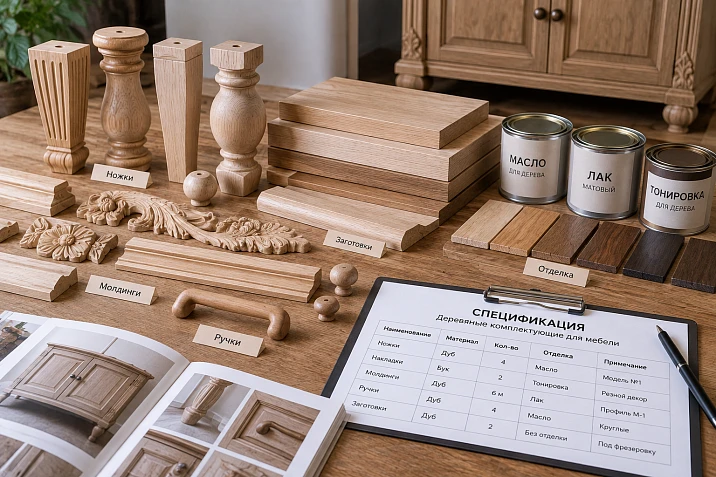
The entry "wooden decor — 24 pieces" does not allow verification of a furniture order. It does not show how many handles are required, which overlays should be right and left, what wood the legs should be made from, and what profile should be installed on the fronts. Even a correctly calculated total quantity does not protect against incompatible parts.
The wooden part of the specification is compiled by individual items. For each one, the purpose, item code, and dimensional version, material, finish, method of connection to the furniture, and quantity are specified. Then the assembled set is checked: whether the color is perceived consistently, whether there is enough space for fasteners, and whether the relief interferes with opening. This order links the selection in the catalog with the work of the designer, painter, purchaser, and assembler.
What to include in the wooden part of a furniture specification
A single piece of furniture may have wooden supports, handles, overlays, rosettes, brackets, and moldings. It is convenient to separate them into a distinct group of ready-made purchased components. At the same time, carcass parts, metal hardware, and fasteners remain in the general project documentation.
The boundaries of the group must be defined in advance. For example, if a solid wood countertop is manufactured in an in-house workshop, it is accounted for as a manufactured part. If it is purchased ready-made, it may be included in the list of purchased wooden elements. It is important to follow one rule and not count the same item twice.
When selecting wooden components for furniture, check the material of the specific version. The general catalog includes products made of wood and MDF, so the section name does not replace the wood species entry in the order.
Each item is assigned its own project designation, for example D-01. It links the list to the furniture drawing. The supplier's item code is recorded separately: the internal item shows the part's place in the project, while the item code helps find and order the selected product.




Divide the elements by function
The function of a part determines which parameters must be checked first. For a support, the mounting and performance under load are important; for a handle, the grip and holes; for an overlay, the mounting surface and free area. The same wood species does not cancel these differences.
| Purpose | Component group | Main check |
|---|---|---|
| Body support | Legs, furniture supports | Height, connection to base, structural calculation |
| Hand opening | Handles | Mounting, projection, finger space |
| Surface decor | Overlays | Contour, protrusion, fit to front |
| Separate accent | Rosettes | Axis position and connection to adjacent parts |
| Design of three-dimensional assembly | Brackets | Adjacency planes and intended role |
| Vertical termination | Capitals | Combination with the post and top rail |
| Linear framing | Moldings, trim | Cross-section, side lengths, angles, and joints |
A bracket can be part of a load-bearing assembly only with appropriate structural justification. Its name and massive appearance do not confirm an allowable load.
Separating by function helps reveal gaps. For example, the decorative set has already been selected, but there is no solution for mounting the supports. This means the kit cannot yet be considered ready for purchase under the approved carcass.
Our factory also produces:
The item code must be accompanied by the finish and degree of readiness
A finished part form does not mean it is already prepared for all operations of a specific production process. An unpainted handle may need finishing, a support may need an approved mounting assembly, and a moulding may need cutting and joint processing. These operations must be allocated before ordering.
For each item, specify what is supplied: material, size, surface quality, presence of coating, and pre-drilled holes. If one item code has several variants, it is not sufficient for an unambiguous purchase. The selected finish is transferred to the schedule in full.
It is useful to add a short note about further processing: “painting in the workshop,” “cutting to the drawing,” “installing fasteners per the assembly.” It shows where the readiness of the purchased part ends and the work of the furniture production begins. Arbitrary modification is permissible only after verifying that the required cross-section and mating surfaces remain.
For example, from STAVROS open boundless possibilities for designers, furniture makers, and anyone striving to create unique high-quality furniture. are selected for their own finishing system. But holes, fasteners, and the possibility of trimming are checked against the specific model. The properties of one support cannot be transferred to the entire catalog section.
Get Consultation
Supports are agreed upon before approving the cabinet height
If the height of the furniture depends on interchangeable legs, their dimensions must be known before the cabinet is released into production. The calculation includes the installation height of the entire assembly: the support itself, the mounting plate, the glide, or other elements that actually add height.
Let us consider a conventional cabinet with an overall height of 760 mm. With a top panel thickness of 24 mm and an installation height of the supports of 136 mm, 600 mm remains for the cabinet. If a new support assembly adds 156 mm, to maintain the overall height the cabinet must become 580 mm. This is a geometric example; the acceptability of the supports themselves is checked separately.
Before buying Wooden furniture legs, compare the upper mounting part with the base of the furniture. The maximum width of the carved section does not show how much space there is for the plate, stud, or other fastener. The position of the supports and the condition of the parts into which they are installed are also important.
The specification records the selected connection method and a reference to the assembly drawing. Strength and stability are determined by the assembled structure. The mere fact of installing four wooden legs does not make it possible to assign a permissible load to the furniture.
Handles are approved before drilling the fronts
A knob handle, a pull handle, and a profile handle differ in their mounting pattern and installation location requirements. Therefore Wooden furniture handles are chosen simultaneously with the facade layout. Purchasing after drilling leaves fewer suitable options and may require rework.
The work note needs the number of holes, the distance between their centers, the handle projection, the facade thickness, and the fastener parameters for the selected assembly. The overall length of the bracket does not replace the center-to-center distance. And the designation "160 mm handle" without clarifying the dimension allows for different interpretations.
Check access to the fasteners from the back side and the space for fingers from the front. If a carved overlay or frame is nearby, they must be fitted together. The parts may not overlap along the contour, but the relief can interfere with grip.
For self-painting, you can select handles without coating. The schedule must link them to the adopted finishing system. The handle coating is evaluated taking into account constant hand contact, even if its color matches the legs and decorative elements.
Overlays and rosettes are selected within the specified facade field
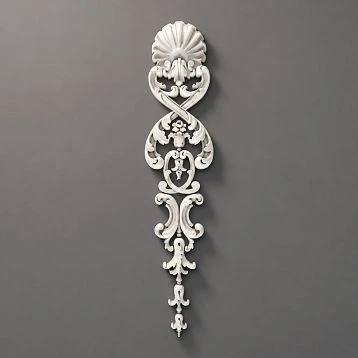
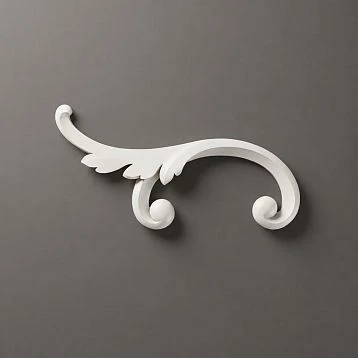
Carved decorative inserts for furniture are chosen after determining the handle and the boundaries of the framing. The width and height are checked against the remaining free field, and the projection — against the movement of the door and the position of adjacent parts.
If the pattern is directional, the schedule separately indicates the right and left versions when they are provided by the model. The entry "two overlays" does not convey the composition of the pair. Rotating one part also does not always replace mirroring.
Wooden sockets are linked to a specific axis or assembly of the composition. When adjoining a molding, the compatibility of shape, relief height, and fit is checked. Matching the overall style does not guarantee a neat connection of two parts.
The documentation specifies the overall dimensions, installation location, and base. A flat overlay on a flat facade and the same element on a convex surface are different tasks. The product thickness indicated in the card is not equal to the depth of the ornament: to check clearances, the full projection from the mounting plane is needed. After placing the decor, the entire required travel of the door or drawer is checked.
Brackets and capitals are checked in three dimensions
У wooden bracket height, width, and depth matter, as well as the surfaces by which it adjoins neighboring parts. In the front view, the product may fit perfectly, but from the side it may turn out to be too deep for the shelf or the upper rail.
Immediately record its role in the project: decorative finishing or participation in a calculated support assembly. In the second case, confirmed data are required for the selected structure and fastening. It is not permissible to assign a load based on external similarity to another bracket.
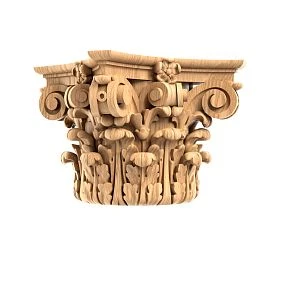
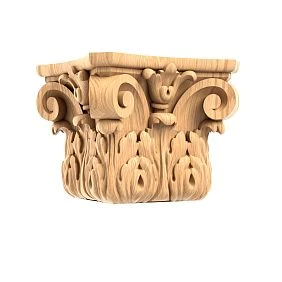
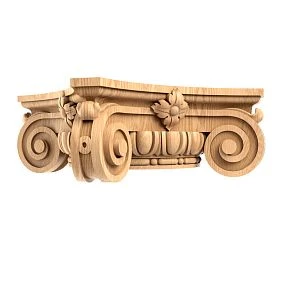
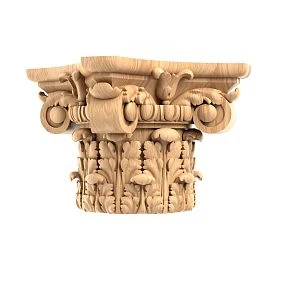
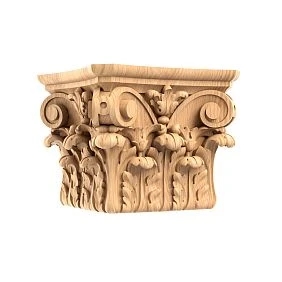
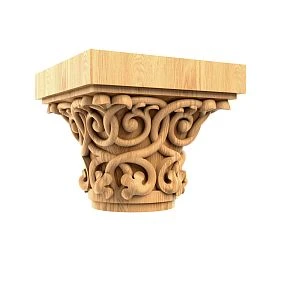
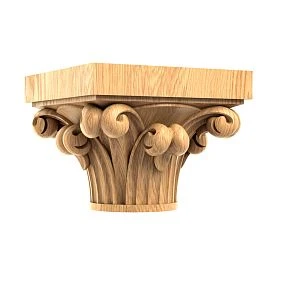
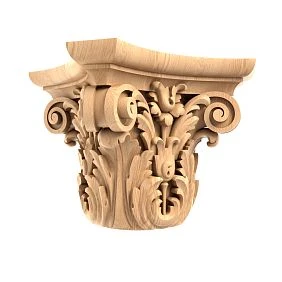
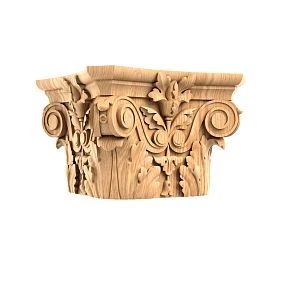
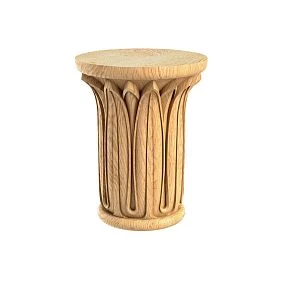
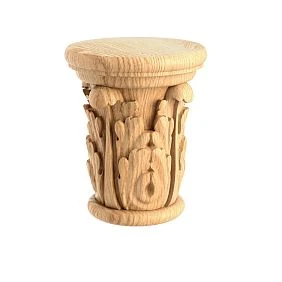
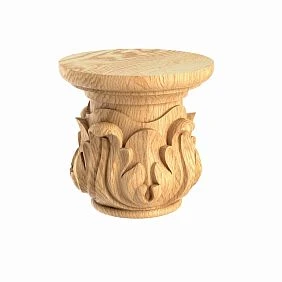
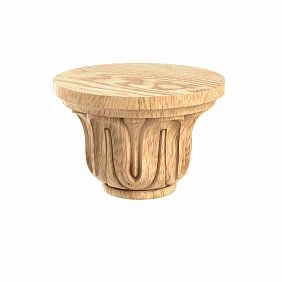
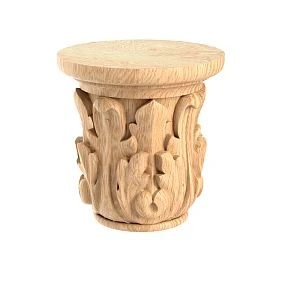
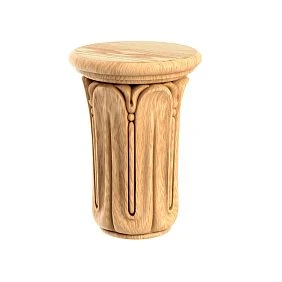
furniture capitals they are coordinated with the upright or pilaster below and the cornice above. The width of the adjoining area, the projection relative to the facade, and the side view are checked. The widest part of the capital does not always correspond to the size of its seating section.
For both types of parts, a section of the assembly is useful. It shows whether the relief obstructs the fasteners, where the neighboring profile ends, and whether installation access remains. If paired elements are used, their orientation is indicated on the drawing and in the schedule so that during assembly the side is not chosen from memory.
Linear trim determines the free field and the cutting method
Wooden moldings and trim it must be selected before the final size of the overlays inside the frame. Both the profile width and the frame offset from the facade edges have an effect. Changing one of these parameters changes the available field.
For example, with a nominal facade width of 480 mm and frame offsets of 35 mm, its outer dimension is 410 mm. A profile 20 mm wide leaves 370 mm inside. If replaced with a 30 mm profile, 350 mm remains. The overlay and handle will need to be checked again, although the facade itself has not changed.
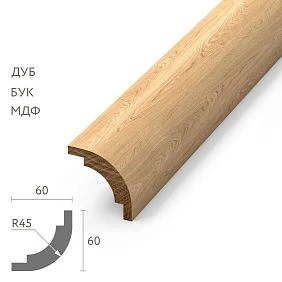
In the linear trim line, record the item code, material, selected cross-section, and length of the commercial strip. Next to it, indicate a reference to the cutting map. The net total length of the parts and the number of purchased strips are different quantities: cuts, fitting, and permissible placement of joints are taken into account.
If the profile has a repeating ornament, the cutting also depends on the position of the pattern. For a section that is smooth along its length, the task is simpler, but the angles and directions of the cuts are still determined in advance. Dimensional designations are read from the drawing of the specific product, without transferring the interpretation of letters from another product group.
The species is chosen taking into account the finish of the entire set
The same piece of furniture can combine an oak tabletop, painted beech supports and wooden handles. Such a combination is acceptable if the different materials are intended by the design and are compatible with the construction. The requirement that "everything be made of one species" does not by itself guarantee a successful result.
With a transparent finish, it is important to match the visible parts by texture and shade. Oak legs, moulding and overlays are examined side by side, and a tint sample is made on each noticeably different group of surfaces. A similar species name does not rule out differences between blanks.
Under opaque enamel, the colour of the wood is usually less significant, but the surface texture, the quality of preparation and the requirements for the joint remain. Choosing beech only out of habit or oak only for the sake of the material's name is not enough. The availability of the required version should be checked for all selected components.
In the specification, the species is recorded on every line. A general note of "oak furniture" is easily lost when handles or overlays are ordered separately. If a separate item is intentionally made of a different material, this must also be visible to the purchaser and the painter.
The quality of lamination and sanding are different parameters
For open wood, the selection of lamellae by colour and texture matters. For a surface to be painted, the permissible characteristics of the blank and the method of preparing them are also important. These requirements cannot be replaced by a single note of "good quality".
In the description quality of STAVROS wooden products the versions of lamination for enamel and for tinting are separated. In the version for enamel, the absence of selection of lamellae by colour and texture is permitted. The version for tinting is focused on matching them, but the natural heterogeneity of the wood remains.
The quality of sanding is considered separately. It does not determine the species, the shade or the presence of a finishing coat. The available options must be checked for the specific article number and transferred to the order line, rather than left as a verbal agreement.
If a smooth handle, a turned leg, and deep carving coexist on the same piece of furniture, preparing these surfaces may differ in labor intensity. Therefore, the set is evaluated before assigning the overall finishing technology. Purchased parts must have a clear degree of readiness, and the remaining operations must be accounted for in the production order.
Enter the internal finish designation
It is convenient to assign a short designation to the approved finish option, for example OT-01. This is an internal workshop code that links various components to a single agreed result. It is not a supplier's article number or standard.
| Project item | Detail | Material | Finish designation |
|---|---|---|---|
| D-01 | Leg | Beech | OT-01 |
| D-02 | Handle | Beech | OT-01 |
| D-03 | Left overlay | Beech | OT-01 |
| D-04 | Right overlay | Beech | OT-01 |
In this conditional example, one code means that the parts must match a common reference sample. The designation stores a description of the color and gloss, the materials used, the substrate preparation, the coating sequence, and the processing conditions for the selected system.
The same code does not require blindly repeating one preparatory operation on every surface. Carving, an end face, and a smooth plane may need different techniques. If handles require a different coating system, this is reflected in a separate technological note while preserving the agreed appearance.
For a clear coating, the wood species and a reference color sample are recorded next to the code. The phrase "the same color" without a sample does not allow a reliable comparison of a tinted leg with a flat overlay or a section of molding.
Link each wooden item to an assembly unit
The leg connects to the furniture base, the handle to the front, the overlay to the mounting surface, and the molding to the base and adjacent sections. For each item, it must be clear where the connection is located and what requirements it places on the part.
Instead of the vague entry "standard installation", specify the fastening method and the node number on the drawing. These show the required holes, mating dimensions, fasteners, and access restrictions. For a bracket, both mating surfaces are additionally important if the design provides for adjoining to two parts.
Metal fasteners may be located in a different section of the general specification, but their connection to the wooden item must be preserved. If the mounting plate of a support or the fastening of a handle changes, both lines are checked. Otherwise, the wooden set will be assembled correctly, but the appropriate connecting parts will not be present at assembly.
When selecting Mounting and finishing materials, verify suitability for specific substrates. A glued joint with untreated wood and a joint with a painted facade require separate verification. The sequence of painting and installation is agreed upon before manufacturing a trial set, including the condition of the surfaces that will be glued.
Check the scale and color on the physical set
Individual photographs do not show how a large carved leg, a thin handle, and a wide molding frame combine. To check, place the selected elements or their representative samples next to each other. Evaluate the set against the background of the facade material and under lighting close to the future use of the furniture.
Compare the intensity of the relief, the thickness of visible edges, the nature of the curves, and the overall scale. The details do not have to repeat a single ornament, but you need to understand which of them sets the composition. If all elements attract attention simultaneously, the resulting furniture may look overloaded even with a single color.
In the section product samples you can check the available options. A short profile sample helps evaluate the cross-section and finish, but does not replace a whole frame. To check grips, paired elements, and specific fastenings, the corresponding parts or full trial assemblies will be required.
A joint fitting confirms the appearance and individual joints. The stability of the entire furniture, the operation of drawers, and the opening of doors are checked on the assembled item. A set of one leg, handle, and overlay does not replace this check.
Which fields are needed in the wooden component list
The list should allow selecting a version without guesswork and finding its place on the furniture. It is convenient to divide the description into permanent information about the item and information about the specific order. Then, when the batch increases, the quantity changes, while the agreed dimensions and finish are preserved.
| Field | What to record |
|---|---|
| Project item | Internal designation, e.g. D-01 |
| Purpose and location | Front support, top drawer handle, left overlay |
| Supplier SKU | Exact designation of the selected model |
| Dimensional version | Values with dimension names and units of measurement |
| Material | Wood species of the specific part |
| Surface readiness | Selected lamination, sanding, presence of coating |
| Finishing | Internal designation and reference to the approved sample |
| Installation | Joining method and joint number |
| Quantity | Per item and per current order |
| Purchase unit | Piece, set, or strip of the selected length |
| Check | What has been checked and which sample is approved |
| Version | Date and designation of the current revision |
Dimension designations are verified against STAVROS drawings and models, if the required materials are available for the selected item code. For the purchaser, it is useful to additionally spell them out in words: height, width, depth, length.
If one model is used with two finishes or in different sizes, create two lines. A shared item code does not make these versions interchangeable. Right and left parts, as well as sets with different contents, are separated in the same way.
The quantity is calculated for each position separately
Let's consider a conditional series of five identical chests of drawers. For one item, four legs, six handles, one left and one right overlay, and one socket are provided. This is an example of the calculation structure, not a ready-made composition of a specific furniture model.
| Position | Per chest of drawers | For five chests of drawers | For the remaining four after the first |
|---|---|---|---|
| Legs | 4 pcs. | 20 pcs. | 16 pcs. |
| Handles | 6 pcs. | 30 pcs. | 24 pcs. |
| Left overlay | 1 pc. | 5 pcs. | 4 pcs. |
| Right overlay | 1 pc. | 5 pcs. | 4 pcs. |
| Rosette | 1 pc. | 5 pcs. | 4 pcs. |
The last column applies if the first assembled chest of drawers is part of an order of five. If it remains a separate display sample, a full set from the third column will be required for five product items. The reserve, consumption for additional tests, and usable leftovers are accounted for separately.
For linear mouldings, the quantity is converted into the selected product strips after checking the cutting plan. A total of finished metres alone is not enough. For parts sold as a set, you also need to check the number of elements within it: four sets and four individual parts may mean a different delivery.
The order includes the requirement taking into account the already available usable parts. The sample used for testing is deducted from it only when it can actually be installed in the finished furniture.
The first set becomes the reference for the small series
After assembling the first item, record the selected article numbers, size versions, material, surface, finish, and fasteners. Save photographs of the assemblies and the physical colour sample. For repeatability, it is also important to record all changes made during the trial assembly.
If the handle was moved, the support was installed through a different plate, or the frame profile was changed, the corrections must be included in the drawings and the schedule. A successful first item does not yet guarantee repetition when the craftsman assembled it according to clarifications that remained only in memory.
When accepting the next set, compliance with the order lines and the approved samples is checked. The parts are laid out by product, separately preserving pairing and the agreed selection of visible wood. A matching article number does not cancel the check of the material and size version.
A repeat order is also tied to the current revision. If the previous version is unavailable, a similar replacement is first checked against the parameters it affects. A wider overlay requires checking the front area, a different handle requires checking the fastening and grip, and a different profile requires checking the joints and cutting plan. The other agreed items do not need to be reviewed without reason.
When to use ready-made parts and when to keep your own production
For complex carving, a repeatable turned profile, and several identical decorative elements, it is first useful to check a ready-made catalog. A purchased part can reduce the number of operations in the workshop if its dimensions and level of readiness suit the project.
For example, in the section ready-made turned elements you can consider individual shapes and composite solutions. For the selected option, clarify the completeness of the set, the dimensions of the joints, and further processing. The presence of an element in the system does not mean compatibility with any post or fastener.
A simple structural block is sometimes more rational to make together with the carcass. The comparison includes material, processing, equipment setup, finishing, and checking the result. With any solution, the item remains in the specification; only the executor and the set of required operations change. This allows you to see the wooden set as a whole, even when some parts are purchased and some are produced in-house.
Where to buy wooden furniture components according to an agreed list
Before contacting the supplier, prepare a list of items with article numbers, dimensions, wood species, surface finish, and quantity. Attach questions about fastening and available options that still need clarification. Such a request provides more useful information than a list of general names: “legs, handles, carving.”
To buy wooden furniture elements at STAVROS, you can consistently select functional parts in the relevant sections and supplement them with carved wooden decor. The availability of the required configuration is checked for each item. Price, lead times, and availability relate to the selected version, not to the product group as a whole.
A section is provided for workshops and furniture manufacturers conditions for manufacturersIt offers shipment from a single piece, which allows discussing an order of parts for preliminary verification; the terms of a specific delivery are clarified separately.
It is more convenient to purchase decorative furniture elements for the entire series using a verified specification. It shows what is installed, how it is finished, what it connects to, and how much is required. Then purchasing, painting, and assembly rely on a single agreed description of the wooden set.