Article Contents:
- What nodes make up the production BOM of a chest of drawers
- Carcass
- Back panel
- Drawers
- Facades
- Handles
- Legs and Supports
- Assembly hardware
- Decorative elements
- What material are chests of drawers made from
- The leg and plate must be qualified together
- Repetition makes the error more noticeable
- BASIC
- CLASSIC
- PREMIUM
- The existing handle is compatible
- The existing leg fits geometrically
- The difference is only in the finish
- Decor does not add value
- The product is produced in a small one-time batch
- Drawers
- Handles
- Legs
- Assembly hardware
- Decoration
- Final height
- Why visual inspection is risky
- What to do if the supplier offers a substitute
- Change Impact Matrix
- Mistake 1. The handle is chosen after the fronts are produced
- Mistake 2. The leg is ordered without a mounting plate
- Mistake 3. One finish is stored under several names
- Mistake 4. The decor is installed without a template
- Mistake 5. The reserve is calculated as a flat percentage
- Mistake 6. Batches are mixed without incoming inspection
- Mistake 7. Each model gets its own handle unnecessarily
- Why RFQ is better than a generic request for "wholesale furniture handles"
- Before prototype
- On prototype
- After approval
- 1. Lock in the cabinet construction
- 2. Break the product down into repeating modules
- 3. Select component candidates
- 4. Check technical compatibility
- 5. Obtain reference parts
- 6. Assemble a prototype
- 7. Lock the BOM
- 8. Create a golden sample
- 9. Calculate gross and net requirements
- 10. Release a pilot batch
- 11. Order the main production run
- 12. Perform incoming inspection and save the revision
- Why you shouldn't match color by screen alone
- What components are needed to produce chests of drawers?
- What material are chests of drawers made from?
- Which handles to choose for a mass-produced chest of drawers?
- How many handles to install on a wide drawer?
- How to choose the leg height for a chest of drawers?
- How to attach wooden legs to the cabinet body?
- Do you need to buy the mounting plate separately?
- How to choose quality furniture hardware?
- How to calculate components for a batch of chests of drawers?
- How much reserve should be left?
- Can one handle be used on several chest of drawers models?
- Should a separate specification be made for BASIC and PREMIUM?
- What should be done if the selected handle has been discontinued?
- How can decorative overlays be controlled on five identical fronts?
- Where can components for chest of drawers production be purchased?

A five-drawer chest is not just a carcass and five fronts. If each drawer has two handles, one piece of furniture already requires ten identical handles. With a run of 200 chests of drawers, the requirement turns into 2,000 parts. Add four legs, mounting plates, glides and decorative overlays, and it becomes clear why components for chest of drawers production cannot be chosen after the series is launched.
For a single item, some decisions can be made on site. For serial production, this turns into a risk. The handle must be approved before drilling the front, the leg before the final calculation of height and the mounting unit, and the decorative overlay before the marking template is released. Each external part receives a specific SKU, material, finish, installation location and quantity per item.
The working chain looks like this:
chest of drawers model → carcass → drawer → front → handle → leg → fastener → decor → SKU → BOM → prototype → approved sample → pilot batch → batch → incoming inspection → repeat order.
It is precisely this logic that distinguishes production configuration from the ordinary selection of furniture hardware. The article does not attempt to explain again all types of hinges and slides or repeat separate material about handles. The task is narrower: to show how a manufacturer of cabinet furniture can assemble one repeatable set for a specific chest of drawers model and make sure that the next batch does not differ from the first.
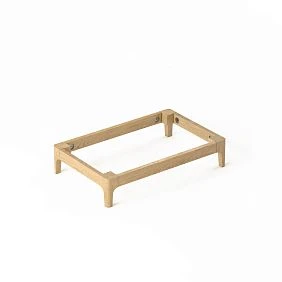
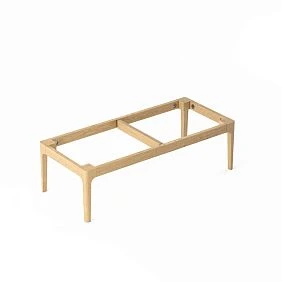
For working with the STAVROS assortment, this scheme will be useful Furniture Handles, Wooden furniture legs and supports, Furniture for legs and handles, Decorative Inserts и wooden furniture moulding. But an assortment becomes a production system only after each selected item is linked to a construction.
What nodes make up the production BOM of a chest of drawers
BOM — bill of materials, the specification of the product composition — for a chest of drawers is more convenient to build not on the principle of “wood, hardware, decor,” but by structural nodes. Then the process engineer, purchaser, and warehouse see the same model in the same way.




Carcass
The carcass includes the side panels, top panel, bottom, partitions, plinth, or other load-bearing elements. The material may be panel-based or combined. For this article, what matters more is not the choice of a specific panel, but that the carcass defines the geometry for all subsequent components: drawer depth, facade position, attachment points for legs, and product height.
Our factory also produces:
Back panel
The back panel is often perceived as a secondary part, but it contributes to the geometric stability of the product and has its own material, dimensions, and fastening method. In the BOM, it must not be lost inside the “carcass” line.
Get Consultation
Drawers
A drawer is a repeating functional module. It has a box, bottom, runners, facade, and front hardware. If a chest of drawers has five identical drawers, one error in the module is automatically repeated five times on each product.
Facades
The facade defines the location of the handle, decorative overlay, moulding, and other visible elements. Even if the material of the carcass and facade is the same, in the specification they are different parts with different functions.
Handles
A handle must be a standalone BOM item with a SKU, finish, installation geometry, and quantity. The phrase "wooden handles — 10 pcs." is too vague for serial production.
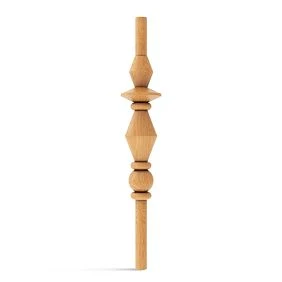
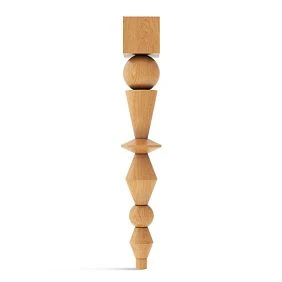
Legs and supports
Legs affect the overall height of the chest of drawers, the floor clearance, and the visual scale. The specific model must be locked in before releasing the working documentation.
Mounting hardware
A stud, plate, glide, or other fastening element must not appear "at assembly." If the structure needs the part, it is included in the BOM as a separate line.
Decorative elements
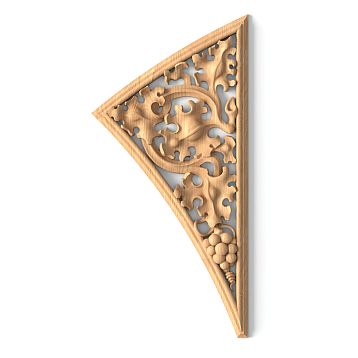
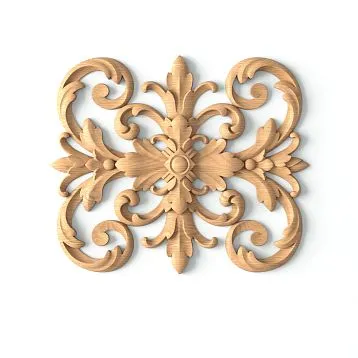
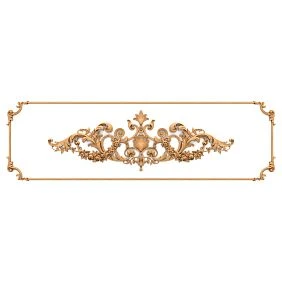
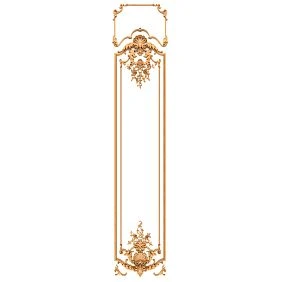
Carved overlays, moldings, decorative strips, and trim must have precise installation coordinates. On a serial facade, decor ceases to be a free composition and becomes a repeatable production operation.
Example BOM for one chest of drawers
A conventional base model with five drawers and two handles on each facade can be described as follows:
| Code | Position | SKU / material | Quantity per 1 chest of drawers | Inspection |
|---|---|---|---|---|
| BODY | Housing | Chipboard / MDF per project | 1 set | dimensions, geometry |
| BACK | Back panel | HDF / as per project | 1 | Dimensions |
| DRAWER | Drawer | module as per drawing | 5 | diagonals, travel |
| FRONT | drawer front | MDF-___ | 5 | size, holes |
| HANDLE | Handle | HL-___ | 10 | SKU, size, finish |
| LEG | Leg | MN-___ | 4 | height, material, finish |
| PLATE | Mounting plate | FUR-___ | 4 | Compatibility |
| FOOT | Thrust bearing | FUR-___ | 4 | type, size |
| DECOR | Overlay | N-___ | 5 | axis, position |
This is not a universal composition for every chest of drawers. A specific model may have one handle per drawer, a plinth instead of legs, no overlays, or a different number of fronts. The value of the table lies elsewhere: it shows that every repeating element must be visible to production.
If the handle changes, the change is reflected not only in the HANDLE line. You need to check the front, holes, drilling template, and sometimes the packaging. If the leg changes, the overall height, mounting hardware, position of the cabinet relative to the floor, and service clearance are affected. A BOM is needed precisely for such relationships.
Materials for furniture manufacturing: what applies to a chest of drawers
The query "materials for furniture manufacturing" is too broad if applied to a finished product as a whole. A chest of drawers is almost always more sensibly considered as a combination of materials, rather than as "furniture made of material X."
The manufacturer separately selects:
-
body material;
-
facade material;
-
back panel material;
-
drawer bottom material;
-
visible leg material;
-
handle material;
-
decorative part material;
-
mounting hardware material.
Different parts perform different tasks. The cabinet body is responsible for the geometry and the foundation of the structure. The front is responsible for the appearance and interaction with the handle. The back panel is responsible for closing and stabilizing the cabinet body. The leg works both structurally and visually. The handle is the point of constant user contact with the product.
Therefore, furniture-making materials cannot be compared using a single rating. The question must always be clarified: material for which part, which technology, and which price/design tier?
What material are chests of drawers made from?
In practice, a modern chest of drawers can combine a panel body, a separate material for the fronts, a back panel made of another sheet material, wooden handles, and solid wood legs. In a classic or premium model, carved overlays and furniture moldings are added to this.
The answer "chests of drawers are made from MDF" or "chests of drawers are made from chipboard" oversimplifies the actual construction. Even when most of the body is made from a single panel, the external components have their own specification.
For the manufacturer, this is convenient. The same body can be used as a platform for several product levels, changing the visible components without fully redesigning the main construction. We will return to this principle in the BASIC / CLASSIC / PREMIUM block.
Why the body material does not determine the quality of the entire chest of drawers
The query "high-quality chests of drawers with good hardware" reflects an important idea: the quality of the finished product is not made up of a single material.
Even a good body does not compensate for:
-
imprecise geometry of the drawers;
-
handles with incompatible mounting;
-
different support heights;
-
drilling errors in the fronts;
-
unstable leg installation;
-
different shade of the visible finish;
-
misaligned decorative overlays.
And the reverse is also true: an expensive handle will not turn a poorly assembled carcass into a quality dresser.
For production assessment, it is useful to divide quality into several contours:
carcass geometry → drawer operation → front hardware → supports → decor → assembly → batch repeatability.
Each contour has its own method of control. For a handle, dimensions and installation matter. For a leg — height, fit, material, and finish. For an overlay — geometry and placement coordinates. For the entire product — matching the approved prototype.
The drawer front is the main repeating module of a dresser
A dresser is especially convenient for production standardization because a single front is often repeated several times. But it is precisely this repetition that makes an error noticeable.
Imagine five identical fronts. If the hole for the handle is offset by a few millimeters on one front, the defect may seem minor. If the same incorrect marking is repeated on five fronts, the entire vertical rhythm reveals the error.
Therefore, a front should be treated as a module:
FRONT TYPE → HANDLE SKU → INSTALLATION GEOMETRY → DECOR → DRAWER POSITION.
For each type of front, it is useful to store:
-
width and height;
-
thickness;
-
material;
-
finish;
-
handle;
-
number of handles;
-
hole coordinates;
-
center-to-center distance, if applicable;
-
decor coordinates;
-
drawing revision.
Then changing a handle automatically means checking the associated front, rather than simply replacing one line in procurement.
Handles must be included in the design documentation before drilling
in the STAVROS catalog Wooden furniture handles of different structural types. For a production dresser, the handle becomes part of the front even before physical assembly.
The sequence should be as follows:
select a specific SKU → obtain technical dimensions → determine orientation → check the grip → approve the position → lock in the drilling → assemble a control facade → only then launch the series.
The reverse sequence — first drilling all facades, then looking for a suitable handle — limits the choice and increases the risk of rework.
Deep standardization of the handles themselves has already been covered in a separate article “Furniture handles wholesale: how to standardize sizes, finishes, and batches for serial production”. In the article about the chest of drawers, it is more important to show the place of the handle within the entire product specification.
One handle or two on a wide drawer
There is no universal rule. The decision depends on the width of the facade, the length and shape of the specific handle, the convenience of the grip, the expected load of the drawer, and the composition.
One long handle can visually unify a wide facade and simplify the hardware set. Two handles create a different rhythm and may be more convenient with a symmetrical grip. But you cannot choose based on the picture alone.
On the prototype, it is useful to compare options:
-
open an empty drawer;
-
open a drawer with a test load;
-
check one-handed grip;
-
check whether the drawer is convenient to use from both sides;
-
evaluate the front from a normal viewing distance;
-
check whether the handles of adjacent drawers conflict vertically.
After selection, it is not an abstract “two handles” that is fixed, but a specific SKU and installation coordinates.
If a chest of drawers has five fronts and two handles on each, one selection error immediately turns into ten repetitions on the product. Therefore, saving time on the prototype here almost always results in greater risk in series production.
Center-to-center distance is part of the front, not a characteristic that can be changed later
For a bow handle or another product with two mounting points, the center-to-center distance becomes part of the front’s engineering documentation. After drilling, it no longer exists separately from the part.
Convenient entry in production documentation:
HANDLE SKU + C-C + X/Y POSITION + ORIENTATION
Where:
-
HANDLE SKU— specific handle; -
C-C— center-to-center distance; -
X/Y POSITION— coordinates on the front; -
ORIENTATION— horizontal, vertical, or other approved orientation.
If the handle is being replaced, it is not enough to make sure the new one is "approximately the same size." You need to check whether the installation geometry matches. Otherwise, before production there is a choice: re-drill the front, change the CNC program, use a different position, or release a new revision.
For a chest of drawers with a large number of identical drawers, this is especially critical. The error affects not just one part, but the entire repeating module.
Knob handles for dresser
A knob handle is often convenient where the front is relatively compact, a single attachment point is needed, and the composition is built around a small accent.
For a production series, its advantages are clear:
-
one drilling point;
-
simple layout;
-
compact size;
-
ability to repeat one SKU across multiple fronts;
-
convenient unification within the collection.
But even here you can't just pick "any knob." A specific SKU has its own length, diameter, projection, mounting area, and fasteners. You need to check whether the knob ends up being too small for a heavy drawer, whether it's comfortable to grip, and whether it interferes with neighboring fronts.
In a series of several chests of drawers, the same knob can be used, for example, on a narrow model and on a bedside cabinet. This reduces the range, but only if ergonomics remain acceptable.
Pull handles for wide fronts
A pull handle offers a different grip character and has a stronger effect on the geometry of the front. When choosing, the manufacturer must know in advance the center-to-center distance and the position of the two holes.
For a wide drawer, a pull handle may be more convenient than a single small knob, but this is not a universal rule. What matters is:
-
actual front width;
-
handle length;
-
projection;
-
center position;
-
number of handles;
-
visual balance;
-
method of opening a loaded drawer.
When ordering handles without coating the factory gains additional freedom for its own finish. Handles with Finish reduce the internal finishing operation. For production, these are two different configurations that cannot be mixed under one internal code.
If the same profile is supplied in several finish variants, it is useful in the BOM to separate the base geometry and the finish. For example:
HANDLE-A / RAW
HANDLE-A / FINISH-01
HANDLE-A / FINISH-02
This way the buyer will not confuse two visually similar versions.
How to standardize handles across several chest of drawers models
Let's imagine that the collection includes chests of drawers with widths of 600, 900, and 1200 mm. The mistake is to automatically assign each model its own handle family. Sometimes this is justified, but it often creates extra SKUs.
It is more useful to build a matrix:
| Model | Facade type | Handles per facade | Candidate | Solution |
|---|---|---|---|---|
| KOMOD-600 | Narrow | 1 | HL-A | approved |
| KOMOD-900 | Medium | 1 | HL-A | approved |
| KOMOD-1200 | Wide | 2 | HL-A | prototype |
| TUMBA-500 | Narrow | 1 | HL-A | approved |
One handle system allows:
-
simplify procurement;
-
increase the batch volume of a single SKU;
-
reduce the risk of mis-picking;
-
create a unified visual language for the collection;
-
simplify the service reserve.
But unification must not break convenience. If a wide front objectively needs a different size or a different type of handle, a separate SKU is created. The goal is not the minimum number of parts at any cost, but the minimum sufficient range.
Furniture legs for a chest of drawers
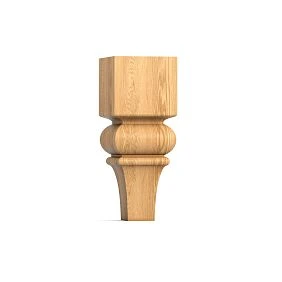
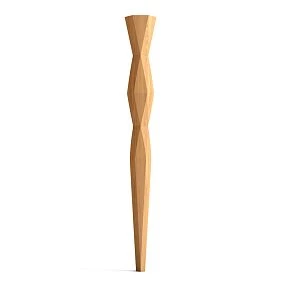
External supports are the second major group that determines the appearance of a production chest of drawers. The STAVROS catalog presents Furniture Legs and Supports made of wood in various shapes and sizes.
For a specific model, you need to check:
-
height;
-
cross-section;
-
shape;
-
material;
-
finish;
-
the mounting part;
-
mounting method;
-
compatibility with the mounting plate;
-
presence of a glide, if provided.
The leg must be approved before the final design documentation is released, because it changes the overall height of the product.
If the body without legs has a height of 760 mm, and after installing the supports the finished chest of drawers should become taller, this increase is included in the product dimension. Changing the leg to a different height is not just a decorative change. The silhouette, the position of the top panel, the floor clearance, and sometimes the usage scenario change.
The leg height changes the entire silhouette of the product
Even a difference of 20–30 mm can be noticeable on the finished chest of drawers. In a low model, a small increase changes the proportion especially strongly. In a tall one, it affects the position of the top surface relative to the user and adjacent furniture.
Therefore, for the leg in the BOM it is useful to store:
SKU / HEIGHT / MATERIAL / FINISH / MOUNTING / LOT
The height must be taken from the technical information of the specific product, not from memory or an old email.
After the prototype, it is necessary to record the reference dimension of the finished chest of drawers from the floor to the top surface. If in the next batch, with the same body, the height has changed, this is a reason to check the supports and the mounting assembly.
The four legs must be of the same production configuration
The statement seems obvious, but in a warehouse, visually similar parts are easily mixed up. Especially if a model has several finishes or a new batch arrived before the previous one was fully used up.
On a single item, supports of different versions must not be mixed without control, even if they look similar. The following is checked:
-
article number;
-
material;
-
height;
-
geometry;
-
coating;
-
batch number, if it is used for traceability.
For natural wood, natural texture variations are possible, but this does not remove the requirement for a consistent configuration. Production must understand which visual deviations are acceptable and which mean a different finish or an incorrect SKU.
For a classic chest of drawers, the difference in the front supports is especially noticeable. If the model has a pronounced carved or turned shape, inconsistency immediately disrupts the symmetry.
Mounting hardware for legs
The leg and its attachment are a single structural assembly, although in the BOM they are listed as separate lines. In the section furniture for furniture legs mounting plates, studs, glides, and other related items are presented.
Before launching the series, it is necessary to determine:
-
which thread or fastener is used;
-
where the mounting plane is located;
-
whether a separate plate is needed;
-
how the plate is attached to the body;
-
whether there is tool access;
-
whether a foot pad is required;
-
whether the leg can be removed for repair or transportation;
-
whether the assembly conflicts with the bottom or internal elements of the cabinet.
If these questions are resolved after receiving the batch of legs, production already depends on improvisation.
The leg and the plate must be qualified together
Bad sequence:
order a leg → receive the batch → look for a fastener.
Working:
select a leg → determine the fastener → assemble the unit → check the prototype → lock in both items.
For example:
| Position | SKU | For 1 chest of drawers | Link |
|---|---|---|---|
| LEG-A | MN-___ | 4 | Main support |
| PLATE-A | FUR-___ | 4 | installation LEG-A |
| FOOT-A | FUR-___ | 4 | Thrust bearing |
If LEG-A changes, the technologist immediately sees which related parts need to be rechecked.
The glide must be included in the specification if it is provided for by the design
The glide seems like a small thing, so it is often left to the discretion of the assembly area. For serial furniture, this is a bad practice.
If the design requires it, the following are recorded:
-
type;
-
size;
-
mounting method;
-
quantity;
-
compatible leg.
It is not acceptable to state: "install any felt glide." Even a small element affects contact with the floor, height, and the appearance of the lowest support point.
If the product is manufactured without a glide, this too must be a deliberate decision, and not the result of the part being out of stock.
Furniture hardware manufacturer: what to check before production
For a chest of drawers manufacturer, a supplier is evaluated not only by assortment. More important is whether the selected item can be turned into a stable BOM component.
Need to check:
-
exact SKU;
-
sizes;
-
material;
-
available finish options;
-
availability of technical information;
-
model stability;
-
reorder capability;
-
a sample or reference part;
-
batch lead time;
-
commercial terms for the required volume.
In a B2B context, the query "furniture hardware manufacturer" means not searching for a brand for the sake of a name, but evaluating the ability to support a specific production program.
The general classification of furniture hardware has already been covered in the material “Furniture hardware from manufacturer STAVROS: how to choose components for furniture”. For a chest of drawers, the task is narrower: handle, leg, fasteners, and decor must all be part of a single serial set.
What “quality hardware” means in a serial chest of drawers
The phrase “quality hardware” is useful only when it is translated into measurable properties.
For a handle, this means:
-
correct SKU;
-
matching installation dimensions;
-
stable finish;
-
proper geometry;
-
compliance with the approved sample;
-
absence of damage.
For a leg:
-
same height;
-
correct mounting part;
-
matching material;
-
identical configuration;
-
compatibility with the fastening;
-
conformity to the surface reference.
For mounting hardware:
-
compatibility with the assembly;
-
correct size;
-
absence of mismatched items;
-
conformity to the specification.
Therefore, quality furniture hardware is not a marketing term but a set of verifiable properties. If control cannot be described, then the criterion has not yet been formulated.
Decorative overlays on drawer fronts
in the STAVROS catalog decorative inlays for furniture. Repeating patterns are especially convenient for a dresser:
-
one central overlay on each front;
-
paired corner elements;
-
vertical composition on the central axis;
-
one accent element only on the top drawer;
-
identical overlays across the entire series of fronts.
For serial production, the main thing is to stop installing decor "by feel." If an overlay repeats, its position must be defined by coordinates or a template.
A convenient notation:
DECOR SKU + CENTER X + CENTER Y + ORIENTATION
If the element is asymmetrical, orientation or a left/right version is added.
Repetition makes errors more noticeable
On a single front, a slight offset may be almost unnoticeable. On five drawers arranged vertically, the differences turn into a rhythmic error.
Especially visible:
-
different installation heights;
-
deviation from the central axis;
-
unequal angle;
-
different offset from the handle;
-
different rotation of the asymmetric element.
Therefore, on the prototype, it is not a single front that is checked, but the entire vertical of the chest of drawers. Only this way can the real repetition be seen.
Furniture moulding on a chest of drawers
wooden furniture moulding can be used in a chest of drawers as a lid profile, lower band, moulded frame, or decorative strip. For production, such a part differs from an overlay: moulding has length, requires cutting, and is often tied to a specific perimeter.
Therefore, counting it only in linear meters is not enough. A diagram is needed:
body part → required length → number of repetitions → commercial length → cutting map → remainder.
Imagine that one facade requires two vertical and two horizontal segments. If a chest of drawers has five facades, the number of repeating parts is already large. An error in cutting or joint angle will be repeated dozens of times per batch.
For each profile, it is useful to record:
-
SKU;
-
material;
-
cross-section;
-
orientation;
-
segment lengths;
-
cut angles;
-
installation location;
-
finish;
-
consumption rate per product;
-
allowable remainder for reuse.
If the same profile is used for both the top rail and the facade, this does not mean that the consumption rates can be combined. Different assemblies may have different cutting maps.
Do not add all types of decor at the same time
A manufacturer is tempted to show the maximum available decorative possibilities in one premium model: an expressive handle, a carved leg, overlays, moldings, a shaped lid profile. Technically this is possible, but visually the details begin to compete.
For most mass-produced dressers, it is useful to choose a hierarchy:
main front hardware + support + one additional decorative element.
For example:
-
expressive handle + understated leg + moulded frame;
-
simple handle + carved leg + central overlay;
-
knob handle + shaped support without an additional overlay.
This is not a strict design rule. Exceptions are possible in historical and complex classic collections. But for mass-produced furniture, such a hierarchy simplifies not only the appearance but also the BOM.
The more different decorative SKUs there are, the more:
-
purchasing lines;
-
the likelihood of mis-picking;
-
operations during assembly;
-
installation templates;
-
stock balances;
-
service items.
Therefore, a new decorative element must justify its place in the product.
BASIC / CLASSIC / PREMIUM from a single carcass
One of the most useful production scenarios is to use the base carcass as a platform and change the external level of configuration.
Let's assume the geometry of the carcass, drawers, and fronts is the same.
BASIC
The base version can use:
-
a simple handle;
-
a simple leg or a neutral support;
-
absence of additional applied decor.
Short BOM, faster assembly, smaller nomenclature.
CLASSIC
Middle level:
-
wooden handle;
-
shaped or turned leg;
-
unified finish of visible wooden elements.
The body remains the same, but the product is perceived differently.
PREMIUM
Premium configuration:
-
more expressive handle;
-
decorative leg;
-
overlay or furniture moulding;
-
additional finishing.
This way, the manufacturer gets three commercial tiers without fully redesigning the frame.
But this approach has an important condition: each version must have its own BOM configuration. You cannot store a single specification for "dresser A" and keep the differences between BASIC and PREMIUM in the manager's memory.
convenient to use:
KOMOD-A-BASIC
KOMOD-A-CLASSIC
KOMOD-A-PREMIUM
and the shared platform part of the BOM plus a set of options.
This is especially useful for procurement. Common body materials can be planned with a single program, while visible components can be planned based on actual demand for product tiers.
When a new component is not needed
Standardization does not mean constantly expanding the range. A new SKU creates cost: it must be described, ordered, received, stored, assembled, controlled, and then supported with service stock.
A new part is not needed if an existing one already solves the task.
The existing handle is compatible
If the current SKU fits in size, grip, center-to-center distance, and style, a visually similar new handle can only fragment purchasing.
The existing leg matches in geometry
If the height, mounting, and scale correspond to the new model, there is no point in creating a similar support just for a minor visual difference.
The difference is only in the finish
Sometimes it is more reasonable to keep one base geometry and several finishes than several nearly identical SKUs. The specific approach depends on the accounting system.
The decor does not add value
If the overlay does not improve the composition and is needed only because "a premium model should have more details," it is better to exclude it.
The item is produced in a small one-time batch
For a one-off project, it is sometimes impractical to create a long-lived serial code. The project position can be set up separately from the main master reference.
Every new SKU must answer the question: what real production, functional, or commercial task does it solve?
Prototype of one chest of drawers before the series
Before ordering a large batch of components, at least one fully equipped prototype must be assembled.
The check is not based on a "beautiful / not beautiful" principle, but on a checklist.
Get Consultation
Drawers
Movement, gaps, position of the fronts, and the ability to use them with the selected handles are checked.
Handles
Grip, position, symmetry, drilling, overhang, and distance to neighboring elements are checked.
Legs
Overall height, stability, visual scale, fastening, and contact with the floor are checked.
Mounting hardware
The actual assembly is checked: tool access, thread compatibility, absence of conflicts with the carcass.
Decor
The axis, repetition across several fronts, interaction with handles and finish are checked.
Final height
The reference dimension of the finished product is recorded.
The prototype must be assembled from the same types of components that will go into series production. A temporary handle of "similar size" or a provisional leg makes the check meaningless.
After approval, a new or final BOM revision is issued.
Golden sample — the series reference standard
After the prototype, it is useful to create a golden sample — an approved physical or documented reference standard.
For a chest of drawers, this could be a fully assembled product or a set of control parts:
-
one front with a handle;
-
one approved leg;
-
mounting plate;
-
thrust bearing;
-
overlay;
-
a profile sample;
-
finish card.
The following are linked to the reference standard:
-
BOM revision;
-
drawing revision;
-
supplier SKU;
-
internal code;
-
material;
-
approved finish;
-
photographs;
-
approval date.
The purpose of the golden sample is to remove reliance on memory. Six months later, a procurement employee should compare a new batch against a specific reference standard, not a photo from an old messenger chat.
This is especially important for finishes. On a screen, two shades may look identical, but on the actual product they may differ. A physical sample helps control the visual result.
How to calculate the requirement for components
Let's consider a conditional series of 120 dressers.
One dresser requires:
-
8 handles;
-
4 legs;
-
4 mounting plates;
-
4 support feet;
-
4 decorative overlays.
Base requirement:
-
Handles:
120 × 8 = 960; -
Legs:
120 × 4 = 480; -
plates:
120 × 4 = 480; -
Foot pads:
120 × 4 = 480; -
overlays:
120 × 4 = 480.
This is the gross requirement — the theoretical requirement without accounting for stock and reserve.
Next, the buyer must subtract the usable remaining stock:
net requirement = gross requirement − approved stock + reserve.
If there are 100 handles in stock, that doesn't mean all 100 can be subtracted. You need to check:
-
whether it's the same SKU;
-
is it the right finish;
-
is it the right revision;
-
is there a blocked batch;
-
is the packaging suitable;
-
are the parts not reserved for another order.
Only the confirmed stock is included in the calculation.
The reserve for handles and legs must be calculated separately
Different components have different risks.
Handles may require a reserve due to:
-
coating damage;
-
fastener loss;
-
installation errors;
-
service replacement.
Legs:
-
due to surface damage;
-
geometric rejection;
-
damage during transportation;
-
service replacement;
-
the need to keep a set of four identical supports.
The pads have their own risk profile: chips, orientation errors, surface texture damage.
Therefore, a universal "+10% to everything" is not necessarily correct. It is better to set the reserve size by SKU, taking into account:
-
restock lead time;
-
criticality of the part;
-
cost;
-
probability of damage;
-
duration of the model's life cycle.
Example:
| SKU | Gross | Usable remnant | Production reserve | Service reserve | To order | |||||||||||||||||||||||||||||||||||||||||||||||||||||||||||
|---|---|---|---|---|---|---|---|---|---|---|---|---|---|---|---|---|---|---|---|---|---|---|---|---|---|---|---|---|---|---|---|---|---|---|---|---|---|---|---|---|---|---|---|---|---|---|---|---|---|---|---|---|---|---|---|---|---|---|---|---|---|---|---|---|
| HL-A | 960 | 80 | 20 | 16 | 916 | |||||||||||||||||||||||||||||||||||||||||||||||||||||||||||
| MN-A | 480 | 20 |
| Parameter | Method |
|---|---|
| SKU | label / document |
| Leg height | measurement |
| handle center-to-center distance | drawing / measurement |
| Finish | approved sample |
| Orientation | sample / photo |
| Mounting | Control node |
This is how the concept of “quality hardware” turns into a procedure rather than a subjective impression.
Repeat purchase for the second batch
The most telling test of specification maturity is a repeat order several months later.
Incorrect request to the supplier:
We need the same handles and legs as in the first order.
A correct request contains:
-
SKU;
-
material;
-
finish;
-
quantity;
-
previous LOT or order number;
-
current revision;
-
required date;
-
if necessary, a link to the approved sample.
If the purchaser can restore the order without the designer's involvement, the documentation works.
What to do if the supplier offers a replacement
The position may have changed, been discontinued, or temporarily unavailable. A new part cannot be accepted just because it looks similar.
The replacement passes verification:
dimensions → mounting → material → finish → prototype or reference front → new BOM revision.
For a handle, the mounting geometry is checked first. If the center-to-center distance differs, the front is affected.
For a leg — height and mounting assembly. If the height has changed, the overall product dimensions change.
For decor — overall dimensions, axis, and installation template.
After approval, the old SKU is moved to the status OBSOLETE or SERVICE ONLY, and the new one becomes active for the next batch.
Revision management: a change to a single part must not go unnoticed
In a dresser series, changes are inevitable. A new finish, a different handle size, a new leg, a decor revision. The danger is not the change itself, but that different departments work from different versions.
At minimum, you need to record:
-
BOM revision number;
-
date;
-
what changed;
-
which models are affected;
-
who approved it;
-
from which batch the change takes effect.
For example:
REV-A — original series.
REV-B — new handle with an unchanged body.
REV-C — new leg and mounting plate.
If the old batch of parts is still in the warehouse, the revision must show whether it can be used. Otherwise, the new dresser can easily be assembled from a mix of the old and new configurations.
Change impact matrix
It is useful to keep a simple map:
| Change | What to recheck |
|---|---|
| New handle | facade, drilling, fasteners, packaging |
| new leg | height, plate, stability, packaging |
| new finish | approved sample, series completeness |
| new overlay | template, axis, interaction with handle |
| new moulding | cutting, joint, consumption rate |
Such a table prevents local decisions that unexpectedly break another assembly.
Typical mistakes when assembling serial chests of drawers
Mistake 1. The handle is chosen after the fronts are produced
Why it happens: hardware is considered a decorative trifle.
Consequence: the chosen handle does not match the holes or requires reworking the drilling program.
How to prevent it: approve a specific SKU before launching the fronts.
Mistake 2. The leg is ordered without a mounting plate
Why it happens: fasteners are left to the assembler.
Consequence: the batch is ready, but the supports cannot be installed as standard.
How to prevent: qualify the leg and the mount as a single assembly.
Mistake 3. One finish is stored under multiple names
Why it happens: the designer, the buyer, and the warehouse use different designations.
Consequence: duplicates and mismatched items appear in orders.
How to prevent: a single reference list of finishes.
Mistake 4. The decor is installed without a template
Why it happens: on the prototype, the craftsman positioned the overlay by hand.
Consequence: a noticeable misalignment along the axes appears in the production run.
How to prevent: after approval, lock in the coordinates or make a template.
Mistake 5. The reserve is calculated as a flat percentage
Why it happens: all components are considered equally risky.
Consequence: stock exists in units, but the required SKU is missing.
How to prevent it: calculate the reserve for each item.
Mistake 6. Batches are mixed without incoming inspection
Why it happens: a new LOT arrived before the old one was finished.
Consequence: a single product may contain parts of different versions.
How to prevent it: label batches and allow mixing only after compatibility is confirmed.
Mistake 7. Each model gets its own handle unnecessarily
Why it happens: the collection is designed by products, not by platform.
Consequence: the number of SKUs, stock items, and service positions grows.
How to prevent: after the prototype, unify applicability.
How to prepare an RFQ for a supplier
The RFQ should be ready for calculation without a series of clarifying emails.
Example for a batch of 120 dressers:
| Position | SKU | Material / finish | Per 1 item | Quantity | Base requirement |
|---|---|---|---|---|---|
| Handle | HL-___ | ___ | 8 | 120 | 960 |
| Leg | MN-___ | ___ | 4 | 120 | 480 |
| Plate | FUR-___ | ___ | 4 | 120 | 480 |
| Thrust bearing | FUR-___ | ___ | 4 | 120 | 480 |
| Overlay | N-___ | ___ | 4 | 120 | 480 |
Add to the table:
-
reserve;
-
required date;
-
delivery address;
-
sample status;
-
marking requirements;
-
batch breakdown, if needed;
-
need for kit packaging;
-
technical specialist contact.
Such a request can already be used to obtain a quote for a wholesale batch.
Why an RFQ is better than a general request for “wholesale furniture handles”
The commercial keyword "furniture handles wholesale" describes a need, but production procurement begins only after the configuration is clarified.
The supplier needs:
model → SKU → finish → quantity → lead time.
Only after that do the price and terms relate to a real task rather than an abstract category.
The same applies to requests for "furniture legs wholesale," "decorative furniture overlays buy," and "furniture mouldings buy." For a factory, the transaction must begin with a specification.
How to integrate a chest of drawers into an overall cabinet furniture program
If a factory produces not only chests of drawers but also nightstands, wardrobes, and consoles, it is useful to look for shared items across models. Cabinet furniture components can repeat: one handle family on a chest of drawers and a nightstand, one support system on several pieces, one finish across the entire collection.
At the same time, hardware for cabinet furniture production must not become an impersonal shared warehouse. Each item still has an applicability matrix: which models it is approved for and in which revision.
For a separate line, it is useful to check in advance whether legs for cabinet furniture manufacturers can be unified across a chest of drawers, a nightstand, and a console. If the geometry and load scenario differ, the design family is retained, but different SKUs are used.
The same applies to the decorative system: decor for cabinet furniture fronts — a repeatable overlay or profile — can become the visual code of the collection, but the coordinates and quantity are set separately for each type of front.
If the task goes beyond a single chest of drawers and concerns the overall system of external parts for different furniture categories, it makes more sense to continue it in the material about standardization of wooden components for serial production. Here, the unit of management remains a specific chest of drawers and the set per one product unit.
Samples and reference parts before ordering a batch
For external components, a sample is useful not as a demonstration souvenir, but as part of the qualification of the supplier and the product.
Before serial purchasing, it is advisable for the manufacturer to have:
-
real handle;
-
an actual leg;
-
compatible mounting hardware;
-
an overlay or a section of molding, if they are part of the model;
-
finish sample.
On the STAVROS website there is a separate section product samples. For a specific production item, the format and availability of the sample should be clarified by the selected SKU rather than assumed automatically.
The sample is used at three stages.
Before prototype
The actual size, surface, color, tactile perception, and compatibility with the project are checked.
At prototype
The part is installed on a real chest of drawers. Here it is checked not on its own, but in the system with the facade or carcass.
After approval
One specimen or a documented reference is retained for incoming inspection of the next batch.
This is especially useful for wooden products and painted parts, where visual perception is no less important than nominal dimensions.
Packaging and internal logistics of components
Even a correctly manufactured part can be damaged after acceptance if internal logistics are not thought through.
Handles can touch each other and get coating damage. Carved overlays can have protruding relief. Legs can take up significant volume and get hit on the edges. Therefore, the production standard should include not only purchasing but also movement within the workshop.
For each group, it is useful to define:
-
what packaging the batch is stored in;
-
how many parts are in the container;
-
whether boxes can be stacked on top of each other;
-
whether individual padding is required;
-
how components are issued to the line;
-
where the service reserve is stored.
With kitting, it is better to assemble external parts into a set only after incoming inspection. Otherwise, one unconfirmed item spreads immediately to dozens of sets.
Service reserve for the chest of drawers after the series ends
A chest of drawers may remain with the customer for years, while the model may already be discontinued. If a handle or leg needs to be replaced two years later, re-supplying the original SKU can be more difficult.
Therefore, the service reserve should be kept separate from the production reserve.
The production reserve is needed for current assembly and to compensate for internal losses.
The service reserve is for future requests.
A decision is made separately for each item. Compact handles and fasteners are easier to store than large decorative supports. An expensive rare overlay may require a completely different policy than a mass-produced handle.
The service stock must be labeled:
MODEL / SKU / FINISH / REVISION / SERVICE
and physically separated from the free production stock. Otherwise, it will quickly be used for the current batch, and a year later it will turn out that the reserve is gone.
STAVROS for a chest of drawers manufacturer
For a cabinet furniture manufacturer, the value of a supplier arises where the assortment can be integrated into a real BOM.
STAVROS has categories that are directly related to a serial chest of drawers:
Once the factory has determined the SKU and volume, the commercial transition should logically be made to the page STAVROS for manufacturers. It publishes special terms for working with furniture manufacturers, personal support, and deliveries across Russia.
For the buyer, it is useful to reach out not with the question "what do you have for a chest of drawers?" but with a prepared table:
SKU → material → finish → per item → batch size → total → lead time.
This reduces the number of clarifications and allows you to receive a quote based on the actual batch.
Practical algorithm for launching a new chest of drawers model
The entire system can be assembled into a sequence of twelve steps.
1. Lock in the cabinet body design
Determine dimensions, number of drawers, facade types, presence of legs and decorative elements.
2. Break the product into repeating modules
For example: FRONT-A × 5, HANDLE-A × 10, LEG-A × 4.
3. Select component candidates
Choose specific handles, legs, mounting hardware and decor.
4. Check technical compatibility
Verify dimensions, mounting, position on the facade and cabinet.
5. Obtain reference parts
Do not go from the catalog straight to a large batch.
6. Assemble a prototype
Check the actual ergonomics and appearance.
7. Lock the BOM
Each approved component gets its own line.
8. Create a golden sample
Keep the reference or control set.
9. Calculate gross and net requirements
Account for the production run, stock, and reserve for each SKU.
10. Release the pilot batch
Check the repeatability of several items.
11. Order the main production run
Send the supplier an accurate RFQ.
12. Perform incoming inspection and save the revision
Only after this is the batch allowed onto the line.
This cycle may seem longer than spontaneous selection, but in serial production it saves time precisely because it reduces the number of returns to decisions already made.
How to coordinate the finish of handles, legs, and decor within a single model
Even with the correct SKUs, a series can look inconsistent if visible wooden parts are approved independently of one another. The handle, leg, and overlay are located on different parts of the product, but the buyer perceives them as one system.
Therefore, after choosing the geometry, a separate finish check must be performed.
First, determine which parts must match as closely as possible:
-
handles and legs;
-
legs and decorative overlays;
-
moulding and facade frame;
-
all wooden elements of the same collection.
Then determine whether a full match is required or a deliberate difference is acceptable. For example, dark legs and natural handles may be a design decision. But this must be recorded in the specification, and not arise because two batches were ordered by different employees.
For each visible part, it is useful to store not a free-text description such as "walnut" or "dark oak", but an internal code:
FINISH-01
FINISH-02
RAW
and next to it — approved sample.
If the factory uses handles without coating, the finish is applied within its own process chain. Then control shifts to production: it is necessary to ensure the same surface preparation, coating system, and color reference. If ready-made Handles with Finish, the purchasing configuration must include a specific finish.
The same principle applies to legs. Externally identical geometry in different finishes represents different production items if they do not undergo their own finishing after arrival.
Why color cannot be approved by screen alone
A photograph depends on lighting, camera, processing, and display. It is sufficient for initial selection, but not for final production approval if the shade is critical.
The actual sample needs to be inspected:
-
near the facade;
-
next to other wooden parts;
-
under the lighting in which the prototype is evaluated;
-
after the full curing of its own coating, if the finishing is done at the factory.
After that, the finish is locked in as part of the golden sample.
Completeness check of one unit before launching the main line
Before the main production run, it is useful to conduct a "zero assembly": gather all external components of one dresser into a separate kit, but do not install them immediately.
For a conventional model with four drawers, the kit may look like this:
8 HANDLE + 4 LEG + 4 PLATE + 4 FOOT + 4 DECOR.
Next, the kit is compared with the BOM. This procedure reveals errors between purchasing and assembly logic:
-
the BOM lists 8 handles, but the facade template requires 4;
-
there are 4 plates for the legs, but no fasteners;
-
there are enough overlays by total quantity, but some have a different orientation;
-
one handle finish was accidentally mixed with another.
After a successful zero kitting, the set can be used as a visual reference for kitting.
This step is especially useful if components for cabinet furniture come from several suppliers. The production kit combines them already on the factory side and shows whether the item is fully ready for assembly, rather than by individual purchase orders.
Check before restarting a model after a pause
If a dresser has not been produced for several months, the old BOM cannot be used automatically without a short audit.
Before a new batch, check:
-
whether all SKUs are active;
-
whether the component cards have changed;
-
whether the finishes are still valid;
-
whether there is an approved sample;
-
whether the current drawing revision matches;
-
whether the stock remainder is suitable;
-
whether the supplier or packaging has changed;
-
whether the service reserve is sufficient after the previous batch.
After that, the buyer creates a new net requirement.
Such a restart audit takes less time than sorting through an already assembled batch with outdated handles or legs. For serial furniture, a pause in production is itself a reason to recheck the configuration — especially if suppliers, employees, or the assortment have changed during that time.
FAQ
What components are needed to produce chests of drawers?
The composition depends on the design, but a production BOM typically includes carcass parts, back panel, drawers, fronts, visible hardware, legs or supports, mounting elements, and decorative parts. If handles, legs, overlays, or trim are used, each item must have its own SKU and quantity per unit.
What material are chests of drawers made of?
A chest of drawers is more reasonably viewed as a combination of materials. The carcass and fronts may be made of panel or wood-based materials, the back panel from a separate sheet material, and handles, legs, and decor from solid wood or other materials per the design. A single term "chest of drawers material" does not describe the entire construction.
Which handles should be chosen for a production chest of drawers?
A specific SKU must be selected, and the size, grip, position on the front, mounting geometry, and finish must be checked. After that, the handle is installed on a control front or prototype. For a series, the repeatability of a specific configuration matters more than the abstract popularity of the model.
How many handles to put on a wide drawer?
There is no universal quantity. One wide front may use one long handle or two separate ones. The decision is verified by drawer width, handle shape and length, grip comfort, and composition. After the prototype, the exact coordinates are fixed.
How do you choose the leg height for a chest of drawers?
The support height must be evaluated together with the carcass. It affects the overall product height, floor clearance, and proportions. First, a specific leg model is selected, then the finished prototype is checked and the control height of the entire chest of drawers is fixed.
How are wooden legs attached to the carcass?
The method depends on the specific leg and carcass design. Mounting plates, studs, and other elements may be used. For production, it is important to qualify the entire assembly before ordering: leg → fastener → plate → carcass.
Should the mounting plate be purchased separately?
If a specific support uses a plate, it must be a separate BOM line item. You cannot assume that suitable fasteners will be found in the assembly. The compatibility of the plate with the leg and the body is verified on a prototype.
How do you choose quality furniture hardware?
For production, quality must be translated into verifiable parameters: dimensional match, finish stability, fastening compatibility, geometry repeatability, conformity to the approved sample, and the ability to reorder. A general statement like "good hardware" without criteria is insufficient.
How do you calculate components for a series of chests of drawers?
The quantity of a specific part per unit is multiplied by the production run. Then only the confirmed usable remaining stock is subtracted from the gross requirement, and the production and service reserve for the specific SKU is added.
What reserve should be kept?
There is no single standard. The reserve depends on the lead time, cost, risk of damage, and service policy. Handles, legs, overlays, and fasteners are best calculated separately rather than applying a single percentage to the entire specification.
Can one handle be used on several chest of drawers models?
Yes, if it fits in terms of geometry, convenience, and design. Such unification reduces the number of SKUs. But the decision must be confirmed on actual fronts, especially if the models differ greatly in width.
Should a separate specification be made for BASIC and PREMIUM?
If the configuration differs, yes. You can have a common platform part of the body and different configurations of external components. This is safer than storing differences in comments or verbal instructions.
What should be done if the selected handle has been discontinued?
The new item is considered a replacement, not an automatic equivalent. You need to check the dimensions, mounting geometry, finish, and reference facade. After approval, a new BOM revision is issued.
How can decorative overlays be controlled on five identical facades?
You need to set the center coordinates, orientation, and installation template. It is better to check not just one facade, but the entire assembled chest of drawers: it is repetition that reveals deviations along the axis and in height.
Where can components for chest of drawers production be purchased?
To select specific categories, you can use the STAVROS catalog, and for manufacturers — to submit the prepared specification via the section terms of working with furniture manufacturers. Before requesting a calculation, it is better to specify the SKU, variant, quantity, and required date.
Bottom line: a serial dresser starts with the specification, not with the final assembly stage
A dresser is a compact piece of furniture, but that is exactly why the repeatability of its parts is so noticeable. Five identical fronts amplify a marking error. Ten handles turn a slight finish discrepancy into a visible problem. Four legs require equal height and compatible mounting. Repeating decor must sit on a single axis.
The working production logic is built as follows:
carcass → drawer → front → handle → leg → mounting hardware → decor → SKU → BOM → prototype → golden sample → pilot batch → batch → incoming inspection → service reserve → repeat purchase.
That is why components for dresser production should be standardized before the main run. Once approved, the model turns from a set of design decisions into a reproducible industrial product: the buyer understands what to order, the warehouse — what to receive and store, assembly — what to install, and service — which part to use a year later.
If the specification is already prepared, the next practical step is to choose specific Furniture Handles, Legs and supports, mounting hardware и Decorative Inserts, test them on a prototype, and pass the quantity into a B2B request. That way, a decorative part becomes not a random element of the final assembly operation, but a managed part of the series.