Article Contents:
- What do Versailles 003-001 and STU-007 have in common
- The main difference — what exactly is included in the order
- When it's more profitable to buy a ready-made Versailles 003-001 chair
- When you need a dining set
- When you don't have your own furniture workshop
- When white enamel or walnut finish with patina is suitable
- When a predictable final result is important
- Have own fabric
- Need a non-standard frame color
- Planning leather, jacquard, velvet, or special texture
- Chair is created according to designer specification
- Beech for enamel
- Oak for tinting
- How to avoid mistakes when mixing materials
- Solid velvet
- Jacquard and patterned fabric
- Hessian and calm textures
- Natural or artificial leather
- Piping, braid or furniture nails
- Check near the table
- High backrest and visual scale
- Check doors, passages and delivery
- Four chairs
- Six chairs
- Eight or more chairs
- Dining room and kitchen-living room
- Living room and study
- Bedroom and dressing room
- Restaurant, hotel, salon and showroom
- Need to quickly furnish a ready-made dining room
- Need to match the fabric of the sofa or curtains
- Need a white classic set without separate painting work
- Need a complex color, gold leaf, or custom patina
- Need one accent chair
- Need a large set for a commercial project
- Do Versailles 003-001 and STU-007 have the same size?
- Can I use STU-007 immediately after receiving it?
- What is already included in Versailles 003-001?
- Which option should I choose if I have my own fabric?
- What is better for white enamel — beech or oak?
- When should I choose oak?
- Is the STU-007 frame cheaper than a finished chair?
- Can I order several STU-007 and upholster them identically?
- How to calculate the amount of fabric?
- Which chair to choose for a ready-made family dining room?
- Which option is better for a restaurant or hotel?
- Can a finished Versailles be repainted in a different color?
- What does the "Prestige" sanding of the frame mean?
- Do I need to order all chairs at once?
- Where can I read more about the frame construction?
- Where can I compare classic chairs for the kitchen and living room?
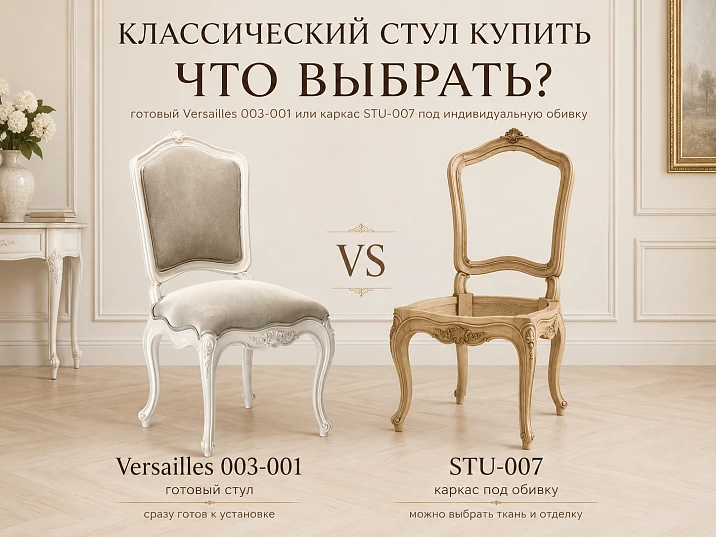
A classic chair can be purchased either as a fully finished piece of furniture or as an assembled wooden frame that still needs to be painted, padded with soft filling, and upholstered with the chosen fabric. Using the example of two STAVROS models, this fork is especially clear. Versailles 003-001 is a finished carved chair with completed wood finishing and professional soft upholstery. STU-007 is an assembled frame of the same size group, prepared for an individual color and subsequent work by an upholsterer.
External resemblance is easily misleading. Both products have the same dimensions 517 × 1003 × 631 mm, a high concave back, carved floral decor, and cabriole legs in the Louis XV style. Both options are made from beech or oak. However, the buyer receives a completely different composition of the order. The finished Versailles can already be included in a dining room, living room, or study as a complete piece. STU-007 remains the basis of a future chair: the wooden structure is assembled, but the final coating, padding, fabric, and decorative finishing of the upholstery must be selected and executed separately.
Therefore, comparing these models only by the price tag is incorrect. For the finished chair, the cost and result already include the work that becomes separate stages for the frame: selecting the finishing system, painting or tinting, forming the soft block, cutting the fabric, upholstering the seat and back, installing piping, braid, or furniture nails, if provided by the design. The frame can offer more freedom, but this freedom requires contractors, time, and precise specifications.
Below is an analysis of when it is more rational to buy the Versailles 003-001 chair, and when it is better to choose the STU-007 chair frame for upholstery. The comparison will help evaluate not only the shape and material but also the entire journey from order to finished interior: who will paint the wood, where to find fabric, how to coordinate multiple chairs, what additional costs to account for, and what to check before placing a purchase.
Short answer.
Versailles 003-001 and STU-007 have the same dimensions 517 × 1003 × 631 mm, are made from beech or oak, and use a similar classic construction with a concave back, carved floral decor, and cabriole legs. Choose Versailles if you need a fully finished chair with completed finishing and professional upholstery. Buy STU-007 if the project has its own fabric, a specific frame color, a workshop, and an upholsterer who will turn the assembled wooden base into a custom upholstered chair.
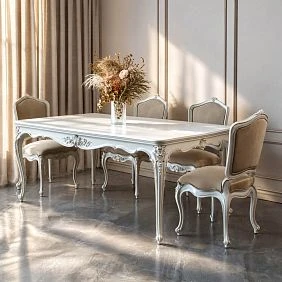
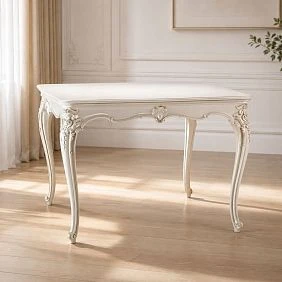
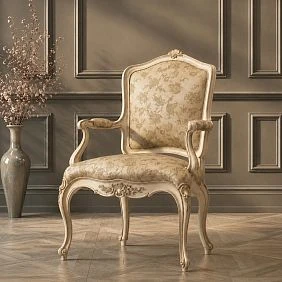
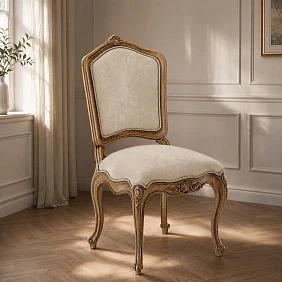
What do Versailles 003-001 and STU-007 have in common
Both models belong to the same recognizable style of classic furniture. Their silhouette is built not on straight massive supports, but on smooth lines: the high backrest slightly embraces the sitter, the front legs have a cabriole curve, and carved floral ornamentation softens the structure. Such a chair does not look like a random addition to a table. It shapes the character of the entire dining set and requires a deliberate combination with the tabletop shape, the finish of other furniture, and the room's textiles.
Matching dimensions is especially important for a fair comparison. Versailles 003-001 and STU-007 have dimensions of 517 × 1003 × 631 mm. The buyer does not have to choose between a large and a small item: the choice is between the degree of readiness. In both cases, you need to check whether there is enough space around the table, whether the high backrest conflicts with a windowsill, decorative panel, or wall molding, and whether it will be convenient to pull out the chair without hitting adjacent objects.
The material also matches in its basic logic. Beech is chosen when the wood is planned to be covered with opaque enamel. Oak is valued for its pronounced texture, so it is usually associated with transparent or semi-transparent tinting. In the finished Versailles, this logic is already turned into complete finish options: beech is offered in white enamel RAL 9010, oak in a walnut tint with patina. For STU-007, the material becomes the starting point for your own project: beech for enamel, oak for tinting.
The same style does not mean the same result. The finished model shows how carving, wood color, and fabric work together. The frame shows the shape without the final layer. After painting and upholstery, STU-007 can become close to Versailles, but can also take on a completely different character: a calm solid fabric, a contrasting edge, a deep enamel color, natural oak tinting, or a more complex decorative finish. That is why the frame cannot be perceived as 'the same chair, just without fabric.' It is a high-level semi-finished product, around which several design decisions still need to be made.
| Characteristic | Versailles 003-001 | STU-007 |
|---|---|---|
| Product type | Fully finished classic chair | Assembled wooden frame for finishing and upholstery |
| Size | 517 × 1003 × 631 mm | 517 × 1003 × 631 mm |
| Material | Solid beech or oak | Solid beech or oak |
| Style | Louis XV, French classic, and baroque motifs | Louis XV, French classic, and baroque motifs |
| Construction | High concave soft backrest, soft seat, carved cabriole legs | High concave backrest with upholstery flanges, base for soft seat, carved cabriole legs |
| Wood finish | Finished: white enamel RAL 9010 for beech or "walnut" with patina for oak | Not finished: beech prepared for enamel, oak for staining |
| Upholstery | Professionally done | Not included; requires forming a soft block and performing upholstery |
| Degree of readiness | Can be used after receiving and inspecting the product | Painting and upholstery work required |
| Primary buyer | Private client, interior designer, dining room furnishing | Furniture workshop, upholsterer, custom project designer, buyer with own fabric |
The table shows the main principle: the basic form hardly puts the buyer before a compromise, but the order composition does. If the interior is already defined and the finished finish fits, Versailles reduces the number of decisions and contractors. If the finish and textiles must be non-standard, STU-007 opens up more possibilities but shifts responsibility for the final result to the project team.




The main difference is what exactly is included in the order
A finished chair is not just a frame with fabric added. To make the piece look cohesive, several layers of work need to be coordinated. The wood shade must support the table and other furniture. The upholstery block must maintain the proportions of the carved back frame. The fabric must be stretched without distortion, especially if it has a pattern, pile, or texture direction. The piping, trim, or furniture nails must cover the technical attachment line and simultaneously become part of the decor.
In Versailles 003-001, these operations are already assembled into one finished product. The buyer evaluates the finished chair from the card, selects a confirmed finish option, and agrees on available upholstery. This is especially convenient when several identical pieces are needed. The larger the set, the more important the repeatability of color, fabric pattern, upholstery block height, and decorative finish.
STU-007 is supplied assembled. The frame joints are made using the tenon-groove principle and additionally glued, and the wooden base includes technical fields for future upholstery. This saves the buyer from having to create a complex carved structure from scratch, but does not turn the frame into a finished chair. Before use, it requires final wood finishing and full work on the seat and backrest.
The main mistake is to see the price of the frame and compare it with the price of a finished Versailles without considering subsequent costs. For an honest calculation, add the cost of primer or tinting compound, enamel, oil or varnish, filler, soft seat base, upholstery fabric, consumables, and the work of the painter and upholsterer to the STU-007. If finishing and upholstery are done in different places, additional logistics and the risk of damaging the already painted carving during transport arise.
| Stage | Versailles 003-001 | STU-007 |
|---|---|---|
| Assembly of the wooden base | Completed | Completed |
| Selection of the finishing system | Selected from confirmed options of the finished product | Designed separately considering the wood species and desired color |
| Painting or tinting | Completed | Must be done after receiving the frame |
| Formation of the soft block | Done | Base, filler, and final density are selected |
| Cutting and upholstery | Done professionally | Performed by the selected workshop or upholsterer |
| Decorative finishing | Approved with the finished model | Piping, braid, or furniture nails are selected separately |
| Number of contractors | Minimal | Usually a painter and an upholsterer are needed, or one full-cycle workshop |
| Customer control | Choosing a ready-made combination and checking order parameters | Control of color, materials, softness, cutting, and quality of all work |
STU-007 will not necessarily be cheaper than the ready-made Versailles. Its advantage lies not in guaranteed savings, but in controlled personalization. The frame is rational when the customer's own fabric, a specific color, and a special decorative solution are truly necessary for the project. If individuality is not needed, additional steps may only increase the timeline, the number of approvals, and the likelihood of the result not matching expectations.
Our factory also produces:
When it is more profitable to buy a ready-made chair Versailles 003-001
The ready-made Versailles is chosen not because the customer has given up individuality, but because the project needs a predictable, finished result. This model already has an agreed-upon frame shape, soft part, and final finish. This approach is especially useful where the chair should not go through several workshops and where any discrepancy in color, fabric, or filler thickness would disrupt the unity of the set.
Get Consultation
When a dining set is needed
A dining group is rarely limited to one chair. For a small table, four seats are usually considered, for a family dining room — six, for a large extendable table — eight or more. The more items, the harder it is to repeat the same result with separate finishing. On six frames, you need to maintain one shade of enamel or tinting, reveal the patina in the carving identically, not change the thickness of the soft seat, and follow the direction of the fabric pattern.
Ready-made classic upholstered chair removes a significant part of these risks. The customer orders finished products and evaluates the set as a single product. This is especially important for an open dining room that is visible from the living room: differences between adjacent chairs are more noticeable there than in a separate room.
Before ordering a set, it is worth measuring the table and the clear passage. The width of one chair is 517 mm, but this figure alone cannot be used in the calculation. A margin is needed between those sitting, and the outer seats should not press against the table legs or obstruct the passage. The high backrest of 1003 mm also affects perception: six such chairs create an expressive rhythm, so it is advisable to leave visual space around the group.
When there is no own furniture workshop
Purchasing a frame only makes sense when it is clear who will finish it. A random painter may paint flat facades well but lack experience with deep carving and curved legs. An upholsterer may reupholster modern furniture perfectly but not know how to neatly finish the open fields of a classic backrest. If suitable specialists are not available, experiments with STU-007 turn a straightforward purchase into a complex production project.
Versailles suits a buyer who does not want to separately source primer, enamel, filling, fabric, trim, and craftsmen. This does not eliminate choices: one needs to decide which finish is more appropriate, how many chairs are needed, and how they match the table. But instead of controlling the technological chain, the buyer focuses on the interior task.
When white enamel or walnut finish with patina is suitable
For beech, the white enamel option RAL 9010 is confirmed. It works well in light classic, neoclassical interiors, and spaces with white trim, moldings, cornices, and doors. The white frame makes the complex carving lighter and allows the fabric to act as an independent color element. Such a chair can be used not only in an all-white dining room but also next to natural wood if the room already has connecting white details.
The oak version with walnut tinting and patina is suitable where it is important to preserve the wood character. The tinting emphasizes the oak grain, and the patina helps to read the carving recesses. This Versailles is easier to pair with a solid wood table, display cabinet, sideboard, or study in a rich classic palette. However, shades from different manufacturers and batches may vary, so one should not choose a chair based solely on the word walnut. It is necessary to compare photos, samples, and actual interior elements.
When a predictable final result is important
A ready-made model is especially rational for projects with a fixed opening or move-in date. When the dining room must be furnished by a certain stage, additional painting and upholstery work becomes a separate risk. Materials need to be coordinated, craftsmen's schedules awaited, each stage accepted, and defects corrected if necessary. Versailles reduces the number of variables: the item is already conceived as a finished chair.
Predictability is also important for remote furnishing. If a designer is managing a project in another city, controlling two workshops is more difficult than ordering ready-made furniture. In this case Catalog of classic solid wood chairs Helps to first compare ready-made models, and then choose the option that is closer to the project in shape, finish, and scale.
When to buy the STU-007 frame for custom upholstery
The STU-007 frame is chosen when standard readiness becomes a limitation. The project may have an approved color from a palette, fabric from a common collection, special seat density, or decorative finish that cannot be achieved within a ready-made model. In such a situation, the wooden base saves not on quality, but on building a complex structure from scratch: the carving, proportions, concave back, and cabriole legs are already formed and assembled.
Have your own fabric
Having your own fabric is one of the most compelling arguments for a frame. The designer can choose a material already used on the sofa, armchairs, curtains, or decorative panels. The repetition does not have to be literal. Sometimes it is enough to use one collection in different colors or connect items with piping of the same shade.
Before purchasing fabric, you need to get a calculation from the upholsterer. You cannot determine the yardage only by the width of the seat and back. The consumption depends on the roll width, pattern repeat, pile direction, method of finishing the back side of the backrest, presence of piping, and allowance for adjustment. A large symmetrical pattern requires more consumption than a solid material because the pattern on several chairs needs to be positioned identically.
If the fabric is expensive or discontinued, it is wise to provide a reserve. It will be useful not only during cutting but also for future local repairs. Storing a small piece is easier than looking for material of the same shade and batch years later. A frame for your own fabric provides this opportunity but requires discipline: first, the cutting and technology are agreed upon, then the material is handed over to the craftsman.
Need a non-standard frame color
The STU-007 made of beech can be considered for opaque enamel. This opens the way to a color that the ready-made Versailles does not have: complex gray, deep blue, muted green, warm beige, or another shade approved by the project. However, the color name on the screen does not replace a sample. On a carved surface, the shade is perceived differently than on a flat wall or facade because light creates many shadows.
Before painting, it is useful to test on a material with similar preparation. It shows not only the color, but also the degree of gloss, coating density, and how the enamel fills small details. A layer that is too thick can visually soften the carving, while a surface that is too glossy can emphasize every unevenness. Working with a classic frame requires careful application of thin layers and control of recesses.
For oak, it is more logical to use a finish that preserves the wood grain. Tinting can bring the frame closer to a table or other furniture, but a complete match based on a photo is not guaranteed. Perception is influenced by the species, grading, surface preparation, composition, and number of layers. Therefore, an oak frame for tinting is best coordinated using a physical sample or a test swatch.
Leather, jacquard, velvet, or a special texture is planned
Different materials change not only the style but also the upholstery technology. Velvet requires a uniform pile direction: if one element is turned differently, under the same lighting it will appear to be a different color. Jacquard with a large pattern needs to be centered relative to the carved frame. Hemp looks calmer, but its structure must be dense enough for tension on a curved back. Natural or artificial leather requires careful cutting because the material behaves differently on curves and corners than fabric.
The frame allows you to select the material according to the usage mode. For a family dining room, abrasion resistance and ease of maintenance are important. For a study or formal living room, tactility and color depth may come to the forefront. For a restaurant, salon, or hotel, the operational characteristics and requirements of the specific facility need to be discussed in advance with the fabric supplier. STU-007 does not dictate a single scenario, but it does not solve these issues on its own: the upholstery specification remains the responsibility of the buyer and the craftsman.
The chair is created according to the designer's specification
In a professional project, the frame color, fabric, trim, patina type, and even the shade of metal nails can be fixed in advance. The finished model then becomes too rigid a framework, and buy the STU-007 chair frame rationally as a basis for precise implementation of the specification.
Before ordering, it is useful for the designer to compile a single table where for each decision the responsible person and sample are indicated: wood species, coating system, color, gloss level, fabric, pattern direction, filler, seat density, trim, and finishing method. Such a table prevents a situation where the painter and upholsterer understand the same project differently.
For a series of several chairs, it is advisable to create and approve one reference sample. After that, the remaining items are replicated based on it. The reference sample is especially important for complex patina, contrasting edge, or fabric with a large pattern. The frame provides freedom, but the quality of the series depends on how precisely this freedom is described.
What makes up the final cost of STU-007
The price of the wooden frame is only the first line of the budget. To get a finished carved chair, you need to calculate materials and labor along the entire path. The mistake is not even that the buyer forgets about the fabric. More often, preparation for finishing, test coatings, delivery between contractors, decorative consumables, and rework are not accounted for if the color or softness did not satisfy after the first sample.
First, the wood finish is determined. For beech under enamel, compatible preparation and topcoat materials are needed. For oak under tinting, a system that provides the desired shade and protects the surface is required. The specific composition depends on the chosen technology, therefore materials for finishing the chair frame should be selected as a single compatible system, not as a random set of cans.
Then the soft part is calculated. It includes the base, filler, possible intermediate layers, and upholstery material. Density and thickness affect the seating and appearance. A too voluminous seat can disrupt the proportions of thin cabriole legs; a too flat one can make the chair visually unfinished. The backrest must remain within the carved frame and not cover decorative details.
Labor is considered separately. Paint finishing of a carved frame is more complex than painting a straight part. Upholstering a concave backrest requires precise tension and neat edge finishing. If there are several chairs, the cost of the trial sample and process setup can be distributed across the series, but this needs to be discussed with the workshop in advance.
| Expense item | What's included | What to check before ordering |
|---|---|---|
| Frame | Assembled carved base STU-007 made of beech or oak | Wood species, size, delivery condition, number of items |
| Preparation and coating | Primer, tinting compound, enamel, oil or varnish depending on the project | Material compatibility, color sample, gloss level, number of layers |
| Soft block | Base, filler and additional layers for seat and backrest | Thickness, density, edge shape, compliance with frame proportions |
| Upholstery material | Fabric, natural or artificial leather, allowance for fitting and repair | Roll width, repeat, pile direction, performance properties |
| Decorative finishing | Piping, braid or upholstery nails according to the chosen technique | Color, thickness, attachment method, compatibility with fabric and wood finish |
| Painter's work | Preparation, test, coating application, interlayer treatment | Experience with carved furniture, reference sample, timeline and acceptance procedure |
| Upholsterer's work | Manufacturing of the soft part, cutting, tensioning and decorative finishing | Experience with classic frames, pattern control, guarantee of series repeatability |
| Logistics | Transportation of the frame, materials, and finished product between participants | Packaging, protection of threads and coating, liability for damage |
After such a calculation, the comparison becomes fair. A finished Versailles may turn out to be more rational, even if the STU-007 card looks more affordable. The frame wins where individual work is already included in the project and its result has independent value. The buyer pays not for the opportunity to "make it cheaper," but for the opportunity to get their own combination of wood, color, softness, and fabric.
How to choose beech or oak
The choice of wood species cannot be separated from the future finish. Beech and oak are suitable for a classic chair, but lead the buyer along different visual paths. Beech has a calmer pattern, so it works well under opaque enamel. Oak is more often left visible: its texture becomes part of the image and supports natural furniture, parquet, wall panels, and other wooden elements.
Beech for enamel
A beech frame STU-007 is chosen when color is more important than the natural wood grain. Opaque enamel allows you to match the chair with doors, kitchen fronts, display cabinets, a console, or wall decor. However, the color should not be selected in isolation from lighting. The same gray or beige shade looks different near a window, under warm lamps, and in evening diffused light.
For classic carving, the thickness of the coating matters. The enamel should cover the wood evenly, but not turn thin plant details into a smoothed relief. Before the main work, the painter coordinates the technology and makes a test. If patina is planned, it is also better to evaluate it on a fragment with depressions and protrusions, rather than on a flat sample.
The finished Versailles in beech with white enamel RAL 9010 is useful as a clear reference point. White color makes the chair lighter, emphasizes the curves, and supports a light dining room well. However, white furniture requires a practical choice of fabric: very light upholstery creates a unified airy image, while darker or colored upholstery helps hide everyday marks and separates the soft part from the carved frame.
Oak for tinting
Oak is suitable for projects where the wood should remain noticeable. Its pattern works together with the tint, rather than disappearing under it. For the finished Versailles, the "walnut" option with patina is confirmed. It creates a richer classic image than white enamel and is well perceived next to a massive table or furniture in a warm wood palette.
When custom finishing the STU-007, it is important not to try to select a shade by name. "Walnut," "dark oak," or "cognac" can differ noticeably across different coating systems. It is better to take a sample of existing furniture, agree on the degree of transparency, and do a test on oak. If the chair must match the table, consider not only the color but also the gloss: a matte tint next to a glossy table may look like a different material.
It is better to order an oak set as one group and finish it in one cycle. Natural wood allows for differences in grain, but the overall shade and coating character must remain consistent. Separate orders with a long interval make it difficult to repeat the result, especially with hand-applied patina.
How to avoid mistakes when mixing materials
Sometimes a customer wants to place an oak table and white beech chairs. This is acceptable if the white color is already repeated in the interior: in doors, baseboards, a sideboard, a lamp, or wall panels. Without such a connection, the contrast may look random. Similarly, oak chairs next to a painted table require the wood shade to be repeated in other details.
You should not assemble one set from beech and oak and then try to make them identical with a clear finish. The species have different grain patterns and absorb stain differently. If a uniform enamel is required, beech is more practical. If visible texture is needed, it is better to make the set from oak.
Additional information about surface preparation and processing level can be checked on the page about what 'Prestige' sanding means. For STU-007 this is important: a well-prepared frame facilitates further finishing but does not eliminate the need to follow the technology of the chosen paint and varnish system.
How to choose fabric for STU-007
Fabric affects the chair no less than the color of the wood. On the tall curved backrest, the material occupies a noticeable area and is almost at eye level. A mistake that would be unnoticeable on a small seat becomes part of the entire composition here: the pattern may shift, the pile may change shade, and a too-loose texture may deform on the curve.
Solid velvet
Velvet helps emphasize the softness of the classic shape. It works well with white enamel, rich tinting, and patina. The main nuance is the direction of the pile. All parts of one chair and the entire set must be cut identically. Otherwise, adjacent backs may appear different in tone even when using fabric from the same roll.
Deep shades of velvet enhance grandeur: blue, green, burgundy, and complex gray create a noticeable contrast with the white frame. Calm beige and milky shades make the interior lighter but require more careful maintenance. Before ordering, evaluate not only the color of the sample but also how it changes when stroking the pile in different directions.
Jacquard and patterned fabric
Jacquard supports the classic style, especially if the pattern is related to the plant motif of the carving. But a large ornament requires precise centering. On the back, the central element should be positioned symmetrically relative to the upper carved part. On several chairs, the pattern is repeated in the same place, otherwise the set will look assembled from different pieces.
Pattern repeat increases consumption. The upholsterer cannot use every free piece of fabric if the pattern needs to be matched. For six or eight chairs, the waste becomes noticeable, so the yardage is calculated after selecting the specific article, roll width, and cutting scheme.
Rogozhka and calm textures
Rogozhka reduces formality and makes a carved chair closer to modern neoclassicism. It is appropriate when the interior needs a classic shape without a heavy palace mood. However, a large weave must withstand tension on curves. Too loose fabric may separate near fastenings or distort the thread pattern.
For a family dining room, practicality is often more important than a complex pattern. Solid rogozhka or textured fabric in a medium tone is easier to combine with different dishes, textiles, and seasonal decor. But the decision on the material's suitability for upholstery is made by a specialist, considering its density and behavior under tension.
Natural or artificial leather
Leather makes the chair more formal and is suitable for an office, meeting room, restaurant, or classic dining room with minimalist textiles. On a concave back, it is important to determine in advance how the material will form along the curved surface. Thickness, elasticity, and permissible seams are discussed before cutting.
Natural leather has natural variations and requires careful layout of parts. Artificial leather can provide a more uniform color, but its properties depend on the specific material. Not every option can be considered interchangeable. The upholsterer must confirm that the selected fabric is suitable for the seat and backrest of this shape.
Piping, braid, or furniture nails
The edge of the upholstery cannot be left random. Decorative finishing closes the technological line and connects the fabric to the frame. Piping from the same fabric makes the design calm. Contrast piping emphasizes the silhouette of the soft insert. Braid supports traditional furniture trim. Furniture nails add a graphic rhythm but require precise spacing and careful installation.
The choice depends on the fabric and wood finish. On a white frame, overly contrast piping can fragment the composition, while on dark oak, a thin light line, on the contrary, helps to read the shape. For a series of chairs, first approve one option, then repeat it without changes.
Size 517 × 1003 × 631 mm: how to check a chair in a real interior
The dimensions of Versailles 003-001 and STU-007 are the same, so the spatial check is suitable for both. The width of 517 mm shows the overall size of one item, the height of 1003 mm shows the scale of the backrest, the depth of 631 mm shows the space the chair occupies from the front edge to the back point. But these numbers are not enough for arrangement: you need allowance for sitting, pulling out, and passage.
Check near the table
First, measure the free length of the table side between legs or supports. Chairs must fit not only in overall width but also with intervals. If a table leg falls into the knee area or prevents the item from being pushed in, a nominally sufficient tabletop will be uncomfortable. For end seats, check whether the table apron interferes and whether there is room for hands.
Then evaluate the depth of the seating area. A chair with a depth of 631 mm should be pulled away from the table, and a passage remains behind it. In a cramped room, a high backrest enhances the feeling of density, so a mockup is more useful than an abstract calculation. The outline can be marked on the floor with masking tape, and the height can be checked
High backrest and visual scale
A height of 1003 mm makes the chair noticeable even behind a large table. This is an advantage of a classic dining room: the backs create a row and do not get lost next to a massive tabletop. However, in a small room, too many high chairs can overwhelm the space. In that case, a light finish, a calmer fabric, and reducing the number of permanently displayed seats help.
The high back also affects the placement of wall elements. If there is molding, a decorative panel, or a painting behind the chairs, you need to check the intersection of lines. The back should not cover a key part of the decor or constantly hit protruding wall elements.
Checking doors, passages, and delivery
Before ordering, measure doorways, corridor turns, stairs, and the elevator. The chair is delivered assembled, so you cannot rely on on-site disassembly without confirmed data. Special attention is required for narrow staircases and entrances to basement restaurants or attic spaces.
For the STU-007 frame, the path is more complex: it may first go to the painting workshop, then to the upholsterer, and only then to the site. Each participant must be able to safely receive and move the assembled structure. The packaging should not be removed prematurely if transportation is ahead, but before finishing, the surface must be checked and prepared according to the master's technology.
How many chairs to order: four, six, or eight
The quantity is determined not only by the number of family members. Consider the size of the table in its normal and extended state, the frequency of hosting guests, available space, and the ability to store additional chairs. A classic model with a high back takes up noticeable volume, so spare items must have a well-thought-out place.
Four chairs
Four Versailles chairs suit a small round or square table if the dimensions of the tabletop and support allow for comfortable placement of each seat. Such a set is well received in a city apartment, a separate kitchen-living room area, or an intimate dining room. For visual unity, all four chairs are ordered simultaneously in the same finish and fabric.
Four STU-007 frames are easier to coordinate as the first author's series. You can make a control chair, check the fit and color, and then complete the remaining three. But fabrics and finishing materials are purchased with a reserve for the entire set at once to avoid dependence on batch differences.
Six chairs
Six seats is a common format for a family dining room. Here, the distance between chairs and the position of the table legs are especially important. Two end items may differ in usage scenario: they are often pushed further away and need a clear passage. The ready-made Versailles is convenient because the repeatability of the series is already built into the ordering logic.
When individually upholstering six STU-007 units, pattern control becomes a separate task. The upholsterer marks the parts and ensures that the center of the ornament, the direction of the pile, and the edge match on all items. The painter must also work with the set as a single series.
Eight or more chairs
A large set suits an extendable table, a spacious dining room, a restaurant, a conference room, or a private reception hall. Here, the cost of error multiplies by the number of items. An incorrect shade, an uncomfortable seat density, or an unsuitable fabric becomes a systemic problem.
Before ordering eight or more frames, it is reasonable to fully complete one sample and conduct an acceptance inspection. For finished chairs, confirm the availability of the selected finish and fabric for the entire series. Sometimes it is useful to include one additional unit as a spare, especially for commercial interiors where furniture is used intensively. This decision is made considering the budget and storage possibilities.
Where to use Versailles and STU-007
The same shape does not tie the chair only to a formal dining room. The difference is created by the finish and fabric. A white Versailles with soft light upholstery can work in an airy neoclassical style, an oak "walnut" version with patina in a rich classic interior, and an STU-007 after custom finishing can support a modern palette, a restaurant concept, or a designer furniture collection.
Dining room and kitchen-living room
In the dining room, the chair should primarily match the table, but a literal color match is not necessary. A white frame can support light facades, doors, and baseboards next to an oak tabletop. A tinted oak chair works well with a natural table if the shades do not clash. The fabric ties the group to curtains, a rug, a sofa, or decorative pillows.
For a kitchen-living room, the practicality of the upholstery is especially important. The chair is used daily, so a too delicate material may require complex care. A ready-made Versailles is chosen when the confirmed upholstery suits the room's usage. An STU-007 is chosen when a material with predetermined performance properties is needed and the workshop is ready to use it correctly.
Living room and study
A single carved chair can be placed near a console, secretary desk, or writing desk. In this scenario, the piece becomes an accent and does not have to fully match the dining set. White enamel makes it lighter, oak and leather make it stricter, and rich velvet makes it more decorative. But even a single chair should be comfortable in depth and height for the chosen area.
For a study, STU-007 is interesting because it allows you to match leather or dense fabric to an armchair and sofa. However, keep in mind: the construction remains a classic chair, not a work chair with adjustments. It is suitable for a guest seat, short meetings, reading, or a desk area if the seating suits the owner.
Bedroom and dressing room
In a bedroom, a classic chair is used near a vanity table, by a window, or next to a wardrobe. The high back makes it more expressive than a bench but requires more space. Here, a more delicate fabric is acceptable than in the dining room because the risk of stains is lower. The frame color can be tied to the headboard, mirror frame, nightstands, or closet doors.
STU-007 is useful when the fabric needs to match the bed headboard. One material connects different pieces, while the enamel shade unifies the chair frame with other painted furniture. The ready-made Versailles is more rational if the interior already suits white enamel or oak finish and separate upholstery work is not justified.
Restaurant, hotel, salon, and showroom
In a commercial interior, the solution depends on the quantity and operational load. A ready-made chair reduces the number of contractors and simplifies procurement. The frame allows for a corporate color, fabric from an approved collection, and custom decorative finish. But for a series, a control sample and confirmation of upholstery properties for the specific usage mode are especially important.
For a restaurant, you need to check not only aesthetics but also ease of movement, cleaning, and arrangement. High backs create an expressive hall but require sufficient distance between tables. In a hotel or salon, a carved chair can be used selectively: at the counter, in the waiting area, near a mirror. Then, a custom STU-007 helps integrate a classic form into the brand palette without buying a fully standard set.
What to buy and prepare along with the chair or frame
The ready-made Versailles does not require separate upholstery, but it still needs to be included in the overall interior set. Next to the chair, choose a table, lighting, textiles, and other classic furniture. The STU-007 frame requires a more practical set: finishing materials, fabric, padding, decorative finishing, and contractor services. All decisions should ideally be made before receiving the product, so the frame is not stored without a clear plan.
To compare other ready-made models, you can choose a ready-made wooden chair in the profile category. If the task is broader and a different base for your own upholstery is needed, it is useful to look wooden chair frames. Comparing neighboring models helps to understand whether the proportions and carved pattern of STU-007 are really needed.
| What to add to the purchase | Why this is needed | For which scenario | What to pay attention to |
|---|---|---|---|
| Materials for painting beech or tinting oak | Prepare and protect the STU-007 frame, get an approved color | Individual frame finishing | Compatibility of the entire system and test coating |
| Upholstery fabric or leather | Form the appearance and operational properties of the soft part | STU-007 for your own upholstery | The yardage is calculated by the upholsterer taking into account the pattern repeat and pile direction |
| Filler and base of the soft block | Create the seat fit and back shape | Complete manufacturing of the soft part STU-007 | Density, thickness, and compliance with frame proportions |
| Edge, braid, or furniture nails | Close the upholstery edge and complete the classic pattern | Author's decorative design | Color and scale must match the carving and fabric |
| Selection of table and decor for a classic dining room | Connect chairs with the overall dining group, rather than choosing them in isolation | Ready-made Versailles set | Table size, number of seats, wood finish, and clearances |
| Guide on how to choose a chair frame | Understanding the base structure and the difference between a frame and a finished item | First order of a furniture frame | Do not expect upholstery and final finishing to be included in STU-007 |
How not to confuse a finished chair with a frame
In the photo, STU-007 already looks like a chair: it has legs, aprons, a backrest, and a seat outline. Because of this, the buyer may think that only stretching the fabric remains. In practice, the soft part requires a base, filler, and professional shaping. The wood also has no final coating. The frame cannot be used in the interior as a finished item until these tasks are completed.
In the product card, you need to look not only at the name and size but also at the product type, surface condition, and configuration. Phrases like "for enamel", "for tinting", "Prestige sanding" describe a prepared base, not a finished paint job. The upholstery fields show where the soft part will be attached, but the fabric and filler do not appear automatically.
The finished Versailles, on the other hand, already has finishing and professional upholstery. It should not be purchased as a blank for a complete overhaul if the project initially requires a different color and custom fabric. Theoretical reworking of a finished item creates unnecessary operations: you will have to remove the upholstery and coating, risking damage to the carving. For custom finishing, it is more rational to immediately choose a frame.
A useful guideline is simple: if the chair needs to be immediately part of the interior after delivery, choose Versailles. If the item goes to a painter and upholsterer after delivery, choose STU-007. This check is more accurate than comparing images and names.
Practical choice for specific situations
Need to quickly furnish a ready dining room
Choose Versailles 003-001. Check the size, quantity, finish, and fabric, then verify the pathways and table dimensions. The frame in this situation will add unnecessary steps and contractors. For additional ideas, you can explore the material on how to decorate a dining room with Versailles chairs.
Need to match the fabric of the sofa or curtains
Choose STU-007, but show the fabric to the upholsterer before ordering. He must confirm the material's suitability and calculate the consumption. At the same time, determine the wood finish, because the edge and fabric are evaluated next to the finished frame color, not raw beech or oak.
Need a white classic set without separate painting work
Suitable white classic chair RAL 9010 made of beech. Before ordering, match the white color with doors and other furniture. Even standard RAL is perceived differently due to gloss and lighting, so it's useful to evaluate the item in the overall palette, not just by the shade name.
Need a complex color, gold leaf, or custom patina
More rational: STU-007 and a workshop experienced in finishing carved furniture. Approve a sample on a relief surface and specify where the patina should be more noticeable. Do not give the craftsman only a photo of the interior: a physical reference or detailed specification is needed.
Need one accent chair
Both models are suitable. Versailles is more convenient if the ready-made finish already matches the interior. STU-007 offers more freedom for bright fabric and non-standard color. But the cost of custom work on a single piece may be relatively higher than on a series, because the trial and setup of the technology are not distributed across multiple items.
Need a large set for a commercial project
Compare two risks. The ready-made Versailles reduces production complexity, but you need to ensure the selected configuration is available for the entire series. STU-007 allows you to hit the brand palette exactly and choose specialized fabric, but requires a control sample and a stable workshop. The decision is made after a full calculation, not based on the price of one frame.
Mistakes when buying Versailles or STU-007
Compare only the price of the card. The frame still needs finishing and upholstery. Calculate the final finished item, including materials, labor, and transportation.
Buying STU-007 without selected craftsmen. Before ordering, you need to understand who handles the painting, who forms the soft block, and who is responsible for the final assembly of the work.
Choosing fabric without consulting the upholsterer. A beautiful material may turn out to be uncomfortable for a concave backrest, require complex pattern matching, or result in unexpected consumption.
Determining color from the screen. Enamel and tinting are checked against a physical sample. The degree of gloss and the behavior of the coating in the carving are especially important.
Not taking into account the dimensions of the assembled chair. The dimensions 517 × 1003 × 631 mm need to be compared with the table, passages, doors, stairs, and elevator.
Mixing different batches in one set. It is better to coordinate chairs, fabric, and finishing materials simultaneously. This simplifies the repetition of shade and pattern.
Trying to rework a finished Versailles into a completely different project. If you need your own fabric and non-standard trim in advance, it makes more sense to buy the frame rather than paying for finished work and then removing it.
Consider STU-007 as a set of individual parts. The frame is delivered assembled. This is an advantage for strength and geometry, but requires checking logistics and the workshop workspace in advance.
Do not approve the control sample. For a series of individual chairs, one fully finished example helps evaluate the fit, color, softness, fabric pattern, and decorative edge before launching the entire set.
Order only the quantity based on the number of seats at the table. You need to consider the table legs, distance between chairs, walkways, and storage of additional units.
Who each option is suitable for
Versailles 003-001 will suit a private buyer who needs a finished classic chair; a designer furnishing a ready-made dining room; a project where white enamel RAL 9010 or oak finish 'walnut' with patina is appropriate; an order of several identical items; a situation without your own painting and upholstery workshop.
Versailles may not suitif a non-standard color is approved, there is custom fabric, a special seat density is required, or a decorative technique that is not available in the ready configuration. In this case, the model's readiness becomes a limitation rather than an advantage.
STU-007 will fit for a furniture workshop, upholsterer, designer with a detailed specification, a buyer with their own fabric, a project with custom enamel or tinting, and an author's collection where every layer of the result needs to be controlled.
STU-007 may not fitif there are no proven contractors, no time for sample trials, the buyer does not want to handle material selection, or expects a ready chair immediately after delivery. In this case, the freedom of the frame turns into an extra organizational burden.
How to buy a classic chair at STAVROS
First, determine the purchase route. For a finished interior, open the card and buy the Versailles 003-001 chairafter checking the material, finish, upholstery, dimensions, and quantity. For an author's project, open the card and select Wooden chair frame, but before placing the order, prepare the finish specification and arrange with the workshop.
If you are not yet sure about the form, compare carved chairs with upholstery и frames made of oak and beech. Categories help distinguish two types of purchase: finished furniture and a base for further production.
Before ordering, note five parameters: quantity, zone dimensions, wood species, desired finish, and upholstery scenario. For Versailles, additionally specify the current fabric and finish option. For STU-007, confirm that upholstery and final coating are not included, and that the selected workshop accepts an assembled frame of that size.
When selecting a chair to match existing furniture, prepare photos in daylight and evening light, table dimensions, and a color sample if available. This will make it easier for the manager to understand the task and for the buyer to avoid choosing based on a general word like "white" or "walnut." Current parameters, availability, and order conditions should be checked directly in product cards before payment.
What to check before ordering.
- whether a chair measuring 517 × 1003 × 631 mm fits under the table and passes through the delivery route;
- whether a finished item or a frame for separate finishing and upholstery is needed;
- whether beech under enamel is suitable or oak with visible texture is required;
- is there fabric, an accurate calculation of its consumption, and an approved method for finishing the edge;
- are all chairs ordered in one series and is a control sample provided for an individual project.
Frequently asked questions about Versailles 003-001 and STU-007
Do Versailles 003-001 and STU-007 have the same size?
Yes. Both models have confirmed dimensions of 517 × 1003 × 631 mm. Therefore, the choice is not between different scales, but between a finished chair and an assembled frame for subsequent work.
Can STU-007 be used immediately after receiving it?
No, it should be considered as the basis for a future upholstered chair. The frame is supplied assembled, but requires final wood finishing, manufacturing of the soft block, and upholstery of the seat and backrest.
What is already included in Versailles 003-001?
This is a finished classic chair: the wooden frame has a final finish, and the seat and backrest are professionally upholstered. The current configuration of finish and fabric should be checked in the product card before ordering.
Which option should I choose if I have my own fabric?
More rational than STU-007. Before purchasing, provide a fabric sample to the upholsterer so they can confirm the material's suitability, calculate the consumption, and account for the pattern repeat, nap, and edge finishing method.
What is better for white enamel — beech or oak?
For opaque enamel, beech is usually chosen. The finished Versailles in beech is offered in white enamel RAL 9010, while the beech STU-007 can be included in a custom painting project.
When should you choose oak?
Oak is suitable when it is important to preserve the visible wood texture. The finished Versailles has a confirmed walnut finish with patina. For the oak STU-007, the tinting and protective coating system is developed separately.
Is the frame of STU-007 cheaper than the finished chair?
In terms of the card price, the frame may seem more affordable, but this is not the final cost of the chair. You need to add finishing materials, the soft block, fabric, painter's work, upholsterer's work, and possible logistics. Compare two fully finished results.
Can I order several STU-007 and upholster them identically?
Yes, but for a series, a control sample is needed. First, one finished chair is approved: color, softness, pattern position, nap direction, and piping. Then the workshop replicates the solution on the remaining frames.
How to calculate the amount of fabric?
The calculation is done by the upholsterer after selecting the specific material. Important factors are the roll width, pattern repeat, nap direction, back side finishing of the backrest, piping, and allowance. You cannot multiply the visible area of the seat and backrest by the number of chairs without a cutting layout.
Which chair to choose for a ready-made family dining room?
If confirmed finish options are suitable and there is no need to use your own fabric, Versailles is simpler and more predictable. It does not require a separate painting and upholstery workshop.
Which option is better for a restaurant or hotel?
Ready-made Versailles is convenient for reducing the number of contractors. STU-007 is useful if a corporate color and specialized upholstery are required. For large quantities, in any case, check the passages, operating mode, repeatability of the series, and the ability to order the required quantity.
Can the ready-made Versailles be repainted in a different color?
Buying a ready-made model for a complete overhaul is not rational: you will have to remove the existing finish and upholstery, creating additional costs and risks. For a non-standard color, it is better to immediately choose STU-007.
What does the "Prestige" sanding of the frame mean?
This is a confirmed level of surface preparation for STU-007. It facilitates further finishing but does not replace the technological preparation for a specific primer, enamel, tinting, oil, or varnish.
Is it necessary to order all chairs at the same time?
For a single set, this is preferable. Ordering simultaneously simplifies the coordination of wood, finish, and fabric. For individual work, it is better to paint and upholster the entire set in one production cycle.
Where can I read more about the frame structure?
Useful material about what a wooden frame consists of. It helps to understand the base structure, and this article answers the next question — whether to buy a frame or a ready-made Versailles.
Where to compare classic chairs for the kitchen and living room?
For a wider selection, you can open the article about which classic chair to buy. It helps to evaluate the general type of furniture, while the comparison of Versailles and STU-007 focuses on the degree of readiness and custom upholstery.
Result: ready-made Versailles or STU-007 frame
Versailles 003-001 and STU-007 are built on a similar classic form, have the same dimensions, and are made of beech or oak. But the buyer purchases two different products. Versailles is a fully finished carved chair with finishing and professional upholstery. STU-007 is an assembled wooden base that gives freedom of color and fabric but requires full painting and upholstery work.
Choose Versailles when you need a complete set, predictable result, white enamel RAL 9010 or oak finish "walnut" with patina, and a minimum number of contractors. Choose STU-007 when the project has its own fabric, non-standard color, special patina, individual softness, and a workshop capable of accurately executing the specification.
Before ordering, compare not the prices of cards, but the cost of two finished chairs. Check the size 517 × 1003 × 631 mm, delivery route, material, order composition, and number of seats. For the frame, pre-approve the contractors, coating system, fabric, and control sample. For the finished product, confirm the current finish and upholstery.
On the STAVROS website, you can go to a finished carved solid wood chair or choose a classic chair frame for upholstery. A conscious choice between them helps to get not just beautiful furniture in the style of Louis XV, but an item that suits your interior, work budget, and actual method of assembly.