Article Contents:
- KZ-001-4: what data must be recorded before a wholesale calculation
- Which fields should be mandatory
- What should not be copied endlessly from the product card into the article
- Why identical dimensions create a particularly dangerous error
- What identical dimensions actually mean
- Why material is a separate mandatory field
- Why finishing is also part of identity
- Why keep the zone
- Why the category is useful but insufficient
- One contract does not mean one product line
- Why a photo doesn't replace a physical sample
- How to use the drawing
- What to store in the sample package
- Why the zone must be preserved even after summing
- How to work with identical rooms
- Why the warehouse abbreviation "KZ-001-4" is dangerous
- How to store
- Why the words "dark" and "natural" are insufficient
- Can both finishes be stored next to each other
- Example 1: a simple set
- Why this is more important than the total amount
- Example 2: a successful set of short parts
- How to maintain remainder banks
- What to do if you want to use a remainder economically
- Why a set code does not replace an SKU
- How to assemble a floor
- Why this is especially useful with identical finishes
- The order of fields matters
- A color label can help, but it does not replace the text
- What to do when repacking
- What to verify
- Why size should not be the main criterion for receiving
- Selective visual inspection
- When a replacement can be considered at all
- If the replacement is approved
- What to check
- Why a shortage alone cannot be used as justification
- Strong scenario
- Weak scenario
- What else is useful to add
- Why the size cannot be shortened to 104×102×2400
- Reordering after a long time
- Why one shared reserve is dangerous
- What reserve to keep
- A whole plank is more valuable than the sum of short offcuts
- How to return leftovers after installation
- Can reserve be combined if the project has officially approved a replacement
- Why finishing the reserve plank is critical
- Reserve for standard rooms
- Step 1. Assign to zones
- Step 2. Separate the warehouse
- Step 3. Check acceptance
- Step 4. What to do with mixed items
- Step 5. Separate cutting
- Step 6. Marking on site
- Step 7. Reorder
- Step 8. Checking the cost of an error
- Step 9. Checking reverse traceability
- Do not choose KZ-001-4 just because it is "richer"
- Do not use an SKU as a way to hide an error from another project
- When it is wiser to keep KZ-001-11
- When it is better to use the standard KZ-001
- Do not purchase before the material and finish are approved
- When ordering a SKU is still premature
- 15 typical mistakes
- Checklist before wholesale ordering KZ-001-4
- Reverse check from warehouse to project
- Reverse check from room to warehouse
- How to work with a specification version
- Product links for selection and verification
- How general B2B requests are included in the order
- A composite internal code helps avoid losing the SKU when transferring data between tables
- Two delivery queues require separate version and stock control
- What to do with the remaining stock from the first queue
- Why a queue must have a date and revision
- The prices of two SKUs are close, but that does not make them commercially interchangeable
- How to compare an estimate correctly
- A warehouse control board helps new employees distinguish between two profiles
- The reference sample must not be used as working stock
- What to sign on the reference sample
- The cost of a sorting error is broader than the cost of a single plank
- A purchase order to a supplier and a warehouse document must have the same line structure
- Why merging in an accounting or warehouse system is dangerous
- What to do if a supplier invoice contains only a single summary line
- After partial issue, balance control is required for each SKU
- How to find the cause of the discrepancy
- A damaged label must not turn the strip into an unidentified remainder
- How to identify a questionable strip
- The reserve bank must have a status: free, assigned, or operational
- Final algorithm
- Can KZ-001-4 and KZ-001-11 be distinguished by size only?
- Can they be combined into one line if both are made of oak?
- Can the remainder of KZ-001-4 be used instead of KZ-001-11?
- How to place a reorder?
- When is a physical sample especially needed?
- Can two SKUs be stored next to each other?
- Why is a shared reserve a bad idea?
- If the supplier offers KZ-001-11 instead of KZ-001-4, what should be done?
- If half of the standard rooms are already installed with KZ-001-4, can the second half be done with KZ-001-11?
- When is it too early to buy KZ-001-4?
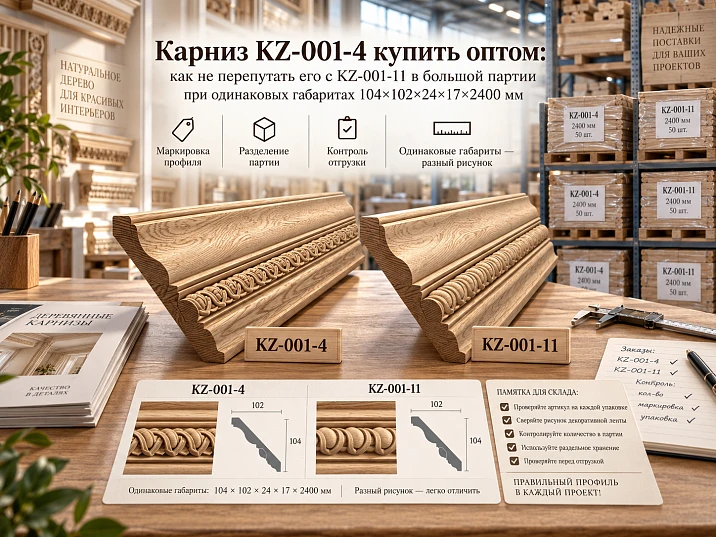
A project simultaneously uses two complex wooden cornices with an insert. One is KZ‑001‑4, the other is KZ‑001‑11. Both have identical numerical parameters: 104 × 102 × 24 × 17 × 2400 mm. Both are available in beech and oak. Both are custom-made items. If the specification is shortened to the line “oak cornice 104×102×24×17×2400,” the warehouse, procurement, and installation teams get almost ideal conditions for mix-ups.
Therefore, buying the KZ-001-4 cornice wholesale is correct only by full product identity:
SKU → material → size → finish → zone → finishing details → number of whole strips → marking → warehouse group → reserve → reorder.
The main principle of the article:
IDENTICAL DIMENSIONS ARE NOT A UNIQUE CORNICE IDENTIFIER. KZ‑001‑4 AND KZ‑001‑11 MUST REMAIN SEPARATE PRODUCT ITEMS AT ALL PROCUREMENT STAGES.
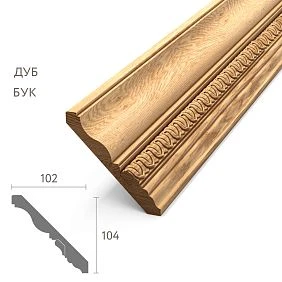
KZ-001-4: what data must be recorded before wholesale calculation
The current STAVROS product card confirms the basic set of characteristics KZ‑001‑4.
| Parameter | KZ‑001‑4 |
|---|---|
| Type | Wooden cornice with insert |
| A | 104 мм |
| C | 102 мм |
| D | 24 мм |
| E | 17 мм |
| Length | 2400 мм |
| Materials | Beech / Oak |
| Sanding quality | «Prestige» |
| Status | Made to order, stated lead time 5–10 days |
These data are needed for calculation and control. But even a full set of 104×102×24×17×2400 + oak does not provide unique product identification, because KZ‑001‑11 has the same numeric parameters.




Which fields should be mandatory
Minimum line:
KZ‑001‑4 / oak / 104×102×24×17×2400 / finish O‑01 / zone “main hall” / quantity ___.
If the cornice is used in beech:
KZ‑001‑4 / beech / 104×102×24×17×2400 / O‑02 / zone “study” / quantity ___.
The SKU comes first because it is what distinguishes the product from another profile with the same dimensions.
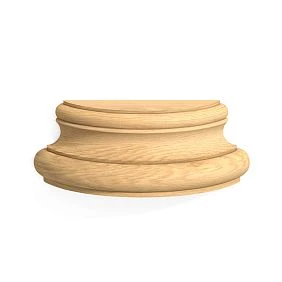
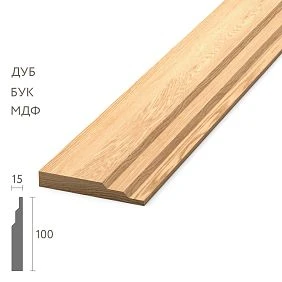
Our factory also produces:

What should not be copied endlessly from the product page into the article
The product page already contains the price, material, status, sanding, and technical fields. In a wholesale article, these data are needed only as a working basis for the mis-shipment scenario. The main value of the page is not a repetition of the product page, but a system that prevents two SKUs with similar dimensions from being confused.
Get Consultation
Dimensions 104×102×24×17×2400 mm are not a unique identifier
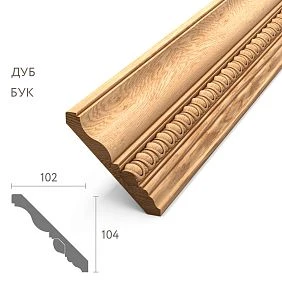
Current product card KZ‑001‑11 confirms the same numeric parameters:
104 × 102 × 24 × 17 × 2400 mm.
And the same base materials:
- Beech;
- Oak.
But KZ‑001‑11 is a different product, a different SKU. Therefore, the entry:
“Cornice oak 104×102×24×17×2400 — 40 pcs.”
does not answer the main question: which 40 pieces — KZ‑001‑4 or KZ‑001‑11?
Why identical dimensions create a particularly dangerous error
If two products differ obviously — for example, one is 55 mm, the other 104 mm — mis-sorting is easier to notice before installation. When the numeric card almost completely matches, a warehouse employee may consider the items identical.
The error is amplified if the name is shortened in the documents:
- “cornice with insert 2400”;
- “large oak cornice”;
- “cornice 104×102”;
- “KZ series 001”.
None of these formulations is sufficient.
What identical dimensions actually mean
They only indicate that the specified dimensions match. This may be useful to an architect for comparing scale and the ceiling line, but it does not prove:
- identity of silhouette;
- identical decorative composition;
- identical perception of light and shadow;
- interchangeability on site;
- stock compatibility;
- right to replace one SKU with another without approval.
A correct specification line must begin with the SKU
The wholesale statement must eliminate the possibility of reading KZ‑001‑4 and KZ‑001‑11 as a single item.
| SKU | Material | Size | Finish | Zone | Quantity |
|---|---|---|---|---|---|
| KZ‑001‑4 | Oak | 104×102×24×17×2400 | O-01 | Grand foyer | 28 pcs. |
| KZ‑001‑11 | Oak | 104×102×24×17×2400 | O-01 | Restaurant | 16 pcs. |
| KZ‑001‑4 | Beech | 104×102×24×17×2400 | O-02 | Office | 8 pcs. |
Such a table does not allow rows to be "collapsed" by size.
Why material is a separate required field
KZ‑001‑4 oak and KZ‑001‑4 beech are the same model but different material versions. They must not be mixed in a single warehouse stock or a single finish group just because the SKU matches.
Why finish is also part of identity
If KZ‑001‑4 in oak is used in two finishes:
KZ‑001‑4 / oak / О‑01
и
KZ‑001‑4 / oak / O‑02,
these are two separate purchasing items after finishing. The remaining dark O‑02 does not cover the O‑01 shortage.
Why store the zone
The zone does not change the physical nature of the product, but it explains the origin of the quantity. If 6 KZ‑001‑4 planks remain in stock, you need to understand whether they belong to the hallway, the office, or the reserve of another building.
KZ-001-4 and KZ-001-11 must not be combined under the line “cornice with insert”
Both items are indeed cornices with an insert. But this is a category description, not a unique name.
The category answers:
“What type of product is this?”
The SKU answers:
“Which exact product is it?”
Wholesale purchasing requires the second level.
Why the category is useful but insufficient
To select the assortment, you can open wooden cornice and compare different KZ. But after selection, the category should disappear from the role of order identifier.
Phrase:
"cornices with insert — 44 pcs."
unsuitable for the warehouse if it contains 28 KZ‑001‑4 and 16 KZ‑001‑11.
One contract does not mean one product line
Commercially, the delivery may be one. Technically, different SKUs, materials, finishes, and zones must be preserved within it.
A physical sample must be linked to a SKU, not exist "on its own"
For an expensive decorative cornice, one table row is not enough. On site, it is useful to have a physical sample or an unambiguous reference to the card, but the sample must be labeled.
Weak labeling:
«cornice for the hall».
Strong:
KZ‑001‑4 / oak / O‑01 / main hall / sample No. K4‑01.
And separately:
KZ‑001‑11 / oak / O‑01 / restaurant / sample No. K11‑01.
Why a photograph does not replace a physical sample
A photo helps identify the overall pattern, but it does not provide a reliable scale of the relief, shadow depth, and actual finish. It is especially bad to use an image as the only evidence when two SKUs are similar in size.
How to use the drawing
A drawing is useful for numerical dimensions. But if both SKUs have the same A, C, D, E, and L, one set of numbers does not distinguish them. Therefore, a drawing must always be accompanied by the item code.
What to store in the sample package
- SKU;
- the material;
- finish code;
- zone;
- approval date;
- project version;
- a photo of the installed reference as supporting material;
- a link to the product page.
A room-by-room application map protects against mix-ups better than a total quantity
If both SKUs are used at the site, each must have an application map.
| Body | Room | SKU | Material | Finish | Quantity |
|---|---|---|---|---|---|
| А | Grand foyer | KZ‑001‑4 | Oak | O-01 | 28 pcs. |
| А | Restaurant | KZ‑001‑11 | Oak | O-01 | 16 pcs. |
| А | Office | KZ‑001‑4 | Beech | O-02 | 8 pcs. |
| Б | Lobby | KZ‑001‑11 | Beech | O-03 | 10 pcs. |
After such a table, a warehouse employee sees not 62 identical-sized cornices, but four product groups.
Why the zone must be preserved even after summing
If KZ‑001‑4 / oak / О‑01 is used in the lobby and also in an office with the same finish, a total volume can be ordered from the manufacturer. But internally, the following must be preserved:
- lobby — 28;
- office — 6;
- total order — 34.
Otherwise, lobby overruns will quietly eat into the office volume.
How to work with identical rooms
If 12 identical luxe units use KZ‑001‑4, a K4‑LUXE set is created. It contains the finished parts and the number of whole planks of one luxe unit. Then:
K4‑LUXE × 12.
The same separately for KZ‑001‑11.
Beech and oak of the same SKU cannot be counted as one stock item
KZ‑001‑4 is available in beech and oak. The dimensions match, the SKU matches, but the material is different.
After finishing, the differences are especially important:
- oak can be used under a semi-transparent finish;
- beech — under a covering enamel or another project-specific system;
- the color and texture of the original wood differ;
- physical samples and the finish must be approved separately.
Procurement identity:
KZ‑001‑4 / oak / О‑01
is not equal to
KZ‑001‑4 / beech / O‑01.
Why the warehouse abbreviation "KZ‑001‑4" is dangerous
If the material is removed from the marking, an employee may issue beech instead of oak to an area where a clear finish is specified. The dimensions will match, and the error will be discovered too late.
How to store
At least two separate groups:
- KZ‑001‑4 / OAK / oak;
- KZ‑001‑4 / BEECH / beech.
In Russian-language documentation, it is better to use "OAK" and "BEECH" in large letters. Latin internal codes are acceptable only as a supplement.
Two finishes of one KZ-001-4 turn one SKU into two purchasing lines
Suppose KZ-001-4 in oak is used:
- in the lobby — natural finish O-01;
- in the office — dark tint O-02.
After the finish is applied, these are physically different items.
| SKU | Material | Finish | Zone | Quantity |
|---|---|---|---|---|
| KZ‑001‑4 | Oak | O-01 | Hall | 28 |
| KZ‑001‑4 | Oak | O-02 | Office | 8 |
Why the words “dark” and “natural” are not enough
A marketing color name is weak for a wholesale batch. A project finish code and a physical reference are needed.
Better:
O-01 / sample 14.09.2026 / approved.
With what:
“natural light oak.”
Can both finishes be stored next to each other
Physically it is possible if the labeling and warehouse system prevent mix-ups. In practice, similar bundles are best separated into individual cells or pallets.
The number of whole KZ-001-4 planks is counted by parts, not by total linear meters
The length of KZ‑001‑4 is 2400 mm. But the line "24 m needed" does not automatically mean 10 planks.
You need to know the finished areas.
Example 1: simple set
Required:
- 8 parts of 2350 mm;
- 8 parts of 850 mm;
- 8 parts of 700 mm.
Net length:
8×2.35 + 8×0.85 + 8×0.70 = 18.8 + 6.8 + 5.6 = 31.2 m.
Mathematical division:
31.2 / 2.4 = 13 planks.
But eight parts of 2350 mm already take up eight almost full planks. The remaining ~50 mm on each of them is useless for 850 and 700 mm. That leaves 16 short parts:
850 + 700 = 1550 mm.
From one 2400 mm plank you can get such a pair, leaving about 850 mm before accounting for the cut. So eight pairs will require another eight planks if the remainder cannot be used otherwise.
Total: not 13, but 16 planks in the simplified cutting plan.
Why this matters more than the total sum
The math by meters says: 13. The parts map says: 16. It is exactly such discrepancies that become a source of urgent reorders.
Example 2: a successful set of short parts
If you need 24 parts of 800 mm:
800 × 3 = 2400 mm.
In an idealized calculation, three parts fit into one plank without accounting for the cut width. In real production, the actual cut and tolerances must be taken into account, so the combination is verified technologically rather than accepted purely arithmetically.
The remainder KZ-001-4 cannot be used as KZ-001-11 just because the size matches
Let's imagine that after the hall, 1100 mm of KZ‑001‑4 / oak / O‑01 remained. The restaurant is short one short part, 950 mm KZ‑001‑11 / oak / O‑01.
Geometrically, the remainder seems suitable. It cannot be used automatically.
Reason:
- the SKU is different;
- the decorative composition is different;
- the insert and the front geometry do not have to match;
- in the project, the restaurant is tied to KZ‑001‑11.
How to maintain remainder banks
Separately:
RESERVE KZ‑001‑4.
RESERVE KZ‑001‑11.
Within each one — a breakdown by material and finish.
What to do if you want to use the remainder economically
You can initiate a project review for a replacement. But until written/official confirmation, the remainder stays KZ‑001‑4 and does not become KZ‑001‑11.
Repeating rooms must be furnished with separate K4 and K11 codes
If KZ‑001‑4 is used in 12 identical suites, there is no need to count each room as a separate project. A standard set is created:
K4‑SUITE.
If KZ‑001‑11 is used in four halls:
K11‑HALL.
Each set records:
- finish sections;
- number of long parts;
- short returns;
- the material;
- finishing;
- commercial length 2400 mm;
- number of source slats;
- reserve.
Why the set code does not replace the SKU
K4‑LUX is an internal project designation. Inside it, KZ‑001‑4 must still be written. Otherwise, a year later a new employee will not understand what exactly is hidden behind “K4”.
How to assemble a floor
For example:
FLOOR 5 = 4 × K4‑LUX + 1 × K11‑HALL.
The warehouse sees that one floor requires two different SKUs of the same dimensions.
Why this is especially useful with identical finishes
If both cornices are oak O‑01, the packages may look almost identical visually. A standard room code creates an additional layer of protection against mis-sorting.
Warehouse labeling should make the SKU the most prominent field
The main mistake is labeling a pack by size:
104×102×24×17×2400 / oak.
Such a label fits two products at once.
Correct format:
KZ‑001‑4 / OAK / O‑01 / HALL / BUILDING A / 6 PCS.
And separately:
KZ‑001‑11 / OAK / O‑01 / RESTAURANT / BUILDING A / 4 PCS.
The order of fields matters
It's better to put the SKU first and larger. Size — below.
A person who sees two packs of the same length should be able to tell them apart in a second.
A color label can help, but it does not replace the text
For example:
- blue sticker — KZ‑001‑4;
- red — KZ‑001‑11.
This is convenient on site, but the text SKU remains mandatory: a colored label can get lost, and new employees do not know the internal legend.
What to do when repacking
If a factory pack is opened and the cornices are divided by floor, the new packaging must receive a new label with the same SKU. You cannot write only “hall cornice.”
Acceptance of a large batch must verify the SKU line by line
If KZ‑001‑4 and KZ‑001‑11 arrived in the same vehicle, acceptance by total quantity is dangerous.
Bad:
“Cornice with insert — 44 pcs., 44 accepted.”
Good:
- KZ‑001‑4 / oak / О‑01 — 28 pcs.;
- KZ‑001‑11 / oak / О‑01 — 16 pcs.
The total is also 44, but the structure has been verified.
What to cross-check
- SKU;
- the material;
- length 2400 mm;
- finish;
- quantity of each variant;
- zone/marking;
- packaging integrity;
- visible damage.
Why size should not be the main acceptance criterion
Because the size matches for two SKUs. If the receiver has only checked 2400 mm and 104×102×24×17, they have not yet confirmed product identity.
Selective visual inspection
For a large batch, it is useful to open several packages of each SKU and make sure that the correct profile is inside. The sample size depends on the site's internal procedures; the article does not specify a universal number.
Replacing KZ-001-4 with KZ-001-11 cannot be accepted at the warehouse level
Suppose the supplier reports: KZ‑001‑4 is temporarily unavailable, but KZ‑001‑11 with the same dimensions and material is available.
This is not automatic equivalence.
A design check is needed:
- silhouette;
- decorative insert;
- light and shadow;
- transition points;
- visual connections between rooms;
- repetition of standard interiors.
The existing STAVROS article about cornice KZ‑001‑11 already demonstrates an important principle: even matching numerical dimensions do not prove full interchangeability of the silhouette.
When a replacement can be considered at all
if:
- the designer sees the actual sample;
- transitions and adjacent rooms have been checked;
- the replacement does not disrupt a series of identical rooms;
- the new SKU is officially added to the specification.
Until then, the warehouse must not independently decide “it will fit, the dimensions are the same.”
If the replacement is approved
Changes:
- the item code in the schedule;
- marking;
- remainders;
- reserve;
- a cutting plan if necessary;
- reorder rules.
Replacing after installation has begun requires verifying the entire series of identical rooms
The scenario is more dangerous: six suites have already been installed on KZ‑001‑4, while the remaining six are proposed to be done with KZ‑001‑11.
Even if each suite is separated by a door, the project must decide whether a change within the same series is acceptable.
What to check
- whether the rooms are visible simultaneously;
- whether the photographs and marketing materials of the property are the same;
- whether repetition of the architectural solution matters;
- whether there are shared corridors and open portals;
- whether some rooms will be perceived as a "different version" without a deliberate reason.
Why you cannot argue based only on shortage
A shortage of goods is a logistics problem. It does not automatically become grounds for changing the architecture.
Strong scenario
Keep the already started room type on KZ‑001‑4, and use KZ‑001‑11 only in a new architecturally separate zone, if the project allows it.
Weak scenario
Mix the two SKUs in random order: numbers 501–506 — KZ‑001‑4, 507–510 — KZ‑001‑11, then KZ‑001‑4 again from the remainder.
This is how a warehouse problem turns into visual inconsistency.
A reorder must copy the full original line
Bad request:
“Need an oak cornice 104×102×2400 — 8 more pieces.”
It describes two possible SKUs at once.
Correct:
KZ‑001‑4 / oak / 104×102×24×17×2400 / О‑01 / main hall / 8 pcs.
What else is useful to add
- original order number;
- building;
- floor;
- sample code;
- finish version;
- the deadline by which the material is needed.
Why the size cannot be shortened to 104×102×2400
Fields D and E are part of the confirmed description. Within the project, it is better to keep the full string 104×102×24×17×2400, especially when similar SKUs are compared with each other.
Repeat order after a long time
After a year, it is advisable to check the current product page, material, and finish again. The SKU helps find the right product, but current production conditions and price may change.
Reserve KZ-001-4 and KZ-001-11 must be counted separately
Even if both items are made of oak, have the same dimensions, and the same finish, the shared reserve "cornice with insert" creates a false sense of interchangeability.
Correct:
RESERVE KZ‑001‑4 → own parts map → own number of slats.
RESERVE KZ‑001‑11 → own parts map → own number of slats.
Why one shared reserve is dangerous
Let's imagine:
- for KZ‑001‑4, a reserve of 3 slats is needed;
- for KZ‑001‑11 — 2 slats;
- the warehouse recorded “oak cornice 2400 — reserve 5 pcs.”
A few months later, one KZ‑001‑4 slat is damaged. The warehouse sees five reserve slats and considers the issue closed. Physically, among them there may be only two KZ‑001‑4 and three KZ‑001‑11.
The overall total “5” is correct. The reserve for a specific SKU is insufficient.
What reserve to keep
There is no universal percentage. The amount is affected by:
- number of repeating rooms;
- length of critical sections;
- the ability to reorder;
- production time;
- complexity of finishing;
- presence of rare short parts;
- probability of damage during installation;
- duration of the project.
The reserve for a large hall and the reserve for twelve identical suites may be calculated differently.
A whole plank is more valuable than the sum of short offcuts
If a future replacement requires a 2100 mm part, four 600 mm remnants do not solve the problem, even though their total length is 2400 mm.
Therefore, it is useful to store the reserve in two levels:
- full planks;
- useful remnants by length ranges.
| SKU | Material | Finish | Whole 2400 | 1200–2399 | 600–1199 | up to 599 |
|---|---|---|---|---|---|---|
| KZ‑001‑4 | Oak | O-01 | 3 | 2 | 4 | ___ |
| KZ‑001‑11 | Oak | O-01 | 2 | 1 | 3 | ___ |
How to return leftovers after installation
Return:
KZ‑001‑4 / oak / O‑01 / 1260 mm × 2.
Not:
“oak cornice — leftover 2.52 m”.
The second entry destroys the product identity and the length structure.
Can reserve be combined if the project has officially approved a substitution
Only if substitutability is actually approved as a design solution for specific zones. Even then, the warehouse system is better off keeping the original SKUs separate and recording the permitted substitution as a rule rather than physically mixing the planks.
Why the finish of the reserve plank is critical
KZ‑001‑4 / oak / O‑01 and KZ‑001‑4 / oak / O‑02 — one SKU, but different repair stocks. If the finish differs, a plank without refinishing cannot be used.
Reserve for standard rooms
If all 12 luxury units are completely identical, the reserve can be stored as:
K4‑LUX / 1 full set
or as a set of whole planks sufficient for a standard repair. Which option is more rational depends on the parts map.
Practical example: 26 KZ-001-4 and 14 KZ-001-11 in one delivery
Let's consider a project where the following are ordered:
- 26 planks KZ‑001‑4 in oak;
- 14 planks KZ‑001‑11 in oak.
Both items:
- 104×102×24×17×2400 mm;
- Oak;
- finish О‑01;
- cornices with insert.
Bad specification:
“Cornice oak 104×102×24×17×2400 — 40 pcs.”
Good:
KZ‑001‑4 / oak / О‑01 — 26 pcs.
KZ‑001‑11 / oak / О‑01 — 14 pcs.
Step 1. Assign to zones
For example:
- KZ‑001‑4 — main hall, 18 pcs.;
- KZ‑001‑4 — office, 8 pcs.;
- KZ‑001‑11 — restaurant, 10 pcs.;
- KZ‑001‑11 — four executive rooms, 4 pcs.
The total quantity has not changed, but now the origin of each plank is known.
Step 2. Split the warehouse
Four cells are created:
- A‑K4‑HALL;
- A‑K4‑OFFICE;
- A‑K11‑RESTAURANT;
- A‑K11‑REPRES.
If the hall and the office use completely identical finishing and production version, their physical stock can be stored in a shared SKU group, but the internal quota remains.
Step 3. Check the receiving
The machine delivered 40 planks. The receiver counts:
- KZ‑001‑4 — 24;
- KZ‑001‑11 — 16.
Grand total — 40. If you check only the grand total, the delivery looks correct.
According to the specification:
- KZ‑001‑4 should be 26 → shortage of 2;
- KZ‑001‑11 should be 14 → excess of 2.
This is a classic mix-up that dimensions do not help detect.
Step 4. What to do about the mix-up
Do not move the extra KZ‑001‑11 into the hall just to close out the number 26. The discrepancy by SKU is recorded and resolved with the supplier/project.
Step 5. Separate cutting
Suppose, out of 26 KZ‑001‑4:
- 22 strips go into the main cutting;
- 2 — production reserve;
- 2 — operational reserve.
For KZ‑001‑11:
- 12 — to cutting;
- 1 — installation reserve;
- 1 — operational.
Even if cutting later shows that one SKU has an extra strip, it cannot automatically compensate for the shortage of the second.
Step 6. Marking on site
Label example:
KZ‑001‑4 / OAK / O‑01 / HALL / STRIP 07 OF 18.
For a restaurant:
KZ‑001‑11 / OAK / O‑01 / RESTAURANT / PLANK 03 OF 10.
Numbering like "07 of 18" is not mandatory for every project, but it is useful in an expensive small batch where the loss of one unit is noticeable.
Step 7. Reorder
In the lobby, one KZ‑001‑4 is damaged. If your own reserve is exhausted, request:
KZ‑001‑4 / oak / 104×102×24×17×2400 / O‑01 / lobby / 1 pc.
Not:
"one cornice plank 104×102".
Step 8. Check the cost of the error
Even without calculating a specific price, it is clear that a mix-up in an expensive custom profile affects more than just the cost of one plank. It can delay:
- finishing of the room;
- installation of the ceiling contour;
- painting work;
- acceptance of the area;
- photo shoot or opening of the site.
Therefore, SKU accuracy has operational value, not just inventory value.
Step 9. Checking reverse traceability
From any KZ‑001‑4 plank in stock, it should be possible to trace back to:
SKU → material → finish → order → area → room.
And conversely, from the hall one can get:
room → KZ‑001‑4 → quantity → balance → reserve.
If this link is lost, the wholesale system is too coarse.
When KZ-001-4 does not need to be purchased at all
KZ‑001‑4 — an expressive cornice with an insert, but this does not mean that it is automatically the best choice for any formal room.
The purchase should be reconsidered if the project requires:
- a calmer profile;
- a smaller architectural scale;
- a simple top line without an insert;
- a different pattern;
- the standard KZ‑001;
- a profile already approved in all other identical rooms.
Do not choose KZ-001-4 just because it is "richer"
Complex relief is not a value in itself. If the room already contains rich wall panels, carved furniture, complex portals, and a ceiling rose, another active profile can overload the top line.
The purchase must serve the architectural objective, not the principle of “more expensive = better.”
Do not use SKU as a way to hide a mistake from another project
If KZ‑001‑11 has already been mistakenly installed in some rooms, this does not mean the others should be switched to KZ‑001‑4 or vice versa. First, the designer decides which product should be the reference for the series.
When it is more reasonable to keep KZ-001-11
If KZ‑001‑11 has already been approved, installed in the reference room, and matches the concept, there is no point in changing it to KZ‑001‑4 just for the sake of a new article number.
The new article must not create artificial competition between the two products. Its purpose is to prevent them from being confused where the project actually uses both.
When it is better to use the standard KZ-001
If the interior needs the same overall scale of 104×102×24×17, but without the decorative insert, the project can consider the standard KZ‑001. Such a choice already belongs to architectural selection, not to the warehouse system of this article.
Do not purchase before the material and finish are approved
The phrase “KZ‑001‑4, color later” is acceptable only at an early budget stage. For the final order, you need to know:
- beech or oak;
- finish;
- zone;
- quantity;
- card/sample;
- finishing areas and cutting.
It is especially dangerous to order the entire batch in one material "just in case" if part of the interior is later supposed to receive a different finish.
When ordering a SKU is still premature
If it has not yet been decided whether KZ‑001‑4 or KZ‑001‑11 goes into a specific hall, it is better not to release the final delivery. The budget can be compared, but the production request must wait for identification.
Errors, checklist, links, and the final ordering algorithm for KZ-001-4
15 typical mistakes
1. Ordering by size only. Cause — dimensions seem like the most reliable technical identifier. Consequence — KZ‑001‑4 and KZ‑001‑11 "merge" into one line. Prevention — make SKU the first field.
2. Not writing the SKU on the invoice or internal request. Cause — employees shorten the description for convenience. Consequence — the warehouse cannot distinguish two items with the same dimensions. Prevention — ban unnamed titles.
3. Mixing up KZ‑001‑4 and KZ‑001‑11. Cause — identical dimensions, material, and length. Consequence — mix-ups between rooms. Prevention — separate lines, cells, and reserves.
4. Treating identical dimensions as proof of interchangeability. Cause — the technical table looks the same. Consequence — a project substitution is made without architectural review. Prevention — treat each SKU as a standalone product.
5. Mixing beech and oak. Cause — the SKU is the same. Consequence — a different material may end up in the clear-finish area. Prevention — material stated prominently in the labeling.
6. Not coding the finish. Cause — people use the words “natural” or “dark.” Consequence — two finishes of the same SKU get mixed up. Prevention — О‑01, О‑02 + a physical sample.
7. Not tying the cornice to the zone. Cause — it seems that after the SKU everything is unambiguous. Consequence — one zone consumes another’s volume. Prevention — include the carcass/room in the schedule.
8. Combining two SKUs in one cutting map. Cause — both strips are 2400 mm. Consequence — the remainder of KZ‑001‑4 virtually covers part KZ‑001‑11. Prevention — separate maps.
9. Using the remainder of KZ‑001‑11 instead of KZ‑001‑4. Cause — the required length fits. Consequence — a different profile appears in the room. Prevention — a remainder always retains its SKU.
10. Labeling packaging with size only. Cause — the technical label seems sufficient. Consequence — both items get the same label. Prevention — SKU first.
11. Accepting a delivery by total quantity only. Cause — the invoice says 40 strips, 40 arrived. Consequence — 24/16 instead of 26/14 goes unnoticed. Prevention — line-by-line receiving.
12. Approving a substitution at the warehouse level. Cause — the shortage needs to be closed quickly. Consequence — a logistics problem turns into an architectural change. Prevention — separate project approval.
13. Placing a reorder without the item code. Cause — the employee remembers the size and material. Consequence — the supplier may send a different SKU. Prevention — copy the original line.
14. Keep one shared reserve. Reason — identical 2400 mm items seem interchangeable. Consequence — the reserve exists on paper, but the required SKU is not physically available. Prevention — a separate stock bank.
15. Change the article number in a standard room after installation has begun without checking the entire series. Reason — shortage or a desire to save money. Consequence — identical rooms receive different ceiling layouts. Prevention — check all visual and series relationships.
Checklist before wholesale order KZ-001-4
| Check | Status |
|---|---|
| Exact SKU KZ‑001‑4 specified | ___ |
| Current product card verified | ___ |
| Size 104×102×24×17×2400 confirmed | ___ |
| Material beech or oak selected | ___ |
| Finish has a code | ___ |
| Physical sample signed | ___ |
| Application rooms listed | ___ |
| Finished lengths have been collected | ___ |
| Number of whole planks calculated | ___ |
| Cutting map ready | ___ |
| Reserve KZ‑001‑4 calculated separately | ___ |
| Packaging marking approved | ___ |
| Warehouse zone allocated | ___ |
| Availability of KZ‑001‑11 in the project verified | ___ |
| Two SKUs not merged into one line | ___ |
| Installation queue determined | ___ |
| Reorder format approved | ___ |
| Specification version specified | ___ |
| Return of leftovers preserves SKU | ___ |
Reverse check from warehouse to project
Before the final shipment, it is useful to take any package and trace it backward:
KZ‑001‑4 → oak → O‑01 → hall → building A → order no.___ → sample K4‑01.
If the link is missing at any step, the system is too coarse.
The same is done for KZ‑001‑11.
Reverse check from room to warehouse
From the hall it must be possible to quickly obtain:
HALL → KZ‑001‑4 → oak → O‑01 → 28 pcs. → installed ___ → remaining ___ → reserved ___.
This makes it possible to quickly understand how much actually remains and which SKU to reorder.
How to work with a specification version
If the project changes the material or finish:
- P01 — KZ-001-4 / oak / O-01;
- P02 — KZ-001-4 / oak / O-02;
- or P02 — KZ-001-11 after an official replacement.
The old version is not deleted if part of the project has already been installed using it. It remains as history.
Product links for selection and verification
If you need to check the product itself, use wooden cornice with KZ-001-4 insert.
Related SKU — KZ-001-11.
For a wide selection — Buy wooden crown and the entire cornice catalog.
For the general commercial scenario cornices wholesale can be considered as a broader cluster, but the SKU article must retain the narrow intent KZ‑001‑4.
If the product is required in a non-standard version, the request custom cornice should logically be directed to the product category and then the specific quantity discussed with the manufacturer.
How general B2B requests are included in the order
If the purchase is made as building materials Moscow wholesale, via finishing material suppliers, building material suppliers, Construction material suppliers Moscow or Wholesale building material suppliers, KZ‑001‑4 must still remain a separate line by SKU.
The same rule applies to wholesale building material suppliers, building materials supplier wholesale, wholesale purchase of building materials, wholesale purchase of building materials, building materials at wholesale prices, construction materials wholesale, building materials wholesale from the manufacturer, delivery of finishing materials, finishing materials wholesale moscow и materials in bulk. A commercial contract may be general, but the product specification must not turn two different KZ into one category.
A composite internal code helps avoid losing the SKU when transferring data between tables
On a large project, the same item passes through several documents: the design list, the estimate, the supplier order, the warehouse table, the floor-by-floor issue list, and the balance report. An error often appears not at the moment of product selection, but when transferring data between these documents.
Two delivery queues require separate version and stock control
A large project often receives curtain rods not in a single truck. The first queue covers Building A, the second covers Building B. Between them, the designer may change the finish or redistribute SKUs.
For example:
Queue 1:
- KZ‑001‑4 / oak / О‑01 — 18 pcs.;
- KZ‑001‑11 / oak / О‑01 — 8 pcs.
Queue 2 according to the original plan:
- KZ‑001‑4 / oak / О‑01 — 10 pcs.;
- KZ‑001‑11 / oak / О‑01 — 6 pcs.
After the first batch, the project changes two rooms: instead of KZ‑001‑4, KZ‑001‑11 is approved there. The second batch must be recalculated before ordering.
New structure:
- KZ‑001‑4 / oak / О‑01 — 8 pcs.;
- KZ‑001‑11 / oak / О‑01 — 8 pcs.
The total quantity of the second batch remains 16. If you check only the sum, the change goes unnoticed.
What to do with the remainder of the first batch
Suppose that after cabinet A, one whole plank of KZ‑001‑4 remains. It can be sent to cabinet B only if the following match:
- SKU;
- the material;
- finishing;
- a version;
- design feasibility of use in the new area.
Then the second purchase of KZ‑001‑4 decreases from 8 to 7 planks. The remainder of KZ‑001‑11 affects only the KZ‑001‑11 line.
Why a batch must have a date and revision
The wording "second batch" is too vague after several changes. Better:
QUEUE 2 / R03 / 14.09.2026.
This is how a supplier order is tied to a specific version of the project specification.
The prices of the two SKUs are close, but that does not make them commercially interchangeable
As of the check on September 14, 2026, the STAVROS product page lists for KZ‑001‑4 a price starting from 12,910 ₽ in beech and 17,370 ₽ in oak. For KZ‑001‑11 — starting from 12,850 ₽ in beech and 17,230 ₽ in oak. Before ordering, the price should be rechecked on the product pages: it may change.
The difference is relatively small. But no conclusion can be drawn from this:
"KZ‑001‑11 costs almost the same, so it can replace KZ‑001‑4."
Price answers a commercial question. SKU answers a product and architectural one.
If the project requires KZ‑001‑4, the savings or small price difference of the second cornice does not remove the need for approval.
How to correctly compare an estimate
Count separately:
- quantity of KZ‑001‑4;
- its material;
- its finish;
- reserve;
- delivery;
- quantity of KZ‑001‑11;
- its own reserve.
The total project cost can be summed at the end, but SKUs must not be combined for the sake of a single average price per plank.
The warehouse control board helps new employees distinguish between the two profiles
If the project is large and deliveries take months, it is useful to keep signed physical samples in the warehouse:
KZ‑001‑4 / DO NOT CUT / REFERENCE.
KZ‑001‑11 / DO NOT CUT / REFERENCE.
A new warehouse worker can quickly check a questionable pack without relying on colleagues' memory.
A reference board is especially useful if:
- goods arrive in several batches;
- packaging is repackaged on site;
- some labels get damaged;
- beech and oak are stored at the same time;
- there are several finishes.
The reference sample must not be used as working stock
Its purpose is identification. If the reference sample accidentally goes into installation at the end of the project, the warehouse loses a quick way to verify future reorders.
What to label on the reference sample
SKU, material, finish, date, order number, and status "control sample".
The cost of a wrong order is broader than the cost of a single plank
If one plank KZ‑001‑11 accidentally went out instead of KZ‑001‑4, the direct material damage is only part of the problem.
Possible consequences:
- installation area stoppage;
- repeat delivery;
- rework;
- designer or technical supervision visit;
- dismantling of the incorrectly installed profile;
- damage to adjacent finish;
- shift of painting works;
- incomplete handover of the premises.
Therefore, a few minutes for line-by-line acceptance and SKU marking is cheaper than correcting one visible error in the finished interior.
The purchase order to the supplier and the warehouse document must have the same line structure
Another source of mis-shipment appears when the purchasing request is detailed but the goods receipt document is simplified. For example, the purchase order to the supplier was correctly issued:
- KZ‑001‑4 / oak / O‑01 — 26 pcs.;
- KZ‑001‑11 / oak / O‑01 — 14 pcs.
But in the warehouse document, the items are combined:
“Cornice with insert, oak, 2400 mm — 40 pcs.”
After such combining, the warehouse can no longer prove how many of each SKU it should store. Therefore, the line structure must be preserved from the initial order through acceptance and issue.
A good chain:
REQUEST → INVOICE → SUPPLIER ORDER → SHIPPING DOCUMENT → WAREHOUSE RECEIPT → ISSUE TO SITE.
At every stage, KZ‑001‑4 and KZ‑001‑11 remain separate lines.
Why merging in an accounting or warehouse system is dangerous
If the program does not allow storing a long description, it is better to create two internal product codes rather than merge products by size.
For example:
- VN‑K4‑OAK‑2400;
- VN‑K11‑OAK‑2400.
The internal code card must always store the official SKU. The internal designation must not become a new independent name that cannot be matched to a STAVROS product.
What to do if the supplier invoice contains only a single consolidated line
Before payment, it is worth requesting a detailed breakdown or attaching your own confirmed specification to the order, where the two SKUs are separated. Otherwise, in a dispute about a wrong-item shipment, the parties will have different understandings of what exactly was included in the 40 planks.
After partial issue, balance control is needed for each SKU
Suppose the warehouse received:
- KZ‑001‑4 — 26 pcs.;
- KZ‑001‑11 — 14 pcs.
Issued to the site:
- 18 KZ‑001‑4 to the hall;
- 10 KZ‑001‑11 to the restaurant.
Expected warehouse balance:
- KZ‑001‑4 — 8 pcs.;
- KZ‑001‑11 — 4 pcs.
If the actual inventory count shows 7 and 5, the total balance is still 12 planks. But one item is short, and the other has a surplus.
Such a check is useful to perform after each major issue, not only at the end of the project.
How to find the cause of the discrepancy
They check sequentially:
- receipt by SKU;
- issue by zones;
- returns;
- repackaging;
- damaged labels;
- temporary movements between floors;
- use of the plank as a sample;
- erroneous installation in someone else's zone.
The key is not to "fix" the balance by moving one plank from KZ-001-11 to KZ-001-4. First, you need to find the actual physical origin of the discrepancy.
A damaged label should not turn a plank into an unidentified leftover
On a construction site, packaging tears, labels get dirty, and individual planks are moved without the box. This is especially dangerous for two similar SKUs.
To prevent one damaged sticker from destroying identity, it helps to duplicate the labeling:
- on the outer packaging;
- on the inner tag;
- in the floor-by-floor inventory list;
- if necessary, on a temporary protective mark on the plank itself that does not damage the product.
If a plank is left without a reliable SKU, it is better to temporarily move it to a quarantine warehouse group until identification, rather than immediately using it where "the size seems to fit."
How to identify a questionable plank
It is checked against the signed reference samples KZ‑001‑4 and KZ‑001‑11, drawings, and cards. If any doubt remains, the item is not included in the critical section until confirmation.
The reserve bank must have a status: free, allocated, or operational
A single KZ‑001‑4 plank may physically be in the warehouse but already reserved for another cabinet. Therefore, a single field “stock = 3” is not enough.
It is useful to distinguish:
- free stock — can be used in new confirmed zones of the same SKU;
- allocated — belongs to a specific queue or room;
- operational reserve — is not consumed for current installation without a separate decision.
| SKU | Available | Allocated | Operational reserve | Total physically |
|---|---|---|---|---|
| KZ‑001‑4 | 1 | 2 | 2 | 5 |
| KZ‑001‑11 | 0 | 1 | 1 | 2 |
If the installer urgently needs one KZ‑001‑4, a physical stock of 5 does not mean that all five are available. Only one is free.
Final algorithm
CONFIRM SKU KZ‑001‑4 → CHECK THE CARD → RECORD 104×102×24×17×2400 → SELECT BEECH OR OAK → APPROVE THE FINISH → SIGN THE PHYSICAL SAMPLE → CREATE A ROOM MAP → CHECK WHETHER KZ‑001‑11 IS PRESENT ON SITE → SPLIT THE SKU → COLLECT FINISHED LENGTHS → BUILD THE KZ‑001‑4 CUTTING PLAN SEPARATELY → COUNT WHOLE PLANKS → CALCULATE OWN RESERVE → LABEL THE BUNDLES → ACCEPT DELIVERY BY SKU → ISSUE BY ZONES → RETURN REMAINDERS TO THE KZ‑001‑4 BANK → REORDER ONLY BY THE FULL ORIGINAL LINE.
Can KZ-001-4 and KZ-001-11 be distinguished by size alone?
No. They have identical confirmed dimensions 104×102×24×17×2400 mm. An SKU is required.
Can they be combined into one line if both are oak?
No. The material matches, but the product is different.
Can the remaining stock of KZ-001-4 be used instead of KZ-001-11?
Only after separate project approval. By default — no.
How should a reorder be placed?
As a full line: SKU, material, size, finish, zone, and quantity.
When is a physical sample especially needed?
When both SKUs, multiple finishes, or deliveries in several batches are used on the project.
Can two SKUs be stored next to each other?
It is possible with rigid labeling, but for expensive similar profiles, separate warehouse cells are safer.
Why is a shared reserve bad?
Because it hides which SKU is actually missing.
If the supplier offers KZ-001-11 instead of KZ-001-4, what should be done?
Do not accept automatically. Send it for project approval, and only after that change the specification.
If half of the standard rooms are already installed with KZ-001-4, can the second half be done with KZ-001-11?
Only if the project consciously accepts such a split. A shortage by itself is not an architectural justification.
When is it too early to buy KZ-001-4?
If the material, finish, rooms, and parts map are not defined, or the project is still choosing between KZ‑001‑4 and KZ‑001‑11.
Before signing the final request, it is useful to perform one last two-way reconciliation. First, from each order line, go to a specific zone: KZ‑001‑4 / oak / O‑01 should map to a hallway, office, or another approved area with a clear quantity. Then do the reverse: for each room, check which SKU, material, and finish are assigned and how many planks are already allocated to that zone. If the same plank is simultaneously listed as the hallway reserve and the available remainder for the office, the warehouse balance is incorrect. If a room does not map to any product line, it is effectively not supplied with material. Such a final check takes less time than finding one erroneous plank after identical-sized KZ‑001‑4 and KZ‑001‑11 have already been distributed across floors and partially installed.
For the operation of the facility, it is useful to preserve the same structure after handover: separate cards for KZ-001-4 and KZ-001-11, the remaining stock of whole planks, finish samples, and a list of rooms. Then local repairs years later begin not with a search for a “similar 104×102 cornice,” but with precise identification of the installed SKU and verification of its current specification.
This same identification must be preserved in the project archive and during subsequent repair work, so that the remaining stock of two similar cornices does not get mixed up after the facility has been handed over.
The final specification must remain equally clear to the designer, purchaser, supplier, warehouse keeper, installer, and maintenance service.
Then product identity is preserved throughout the entire project life cycle.
After this preparation, buying cornice KZ-001-4 wholesale means ordering not a “oak cornice 104×102×2400,” but a specific SKU with material, finish, zone, cutting map, separate reserve, and unambiguous reorder — even if KZ-001-11 with the same numerical dimensions is lying next to it in the same truck.