











































































Article Contents:
- Makeup area: an interior within an interior
- Why the makeup area requires separate design
- Three reasons why the area looks unfinished
- The correct sequence of design
- Moldings on the wall behind the dressing table: building a frame
- Vertical frame: from the horizontal belt to the cornice
- Frame from floor to ceiling: a "portal" solution
- Moldings around the mirror: framing without a separate frame
- Moldings on the sides of the sconce: architectural "pilasters"
- Choosing a molding for the vanity area: parameters
- Mirror and frame: the heart of the makeup zone
- Mirror size: proportions for the table
- Wooden mirror frame: a warm accent in the area
- When the mirror is frameless: a clean solution
- Decorative stucco in the vanity area: four positions
- Position one: above the mirror
- Position two: the "keystone" of the top frame
- Position three: corner inserts in the frame
- Position four: paired side elements
- Vanity area sconce: light and architecture
- Side sconces: professional option
- Decorative design of the sconce mounting point
- Mirror with perimeter lighting
- Updating the table itself: furniture decor as the third layer
- Moldings on table drawers
- Decorative overlays on facades
- Furniture handles: the final touch
- Three options for designing the vanity area
- Option "Romantic classic"
- Option "Modern neoclassicism"
- Option "Glamour and Art Deco"
- Vanity table in the dressing room: design specifics
- Features of designing a dressing table in a walk-in closet
- Stucco molding in the walk-in closet: delicate and precise
- Dressing table in a beauty salon and studio: commercial aesthetics
- What works in a salon
- Color and painting of the dressing table area: three working options
- Monochrome: everything in one color
- White moldings on a colored wall
- Warm two-tone scheme
- Complete shopping checklist for the dressing table area
- Installation of moldings in the dressing table area: step by step
- Step one: marking from the central axis
- Step two: cutting the molding
- Step three: installation and fixing
- Step four: installation of decorative elements
- Step five: table decor
- Step six: painting the area
- Frequently Asked Questions
- STAVROS: complete set for a beautiful makeup area


Makeup area: an interior within an interior
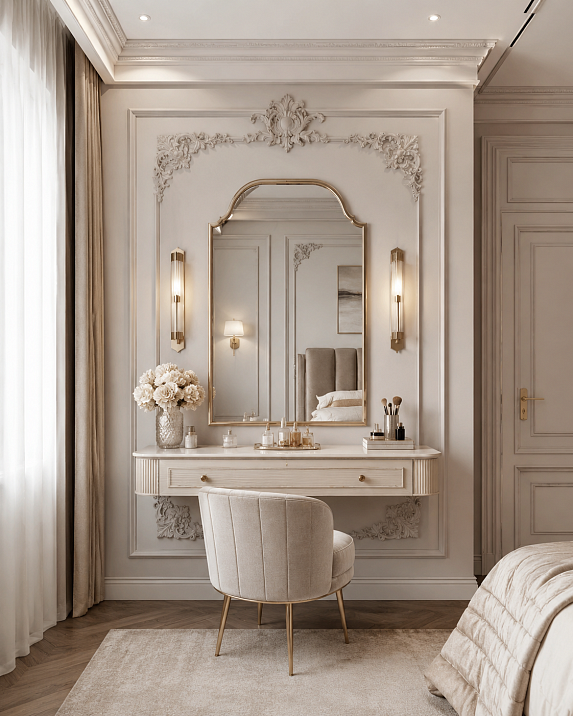
There is such a concept — a "zone within a zone." A vanity table in the bedroom or dressing room is exactly that. A small space that lives its own life: here the day begins in the morning, here you look at yourself, here you create your image. And if this space is beautifully designed, it works as a personal office, as a small theater, as an architectural statement about its owner.
But most often, the vanity table stands against a bare wall. A beautiful mirror, decent furniture, good lighting — but something is off. The area does not read as a single whole: each element exists on its own, there is no connection between them, no architectural framing.
This is exactly the problem that solves stucco for a dressing table combined with moldings, a mirror frame, and furniture decor. Three layers of design — wall, mirror, furniture — and the makeup area turns into a complete, luxurious, stylish composition.
A dressing table looks expensive when the mirror, Moldings made of polyurethane, light, and Decorative stucco are assembled into one vertical composition: the wall gets a frame, the mirror becomes the center, decorative elements provide an accent, and furniture decor supports the style of the table itself.
How this is built — in detail, with specific dimensions and a sequence of solutions — read in this article.




Why the makeup area requires separate design
A dressing table is not just a piece of furniture against a wall. It is an area with a special functional and aesthetic meaning. It needs proper lighting, a convenient mirror, and the feeling that you are in a beautiful, well-thought-out space — not in a random corner.
Our factory also produces:




Three reasons why the area looks unfinished
Reason one: a wall without a frame. The table stands against the wall, the mirror hangs, but there is no architectural connection between them and the wall. Moldings behind the vanity table create a vertical frame that "holds" the entire area.
Reason two: a mirror without a frame. A mirror sheet glued to the wall or simply hung is a technical solution, not a decorative one. mirror frame or a molding frame turns the mirror into the central element of the composition.
Reason three: furniture without decor. A simple table with flat fronts and cheap handles reduces the overall impression even with a beautiful wall. decor for furniture and new Furniture Handles elevate the table's level to match the decorated wall.
Get Consultation
The correct sequence of decoration
The order of decisions determines the result:
-
The width of the area is determined (equal to the width of the table + 30–60 cm on each side).
-
A molding frame or a vertical system of moldings is built on the wall.
-
A mirror is integrated into the system — with a frame or in a molding frame.
-
Sconces or lighting are added symmetrically.
-
In key points — one or two decorative accents from decorative molding.
-
The table itself is updated: overlays on the facades, moldings on the drawers, new handles.
Moldings on the wall behind the vanity table: building a frame
Moldings made of polyurethane on the wall behind the vanity table is the first and main step. They create an architectural "scene" for the entire area.
Vertical frame: from the horizontal belt to the cornice
The most common solution is a vertical molding frame from a horizontal belt at a height of 85–95 cm (table surface level) to the cornice or to a height of 220–240 cm.
Parameters:
-
Frame width: table width + 30–50 cm on each side. For a 90 cm table → frame 150–190 cm wide.
-
Frame height: from the belt or from the baseboard to the cornice — 130–160 cm of clean vertical area.
-
Molding: 25–40 mm, profile matching the interior style.
A horizontal band at a height of 85–95 cm creates the lower horizontal line of the frame. It runs across the entire width of the wall — not just in the table area. This "ties" the zone to the rest of the wall.
Frame from floor to ceiling: a "portal" solution
For dressing rooms with high ceilings and spacious bedrooms — a molding frame from the baseboard to the cornice. Width: table width + 40–70 cm on each side.
Inside the frame: lower zone (table), upper zone (mirror, sconces, decor). A horizontal molding band divides them.
Moldings around the mirror: framing without a separate frame
If the mirror has no ready-made frame — molding framing directly on the wall. The molding is installed around the mirror's perimeter with a 5–10 mm gap from its edge.
Molding width for mirror framing: 25–40 mm. The same profile as the main zone frame. A single profile for all molding elements is mandatory.
Moldings on the sides of sconces: architectural "pilasters"
Vertical moldings on the sides of the mirror — from the horizontal band to the top horizontal of the frame — create "pilasters" that hold the mirror as if in an architectural portal.
If the sconces are located on the sides of the mirror, they are mounted on these vertical moldings or in the area between the moldings and the mirror.
Choosing a molding for the vanity area: parameters
| Zone style | Molding profile | Width | Projection |
|---|---|---|---|
| Classic, neoclassic | S-shaped, multi-level | 30–45 mm | 14–22 mm |
| Modern neoclassicism | Rectangular with bevel | 25–35 mm | 10–16 mm |
| Provence, romance | Classic with rounded edges | 28–40 mm | 12–18 mm |
| Art Deco, glamour | Stepped rectangular | 30–45 mm | 15–20 mm |
| Scandinavian | Narrow rectangular | 18–28 mm | 8–12 mm |
Mirror and frame: the heart of the makeup zone
The mirror in the makeup zone plays a dual role: functional (working with reflection) and decorative (visual center of the entire zone). It should be the right size, the right height, and properly framed.
Mirror size: proportions relative to the vanity
Basic rule: the mirror is not wider than the vanity. Optimal is 70–90% of the vanity width.
| Table width | Mirror width | Mirror height |
|---|---|---|
| 60 см | 42–54 cm | 70–90 cm |
| 80 см | 56–72 cm | 80–100 cm |
| 100 см | 70–90 cm | 90–120 cm |
| 120 см | 84–108 cm | 100–130 cm |
Mirror height: lower edge at 90–100 cm from the floor (5–15 cm above the table surface), upper edge at 170–200 cm. This is a working range convenient for both sitting and standing.
Wooden mirror frame: a warm accent in the area
mirror frame made of natural wood — this is a tactile material signal of quality. In the makeup area, where everything should be pleasant to look at and touch, a wooden frame creates a feeling of a luxurious, lived-in space.
The wooden frame can be:
-
In natural wood color — as a "warm" accent in a monochrome area.
-
Painted to match the molding color — monochrome for the entire area.
-
Patina-finished — gold, silver, bronze — for a classic or glamorous style.
The frame width should match the molding width: approximately 0.8–1.2 times the molding width. A 15 mm frame with 40 mm moldings is a scale mismatch that is immediately noticeable.
When the mirror is frameless: a clean solution
A frameless mirror set into a molding frame on the wall is a concise modern technique. The mirror sheet is mounted with adhesive or clips, with molding around its perimeter. No additional frame.
This solution is suitable for minimalist, Scandinavian, or strictly modern interiors where a wooden frame would be too "warm" a detail.
Decorative stucco in the vanity area: four options
Decorative stucco for the makeup area — this is a point accent. One or two elements at key points create the "climax" of the architectural molding system.
Position one: above the mirror
A decorative element along the central axis of the mirror, slightly above its top edge or the top molding of the frame. This is the "header" of the entire zone.
Type: floral medallion, cartouche, horizontal ornamental band. Size: 120–200 mm horizontally.
Distance from the top molding of the frame to the decorative element: 5–15 cm.
This technique enhances the vertical axis: the gaze rises from the table up, passes through the mirror, and meets the decorative accent.
Position two: "keystone" of the top frame
A decorative overlay in the center of the top horizontal molding of the frame — directly on the molding. Size: 80–150 mm. This is the architectural center of the upper boundary of the zone.
Buy Moldings for this position means choosing a flat element with low relief that does not conflict with the molding profile.
Position three: corner inserts in the frame
Decorative corner inserts in the two top or all four corners of the molding frame — from the category Polyurethane wall decorThey conceal the corner joints of the molding and add decorative accents at four points of the system.
Size of corner inserts: 50–90 mm. Style: floral for classic, geometric for neoclassical.
Position four: paired side elements
Symmetrical decorative overlays on the sides of the mirror — on vertical moldings or on the wall next to them — at the level of the mirror's center. They create a "frame from within" for the mirror.
Size: 70–110 mm each. Strict symmetry: same height from the floor, same distance from the mirror axis.
Sconces in the vanity area: light and architecture
Proper lighting in the makeup area is not just "good visibility." It is an architectural element that works in a system with moldings and stucco.
Side sconces: professional option
Two sconces on the sides of the mirror are a professional standard. Side light illuminates the face evenly, without shadows from eyebrows and nose.
Installation parameters:
-
Center height of sconces: 150–165 cm from the floor. When working while seated — slightly lower, 140–155 cm.
-
Distance from the edge of the mirror to the center of the sconce: 15–25 cm.
-
Strict symmetry: same height for both sconces, same distance from the mirror.
Decorative design of the sconce mounting point
The mounting point of the sconce is finished in one of three ways:
-
Decorative plate 80–120 mm under the base of the fixture.
-
Molding frame 25×35 cm around the mounting point.
-
Rosette from the category Buy molding — small, 150–200 mm in diameter, as a wall element.
Mirror with perimeter lighting
An alternative option is a mirror with built-in LED perimeter lighting. In this case, side sconces are not needed. A molding frame is installed around such a mirror — the LED strip remains visible from behind the edge of the mirror, and the molding creates an external architectural frame.
Updating the table itself: furniture decor as the third layer
A beautiful wall, a beautiful mirror — and a plain boring table. That's a mismatch. The third layer of zone design is the decor of the furniture itself.
Moldings on the table drawers
If the vanity table has drawers with flat fronts — each drawer gets a molding frame. This is a technique from article No. 91 about dressers: Moldings for furniture create frames on the flat front that visually elevate the furniture's level.
Molding width for table drawers: 10–18 mm (furniture scale, not wall scale). Profile: the same as on wall moldings — unity of style.
Decorative overlays on fronts
decor for furniture — wooden carved appliqués — mounted on the central drawer or on the side fronts of the table. One element on the central drawer — accent, emphasizing the axis.
Size of furniture appliqués for the vanity table: 40–80 mm. Floral ornament for classic and Provence, geometric — for neoclassical and Art Deco.
Furniture handles: the final touch
Furniture Handles — this is a detail that instantly reads as a quality indicator. Wooden handles made of natural wood in the vanity table area — this is a tactile and visual signal that 'everything is thought out here'.
Handle selection:
-
Arched bracket — for the classic makeup area.
-
Round "button" — for Provence and romantic style.
-
Horizontal rectangular — for Scandinavian and minimalist interior.
-
Figural with floral relief — for Baroque and rich classic style.
Uncoated wooden handles can be painted to match the exact color of the table — a monochrome solution where the handles "dissolve" into the overall color scheme. Coated wooden handles provide a warm natural accent.
Three design options for the vanity table area
Option "Romantic Classic"
For a feminine interior with soft tones, floral decor, and a sense of coziness.
Wall:
-
Moldings made of polyurethane 30–35 mm, classic S-shaped profile.
-
Horizontal molding belt 25 mm at a height of 90 cm.
-
Floral medallion 160–180 mm above the mirror.
-
Corner inserts in the four corners of the frame.
Mirror:
-
Frame made of natural wood with a classic profile, white or with patina.
Table:
-
decor for furniture — floral overlay on the central drawer.
-
Furniture Handles — arched or with floral ornament.
Painting: all white or in a soft pink/cream tone. The mirror frame is in natural wood.
Effect: lightness, femininity, a 'boudoir' feel.
Modern Neoclassical Option
For a strict, elegant interior with a monochrome color scheme.
Wall:
-
Buy polyurethane moldings 28–32 mm, rectangular profile with a bevel.
-
One geometric medallion 140–160 mm above the mirror.
Mirror:
-
Without a frame, in a 25 mm molding surround.
Table:
-
Molding frames on drawers 12–15 mm.
-
Minimalist wooden handles without coating, painted in the color of the table.
Painting: monochrome — everything in a single color (white, light gray, dusty blue).
Effect: architectural purity, expensive minimalism.
Glamour and Art Deco Option
For a bright, distinctive makeup area in Hollywood glamour style.
Wall:
-
Moldings 35–45 mm, stepped rectangular profile.
-
Double frame — outer + inner with a field between them.
-
Cartouche above the mirror 180–220 mm.
Mirror:
-
mirror frame with gold or silver plating.
-
Or a mirror with built-in LED lighting.
Table:
-
decor for furniture — geometric overlays on the facades.
-
Figurative handles with relief made of furniture handles.
Painting: wall in a dark tone (anthracite, dark blue, bottle green), moldings in white or cream.
Effect: theatricality, luxury, strong feminine energy.
Dressing table in the walk-in closet: design specifics
A walk-in closet is a closed, intimate space. There are no random viewers here, but there is a need for maximum functionality and beauty 'for oneself.'
Features of designing a dressing table in a walk-in closet
-
The width of the zone is limited. A walk-in closet often has a passage width of 80–120 cm. The frame cannot be wide — usually no wider than the table width.
-
Height is important. A molding frame from the baseboard to the ceiling in a narrow space visually 'stretches' the walk-in closet.
-
The mirror is a functional accent. In a walk-in closet, the mirror works as a 'fitting mirror' — it should be tall enough for a full-length view or at least waist-high.
Stucco in the walk-in closet: delicate and precise
Buy decorative stucco for a walk-in closet means choosing one small accent above the mirror (80–130 mm), a delicate molding 20–28 mm, and a single paint color matching the wall.
A walk-in closet does not tolerate overload: one molding profile, one mirror, one decorative element.
Vanity table in a beauty salon and studio: commercial aesthetics
Stucco molding on a salon vanity table is not just decor. It's a brand. A client sitting in front of a mirror in a beautifully designed area feels a different level of service and remembers the space.
What works in a salon
-
A unified frame for the entire line of workstations. If there are several vanity tables in a row in the hall — a horizontal molding belt along the entire wall at the height of the countertop + vertical molding dividers between workstations.
-
A unified decorative element above each mirror. Identical medallions above each workstation — rhythm, system, corporate style.
-
Unified painting. Moldings, decor, wall — in the salon's corporate color.
Moldings made of polyurethane are ideal for commercial interiors: precise geometry, easy installation, painting in any corporate color.
Color and painting of the vanity table area: three working options
Monochrome: everything in one color
Moldings, decorative elements, wall — in one color. The mirror frame and handles — in the same color or as the only contrasting accent. The most modern, strict solution.
Best colors for a monochrome zone:
-
Warm white — universal, fresh.
-
Dusty pink — feminine, delicate.
-
Creamy beige — warm, cozy.
-
Light gray — architectural, neutral.
White moldings on a colored wall
Wall in a saturated color, moldings and Decorative stucco — white. Clear contrast, well-defined frame. mirror frame — in white or natural wood.
For the vanity area, this option creates a feeling of a bright, cinematic space.
Warm two-tone scheme
Lower zone (below the horizontal belt) — slightly darker. Upper zone (behind the mirror, moldings) — lighter. The molding belt is the transition boundary. A soft, cozy option for the bedroom.
Complete shopping checklist for the vanity area
| Task | What to buy |
|---|---|
| Frame on the wall | Moldings made of polyurethane 25–40 mm + 20% spare |
| Mirror design | mirror frame or molding framing |
| Decorative accent above the mirror | Buy decorative stucco — 1 medallion or cartouche |
| Corner inserts for the frame | Polyurethane wall decor — corner elements |
| Updating the table fronts | decor for furniture — drawer overlays |
| New table handles | Furniture Handles — wooden, matching the zone style |
| Mounting material | Glue + acrylic sealant |
| Finish | Primer + acrylic paint |
| full set | Buy molding + frame + furniture decor + handles |
Installing moldings in the vanity area: step by step
Step one: marking from the central axis
The central axis of the mirror and table is the starting point for all markings. From it — equal distances to the vertical sides of the frame. Horizontals — by level. Symmetry is mandatory.
Step two: cutting the molding
Frame corners — 45°. Miter saw or miter box with a metal stop. Each corner — first dry-fit.
Trimming allowance: 20% of the calculated length.
Step three: installation and fixation
Apply mounting adhesive in a zigzag pattern across the entire back side. Press along the markings, secure with tape for 1.5–2 hours. For joints: use acrylic sealant, smooth out, let dry, sand with 320 grit.
Step four: installation of decorative elements
Using the same technique. Central axis — marking. Decorative element — strictly along the axis. Test dry before applying adhesive.
Step five: table decor
Sand the fronts with 180–240 grit sandpaper. Degrease. Glue furniture overlays with PVA glue. Drill holes for new handles. Prime all furniture, paint.
Step six: painting the area
Prime all system elements. Let dry. Apply two thin coats of acrylic paint — check joints under side lighting after the first coat.
Frequently asked questions
How to decorate the wall behind the vanity table?
polyurethane moldings for a vertical zone frame, buy decorative molding above the mirror, frame for mirror or with molding framing. Everything in a single paint color.
What to buy for the makeup zone?
Moldings made of polyurethane with a 20% margin, one decorative element from stucco decoration, mirror frame, decor for furniture, Furniture Handles, glue, sealant, primer, paint.
Can molding be used in a walk-in closet?
Yes. A delicate Molding 20–28 mm around the perimeter of the vanity area, one small decorative accent above the mirror, monochrome paint. Without overload.
How not to overload the vanity with decor?
One molding frame, one mirror with a frame or in molding framing, one decorative element above the mirror. The table — overlays on the central drawer and new handles. Do not add more than two decorative points to the entire zone.
Are sconces needed in the vanity area?
Preferably. Side sconces are the professional lighting standard for the makeup area. They illuminate the face evenly. They are mounted symmetrically at a height of 150–165 cm, at a distance of 15–25 cm from the edge of the mirror.
How to choose handles for a vanity table?
By zone style: arched brackets for classic, round knobs for Provence, rectangular horizontal handles for neoclassical. Wooden Furniture Handles without coating are painted in the color of the table — a monochrome solution.
STAVROS: a complete set for a beautiful makeup area
The vanity area is a personal space. It should be beautiful, well-thought-out, and inspiring. And it is here that every detail matters: molding, frame, drawer front, handle.
STAVROS offers everything needed to design the vanity area in a unified system: Moldings made of polyurethane — a wide selection of profiles for wall frames and mirror trims, buy decorative moldings — medallions, cartouches, floral and geometric overlays, Mirror Frames made of natural wood to suit any style, decor for furniture — wooden overlays for updating table facades, Furniture Handles made of natural wood with and without coating, Polyurethane wall decor for horizontal borders and corner inserts.
Buy molding a set for the vanity area means getting a coordinated system of moldings, decor, and furniture parts that work together.
STAVROS. Delivery across Russia. Pickup in Moscow and St. Petersburg.
The makeup area deserves to be beautiful. Make it so.