Article Contents:
- Деревянный молдинг MLD-054 47×18: что реально можно купить в карточке
- Деревянные молдинги для мебели под эмаль: сначала определить, будет ли вообще видна древесина
- MLD-054 из МДФ: рациональный вариант, когда поверхность полностью окрашивается
- Буковый MLD-054: когда нужен именно массив, но дубовая текстура не обязательна
- Дубовый MLD-054: когда дорогой материал действительно имеет смысл
- Сравнение цены справедливее делать не только по планке, но и по метру
- Ширина 47 мм: материал выбирать рано, если сам профиль ещё не проверен на фасаде
- 18 мм по высоте профиля: зачем смотреть боковой вид фасада
- 2600 mm for MDF and 2400 mm for solid wood: length is a secondary criterion for material selection
- Non-standard MLD-054 500–6000 mm: when it is useful
- Packaging frame 390 ₽: include in the estimate, but do not base material choice on it
- Quarter cut selection for MLD-054: a separate option, not related to the question of 'oak or MDF'
- What to check in the MLD-054 order before payment
- How to coordinate MLD-054 with baseboard and trim without turning the article into a full room renovation
- When MDF truly deserves to be placed first on the list
- When to choose beech
- When oak is truly justified
- One painted sample of MLD-054 before the main batch: how to see whether oak has visual meaning
- What changes if the furniture needs to be repainted or the wood revealed after a few years
- Decision matrix: which MLD-054 material to check first
- The “oak is already specified by the designer, so it can’t be changed” error: what to clarify before payment
- When not to buy MLD-054 yet
- Which MLD-054 to order in three typical scenarios
- Questions before ordering MLD-054
- What is the cross-section of MLD-054?
- What is the standard length of MDF?
- What is the length of beech and oak?
- How much does MDF MLD-054 cost?
- How much does beech cost?
- How much does oak cost?
- What sanding options are available?
- What does "Under enamel" mean for MDF?
- Is there any point in choosing oak under white enamel?
- When is beech more logical than oak?
- Can I order MLD-054 longer than 2600 mm?
- Do I need to pay for packaging?
- Is there a rabbet (rebate) option?
- What is more important to choose first — material or length?
- What should be the last thing to check before payment?
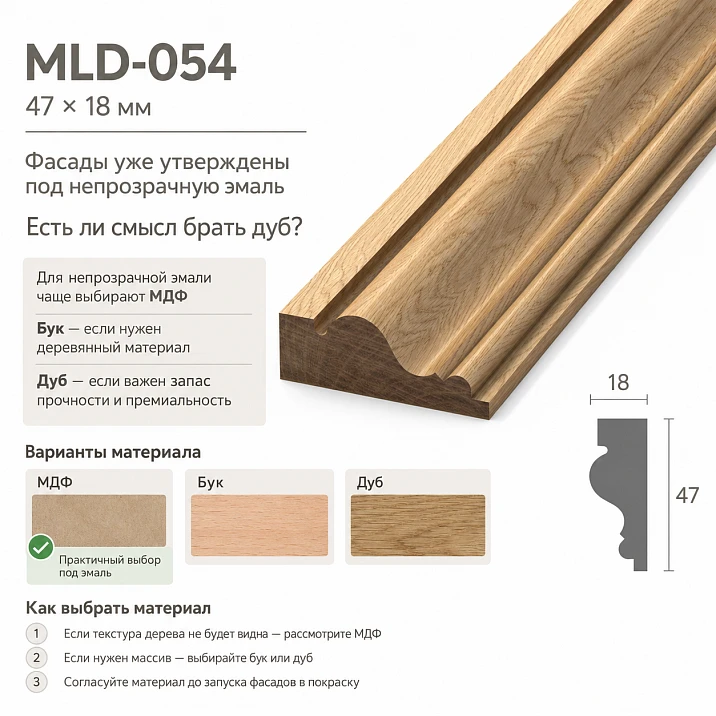
The facades are already designed, the MLD-054 profile is selected by pattern and width of 47 mm, and the finish is finally approved: opaque enamel. At this stage, three material options remain in the card — MDF, beech, and oak — with noticeably different prices. A normal buyer's question arises: if the natural texture will still be covered after painting, what exactly are you paying for when moving from MDF to beech and especially to oak?
For such a project, a universal answer like "wood is always better" cannot be given. For MLD-054, MDF is directly presented as an option under enamel; beech and oak are solid wood versions. If the task comes down to a smooth painted profile and the project does not require solid wood as a material, MDF should be considered first. If solid wood is fundamentally needed — for example, all the surrounding furniture trim is already wooden, the possibility of a different future finish is important, or the client's specification requires it — then beech and oak are compared. And oak makes the most sense where its own texture and grain actually work in the design, rather than being hidden under opaque enamel.
As of September 8, 2026, the card shows: MDF 47×18×2600 mm — 1,230 ₽; beech 47×18×2400 mm — 2,900 ₽; oak 47×18×2400 mm — 4,320 ₽. All three versions come in "Prestige." Non-standard lengths can be ordered from 500 to 6000 mm. Therefore, it is reasonable to decide on the material before calculating the final batch: the three options differ not only in price and material nature, but also in standard length.
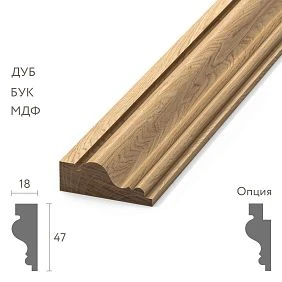
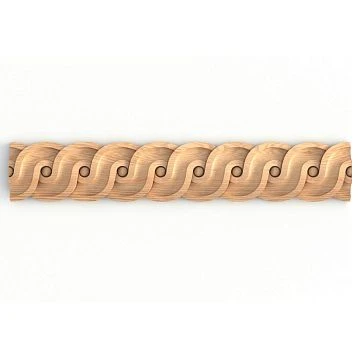
Wooden molding MLD-054 47×18: what you can actually buy in the card
MLD-054 has one cross-section — 47 × 18 mm. The main commercial versions differ in material and standard length.
| Material | Size A × C × L | Sanding | Price as of 08.09.2026 | Availability in St. Petersburg at the time of check |
|---|---|---|---|---|
| MDF | 47 × 18 × 2600 mm | Prestige | 1 230 ₽ | 140 pcs. |
| Beech | 47 × 18 × 2400 mm | Prestige | 2 900 ₽ | 158 pcs. |
| Oak | 47 × 18 × 2400 mm | Prestige | 4 320 ₽ | 15 pcs. |
For the selected MDF configuration in the card, the lamination quality "Under enamel" is specified. If in stock, the product is shipped after warehouse preparation, and if not, the average production time for custom orders is stated as 5–10 days.
If the profile is already agreed upon in shape, buy wooden molding MLD-054 47×18 better only after fixing the material and finish. The article number MLD-054 itself does not answer whether it will be MDF, beech, or oak.




Wooden moldings for furniture under enamel: first determine whether the wood will be visible at all
Before comparing materials, ask one question: what will a person see after the final finish?
If MLD-054 is coated with dense white, gray, graphite, green, or another opaque enamel, the natural color and grain of the wood cease to be the primary visual characteristic. Then choosing oak cannot be explained only by the beauty of the oak texture — it will not work as it would under a clear lacquer or stain.
If the finish is clear, semi-transparent, tinted, or assumes preserving a readable wood surface, the species becomes part of the appearance.
For an already approved opaque enamel, the following sequence is useful:
- does the project need solid wood as a material regardless of appearance;
- if yes — is beech sufficient;
- if there is no requirement for solid wood — is MDF suitable in terms of construction and finishing technology;
- only after this compare the cost.
That is exactly how it should be done Buy wooden moldings for furniture: do not automatically choose the most expensive wood species, but link the material to the actual finish.
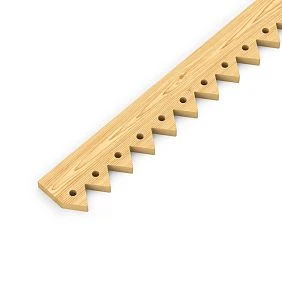
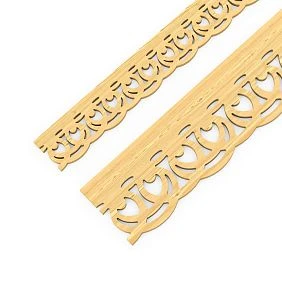
Our factory also produces:
MLD-054 made of MDF: a rational option when the surface is fully painted
The MLD-054 card directly describes MDF as a solution for modern enamel projects. In the current product line, this is 47 × 18 × 2600 mm, Prestige, For enamel, 1,230 ₽.
In the specific scenario of the article, MDF has a clear advantage: the buyer does not pay for more expensive solid wood for the sake of a wood grain pattern that will later be completely covered anyway.
But this does not mean that MDF is better than wood in general. MDF is a separate material with its own processing and finishing technology. It is only suitable when the furniture construction, installation, and customer requirements allow its use.
For a painted furniture facade, the solution looks rational if the following conditions are met simultaneously:
- the 47×18 profile fits the geometry;
- the surface will be fully opaque;
- the project has no requirement for "solid wood only";
- the material of adjacent parts does not require specifically a wooden blank;
- the finisher works with MDF and has an approved system of primer and enamel.
With such an initial task, switching to beech or oak should have a separate explanation, not happen "just in case."
Get Consultation
Beech MLD-054: when solid wood is specifically needed, but oak texture is not required
Beech is an intermediate logic between MDF and more expensive oak. It is already a solid wood part, but in the current MLD-054 it costs 2,900 ₽ per 2400 mm, not 4,320 ₽ like oak.
Beech should be considered when the designer or client explicitly requires solid wood, but after painting, the oak grain pattern is not specifically needed.
The reasons can be different:
- all furniture framing is made of solid wood;
- there is a technological requirement from the workshop;
- the project provides for further restoration or changes to the finish;
- adjacent parts are already beech;
- the contract specifies solid wood timber moldings.
If these reasons are absent and the entire surface will be covered with dense enamel, it is useful for the buyer to ask themselves again what exactly the transition from MDF to beech provides.
When you need buy wooden molding for furniture being solid wood, beech often becomes the first option for comparison with oak, rather than an automatic second place after it.
Oak MLD-054: when expensive material really makes sense
The oak plank MLD-054 currently costs 4,320 ₽ per 2400 mm. This is 1,420 ₽ more expensive than beech and 3,090 ₽ more expensive than one standard MDF plank, although the standard lengths of MDF and solid wood differ.
Oak makes the most sense in three cases.
The first is when the texture remains visible. Then oak is chosen not only as a structural material, but also as part of the finish pattern.
The second is when MLD-054 must match the wood species of other exposed oak parts: the facade frame, cornice, baseboard, casing, or furniture plinth.
The third is when the project or contract explicitly requires solid oak regardless of the future color.
If the molding is completely covered with white enamel and there is no exposed oak nearby, the phrase "let's take oak because it's more expensive and therefore better" is not a technical justification.
It is fairer to compare the price not only per strip, but also per meter.
Standard lengths differ: MDF — 2600 mm, beech and oak — 2400 mm. Therefore, a simple comparison of 1,230 / 2,900 / 4,320 ₽ slightly distorts the picture.
Conditional price per nominal meter:
| Material | Plank price | Length | Conditionally per 1 m |
|---|---|---|---|
| MDF | 1 230 ₽ | 2.6 m | ≈473 ₽/m |
| Beech | 2 900 ₽ | 2.4 m | ≈1,208 ₽/m |
| Oak | 4 320 ₽ | 2.4 m | 1,800 ₽/m |
This is not a retail price for a "meter cut," but an analytical recalculation of standard products.
It shows that beech costs about 2.55 times more than MDF per nominal meter, and oak about 3.8 times more. Therefore, with a solid opaque enamel, the question "what exactly am I getting for the surcharge?" becomes especially practical.
Width 47 mm: it's too early to choose the material if the profile itself hasn't been tested on the facade yet.
Before arguing MDF versus oak, you need to make sure that MLD-054 is suitable in scale at all.
47 mm is a noticeable width for a furniture frame or decorative strip. On a small facade, it can take up a significant part of the surface; on a large one, it will look calmer.
The easiest way is to cut out a paper strip 47 mm wide and apply it to the drawing or the actual facade. Check:
- the indent to the handle;
- the distance to the panel or other relief;
- the proximity to the cornice;
- the hinge and fastening zone;
- the symmetry of the frame;
- the free field between two parallel moldings.
Don't invent universal indents. If 47 mm look heavy on a specific facade after marking, choosing expensive oak won't fix the erroneous geometry.
18 mm in profile height: why you should look at the side view of the facade
C=18 mm affects the relief, not just the number in the card.
If MLD-054 is placed next to a handle, adjacent profile, cornice, or protruding frame, frontal visualization is not enough. A side section is needed.
On it, you check how much the profile protrudes from the facade plane, whether it conflicts with the opening of an adjacent door, and whether it creates an undesirable transition next to another overlay part.
This is equally important for MDF, beech, and oak: the material does not change the published section of 47×18.
2600 mm for MDF and 2400 mm for solid wood: length is a secondary condition for material selection
Standard MLD-054 MDF is 200 mm longer than solid wood.
This is important if the project contains long continuous sections. But the article does not reduce material selection to the number of strips: first, the finish and material issue is resolved, then length logistics.
For example, if one decorative line is 2480 mm, standard MDF of 2600 mm theoretically covers it with one piece, while standard solid wood of 2400 mm does not. But this does not mean you should choose MDF only for length: the project may require solid wood or a custom order.
For such cases, the card allows manufacturing MLD-054 from 500 to 6000 mm.
That is, the standard length is not a rigid product limit, but a base warehouse configuration.
Non-standard MLD-054 500–6000 mm: when it is useful
Non-standard length makes sense if the material is already selected and a specific project node needs to be resolved.
For example:
- avoid an unwanted joint on a long front line;
- obtain short parts without excess waste;
- synchronize several identical furniture elements;
- prepare the length for a serial project.
But non-standard cannot be ordered on the principle of "make it 4870 mm so we don't have to think later." First, you need the size of the finished part, the installation method, the transport route, and the manufacturer's confirmation.
The card warns that an individual length increases the delivery time. For a very long rod, the entry, packaging, and transportation are checked separately.
Packaging frame 390 ₽: include in the estimate, but do not base material selection on it
For MLD-054, the card currently indicates a rigid packaging frame at 390 ₽ for safe transportation. The norm applies to small batches: up to 2 pcs. for solid wood, up to 9 pcs. for MDF.
This is an actual invoice line, but it should not determine whether to buy MDF or oak.
390 ₽ is significantly less than the difference between the materials themselves. For example, switching from one standard beech plank to an oak one increases the price by 1,420 ₽.
Therefore, packaging is included in the budget after material selection, not the other way around.
Quarter sampling for MLD-054: a separate option, not related to the question of "oak or MDF"
The card also offers quarter sampling per technical specification for orders from 100 pcs. The service cost is 185 ₽ per item.
For a typical single furniture project, this parameter may not be needed at all.
The main thing is not to mix different decisions:
material answers the question of what MLD-054 is made from;
a quarter — to the question of what additional processing a specific project needs.
If there is no technical specification for sampling, you should not add it just because the option is present in the card.
What to check in order MLD-054 before payment
The working order line should be specific:
MLD-054 / 47 × 18 mm / MDF, beech or oak / Prestige / standard or agreed non-standard length / quantity.
For MDF:
47 × 18 × 2600 mm / MDF / Prestige / For enamel.
For solid wood:
47 × 18 × 2400 mm / beech or oak / Prestige / selected finish specification.
Before payment, check:
- the material;
- actual length;
- quantity;
- the current price;
- availability;
- applicability of the packaging frame;
- delivery;
- non-standard size, if ordered;
- additional processing only if technical specifications are available.
Warehouse stock is a dynamic parameter, so the availability figures from the article cannot be carried over to a future order without re-checking the product card.
How to coordinate MLD-054 with a plinth and architrave without turning the article into a full room renovation
If the furniture is in the same visual zone as the door and floor trim, it is useful to compare the material and finish before painting.
For example, if the furniture MLD-054 is completely white, and an open oak plinth remains nearby, the oak molding on the facade after dense enamel will not necessarily create a visible connection with the plinth. Externally, the connection will be formed by color and profile, not by the wood species under the coating.
If part of the molding is tinted and the texture remains open, the match of the wood species becomes more noticeable.
For such a check, you can separately buy a wooden baseboard from the profile section and compare its material with the furniture.
The logic for doorways is the same: Wooden casings are selected as a separate system, and MLD-054 does not have to match their wood species if the entire furniture profile is hidden by opaque enamel.
When MDF really deserves to be put first on the list
MLD-054 made of MDF is the first candidate if all the following conditions are met simultaneously:
- facades are already approved for matte enamel;
- the wood texture should not be visible;
- the project does not require solid wood;
- the length of 2600 mm is suitable or the required non-standard length is available;
- the workshop confidently works with MDF under the chosen coating system;
- adjacent visible parts do not require the same wood species.
In this scenario, more expensive beech or oak must have a specific design justification.
When to choose beech
Beech is worth choosing if you need solid wood specifically, but there is no task to show oak texture.
This may be related to the furniture construction, the workshop's internal standard, matching other beech parts, or the future possibility of changing the finish character.
With solid enamel, beech provides a solid base without the maximum oak price.
When oak is truly justified
Oak is logical if its wood species remains part of the result.
For example:
- clear varnish;
- stain or tinting;
- partially open texture;
- adjacent oak elements remain visible;
- oak solid wood is required in the contract;
- The project is built around a specific oak veneer.
If all of this is absent and 47×18 MLD-054 will be finished with white enamel, oak cannot be considered a mandatory choice just because it is the most expensive.
One painted sample of MLD-054 before the main batch: how to see whether oak has visual relevance
If the dispute between MDF, beech, and oak is specifically about the appearance after enameling, the most useful experiment is not to discuss the material abstractly, but to make a control sample in the actual finishing system.
Take one short fragment or one test piece from the material in question, apply the same primer and the same opaque enamel that will be used on the facade, and look at the result next to a finished door sample.
What needs to be checked is not "which wood is prettier before painting," but something else:
- whether the texture is readable after the finish;
- whether the surface differs visually under raking light;
- whether the client cares about the nature of the material itself if the eye can no longer see it;
- whether the molding matches adjacent painted parts;
- Is the surcharge justified specifically in this finish?
If, after the approved enamel, three materials look the same to the client, the choice becomes a constructive and contractual matter, not a decorative one. If oak still provides the desired grain pattern under the chosen semi-transparent system, then the finish is actually no longer an "opaque enamel," and the decision should be reconsidered as a separate scenario.
Such a test is especially useful for expensive furniture: it turns the dispute "oak is more solid" into a verifiable decision.
What will change if the furniture is later repainted or the wood is exposed after a few years?
Sometimes solid wood is chosen not for its current appearance, but for future renovation. Here, two different scenarios need to be distinguished.
Repeated opaque painting.
If, after a few years, the furniture is simply repainted in another opaque color, the oak texture itself may again not become a visual advantage. In such a case, future repainting is not a sufficient argument for oak by itself.
Transition to a transparent or semi-transparent finish.
This is a completely different task. For solid wood, there is a potential opportunity to show the real wood, but it cannot be promised in advance that a part after years of enamel finish will easily turn into a perfect transparent oak molding. The removal of the coating, the condition of the surface, and traces of previous treatment are assessed on a case-by-case basis.
Therefore, the phrase "we'll take oak and later expose the wood" should be a technical decision of the workshop, not a beautiful assumption at the time of purchase.
Decision matrix: which MLD-054 material to check first
For already approved facades under enamel, it is convenient to reduce the choice to a single table.
| Project conditions | What to check first |
|---|---|
| Opaque enamel, solid wood not required | MDF |
| Opaque enamel, solid wood specifically required | Beech |
| Oak solid wood required per specification | Oak |
| Texture must remain visible | Beech/oak per finish sample |
| Open oak parts are nearby | Oak and finish compatibility |
| The main goal is to minimize cost with opaque enamel | MDF when allowed by the design |
This is not a material rating or a universal recommendation. The table shows the order of checks to avoid starting the selection with the most expensive option.
After selection, the material still undergoes three separate checks: geometry 47×18, required length, and installation technology.
The mistake "oak is already specified by the designer, so it cannot be changed": what to clarify before payment
The word "oak" in a visualization or preliminary estimate can mean different things.
Sometimes the designer has indeed specified a specific material, and changing it would violate the author's specification. In another project, "oak" is recorded as a working label for color or general finish character, and the final surface will still be fully opaque.
Before payment, you need to clarify what exactly is recorded:
oak as a mandatory material;
oak as a desired texture;
oak as a preliminary option before choosing enamel.
If the first — the material is not changed without approval. If the second — with opaque enamel, it is worth checking whether this texture will be visible at all. If the third — MDF and beech can be compared as real alternatives.
One short question to the designer before ordering is cheaper than replacing an already purchased batch of MLD-054.
When not to buy MLD-054 yet
It is better to postpone the purchase if:
- width of 47 mm has not yet been checked on the facade;
- the finish may change from enamel to a transparent coating;
- the client says "I want wood" but does not specify whether solid wood is needed;
- non-standard length chosen without checking delivery and installation;
- the material of adjacent parts has not yet been approved;
- in the estimate, MLD-054 is recorded without material and length.
It is especially dangerous to first buy oak, and then finally approve an opaque enamel only because "it was already ordered." The material and finish must confirm each other before payment.
Which MLD-054 to order in three typical scenarios
Facades are fully under opaque enamel, no requirement for solid wood.
First consider MDF 47×18×2600 mm.
Enamel is opaque, but the project requires solid wood.
Compare beech 47×18×2400 mm with oak and check whether there is a reason to pay specifically for oak.
The texture should remain visible fully or partially.
Then the wood species becomes part of the design: beech and oak are chosen based on a real finish sample, not just by price.
After that, you can proceed to the MLD-054 card and specify the exact configuration, and if the profile is not yet final — buy wooden moldings from the general section and compare other cross-sections.
Questions before ordering MLD-054
What is the cross-section of MLD-054?
47 × 18 mm.
What is the standard length of MDF?
2600 mm.
What is the length of beech and oak?
Standard solid version — 2400 mm.
How much does MDF MLD-054 cost?
1,230 ₽ as of September 8, 2026.
How much does beech cost?
2,900 ₽ per standard 2400 mm plank.
How much does oak cost?
4,320 ₽ for the standard 2400 mm strip.
What sanding is available?
In the current trade table — "Prestige."
What does "Under enamel" mean for MDF?
This is a workpiece configuration designed for opaque finishing; it does not mean the molding is already painted.
Is there any point in choosing oak under white enamel?
Only if the project has a specific requirement for oak solid wood. If the texture is completely covered and no one requires solid wood, it's worth comparing MDF and beech before paying extra for oak.
When is beech more logical than oak?
When solid wood is needed, but oak texture and species are not an independent value of the project.
Can I order MLD-054 longer than 2600 mm?
Yes. The card allows custom lengths from 500 to 6000 mm on request.
Do I need to pay for packaging?
The card indicates a rigid packaging frame of 390 ₽ for small batches according to the specified standards. Actual application is verified in the invoice.
Is there a quarter sampling?
Yes, as an additional service for orders from 100 pcs.; the price at the time of checking is 185 ₽ per item.
What is more important to choose first — material or length?
First the finish and material, then the standard or non-standard length of the specific project.
What should be checked last before payment?
Article MLD-054, 47×18, material, length, "Prestige", finish, quantity, availability, packaging, and delivery.