


































Article Contents:
- Wooden frame of the dresser STL-026-14: what exactly the card confirms
- Why 1200×520×350 mm cannot be automatically converted into the size of the dresser fronts
- Example: why simply dividing 1200 mm does not give the drawer size
- The dresser frame arrives disassembled: how this changes the order of work
- The hardware kit is included, but it cannot be automatically considered a kit for drawers
- Should you first buy the wooden dresser frame or first order the fronts
- One contractor makes the entire dresser
- The frame and fronts are made by different contractors
- What is the size of STL-026-14?
- Are these the dimensions of the future facades?
- Can facades be ordered using only these three numbers?
- Is STL-026-14 delivered assembled?
- Is the hardware included?
- Is there an STL-026-14 made of beech?
- Is there one made of oak?
- What sanding is applied?
- Can it be selected for enamel or tinting?
- How much does STL-026-14 cost?
- What is the production time for custom orders?
- How is STL-026-14 different from STL-026-13?
- Where can I buy STL-026-14?
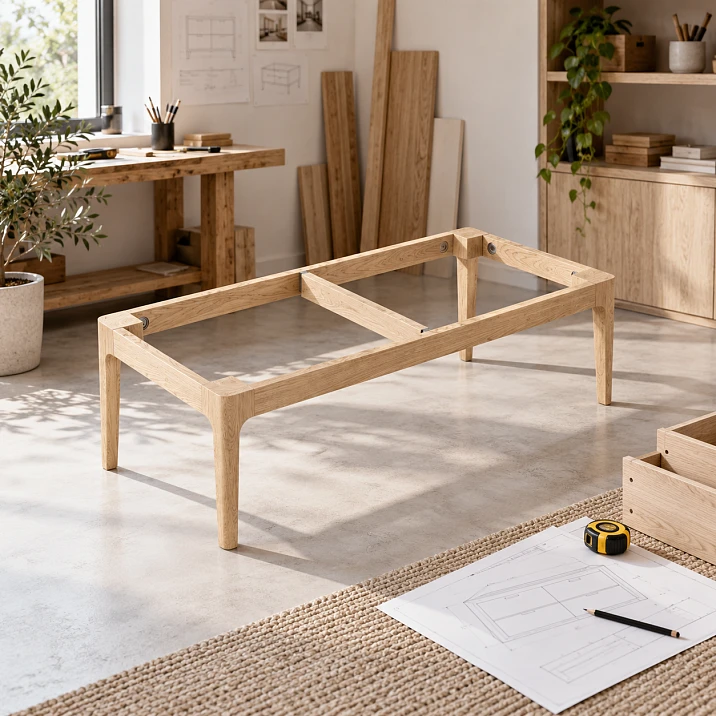
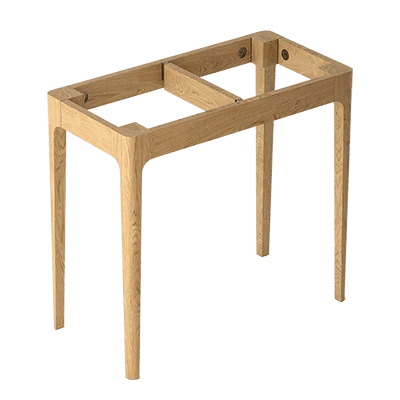
The dresser frame has already been selected, and the facade manufacturer is asking for dimensions. The STL-026-14 card has a clear number — 1200×520×350 mm. It is tempting to immediately pass these three values to the second contractor and start production of the facades, drawers, and handles.
Doing so is risky. 1200×520×350 mm is the confirmed overall dimension of STL-026-14, but it is not a ready-made table of dimensions for future facades, drawers, and technical gaps. The card does not publish individual mounting dimensions for each opening in the text section. Additionally, the frame is delivered disassembled with a set of hardware. Therefore, the external dimension cannot be automatically turned into a production task for another furniture maker.
The rational sequence is as follows: first, lock in the specific configuration of STL-026-14, obtain the current drawing, agree on assembly and the facade system, then determine the actual mounting dimensions — and only after that start producing related parts.
If the project is already linked to this model, you can Buy dresser frame STL-026-14. If the base model is still being selected, it is more convenient to first buy a solid wood dresser frame through a separate category.
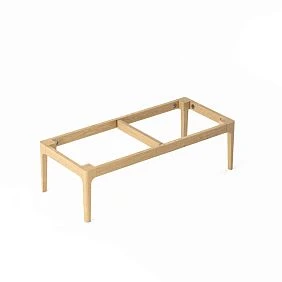
Wooden dresser frame STL-026-14: what exactly the card confirms
STL-026-14 has one published overall size:
1200×520×350 mm.
The card also confirms:
| Parameter | STL-026-14 | | --- | --- | | Product type | dresser frame | | Size | 1200×520×350 mm | | Material | beech / oak | | Sanding | Prestige | | Re-gluing | options for enamel / for tinting | | Delivery | disassembled | | Set | with a set of hardware | | Made to order | on average 5–10 days | | Shipping | across Russia |
On fresh STAVROS STL-026-14 pages, the price starts from 27,130 ₽. Before paying for a specific configuration, it is better to check the price again in the card itself: the cost depends on the selected finish.
The main thing for this article is to correctly separate the two groups of data.
The card already confirms: article number, overall dimensions, material, sanding quality, preparation option, disassembled delivery, and availability of a hardware kit.
The card does not provide a ready production task for: dimensions of each facade, depth of each drawer, gaps, guide rail layout, facade overlap, and handle positions.


Why 1200×520×350 mm cannot be automatically converted into the dimensions of dresser facades
Let's imagine that only a message was sent to the contractor:
Dresser 1200×520×350. Make the facades.
From these three numbers, he does not know:
- how many facades there should be;
- how the front part is divided;
- where the internal partitions are located;
- what gaps are provided;
- facades are overlay or have a different scheme;
- what extension system is used;
- where are the guides located;
- what is the thickness and construction of the drawer;
- where are the handles located.
Even if the overall rectangle is clear, the mounting geometry remains unknown.
Therefore, the external dimensions of the product and the facade size are different project parameters.
Our factory also produces:
Example: why simply dividing 1200 mm does not give the drawer size
Suppose the designer wants to visually divide the dresser into three equal sections.
Mathematics suggests:
1200 / 3 = 400 mm.
But this is only arithmetic division of the overall dimension.
It does not prove that each future facade should have a width of 400 mm.
In a real product, the size is affected by:
- outer posts;
- intermediate elements;
- gaps;
- method of facade overlay;
- selected hardware;
- the construction of the drawer itself.
Therefore, the number 400 mm cannot be sent to production as a "calculated facade" until a specific furniture unit is confirmed.
Get Consultation
The dresser frame arrives disassembled: what this changes in the order of work
The card directly indicates that STL-026-14 is supplied disassembled with a set of fittings.
This is an important feature specifically for a project with two contractors.
If one manufacturer buys the frame, and the second already wants to make facades, you cannot treat the box with disassembled parts as a ready-measured body.
First, you need to understand:
- how a specific frame is assembled;
- what geometry results after assembly;
- which elements form the openings;
- what dimensions the second contractor needs;
- where the boundary of responsibility between manufacturers lies.
The article does not turn this section into an assembly instruction: installation must be performed according to the documentation and the project. The order is important — do not start mating parts before the geometry is confirmed.
There is a set of fittings, but it cannot automatically be considered a set for drawers.
The phrase "with a set of fittings" can easily be misleading.
The buyer may decide:
This means that drawer slides, handles, and everything else are already included.
The card does not confirm this.
From the public description, it is reliably known only that the frame is supplied with a set of fittings. The specific composition of this set cannot be expanded by guesswork.
Therefore, before ordering, you need to clarify separately:
- what exactly is included in the delivery set of STL-026-14;
- which elements relate to the assembly of the frame itself;
- whether drawer slides are required separately;
- whether fronts are required separately;
- Are handles required separately?
Thus, the estimate is not based on the assumption that "all the hardware is already there."
First buy the wooden frame of the dresser, or first order the fronts
The decision depends on the project organization.
One contractor makes the entire dresser
If one workshop is responsible for both STL-026-14, the drawers, and the fronts, it can be given the product card and the drawing, and the internal dimensions can be coordinated within a single specification.
In this scenario, the physical delivery of the frame before all work begins is not always mandatory — if the manufacturer works according to precise documentation and takes responsibility for the joining.
The frame and the fronts are made by different contractors
Here the risk is higher.
One supplies the base, the second must fit into the actual openings.
It is more rational to first fix the STL-026-14 structure and obtain reliable mounting dimensions, rather than asking a second contractor to calculate them from the external dimensions of 1200×520×350 mm.
That is why buy a solid wood dresser frame Better as part of an agreed furniture project, rather than as a separate beautiful element without working documentation.
Is it necessary to wait for the physical assembly of STL-026-14?
Not always.
There are two safe paths.
Path 1 — based on the current working drawing. If the manufacturer or designer has sufficient documentation to determine the mounting dimensions, the facades can be designed according to it.
Path 2 — based on the actually assembled frame. If exact internal dimensions are not available, it is more reliable to perform a test assembly and take real measurements.
There is only one wrong path:
external dimensions 1200×520×350 → self-invented facades.
Dry assembly of the frame: what to measure before handing over to the facade specialist
If the project requires a test assembly, after it the furniture maker needs not three external numbers, but a specific map of openings.
Usually, the work assignment includes:
- actual dimensions of each opening;
- location of vertical and horizontal elements;
- position of internal partitions;
- system of future drawers;
- selected guides;
- mounting diagram of the facade;
- design clearances;
- position of handles.
Specific values are not specified in the article because they depend on the actual structure and chosen hardware.
The useful result of assembly is not the phrase "frame 1200 mm," but a set of verified mounting dimensions.
Frame made of beech or oak: geometry first, material later
STL-026-14 is available in beech and oak.
But changing the wood species does not answer the main question of the article.
If the dimensions of the facades are not yet known, choosing oak instead of beech does not create them.
Correct order:
frame → drawing → geometry → facades → material and finish as a single system.
Material is important already at the next stage — when the appearance of the body and facades needs to be coordinated.
"For enamel" and "for tinting": this decision is related to the future facades
The card presents preparation options for enamel and for tinting.
If the future facades are made in another workshop, the finish needs to be coordinated in advance.
Otherwise, you will get a technically assembled dresser, but visually the body and facades will live separately.
Before starting production, it is useful to record:
- whether the coating will be opaque;
- whether the wood texture should remain visible;
- color;
- facade material;
- gloss level;
- control sample.
For additional verification of terms and skill levels, you can look at quality of wood products Standard and Prestige.
Why "oak frame" and "oak facade" do not yet guarantee the same color
Wood species is not a finished finish.
Two oak parts may visually differ if the following are used:
- different stains;
- different oils or varnishes;
- different levels of gloss;
- different preparation technology;
- different texture selection.
Therefore, the entry:
frame oak, fronts oak
insufficient.
A coordinated finishing specification is needed.
If a semi-transparent finish is used, a physical sample is especially useful.
Beech STL-026-14 under enamel: when such a scenario is logical
If the dresser is to have an opaque paint finish and the wood texture is not the main visual element, a beech frame under enamel can be a logical configuration.
But the article does not claim that beech is 'always better for painting'.
The decision depends on the project.
The main thing is that the facades and visible parts of the frame receive a coordinated system.
If the facade workshop paints separately, they are given not only the color code but also the finish reference.
Oak STL-026-14 for tinting: when visible wood becomes part of the project
If the project preserves visible texture, the tinting option requires even more careful synchronization.
Need to agree in advance:
- future shade;
- sample;
- degree of coating transparency;
- gloss;
- facade material;
- visual compatibility.
Facades cannot be launched "just from oak," hoping that tinting will even everything out later.
What to pass to the facade manufacturer instead of the message "dresser 1200×520×350"
A good technical specification looks something like this:
Base: STL-026-14.
Overall frame dimensions: 1200×520×350 mm.
Frame material: beech/oak.
Finish: ___
Drawing STL-026-14: attached.
Mounting dimensions of openings: attached as a separate diagram.
Drawer system: ___
Guides: ___
Facade type and gaps: ___
This is already a working furniture specification.
Why handles cannot be marked out before the facades themselves
The handle position is determined relative to the actual facade.
If the craftsman only has the overall size 1200×520×350 mm, he still does not know the final geometry of each face panel.
Correct sequence:
frame → openings → facades → handles.
If the handles are marked out in advance according to the overall rectangle of the dresser, the entire visual rhythm may shift after the facades are changed.
STL-026-14 and STL-026-13: these are two separate products
Nearby in the lineup there is Chest of drawers frame STL-026-13.
Its size:
780×500×160 mm.
This is not "STL-026-14, just reduced as desired."
It has a different article number and different geometry.
On recent pages, STAVROS STL-026-13 appears from 18,530 ₽, and STL-026-14 from 27,130 ₽.
If the project requires a different base format, the two SKUs should be compared as independent products, rather than manually scaling one drawing.
When it makes sense to open the general category of furniture frames
If the project hasn't yet reached a specific STL-026-14, it's more useful to look at a broader section and buy wooden furniture frames only after choosing the type of furniture.
The category includes various frames and under-tables.
This is better than trying to adapt STL-026-14 to a task that requires a different base.
When facades can already be sent into production
Facades can be considered ready for production if:
- the article STL-026-14 is finally selected;
- current drawing received;
- assembly diagram is clear;
- mounting dimensions are defined;
- drawer system selected;
- guides agreed upon;
- gaps approved;
- facade material chosen;
- finish of frame and facades coordinated;
- responsibility of two contractors is divided in writing.
Only after this does the phrase "launching facades" mean a controlled production stage.
If the frame has already arrived: what to check before ordering facades
Before passing measurements to the second contractor, it is useful to check:
- whether the correct article number was received;
- whether the size 1200×520×350 matches;
- does the material match;
- whether the set of fittings is present;
- whether there is any transport damage;
- whether the assembly diagram is clear;
- whether all frame elements are in place.
After a test assembly, the necessary mounting dimensions are taken.
If the facades were already launched too early
The worst strategy is to continue production just because the order has already been paid for.
If it turns out that the dimensions were taken from the overall size, you need to immediately check the drawing and stop irreversible operations if that is still possible.
Then there are two options:
- the dimensions coincidentally match the real project — after verification, production continues;
- the dimensions are not confirmed — the specification is adjusted before further processing.
The earlier the error is detected, the less rework is needed.
How to avoid desynchronization between two contractors
If the frame and facades are made by different workshops, it is useful to designate one document as the "master version" of the project.
It records:
| Parameter | Status | | --- | --- | | STL-026-14 | approved | | Size 1200×520×350 | confirmed | | Material | ___ | | Drawing | revision ___ | | Mounting dimensions | revision ___ | | Drawer system | ___ | | Guides | ___ | | Finish | ___ | | Facades | approved / not approved |
Then no one works from an old PDF or a photo from a messenger.
How to record STL-026-14 in the order
Bad:
dresser frame — 1 pc.
That is also bad:
wooden base 1200 mm.
Better:
STL-026-14 / dresser frame / 1200×520×350 mm / beech or oak / Prestige / regluing option ___ / 1 pc.
Separately:
Delivery is disassembled, hardware kit — according to the current card configuration.
This way the order can be checked line by line.
What dimensions does the facade maker need after assembling STL-026-14
After a test assembly, it is useful not to limit yourself to one measurement of the opening width. For each future facade or drawer, a separate line is created.
For example:
| Position | What needs to be confirmed | | --- | --- | | F1 | actual width and height of the opening | | F2 | actual width and height of the opening | | J1 | position of guides and working depth | | J2 | position of guides and working depth | | H1 | handle location relative to the finished facade |
Here it is fundamentally important not to substitute numbers "by analogy". Each dimension must come either from the current drawing or from the actual geometry of the assembled frame.
If the facade maker receives a table with verified positions F1, F2, J1 and J2, the probability of desynchronization is significantly lower than when reporting "dresser 1200×520×350".
External depth of 350 mm does not automatically equal the drawer depth
The same risk arises with the third dimension.
From the total depth of 350 mm, you cannot directly derive the drawer box depth.
It can be influenced by:
- the thickness of the frame elements themselves;
- the rear part of the structure;
- selected guides;
- installation clearances;
- the position of the facade;
- internal layout.
Therefore, the formula:
350 mm − a few millimeters = drawer depth
is not a working method.
First, the extension system is selected and the frame structure is checked. Only then does the actual depth of the future drawer appear.
A height of 520 mm also does not indicate how many fronts there will be.
The total height alone cannot automatically determine:
make two fronts of 260 mm each;
Or:
three fronts of approximately 173 mm each.
This is arithmetic of the overall rectangle, not furniture specification.
The actual division is influenced by the frame structure, placement of horizontal elements, chosen storage system, and design clearances.
If the designer wants three visually identical rows, this still needs to be aligned with the technical scheme.
Therefore, the number of fronts is approved before their production, not derived from the number 520.
What to do if the facade contractor requires dimensions before the frame arrives
This happens often: deadlines are tight, and the frame is still in production.
In this case, there are three options.
First: get the current drawing from STAVROS and pass it to the facade designer.
Second: ask the contractor to prepare only the facade design, but not start final processing until dimensions are confirmed on site.
Third: wait for the frame, assemble it, and take measurements.
The riskiest option is to give the contractor only the overall dimension and ask to "allow for standard gaps." For STL-026-14, the article does not recommend this approach.
Why the drawing date and version matter
If the project lasts several months, participants may end up with different files.
One cabinetmaker works from the PDF in the first email, another from a later version, and the purchaser only looks at the product card.
Therefore, it is useful to record in the general specification:
STL-026-14 / drawing revision ___ / date ___
And separately:
mounting dimensions of facades / revision ___ / date ___
Thus, the dispute "I had a different number" is resolved by the document, not by memory.
What to check when accepting a disassembled frame
Before assembly, it is useful to verify the set not only visually.
Check:
- marking STL-026-14;
- declared material;
- number of main parts;
- presence of the hardware kit;
- packaging condition;
- absence of chips and cracks;
- compliance with the current drawing.
If a problem is found, it is better to record it before finishing and before manufacturing facades based on actual dimensions.
After the second contractor has already manufactured expensive facades, any uncertainty in the frame itself becomes significantly more costly.
When can the project of two contractors be considered synchronized
The project can be considered assembled into one system when both contractors use the same initial data.
They must match:
- article STL-026-14;
- drawing version;
- mounting dimensions;
- box system;
- type of facades;
- finishing map;
- position of handles;
- date of last change.
If one item changes, the new version must go to all participants.
This is exactly what prevents a situation where the frame is already assembled according to one logic, and the facades are shipped to the site according to another.
It is better to sign the control measurement after assembly directly on the drawing
After dry assembly, it is not enough to send the contractor photos with a tape measure.
It is more reliable to put the actual dimensions directly on the working drawing STL-026-14 and sign the measurement date. Then each dimension is tied to a specific opening and does not lose context.
For example:
F1 — actual opening × mm, measurement 09.09.2026
F2 — actual opening × mm, measurement 09.09.2026
If the design changes later, the new measurement gets a new revision. This way, facades are not launched based on old numbers from correspondence.
Before the final launch of facades, it is useful to re-check the physical frame, the current drawing, and the latest list. If all three sources match, the project is ready for handover to production.
When STL-026-14 does not need to be purchased yet
It is better to stop the order if:
- a finished dresser is needed, not a frame;
- facades are already designed for a different base;
- dimensions 1200×520×350 are interpreted as drawer dimensions;
- material is selected, but the finish is not approved;
- two contractors use different drawings;
- the facade system is not defined;
- it is unknown which exact dimensions the second manufacturer needs.
In these cases, buying the frame will not automatically solve the problem.
Errors when ordering STL-026-14 and facades
Error: taking the overall dimension as the mounting size.
The card confirms 1200×520×350 for the frame, not the dimensions of each facade.
Error: mistaking the hardware set for a set of guides and handles.
The composition must be confirmed separately.
Error: launching facades before determining the drawer system.
Guides and construction affect the working geometry.
Error: ordering an oak body and oak facades without a finish sample.
The same wood species does not guarantee the same finish.
Error: considering STL-026-13 a reduced version of STL-026-14.
This is a separate SKU.
Where to buy the frame of the dresser STL-026-14
If you need exactly this base, you can order the frame of the dresser STL-026-14.
If the dresser model is still being chosen — go to the section buy a solid wood dresser frame.
If you need a different furniture base — view the section buy furniture frames and table bases.
For general recommendations on further work with wooden products, you can separately view finishing and installation of wooden products.
Questions before purchasing STL-026-14
What is the size of STL-026-14?
1200×520×350 mm.
Are these the dimensions of the future facades?
No. This is the overall frame dimension.
Can I order facades using only these three numbers?
Not advisable. Confirmed mounting dimensions and a selected facade/drawer system are required.
Is STL-026-14 supplied assembled?
No. The card indicates disassembled delivery.
Does the hardware come included?
The card confirms the hardware set, but the specific composition needs to be checked against the current configuration.
Is there a STL-026-14 in beech?
Yes.
Is there one in oak?
Yes.
What sanding?
Prestige.
Can I choose it for enamel or tinting?
The card contains such preparation options; the specific configuration must be selected when ordering.
How much does STL-026-14 cost?
On fresh STAVROS pages, it is displayed from 27,130 ₽; before payment, check the current price of the selected material in the card.
What is the production time for custom orders?
The average time is 5–10 days.
How is STL-026-14 different from STL-026-13?
These are different SKUs: STL-026-14 has dimensions 1200×520×350 mm, STL-026-13 — 780×500×160 mm.
Where can I buy STL-026-14?
In the card of the STL-026-14 dresser frame on STAVROS.