Article Contents:
- What exactly is the NPU-230 and what dimensions are confirmed by the card
- Important clarification on the orientation of dimensions
- Why 27 mm is more important than the frontal field
- Gap in the closed position
- Minimum gap during rotation
- Gap in the fully open position
- Geometric center of the facade
- Visual center of a tall door
- Center relative to the visible part, not the entire door
- Why positioning too close to the edge is dangerous
- Adjacent tall cabinet
- Side wall
- Door frame trim
- Handle of the adjacent cabinet
- Own handle
- Another opening front
- External handle
- Integrated handle or profile
- System without a visible handle
- Before installation
- Why you cannot glue immediately after a paper fitting
- Do you need to remove the facade
- In the color of the facade
- In contrast
- Support adjacent facades
- The layout touches the wall or furniture
- The gap remains only nominally
- The carved element falls into the working grip
- The equipment instructions do not allow additional mass or geometry
- The facade already has a complex panel
- The overlay looks too large
- Can the NPU-230 be glued to a facade with two separate doors for the refrigerator and freezer?
- What to do if the refrigerator is flush against the wall on the hinge side?
- Can the NPU-230 be placed above center so it doesn't interfere with the handle?
- Can decor be glued directly to the refrigerator door itself without a furniture facade?
- Do you need to account for the opening of the adjacent door if the refrigerator opens normally?
- If there's 30 mm left to the wall, does that mean the NPU-230 with a 27 mm protrusion will definitely fit?
- Can the small NPU-230 be used as an exact replacement for the large one?
- Do I need to remove the overlay for refrigerator maintenance?
- What should I use to cover an empty facade if the large NPU-230 does not fit the trajectory?
- Can NPU-230 be used on a facade without a handle?
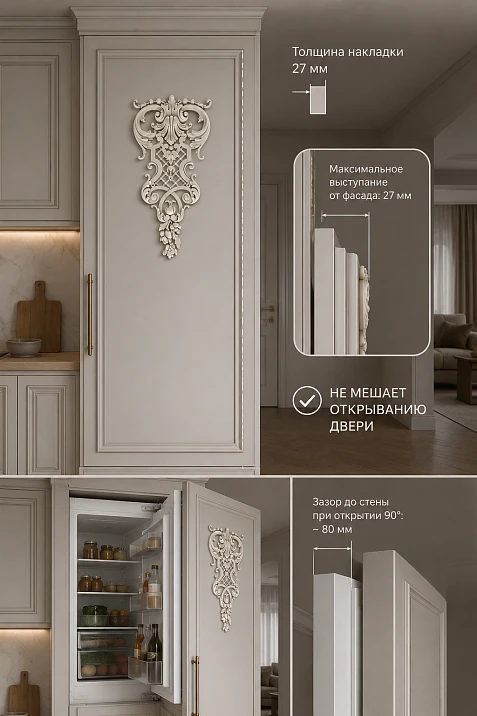
A tall smooth facade of a built-in refrigerator often looks too empty next to paneled doors, cornices, decorative moldings, and other details of a classic kitchen. The most obvious way to complicate it without a full frame is to place one large carved overlay in the center. The NPU-230 idea made of polyurethane suits this task: the manufacturer classifies it as a carved overlay and explicitly allows its use on furniture and doors.
But for an already installed refrigerator, the main question is not whether the pattern fits on the facade. The large version of NPU-230 has dimensions of 280 × 536 × 27 mm, and it is the third dimension that requires special checking. The overlay protrudes relative to the base plane; when the door moves, this volume moves together with the facade. Therefore, a static measurement in the closed position is not sufficient.
The direct answer is this: gluing NPU-230 onto the furniture facade of a built-in refrigerator can only be considered after checking the actual opening trajectory, free space near the wall or adjacent cabinet, the handle area, and the limitations of the facade system itself. If a full-size mockup with a thickness of 27 mm passes through the entire working angle without contact in the required position, the solution can be developed further. If it does not pass, the decorative overlay should be shifted, rotated in an allowed orientation, replaced with a more compact version of NPU-230, or the decor should be moved to a stationary part of the kitchen.
This is not overcaution. In a built-in refrigerator, the facade is a movable furniture part, not a free wall surface. Therefore, a good choice here starts not with a cart, but with a mechanical fitting.
What exactly is NPU-230 and what dimensions are confirmed by the product card
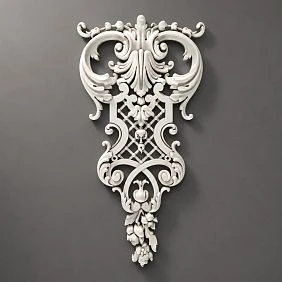
NPU-230 is a carved overlay made of polyurethane. The current STAVROS product card shows two sizes.
| Execution | Size A × B × C, mm | Material | Price |
|---|---|---|---|
| Small | 160 × 306 × 16 | Polyurethane | 3 730 ₽ |
| Large | 280 × 536 × 27 | Polyurethane | 12 870 ₽ |
For the kitchen in question, we take the large version costing 12,870 ₽. The product card indicates the overlay is intended for furniture, doors, walls, and ceilings, so the very idea of using NPU-230 on a furniture facade does not contradict the product's purpose.
Buy carved overlay NPU-230 made of polyurethane only after checking the specific door.




Important clarification on dimension orientation
The card shows the size as A × B × C = 280 × 536 × 27 mm, but the accessible text version of the page does not include a visual diagram of the axes, based on which one could unambiguously declare A as horizontal width and B as vertical height.
Therefore, a careful wording is used below:
if NPU-230 is installed in an orientation where it occupies 280 mm horizontally across the facade and 536 mm vertically, then on a facade 600 mm wide, the frontal calculation looks like this:
600 − 280 = 320 mm.
With symmetrical placement:
320 / 2 = 160 mm.
That is, conditionally, there will be 160 mm of free space on the left and right.
If, after checking the drawing or the physical product, the chosen orientation is different, the calculation must be recalculated based on the actual horizontal dimension. This is especially important for asymmetric carving: the product cannot be automatically rotated just because it is geometrically more convenient. First, you need to make sure that the pattern allows such a position.
Our factory also produces:

Why 27 mm matters more than the frontal field
280 and 536 mm answer the question of how large the overlay looks on the facade. 27 mm answers the question of whether the facade can move normally next to surrounding objects.
On a wall, a protrusion is almost always assessed only visually. On a door, it becomes part of a moving volume. If the facade passes near the side of an adjacent cabinet, wall, trim, protruding handle, or decorative column when opening, the trajectory of the outer point of the NPU-230 will differ from the trajectory of the facade plane itself.
Hence the main rule of the entire article: first, movement is checked, then composition, and only after that — the purchase.
Get Consultation
Why a closed facade can have free 160 mm but still catch when opening
Suppose a furniture facade has a nominal dimension of 600 × 2000 mm, and a large NPU-230 is installed in the 280 mm horizontal orientation. In the closed position, everything looks comfortable: 160 mm to the side edges.
From this, one cannot conclude that the overlay is safe.
When the door rotates, each point on its surface describes an arc relative to the axis of rotation. The farther this point is from the axis and the more it protrudes from the facade plane, the more important the actual geometry of neighboring objects becomes.
For the buyer, there are three different distances here, which are often mistakenly taken as one.
Gap in the closed position
This is the distance between the facade and the adjacent object when the door is closed. It only shows the starting situation.
For example, between the edge of a furniture facade and the wall, there may visually be a few centimeters. But this does not mean that the protruding decor will pass by the wall midway through the movement.
Minimum clearance during rotation
This is a key measurement. It cannot be reliably determined with a single ruler in the closed position, because the minimum distance may occur at an intermediate angle — depending on the specific hinge, the position of the facade, and the adjacent plane.
Therefore, the entire working range of movement needs to be checked.
Clearance in the fully open position
It is important for daily use. The door may not collide with furniture during the process, but at maximum opening, the overlay will be close to the wall or the handle of the adjacent cabinet. Then a single careless movement will regularly stress the decorative part.
Such an installation cannot be considered successful even if there is no formal contact during normal opening.
The most reliable check is a full-size mockup of 280 × 536 × 27 mm
For this task, a paper template is only useful at the first stage. It shows the frontal position but does not model the 27 mm protrusion at all.
A volumetric mockup is needed.
It doesn't have to be beautiful. A light rigid blank with the external dimensions of the selected NPU-230 orientation and a total thickness of about 27 mm will do. This could be foam board, several layers of foam material, a cardboard box, or another lightweight structure that won't scratch the facade.
What matters is different: the mockup should model not the pattern, but the occupied volume.
Step 1. Determine the intended location
First, mark the center of the composition on the closed facade. If the overlay is placed along the door axis, check for equal margins on the left and right. If a handle or neighboring furniture forces the decor to be shifted, mark the actual position, not the ideal geometric center.
Step 2. Temporarily secure the mockup
Use a method that is safe for the facade's finish. Avoid using strong tape on painted or lacquered furniture without testing—it may damage the coating.
The mockup should hold securely enough not to shift during slow opening.
Step 3. Open the door slowly
Move the facade through the entire usual working angle: from the closed position to the position in which the refrigerator is actually used.
You cannot limit yourself to an arbitrary angle. Refrigerator drawers or shelves may require a specific opening; it needs to be checked against the specific model of the appliance and its instructions.
Step 4. Check all potential contact points
They look not only at the adjacent cabinet. They check:
-
a wall;
-
door trim;
-
handle of the adjacent cabinet;
-
decorative column;
-
cornice or vertical molding nearby;
-
side panel of the kitchen cabinet;
-
another opening front;
-
handle of the door being decorated.
Step 5. Repeat the check with adjacent doors open
In the kitchen, two facades can move simultaneously. If a tall cabinet or pencil case is located nearby, its open handle may end up closer to the NPU-230 than the closed plane.
Therefore, testing only one door in a "perfectly empty" environment is not enough.
Step 6. Only after a successful mechanical check evaluate the appearance
If the mock-up does not touch anything, leave it on the facade and look at the kitchen from the passage, from the table, from the living room, at eye level, and under evening lighting. A large overlay of 280 × 536 mm may be mechanically compatible but visually appear too large.
Five mandatory checks before ordering the NPU-230
It is more convenient to view the task as a sequence of five filters. If one of them is not passed, it is too early to proceed with the purchase.
| Check | What we measure or test | What can change the decision |
| Facade | actual size, seams, edges, handle position | the overlay does not fit or looks cramped |
| Volume | protrusion of the selected configuration | 27 mm is too much for the surrounding area |
| Opening | full working angle | contact with the wall or adjacent furniture |
| Hardware | handle, hinges, method of attaching the facade | conflict with grip or system limitations |
| Usage | cleaning, service, adjacent doors | inconvenience in daily use |
Check 1. Real facade
Do not rely only on the standard cabinet width of 600 mm. Measure the actual furniture door that will receive the decor.
For a built-in refrigerator, the external width of the cabinet, the width of the facade, and the visible plane of the facade may differ. There may be technical gaps, false panels, integrated handles, or a protruding profile on the sides.
For the composition, what matters is not how many millimeters from the edge of the body to the edge of the body, but what clean plane is actually available for the overlay.
Check 2. Protrusion
For a large execution, the reference is C = 27 mm according to the card. This dimension cannot be "forgotten" after the frontal fitting.
If there is a narrow passage, a wall, or an adjacent tall cabinet next to the cabinet, a volumetric mock-up is mandatory.
Check 3. Full working angle
The door must open as much as required for normal access to the refrigerator. If, after installing the decor, a person is forced to hold the door every time and not bring it to the usual position, the solution is technically unsuccessful.
Check 4. Handle and grip
The large overlay should not fall where the palm regularly touches the facade.
If the handle is external, check the visual and physical distance between it and the carved element. If the facade is handleless and opens via a profile, edge, or mechanical system, make sure the decor does not fall into the working area of the hand.
Check 5. Facade system limitations
NPU-230 is attached to the furniture facade, not to the refrigerator body. But the facade itself is connected to the built-in appliance mechanism.
Different models may have limitations on the weight, thickness, and construction of the furniture door. The weight of the large NPU-230 is not specified in the available card, so it cannot be automatically claimed that additional decor is acceptable for any hinge.
Before final installation, check the instructions for the refrigerator and furniture fittings. If the documentation specifies a maximum facade weight or other limitations, they take priority over the decorative task.
Where to place a large overlay on a 600 × 2000 mm facade
After the mechanical check, a second question arises: where exactly the NPU-230 should be located.
Frontal center is only one of the options.
Geometric center of the facade
If the facade is 600 × 2000 mm and the overlay in the selected orientation occupies 280 mm in width and 536 mm in height, its geometric center coincides with the center of the door.
Horizontally, this conditionally leaves 160 mm of margin on each side.
Vertically:
2000 − 536 = 1464 mm.
If placed strictly in the center:
1464 / 2 = 732 mm from top and bottom.
This option is symmetrical, but not always the best for a kitchen. The lower part of a tall facade may be perceived differently due to the adjacent countertop, and the upper part due to the cornice or ceiling.
Visual center of a tall door
On a tall door, a decorative element is often better evaluated not mathematically, but relative to surrounding horizontals: upper cabinets, cornice, handle line, countertop, and adjacent panels.
If all adjacent facades have a central medallion at a certain height, it makes sense to align the NPU-230 with that line.
Shifting is only possible after checking the opening in the new position. On a moving facade, even a slight shift can change the distance to a neighboring obstacle.
Center relative to the visible part, not the entire door
If part of the facade is visually covered by a long handle, bottom plinth, or top cornice, the compositional center may differ from the geometric one.
This is not an error provided that the offset is made intentionally and verified with a full-size template.
Why being too close to the edge is dangerous
By shifting the overlay away from the wall or adjacent cabinet, it's easy to solve one problem and create another—bringing the carved element closer to the free edge of the door.
Then the relief participates more in the trajectory, and the decorative composition looks "pressed" to one side.
Therefore, offsetting is not a universal cure. It is evaluated simultaneously for mechanics and symmetry.
What exactly the NPU-230 might catch when opening
The phrase "check the neighboring furniture" is too general. In practice, there are several typical conflicts, and each has its own solution.
Adjacent tall cabinet
This is the most obvious scenario. Two tall units stand side by side, with a small gap between the fronts. While both doors are closed, everything looks safe.
The problem appears if the decorated front, when turning, approaches the side of the adjacent cabinet or its handle.
Solution: volumetric mock-up and checking two doors in different opening combinations.
Side wall
If the refrigerator is installed against a wall, the hinge side is especially important. Some fronts change position relative to the cabinet when opened, according to the hinge geometry.
It cannot be assumed that 27 mm automatically "moves away from the wall" or, conversely, necessarily "goes into the wall." This is determined by the specific mechanics. The check is done physically.
Door frame trim
A tall kitchen cabinet is sometimes located at the entrance to the room. The trim protrudes from the wall plane, and its edge becomes the nearest point.
In the closed state, there may be a sufficient gap between the front and the wall, but when turning, the decor passes close to the trim.
Handle of the adjacent cabinet
A handle is a small object that is easy to forget in measurements. At the same time, it protrudes further than the plane of the adjacent front and can become the first point of contact.
Long handles and knob handles near the tall refrigerator door are especially critical.
Own handle
If the NPU-230 is installed next to the handle of the same door, check not only the physical contact of the parts, but also the position of the fingers.
The carved relief should not force you to grab the handle at an awkward angle every time.
Another opening front
Two doors may each work perfectly on their own, but collide with each other if opened simultaneously. In a kitchen, this is a normal scenario, not a rare accident.
Therefore, the final test should include adjacent opening elements.
Large NPU-230 or small 160 × 306 × 16 mm: when a smaller size solves the problem
The NPU-230 has a useful feature: the same model is available in a smaller version, 160 × 306 × 16 mm.
This is not just an aesthetic alternative. The small plate protrudes less and takes up less front area, so it may be more convenient in a tight mechanical zone.
| Parameter | Small NPU-230 | Large NPU-230 |
| Size A × B × C | 160 × 306 × 16 mm | 280 × 536 × 27 mm |
| Price | 3 730 ₽ | 12 870 ₽ |
| Character on the tall facade | More delicate | large central accent |
| Protrusion along C | 16 мм | 27 мм |
| When to consider | little free space, needs calm decor | facade is large and the trajectory is free |
If the large NPU-230 volumetric model conflicts with the wall by just a few millimeters, you cannot automatically assume that the small version will definitely solve the issue. It also needs to be tested. But 16 mm instead of 27 mm provides a different overall dimension scenario and makes the small model a logical alternative.
The difference in frontal scale is also significant. On a 600 × 2000 mm facade, the small overlay will look much calmer. This is useful if the kitchen is more neoclassical rather than richly classical.
Buy decorative polyurethane overlays makes sense after the allowable overhang and scale of the decor are determined.
When is it better to move the decor from the door to the fixed side panel of the tall cabinet
Sometimes the problem is solved not by a different overlay, but by a different surface.
If there is no safe place on the moving facade due to a wall, handle, or opening trajectory, you can consider the fixed side panel of a tall cabinet—if it is visible and fits the composition.
This solution has several advantages.
First, the decorative element no longer participates in movement. There is no need to check the trajectory of the overlay itself.
Second, contact with the hand disappears each time the refrigerator is opened.
Third, on the side panel you can sometimes choose a freer position without being tied to the handle.
But this option cannot be considered automatically better. The fixed side panel may be too narrow, hidden by a wall, or not participate in the interior at all. Additionally, decor on the side panel and decor on the facade are perceived differently: the former decorates the cabinet body, the latter—directly the door.
If the task is to design not just one facade, but the entire tall block, it is useful to check out a separate STAVROS article about Built-in refrigerator portal design. This is a different scenario: there the decorative system is built around the entire cabinet, not reduced to a single NPU-230 on a movable door.
When it is better to use a molding instead of a large overlay
NPU-230 creates a local relief accent. If the facade looks empty, but the 27-millimeter protrusion is undesirable, the same compositional problem can be solved differently — with a thinner frame.
Moldings made of polyurethane are suitable for a scenario where a contour is needed, not a central medallion.
The difference is fundamental:
-
NPU-230 concentrates the decor at one point;
-
the molding distributes it along the perimeter or part of the facade;
-
the overlay has a large local protrusion;
-
the molding's depth depends on the specific profile and can be less;
-
the central overlay is simpler compositionally, but more demanding of free space in its location area;
-
The frame requires more joints and more precise marking.
If the main problem is not the overall protrusion of the door, but only the contact of a large central relief at a specific point, a thin molding composition may be more reasonable.
But it also cannot be designed without checking movement. Even a thin profile on the outer edge of the door can fall into the trajectory of a neighboring object.
Handle, profile, or handleless facade: how the opening method changes the placement of decor
The opening method of the facade determines not only convenience, but also the available decorative area.
External handle
The most obvious case. A free area for the hand is needed near the handle. The large NPU-230 should not create relief where the palm comes into contact with the facade.
If the handle is vertical and long, it visually already forms a strong line. The overlay has to be aligned not only with the center of the door, but also with this vertical.
Integrated handle or profile
If the grip is on the edge of the facade or profile, the central area is freer. But it is necessary to check whether the NPU-230 will be too close to the area where fingers press when opening.
System without a visible handle
Here it is especially important to know where a person actually presses or grabs. If the usual working point coincides with the relief overlay, operation will be uncomfortable.
The absence of an external handle does not mean that the entire surface is available for decor. The working area still exists.
Additional mass and hinges: what cannot be claimed without the refrigerator instructions
A large polyurethane overlay adds not only relief but also some mass to the furniture facade. In the current NPU-230 card, the weight of the large version is not specified, so the article cannot honestly calculate the load on the hinges.
This means two things.
First: one cannot promise that NPU-230 fits any built-in refrigerator system just because the material is lighter than many massive furniture parts.
Second: before installation, you need to open the manual for the specific refrigerator model and check the section on the furniture facade. The appliance manufacturer may specify allowable weight, thickness, mounting method, and door panel geometry.
If the facade is already close to the upper weight limit, additional decor requires coordination with a cabinetmaker or appliance specialist.
It should also be considered that built-in refrigerators use different schemes for connecting the furniture door to the appliance door. There is no universal calculation for all options.
Here the principle is simple: the decorative card NPU-230 confirms application on furniture, but does not replace the technical documentation of a specific refrigerator.
How to glue the overlay onto a ready-made furniture facade
Installation begins not with glue, but with checking the surface.
The furniture facade may be painted with enamel, covered with film, varnish, veneer, or other material. The same mounting compound cannot be considered compatible with all coatings without testing.
STAVROS indicates adhesive mounting as the typical installation method for the decorative element. The NPU-230 page also offers mounting glue as a related product. But specific compatibility must be confirmed for your finish coating.
Before installation
-
Clarify the material and coating of the facade.
-
Check the instructions of the selected glue.
-
Do a test on an inconspicuous sample or technological area, if allowed.
-
Mark the position of the overlay with removable marking.
-
Once again, conduct a full opening test with the three-dimensional mock-up.
-
Ensure that the door can be removed or serviced in the future without damaging the adjacent decor.
Why you can't glue immediately after a paper mock-up
Paper does not show 27 mm of thickness. If the overlay is already glued, a trajectory error turns from a matter of choice into a repair task.
Do you need to remove the facade
This depends on the installation technology, type of coating, and furniture maker's recommendations. A removed door is more convenient for precise marking and pressing, but dismantling the furniture facade of a built-in refrigerator may require adjustment after reinstallation.
If you have no experience with such a system, it is safer not to disassemble it just for decor without necessity.
Painting with NPU-230 on the refrigerator facade
Color affects whether the overlay will be perceived as part of the furniture door or as a separate molding detail.
In the color of the facade
The most seamless option. The relief becomes noticeable through light and shadow, not through contrast.
On a tall built-in refrigerator facade, this often helps avoid the feeling of a "stuck-on ornament."
But the same paint code does not always guarantee the same visual perception on different materials. The facade base and polyurethane reflect light differently, so a test coat is advisable.
In contrast
The contrasting NPU-230 becomes the main accent of the tall cabinet. On a 600 × 2000 mm facade, the large overlay is already noticeable; contrast enhances its role even further.
This technique is justified if the decor echoes other contrasting elements of the kitchen — for example, handles, patina, or individual molded details.
Support the adjacent facades
If adjacent doors already have carved medallions or panels, NPU-230 can be used as a unifying motif. But the scale must be proportionate.
The large overlay does not have to copy every adjacent detail. Its task is to integrate the tall smooth facade into the overall system.
Why the hinge side and the position of the overlay on the facade need to be checked separately
Two identical facades with the same NPU-230 can behave differently simply because one has hinges on the left and the other on the right. For a decorative element on a stationary wall, this hardly matters; for the door of a built-in refrigerator, it does.
The overlay moves together with the furniture facade. Therefore, it is important to know not only the distance from its edge to the edge of the door, but also which part of the decor is closer to the opening axis and which is closer to the free edge. The closer the relief is to the area that passes near the wall, the side of the cabinet, or the adjacent facade, the more thorough the check needs to be.
You cannot use a universal formula "leave X millimeters from the hinge." The geometry depends on the specific system. With some facades, the outer edge noticeably moves forward when opening, with others the trajectory is more controlled by the furniture hinge or the mechanism of the appliance. Therefore, the safe offset is determined not by an article or a typical kitchen drawing, but by a physical test of the specific door.
It is practically useful to make two mock-ups of the position of the same NPU-230: the first — strictly in the center of the facade, the second — shifted away from the dangerous side. After that, run both options through the same working angle.
If the center passes freely, no offset is needed. If the central position causes contact and the offset solves it, the second question remains — whether it ruins the composition. On a tall door, asymmetry is clearly noticeable, especially if neighboring facades have a symmetrical layout.
There is another detail: if the NPU-230 ornament has a pronounced direction or axis of symmetry, a mechanically convenient offset can make the pattern look visually wrong. Therefore, the trajectory and composition are checked together.
For a kitchen against a wall, it is useful to conduct a separate test on the hinge side. Install a volumetric mock-up in the intended place, slowly open the door, and observe the part of the mock-up closest to the wall. Then repeat with a different mounting height. Sometimes the obstacle is not at the level of the facade center, but higher — for example, a protruding trim, cornice, or handle of a neighboring tall cabinet.
That is why the question "will 280 mm fit on a width of 600 mm" is secondary. For a moving door, what matters more is where these 280 mm are located relative to the axis and the nearest obstacles.
If the refrigerator has two furniture doors, the NPU-230 cannot be designed as a decoration of one tall panel.
Many built-in refrigerators have separate furniture facades for the refrigerator and freezer compartments. Externally, they may form a single tall column, but mechanically they are two independent doors.
This completely changes the logic of the decoration.
A large NPU-230 cannot be placed so that it crosses the horizontal seam of two facades. Even if the pattern beautifully connects them in the closed position, when opening one door, the overlay will physically interfere with the second. The decoration must belong to one moving part.
For a two-door unit, first determine which door is visually suitable for the accent. The upper door usually has a larger visible area, but this is not a rule: a specific kitchen may have a tall lower section, an external handle in the center, or a horizontal line of adjacent fronts that the overlay should better align with.
Then each front is measured separately. The nominal height of the entire tall unit of 2000 mm is already useless here. If the upper door has an actual height, for example, significantly less than the total column height, large 536 mm elements may take up too much of its field.
The next test is independent opening. The NPU-230 mockup is fixed on the selected door and three modes are checked:
-
only the decorated door opens;
-
only the adjacent door opens;
-
both doors are in the open position in the combination that is possible in everyday use.
The third mode is needed because the handles and edges of the two doors may come closer together than it seems in the closed state.
If the large element does not fit on one door, the small NPU-230 160 × 306 × 16 mm gains an additional advantage. It allows preserving the NPU-230 motif without attempting to visually combine two independent panels.
There is another path — to abandon the overlay on the doors and transfer the decorative logic to the fixed portal around the refrigerator. This is especially appropriate if both fronts already have their own handles, panels, or noticeable horizontal seams. Then the portal unifies the entire tall unit architecturally, without interfering with the movement of individual doors.
Why "30 mm to the wall, but the overlay protrudes 27 mm" is an incorrect way to check
One of the most dangerous mistakes in this task is comparing two numbers and deciding that since 30 is greater than 27, there remains a margin of 3 mm.
Such a calculation is incorrect by the very formulation of the task.
27 mm is the size of the overlay protrusion relative to the base plane. 30 mm — let's assume, is the static gap between the facade and the wall in one position. These values relate to different geometric conditions. When the door rotates, the plane of the facade changes orientation, and the edge of the relief moves along its own trajectory.
Even if in the closed position there remains 3 mm between the outer point of the NPU-230 and the wall, at an intermediate angle this gap may decrease, increase, or move to another point. Without knowing the hinge kinematics, this cannot be determined by simple subtraction.
Therefore, the article deliberately does not provide a "minimum safe gap" in millimeters. There is no such universal figure for all built-in refrigerators and all adjacent walls.
The practical solution is a physical mock-up and observation of the minimum distance during movement.
To make the test more useful, you can temporarily attach a strip of soft material or a paper indicator to the nearest obstacle, which will show even a light touch. At the same time, you must not apply force and continue opening the door after contact: the task of the test is to detect a conflict, not to check the strength of the mock-up.
If the mock-up passes with a tight fit, that is also a bad result. The real facade may slightly change position after adjustment, temperature changes of materials, hinge wear, or re-hanging after service maintenance. The decorative element should not be designed for a random gap of fractions of a millimeter.
A real operational reserve is needed, but its value is determined by the specific assembly and the manufacturer's recommendations for furniture/appliances. If doubt remains, it is wiser to choose a smaller NPU-230 or a flatter decor than to try to derive a universal standard from two incomparable numbers.
Service, facade removal, and cleaning: a check that is easy to forget before gluing.
A built-in refrigerator is equipment that will eventually need servicing, adjusting, or replacing. The decor should not turn a routine service operation into dismantling stucco molding.
Before gluing on the NPU-230, it is useful to know how the furniture panel of a specific refrigerator model is removed. In some systems, access to the fasteners is from the side or top; in others, you need to open the door at a certain angle, remove decorative caps, or adjust the mounts.
If a large overlay covers a service point, obstructs tool placement, or prevents placing the removed panel on a flat surface without risking damage to the threads, its position should be changed before installation.
It is especially important to check the service scenario if the NPU-230 is close to the edge. After removing the door, the technician may stand the panel on its edge or rotate it. The 27 mm relief becomes a vulnerable protruding part that can easily hit the floor, countertop, or cabinet body.
Cleaning is also important for daily use. The refrigerator is opened many times a day, so the furniture panel is in constant contact. The relief overlay creates recesses where dust and kitchen grime are more visible than on a smooth door. This is not a reason to avoid the NPU-230, but it is a good argument not to place it too close to the handle or an area regularly touched by fingers.
When painted in the color of the panel, maintenance is visually simpler: small marks and shadows contrast less. Contrasting patina or a complex two-tone finish makes the relief more expressive but simultaneously highlights dirt in the recesses.
Separately, consider the possible replacement of the refrigerator. If a new model in a few years requires a different furniture layout, the panel with the glued NPU-230 can remain part of the kitchen only if a compatible door structure is maintained. Therefore, for an expensive decorative element, it is useful to know in advance whether it is part of a specific door or part of a more durable cabinet architecture.
If the kitchen is designed for long-term use and the appliance may change, moving the main stucco decor to fixed side panels or a portal is sometimes more practical: the furniture architecture remains, and the appliance doors are easier to replace.
Three solutions to one problem: a large overlay, a small overlay, or a molding frame
An empty tall panel can be styled in different ways. It is useful to compare before purchasing because these solutions create different mechanics and different visual scale.
| Solution | Main advantage | Main risk | What to check first |
| NPU-230 280 × 536 × 27 | One strong central accent | large local protrusion | trajectory of the 27 mm volumetric layout |
| NPU-230 160 × 306 × 16 | the same motif on a smaller scale | may look too small on a tall facade | scale and trajectory of 16 mm |
| Molding frame | distributes decor across the plane | more joints, possible conflict at door edges | depth of the selected profile and edge movement |
The large NPU-230 works best when the facade truly needs one dominant decorative center and there is free space around it.
The small version is useful if you want to keep the NPU-230 pattern, but the kitchen is calmer or the large overlay does not fit mechanically.
Molding frame — a different character. It does not create one thick central volume, but instead fits closer to the door perimeter, where the trajectory of some points may be more critical. Therefore, molding cannot be considered automatically safer: its specific depth and position also require verification.
There is also a fourth solution — leave the facade smooth. If carved cornices, paneled doors, decorative handles, and a styled portal are already present nearby, an additional NPU-230 may worsen the composition. The absence of decor is sometimes a deliberate way to give a tall facade a visual pause.
The choice becomes simple if you start from the task. Need a medallion — test NPU-230. Need a calmer accent — test the small version. Need a contour — look at molding. Need a mechanically neutral architectural connection — move the decor to the fixed portal.
When it is better not to buy a large NPU-230
There are situations where refusing to buy is a more sensible decision.
The mockup touches the wall or furniture
This is a direct technical stop. You cannot assume that "the real overlay will press slightly thinner" or that contact will be rare.
The gap remains only nominally
If a minimal gap remains between the mockup and the obstacle, which may disappear during adjustment or slight play, the installation cannot be considered reliable.
The carved element falls into the working grip
Beautiful decor that daily obstructs opening the refrigerator does not fulfill its purpose.
The appliance instructions do not allow additional mass or geometry.
This technical limitation is more important than aesthetics.
The facade already has a complex panel molding.
The NPU-230 should not overlap an existing profile, groove, or frame unless the composition was specifically designed for it.
The overlay looks too large.
The large size of 280 × 536 mm on a narrow facade can visually occupy too much of the surface. In such a case, the small NPU-230 160 × 306 × 16 mm may be better even with full mechanical clearance.
Practical algorithm: from measuring the facade to the 'buy' button.
Below is a sequence that eliminates most errors.
1. Measure the actual door.
Record the width and height of the furniture facade exactly. Do not take the nominal size of the cabinet.
2. Mark the handle's working area
Highlight the area that the hand regularly touches.
3. Select the orientation of the NPU-230
Confirm it against the drawing or a physical sample. If it occupies 280 mm horizontally, only then use the calculation of free margins from this value.
4. Make a paper front template
It is needed to assess the scale and position.
5. Make a volumetric mockup with a thickness of 27 mm
This is the main mechanical test.
6. Check the entire trajectory
Open the facade to the actually required working angle.
7. Check adjacent doors and handles
Repeat the test in real combinations.
8. Check the refrigerator documentation
Especially the permissible weight and requirements for the furniture facade, if specified.
9. Compare the large and small variants
If 27 mm creates a problem, test the 16-millimeter version.
10. Only after this place the order
If the large NPU-230 passes all checks, you can order NPU-230 280 × 536 × 27 mm.
Measurement control card: what to record before ordering so you don't have to recheck everything after delivery
For a complex facade, it's useful not to keep dimensions "in your head" but to make a short object card. It especially helps when the choice of decor is discussed by the kitchen owner, designer, and cabinetmaker: everyone gets one set of initial data.
Record the actual width and height of the door, not the cabinet. Then separately, the width of the clean decorative field between the handle, panel edges, profile, or other details. If the facade is smooth, the field may coincide with most of the door; if there's a handle or integrated profile, the available area is narrower.
The next group is distances to potential obstacles. It's useful to record what's to the left and right of the refrigerator: a wall, an adjacent cabinet, a display case, a door trim, an open kitchen side panel. For each obstacle, not only the static gap is recorded, but also the result of a volumetric fitting: "passes freely," "converges mid-swing," "contacts," "the handle of the adjacent door interferes."
Separately, specify the hinge side. This seems obvious until you start comparing two overlay offset options. If a week later the designer returns to the diagram and sees only the numbers 600 × 2000 mm, without the opening side it's easy to repeat an unsuitable position.
Next is the working angle. Here, you don't need to invent degrees if they're unknown. Record a practical criterion: "the door opens enough to freely remove the bottom drawer," "the shelf slides out without obstruction," "the container can be taken out." This is more useful than an abstract number, because the goal of opening the refrigerator is access to internal elements.
After fixing the NPU-230 layout, be sure to check these exact actions. It happens that a door with decor opens at a large angle without contact, but not enough to fully remove the internal drawer. Formally, the door works, but operationally, the solution is unsuitable.
The card should also include the position of the overlay center from the top and side edges of the facade. If after fitting a non-geometric center is chosen, the recorded offsets will allow precise transfer of the position during final marking.
For a large NPU-230, it's convenient to save two options:
-
option A — the position that looks best from the front;
-
Option B — a position that provides a larger opening margin.
After comparison, choose the one that passes both tests. If you have to choose between a beautiful but dangerous option and a slightly less symmetrical but safe one, it is better to reconsider the type of decor itself. A small NPU-230 or molding often resolves the conflict without compromising the mechanics.
It is also useful to photograph the facade with a 3D mock-up in the closed position and at the point of minimum clearance. Such photos give the cabinetmaker more information than the phrase "it seems to almost fit."
The control card may look like this:
| Parameter | What to record |
| Facade | actual width × height |
| Clear field | available area without handle and profiles |
| Hinge side | left / right |
| Adjacent object | wall, pencil case, trim, handle, etc. |
| Layout position | indent from top and side edge |
| Layout protrusion | 27 mm for large version |
| Working test | door, shelves, and drawers fully accessible |
| Minimum approach point | where exactly the risk occurs |
| Adjacent facades | joint opening checked |
| Equipment limitations | instructions for furniture facade checked |
| Total | large / small / molding / transfer to portal |
Such a table is needed not for formality. It separates the frontal composition, movement mechanics, and equipment limitations. Until all three blocks yield a positive result, ordering the large NPU-230 is premature.
Decision matrix: buy the large NPU-230 or look for another option
| Situation | Solution |
| Facade is large, 27 mm layout passes at the full angle, handle is far away | large NPU-230 is suitable for further fitting |
| Looks good from the front, but there is contact when opening | do not buy in this position |
| Conflict only due to the large protrusion | check the small NPU-230 160 × 306 × 16 mm |
| The overlay interferes with the working grip | shift and repeat the test or choose a different decor |
| There is no safe place on the sliding door | move the decor to the fixed side panel or portal |
| A calmer pattern is needed | look at other decorative overlays |
| Need a frame, not a central accent | compare with polyurethane molding |
| Refrigerator facade restrictions are unclear | first check the manual/service |
You can buy ready-made stucco matching the Baroque style. Calculate the quantity: linear meters of cornices and moldings, number of rosettes, pilasters, consoles, corner elements. Add a ten to fifteen percent allowance for trimming. reasonable after the type of solution itself is determined: large central overlay, small overlay, frame, or decor of a fixed portal.
Bottom line: NPU-230 on a built-in refrigerator is checked not with a ruler, but with movement
The large carved overlay NPU-230 280 × 536 × 27 mm can indeed become a central decorative accent on a tall smooth furniture facade of a built-in refrigerator. The product card allows the use of NPU-230 on furniture and doors, and the size 280 × 536 mm allows it to be considered for a large facade plane.
But for a moving door, the decisive parameter becomes volume and trajectory.
If the facade is conditionally 600 mm wide and after checking the orientation of NPU-230 it occupies 280 mm horizontally, when centered, 160 mm of margin remains on each side. This is a good frontal result, but it guarantees nothing when opening.
Before ordering, you need to make a mockup 27 mm thick, temporarily install it in the intended place, and slowly move the facade through the entire working angle. The wall, adjacent cabinet, trim, handles, another opening facade, and the grip area are checked. The refrigerator and furniture system documentation is studied separately: additional decor must not violate facade restrictions.
If the large mockup passes freely, does not interfere with the hand, and compositionally suits the kitchen, purchasing one NPU-230 for 12,870 ₽ makes sense.
If 27 mm creates a conflict, there are three more reasonable paths than "glue and hope": check the small NPU-230 160 × 306 × 16 mm, choose thinner decor, or move the decorative accent from the moving door to the fixed part of the cabinet.
This is exactly how this task is solved before purchase: first movement — then decor.
FAQ
Can the NPU-230 be glued to a facade with two separate doors for the refrigerator and freezer?
It can only be considered as two independent facades. The overlay must not cover the seam between the doors or physically connect them. For each facade, the position, opening, and working area are checked separately.
What to do if the refrigerator is flush against the wall on the hinge side?
Do not make a conclusion based on the closed position. Install a full-size mockup and check the full working angle. Only the actual kinematics of the specific hinge will show whether the decor approaches the wall.
Can the NPU-230 be placed above the center so it does not interfere with the handle?
Yes, if the new position is compositionally justified and the mechanical check is repeated after the shift. On a tall door, vertical displacement may change the distance to neighboring objects.
Can the decor be glued directly onto the refrigerator door itself without a furniture facade?
This article discusses the furniture facade of built-in appliances. The possibility of mounting directly on the standard refrigerator door must be determined by the manufacturer of the specific appliance and the material of its coating. The NPU-230 card itself does not grant such permission.
Do I need to consider the opening of the adjacent door if the refrigerator opens normally?
Yes. Two facades may not conflict individually, but can meet with handles or relief when opened simultaneously.
If there is 30 mm left to the wall, does that mean the NPU-230 with a 27 mm protrusion will definitely fit?
No. These values cannot simply be compared as static. During rotation, the geometry changes, so a physical test is needed across the entire working angle.
Can the small NPU-230 be used as an exact replacement for the large one?
It is the same article in a smaller size, but the visual scale changes significantly. The small version is convenient as an alternative in limited space, but it also needs to be tried on and checked for movement.
Is it necessary to remove the overlay for refrigerator maintenance?
It depends on the facade design and the method of access to the appliance. Before installation, you need to check whether the furniture door can be removed later or the refrigerator serviced without damaging the decor.
What should be used to cover an empty facade if the large NPU-230 does not fit the trajectory?
Consider the small NPU-230, another thinner overlay, a molding frame, or decor of a fixed side panel/portal. The choice depends on where exactly the conflict occurs.
Can the NPU-230 be used on a facade without a handle?
Yes, if the opening system and the working area for pressing or gripping do not intersect with the decor. The absence of an external handle does not mean that the entire surface is free for an overlay.