Article Contents:
- Why six coordinated parts are better than six random overlays
- What exactly is included in the C-030 kit
- Confirmed specifications of C-030
- What role do N-424L and N-424R play
- What role do N-431L and N-431R play
- The role of N-244 on the central axis
- The role of N-300 and permissible design freedom
- Why the overall size of 262 × 244 × 15 mm does not equal the facade size
- What margins to leave around the decor
- Thickness 15 mm and light-shadow effect
- Full-size paper template C-030
- Why the template is needed before purchasing multiple sets
- How to determine the center of a furniture facade
- Marking without losing symmetry
- Placement control map
- Three design scenarios for using C-030
- Vertical composition on a cabinet door
- Wide buffet facade
- Decorative field on wall panel
- Finishing before fixing
- Finishing after installation
- Order individual parts instead of the full set
- Confusing L and R
- Lose one element during unpacking
- Estimate the scale from a photo
- Not make a 1:1 template
- Place the handle over the ornament
- Split one set between two identical doors
- Buy beech for a transparent oak composition
- Order parts at different times
- Not check the thickness near the molding
- How many parts are included in C-030?
- What do the letters L and R mean?
- What is the overall size of the kit?
- Will a facade measuring 262 × 244 mm fit?
- What wood species is C-030 made from?
- What to choose for white enamel?
- What should I choose for clear tinting?
- How does Standard differ from Prestige?
- Can the kit be split into two doors?
- Can C-030 be used on a wall?
- Is the kit suitable for the door?
- How to mark the overlays?
- Do I need to make a template?
- What Adhesive to Use?
- Paint before or after installation?
- Do I need to order all kits in one batch?
- What to check upon receipt?
- Can I replace one element with a similar overlay?
- Where can I see other sets?
- Where can I buy the C-030 kit?

Buy decorative set C-030 It is worth it when the facade needs not just one random carved detail, but a coordinated composition of six wooden overlays. Such a set helps to immediately obtain paired left and right elements, central accents, and a unified ornament scale for a cabinet, sideboard, chest of drawers, furniture portal, door, or wall panel. The main advantage of buying a complete set is not only convenience, but also a controlled result: elements can be aligned relative to one axis, ordered in the same wood species and sanding quality, prepared for a common finishing method, and you don't have to search for compatible SKUs after starting work.
C-030 consists of six separate parts: N-424L, N-424R, N-431L, N-431R, N-244, and N-300. The overall size indicated for the set is 262 × 244 × 15 mm. Versions in beech and oak are available, with Standard or Prestige sanding options, as well as regluing for enamel or tinting. These parameters give the buyer several finishing paths, but do not eliminate the need for design verification: the set size cannot be automatically taken as the minimum facade size, and the proposed placement schemes should be checked against drawings and a full-size template.
The set is especially useful where symmetry must be immediately apparent. Left and right parts cannot be swapped without evaluating the pattern, central elements cannot be placed 'by eye', and one set should not be automatically divided between two identical doors. Before ordering, you need to determine the number of complete compositions, material, preparation quality, type of future coating, and the actual installation field. After that, C-030 turns from a set of carvings into a clear system for serial or custom facades.

Why six coordinated parts are better than six random overlays
Random selection starts with the shape of each overlay individually. The buyer finds a beautiful left branch, then looks for a similar right one, adds a central flower, and tries to tie the parts together into a whole. Even if all elements are made of wood, the composition may fall apart: the depth of carving, thickness, direction of leaves, density of ornament, and edge character change.
C-030 solves a different problem. It initially combines six elements into a set, so the buyer works not with six unrelated cards, but with one decorative system. This does not mean there is a single mandatory installation scheme. However, the overall set facilitates symmetrical marking and reduces the risk that the central part will be too large and the side branches stylistically foreign.
When purchasing a complete set, it is easier to control the material and finishing. All six elements can be ordered in beech or oak, choose Standard or Prestige, and determine gluing for enamel or tinting. If parts are purchased at different times, the risk of differences in batch, surface, and preparation for finishing increases.




What exactly is included in the C-030 set
| Element | Quantity | Type | Role in composition |
|---|---|---|---|
| N-424L | 1 | Left overlay | Forms one outer branch |
| N-424R | 1 | Right overlay | Mirrors the outer branch |
| N-431L | 1 | Left overlay | Creates an inner paired level |
| N-431R | 1 | Right overlay | Connects the right side to the center |
| N-244 | 1 | Central element | Works as the main axis accent |
| N-300 | 1 | Additional central element | Completes or connects the central composition according to the project |
The letters L and R in the article numbers denote different mirror parts. These are not two identical items with different markings. If you lose one element during unpacking or accidentally replace it with a second left one, the symmetry will be broken. Therefore, the set must be accepted according to the full list, and each part must be kept under its original designation until the marking is complete.
Detailed composition and available versions can be viewed in the C-030 card. Before ordering, it is worth checking not only the number of parts, but also the material, grinding option, type of gluing, current price and terms of receipt.
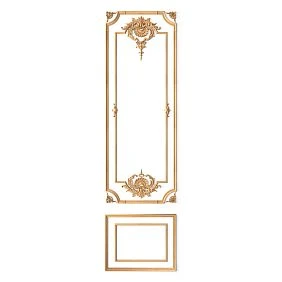
Our factory also produces:

Confirmed characteristics C-030
| Parameter | Confirmed value | What to check before ordering |
|---|---|---|
| Article number | C-030 | Do not mix with individual overlays from other sets |
| Composition | 6 separate elements | Check the presence of all six positions upon receipt |
| Overall dimensions | 262 × 244 × 15 mm | Do not automatically count the size of a suitable facade |
| Materials | Beech or oak | Link the selection to the base and future finish |
| Sanding | Standard or Prestige | Select considering the required finish |
| Re-gluing | For enamel or tinting | Agree on the type of finish before ordering |
| Application | Furniture and interior compositions | Check the free space and installation method |
Get Consultation
What role do N-424L and N-424R play
This pair forms the outer side branches of the composition. In a symmetrical scheme, the elements are positioned relative to the central axis and define the extreme span of the ornament. The farther apart they are, the wider the entire composition appears. The closer to the center, the denser and heavier the decorative node becomes.
External elements require special inspection on the facade with a handle. The branch should not enter the frequent touch zone, interfere with the hand, or cross the technological frame. On the cabinet door, you also need to evaluate the opening of the adjacent door and the distance to the body.
What role do N-431L and N-431R play?
The inner pair connects the outer branches with the central parts. It forms the second level of the ornament and helps avoid an empty gap between the edges and the axis. If the distance is too small, the elements may merge into a heavy spot. If too large, they cease to be perceived as a single system.
The marking of the inner pair is done after determining the center and the position of N-244 and N-300. This makes it easier to maintain equal intervals and not adjust the central elements to already fixed edges.
The role of N-244 in the central axis
N-244 works as the main central accent. On a vertical facade, it can set a point from which the composition unfolds upward and to the sides. On a wide field, it holds the visual center between paired branches.
The position of N-244 cannot be determined only by the overall height of the door. You need to consider the handle, panel, molding, adjacent drawers, and eye level. A paper template allows you to see if the accent is too low or too close to the top edge.
The role of N-300 and permissible design freedom
N-300 can complete the central axis or be used as an additional connecting element. The specific scheme should be checked against the drawing and design layout. The article does not specify a single mandatory position for this part because the surface shape and project objectives vary.
The main rule is not to turn N-300 into a random leftover. If the part is included in the composition, its function is determined in advance: top accent, bottom finish, connection with N-244, or a separate place in the overall layout.
Why the overall size 262 × 244 × 15 mm does not equal the facade size
The kit dimensions describe the decorative set itself, but the facade needs free margins. Space must remain around the carving so the composition does not press against the edge, frame molding, panel, handle, or technical groove.
If you take a surface exactly 262 × 244 mm, the decor will visually fill it almost completely and will not have a background. Therefore, the minimum base size cannot be set as a single universal number. It is determined by a full-size layout with actual margins.
Before designing, it is useful to study general rules for choosing wooden overlays for a cabinet, and then check C-030 as a specific composition.
What margins to leave around the decor
A universal margin in millimeters is not confirmed. It is determined by the facade scale, frame thickness, and visual task. Top and bottom margins may differ if the composition is tied to a handle or panel.
For a symmetrical door, side margins are usually checked to be equal. On a wide panel, a more free layout is possible. The decision is fixed on a template so the installer does not determine the intervals anew.
Thickness 15 mm and light-shadow
A depth of up to 15 mm makes C-030 not a flat printed graphic, but a noticeable relief. With side lighting, the branches and central elements cast shadows, so the distances between them are perceived more strongly than in the drawing.
The thickness needs to be compared with the adjacent molding, panel, and handle. If the overlay protrudes more than all other parts, it will become the main accent. This may be planned, but should not come as a surprise after installation.
Full-size paper template C-030
- Get or download drawings of all six elements.
- Print the outlines at 1:1 scale.
- Label each part with L, R, and the article number.
- Cut out the paper templates without changing the scale.
- Mark the vertical and horizontal axes of the facade.
- Secure the central elements with masking tape.
- Add the inner pair N-431L/R.
- Position the external pair N-424L/R.
- Check the gaps, handle, panel, and opening.
- Photograph the approved diagram with a ruler.
Paper does not show the actual thread depth, but accurately reveals scale errors and asymmetry. To check volume, it is useful to attach a physical sample of one part or create a temporary spacer of the appropriate thickness.
Why a template is needed before purchasing multiple sets
One set may fit the central door but be too large for the side ones. If the furniture consists of several sizes, each is checked separately. Ordering the same number of sets for all fronts based on one measurement is risky.
The template helps determine the actual number of complete sets. Perhaps C-030 is only needed for the two main doors, while the remaining surfaces are better left plain or decorated with individual elements.
How to determine the center of a furniture front
First, measure the width and height of the working surface, not the entire door. If there is a frame, panel, or protruding edge, center the composition within the free field. Then draw a vertical axis and control horizontals.
The center of a geometric rectangle does not always coincide with the visual center. The handle, top cornice, and bottom base can shift perception. Therefore, the final position is evaluated from a distance and with the furniture closed.
Markup without loss of symmetry
- Draw the vertical axis of the work surface.
- Determine the position of N-244 and N-300.
- Mark the horizontal levels of centers or reference points.
- Place N-431L and N-431R at the same distance.
- Add the outer pair N-424L and N-424R.
- Check mirror symmetry using photos and measurements.
- Transfer the layout to the second facade using a single template.
- Only after re-verification proceed to installation.
Placement control card
| Checkpoint | What to fix | Why |
|---|---|---|
| Vertical axis | Coordinate relative to the work plane | Saves the center of the entire composition |
| N-244 | Height and center position | Sets the main accent |
| N-300 | Interval to N-244 | Links central elements |
| N-431L/R | Paired intervals | Provides internal mirroring |
| N-424L/R | External span | Defines the composition width |
| Handle | Boundary of the capture zone | Prevents conflict with decor |
| Molding | Minimum layout distance | Separates two relief levels |
Three design scenarios for C-030 application
Below are scenarios, not mandatory manufacturer schemes. Each option must be checked against part drawings, actual facade, and design layout.
Vertical composition on cabinet door
Central elements are placed along the axis, inner and outer pairs form a symmetrical frame. This option is suitable for a tall central door where the carving should work as a single medallion.
Wide sideboard facade
Paired details can be spaced wider, preserving the common center and equal intervals. The composition becomes more horizontal and supports the proportions of a wide door or blind panel.
Decorative field on a wall panel
C-030 is placed inside a molding frame as a solid panel. It is important to leave a background between the carving and the frame so that the two levels of decor do not merge.
Can one set be divided between several facades
Physically, the details can be placed separately, but the original symmetry is lost. One door may have only left branches, another only right ones. Central elements will not repeat, so the two doors will not look identical.
For two identical facades, two full sets of C-030 are usually needed. This is not a universal rule for any furniture, but a practical conclusion for a repeatable symmetrical composition. If the project is intentionally asymmetrical, distribution is discussed separately.
Calculating the number of sets
| Task | Approximate approach | What to Check |
|---|---|---|
| One central door | One full set | Full-size template and free fields |
| Two identical doors | Usually two full sets | Single template and one batch |
| Wide common facade | One set or design solution | Span of paired elements |
| Several different facades | Separate check for each size | Do not copy the scheme automatically |
| Wall panel | By number of repeated panels | Frame size and interpanel gaps |
| Doors in one room | By number of identical compositions | Opening direction and handles |
C-030 on the cabinet
On the cabinet, the set can decorate one central door, a pair of symmetrical doors, a wide wardrobe facade, or an upper decorative panel. The main thing is not to make the decor repeat on every surface. One expressive composition often works stronger than many small ones.
For two paired doors, a single template and the same height of the central axis are used. If the handles are located between the doors, the external span of the overlays should not interfere with the grip.
Built-in wardrobe and junctions
In built-in furniture, the distance to side walls, ceiling cornice, and adjacent panels is checked. The relief should not touch the slope or prevent the door from opening to the required angle.
If the facades are removed for finishing, the markings are fixed before dismantling and transferred to each door separately.
C-030 on a chest of drawers
The set should not be automatically split into individual drawers. A high relief divided by inter-drawer gaps may lose its integrity. A more logical area is the central door, a common decorative facade, or a blind side panel.
If the composition still spans multiple fronts, the operation of each drawer and the stability of the visual axis when the body is closed must be checked.
C-030 on a sideboard
A sideboard provides wide blind surfaces and glass doors. It is better to place the carving where it does not conflict with the transparent insert and handles. On the central wooden door, C-030 can unite the lower and upper parts of the body.
For two identical side doors, it is easier to order two complete sets than to try to divide one.
C-030 on a furniture portal
On the portal, the set works as a central crest or plant composition. Here, the axis of the opening, the distance to the cornice, and the scale of the vertical posts are especially important.
If the portal already has carved capitals or overlays, C-030 should support them rather than compete with them. The number of ornaments is limited on the layout.
C-030 on an interior door
Before placement, check the handle, lock, panels, opening direction, high-touch areas, and relief thickness. Overlays should not interfere with the hand or touch the adjacent wall when fully opened.
For a door, a full-size mock-up is especially important. A contour that seems compact on paper may take up a significant portion of the door leaf.
C-030 inside a wall frame
The set can be used as a wooden panel within a molding layout. Leave a free field between the outer branches and the frame. If the distance is too small, the carving and molding blend together.
The base, fixing method, and finish are determined by the project. The wall scenario does not turn overlays into structural elements.
How to choose wooden decor for a facade
Before choosing C-030, determine whether the surface needs an independent central composition. If the facade already has complex paneling, active hardware, and contrasting molding, six carved details may overload it.
The general approach to proportions and materials is covered in the article about how to choose wooden decor for furniture facades. C-030 is chosen after the location for the composition is confirmed.
Beech or oak for C-030
| Criterion | Beech | Oak |
|---|---|---|
| Main visual scenario | Calm surface, emphasis on carving | Pronounced natural texture |
| Opaque finish | Suitable for enamel after preparation | Possible according to project technology, but texture is hidden |
| Transparent finish | Varnish or tinting after sample | Oil, varnish, stain or tinting as per project |
| Combination with the facade | With beech or painted base | With oak and oak veneer |
| What to check | Color under enamel and end faces | Direction and spread of texture |
Beech under enamel
Beech is chosen when the decor and facade should look like a single painted object. Dense enamel shifts attention from the wood grain to the shape of leaves and central elements.
Before serial finishing, a test coating is done on the selected material and sanding quality. This allows evaluation of the relief, angles, and transition to the facade.
Oak under tinting
Oak suits a project where the texture should remain visible. On paired elements, the wood grain will not be mirrored, so parts are sorted by tone and overall character.
Tinting is checked on a sample. The same composition may look different on the facade and overlays due to batch and preparation differences.
Re-gluing for enamel or tinting
The type of re-gluing is chosen before ordering, as it is related to the future coating. You cannot first order an arbitrary execution and then expect the same result under opaque enamel and transparent tinting.
The application specifies: material, Standard or Prestige, re-gluing for enamel or tinting, and the intended finish. This reduces the risk of different interpretations of the order.
Standard and Prestige without false opposition
Standard cannot be called poor quality. It is a preparation option chosen based on project requirements. Prestige involves more detailed manual sanding and may be important for a complex transparent finish or a particularly demanding surface.
The choice is made based on the control sample, thread depth, painting method, and budget. Under dense enamel, the requirements may differ from those for transparent varnish.
Comparison of preparation options
| Parameter | Standard | Prestige |
|---|---|---|
| Approach | Machine preparation | More detailed manual sanding |
| When to consider | Project with suitable finish technology | Demanding transparent or complex decorative finish |
| What to check | Sample after selected finish | Relief, edges, and hard-to-reach areas |
| Solution | By technical specification | By project's high requirements |
Paint overlays before or after installation
Finish before fixing
It is easier to paint the side surfaces and deep areas. This option is convenient for contrasting decor. The disadvantage is that the joint remains visually independent, and the mounting compound must be compatible with the finished coating.
Finishing after installation
Overlays and the facade can be combined with one enamel or patina. The transition looks more monolithic, but painting deep carvings is more difficult. The base must be prepared in advance.
There is no universal answer. The technology is chosen by the finisher and furniture manufacturer after a trial assembly.
Control painting of a complete fragment
The best sample is not a separate stroke on a board, but a fragment where the overlay is attached to the facade material. It shows color, shadow, transition, gloss, and readability of the relief.
For oak, the texture is evaluated; for beech under enamel, the uniformity of the covering layer. The approved sample is kept until the end of the batch.
How not to confuse C-030 with a set of random parts
The card and order must simultaneously contain the article C-030, six elements, and the full list N-424L/R, N-431L/R, N-244, N-300. If the buyer is offered only a part, it is no longer the original configuration.
Also check the overall size, material, sanding, and regluing. Similar plant carving does not guarantee compatibility.
When one complete set is better than individual overlays
A full set is more convenient for a central symmetrical composition, a repeatable furniture series, and a project where a uniform finish needs to be maintained. Individual elements are chosen when a deliberately asymmetrical layout or a different scale is needed.
After getting acquainted with C-030, you can look at what other sets of carved decor STAVROS produces.
When C-030 is not suitable
- the facade is too small for the composition and free margins;
- there is already a lot of active relief on the surface;
- the handle crosses the central area;
- a single small overlay is needed;
- the project requires a different stylistic pattern;
- the base does not allow reliable fastening of the wooden decor;
- thickness 15 mm conflicts with opening or adjacent parts;
- a structural, not decorative, element is needed.
In this case, it is better to open the catalog of wooden decorative overlays and select a different set or individual elements.
Surface preparation
The base must be strong and compatible with the chosen fixing method. Old peeling coating cannot be considered a reliable base. Before installation, check the plane, cleanliness, and absence of conflicts with the panel.
The exact preparation procedure depends on the facade material and finish. The universal technology is not specified in the initial data.
How to choose a mounting compound
The composition depends on the wood of the overlay, base, coating, and operating conditions. One glue cannot be assigned for any furniture or wall. It is useful to study in advance how to choose mounting glue for wooden decor, and make the final decision according to the manufacturer's instructions for the composition.
Dry fit before fixing
All six elements are laid out simultaneously. Checking one part does not show overall symmetry. Overlays are temporarily held in a safe way, photographed, and distances compared.
On two facades, templates are placed side by side. A difference of a few millimeters may be noticeable on repetitive furniture.
Part Marking
| Marking | Example | Why |
|---|---|---|
| kit | C-030 №1 | Do not mix sets |
| Facade | Cabinet, left door | Preserve purpose |
| Article number | N-424L | Do not confuse mirror elements |
| Position | Outer left | Simplify installation |
| Material | Oak | Do not mix species |
| Finishing | Tinting, sample #2 | Match approved finish |
Kit acceptance
- Verify item C-030.
- Recount six elements.
- Check N-424L and N-424R.
- Check N-431L and N-431R.
- Ensure N-244 and N-300 are present.
- Check beech or oak.
- Check Standard or Prestige.
- Check the regluing against the agreed finish.
- Inspect the relief under side lighting.
- Keep the packaging and labeling until installation.
Why elements from the same batch matter
For transparent finishes, wood differences are more noticeable. Ordering at the same time makes tone matching and preparation easier. For enamel, one batch helps maintain a consistent technological route.
If one element is lost after finishing, reordering may require new color and surface approval. Therefore, acceptance and storage are especially important.
Storage until installation
Overlays are stored so as not to lose the pair and not to damage thin carved areas. Each set is kept separately; parts are not stacked without a protective pad.
Storage conditions are determined by the material and production technology. Before starting work, the products are inspected again.
What to buy with C-030
| Position | Why | What to Check | Link |
|---|---|---|---|
| Full set C-030 | Get six matched parts | Material, sanding, regluing, quantity | C-030 decor set of six overlays |
| Another set or single overlays | Choose a different scale or pattern | Pattern and thickness compatibility | Individual wooden overlays for facades |
| Mounting compound | Attach parts to the base | Wood, base, coating | to choose mounting glue for wooden decor |
| Test facade material | Assemble a control color sample | Color match and adhesion | As per project |
| Molding or frame | Organize a decorative field | Distance to relief | According to the approved specification |
Practical selection: one central door
For one central door, it is enough to check one full set. The template is placed along the axis, the fields and handle are evaluated. If the composition is approved, order C-030 in the selected material.
Practical selection: two identical doors
For two identical compositions, two sets are usually needed. One template is copied onto both doors. Ordering in one batch reduces the risk of differences.
Practical selection: wide buffet
On a wide facade, a more generous distance between pairs is allowed. However, the central elements must hold the composition. The solution is checked from a distance appropriate to the room.
Practical selection: door and wall panel
On the door, the main constraints are the handle, opening, and contact. On the wall panel, they are the frame size, background, and lighting. The same set behaves differently, so the template cannot be transferred without verification.
Practical selection for serial furniture
Serial production requires a layout passport: axis coordinates, intervals, article numbers, material, finish, and reference photos. The first facade is approved before launching all the others.
Mistakes when buying and installing
Order individual parts instead of a full set
You may lose one of the pairs or get different processing.
Confusing L and R
The mirror pattern will break even if the sizes seem close.
Lose one element when unpacking
The composition will no longer be complete, and reordering will complicate batch coordination.
Assess scale from a photo
The photo does not show the actual dimensions of 262 × 244 mm and depth of 15 mm.
Not making a 1:1 template
The error will be discovered after fixation.
Place the handle over the ornament
The hardware will interfere with grip and break the pattern.
Split one set between two identical doors
It won't be possible to repeat the symmetry without a second set.
Buy a beech for a transparent oak composition
The difference in wood species will remain noticeable.
Order parts at different times
The visual character of the batch and preparation may change.
Not checking the thickness near the molding
The relief may turn out to be disproportionate or interfere with opening.
Visual hierarchy: what should be the main element
A panel, molding, handle, carving, and wood grain can all be present on the facade simultaneously. If each element is equally active, the eye doesn't know where the center is. C-030 works better when it is assigned a specific role: the main decorative medallion, a supporting motif, or a link between the central axis and the side fields.
Before ordering, it is useful to remove unnecessary details from the layout and see if the composition holds up. If C-030 looks convincing without a contrasting handle and complex molding, the facade has a clear hierarchy. If the set has to be 'saved' with additional ornament, it is likely that the wrong field or scale was chosen.
One composition or repeat on each facade
Repetition enhances rhythm but simultaneously increases visual mass. One C-030 on the central door can become the accent of the entire cabinet. The same set on six identical doors will turn the facade into a dense ornamental grid.
The number of decorative centers is determined based on the overall view of the furniture. Sometimes it is more rational to order two sets for the main doors and leave the other surfaces calm. This approach reduces the budget and makes the carving more noticeable.
How to evaluate C-030 from a working distance
The template is examined not only up close. For a cabinet, the view from the room entrance is important; for a dresser, from the opposite wall; for a door, from the hallway and the room. From a distance, small intervals merge, and the overall silhouette becomes more important than details.
After evaluating from afar, you need to approach the facade again and check the quality of the connection with the background, handle, and frame. The composition should work on two scales: as a general botanical sign and as neat carving upon close inspection.
Top, center, or bottom placement
The geometric center is not always suitable. On a tall door, the composition is sometimes shifted higher so that it remains in the field of view and does not fall into the frequent touch zone. On a dresser, on the contrary, top placement may conflict with the countertop and handles.
Offset is only permissible as a design solution. It is fixed by a dimension from a specific edge or control line, not by the phrase "slightly above center." For repeated facades, the same dimension is used.
Handle working area
You need to check not only the handle attachment point, but also the space occupied by the palm. The outer branch may not cross the hardware in the drawing, but it can interfere with fingers when opening.
On the paper template, mark the working rectangle around the handle. Then several people open the facade with a normal motion. If the hand touches the decor, the composition is shifted or another hardware is chosen before ordering the batch.
Connection C-030 with panel
The panel already defines the inner field. The set can be placed inside it, on the flat central part, or above it, but the elements should not accidentally cross the height difference. An overlay partially lying on different levels requires a separate structural check.
If the panel is small, do not forcibly reduce the intervals between the six parts. It is better to choose a different decor than to turn a plant composition into a dense clump.
Connection C-030 with frame molding
The molding creates a border, and C-030 creates an inner accent. A background is needed between them. When the outer branches almost touch the frame, the two types of decor compete and complicate the finish.
In a full-size mockup, it is useful to mark not only the overlays, but also the actual width of the molding. This shows how much free surface will remain after assembling the entire facade.
Combination with furniture cornice
The upper cornice enhances the vertical architecture of the cabinet or sideboard. If it already contains active carving, the central C-030 should be calmer in placement and surroundings. Two large ornamental centers at a small height overload the piece.
When ordering a cornice and a set of one piece of furniture, the material and finish must be coordinated. Beech and oak under a transparent coating should not be mixed without an intentional design solution.
Monochrome finish
When overlays and the facade are painted in one color, the composition is read through relief and shadow. This option makes the six details part of the furniture's architecture, rather than a separate appliqué.
Monochrome requires a careful transition between the base and the edges of the overlays. The painting technology is chosen in advance: before installation, after fixation, or combined.
Contrast finish
Contrast emphasizes each element, so the slightest asymmetry becomes more noticeable. If oak overlays are darker than the painted facade, intervals and pairing must be especially precise.
This option is best tested first on a digital mockup and a physical sample. Contrast can visually enlarge the set and require more free space.
Patina and relief highlighting
Patina can enhance the depth of leaves and central details. However, the application method, shade, and compatibility with the main coating are not defined in the source data. The decision is confirmed with a sample.
For six elements, it is important to maintain the same intensity. Different patina on the left and right branches destroys mirroring even with precise geometry.
Transparent varnish and visible wood
A transparent finish shows the structure of beech or oak, so sorting becomes part of the composition. Paired parts will not have an identical pattern, but they can be matched by overall tone and saturation.
On oak, the expressive texture can compete with fine carving. A test piece shows whether the ornament pattern is preserved after varnishing or tinting.
How side light changes the set
Under frontal lighting, C-030 looks calmer. Side light enhances the 15 mm depth, shadows between elements, and all marking irregularities. Therefore, the sample is examined in a real room at different times of the day.
If a wall light is planned nearby, its position is checked before installation. The lamp should not create an accidental heavy shadow on only one side of the composition.
The first approach is one C-030 on each door. This usually requires two full sets and a single layout. The second is one overall composition visually centered around the central joint. The second layout is more complex because the parts are on moving doors.
The overall pattern across the joint is checked with the wardrobe both closed and open. Protruding elements must not collide or interfere with the gap.
Three-door wardrobe: central accent
On a three-door composition, C-030 is often more logically placed only on the central door. The side doors retain the background and support the symmetry of the cabinet.
If the set is repeated on all three fronts, the central axis of the furniture may be lost. The solution is checked on a general frontal sketch.
Cabinet with mirror inserts
Wooden overlays must not extend onto the mirror without a specially designed structure. In blind areas next to the mirror, C-030 can serve as a connecting decorative element.
The reflection doubles the pattern and visually increases its density. Therefore, the template is considered with the mirror already installed or temporarily marked.
Sideboard with glass doors
On a glass door leaf, the set requires a separate structural solution, which is not confirmed in the initial data. It is safer to consider a blind frieze, lower door, or side panel.
If the carving is located near glass, its finish should support the frame rather than obstruct the view of the contents.
Chest of drawers with a row of drawers
Placing individual details on each drawer is only possible according to the project scheme. One complete set, broken by inter-drawer gaps, often loses its central axis.
An alternative is decoration on the side panel, central door, or wide lower front.
Interior door with panels
First, determine a free flat area inside the panel. Then check the lock, handle, and wall contact. The overlays must not become impact points.
If the door is painted entirely, the transition technology between the carving and the panel is coordinated before installation.
Wall panel in the hall
In hall C-030, it can be used as a central sign inside a large frame. The placement height is determined by the lines of furniture, doors, and lighting fixtures.
The composition should be readable from the passage. Too small internal distance between details disappears from a distant point.
Commercial interior
In a hotel, salon, or showroom, a repeatable set can become a signature decorative motif. For a series, a reference, a single batch, and a production card are especially important.
With intensive contact with visitors, overlays are placed outside constant touch zones. Operating conditions and coating are coordinated separately.
Restoration of old furniture
C-030 should not be used as a random replacement for lost historical carving without stylistic verification. First, compare the scale, ornament, and material of the existing item.
The old base is checked for strength. A new overlay does not fix a damaged surface and does not replace restoration preparation.
Custom new furniture
In a new project, the facade dimensions can be coordinated with C-030 in advance. This is more convenient than trying to fit the set into an already finished small door.
The designer allocates free margins, handle space, molding, and painting technology before launching the body parts.
Serial furniture and repeatability
For a series, the coordinates of each item, direction L/R, material, sanding, regluing, and finishing are fixed. One photo without dimensions is insufficient.
When changing the size of a facade, a new map is created. You cannot simply scale distances without checking the actual parts.
Composition passport C-030
| Passport field | What to record | Who confirms |
|---|---|---|
| Product | Cabinet, door, panel, or other object | Client and designer |
| Article number | C-030 and full composition | Assembler |
| Material | Beech or Oak | Customer |
| Preparation | Standard or Prestige | Technologist |
| Re-gluing | For enamel or tinting | Finisher |
| Axes | Coordinates per drawing | Construction set |
| Finish | Approved sample number | Customer and finisher |
| Quantity | Number of complete sets | Assembler |
Specification for order
In the specification, you should not write just "set C-030". You need to specify the number of complete sets, material, Standard or Prestige, regluing for enamel or tinting, and the purpose of each set. If two sets go to paired doors, this is noted directly in the document.
A separate line records the number of the approved color sample and the layout scheme. This way, the order, finishing, and installation rely on one version of the data.
How to count sets for a furniture series
First, compile a list of facades that will actually have a complete composition. Then group identical sizes and check each with a template. The number of sets equals the number of approved complete compositions, not the number of all cabinet doors.
If a series has ten cabinets with two identical decorated doors each, usually twenty complete sets will be required. But this calculation is valid only after confirming that each door uses an independent C-030.
Why you cannot count parts individually instead of sets
An individual parts list is convenient for acceptance, but the purchasing meaning of C-030 is a complete set. If you count only the total number of overlays, it is easy to order extra central parts and miss one of the mirror pairs.
In the order, first specify the number of C-030, and then below disclose the control composition of each set.
Packaging of one set
Upon receipt, it is important to maintain the connection between the six parts. Even if the elements are packed together, after unpacking they are marked with the set number. For a series, separate packages or trays are created for each facade.
Thin threaded sections are protected from pressure from adjacent parts. The packaging and delivery method is clarified before ordering.
Delivery of multiple sets
For a batch, the number of packages, labeling, impact protection, and safe unloading capability are checked. Wooden decor should not be treated as ordinary fasteners that can be poured into one box.
If finishing is done at another facility, a specification and facade distribution map are attached to the batch.
Incoming batch inspection
Do not immediately send all overlays for finishing. First, recount the sets, verify the wood species, preparation, and full composition. Then, selectively apply parts to a reference template.
Discrepancies are recorded before painting and installation. After surface modification, it is more difficult to determine the original condition.
Pairing check
N-424L is placed next to N-424R, and N-431L next to N-431R. The mirror direction, marking, and compliance with the approved layout are evaluated.
Pairing does not mean identical wood grain. For transparent finishes, additional sorting by tone is performed.
Checking central parts
N-244 and N-300 are counted separately because they do not have L/R letters. They can easily be mixed up between sets during finishing.
In production containers, central elements are marked with the facade number and position along the axis.
What to do if a part is missing
Do not assemble a facade without one element and hope to add it later. First, record the shortage, keep the packaging, and clarify the possibility of completing the set.
If the remaining parts are already finished, keep a color sample and batch data for reordering. Exact matching cannot be guaranteed without verification.
What to do in case of damage
Damage is photographed before repair and installation. Not every defect can be safely eliminated without altering the pattern. A specialist makes the decision after assessment.
For a series, it is important not to replace a damaged left part with a random right part or a similar article.
Transfer of kit to finisher
The finisher receives not just a box, but a passport: material, type of lamination, Standard or Prestige, paint code, and grouping scheme. Paired elements are not separated across different workstations without marking.
After finishing, the kit number is preserved on the reverse side using a safe method or on the packaging.
Transfer of kit to installer
The installer receives the facade, template, reference photo, list of SKUs, and control dimensions. The phrase "arrange symmetrically" is insufficient.
Before fixing, the master lays out all six parts and receives confirmation from the responsible person.
Installation reference
For a series, one facade is designated as the reference. It stores approved intervals, orientation, and color. Other products are compared to it until final acceptance.
If the reference is changed, the drawing and version number are updated. The old scheme is removed from production.
Post-installation control
- vertical axis matches the project;
- left and right parts are not swapped;
- intervals between pairs are equal;
- central elements are at the specified height;
- handle moves freely;
- door opens without touching;
- edges of trims fit according to accepted technology;
- finish is not damaged;
- composition matches the reference photo.
Acceptance from a distance
Technically precise dimensions do not yet guarantee a good perception. Finished furniture is viewed from the usual points of the room. A slight misalignment, unnoticeable at the workbench, can be striking in the frontal view.
First, the overall silhouette is assessed, then one approaches closer and examines the joints and coating.
Inspection under side lighting
Side light reveals depth, finishing marks, and differences in part height. The check is carried out before the furniture is handed over to the customer.
If there is no constant side light in the room, a portable source is used only for quality control, not to change design requirements.
Care for carved decoration
The care method depends on the finish coating. A universal product for enamel, varnish, oil, and tinting cannot be prescribed. Recommendations are given by the coating manufacturer.
Deep relief is cleaned carefully, without applying pressure to thin leaves. Before using the product, an inconspicuous area is tested.
Coating repair
Local repair is more difficult on transparent finishes because the wood color remains visible. For enamel, the shade and gloss are important. A preserved sample facilitates matching.
If the carving itself is damaged, the work is handed over to a specialist. Self-rough sanding can alter the pairing.
Re-order to expand the collection
If a second cabinet or sideboard is planned later, it is useful to save the article number, material, preparation, edge banding type, and finish sample. However, complete matching of wood from different batches is not guaranteed.
For one furniture collection, it is more rational to order the main sets simultaneously.
How to connect C-030 with other items
The composition can be repeated not literally, but through material, color, or a botanical motif. For example, the cabinet receives a full C-030, while the chest of drawers gets more subdued single overlays of the same finish.
Repeating the full set on each item can make the interior monotonous. The hierarchy is determined in the overall design plan.
Wall color behind the furniture
A contrasting background enhances the silhouette of the furniture and carving. A background close in tone makes the composition calmer. This effect is evaluated together with the facade sample, not by a separate palette.
For a wall panel, the base color directly affects the readability of each element.
Hardware near C-030
The handle should support the scale but not repeat the entire plant pattern. Too complex hardware competes with the six overlays.
Before ordering, check the handle protrusion, grip direction, metal or wood color, and distance to the outer pair.
When a designer layout is needed
The layout is especially useful for multiple sets, non-standard doors, portals, and wall panels. It shows not only the overlays themselves but also the furniture, background, lighting, and adjacent decor.
The digital sketch is supplemented with a 1:1 paper template. An image on the screen alone does not confirm the physical scale.
When a paper layout is sufficient
For a single simple door with a flat field, a paper template can cover the main task. The key is to print all six elements without scaling and check the depth with a separate sample.
If there is a complex panel, contrasting finish, or series repetition, a more detailed protocol will be required.
Commercial purchase route
First, confirm that a ready-made set is needed, not a single overlay. Then open the card, check the composition, and make a template. After fitting, choose beech or oak, Standard or Prestige, and re-gluing for enamel or tinting.
Next, count the number of complete compositions, not individual parts. For repeatable facades, place the order as one batch and attach the specification.
Order the complete set C-030 as one batch
C-030 combines six matched wooden overlays for a symmetrical furniture or interior composition. Before purchasing, check the surface size, margins around the ornament, handle, molding, and the number of repeatable facades.
Then you can choose C-030 in beech or oak, check the sanding quality, type of lamination, current price, and ordering conditions.
FAQ about the C-030 decor set
How many parts are included in C-030?
Six: N-424L, N-424R, N-431L, N-431R, N-244, and N-300.
What do the letters L and R mean?
Left and right mirror parts. They are not interchangeable instances.
What is the overall size of the set?
The card specifies the size as 262 × 244 × 15 mm.
Will a facade measuring 262 × 244 mm fit?
Not necessarily. Free margins are needed around the decor, so the base size is checked with a template.
What wood species is C-030 made from?
made of beech and oak.
What to choose for white enamel?
Beech and glue-laminated board for enamel are often considered, but the final decision is confirmed with a sample.
What to choose for transparent tinting?
Oak and a tinted finish can be considered if the texture should remain visible.
How does Standard differ from Prestige?
Standard is machine preparation, Prestige is more detailed hand sanding. The choice depends on the finish.
Can the set be split for two doors?
It can be done in the design, but two identical compositions from one set won't work. Usually, two full sets are needed.
Can C-030 be used on a wall?
Yes, as a decorative panel inside a frame, if the base and installation are coordinated.
Is the set suitable for a door?
Yes, after checking the handle, lock, panels, opening, and relief thickness.
How to mark the overlays?
First the center and N-244/N-300, then the inner pair N-431L/R and outer N-424L/R.
Is it necessary to make a template?
Yes. A full-size template helps check scale and symmetry before installation.
Which glue should I use?
The composition is selected based on the wood, base, and coating. A universal option is not specified in the initial data.
Paint before or after installation?
Both approaches are possible. The decision depends on the contrast, coating, fixing method, and the required joint type.
Do I need to order all sets in one batch?
For repeat furniture, this is desirable to simplify the coordination of material and finish.
What to check upon receipt?
Article number, six parts, L/R, material, sanding, regluing, and thread condition.
Can one element be replaced with a similar overlay?
Only after a design check. A random replacement may change the scale and pattern.
Where can I see other sets?
In the decorative overlays category and the general article about carved decor sets.
Where can I buy the C-030 set?
In the STAVROS card, you should check the composition, execution, price, and current order conditions.
Conclusion
C-030 is valuable not for the number of parts itself, but because it combines four mirror overlays and two central elements into one decorative system. The buyer does not need to randomly assemble the left and right sides, look for a central accent, and adjust different reliefs.
An informed order starts with a 1:1 template. It shows whether the size 262 × 244 × 15 mm fits a specific facade, where the handle and molding run, how many complete sets are required, and whether symmetry is lost.
After approving the composition, all that remains is to choose beech or oak, Standard or Prestige, regluing for enamel or tinting, and order the required number of complete sets. This route allows turning six separate STAVROS overlays into a unified facade, rather than a set of randomly attached parts.
How to check the composition on a printed facade
If the actual furniture has not been made yet, you can print the facade at a reduced scale and separately overlay the C-030 contours. Such a mockup helps compare several layout options and understand whether one set or a repeat is needed. After choosing the proportions, the decision must be checked with a 1:1 template, because the reduced diagram does not convey the actual relief and handle working area.
How to agree on C-030 with the customer
The customer is shown not only the product card, but also the specific layout on their facade. The agreement includes the material, color, position of the six elements, number of sets, and a photo of the full-size template. The wording "as in the picture" is insufficient: it does not fix the intervals, height, and orientation of the left and right parts.
How to avoid different versions of the layout
Each drawing and photo is assigned a date or version number. After approval, old versions are removed from the installer's and finisher's working folder. This is especially important when the central elements have been moved several times. One employee should not install according to an early scheme while another is guided by the final layout.
How to check symmetry without complex equipment
A vertical axis, tape measure, square, and a few control dimensions are sufficient. Distances from the center to paired points N-431L/R and N-424L/R are measured, then the diagonals of the overall composition are compared. A straight-on photograph helps detect tilt. The tool does not replace design evaluation but protects against accidental misalignment.
When central elements need to be spaced apart
The distance between N-244 and N-300 depends on the field height and overall scheme. On a tall door, they can be visually spread apart; on a compact one, they can be gathered tighter. However, any change in spacing is always checked together with the paired branches. If the central axis is stretched too much, the set ceases to be perceived as a whole.
When central elements are better left compact
A compact central group suits a facade with limited height or a pronounced frame. It creates a dense accent and leaves more background above and below. The drawback is the risk of a heavy spot. Therefore, N-244 and N-300 are first placed on a template, and only then the inner pair is brought in.
How to account for the opening direction
On the right and left doors, the hand approaches the handle from different sides. The outer branches C-030 should not fall into the natural movement trajectory. For the door, it is also checked whether the relief touches the wall, trim, or adjacent furniture. The opening direction is noted in the composition passport.
Why the set cannot be considered a fastening element
C-030 performs a decorative function. Overlays do not reinforce the facade, do not hold glass, and do not cover a structural defect without a separate engineering solution. If the base has cracks, weak coating, or incorrect geometry, it is first repaired. Carved decor is installed only on a prepared surface.
How to preserve the kit during room renovation
If furniture remains in the room during finishing work, the relief is protected from impacts and construction dust. The protective material should not press on protruding leaves. The covering method is coordinated with the coating. After renovation, the decor is inspected under side lighting and cleaned only with products compatible with the finish.
Final check before placing the order
Before payment, double-check the article C-030, six elements, the number of complete sets, beech or oak, Standard or Prestige, and regluing for enamel or tinting. Separately, verify that the template is approved, the facade has sufficient margin, the handle does not conflict with branches, and the finishing and installation method is agreed upon by specialists.