Article Contents:
- Confirmed dimensions, materials, and purpose
- What is carved molding and why is it needed
- Why K-091 and K-095 cannot be considered interchangeable
- When to buy K-091
- When to buy K-095
- K-091 or K-095: comparison by real scenarios
- Why a five-fold difference in width changes the result
- How thickness of 27 and 10 mm affects
- How to choose based on viewing distance
- How to select by free field
- How the furniture handle affects
- How lighting affects
- How to select for furniture panel
- How to select for wall panel
- How to select for door
- How to select for cabinet
- K-091 as a standalone horizontal frieze
- K-095 as a thin frame line
- K-091 for bed headboard
- K-095 for bed headboard
- K-091 for large mirror
- K-095 for mirror frame
- K-091 for furniture front
- K-095 for furniture front
- K-091 for door portal
- K-095 for door panel
- K-091 for accent wall
- K-095 for repeating rhythm
- Short module K-091 500 mm long
- Long K-091 2000 mm length
- Short K-095 300 mm length
- Long K-095 2000 mm length
- How to choose short or long version
- How to position the K-091 joint
- How to position the K-095 joint
- How to match the pattern at corners
- How to calculate a rectangular frame
- How to calculate a horizontal frieze
- How to calculate molding for a door panel
- How to calculate baguette for furniture facade
- What allowance to leave for cuts
- How to use leftovers
- Beech under white enamel
- Beech for colored or black enamel
- Oak for tinting
- Beech or oak for furniture
- Beech or oak for wall panels
- Sanding "Standard" or "Prestige"
- Why sanding does not replace finishing
- How not to flood K-091 with enamel
- How to paint K-095 evenly
- Paint before or after installation
- How to coordinate the finish of baguette and overlay
- How to coordinate the finish of baguette and handle
- How to prepare a furniture facade
- How to prepare the wall
- How to choose glue
- How to perform a dry layout
- How to install the first line
- How to mount K-091
- How to mount K-095
- How to design an internal corner
- How to design an external corner
- How to hide a joint without losing the pattern
- How to store trim before installation
- How to accept an order upon receipt
- How to care for painted beech
- How to care for tinted oak
- K-091 in the living room
- K-095 in the living room
- K-091 in the bedroom
- K-095 in the bedroom
- K-091 in the hallway
- K-095 in the hallway
- K-091 in a nautical or ethnic theme
- K-095 between classic and modern interior
- How to use two profiles in one project
- How to combine K-091 with sockets
- How to combine K-095 with overlays
- Mistake: choosing only by photo
- Error: consider K-091 as enlarged K-095
- Error: place K-091 on a narrow panel
- Error: using K-095 on a large wall without checking
- Error: not accounting for the 27 mm protrusion
- Error: placing K-091 too close to the handle
- Error: considering the baguette as a finished load-bearing frame
- Error: buying without a cutting diagram
- Error: applying a thick coat
- Error: mixing beech and oak in the same frame
- Error: mixing sanding grits
- Error: not checking the pattern direction
- Error: using a marine motif as a promise of water resistance
- Error: overloading K-091 with additional decor
- Error: leaving K-095 without a central meaning
- Who K-091 suits
- Who K-091 does not suit
- Who K-095 suits
- Who K-095 does not suit
- Practical choice: dresser front
- Practical choice: built-in wardrobe
- Practical choice: wide interior door
- Practical choice: small door panel
- Practical choice: panel above the sofa
- Practical choice: niche
- Practical choice: buffet or display case
- Practical choice: series of identical facades
- Practical choice: repairing old furniture
- Practical choice: custom-made new furniture
- Practical choice: classic interior
- Practical choice: modern interior
- How to choose a different profile if both models are not suitable
- How to buy on STAVROS
- What to buy together with K-091 and K-095
- How to choose one profile for the entire furniture collection
- How to estimate the total project budget
- FAQ: questions about K-091 and K-095
- How is K-091 different from K-095?
- How much wider is K-091 than K-095?
- How much does the thickness differ?
- Which baguette is suitable for a small furniture front?
- Which profile should I choose for a large wall panel?
- Can K-091 be used for a door panel?
- Will K-095 fit a large mirror?
- What does the "seashell" ornament mean?
- Which pattern is easier to match?
- What length is available for K-091?
- What is the length of K-095?
- What to choose for white enamel?
- How to preserve the texture of oak baguette?
- What is the difference between the "Standard" and "Prestige" finishes?
- Do I need to paint the molding before installation?
- How to calculate the amount of baguette?
- What allowance should be left for cuts?
- Can K-095 be combined with carved overlays?
- Which rosettes are suitable for wide K-091?
- Can these profiles be used as a ready-made frame for glass?
- Can K-091 be used in the bathroom?
- What to choose next to a furniture handle?
- Where to buy K-091 and K-095?
- What should I check before ordering?
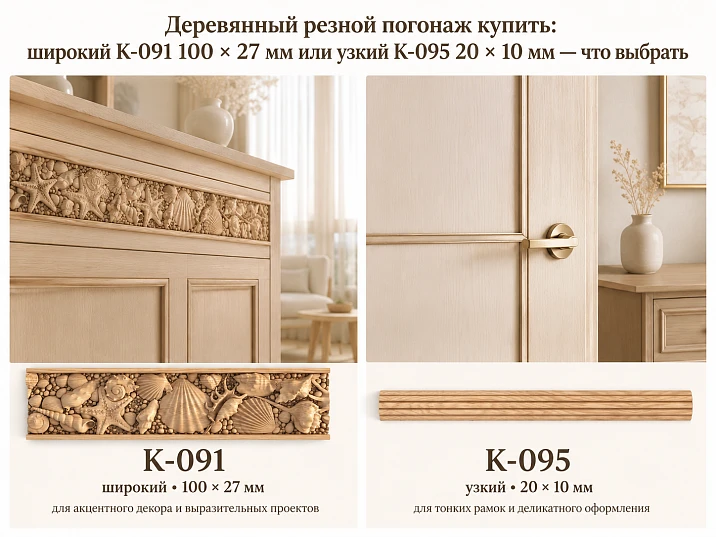
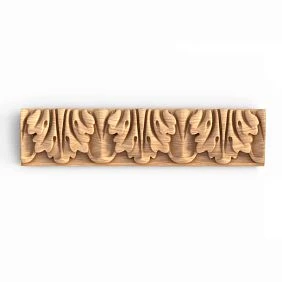
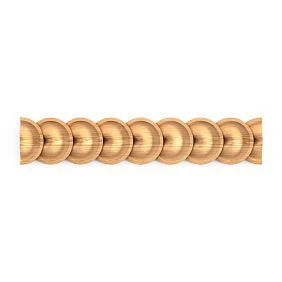
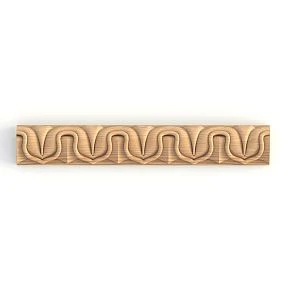
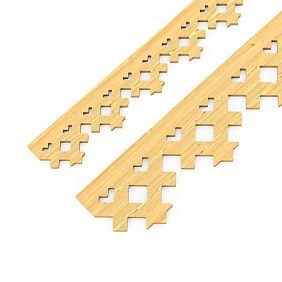
Wooden carved molding can be purchased both as a main decorative belt and as a thin frame line, but K-091 and K-095 solve these tasks differently. K-091 has a cross-section of 100 × 27 mm and a rich ethnic "seashell" ornament. K-095 is significantly more compact: its cross-section is 20 × 10 mm, and the pattern is built on calm longitudinal convex stripes.
K-091 is five times wider and almost three times thicker than K-095. On a large wall panel, wide cabinet, headboard, or large door, it reads as an independent frieze. K-095 is suitable for furniture panels, small facades, cabinet doors, decorative frames, and repeating vertical or horizontal lines. It is easier to place next to a handle, overlay, or rosette without overloading the surface.
Both models are made from beech or oak, available with "Standard" or "Prestige" sanding. Beech is chosen for opaque enamel, oak for tinting while preserving natural texture. For K-091, lengths of 500 and 2000 mm are confirmed; for K-095, 300 and 2000 mm. The short format helps work with local inserts, while the long format allows assembling extended lines with fewer joints.
The choice cannot be made based solely on a photo. You need to consider the scale of the facade or wall, viewing distance, depth of chiaroscuro, position of handles, future finish, and cutting layout. The article covers dimensions, joining, quantity calculation, combination with rosettes R-082 and R-083, overlays N-418 and N-419, installation, and mistakes that lead to an overloaded frame or too weak decor.
Short answer. K-091 is worth buying when you need a wide independent frieze that immediately sets the character of a wall panel, headboard, door, cabinet, or large mirror. K-095 is chosen for a narrow frame, furniture panel, door, facade, or extended line next to other decor.
K-091 cannot be considered simply an enlarged K-095: the models have different ornaments, thickness, scale, and role in the composition.
Buy wide wooden baguette K-091 Buy narrow wooden baguette K-095 Choose carved solid wood molding
Confirmed dimensions, materials, and purpose
| Parameter | K-091 | K-095 |
|---|---|---|
| Cross-section | 100 × 27 mm | 20 × 10 mm |
| Short length | 500 мм | 300 мм |
| Long version | 2000 мм | 2000 мм |
| Material | Beech or oak | Beech or oak |
| Sanding | "Standard" or "Prestige" | "Standard" or "Prestige" |
| Preparation | Beech under enamel, oak under tinting | Beech under enamel, oak under tinting |
| Ornament | Ethnic motif "seashells" | Longitudinal convex stripes |
| Nature of the Pattern | Rich, chaotic, independent | Calm, linear, versatile |
| Main role | Main frieze or decorative belt | Frame, panel, or dividing line |
| Application | Furniture, doors, cabinets, headboards, walls, large compositions | Door panels, wall panels, furniture fronts, frames |
| Joining | A chaotic pattern makes it easier to join elements | A simple linear pattern is easy to align |




What is carved molding and why is it needed
Carved molding is a ready-made decorative wood profile sold in fixed-length segments, used for frames, panels, friezes, doors, furniture, and wall panels.
The buyer gets a repeatable pattern and precise cross-section, not a random strip that would need to be manually cut or routed.
The main practical task is to match the profile scale to the surface. A too-wide element will overwhelm the facade, a too-narrow one will get lost on a large wall.
The general principle is explained in the material about how to choose baguette molding for a frame, mirror, furniture, and portal.
Our factory also produces:
Why K-091 and K-095 cannot be considered interchangeable
The difference in width is 80 mm, and in thickness — 17 mm. This changes the light and shadow, the distance to the handles, the amount of free space, and the way the ornament is perceived.
K-091 occupies a significant part of the facade and works as the main decorative belt.
K-095 retains more free surface and helps to assemble a frame around the central overlay or panel.
The choice is based on the role of the decor, not on the desire to buy a larger or more compact option without a layout.
Get Consultation
When to buy K-091
The model is suitable for a large wall panel, a wide cabinet, a bed headboard, a large door, and the framing of a large mirror.
The "seashell" ornament should be visible from a distance and become an independent theme.
The width of 100 mm requires free space around it and is not suitable for a tight furniture panel.
For a large composition, you can Buy carved molding K-091 in lengths of 500 or 2000 mm.
When to buy K-095
The model fits a small door, a dresser front, a door panel, a frame, and a repeating linear layout.
The 20 × 10 mm section is easier to place next to the handle and complement with an overlay or rosette.
The calm pattern does not draw attention away from the central decor.
For such a task, you can buy carved molding K-095 in lengths of 300 or 2000 mm.
K-091 or K-095: comparison based on real scenarios
| Scenario | K-091 | K-095 | What to Check |
|---|---|---|---|
| Small furniture front | May overload the surface | Fits better | Free space and distance to the handle |
| Large wall panel | Reads well | May get lost | Viewing distance and lighting |
| Wide door | Works as a standalone frieze | Creates a thin panel | Canvas and handle scale |
| Frame around the mirror | For a large mirror and strong ornament | For a small or multi-layer frame | Support base and glass mounting method |
| Combination with overlay | Often it's enough to use separately | Convenient to complement with central decor | So that the patterns don't compete |
| Horizontal belt | Expressive main frieze | Thin dividing line | Wall height and adjacent profiles |
| Layout | 500 and 2000 mm | 300 and 2000 mm | Joints, corners, and technological allowance |
| Finishing | Deep pattern is especially sensitive to thick layer | Linear relief is easier to paint evenly | Test swatch |
Why a fivefold difference in width changes the result
On a furniture door, a width of 20 mm is perceived as a neat line, while 100 mm occupies most of the field and turns into an independent insert.
On a wall, the situation is reversed: K-095 can become too thin, especially if the panel is viewed from several meters away.
K-091 preserves the readability of the ornament and creates a powerful chiaroscuro due to its thickness of 27 mm.
The scale should be evaluated on a full-size mockup, not on a small photo of the card.
How the thickness of 27 and 10 mm affects
K-091 protrudes significantly more from the surface and creates a deep shadow.
Next to a handle, trim, or furniture edge, such a protrusion requires more clearance.
K-095 is thinner and fits more easily into the frame, but still needs to be checked against adjacent details.
A transverse cardboard template shows the actual protrusion better than a frontal printout.
How to choose based on viewing distance
Up close, the buyer sees fine transitions of the pattern and the quality of the finish.
At a distance, some details merge into a common stripe.
K-091 retains its character on a large wall and large furniture.
K-095 reveals itself better on a facade, door, and frame that are viewed from close range.
How to choose by free field
A wide frieze needs a background so the ornament does not hit the edges.
On a narrow panel, K-091 may leave too small margins and visually expand the facade.
K-095 allows you to preserve air and place a central overlay.
Before ordering, not only the profile itself is marked, but also the free areas around it.
How the furniture handle affects
The handle should remain comfortable, and fingers should not touch the protruding relief.
K-091 is placed further from the grip area, especially on the cabinet door.
K-095 is easier to run next to the handle, preserving the workspace.
The test facade is opened several times before final installation.
How lighting affects
Side light enhances the depth of the K-091 ornament and makes the "seashell" motif even more noticeable.
On K-095, the light creates calm longitudinal highlights.
With frontal diffused lighting, both profiles look softer.
The sample is evaluated under daylight and evening light.
How to choose for a furniture panel
For a small panel, K-095 is more suitable because the 20 mm width leaves room for the central field.
K-091 is only appropriate on a large door or wide panel, where 100 mm does not overwhelm the composition.
The frame size is calculated together with the corner cuts.
The placement of the handle and hinges is checked before cutting.
How to choose for a wall panel
K-091 can serve as a top or central frieze that unifies a large surface.
K-095 is suitable for inner frames, repeating rectangles, and dividing lines.
On one wall, both scales can only be used with a clear hierarchy.
If every profile tries to be the main one, the panel looks cluttered.
How to choose for a door
On a wide classic door K-091, it can form an independent belt.
On a standard paneled door K-095, it often looks more proportional.
The profile should not interfere with the handle, lock, and door leaf fit.
The frame is checked with the door fully closed and open.
How to choose for a cabinet
A large cabinet with wide fronts accepts K-091 as a strong decorative element.
On narrow doors, it is better to use K-095 and center overlays.
The pattern should continue between paired fronts or be intentionally interrupted.
Before installation, all doors are laid out next to each other.
K-091 as an independent horizontal frieze
The 100 mm width allows the profile to be used without the mandatory addition of other carved elements.
The ornament forms its own narrative and can complete the upper part of a wall panel or wide facade.
On a long wall, it is important to determine the height of the frieze relative to furniture, doors, and the cornice.
A placement that is too low may conflict with the back of a sofa or headboard.
K-095 as a thin frame line
The 20 × 10 mm section is suitable for rectangular and square frames on furniture and walls.
Longitudinal convex strips create a calm relief and do not interfere with the central overlay.
The profile can be repeated in several rows if equal margins are left between the lines.
The frame is first constructed on the drawing, then transferred to the surface.
K-091 for a bed headboard
On a wide headboard, the profile can become the main decorative band.
The "seashell" motif reads better when there is a free plane or calm upholstery around it.
A thickness of 27 mm requires checking next to the textile and wall.
Beech for enamel or oak for tinting are chosen together with legs, frame, and cabinets.
K-095 for bed headboard
A narrow baguette fits the frame around the central panel or soft insert.
It does not take up much space and can be repeated along several contours.
The longitudinal pattern easily connects with the vertical lines of the cabinet and doors.
On a large headboard, the profile is checked from a distance so that it does not get lost.
K-091 for large mirror
A wide ornament suits a large interior composition where the frame should be noticeable.
However, decorative molding cannot automatically be considered a load-bearing frame for glass.
The mirror must have a separate structure and secure fastening.
The baguette is used as a decorative framing after design verification.
K-095 for mirror frame
A narrow profile suits a small frame or an inner contour around a ready-made load-bearing base.
It preserves more mirror surface and blends more easily with furniture.
With a large mirror size, a single line of K-095 may be visually insufficient.
Then multiple contours are used or another profile is chosen after a mockup.
K-091 for furniture facade
On the wide front of a sideboard, cabinet, or chest of drawers, the frieze creates a strong central belt.
Handles and plates should be subdued enough not to compete with the ornament.
On a small door, the profile may take up excessive space.
Before ordering, a paper strip 100 mm wide is applied to the front.
K-095 for furniture front
The profile helps assemble a frame around the panel, central overlay, or smooth field.
Width 20 mm is suitable for cabinet doors, nightstands, and chests of drawers.
More space remains for fingers next to the handle.
For compact decor, you can see lengths K-095 300 and 2000 mm and choose a convenient cutting format.
K-091 for door portal
On a large portal, a wide frieze supports the architectural scale.
The ornament can run along the top or become a separate horizontal insert.
Vertical application requires checking the pattern direction and joints.
K-091 cannot be used on a regular narrow trim without sufficient support surface.
K-095 for door panel
The narrow profile suits inner frames and repeating rectangles.
It conflicts less with the trim, handle, and lock.
The 2000 mm length is convenient for long sides, short 300 mm ones for small inserts and local areas.
Corner cuts are calculated before ordering.
K-091 for an accent wall
A wide frieze can divide the wall horizontally or frame a large panel.
It reads well from a distance and does not require close proximity to other carved elements.
The ornament should be connected to the furniture and textiles, otherwise a nautical or ethnic theme will look random.
For such a project you can choose a wide ethnic molding for the wall.
K-095 for a repeating rhythm
A thin profile is convenient to repeat on several doors or wall panels.
An identical step creates a cohesive system without an overloaded ornament.
A linear pattern makes it easier to align adjacent segments.
For a series of facades, one control template retains the same fields.
Short module K-091, 500 mm long
The format suits a local fragment, a trial layout, a small insert, and an area where a long plank would need heavy trimming.
On a 500 mm wall panel, it can be used as a standalone central module.
For a long frieze, many short elements create more joints.
The quantity is calculated based on the layout, not the convenience of individual packaging.
Long K-091, 2000 mm long
Two-meter linear elements reduce the number of joints on the wall, headboard, and wide cabinet.
A chaotic pattern simplifies joining, but the joint position is still planned.
The long plank is checked along the delivery route, storage, and the possibility of even cutting.
The main visible sections receive the most solid segments.
Short K-095 300 mm long
The format is suitable for a small panel, short side of the frame, sample, and local repair.
It helps reduce waste if the surface dimensions are close to 300 mm.
For a large rectangular frame, many short planks increase the number of joints.
Before purchasing, compare the cutting layout of short and long versions.
Long K-095 2000 mm long
The two-meter version is convenient for vertical lines, doors, tall facades, and wall frames.
The simple pattern allows for neat joining of segments when necessary.
A long plank helps obtain two or more sides of the frame with less waste.
Cutting begins with the longest sections.
How to choose a short or long version
First, draw the composition and record the length of each straight section.
Then distribute two-meter planks to the longest sides.
Short modules are used where they almost match the required size.
Buying only short or only long elements without a cutting map is inefficient.
How to position the K-091 joint
It is better to move the joint away from the central viewpoint and the corner where several lines converge.
The chaotic pattern of "seashells" helps make the transition less noticeable.
Two parts are preliminarily dry-fitted and the calmest continuation of the pattern is selected.
After finishing, the joint should not turn into a separate vertical strip.
How to position the K-095 joint
Longitudinal convex strips should continue without a step.
The connection is placed on a straight section, not near a corner cut.
The ends are checked for tightness and uniform profile height.
For a painted frame, geometry is more important than trying to hide a poorly fitted joint with a thick layer of enamel.
How to align the pattern at corners
A corner cut changes the profile direction and requires precise symmetry.
On K-095, the linear pattern should neatly turn around the frame.
On K-091, the corner composition is more complex due to the width and richness of the ornament.
Before working with a full plank, it is useful to assemble a control corner from short fragments.
How to calculate a rectangular frame
Measure two vertical and two horizontal sides along the line of the future profile.
Add an allowance to each side required for the chosen corner joint method.
Then distribute lengths of 300, 500, and 2000 mm.
The total perimeter without cutting does not show the actual number of planks.
How to calculate a horizontal frieze
Measure the clear length of the wall or facade between the final boundaries.
Determine whether the frieze will be solid, symmetrical, or divided by a central element.
For K-091, two-meter planks reduce the number of joints.
Short modules are used for finishing or local accent.
How to calculate the baguette for a door panel
Measure the actual field after installing the handle, lock and other fittings.
The frame must have equal margins from the edges.
K-095 is more often suitable in scale and allows economical use of the two-meter length.
K-091 is used only on a really large panel after the layout.
How to calculate the baguette for a furniture facade
Each facade is measured separately, even if the doors seem identical.
Hinges, gaps and handles must not fall into the profile area.
For a series of doors, create one template and check it on all elements.
The order is calculated for a full set of furniture, not for a single sample.
What allowance to leave for cuts
A universal percentage cannot be given without a diagram.
The quantity depends on the number of corners, joints, pattern repeatability, and the installer's experience.
For a complex frame, the allowance is larger than for a single straight line.
First, a cutting map is created, then a reserve is added for test cuts and replacements.
How to use leftovers
Short fragments K-095 are suitable for small inserts, color samples, and repairs.
Remnant K-091 can be saved for checking tinting or replacing a local area.
Trimmings are marked with article number, material, and finish.
Random mixing of residues from different batches and species is not allowed.
Beech under white enamel
Beech is chosen when the molding needs to have an opaque white color and match a furniture front, door, or wall panel.
On K-091, white enamel emphasizes deep chiaroscuro, but a thick layer can smooth out the ornament.
On K-095, a solid finish maintains a calm linear character.
A test coating is done before processing the entire set.
Beech under colored or black enamel
Colored enamel allows the baguette to be linked with furniture, a wall, or a door system.
Dark K-091 looks particularly graphic and can become the main accent.
Black K-095 creates a thin contrasting frame.
The gloss level is coordinated with adjacent surfaces, not chosen separately.
Oak under tinting
Oak is chosen to preserve the natural wood texture.
On the wide K-091, the fiber pattern interacts with the rich thread, making the frieze even more active.
On K-095, the texture reads more calmly along the longitudinal lines.
The shade is compared with doors, floor, furniture, and central decor.
Beech or oak for furniture
Beech under enamel is convenient if the frame must match the painted facade.
Oak under tinting suits a natural wardrobe, sideboard, chest of drawers, or headboard.
One frame should not accidentally combine different wood species.
The material is recorded in the specifications for all slats and related elements.
Beech or oak for the wall panel
Painted beech helps integrate the profile into the wall color or create a contrasting band.
Oak creates an independent wooden line and requires coordination with other natural elements.
K-091 made of oak becomes especially expressive.
K-095 allows the wood to remain a more subtle accent.
Sanding "Standard" or "Prestige"
Both models are available in two confirmed sanding options.
The buyer must select the option in the product card and order the entire set uniformly.
Sanding is not a finished paint coating.
For complex finishing, it is useful to test the full cycle on one sample.
Why sanding does not replace finishing
Prepared wood still needs the chosen system of enamel or tinting.
An untreated profile gets dirty faster and may differ in shade.
K-091 has deep areas where it is especially important to apply the coating evenly.
K-095 requires maintaining clear longitudinal stripes.
How to avoid flooding K-091 with enamel
A thick layer can smooth the edges of shells and reduce the depth of the ornament.
The material is applied using an approved technology in thin, controlled layers.
The test sample is examined under side lighting.
If the pattern loses readability, the painting system is adjusted before the main batch.
How to paint K-095 evenly
The longitudinal profile seems simple, but runs immediately create a noticeable uneven line.
The corners of the frame and joints are processed with particular care.
The solid enamel must maintain uniform gloss on all slats.
The test facade is accepted before finishing the rest of the furniture.
Paint before or after installation
Pre-finishing provides access to side surfaces and makes it easier to work with deep ornamentation.
Post-installation finishing helps hide joint marks and small transitions.
The optimal sequence depends on the base, corners, and chosen coating.
For a complex frame, a test assembly is useful.
How to coordinate the finish of the molding and overlay
The central decor and frame should match in material or be based on a deliberate contrast.
K-095 is often combined with overlays, so the difference in shades will be noticeable.
K-091 is usually self-sufficient, but a rosette or central element requires particularly careful coordination.
All parts are viewed together before painting.
How to coordinate the finish of the baguette and the handle
A metal or wooden handle becomes part of the overall composition.
Dark hardware on light K-095 creates a graphic contrast.
Next to K-091, the handle should be calm enough and not compete with the ornament.
The position and color are checked on the fully assembled facade.
How to prepare a furniture facade
The surface must be smooth, durable, clean, and ready for the chosen finish.
The frame is marked along the central axes and equal offsets.
On painted MDF, the compatibility of the mounting compound with the coating is checked.
The profile should not overlap the technological gaps and hardware fastenings.
How to prepare the wall
Weak paint, crumbling plaster, and noticeable waviness of the base prevent tight adhesion.
K-091, 100 mm wide, is especially good at showing unevenness along the long top edge.
K-095 is thinner, but also does not hide large defects.
The base is put in order before cutting and painting the profile.
How to choose glue
The composition must be compatible with both wood and the base.
Painted facade, MDF, plaster, wood, and laminated surface may require different solutions.
Universal glue cannot be recommended without checking the specific project.
In this section you can select glue for carved moldings and finishing materials after compatibility verification.
How to perform a dry layout
All pieces are placed without final fixation.
Check corners, joints, pattern continuation, and distance to handles.
K-091 is evaluated from a distance, K-095 — up close and across the entire frame.
A photo of the dry layout helps to see misalignments.
How to install the first line
The first horizontal or vertical line sets the geometry of the entire composition.
It is checked against the facade, door, floor, and adjacent frames.
An error of a few millimeters will repeat on all subsequent elements.
Fixation begins only after a re-check.
How to mount K-091
The wide profile requires even contact of the entire support surface.
The part is temporarily fixed so as not to damage the protruding ornament.
The joints are aligned before applying the final coating or according to an approved scheme.
A heavy or long section cannot be held with random weak tape.
How to install K-095
A narrow profile can easily shift along the line, so the marking must be precise.
Special attention is paid to corners and the parallelism of opposite sides.
On a long frame, several control points help maintain an even gap.
The glue should not come out onto the front surface.
How to finish an internal corner
Two profiles meet at the chosen angle and must match in height.
On K-095, longitudinal stripes emphasize an inaccurate cut.
On K-091, a wide pattern requires preliminary selection of the most seamless joint.
The control angle is assembled on a separate fragment.
How to design an external corner
The external corner is more noticeable and more often subjected to accidental impacts.
The ends must be carefully aligned without a step.
K-091 creates a large protrusion, so it is especially important to protect it in the walkway area.
K-095 is lighter in scale, but the thin edge also requires precise installation.
How to hide the joint without losing the pattern
The joint is masked by precise fitting, not by a thick layer of putty or enamel.
On K-091, a chaotic ornament helps distribute attention.
On K-095, the line must continue evenly.
The composition for local treatment is checked on the residue.
How to store moldings before installation
The planks are placed horizontally on a flat support.
The carved relief is protected from friction and point load.
Short and long options are marked by article, material, and room.
Painted parts are separated with soft gaskets.
How to accept an order upon receipt
Check the article, cross-section, length, material, sanding, and quantity.
K-091 must match the size 100 × 27 mm, K-095 — 20 × 10 mm.
All elements of one composition are laid out side by side and inspected before finishing.
Questions are resolved before cutting and installation.
How to care for painted beech
Care rules are determined by the enamel and protective coating.
Dust from relief K-091 is removed with a soft brush or cloth.
K-095 is cleaned along the longitudinal stripes without abrasives.
Local repair begins with checking the color on a leftover piece.
How to care for tinted oak
The care product must be compatible with the finish coating.
Strong friction may change the gloss of protruding areas.
Moisture is not left in recesses or near joints.
The finishing sample is preserved after installation.
K-091 in the living room
A wide frieze suits a wall panel, a large mirror, the headboard of a sofa area, or a decorative belt above furniture.
The ornament should be connected with the textiles, wood, and overall theme of the room.
If the living room already has many active textures, K-091 is better used locally.
On a long wall, the position of joints is calculated in advance.
K-095 in the living room
A narrow profile suits a molding grid, a frame around a panel, and furniture facades.
It helps connect several zones with a single repeating contour.
On a large wall, one line is checked from a distance so that it does not get lost.
If necessary, use several frames with the same fields.
K-091 in the bedroom
On the headboard or wide wall panel, the profile creates a noticeable decorative belt.
The "seashell" motif suits an interior where an ethnic or marine theme is genuinely supported.
Too close proximity to a textile pattern can overload the wall.
Beech under enamel allows the ornament to be calmer, oak — more expressive.
K-095 in the bedroom
The profile is suitable for a frame on the headboard, wardrobe doors, and vanity table.
The width of 20 mm does not take up much space and is easily repeated.
The central overlay or rosette can be added after checking the scale.
All frames on paired facades are placed symmetrically.
K-091 in the hallway
On a large cabinet or wide wall panel, the frieze can become the main accent.
In a narrow corridor, the 27 mm protrusion and 100 mm width are checked especially carefully.
The profile should not fall into the door opening and passage area.
Light enamel reduces visual heaviness.
K-095 in the hallway
A narrow baguette is suitable for cabinet doors, mirror frames, and small wall panels.
It leaves more free space and does not interfere with handles.
A repeating contour helps connect several doors.
Material
K-091 in a nautical or ethnic theme
The ornament's name is directly related to the 'seashell' motif.
The profile is appropriate when the theme is supported by color, materials, and other items.
A single wide frieze is often expressive enough without additional overlays.
A nautical motif does not automatically mean suitability for a bathroom or outdoor environment.
K-095 between classic and modern interior
Longitudinal stripes look calmer and fit more easily into a transitional style.
The profile can be painted in the color of the facade, leaving only the chiaroscuro.
Oak with a tint adds a natural character.
The neutrality of K-095 makes it a convenient background for a more expressive overlay.
How to use two profiles in one project
K-091 can be assigned as the main frieze on the wall, and K-095 as a thin line on the furniture.
This combination works if the scales are separated and do not compete on one small surface.
It is better to coordinate the material and finish.
Using both profiles on one facade without a full-size layout is risky.
How to combine K-091 with sockets
The wide frieze is already saturated, so the socket should have a clear function — center, completion, or a separate accent.
To check, you can select a socket for the wide K-091 and compare the scale on the layout.
Another option is select a central element for a wide frieze.
Do not add both sockets and several overlays simultaneously without hierarchy.
How to combine K-095 with overlays
The narrow frame leaves room for the central carved element.
You can select a compact decor for K-095 for a furniture front.
For another composition, a link is suitable Central overlay for the facade after checking the dimensions.
The frame and overlay are placed along a common axis.
Error: choosing only by photo
The frontal shot does not show the actual width and protrusion.
K-091 and K-095 may appear similar linear details, although they occupy the surface completely differently.
The paper cross-section template immediately shows the scale.
Before a large order, it is useful to obtain or make an accurate mockup.
Error: consider K-091 as an enlarged K-095
The models have different ornaments and purposes.
K-091 is an independent frieze with "sea shells", K-095 is a calm linear profile.
Replacing one with the other changes the entire composition.
The choice is made based on role, not width as the only parameter.
Error: placing K-091 on a narrow panel
A width of 100 mm can take up almost the entire field and leave random edges.
A thickness of 27 mm will further increase the visual mass.
K-095 is more suitable for a small door.
The layout is applied together with the handle.
Error: using K-095 on a large wall without checking
A single thin line may be lost from a distance.
On a large panel, the profile is used as a series of frames or a larger option is chosen.
K-091 better preserves readability.
The main viewpoint is determined before ordering.
Error: not accounting for the 27 mm protrusion
The wide K-091 noticeably protrudes forward.
It may interfere with the handle, door, adjacent profile, or passage.
The front layout does not show this issue.
A 27 mm thick volumetric template is needed.
Error: placing K-091 too close to the handle
Fingers will touch the threads, and the ornament will get dirty faster.
The handle must have a free working area.
K-095 is easier to place nearby due to its smaller cross-section.
Before fixing, the facade is opened several times.
Error: considering the baguette as a ready-made load-bearing frame
The molding performs a decorative function.
A mirror, glass, or painting requires a separate base and secure fastening.
Do not transfer load to the decorative profile without calculation.
The frame structure is designed separately.
Error: buying without a cutting diagram
The total perimeter does not show the number of two-meter and short planks.
Without a map, you can get a lot of waste or extra joints.
First, distribute long sections.
Then add short modules and allowance.
Error: painting with a thick layer
K-091 loses ornament depth, K-095 loses clarity of longitudinal stripes.
Drips are especially noticeable on corners and joints.
A test coat is mandatory.
The finishing system is adjusted before working with the entire batch.
Error: mixing beech and oak in one frame
Wood species look different under the finish.
Under a transparent system, the difference becomes especially noticeable.
Even under enamel, the preparation may differ.
The entire set is ordered from one confirmed material.
Error: mixing sanding types
"Standard" and "Prestige" must not be accidentally combined in one series of facades.
The difference in preparation will affect the finish.
In the order, the sanding option is specified for each item.
The kit is checked upon receipt.
Error: do not check the direction of the pattern
Linear K-095 must maintain a single orientation on all sides of the frame.
K-091 requires deliberate placement of the ornament on adjacent segments.
An inverted part may disrupt the rhythm.
Orientation is marked before cutting.
Error: using a marine motif as a promise of moisture resistance
The name of the ornament does not confirm suitability for wet rooms.
Material, coating, substrate, and operating conditions must be agreed upon separately.
K-091 cannot be automatically recommended for a bathroom.
Before ordering, check the specific project.
Error: overloading K-091 with additional decor
A wide frieze already has a rich narrative.
Several large rosettes and overlays can create competition.
The addition is used only with a clear role.
Sometimes it's better to leave K-091 as the only carved accent.
Error: leaving K-095 without a central meaning
A narrow frame can look empty if the field is too large.
In this case, add an overlay, rosette, panel, or a second line.
Each element must be connected by a common axis.
Random filling with multiple parts is not allowed.
Who K-091 suits
The model suits a large wall, wide cabinet, headboard, large door, and interiors with a pronounced ethnic theme.
It is needed by a buyer who wants a standalone frieze.
The profile is clearly readable from a distance.
On small furniture, it may be excessive.
Who K-091 does not suit
The model does not suit a narrow door, cramped panel, or area near a handle without free space.
It can overload an interior with many other carved details.
The 27 mm protrusion requires space.
For a thin frame, it's better to choose K-095.
Who K-095 is suitable for
The model is suitable for furniture frames, door panels, small facades, and repeating lines.
It is convenient for combining with overlays.
The 20 × 10 mm cross-section preserves the free field.
On a huge wall, a single line needs to be checked from a distance.
Who K-095 is not suitable for
The profile may get lost on a large panel or wide portal.
It does not create as independent an ethnic accent as K-091.
For a large headboard, several contours may be required.
Sometimes it is more rational to choose a wider profile.
Practical choice: dresser front
On a small drawer or door, K-095 is often more suitable.
The profile creates a frame and leaves space for the handle and central overlay.
K-091 is used only on a wide front after a full-size check.
All elements of the dresser are marked simultaneously.
Practical choice: built-in wardrobe
On wide doors, K-091 can create a horizontal band that repeats throughout the composition.
K-095 is convenient for separate frames on each door.
The pattern should continue between paired fronts or have a clear finish.
Handle positions are determined before cutting.
Practical choice: wide interior door
K-091 is suitable for a large insert or top frieze.
K-095 forms the inner frame and is easier to match with the casing.
The profile must not fall into the lock area or the panel's adjoining zone.
The layout is evaluated from both sides of the door.
Practical choice: small door panel
K-095 is almost always safer in terms of scale.
A width of 20 mm allows preserving the central field.
K-091 may take up too much space and make the door heavy.
Frame corners are checked before ordering the full set.
Practical choice: panel above the sofa
K-091 can serve as the lower or upper decorative belt of a large composition.
K-095 is suitable for a thin frame around the image.
The panel's load-bearing base and mounting are calculated separately.
Distance to the sofa and sconces are considered when choosing the projection.
Practical choice: niche
In a deep niche, side lighting enhances the relief.
K-091 creates a strong shadow and can become an independent focal point.
K-095 is suitable for thin framing of shelves or an inner panel.
The size is checked inside the actual recess.
Practical choice: buffet or display case
A wide facade can accept K-091 as a central frieze.
Decorative molding on glass doors cannot be used as the sole load-bearing frame.
K-095 fits the inner contour around safely installed glass.
Glass mounting is designed independently.
Practical choice: series of identical facades
K-095 is convenient for a repeating frame due to its linear pattern.
One template helps maintain consistent indents.
K-091 can be used as a single belt across multiple facades if the pattern is consistent.
The entire set is ordered as one batch.
Practical choice: repairing old furniture
Ready-made millwork helps cover an empty surface and create a new frame.
First, check the strength of the old coating and the geometry of the facade.
K-095 is easier to fit into the existing scale.
K-091 is suitable for a major overhaul where decor becomes the main focus.
Practical choice: custom-made new furniture
The profile is included in the drawing before manufacturing the facades.
This way, you can leave margins in advance, determine handles and attachment points.
K-091 requires more free space and thicker construction.
K-095 is easier to integrate into a multi-layer frame.
Practical choice: classic interior
Both models suit classic furniture but provide different levels of saturation.
K-091 creates a bright ethnic frieze.
K-095 supports calm paneled geometry.
The material and finish are linked to doors, baseboards, and furniture.
Practical choice: modern interior
K-095 is easier to use as a thin line in the color of the facade.
K-091 can work as a single contrasting artistic accent.
Many other carved details are not required in a modern space.
The layout is tested against minimalist furniture.
How to choose a different profile if both models don't fit
Sometimes 100 mm is too much, and 20 mm is too little.
There are other sections, patterns, and lengths in the category.
You can view wide and narrow profiles and select an intermediate scale.
You cannot choose an unsuitable item just because you like the material.
How to buy on STAVROS
First, determine the role: a standalone frieze or a frame line.
Then check the section, length, material, and finish.
After calculation, open the card of the desired model and related elements.
For a general selection, you can Buy wooden picture frame molding through the carved molding category.
What to buy together with K-091 and K-095
The wide K-091 is more often used independently, so it should be supplemented carefully. The socket or central element should support the frieze, not compete with the "seashell" motif. The narrow K-095 is easier to include in a set: it creates a frame, while the N-418 or N-419 overlay forms the central accent.
Mounting and finishing materials are selected after determining the base, species, and future coating. Beech and oak require different visual approaches, and the adhesive must be compatible with both the wood and the surface of the furniture, door, or wall.
| What to add | Why | For which scenario | What to Check |
|---|---|---|---|
| K-091 size 100 × 27 mm | Create an independent wide frieze | Wall, headboard, cabinet, large door | Free field, protrusion, and length |
| K-095 size 20 × 10 mm | Assemble a thin frame or line | Facade, panel, door, small mirror | Corners, handle, and symmetry |
| Buy wooden rosette R-082 | Add a central accent to a wide frieze | Large wall or furniture panel | So that the decor does not overload K-091 |
| Buy carved rosette R-083 | Complete an independent composition | Panel, cabinet, door, headboard | Scale and common axis |
| Buy wooden overlay N-418 | Create a center inside frame K-095 | Chest of drawers, wardrobe, furniture door | Field size and material |
| Buy carved overlay N-419 | Assemble a furniture composition from a frame and overlay | Wide facade or panel | Finish and handle position |
| Buy materials for installing a wooden baguette | Prepare the base, fastening, and finish | Furniture, door or wall | Compatibility with wood and coating |
| Catalog of wooden baguettes STAVROS | Compare other profiles | When 100 and 20 mm don't fit | Section, ornament, length, and material |
How to choose one profile for the entire furniture collection
If a chest of drawers, wardrobe, cabinet, and sideboard belong to the same series, identical trim helps connect them without fully repeating the facades. K-095 is more convenient for this approach: the thin frame maintains a unified language and does not overload small doors. K-091 can be reserved for one main piece — for example, a wide sideboard or headboard — so it doesn't compete with the rest of the furniture.
Before ordering, it's useful to lay out all facades on one diagram and check which profile truly repeats without losing scale. If K-091 is used only once, its color and material still connect it to the other elements. If K-095 runs through the entire series, it's especially important to order the same sanding and finish the set in one batch.
How to estimate the total project budget
The price of one strip does not reflect the cost of a finished frame or frieze. You need to account for the number of short and long pieces, allowance for corners, test painting, rosettes, overlays, and mounting materials. K-091 may require fewer additional parts, but its large format increases demands on layout and finishing. K-095 is cheaper to evaluate only after calculating the total perimeter and number of frames.
It's worth comparing two complete specifications: a version with a wide standalone frieze and a version with a narrow profile plus central decor. Such a calculation shows the real difference and helps order a full set without later surcharges for missing elements.
FAQ: Questions about K-091 and K-095
How is K-091 different from K-095?
K-091 — wide frieze 100 × 27 mm with a "seashell" motif. K-095 — narrow profile 20 × 10 mm with longitudinal convex stripes.
How much wider is K-091 than K-095?
Five times: 100 mm vs 20 mm.
How does the thickness differ?
K-091 has a thickness of 27 mm, K-095 — 10 mm.
Which baguette is suitable for a small furniture front?
Usually K-095, because it leaves more free field and space near the handle.
Which profile to choose for a large wall panel?
Usually K-091, since the wide ornament is better readable from a distance.
Can K-091 be used for a door panel?
Only on a large panel after a full-size check. On a small door, the profile may be too wide.
Will K-095 fit a large mirror?
As a thin decorative contour — yes, but on a large mirror, a single line may be visually insufficient.
What does the 'seashell' ornament mean?
The K-091 card describes a rich ethnic motif. The name does not imply confirmed moisture resistance.
Which pattern is easier to match?
Both are designed for joining: the chaotic K-091 pattern hides transitions, the linear K-095 is easily aligned along the strips.
What length is available for K-091?
500 and 2000 mm.
What length is available for K-095?
300 and 2000 mm.
What to choose for white enamel?
Beech
How to preserve the texture of an oak baguette?
Select oak for tinting and check the finish on a sample.
What is the difference between the "Standard" and "Prestige" sanding options?
These are two confirmed preparation options. The specific choice must be made in the product card; sanding does not replace the final finish.
Is it necessary to paint the molding before installation?
The order depends on the project. Pre-finishing makes it easier to access the relief, while finishing after installation helps treat the joints.
How to calculate the amount of baguette?
Draw all straight sections, distribute lengths of 300, 500, and 2000 mm, determine joints, and add allowance for cuts.
What allowance should be left for cuts?
There is no universal percentage. It depends on the number of corners, joints, and complexity of the pattern.
Can K-095 be combined with carved overlays?
Yes, the profile works well as a frame for N-418 or N-419 after checking the dimensions.
Which sockets fit the wide K-091?
The diagram shows R-082 and R-083, but their scale needs to be checked on the mockup.
Can these profiles be used as a ready-made frame for glass?
Not automatically. They are decorative trim, and glass or mirror requires a separate load-bearing base and fastening.
Can K-091 be used in a bathroom?
The ornament name does not confirm suitability for wet rooms. Conditions need to be agreed separately.
What to choose near a furniture handle?
Most often K-095 due to its smaller cross-section.
Where to buy K-091 and K-095?
In the corresponding product cards or through the STAVROS carved molding category.
What should be checked before ordering?
Cross-section, length, material, sanding, pattern, cutting, angles, finish, base, and accompanying decor.
How to check the full-size layout K-091
Cut a strip 100 mm wide from paper or cardboard and add a side template 27 mm thick.
The layout is applied to the facade, door, or wall along with the handle and adjacent profiles.
Then step back to the main viewpoint and assess whether the frieze occupies too much area.
This test helps reject an unsuitable scale before purchasing the wood.
How to check the full-size layout K-095
Mark a line 20 mm wide on the surface and assemble the full contour of the future frame.
Place a template of the overlay, rosette, or central field inside.
Check the same indents and handle position.
If the line is lost from a distance, the frame is reinforced with a second contour or a different profile is chosen.
How to check the combination of K-091 and K-095
Profiles are laid out at different levels and not made equivalent.
K-091 is assigned as the main element, K-095 as an auxiliary line.
Enough free surface is left between them.
If the composition looks too saturated, one of the profiles is removed.
How to check the finished facade
After installation, evaluate symmetry, angles, joints, and distance to the handle.
The facade is opened and closed several times.
Under side lighting, check for paint runs and steps.
Only after accepting the control facade are the remaining furniture elements designed.
How to check the finished wall panel
Look at the panel up close, from the center of the room, and from the entrance.
K-091 should preserve the ornament but not overwhelm the furniture.
K-095 should be visible as a deliberate line, not a random shadow.
Lighting is turned on in all design scenarios.
How to save order data
Record the article, cross-section, length, material, sanding, and finish.
Save the cutting layout, joint positions, and color sample.
For a series of facades, leave an indentation template.
This data simplifies local repairs and reordering.
Is a spare piece needed?
For one short insert, a reserve is not always mandatory.
For a series of facades, a long frieze, or a complex frame, a spare element is useful.
It is finished simultaneously with the main set.
The remainder is marked and stored without load on the relief.
Why finished molding is better than a random batten
For K-091 and K-095, the cross-section, pattern, material, lengths, and sanding options are confirmed.
A random batten does not create a carved ornament and requires self-processing.
A ready-made profile simplifies repeating the pattern on multiple facades.
The buyer focuses on cutting, finishing, and installation.
How to choose between wood and polyurethane profile
Wood is chosen for its natural material, the possibility of enamel or tinting, and its connection to furniture.
Polyurethane molding solves a different problem and is not a direct replacement in terms of texture.
The comparison reveals material about how a wooden baguette differs from a stucco molding.
The final choice depends on the base, finish, and character of the interior.
How to combine a baguette with other wooden profiles
Adjacent moldings, trims, and frames should have a clear hierarchy.
K-091 requires a calm environment, K-095 can repeat the geometry of other lines.
It is useful to see how to combine wooden profiles on the wall and furniture decor.
All elements are evaluated at the same scale and color.
Final check before payment
Check K-091 100 × 27 mm or K-095 20 × 10 mm, the required length and quantity.
Check beech or oak, sanding, and future finishing.
Make sure the cutting plan accounts for joints, corners, and technological allowance.
After that, add matching sockets, overlays, and mounting materials.
Result: wide frieze K-091 or narrow baguette K-095
K-091 is chosen for a large, independent accent. The cross-section of 100 × 27 mm, lengths of 500 and 2000 mm, and the "seashell" motif suit a wide wall panel, headboard, cabinet, door, and large mirror. The frieze is easily readable from a distance but requires free space and careful combination with other carved elements.
K-095 is chosen for furniture frames, panels, doors, facades, and repeating lines. The cross-section of 20 × 10 mm and lengths of 300 and 2000 mm help economically cut small and extended areas. The longitudinal convex strips easily combine with overlays N-418 and N-419 and leave space near the handle.
Both models are made from beech or oak with "Standard" or "Prestige" sanding. Beech is suitable for enamel, oak for tinting. Before ordering, you need to make a full-size mockup, create a cutting map, choose the position of joints, and conduct a test finish.
On the STAVROS website, you can open the cards for K-091 and K-095, go to the catalog of wooden moldings, select sockets, overlays, and mounting materials. A finished profile with confirmed dimensions helps create expressive decor without random mismatches in scale, pattern, and finish.