Article Contents:
- Short answer: when you need a wooden block
- How a wooden block differs from batten
- Where wooden blocks are used
- For walls and panels
- For furniture
- For decorative finishing
- For repairs and extensions
- For interior
- How to choose the cross-section of a wooden block
- How to choose material
- Wooden bar for furniture
- Wooden block for wall decor
- Block, batten, trim, and corner: what to choose for finishing
- What to look for before buying
- Wooden block for painting
- Wooden block in different scenarios: three live examples
- Mistakes when choosing a wooden block
- What to buy together with a wooden block
- FAQ: questions about wooden blocks
- About the Company STAVROS
There are materials that work in the shadows — literally. They are not visible in the finished interior, but without them, nothing holds, levels, or attaches. A wooden block is exactly that material. Modest, unobtrusive, technically precise. It hides behind wall cladding, inside furniture bodies, under decorative panels — and it is what makes the entire structure stable.
But Wooden block — is not only a mounting base. In the right hands, it becomes part of the decor, a restoration element, a support for furniture legs, and a base for visible decorative profiles. The question is how to choose the right one — by cross-section, wood species, moisture content, and purpose. That is exactly what we will cover in this article: consistently, practically, and without unnecessary words.
Short answer: when you need a wooden block
Before diving into details, let's provide a quick application map.
A wooden block is needed if:
-
You are assembling a frame — for walls, partitions, or lathing under panels;
-
Need a hidden mounting base for Wooden planks, moldings or cladding;
-
Need to reinforce or restore the furniture body from the inside;
-
Need to create a flat surface for attaching decorative elements;
-
Restoring old furniture — a wardrobe, chest of drawers, nightstand, sideboard;
-
Laying a technical base for a floor plinth or wall panel.
And an important caveat right away: if the element will be visible — if it ends up on the wall surface, in the interior, or on furniture — a regular construction block is not always suitable. For visible parts, you need a neat wooden profile with even geometry and good sanding: Wooden plank, Pogonazh iz massiva or Wooden molding.
This distinction is key. We'll break it down in detail further.




How a wooden batten differs from a slat
Confusion between a block and a batten occurs constantly — even among people professionally involved in repairs and furniture. Let's break it down honestly.
| Element | What it's suitable for |
|---|---|
| Wooden block | Frame, installation, reinforcement, hidden base, lathing |
| wooden plank | Visible wall finishes, furniture, decorative lines in the interior |
| Wooden molding | Joints, frames on furniture facades, decorative transitions |
| Wooden corner bracket | External and internal corners in finishes and furniture |
| Moldings from solid wood | Decorative frames, horizontal profile lines |
| Pogonazh iz massiva | General name for profiled wooden elements |
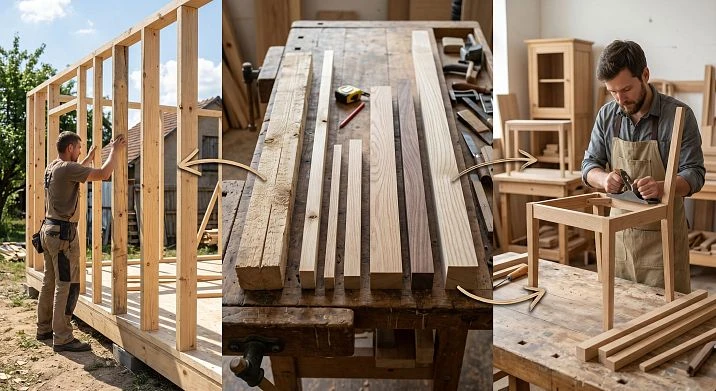
Fundamental difference. A block is a structural element. It can have knots, slight bends, and uneven surfaces — if it is hidden inside a structure, this is not critical. A batten is a visible element. It must be straight, with neat edges and high-quality sanding, because it is seen.
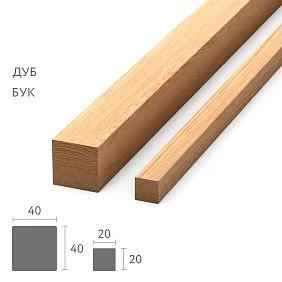
Cross-section. A block usually has a square or rectangular cross-section with an aspect ratio close to 1:1 or 1:2 — for example, 40×40, 50×50, 40×60, 50×70 mm. A batten is an elongated, flat, or narrow profile with an aspect ratio of 1:3 or more — for example, 20×60, 15×40, 10×30 mm.
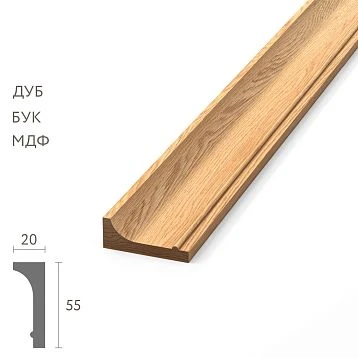
Processing. A construction block is often sold with a sawn surface — without sanding. Decorative Wooden plank for wall — always with a finish sanding and smooth edges. For interior tasks, this is a fundamental difference.
Our factory also produces:


Where a wooden block is used
Get Consultation
For walls and panels
One of the most common scenarios is creating a lathing or hidden frame for decorative wall panels. The bars are attached horizontally or vertically to the wall, forming a flat plane — and then the visible elements are mounted to them: Wooden boards in interior, facing panels, moldings.
Here, the bar solves several tasks at once: it levels an uneven wall, creates a ventilation gap behind the cladding, and provides a reliable base for fasteners.
For lathing under lightweight panels — a bar 25×40 or 30×50 mm. For heavier cladding — 40×60 or 50×50 mm. The installation step of the bar is determined by the panel size and its weight — usually 400–600 mm.
For furniture
Inside a furniture body, a wooden bar acts as a reinforcement and mounting base. It is attached from the inside of a cabinet, chest of drawers, or sideboard and serves as a base for attaching the back wall, fronts, shelves, or decorative elements.
When restoring old furniture — a Soviet cabinet, sideboard, or kitchen — bars are often used to reinforce loose joints. It's quick, inexpensive, and effective: the bar is cut to size, glued, and fixed with self-tapping screws in the corner — and the furniture becomes rigid again.
Fastening wooden legs to the body of a nightstand or chest of drawers also often goes through a mounting bar: it creates a wider area for fastening than the thin bottom of the body.
For decorative finishing
A wooden bar often serves as a hidden base for visible decorative profiles. This is especially relevant when installing veneer wood on plasterboard or hollow walls: plasterboard itself does not hold fasteners securely, but a pre-attached block does.
Similarly — during installation solid wood moldings on the wall: if the wall is uneven or made of hollow material, a hidden block creates a level base for fastening.
For repairs and extensions
In repairs, a block is constantly needed: underlays for flooring, extensions to compensate for differences, auxiliary parts for installation wooden baseboard for floor, fasteners for wooden corner piece in non-standard room corners.
A block in repairs is a universal consumable material. It is bought with a small margin because trims and extensions are inevitable in any project.
For interior
But what if the block should remain visible? This happens — in loft, rustic, industrial interior, Japanese minimalism styles. Here, exposed wooden elements are part of the design.
In this case, the block must be sanded, have even geometry, and a suitable wood species. For visible interior use, this is already closer to decorative wooden profile or batten, not a construction timber.
How to choose the cross-section of a wooden block
The question of cross-section is an engineering issue. A mistake here leads to two extremes: either a too flimsy structure or an unjustifiably heavy one.
For light installation tasks (underlays, extensions, mounting lightweight panels) — cross-section 20×30, 25×40 mm. These are economical formats that are easy to work with — they cut well and bend under slight pressure.
For battens under medium-weight wall panels — cross-section 30×50, 40×40 mm. They hold well and do not sag under standard loads.
For heavy cladding and loaded frames — 50×50, 40×60, 50×70 mm. Here, a suitable wood species is needed — pine with a dense structure or larch.
For furniture applications (reinforcing the body, mounting strips) — cross-section 20×40, 25×50 mm. The block should not take up too much space inside the body but must hold the fasteners.
For visible interior elements — choose a neat, even cross-section, preferably with milled edges. Or, consider immediately Wooden profile or wooden strip with the required cross-section.
Warning about "warping". A bar that is too thin bends under load or "warps" — twists along its axis. This is especially noticeable in pine when humidity changes. For long horizontal spans — choose a bar with a cross-section of at least 40 mm in the smaller plane.
How to choose material
Not all wood is the same. The species determines strength, density, behavior under load, reaction to humidity, and appearance.
Pine is the most common and affordable choice for mounting tasks. Lightweight, easy to work with, holds screws well. Downside — relatively soft, can warp in high humidity. For hidden mounting tasks — a good option. For visible finishing — choose specimens without large knots.
Spruce is similar to pine in characteristics, slightly less resinous. For interior tasks, it is often preferable because the surface is smoother. Spruce slats and moldings accept paint and varnish more evenly.
Birch is denser than pine, with a more uniform structure. Holds fasteners well, suitable for furniture applications. Birch bar for mounting strips inside furniture — a reliable choice.
Beech is hard, dense, with a beautiful texture. For visible elements — one of the best species. More expensive than pine, but greatly outperforms where appearance and strength matter. Wooden profile Made of beech — a premium choice.
Oak is the hardest of common domestic species. For load-bearing and decorative elements that will be visible: open shelves, visible slats, timber elements in designer interiors. For hidden mounting — excessive in price.
Larch has high density and resistance to humidity. For mounting tasks in wet rooms — the best choice among coniferous species.
What to check when purchasing:
-
Humidity: construction lumber is sold in two categories — natural moisture content and kiln-dried. For furniture and interiors — only kiln-dried, 8–12%.
-
Knots: acceptable in mounting bars. In visible decorative elements — undesirable.
-
Straightness: checked visually by applying the bar to a flat surface. A crooked bar will cause misalignment in the structure.
Wooden block for furniture
Let's take a closer look at the furniture scenario — it is the most diverse and practically significant.
Reinforcing the body. An old cabinet that has started to "breathe" at the corners, come apart at the joints, or creak — is the first candidate for bar reinforcement. Cut bars 25×40 mm, glue them with PVA glue in the corners of the body, secure with self-tapping screws — and the rigidity of the structure is restored.
Base for facades. In some furniture structures, a wooden bar serves as a strip to which doors or facades are attached. This is especially relevant in homemade furniture or during restoration when the original mounting strips are worn out.
Internal support for a shelf. A horizontal bar fixed on the side of a cabinet — this is our "old-fashioned" way to hold a shelf without hardware. Reliable, simple, durable.
Repair and restoration. Old furniture is a special story. Soviet cabinets, chests of drawers, sideboards often have excellent wooden bodies that simply need joint reinforcement. A wooden bar for mounting inside the body + decorative renewal on the outside — Buy wooden trim for frames on facades, wooden furniture handles — and the furniture lives for another twenty years.
Attaching decorative elements. Wooden legs they are mounted more reliably if under the attachment point there is not a thin body panel, but a block reinforcing the fastening area. This is relevant for heavy enclosures and supports with lateral load.
Wooden block for wall decor
A special and increasingly popular scenario is wall decorative systems. Vertical slats, horizontal profiles, paneling — all require a proper base.
Hidden base for slat panels. The most common modern interior trend is a wall of vertical wooden slats. The slats are attached to horizontal blocks that are pre-mounted on the wall. The blocks create a flat vertical plane and serve as fixation points for each slat.
Spacing of horizontal blocks — according to the slat size. For wooden lumber in interior design lengths of 2.4–2.7 m, three to four horizontal blocks are recommended: near the floor, in the middle, and near the ceiling, plus one additional.
Mounting strip for moldings. Moldings from solid wood on walls create a classic frame system. If the wall is uneven, the molding is not placed directly on the plaster but through a leveling block — it compensates for irregularities and ensures a tight fit.
Hidden frame for cladding. Full wall cladding with wooden panels, MDF, or paneling requires a proper frame. A wooden block is the basis of this frame. A properly installed block frame provides a flat plane, a gap from the wall for ventilation, and a rigid base for fasteners.
When a slat is better than a block. If the vertical element on the wall will be visible — choose wooden strip..., not a block. The difference in processing and geometry with identical dimensions is fundamental. A smooth, neat batten creates a decorative effect. A construction block with a sawn surface on the wall is a technical look.
Block, batten, molding, and corner: what to choose for finishing
Practical table for quick orientation.
| Task | What to choose |
|---|---|
| Hidden frame for cladding | Wooden block |
| Vertical lines on the wall | wooden plank |
| Close the joint of two planes | Wooden molding |
| Finish the external corner | Wooden corner bracket |
| Frame on a furniture facade | Molding or solid wood molding |
| Frame a mirror or panel | Wooden Picture Frame |
| Finish the bottom of the wall or floor | Wooden baseboard |
| Decorative visible profile | Pogonazh iz massiva |
| Reinforce furniture body | Wooden block |
This table answers the question "what to choose" that arises at every site. A block and a batten are not interchangeable elements. Each has its place.
What to look for before buying
List of specific parameters to check before bringing a block home or ordering online.
Cross-section. Make sure the selected cross-section matches the task. Don't pick "by eye" — calculate the load or at least follow the recommendations above.
Length. Standard block lengths are 2 m, 2.5 m, 3 m. Choose with a 10–15% margin for trimming and joints. Running out of one block mid-project means a trip to the store and lost time.
Wood moisture content. Construction block with natural moisture (above 20%) will shrink and deform when drying. For furniture and interiors — only kiln-dried. Check with a moisture meter or by batch marking.
Straightness. Place the block on a flat surface. Is there any sagging along the length? Any twisting along the axis? A crooked block in a frame will cause the entire plane to be skewed.
Sanding quality. For hidden tasks — not critical. For visible elements — the surface must be smooth, without saw marks or coarse fibers.
Presence of knots and cracks. Small knots in a mounting block are acceptable. Large through knots weaken the structure. Cracks along the grain are a reason for rejection.
Breed. Make sure the breed matches the task — especially important when working in damp rooms.
Cutting allowance. Always take 10–15% more than the calculated amount. Cuts, failed saw cuts, spare pieces — all of this is needed.
Wooden block for painting
A topic often overlooked when purchasing. Then people wonder why the paint lies unevenly or stains show through.
Hidden installation — the surface doesn't matter. If the block goes inside the structure and won't be visible — surface quality doesn't matter. The fastener holds, the structure stands — the task is complete.
Visible surface for enamel. Enamel is a covering coating, but it mercilessly highlights surface irregularities. For painting under white or colored enamel, you need a block with good sanding: 180–220 grit. Pre-priming is mandatory — especially for pine, which produces resinous secretions.
Under varnish. Varnish is transparent — it shows everything: the wood texture, its color, fiber pattern. For varnishing, uniformity of the breed is important — birch or spruce without large knots will give a beautiful result. For a visible block element under varnish — it's better to choose Wooden profile with professional processing.
Under stain. Stain changes the color but reveals the texture. The breed is crucial here: pine stains unevenly due to resin pockets. Birch and alder give an even result. Oak under stain is expressive, with a rich pattern.
Tip. If the task is a visible decorative element for painting, consider immediately Wooden planks or Pogonazh iz massiva — there the surface is already prepared for coating, and you don't need to spend time on preparation.
Wooden beam in different scenarios: three live examples
Scenario one: slatted wall in the living room. You want to make a wall with vertical wooden slats in a modern minimalist style. A slatted wall is a decorative element. The beams here form a hidden horizontal lathing: three to four horizontal beams 25×40 mm, fixed to the wall with a spacing of 60–80 cm. Slats 20×40 mm are attached to them. The visible slats are high-quality, sanded. The hidden beams are construction-grade, economical.
Scenario two: restoration of a Soviet chest of drawers. A 1970s chest of drawers with loose drawers and peeling fronts. Inside — beams 25×40 mm in the corners, on glue and self-tapping screws, reinforce the joints. Outside — wooden furniture handles replaced with new ones, the fronts updated wooden veneer around the perimeter, and everything painted with white enamel. The beam is a hidden base. The decor is a visible system.
Scenario three: hallway cladding. The hallway wall is crooked and cold. Horizontal beams 40×60 mm with a spacing of 40 cm level the plane and create a lathing. Decorative wooden panels are attached to the lathing. At the bottom — with a classic profile creates a sense of solidity, reliability. hides the gap between the panels and the floor. The corner — Wooden corner bracket finishes the transition to the adjacent wall. The beam is the foundation. Everything else is architecture.
Mistakes when choosing a wooden beam
Buying a beam without understanding the load. The cross-section must match the task. "I'll take a thicker one, I won't go wrong" — extra weight and extra money. "I'll take a thinner one, it'll do" — a flimsy structure.
Use a building block as visible decor. A sawn surface, possible knots, and uneven geometry are normal for a hidden element and unacceptable for a decorative one. For visible parts — batten, profile, molding.
Do not check geometry. Visual straightness check before purchase takes 30 seconds. A crooked block in the frame is a problem that cannot be fixed later without disassembly.
Take wet material. A block of natural moisture will shrink in size, warp, or crack when drying. For interiors — only dry material.
Choose too small a cross-section for the frame. A frame made of thin blocks will sag under the load of panels. Minimum for lathing under wall cladding — 30×50 mm.
Confuse a block with a decorative batten. These are different products with different purposes. Batten — for wall decoration. Block — for frame and installation.
Do not consider future painting. If the block will be visible and painted — appropriate surface treatment is needed. Without preparation, the paint will apply poorly.
Do not leave allowance for trimming. Calculating exactly is a strategy that guarantees a shortage of material at the end.
What to buy together with a wooden block
For those managing a comprehensive project — wall installation, furniture restoration, or decorative finishing.
Wooden plank — for visible decorative lines on walls, furniture, and interiors. The basis of slat systems.
Pogonazh iz massiva — a full range of profiled wooden elements for finishing and decoration.
Wooden molding — for frames on furniture fronts, decorative transitions, and joints.
Wooden corner bracket — for finishing external and internal corners in decoration.
Moldings from solid wood — decorative horizontal profiles for walls and furniture.
with a classic profile creates a sense of solidity, reliability. — finishing the lower wall area when paneling.
Wooden Picture Frame — for framing mirrors, paintings, and decorative panels.
Wooden decoration — overlays and decorative elements for furniture.
decor for furniture — accent wooden elements for facades, drawers, and doors.
wooden furniture handles — brackets, knobs, rails for comprehensive furniture renovation.
Wooden legs — for furniture that is raised above the floor or updated.
FAQ: questions about wooden block
How does a wooden block differ from a batten?
Wooden block — structural element for concealed installation, frames, and reinforcement. Wooden plank — visible decorative profile for walls, furniture, and interiors. The main difference is the degree of surface treatment and the nature of application.
Can a wooden block be used for furniture?
Yes. A wooden block for furniture is used as body reinforcement, mounting strip, internal support, and base for attaching decorative elements. For visible furniture parts, choose a well-finished profile or batten.
What cross-section of the block should I choose?
For light mounting tasks — 25×40 mm. For wall lathing — 30×50–40×40 mm. For a frame under heavy cladding — 50×50–40×60 mm. For furniture reinforcement — 20×40–25×50 mm.
Can you paint a wooden batten?
Yes. For concealed installation — not needed. For a visible element under enamel — sanding with 180–220 grit and priming is required. For decorative tasks under paint, it is better to choose immediately Pogonazh iz massiva with professional processing.
What to choose for a decorative wall: block or batten?
For a visible decorative wall — wooden strip with a smooth sanded surface. The block is for a hidden horizontal lathing to which the slats are attached.
About the company STAVROS
A wooden block is the foundation. But the real result starts with a properly selected material: profile, slat, molding, baseboard, or decorative millwork. STAVROS produces Wooden planks, Pogonazh iz massiva, Moldings, corners, Baseboards, Decorative Inserts, Handles и furniture legs.
STAVROS is a manufacturer with a full range of wooden products for interiors, furniture, and finishing. All elements are designed in a unified system: by cross-section, processing, wood species, and style. This allows you to outfit a project from a single supplier — without inconsistencies in quality and tone.