










































































Article Contents:
- What are wooden slats on the wall: the essence of the technique
- How wall slats fundamentally differ from slatted partitions
- Where to use wooden slats: a complete overview of scenarios
- TV zone: accent behind the television
- Wall Behind Sofa in Living Room
- Hallway: verticality in a narrow space
- Bedroom: headboard and accent wall
- Office and work area
- Staircase zone
- Hall, reception, lobby
- How to choose the size of the slat: parameters that determine everything
- Profile width
- Depth (thickness) of the slat
- Rail length
- Wall scale
- How to choose the spacing between slats: rhythm is not just aesthetics
- Frequent spacing (20–40 mm between slats)
- Rare spacing (80–150 mm and more)
- Medium spacing (40–80 mm)
- Formula for Calculating Number of Slats
- Slats for the TV zone: how to do it right
- Sockets and cable channels
- TV bracket
- Backlighting behind slats
- Ventilation
- Color of slats for the TV zone
- Slats for the hallway: narrow space — precise calculation
- Vertical slats elongate the height
- Slats mask a blank wall
- Width of slats for the hallway
- Color of slats in the hallway
- Height of the slat zone
- Slats for the bedroom: silence in rhythm
- Accent wall behind the bed
- Material and color for the bedroom
- Step in the bedroom
- Slats for office, restaurant, and showroom: commercial interior
- Why slats make a commercial interior more expensive
- Reception and waiting area
- Meeting rooms and offices
- Restaurant: warmth and atmosphere
- Showroom and sales floor
- Beauty salon
- Material and coating of wooden slats
- Solid wood
- Batten Coating
- Connection of slats with other wooden moldings
- Mistakes when choosing and installing wooden slats
- Installation of wooden slats on the wall: technique and procedure
- Marking
- Mounting methods
- Work sequence
- Final lighting
- Where to buy wooden slats for the wall
- FAQ: Answers to Popular Questions
- About the manufacturer
There are solutions that change the perception of space not through major renovations, but through one precise step. Wooden slats on the wall are just such a solution. One profile, repeated in the right rhythm vertically, turns an empty wall plane into an architectural accent. No complex structures, no heavy decor — only line, repetition, and properly selected material.
This is not a trend from last season that will disappear with a new collection. Slats on the wall are a technique that has been working in interiors for centuries: from the wooden panels of palace halls to minimalist Scandinavian living rooms. The scale, spacing, color, and profile change — the essence remains: vertical rhythm makes the wall come alive.
This article is written for those who want to use decorative slats correctly. Not just "nail the strips," but create a thoughtful solution that works for a specific task: a TV zone, hallway, bedroom, office, restaurant. We'll cover everything—from profile size to installation nuances.




What are wooden slats on a wall: the essence of the technique
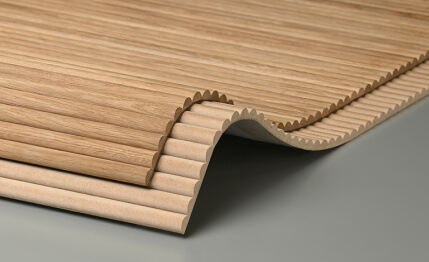
Wooden plank for a wall—this is a linear profile made of solid wood with a rectangular or square cross-section, which is attached to the wall vertically, horizontally, or at an angle with a set spacing. A collection of such slats creates a rhythmic cladding—an accent surface that changes the character of the wall.
The main effect of wall slats is vertical rhythm. Vertical lines visually elongate the wall and ceiling, making the space feel taller. This optical property is used deliberately: in narrow hallways, rooms with low ceilings, and spaces where height needs to be added without actual reconstruction.
Beyond optics—tactility. Wood is warm, alive, and textured. A wall with wooden slats is a wall you want to touch. It doesn't just look different—it feels different. This is important in living spaces: bedrooms, living rooms, studies.




How wall slats fundamentally differ from a slatted partition
This question often arises, and the answer here is important.
A slatted partition is a freestanding or floor-and-ceiling-attached structure that divides space into zones. It works in volume, has a front and back side, and is visible from two directions. It is a functional architectural structure.
wooden planks on the wall is a wall cladding. The slats are attached to an existing wall and work as its decorative layer. They are not meant to divide space—their task is to transform a specific plane: make it accent, warm, rhythmic, and expressive.
These are two different tools for two different tasks.
Our factory also produces:





Where wooden slats are used: a complete overview of scenarios
Get Consultation
TV zone: accent behind the television
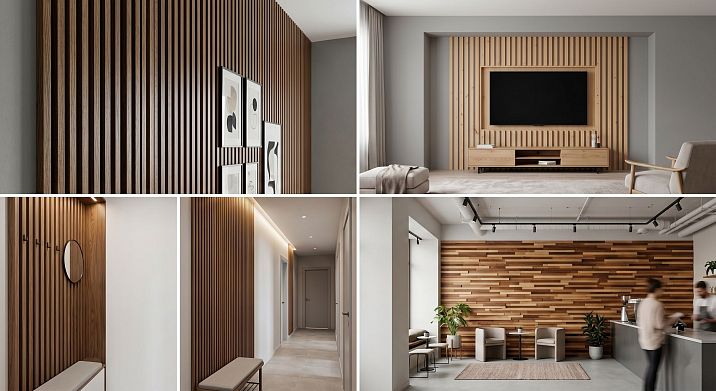
A TV wall with wooden slats is one of the most popular interior scenarios of recent years. Why does it work? Because a TV on an empty wall is just an electronic device. A TV against a background of vertical wooden slats is already a zone, a focal point, a design solution.
The slats create a background against which the screen reads clearly, without competition. At the same time, the warm texture of wood softens the technological nature of the screen — the interior becomes lively, rather than resembling a tech exhibition.
For technical nuances, see the separate block below.
Wall behind the sofa in the living room
The wall behind the sofa is the most "expressive" zone in the living room. It is what guests see upon entering. It forms the first impression of the room. Wooden slats on this wall create a warm, tangible, rich background — without bulky decor, wallpaper, or molding.
The height of the slats — from floor to ceiling or to the level of the ceiling cornice. The width of the zone — across the entire wall or only behind the sofa. The color — matching the floor, matching the furniture, or contrasting.
Hallway: verticality in a narrow space
The hallway is a place where space is always limited. Vertical wooden slats on the hallway wall work as an architectural trick: the lines stretch upward, the eye follows them, the ceiling visually rises. A narrow corridor appears taller, and therefore more spacious.
Additional effect: the slats create a finished look for the entry area without expensive finishing. This is especially valuable in new buildings with standard wall finishes.
Bedroom: headboard and accent wall
In the bedroom, slats most often appear behind the bed — as a replacement for a headboard or as wall decor above it. This is a soft, calming rhythm: even vertical lines in a calm wood color create a neutral background that does not overload the space before sleep.
The height of the slat zone in the bedroom is usually from the floor to a height of 120–180 cm, not to the ceiling. This creates a "framing" of the bed without breaking the space.
Office and work area
An office with wooden slats on the wall is a space that feels more serious and thoughtful. Slats create a sense of order, structure, and concentration. In a home office or in a corporate office — the effect is equivalent.
Staircase zone
The wall along the staircase is long, tall, and often inconvenient for decorating. Vertical slats on the stair wall are a technique that turns a technical area into a decorative element. The slats follow the vertical line of the wall, creating a rhythm that "accompanies" movement along the stairs.
Hall, reception, lobby
In commercial interiors — a separate discussion. Wooden slats in the hall or on the reception wall instantly elevate the perceived value of the space. This is materiality, warmth, professionalism. More on commercial scenarios below.
How to choose the size of a slat: parameters that determine everything
The size of a slat is not "big or small." It is a system of several parameters, each of which affects the final result.
Profile width
The width of the slat determines the visual weight of the element — how "loudly" it sounds on the wall.
| Batten width | Visual effect | Application |
|---|---|---|
| 15–20 mm | Light, delicate rhythm | Minimalism, scandi, small rooms |
| 25–40 mm | Balanced, universal | Apartment, office, restaurant |
| 50–70 mm | Expressive, architectural | Large spaces, high ceilings |
| 80 mm and more | Bold, structural | Commercial interiors, halls, lobbies |
Mistake: choosing a wide slat for a small room. A bold profile in a small space creates a feeling of "pressure".
Slat depth (thickness)
Depth is how far the slat protrudes from the wall. It is a key parameter for the play of light and shadow.
-
Depth 10–15 mm: minimal shadow, delicate relief.
-
Depth 20–30 mm: distinct shadows, noticeable volume.
-
Depth 40 mm or more: pronounced three-dimensional effect, especially with side lighting.
When lighting slats from above or below (LED strip at the floor or under the ceiling), the depth of the slat creates contrasting shadows in the gaps. The deeper the slat, the more expressive the lighting effect.
Slat length
Standard lengths are 2000, 2400, 3000 mm. For ceilings 2700–3000 mm, a 3000 mm slat is optimal — it runs from floor to ceiling without joints. A joint in the middle of the slat is noticeable and undesirable.
If the ceiling is higher than 3000 mm, join slats with offset (staggered), like parquet flooring. Joints at the same level are unattractive.
Wall scale
A small wall 1–1.5 m wide — 5–8 slats are enough. A wide wall 4–6 m — may require 15–25 slats depending on spacing. The ratio of slat width + spacing determines the density of the rhythm.
How to choose spacing between slats: rhythm is not just aesthetics
Spacing between slats — the distance from one profile to another. This is perhaps the most influential parameter in terms of aesthetics.
Frequent spacing (20–40 mm between slats)
Dense rhythm. Slats occupy most of the wall area, gaps between them are minimal. Effect: a rich, warm, wooden surface. Resembles wooden paneling or wainscoting. Works well in classic, Scandinavian, Japanese interiors.
Nuance: with frequent spacing, it's important that the wall color behind the slats (in the gaps) does not compete with the slat color. Most often, the wall is painted the same color as the slats or a similar shade.
Wide spacing (80–150 mm or more)
Slats are placed with large gaps. The visual effect is airy, light, and rhythmic. The wall behind the slats plays an important role: if it is a contrasting color, the gaps become part of the decor. If the wall is dark and the slats are light, the depth of the space is noticeable.
Wide spacing is a popular choice for modern minimalist interiors. A few vertical lines on an empty wall create elegance without overload.
Medium spacing (40–80 mm)
A universal option. Slats and gaps are visually approximately equal — a balance. The rhythm is readable but not dominant. Suitable for residential and commercial interiors without strict stylistic constraints.
Formula for calculating the number of slats
For a simple calculation:
Wall width ÷ (slat width + spacing) = number of slats
Example: wall 4000 mm, slat 30 mm, spacing 50 mm → 4000 ÷ 80 = 50 slats.
Add 10–15% extra for trimming and defects.
If you are purchasing wooden strip in linear meters — multiply the number of slats by the wall height.
Slats for TV zone: how to do it right
A TV zone with wooden slats is technically more complex than just a decorative wall. Several specific factors need to be considered.
Sockets and cable channels
Before installing the slats, mark the exact location of all sockets, USB ports, and cable outlets. If the TV cable runs along the wall surface, it must be hidden in a cable channel or groove before installing the slats.
The slats are mounted on top of the wall — hiding cables after installation will no longer be possible.
TV bracket
If the TV is mounted on a swivel or tilt bracket, keep in mind that the bracket must be fixed to the wall (with an anchor or dowel), not to the slats. The slats do not bear the structural load of the TV.
Diagram: mark the spot for the bracket → secure the bracket to the wall → install the slats around the bracket. Or: cut a slot in the slats for the bracket fastening.
Backlighting behind the slats
LED strip behind the TV zone slats is a strong decorative technique. The strip is attached to the wall between or behind the slats. When the TV is turned on, the backlight creates a soft diffused glow — this reduces eye strain and adds atmosphere.
For this effect, the slats need sufficient depth (at least 20–25 mm) so that the tape is hidden from direct view but provides side light through the gaps.
Ventilation
If a TV set-top box, media player, or router is located behind the slats, leave enough gaps for air circulation. Overheating of equipment in an enclosed space is a risk of breakdown.
Color of slats for the TV zone
For the TV zone, dark tones are optimal: wenge, mocha, dark walnut, black tint. Dark background + screen = contrast that makes the image more saturated. Light slats also work — in a light Scandinavian interior — but the dark option gives a more cinematic result.
Slats for the hallway: narrow space — precise calculation
The hallway is a special space. People don't sit or live here, but this is where the first impression of the apartment is formed. Wooden slats in the hallway are a solution that works for several tasks at once.
Vertical slats elongate the height
If the ceiling in the hallway seems low, vertical slats are the best optical tool. The eye follows the lines upward. The wall appears higher, the space feels more spacious. This is not magic — it's geometry.
Slats mask an empty wall
In standard hallways, there is a long wall without windows or architectural accents. It is this wall that most often seems boring and unfinished. A few wooden slats in a rhythmic pattern — and the wall gains character without expensive finishing.
Width of slats for hallway
In a narrow hallway, a delicate profile: 20–30 mm wide. Wide slats in a small space create a feeling of "clutter." A light profile is unobtrusive and works for verticality.
Color of slats in hallway
Light wood in a light hallway — a Scandi option: clean, fresh, spacious. Dark wood in a neutral hallway — contrast that creates depth. Slats painted the color of the wall — a monochrome technique where the relief is only visible in light and shadow.
Height of slat zone
In a hallway, slats most often go from floor to ceiling — full wall height. This maximizes the vertical effect. Alternative: slats from floor to a height of 180–200 cm with an open wall above — a kind of "low paneling."
Slats for bedroom: silence in rhythm
In a bedroom, every decorative element should work for peace, not excitement. Wooden slats are one of the few decorative techniques that are always appropriate in a bedroom.
Accent wall behind the bed
The wall behind the headboard is the main decorative plane of the bedroom. Slats here create a "frame" for the bed — a visual background against which the bed reads as a central element, rather than being lost against an empty wall.
Scheme: slats behind the bed, the width of the bed + a 30–60 cm offset on each side. Zone height — from mattress level (approximately 50 cm from the floor) to a height of 180–200 cm. Or — full wall height: from floor to ceiling.
Material and color for the bedroom
In the bedroom, the warmth of the material is important. Natural light wood without paint is the calmest option. Stained oak in gray-brown tones — if the interior is warm and neutral. White painted slats — for a bedroom in Scandinavian or neoclassical style.
Avoid dark, saturated tones in the bedroom if the room is small — dark slats "absorb" light and narrow the space.
Spacing in the bedroom
Medium or wide spacing is optimal for the bedroom. Dense rhythm in the bedroom is too visually active. A few vertical lines with good gaps — calm, orderly, cozy.
Slats for office, restaurant, and showroom: commercial interior
This is a separate class of tasks, and here wooden slats work differently than in a residential space.
Why slats make a commercial interior more expensive
The perception of space cost is directly linked to the materiality of the finish. An office with bare painted walls and an office with accent walls made of wooden slats are different price categories in the visitor's eyes. At the same time, the real difference in finishing cost is significantly less than the perceived difference in "level."
Wood is a material associated with quality, nature, and thoughtfulness. In a commercial space, it is a direct tool for managing perception.
Reception and waiting area
A reception wall with vertical wooden slats is a standard of modern design. The company logo against the slats, lighting from above or below, dark wood on a light counter — this is a system that creates a professional image from the first second.
Meeting rooms and offices
In the meeting room, slats on one accent wall create a sense of concentration and seriousness. This is an interior where you want to work. The materiality of wood is a psychological signal: here they think, here they make decisions.
Restaurant: warmth and atmosphere
In a restaurant, wooden slats work for the atmosphere — one of the key success factors. Slats create zoning (without rigid partitions), add warmth and coziness, and absorb some acoustics. Dark wood in an Italian or Japanese-themed restaurant is an image that works for the establishment's reputation.
Showroom and sales floor
In a showroom, wooden slats provide a neutral but high-quality background for the display. A product against a background of wooden slats looks more expensive than the same product against a white wall. All experienced visual merchandisers know this.
Beauty salon
In a beauty salon — slats in the waiting area, in work rooms, on the wall behind the master's workstation. The naturalness of wood in a beauty space is a signal of naturalness and care. An aesthetically precise solution.
Material and coating of wooden slats
Solid wood
Solid wood slat — is a profile made from solid wood without gluing or pressing. Natural texture, unique grain pattern, natural scent — these are all characteristics that analogs lack.
Solid wood is the best choice for residential interiors and premium commercial spaces. Solid wood slats are durable, repairable (can be sanded and repainted), and accept any finish well.
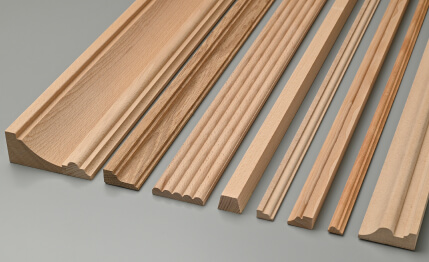
In the solid wood moldings — profiles from different wood species with different textures and densities.
Slat finish
Natural varnish: preserves wood texture, protects against moisture and dust. Matte varnish — for Scandinavian and modern styles. Glossy — for classic.
Stain + varnish: tints the wood to the desired shade (light oak, dark walnut, wenge, ebony), preserving texture. This is the most popular option for creating a cohesive interior.
Enamel or acrylic paint: for white, gray, or colored slats. Painting hides the texture — only the profile shape remains.
Uncoated slats (for painting): allow you to set any color on site. Buy, install, paint together with the wall — or contrastingly.
Tinting to match furniture or flooring: if the interior has parquet or furniture made of oak or ash — the slats are tinted to the same shade. This creates consistency without pedantic matching.
Connection of slats with the rest wooden molding
Slats on the wall are not an isolated element. In a well-designed interior, they coordinate with wooden skirting board, door trims, wooden moldings and other wooden decor elements. A unified color, a single wood species, or a consistent finish is what makes the interior cohesive.
If the slats turn into a corner, you need Wooden angle: it covers the ends of the slats at wall corners and makes the transition neat.
Mistakes in choosing and installing wooden slats
Let's break down typical mistakes — so you don't fall into them.
Buying slats without calculating the spacing. Ordering slats and then calculating the spacing "on site" is a path to an unthought-out result. First calculation, then order.
Not accounting for outlets, switches, and TV brackets. This leads to slats being installed and then discovering: an outlet in the middle of a slat, a bracket that can't be mounted. All marking — before installation.
Making the rhythm too frequent in a small room. Dense slats in a small space create visual "noise." In small rooms — a light profile and sparse spacing.
Choosing the color of the slats separately from the floor and furniture. Slats are part of the system. Their color should coordinate with the parquet, furniture, and doors. Select samples together, under the same lighting.
Do not count linear meters. Classic mistake: only calculated the width of the wall, forgetting to multiply by the height. Result: not enough slats, and getting more from another batch risks a shade difference.
Forget about ends and corners. The ends of slats in wall corners look ugly if not covered. Wooden angle — a mandatory element when installing slats in corner areas.
Do not account for cutting waste. 10–15% above the calculated quantity is the minimum reserve. Slats are cut to length, adjusted, and sometimes there is damage during installation.
Use raw slats without acclimatization. Wooden slats should sit in the room for 3–5 days before installation — at the same humidity and temperature where they will be placed. Without acclimatization, there is a risk of deformation after installation.
Attach slats without a level. Even a slight tilt of one slat by 1–2 mm is noticeable at wall height. A level is mandatory for each slat.
Install slats on an unprepared wall. The wall under the slats must be level and dry. Damp plaster or a crooked wall — the adhesive won't hold, and the slats will come off.
Installing wooden slats on a wall: technique and order
Marking
-
Determine the width of the wall (excluding corners and doorways).
-
Calculate the number of slats and spacing using the formula.
-
Mark the position of each batten with a pencil — from the center of the wall to the edges (symmetrically).
-
Strike vertical lines using a level.
Methods of mounting
Construction adhesive ("liquid nails"): applied to the back side of the batten, then the batten is pressed against the wall. Suitable for smooth walls with good adhesion.
Finish nails (brads): quick, reliable. The nail is countersunk with a nail set, then puttied — no traces left.
Screws + wall plugs: for concrete or brick walls. Screws are driven in flush, covered with caps or puttied.
Combined method: adhesive + brads. Adhesive ensures even contact along the entire length, brads hold the batten in place until the adhesive sets.
Work sequence
-
Prepare the wall: level it, apply primer.
-
Mark the position of the battens using a level.
-
Apply adhesive to the batten — in a strip along its entire length.
-
Press the batten against the wall along the marked line.
-
Secure with brad nails or tape until the glue sets.
-
Move to the next slat.
-
After installing all slats, fill nails and joints with putty.
-
Sand, paint, or varnish (if not painted before installation).
Final lighting
If lighting is planned, install the LED strip before or during slat installation (depending on the design). The strip is attached to the wall at the base or top of the slat area. The LED strip profile hides it from direct view.
Where to buy wooden slats for the wall
buying wooden slats for the wall important from a manufacturer that guarantees a precise profile, uniform coating, and the ability to select the required length.
In the Stavros catalog — Wooden plank from solid wood with delivery across Russia. Nearby is the full range of accessories for a complete solution: Wooden trim, Wooden moldings, Wooden angle for finishing corners and Wooden baseboard for finishing the area near the floor. All Wooden products for interior — in one catalog.
FAQ: Answers to popular questions
How to choose wooden slats for the wall?
Determine the profile size (width 20–50 mm for living spaces), calculate the spacing between slats, choose a color to match the floor or furniture. Consider the ceiling height and wall scale.
How do wall slats differ from a slatted partition?
Wall slats are wall cladding for decorating a surface. A slatted partition is a freestanding structure for zoning space. These are different tools for different tasks.
Which slats to choose for a TV zone?
Dark wood (stain, wenge) for a cinematic background. Profile depth from 20 mm to create shadow. Consider the position of outlets and brackets before installation.
What spacing between slats is best?
Average spacing 40–70 mm is universal. Wide spacing 80–120 mm for a minimalist interior. Narrow spacing 20–40 mm for a rich "wooden" background.
Are wooden slats suitable for a hallway?
Yes. Vertical slats in the hallway visually elongate the wall height. Optimal profile width is 20–30 mm.
Can I use slats in the bedroom?
Yes. Slats behind the headboard are one of the most popular techniques. Use calm tones and a medium or sparse spacing.
How to calculate the number of wooden slats?
Wall width ÷ (slat width + spacing) = number of slats. Multiply by wall height to calculate linear meters. Add 15% reserve.
Can wooden boards be painted?
Yes. Acrylic paint or enamel on a primed surface. It's better to paint before installation — the coating quality is higher.
Which slats are suitable for an office or restaurant?
Profile 30–50 mm, dark tint or natural finish. In a restaurant — warm wood tones. In an office — neutral or dark tones.
Where to buy wooden slats for the wall?
In the STAVROS catalog: Wooden plank made of solid wood with delivery across Russia.
About the manufacturer
STAVROS is a Russian manufacturer of wooden profiles and solid wood products for residential and commercial interiors. The catalog includes — wooden slats for wall, Wooden trim, Wooden moldings, Wooden angle и Wooden baseboard — full range for creating accent walls, TV zones, hallways and commercial interiors. Everything for working with wood in the interior — on the website STAVROS.