Article Contents:
- Which baluster to choose: L-049.1 or L-099.1
- What is a baluster and why it cannot be chosen separately from the entire staircase
- A baluster does not replace a stair post
- A baluster is not chosen without a handrail
- The product height is not equal to the height of the finished railing
- The installation step cannot be assigned from a photo
- How the acanthus motif works
- When a carved baluster looks convincing
- Why L-049.1 cannot be judged by a single detail
- How carving affects the finish
- When to choose L-049.1 from beech
- When to choose L-049.1 from oak
- Who L-049.1 is suitable for
- Why a square cross-section is convenient for design
- How vertical fluting works
- What styles does L-099.1 suit
- When is L-099.1 better than a carved model
- How to choose material for L-099.1
- Why do flutes require clean sanding
- Who is L-099.1 suitable for
- Classic staircase with carved posts
- Neoclassicism with light enamel
- Art Deco
- Modern interior with a wooden staircase
- Eclecticism
- Staircase in a public or commercial interior
- Beech under white or colored enamel
- Oak under a clear coating
- Oak balusters for dark tinting
- Can beech be used under clear varnish
- Can oak be painted with dense enamel
- Why it's better to choose all elements from the same wood species
- White Enamel
- Dark enamel
- Oak tinting
- Transparent coating
- Combined Finishing
- When "Standard" is enough
- When to choose "Prestige"
- Why You Can't Compare Only the Price of a Single Piece
- Lower Mounting Section
- Upper Section for the Handrail
- Width and Orientation
- Trimming to Height
- Checking with a Template
- First, Determine the Boundaries of the Row
- Consider the actual width of the baluster
- Do not assign a universal step
- Consider the steps
- Add margin deliberately
- Why one batch matters more than the minimum quantity
- Example of calculation logic without universal numbers
- Handrail for L-049.1
- Handrail for L-099.1
- Handrail material
- Stringer board
- Post for L-049.1
- Post for L-099.1
- Why you cannot choose posts after installing balusters
- Grand staircase in a country house
- Compact staircase between walls
- Double-height balustrade
- Home library or study
- Hotel or restaurant
- Staircase next to a modern living room
- Baluster and stair post
- Baluster and furniture leg
- Baluster and decorative column
- Carved and turned model
- Square smooth and fluted baluster
- Beech for enamel and ready-painted baluster
- Need to make the staircase the main decoration of the hall
- Need a strict balustrade without floral ornament
- Need to update an existing staircase
- Need balusters for white enamel
- Need a natural oak row
- Need a staircase for a commercial interior
- Marking the row
- Trimming
- Fastening
- Finishing Before or After Installation
- Protecting the relief during work
- Care after installation
- Choosing from a single photo
- Ignoring the drawing
- Same finish for beech and oak without understanding the result
- Purchase of balusters without handrail and posts
- Calculation of quantity based on arbitrary step
- Order without reserve
- Mixing of batches and wood species
- Incorrect sanding category
- Too thick enamel
- Use of interior baluster outdoors without approval
- Installation without safety check
- Wood texture and shade
- Uniform sanding
- Single test paint
- Acceptance before installation
- Marking of elements
- What to do with spare parts
- Which baluster is more decorative?
- Which model is suitable for Art Deco?
- What is the size of L-049.1?
- What is the size of L-099.1?
- What materials are the models available in?
- What to choose for white enamel?
- What should I choose for oil or clear varnish?
- How does "Standard" differ from "Prestige"?
- Can L-049.1 and L-099.1 be combined in one railing?
- How many balusters are needed for a staircase?
- Is a spare needed?
- Should I order the handrail at the same time?
- Which posts are suitable for L-049.1?
- Which posts are suitable for L-099.1?
- Can these balusters be used outdoors?
- Do I need to paint the balusters before installation?
- How to avoid mistakes with the orientation of L-099.1?
- Where to buy L-049.1?
- Where to buy L-099.1?
- What to check before payment?
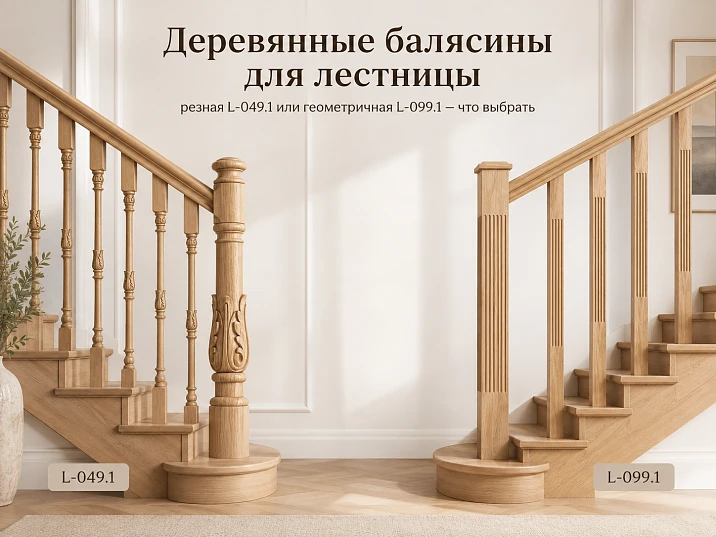
Comparison of two current models for interior stair railings
Which baluster to choose: L-049.1 or L-099.1
Short answer: The carved L-049.1 is suitable for a staircase that should become a prominent decorative part of the interior. The geometric L-099.1 with a square cross-section and vertical fluting works better in a strict repetitive railing. Both models have a height of 1000 mm, are available in beech and oak, and before ordering you need to check the drawing, mounting sections, quantity of items, material of the handrail and stair posts.
buying wooden balusters for stairs Buy carved L-049.1 Buy geometric L-099.1
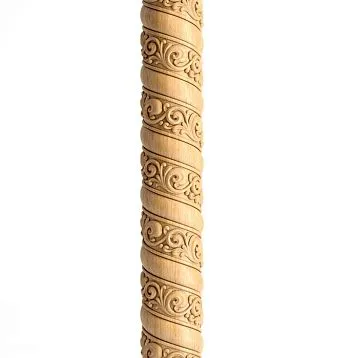
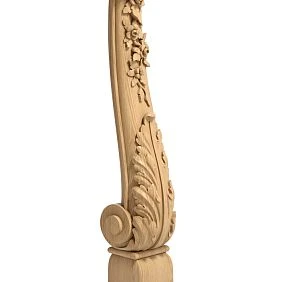
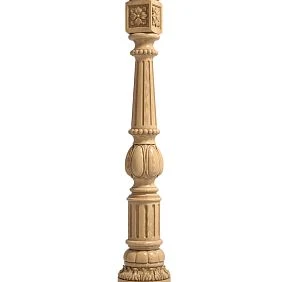
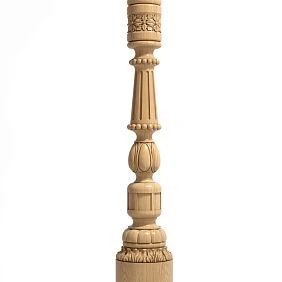
L-049.1 — for expressive fencing. The turned-carved form and acanthus leaves make each vertical a noticeable part of the staircase.
L-099.1 — for a strict rhythm. The square section 50 × 50 mm and vertical fluting create a calmer, architectural line.
Both models are 1000 mm high. This does not mean they can be installed without design trimming and checking the finished fence height.
Beech for enamel, oak for tinting. The material is chosen based on the future finish, not just price or wood species name.
"Standard" or "Prestige". For complex carving L-049.1, manual sanding is especially important; on L-099.1, the cleanliness of the flutes must be controlled.
The railing is assembled as a set. It is better to select balusters, handrails, and stair posts from the same wood, finish, and scale.
It is easier to buy wooden balusters for a staircase than to assemble a successful railing from them. A mistake is rarely noticeable on a single detail. It becomes apparent after installing the entire row: the carved model turns out to be too active for a calm interior, the square one too strict for a grand staircase, the handrail does not match in scale, and the posts look heavier or lighter than the balusters. Therefore, the choice between L-049.1 and L-099.1 should be made not based on a single photo, but on the overall railing task.
Both models are designed for wooden stairs, balustrades, and interior railings, but create a different character. L-049.1 works as a decorative vertical. Smooth lines and a carved acanthus motif are noticeable even with a calm finish. L-099.1 is based on a square cross-section and flutes. It creates a repeatable architectural rhythm and does not compete with the handrail, posts, or wall finish.
The height of both balusters is 1000 mm, but this is not the finished railing height. The project includes the bottom base, mounting method, handrail section, handrail itself, possible trimming, and the angle of the stair flight. You cannot take the number 1000 mm and automatically assume that the finished railing will have exactly that height. The drawing of each model must be compared with the staircase project and current safety requirements.
Material and sanding quality affect no less than shape. Beech for enamel is suitable for opaque coating when the wood grain will be covered. Oak for tinting is chosen for oil, stain, clear or semi-transparent varnish. "Standard" implies machine sanding, "Prestige" implies more detailed manual preparation. For L-049.1 this is especially noticeable on the carved ornament, for L-099.1 in the cleanliness of the edges and flutes.
A buyer who still needs to compare other shapes can open the category and buying wooden balusters for stairs, comparing carved, square, round, rectangular, and turned-carved models. But if the choice has already narrowed down to two specific items, it is more useful to immediately compare them by shape, material, finish, and role in the railing.




What is a baluster and why it cannot be chosen separately from the entire staircase
A baluster is a vertical railing element that connects the lower part of a staircase or balustrade to the handrail. For the buyer, it is both a structural and decorative detail. It contributes to overall rigidity, supports the top line of the railing, and sets the repetition along the entire length of the flight. It is this repetition that turns a single beautiful form into architecture.
It is difficult to understand the final effect from a single baluster. The carved acanthus motif L-049.1 looks delicate in the product card, but in a row of several dozen pieces, it becomes the main decorative pattern of the staircase. The fluting L-099.1 seems simple, but when repeated, it creates a pronounced vertical grid. The longer the flight, the stronger the rhythm works, and the more important it is to check the scale before ordering.
Our factory also produces:
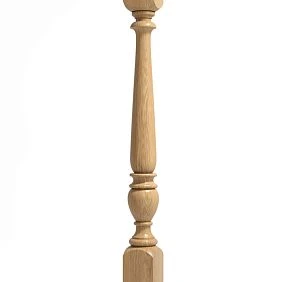
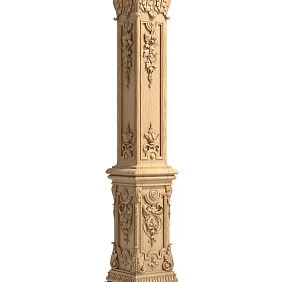
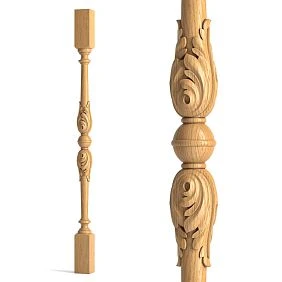
A baluster does not replace a stair newel post
The starting, turning, and support points of a railing usually require more massive elements. The baluster forms the row between them, while the newel post fixes the beginning, end, or change of direction. If the same thin detail is placed everywhere, the railing may look unfinished and require a different structural scheme.
Get Consultation
A baluster is not chosen without a handrail
The top line of the railing unifies the entire row. The handrail must match in width, profile, material, and connection method. A handrail that is too massive will visually overwhelm slender balusters. One that is too thin will get lost above the expressive L-049.1. Therefore, it is better to select the model and handrail in parallel.
The product height is not equal to the height of the finished railing
The size of 1000 mm describes the baluster itself. In a real staircase, part of the length may go into the mounting assembly, be cut at an angle, or connect to a subrail. The final height depends on the design scheme. A universal recommendation without a drawing is more dangerous than helpful.
The installation spacing cannot be determined from a photograph
The number of balusters depends on the length of the flight, the shape of the treads, the placement of newel posts, the mounting into the step or stringer, allowable openings, and safety requirements. An article can explain the calculation principle but should not give a single distance as suitable for all staircases. The final decision is made by the designer or craftsman.
Characteristics of L-049.1 and L-099.1 to check before ordering
| Parameter | L-049.1 | L-099.1 | What this means for the project |
|---|---|---|---|
| Form type | Turned-carved, smooth lines, decor with acanthus leaves | Geometric, square, with vertical fluting | The first makes the railing decorative, the second makes it strict and repetitive. |
| Size | 1000 × 50 mm | 1000 × 50 × 50 mm | The drawing needs to be matched with the landing, handrail, and finished railing height. |
| Material | Beech or oak | Beech or oak | It is better to order the entire row and adjacent elements from the same wood species. |
| Wood preparation | Beech under enamel, oak under tinting | Beech under enamel, oak under tinting | The species is chosen based on the finish: opaque or semi-transparent. |
| Sanding quality | "Standard" or "Prestige" | "Standard" or "Prestige" | «Prestige» reduces the volume of manual preparation before finishing. |
| Order status | Custom Order | Custom Order | Production, sanding, finishing, and installation should be included in the overall schedule. |
| Average production time | 5–10 days | 5–10 days | It is better to confirm the current date before ordering the entire set. |
The dimensions show that both models are designed for the same height scale but differ in cross-sectional character. L-099.1 has a confirmed square section of 50 × 50 mm. For L-049.1, the card indicates a size of 1000 × 50 mm; the shape and seating areas should be checked on the drawing, not inferred by analogy with the square model.
Before ordering, it is useful to open both cards: buy carved baluster L-049.1 made of oak or beech can be done after selecting the material and sanding; buy geometric baluster L-099.1 with flutes — after checking the square cross-section, fit, and overall style of the railing.
L-049.1: when the staircase needs an expressive carved vertical
L-049.1 is built on a smooth turned form and carved decor in the form of acanthus leaves. The ornament does not cover the entire surface with a solid pattern, so the baluster remains light but no longer looks neutral. In a row, it creates a noticeable decorative belt and suits a staircase that should participate in the interior on par with doors, furniture, and wall panels.
How the acanthus motif works
The acanthus leaf is associated with the classical architectural tradition. On L-049.1, it does not turn every detail into a massive sculpture but emphasizes the transitions of form. When repeated along the flight, the motif becomes readable but does not fragment the railing into random pieces. Such a pattern is appropriate for a grand staircase, home library, double-height living room, and an interior where carved cornices, columns, architraves, or furniture decor are already present.
When a carved baluster looks convincing
L-049.1 is best revealed where there is free space around. If the staircase flight is squeezed between heavy walls, decorated with a complex carpet, bright panels, and a lot of metal, the carving may get lost or overload the composition. On a light wall, next to natural wood or calm painted finishes, it reads more clearly.
Why L-049.1 cannot be judged by a single detail
One baluster looks elegant, but there can be dozens in the railing. Each acanthus motif will repeat. Before ordering, it is useful to create a visualization of at least one span. If the pattern seems too saturated, it is not necessary to completely abandon the model: L-049.1 can be used in the front area, on the second-light balustrade, or in combination with calmer elements, if the project allows such a transition.
How carving affects the finish
Deep transitions and shallow areas require careful sanding. Under dense enamel, thin lines can become softer if applied too thickly. Under transparent tinting, processing marks and uneven absorption are more noticeable. For a large set, the quality of preparation affects not only the appearance but also the labor intensity of the entire finishing work.
When to choose L-049.1 from beech
Beech is suitable for white, milky, gray, colored, or combined enamel. An opaque finish allows connecting a carved baluster with painted posts, handrail, and risers. White L-049.1 looks lighter, dark — more contrasting and solemn. The color should be checked on a sample because the carved relief creates its own shadows and changes the perception of the shade.
When to choose L-049.1 from oak
Oak under tinting is suitable for a staircase with an open wood texture. Transparent varnish, oil, or stain emphasizes the pores and makes each baluster slightly individual. On carved acanthus, this creates additional depth. For a row, it is important to order one batch and finish all products simultaneously so that tonal differences do not appear random.
Who is L-049.1 suitable for
The model should be considered for classic, neoclassical, eclectic, and formal interiors. It works well in a country house, a large two-level apartment, a hotel, restaurant, or salon with a pronounced decorative concept. For a minimalist staircase without other carved details, it may be too active.
L-099.1: square geometry and vertical flutes
L-099.1 has dimensions 1000 × 50 × 50 mm, a square cross-section, and vertical flutes. The shape is simple in overall geometry but not flat: the longitudinal grooves create a play of light and emphasize height. In a railing, this model forms a calm repetition and suits an interior where decorativeness is built not on plant ornamentation but on proportions and precision of lines.
Why a square cross-section is convenient for design
The size 50 × 50 mm is clear in terms of layout. It is easier to match with the bowstring, sub-rail, base, and handrail. The flat faces provide clear orientation, and the flutes should face the same way on all elements. During installation, it is especially important not to rotate any balusters differently: a misalignment immediately disrupts the rhythm.
How vertical flutes work
Longitudinal grooves visually elongate the railing and make the square shape less heavy. On light enamel, the relief is read through shadow. On oak under tinting, the flutes enhance the texture contrast. With a very dark coating, deep areas can become almost black, so a test sample is needed before the entire batch.
Which styles L-099.1 suits
The model easily fits into Art Deco, modern classic, strict eclecticism, and interiors with architectural panels. It can also work in a more contemporary space if the handrail, posts, and finishes support square geometry. L-099.1 does not look sterile: the flutes provide enough relief so that the railing does not resemble a row of plain blocks.
When L-099.1 is better than a carved model
If the interior is already saturated with decorative doors, moldings, floor patterns, or furniture, a strict baluster helps avoid overloading the staircase. It is also convenient on a long flight: the repetition of flutes creates order and does not tire the eye. For a small staircase area with limited width, a square silhouette often looks more cohesive than a complex turned shape.
How to choose the material for L-099.1
Beech under enamel provides a smooth painted geometry. White or light gray finish highlights the flutes with a soft shadow. Black and deep colored enamel make the model graphic. Oak under tinting creates a warmer result and connects the balusters with oak steps, handrail, or floor.
Why flutes require clean sanding
On a smooth square face, a defect is noticeable, but in a longitudinal groove it may become even more apparent after painting. Machine sanding "Standard" is suitable for a workshop that is ready to inspect and refine all flutes. "Prestige" reduces this stage, which is especially important when dealing with a large number of identical products.
Who L-099.1 is suitable for
The model should be chosen for a strict balustrade, a modern staircase with a wooden handrail, an Art Deco interior, and a project that requires a repeating vertical rhythm. It is suitable for a private house, hotel, office, restaurant, and public area, provided the railing is designed and meets safety requirements.
The main difference between the two models: ornament or architectural rhythm
L-049.1 and L-099.1 have the same confirmed height, are available from the same wood species, and in two sanding categories. Therefore, the choice does not come down to a technical parameter like "which is taller" or "which wood is available." The decision is made by form.
| Criterion | L-049.1 | L-099.1 |
|---|---|---|
| Character | Smooth, decorative, classic | Strict, geometric, architectural |
| Main pattern | Acanthus leaves and turned-carved transitions | Vertical flutes on a square section |
| Visual effect in the row | Rich decorative repeat | Clear vertical grid |
| Suitable interior | Classic, neoclassical, formal eclecticism | Art Deco, modern classic, strict eclecticism |
| Combination with decor | Supports carved columns and decorative handrails well | Pairs well with minimalist columns and clear handrail profile |
| Main risk | Overload a small interior with excessive ornamentation | Making the staircase too dry when randomly selecting other elements |
If the staircase is to become the main decorative object, L-049.1 provides a stronger image. If the railing should support the architecture and not conflict with other details, L-099.1 is safer. One model cannot be called better than the other without context: they solve different tasks.
Which baluster matches the staircase style
The staircase style is formed not by the collection name, but by proportions, material, and repeating lines. The baluster is in front of the eyes on each section of the flight, so its pattern has a stronger impact than a small decorative element on the wall. To choose L-049.1 or L-099.1 without error, you need to look at the steps, handrail, posts, risers, floor, and nearby furniture.
Classic staircase with carved posts
For such a composition, L-049.1 usually looks more natural. The acanthus motif supports carved finials, panels, cornices, and complex profiles. But even in a classic interior, it is important to observe moderation. If the staircase posts are already very ornate, the handrail has a complex profile, and the walls are decorated with panels, the balusters can be slightly calmer. In this case, L-049.1 needs to be checked on a visualization of the entire flight.
Neoclassicism with light enamel
Both models can work under white or milk enamel. L-049.1 creates a more formal option, L-099.1 a stricter one. If the interior is based on smooth walls, thin moldings, and calm furniture, the fluted L-099.1 often looks more precise. For rich neoclassicism with carved doors and decorative columns, L-049.1 is more appropriate.
Art Deco style is renowned for its love of ornamentation, symmetry, and refined details. The molded decoration NPU-422 can become an excellent complement to geometric motifs and contrasting color combinations characteristic of this style. Try highlighting it with metallic paint or patina — and you’ll get an eye-catching detail that’s hard to look away from.
In an Art Deco interior, geometry, verticality, and repetition are important. L-099.1 follows this logic thanks to its square cross-section and fluting. It can be painted in a deep dark color, made contrasting to the steps, or retain the oak texture. L-049.1 in Art Deco is possible only as a deliberate decorative contrast, but its plant motif will require support in other elements.
Modern interior with a wooden staircase
When steps, walls, and furniture have simple forms, L-099.1 is easier to incorporate without stylistic conflict. Fluting adds relief but does not turn the railing into a historical reconstruction. Light oak or painted beech help connect the model with a modern interior.
Eclecticism
An eclectic space allows mixing, but it must be controlled. L-049.1 can be combined with a minimalist handrail and calm posts, making the balusters the main decorative motif. L-099.1, on the other hand, can balance expressive wallpaper, colored stone, or complex furniture. In both cases, it is important to define one leading pattern.
Staircase in a public or commercial interior
In a hotel, restaurant, salon, or showroom, the railing is perceived by many people and must withstand intensive use. L-099.1 is easier to incorporate into strict architecture and repeat on a long balustrade. L-049.1 suits a space with a grand character but requires particularly careful finishing and regular maintenance of the relief.
Oak or beech: what to choose for L-049.1 and L-099.1
The choice of wood species determines not only the appearance but also the method of preparing the entire batch. In the cards of both models, beech is offered for enamel, and oak for tinting. This is not an arbitrary division. Beech has a calmer structure and is convenient for an opaque finish. Oak has pronounced pores and grain that are worth preserving.
Beech under white or colored enamel
If the railing should be white, gray, black, green, or painted to match wall panels, beech becomes a rational choice. The opaque layer unites the balusters, handrail, and posts into one color. On L-049.1, enamel emphasizes the relief with shadow; on L-099.1, it highlights the fluting and square geometry.
The same color code does not guarantee the same result. Perception is influenced by the primer, layer thickness, gloss level, and surface shape. A carved baluster creates more shadows than a square one. If models are mixed in one railing, a test coating should be done on both.
Oak under a transparent coating
Oak balusters suit a staircase with natural steps, an oak handrail, and an open texture. Clear varnish preserves the natural shade, oil makes the surface more tactile, stain or tinted varnish changes the color. With any translucent finish, the quality of sanding becomes especially noticeable.
On L-049.1, the texture follows smooth transitions and carved ornament. On L-099.1, straight fibers and fluting create a stricter pattern. The same wood species is perceived differently on two geometries, so you cannot choose oak based only on a flat board sample.
Oak balusters for dark tinting
Dark color makes the railing contrasting and emphasizes the depth of the relief. For L-049.1, this enhances the acanthus leaves but may darken small recesses. On L-099.1, the fluting becomes more graphic. A test sample with the same number of layers and finish is mandatory before the entire batch.
Can beech be used under clear varnish
Technically, wood can be coated with different compounds, but the "under enamel" option allows selecting lamellas without strict matching in color and texture. Under clear varnish, these differences remain visible. If the buyer values a solid natural surface, oak for tinting is more predictable.
Can oak be painted with dense enamel
Yes, but the expressive porous texture will be covered. The buyer pays for the wood species without using its main visual advantage. For opaque color, beech is often more rational if the project does not require oak for other structural reasons.
Why it's better to choose all elements from the same wood species
Balusters, handrail, and posts are located close together and are perceived as one system. Under a transparent coating, mixing beech and oak is immediately noticeable. Under enamel, the difference is less, but uneven structure can affect preparation and gloss. One wood species simplifies finishing and makes the result more predictable.
Enamel, tinting, or clear finish
The finish must simultaneously protect the wood, complement the interior, and preserve the shape. A mistake occurs when the color is chosen separately from the carving and fluting. The more complex the surface, the more precise the control of each layer must be.
White enamel
A white railing visually lightens the staircase and works well next to dark steps. On L-049.1, it makes the carving more airy; on L-099.1, it emphasizes the fluting through soft shadows. The surface must be uniform, without buildup in the recesses.
Dark enamel
Black, graphite, or deep color creates a strong silhouette. L-099.1 becomes almost a graphic architectural element. L-049.1 looks more solemn, but the fine pattern may partially get lost in the shadows. Lighting should be assessed before choosing the color.
Oak tinting
Stain or tinted varnish allows you to change the shade while preserving the pores. For a full railing, it is important to treat all parts in one batch and under identical conditions. The baluster, handrail, and post absorb the compound differently due to shape and grain direction, so the craftsman must control the result on each element.
Clear coating
A clear finish suits light oak and interiors where the wood should remain natural. It does not hide sanding marks, glue residue, or accidental scratches. For L-049.1, the carved transitions are checked especially carefully; for L-099.1, the longitudinal fluting and edges.
Combined finish
Sometimes the steps and handrail are left wooden, while the balusters are painted. This contrast helps lighten the railing. For example, white L-049.1 with an oak handrail creates a classic result, while graphite L-099.1 with natural oak creates a modern one. It is important to decide in advance which elements belong to each color group.
"Standard" or "Prestige": how to assess the scope of preparation
"Standard" means machine sanding, "Prestige" means detailed hand finishing. The difference is especially noticeable in a large set. Even a few extra minutes of processing each baluster turn into hours of work on a long staircase.
When "Standard" is sufficient
This option is suitable for a joinery or finishing workshop that knows how to finish complex surfaces. A specialist will check the grain, edges, recesses, and seating areas before priming. The buyer saves on initial preparation but must include their own work in the budget and schedule.
When to choose "Prestige"
Hand sanding is useful when a transparent finish is required, deadlines are tight, or there is no separate preparation area. For L-049.1, "Prestige" reduces work around carved ornamentation. For L-099.1, it helps achieve clean flutes and edges.
Why you can't compare only the price of a single piece
A railing requires a series. A small difference in price multiplies by the number of balusters, but the same happens with labor costs. Compare the cost of the full set, hand finishing, priming, painting, and timelines. Sometimes more expensive preparation turns out to be more rational.
How to check dimensions against the drawing
A height of 1000 mm is just the first parameter. For installation, you need to know the shape of the top and bottom seating areas, the working length of the decorative part, the cross-section width, and where trimming is allowed. This data cannot be guessed from a photo. A drawing of each model must be included in the staircase project before ordering the entire batch.
Bottom seating area
A baluster can be attached to a step, stringer, balustrade, or sub-baluster base. For each method, it is important that the lower part has sufficient length and shape for a safe joint. If the decorative relief starts too close, arbitrary trimming can ruin the pattern.
Top section under the handrail
On a straight balustrade, the top can be connected to a horizontal handrail. On a flight of stairs, the line runs at an angle, and the balusters require design preparation. You cannot cut a row "on site" without a template: a difference in height or angle will immediately disrupt the top line.
Width and orientation
L-099.1 has a square cross-section of 50 × 50 mm. This helps calculate the row but requires identical orientation of the flutes. L-049.1 is specified as 1000 × 50 mm, and the exact cross-sectional shape and fit should be checked on the drawing. It should not be automatically assumed to be square.
Height trimming
The permissible trimming point is determined by the product shape and the design. If you shorten a baluster at a random point, you can disrupt the proportion, bring the ornament closer to the handrail, or make the lower part too short. Before ordering, you need to understand which section will remain after installation.
Mock-up check
For a complex project, it is useful to print the baluster outline at full scale or assemble one test section. The mock-up shows how the shape looks next to the step, post, and handrail. This is especially important when choosing between the ornate L-049.1 and the strict L-099.1.
How to calculate the number of balusters for a flight or balustrade
The quantity cannot be determined solely by dividing the length by an arbitrary spacing. First, place the starting, turning, and support posts on the drawing, then account for treads, stringers, platform edges, and permissible openings. After that, calculate the row of balusters. Each project has its own scheme.
First, determine the boundaries of the row
From the total length, subtract the areas occupied by stair posts, connecting elements, and installation gaps. On the landing, boundaries may not align with the floor edges. On the flight, the position depends on the steps and the fastening method.
Consider the actual width of the baluster
For L-099.1, the plan width is 50 mm. L-049.1 has a maximum confirmed size of 50 mm per the card, but the working shape should be checked on the drawing. When calculating, consider not only the center between elements but also the actual clear opening.
Do not assign a universal step
The safety of the railing is determined by the design and applicable requirements. A single distance cannot be recommended for any home, children's area, public building, or balustrade. Placement must be verified by the designer or craftsman responsible for the structure.
Consider the steps
On a stair flight, balusters can be placed one or several per step depending on the tread width, pattern, and requirements. L-049.1 with its expressive shape requires checking to ensure the carved motif is not too tightly compressed. L-099.1 tolerates frequent repetition more easily, but it too must remain proportional.
Add a reserve consciously
A reserve is needed not as a random percentage, but as insurance for a specific project. For a long row, it is useful to have a few extra items in case of damage during cutting, finishing, or installation. The exact amount of reserve depends on the complexity of the work and the possibility of future purchase from the same batch.
Why one batch is more important than the minimum quantity
Oak parts vary in grain, and enamel and tinting may appear different across batches. It is better to order a complete set at once, including spares. Then all items undergo sanding and finishing simultaneously, and the craftsman can arrange lighter and darker balusters along the row.
Example of calculation logic without universal numbers
First, measure the length of the railing section. Then place the posts and determine the actual space between them. After that, the designer sets the number of balusters considering their width, allowable gaps, and fastening. The resulting number is checked on the drawing of the entire flight. Only after such verification is the order placed.
How to choose a handrail for L-049.1 and L-099.1
The handrail forms the top line and unifies the entire row. It should be comfortable for the hand, match the scale of the balusters, and have a compatible design. It is useful for the buyer to choose a wooden handrail for the balusters simultaneously with selecting the model, not after receiving the entire batch.
Handrail for L-049.1
A carved baluster allows for a more expressive handrail profile. However, the top line should not compete with the acanthus motif. If the posts and the under-rail part are already decorative, it is better to keep the handrail clear and comfortable. An overly complex profile will overload the row.
Handrail for L-099.1
Square geometry and fluting pair well with a straight or moderately profiled handrail. It can echo strict architecture but should not look like a random smooth beam. It is important to choose the width and shape that visually rest on a 50 × 50 mm row.
Handrail material
For a clear finish, it is reasonable to use the same wood species as the balusters. An oak handrail next to beech elements will differ in texture. Under opaque enamel, the material can be matched by technique, but a single species simplifies preparation.
Underhandrail strip
In some systems, a separate strip is used between the balusters and the handrail. It helps assemble the top joint and simplify row installation. Its presence, profile, and dimensions are determined by the project. It cannot be assumed that any handrail directly mounts on any baluster.
How to choose stair newel posts
Posts mark the start, end, and turn of the railing. They should be noticeably more stable than balusters but not look out of place. In the category, you can buy wooden posts for stair railing and compare them by style, cross-section, and decorative appeal.
Post for L-049.1
A post with smooth transitions, carved decor, or architectural finial approaches the carved baluster. It can be more elaborate than the row, but the motifs must belong to the same stylistic system. A random heavy post can overwhelm the elegant L-049.1.
Post for L-099.1
A geometric baluster pairs better with a square or architecturally structured post. Fluting can be repeated, but it is not necessary. What matters more is that the post has a clear connection in width, material, and vertical lines.
Why you cannot choose posts after installing balusters
Their cross-section affects the row length and the position of the first baluster. If the post turns out wider than expected, the distances must be recalculated. Therefore, posts, handrails, and balusters are included in one specification before ordering.
Why it is better to assemble all components as one system
The staircase railing looks cohesive when the material, sanding, color, and scale are repeated. A random handrail, posts of a different wood species, and balusters from multiple batches create inconsistency that cannot be fixed with a single coat of varnish.
In the parent category, you can select components for a wooden staircase: balusters, handrails, and posts. This approach helps compare elements before placing an order and avoid the situation where a beautiful part has to be adjusted to an already chosen incompatible system.
What to buy together with balusters
A single batch of balusters does not turn into a finished railing by itself. The buyer needs a top rail, support elements, and a connection plan. It is better to choose related products not as a formal addition to the cart, but as parts of one system. Then the material, scale, and finish are coordinated before installation begins.
If the staircase is still being designed, first determine all visible components, and then place a single order. For reconstructing an existing railing, measure the existing posts, handrail, and mounting points. A new baluster must match them not only in style but also in geometry.
| What to add to the purchase | Why this is needed | For which scenario | What to Check |
|---|---|---|---|
| Wooden handrail for balusters | Unites the row and forms a convenient top line of the railing | Stair flight, landing, balustrade | Profile, width, wood species, connection method, and under-rail part |
| Wooden posts for stair railing | Fix the start, end, turn, and support points | Any system with a change of direction or a long row | Section, height, style, material, and location on the drawing |
| Components for wooden staircase | Help to assemble balusters, handrails and posts in one system | New staircase or complete renovation | Compatibility of sizes, wood species and finish of all elements |
| Other wooden balusters | Allow to compare the shape if L-049.1 or L-099.1 does not fit the style | The buyer is still choosing between carved, round and square model | Size, shape, type of processing, material and drawing |
| Carved L-049.1 | Creates an expressive row with acanthus decor | Formal, classical or neoclassical staircase | Thread grinding, material and saturation of the future finish |
| Geometric L-099.1 | Forms a strict row of square fluted elements | Art Deco, modern classic and strict balustrade | Orientation of flutes, cross-section 50 × 50 mm and clean edges |
How balusters work in different interior situations
Grand staircase in a country house
A large hall and a wide flight allow the use of an expressive form. L-049.1 can become the main pattern of the railing, especially if there are carved doors, wooden panels or classic furniture nearby. For such a space, it is important to maintain the scale of the posts and handrail: too light elements will be lost next to a rich row.
Compact staircase between walls
In a small area, complex carving can feel too dense. L-099.1 creates a clear vertical line and does not visually reduce the space. Light enamel will enhance the feeling of airiness, while oak under a clear coating will preserve the natural character.
Second-light balustrade
A long horizontal section clearly shows the repeat. L-049.1 turns the balustrade into a decorative frieze, L-099.1 into a strict architectural grid. Here it is especially important to visualize the entire row because a person sees it from different floors and at different angles.
Home library or study
Oak L-049.1 will support classic cabinets, panels, and warm wood. L-099.1 with a dark tint will suit a more formal study and Art Deco interior. It is better to match the handrail color to the furniture or floor so the staircase does not look like a separate random object.
Hotel or restaurant
In a commercial space, repeatability, clean finish, and maintenance are important. L-099.1 is easier to fit into a long railing where geometry must be uniform. L-049.1 creates a more grand appearance but requires careful maintenance of the carved relief. For both models, the structure is designed for intensive use.
Staircase next to a modern living room
If there is a minimalist sofa, simple furniture, and large smooth surfaces nearby, L-099.1 usually looks natural. The fluting adds relief without historical heaviness. L-049.1 can be used as a contrast, but then other carved motifs should support it.
Can balusters be used outdoors
The main scenario of this article is an interior staircase and interior balustrade. Outdoor use of wood requires different preparation: moisture-resistant glue, a protective system, end-grain sealing, regular maintenance, and understanding how the material will react to moisture, sun, and temperature changes.
It is not allowed to transfer the internal configuration of "beech or oak under regular finishing" to an open terrace without confirmation. If balusters are needed for a balcony, porch, or external staircase, the feasibility of manufacturing and conditions should be separately agreed upon with the manager and designer. The finishing must be designed for an aggressive environment, and the structure must be designed for outdoor loads.
How not to confuse a baluster with similar elements
Baluster and stair post
A baluster repeats in a row and has a lighter scale. A post fixes support points and is usually larger. A buyer sometimes tries to use a carved baluster at the beginning of a flight, but the decorative shape may be insufficient for the structural task.
Baluster and furniture leg
Both parts can be turned, but are designed for different assemblies. A furniture leg bears the vertical load of the body, while a baluster is part of the railing and connects to the handrail. You cannot choose a product based solely on similar height or pattern.
Baluster and decorative column
A column can be an architectural element, overlay, or part of furniture. It has a different cross-section, placement, and purpose. L-049.1 and L-099.1 should be purchased specifically as stair railing elements with design verification of the assemblies.
Carved and turned model
A turned baluster is built on a rotational form without separate complex ornamentation. L-049.1 combines turned transitions with carved acanthus. This increases decorativeness and requirements for sanding.
Square smooth and fluted baluster
L-099.1 is not a regular 50 × 50 mm bar. The vertical flutes create relief and require consistent orientation. If the customer needs a completely smooth geometry, it is worth comparing other models in the category.
Beech for enamel and ready-painted baluster
Preparation for enamel does not mean the product is already painted. The customer needs to arrange priming and finishing. The same applies to oak for tinting: it does not have a ready shade without separate treatment.
Practical choice for specific tasks
Need to make the staircase the main decoration of the hall
Consider L-049.1, carved posts, and a handrail of appropriate scale. Create a visualization of the entire row and check if the acanthus motif competes with doors and wall decor. For white enamel, choose beech; for natural finish, choose oak.
Need a strict balustrade without plant ornament
L-099.1 with flutes will provide vertical rhythm and maintain architectural purity. Select square or minimalist posts and a moderately profiled handrail. Check the orientation of all parts in the drawing.
Need to update an existing staircase
First, measure the mounting points, the height between the base and the handrail, the cross-section of the preserved elements, and the distances between the posts. New balusters cannot be chosen based only on the old height. If the handrail remains, compatibility of the top joint must be checked.
Need balusters for white enamel
Choose beech. L-049.1 will create a more decorative result, L-099.1 — a strict one. Order a sample piece or paint swatch to check how the color works on the carving and fluting.
Need a natural oak row
Order oak for tinting, handrail and posts of the same species. It's better to take all elements from one batch and finish them simultaneously. For a long balustrade, add a conscious reserve.
Need a staircase for a commercial interior
Coordinate the shape choice with the overall architecture, and the structure with the designer. L-099.1 is easier to repeat in a long row, L-049.1 works stronger as a decorative image. In both cases, consider intensive maintenance and safety requirements.
Installation, preparation and maintenance: what's important before starting work
Even a correctly chosen model can look bad after inaccurate installation. In staircase railings, errors repeat throughout the row: one wrong angle, one shifted axis, or different heights of several details immediately catch the eye. Therefore, installation begins not with the first baluster, but with a complete drawing and trial assembly of a section.
Row marking
On the base, mark the position of posts, end balusters, and all intermediate elements. For L-099.1, additionally control the orientation of faces and fluting. For L-049.1, ensure the same direction of the carved pattern, if provided by the shape.
Trimming
On an inclined flight, the upper and lower ends may require design processing. Trimming is done according to a template, not individually for each part "by eye." Before a series, one baluster is checked to ensure the decorative part remains proportional.
Mounting
The method depends on the step, stringer, sub-rail, and handrail. It is not possible to universally recommend one screw, dowel, or glue without a project. The joint must match the base material and load. If the staircase already exists, the craftsman assesses its condition before ordering new elements.
Finishing before or after installation
Most of the sanding, priming, and finishing is more convenient to do before final assembly, when the entire surface is accessible. However, seating areas and connection points should not be coated in a way that interferes with the joint. The sequence is coordinated with the craftsman.
Protecting the relief during work
L-049.1 requires careful storage and handling: protruding carved areas should not be used as handles. L-099.1 is protected from impacts to edges and flutes. Before installation, products are stored on a flat surface in a dry room.
Care after installation
Smooth areas are cleaned with a soft cloth. Dust from carvings and flutes is removed without hard brushes or abrasives. The care product must match the finish. Damage to the coating on one element is best repaired immediately, before moisture or dirt gets into the wood.
Mistakes when buying wooden balusters
Choosing by one photo
In a large shot, both models look expressive, but the row changes the effect. L-049.1 may turn out too ornate, L-099.1 too strict. A visualization of at least one flight is needed.
Ignoring the drawing
The buyer only knows the height of 1000 mm and discovers a mismatch in the seating areas. Before ordering, they check the entire geometry, not just one number.
Identical finish for beech and oak without understanding the result
Beech is chosen for opaque enamel, oak for tinting. If both are coated with clear varnish, differences in lamellas and texture will be noticeable. If oak is covered with dense enamel, its pattern will be lost.
Purchasing balusters without a handrail and posts
Later it turns out that the top line does not match in scale or the posts take up more space. All main elements need to be included in one project.
Calculation of quantity based on arbitrary spacing
One distance does not fit every staircase. You need to consider allowable openings, element widths, steps, posts, and the method of fastening.
Ordering without a reserve
During trimming or finishing, one part may be damaged. A baluster purchased later sometimes differs in texture or batch. The reserve is calculated together with the craftsman.
Mixing batches and wood species
Different batches of oak may vary in tone, while beech and oak differ in structure. It is better to order a complete set at the same time.
Incorrect sanding category
The customer selects 'Standard' but does not account for manual finishing. Or orders 'Prestige' even though the workshop still fully re-sands every part. The choice should reflect the actual finishing process.
Enamel too thick
Overlaps cover the L-049.1 thread and L-099.1 flutes. The finish is applied in thin, even layers.
Using an interior baluster outdoors without approval
The standard finishing system is not automatically designed for rain, frost, and sun. An outdoor project requires separate preparation and confirmation.
Installation without safety check
A beautiful row does not replace structural calculation. The railing must be stable, and the openings must comply with applicable requirements.
Who is L-049.1 suitable for
- a grand staircase that should become a noticeable part of the interior;
- a classic and neoclassical home;
- a balustrade next to carved doors, panels, and furniture;
- a buyer who is ready to pay attention to sanding and finishing the relief;
- a white painted beech railing;
- an oak staircase with a clear or tinted finish;
- a hotel, restaurant, or salon with a grand decorative concept.
Who is L-099.1 suitable for?
- a strict square balustrade;
- an Art Deco interior and modern classic;
- a long railing with a repeating vertical rhythm;
- a staircase where there are already other expressive decorative elements;
- a light enamel finish with soft shadows in the flutes;
- an oak structure with clear geometry;
- a commercial space where the uniform shape of the entire row is important.
When it's better to choose a different model
- neither carved acanthus nor square flutes suit the project's style;
- a different cross-section or height is needed;
- the landing sections are not compatible with the existing staircase;
- the buyer is looking for a round, smooth, or flat baluster;
- outdoor use has not been coordinated with the manufacturer and designer;
- the staircase requires a special structural system that these models do not cover;
- there is no possibility to finish and install the wooden kit professionally.
What to check before placing an order
- finished railing height;
- drawings L-049.1 and L-099.1;
- upper and lower landing sections;
- length of each flight and balustrade;
- location of starting, turning, and support posts;
- number of balusters according to the design;
- justified allowance;
- beech for enamel or oak for tinting;
- sanding quality "Standard" or "Prestige";
- handrail and under-rail part;
- the breed and finish of stair posts;
- production time and overall finishing schedule;
- storage conditions before installation;
- suitability for outdoor use, if planned;
- compliance of the project with safety requirements.
How to buy L-049.1 and L-099.1 on STAVROS
First, choose the type of railing. For a carved formal row, open the L-049.1 card. For a strict square balustrade, open L-099.1. Then download or study the drawings, match them with your staircase, and only then calculate the quantity.
At the next stage, choose the material. Beech is suitable for opaque enamel, oak for tinting and clear finish. Determine the sanding quality considering the workshop's capabilities. Then select handrails and posts of the same breed and comparable scale.
For a complete project, it is convenient to open the section and select components for a wooden staircase. If there are any doubts about fit, quantity, or finish, it is better to send the staircase drawing and list of elements to the manager before ordering the entire batch.
The current price, available options, lead time, and order status should be checked in the product cards. Do not finalize a purchase based on an old screenshot or a single number from an article. STAVROS helps you select specific products, but the structural design of the railing must be approved by a craftsman or designer.
Why it's better to complete one staircase with a single batch
A wooden railing is assembled from a large number of identical parts, and it is the repetition that makes differences noticeable. One baluster slightly darker than its neighbor may not attract attention, but several dissimilar groups along the flight already create a patchy appearance. This is especially important for oak with a transparent or tinted coating.
Wood texture and shade
Natural wood is never completely identical. The purpose of a single batch is to reduce random variation and allow the craftsman to distribute parts along the row. Darker or more expressive balusters can be placed symmetrically or positioned in areas where the difference looks natural.
Uniform sanding
If part of L-049.1 is ordered in "Standard" and part in "Prestige", the preparation depth will differ. The same applies to L-099.1: flutes after uneven finishing may absorb primer and tint differently. It is better to maintain one quality category within a single staircase.
Single test coating
Before finishing the entire series, the craftsman selects several characteristic parts, applies a test compound, and evaluates the result. For L-049.1, they check that the carving is not lost; for L-099.1, that the flutes do not become too dark. After approval, all products are treated with one system.
Inspection before installation
The received set is laid out and counted. The article numbers, dimensions, material, sanding quality, and relief condition are checked. L-099.1 is additionally inspected along the edges and flutes, L-049.1 along the carved leaves and smooth transitions. Any issues are best resolved before cutting and applying the coating.
Element Marking
After laying out, each baluster can be assigned a place on the drawing. This marking helps preserve the chosen order after sanding and painting. For oak, this is especially useful: the row pattern remains manageable and is not assembled randomly during installation.
What to Do with Spare Parts
Spare balusters are finished together with the main batch and stored with a record of the coating composition. If a replacement is needed in a few years, the finished part will be closer in color than a new blank from another batch.
FAQ: Questions about L-049.1 and L-099.1
Which baluster is more decorative?
L-049.1. It has a turned-carved shape and acanthus ornament. L-099.1 looks stricter due to its square cross-section and fluting.
Which model is suitable for Art Deco?
L-099.1 is easier to incorporate into Art Deco due to its geometry and vertical rhythm. The final result depends on the handrail, posts, and finish.
What is the size of L-049.1?
The card indicates a size of 1000 × 50 mm. The exact cross-sectional shape and mounting areas should be checked on the drawing.
What is the size of L-099.1?
1000 × 50 × 50 mm. The model has a square cross-section.
What materials are the models available in?
Both balusters can be ordered in beech or oak.
What to choose for white enamel?
Beech for enamel. It is designed for opaque coating.
What to choose for oil or clear varnish?
Oak for tinting, if it is important to preserve the natural wood grain.
How does "Standard" differ from "Prestige"?
"Standard" — machine sanding, "Prestige" — detailed manual preparation. For carving and fluting, the difference affects the amount of subsequent work.
Can L-049.1 and L-099.1 be combined in one railing?
Only according to a well-thought-out design. Random alternation of thread and square geometry usually disrupts the rhythm. More often, one model is used as the main one.
How many balusters are needed for a staircase?
The quantity is calculated based on the length of the flight, the position of the posts, the width of the products, permissible openings, and the method of fastening. There is no universal step.
Is a reserve needed?
For a large row, it is reasonable to provide several additional parts, but the exact quantity is agreed upon with the master.
Should the handrail be ordered at the same time?
Yes, this helps to check compatibility in terms of material, profile, width, and top node.
Which posts are suitable for L-049.1?
Usually carved or smoothly profiled, but the specific model is chosen based on the overall style and scale.
Which posts are suitable for L-099.1?
Square or architecturally strict, coordinated in cross-section and finish.
Can these balusters be used outdoors?
Only after separate approval of the material, glue, protective finish, and conditions. The main scenario is interior railing.
Do the balusters need to be painted before installation?
Most of the preparation and finishing is convenient to do before final assembly, but the mounting points must remain compatible with the fastening.
How to avoid mistakes with the orientation of L-099.1?
The same direction of edges and flutes must be set for the entire row in the drawing and marking.
Where to buy L-049.1?
In the separate STAVROS card, you can choose beech or oak, "Standard" or "Prestige" and place an order.
Where to buy L-099.1?
In the L-099.1 model card, the material, sanding quality, and current order conditions are available.
What should I check before payment?
Drawing, quantity, material, finish, sanding, handrail, posts, timeline and compliance with safety project.
Result: L-049.1 is chosen for its carved image, L-099.1 for its strict geometry
L-049.1 and L-099.1 have the same confirmed height, are available in beech and oak, and allow you to choose the quality of sanding. But visually they solve different tasks. The carved model turns the staircase into a decorative center. The square fluted one creates a clear architectural row.
Before purchasing, you need to check not only the article number, but the entire system: fit, quantity, handrail, posts, material and finish. Beech for enamel suits an opaque color, oak for tinting suits a natural texture. It is better to order a complete set in one batch.
On the STAVROS website you can select and buying wooden balusters for stairs, go to the cards of L-049.1 and L-099.1, and then choose a handrail and stair posts. This path helps to assemble the railing without random mismatches in shape, wood and scale.