Article Contents:
- When a furniture leg really deserves to be decorative
- The Main Principle
- A simple role test
- Where this shows up in prices
- A decorative leg doesn't have to be carved
- The term “shaped”
- The scale of the leg must match the body
- Two simple metrics
- Why numbers matter more than photos
- Height is only half the question
- What to note when choosing
- About the catalog range
- Carved wooden furniture legs
- How to find it in the catalog
- Designer furniture legs: what makes a support designer
- Examples from the catalog
- The trap of the word “designer”
- Carved decorative leg
- About light and finish
- When a carved leg is superfluous
- Turned decorative leg
- Profile rhythm
- Price range
- Geometric decorative support
- Price examples
- How to choose
- Ball-shaped decorative leg
- About the floor support
- MN-233: when a turned leg becomes a designer piece
- What it shows
- Limitation
- Cabriole: a decorative leg with direction
- How it works in a composition
- About orientation
- Sculptural leg: when the support becomes the main decor
- Price as a signal
- The principle of hierarchy
- Wood and metal in a single leg
- Material coordination
- Practical advantage
- Classic decorative legs
- How not to overdo it
- Art Deco style decorative legs
- What to consider
- Modern decorative legs
- The mistake of modern style
- Leg color: continuation of the body or contrast
- How to check
- Unified system
- Beech or oak for a decorative leg
- Gluing grade and sanding
- Price difference
- A leg can be beautiful on its own and not suit the furniture
- Review questions
- Overload test
- How to check a decorative leg with a 1:1 template
- What is visible on the template
- About height
- One test leg before ordering a set
- Conditions
- Calculating the difference
- Specification
- Where to buy decorative furniture legs
- Order terms
- What to clarify with the manager
- Craftsmen's questions
A light oak dresser with smooth fronts and no decoration. The craftsman puts carved acanthus legs on it and gets a piece whose top speaks one language and whose bottom speaks another. The reverse is no better: a sideboard with carved overlays, a cornice and figured handles was placed on equally expressive legs, and the eye doesn't know where to look. In both cases the legs themselves are good. The mistake is that the role of the leg in the furniture was never defined.
A decorative leg is not a type but a role. Carved, turned or geometric tells you how the form was shaped, while decorative tells you that the leg becomes part of the furniture's artistic image. It is appropriate when the lower part of the piece is clearly visible, the body is relatively simple and the support helps create the style. If the front is already saturated with carving, overlays and moulding, the leg is better left neutral. Below we break down how to determine the role of the leg, how to relate its scale to the body, which shapes suit which styles and which ready-made STAVROS articles you can take for each task. We do not cover the technology of turning and carving: there are separate materials on that. Turned Legs и carved legs.
When a furniture leg really should be decorative
Not every piece of furniture benefits from an expressive leg. Before choosing a shape, answer the question: do you even need an accent support?
A decorative leg is appropriate when the lower part of the furniture is clearly visible: the piece stands on tall supports, there is free space around it, and people walk around it. It works when the body is relatively simple and the leg should shape the style. It is needed when the furniture stands alone and is viewed from all sides: a console in the middle of a hall, a dresser in a bedroom, a dressing table. And it is justified when the supports are part of the designer's concept, for example in furniture conceived around an expressive leg.
A neutral leg is better when the facade is already rich in decor, with many carved overlays, expressive moulding, complex handles, or a decorative cornice. Then one more bright detail starts to compete with the rest.




The main principle
A leg should either support the furniture composition or become its main lower accent. It should not compete with all the other decor. This principle matters more than any style rules: two "main heroes" on one piece always argue.
Our factory also produces:
A simple role test
Take a photo of the future piece without legs and cover the bottom third of the sheet. Ask yourself what is missing: silhouette, character, lightness, or just support. If only support, you need a neutral leg. If the piece looks boring and you want to add character, you need an accent leg. If the piece is already overloaded, look for the quietest shape.
Get Consultation
Where this shows in prices
The catalog demonstrates all three roles. Quiet neutral supports cost from 440 rubles (MN-222) and 540 (MN-145), noticeable turned ones from 2,000 to 4,000, and sculptural and one-off ones from 9,000 to 143,160 rubles (MN-244). Data as of the time of checking; before ordering, check the current price in the product card. The range shows that the role of the leg determines the budget more than the wood species.
A decorative leg is not necessarily carved
A very important distinction. Carved, turned, and geometric describe the way the shape is formed. Decorative describes the role of the leg in the furniture composition. These are different axes, and confusing them means limiting your choice.
Decorative quality can be created in five ways.
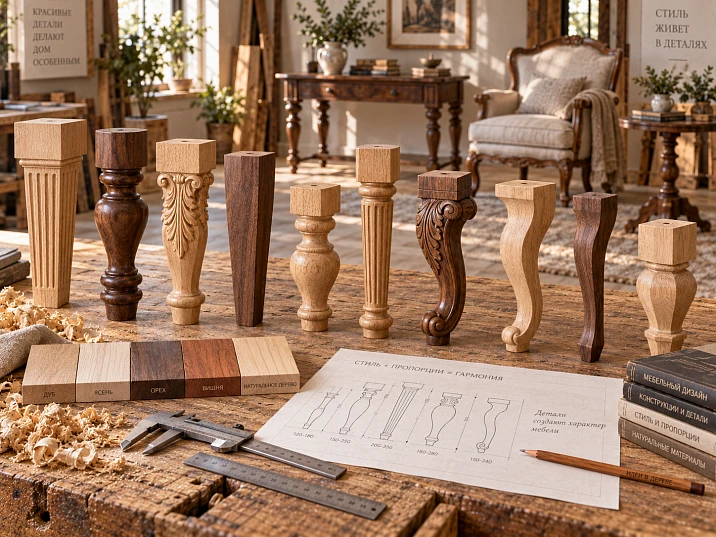
By turning: sphere, roller, neck, rhythm of the profile. A turned leg can be very expressive without a single carved element.
By carving: ornament, acanthus, volute, lion's paw. Here the relief becomes a visible part of the design.
By geometry: unusual cross-section, facet, slant. A straight leg with an unexpected bevel is already an accent.
By material: expressive texture of oak under oil. The wood itself works as decor.
By combining materials: wood and metal in a single leg.
This leads to a practical conclusion. If you need an accent leg, don't limit yourself to the "carved" category. Look at turned and geometric ones, especially from the "Modern" and "Art Deco" collections, where decorativeness is built on proportions and lines.
The term "shaped"
The word "shaped" in customer queries means a leg with a non-standard form. This is not a separate technology: a shaped leg can be turned, curved, carved, sculptural, or combined. When choosing, look at the actual geometry of the specific product.
The scale of the leg must match the body
The central block of the article. A large body on too-thin legs looks top-heavy and as if it has been randomly placed on small supports. A small cabinet on massive shaped legs gets a support that is visually heavier than the object itself. Both situations disrupt the sense of stability.
Check six dimensions: body height, body width, depth, leg height, maximum leg width, number of supports.
Two simple metrics
First metric: the ratio of leg height to body height. A 150 mm leg under a 700 mm body is about 21 percent of its height. A 240 mm leg under the same body is already 34 percent, and the furniture becomes noticeably more airy.
Second metric: the share of the body width that the legs occupy in the front view. Two 60 mm legs on a 900 mm wide body occupy 120 mm, that is about 13 percent. Two 100 mm legs occupy 200 mm, or 22 percent. The larger the share, the more massive the support looks.
These are the author's guidelines for comparing options, not standards. They help you see the difference before the template: if your option falls outside the proportions you consider successful on similar furniture, then it is worth revisiting the dimensions.
Why numbers matter more than photos
Catalog photos show the leg without context. There is no body nearby, no ruler, no floor. So choose by the numbers from the “All sizes and prices” table, and check the beauty on a 1:1 template.
Height is only half the question
Two legs 200 mm high can have a maximum width of 45 mm, 90 mm, or 140 mm. Visually, these are three completely different solutions: slim, medium, and massive. Therefore, you need to compare not only the height, but the combination: height, maximum cross-section, and the character of the profile.
Take three turned models from the catalog. According to the description in the card, leg MN-220 is a sphere about 105 mm high. Leg MN-094, 100 mm high, has a relief conical profile. Both sizes are almost the same in height, but the sphere looks more massive because of its concentrated volume, while the cone looks lighter. The difference is immediately apparent, and height does not explain it.
What to record when choosing
For each candidate: height, maximum diameter or width, top and bottom diameter, number of rings or transitions, perceived weight (light, medium, massive). Such a table of five or six candidates replaces hours of looking at pictures.
About the catalog range
According to the general description, the leg height in the catalog varies from 30 to 2100 mm, and the diameter of round ones from 20 to 100 mm. This means that for any task you can find both light and massive options. Look for them using size filters A, B, and C in the section unpainted legs.
Decorative wooden furniture legs
Measured customer queries call them “decorative wooden furniture legs” and “decorative wooden furniture legs.” These refer to a support with a non-standard shape that differs from a simple block.
A decorative leg can be turned: a rotation profile with rings and spheres. It can be curved: a cabriole with an S-shaped bend. It can be carved: with ornament and relief. It can be sculptural: with the image of an animal or plant. It can be combined: a turned body with carved inserts or a metal element.
The main thing is not to turn the word “decorative” into a separate technology. It is a description of the result, not the method. When you see “decorative legs” in a query, figure out exactly which shape you need: round with a profile, curved, or sculptural.
How to find it in the catalog
The catalog does not have a "shaped" filter, but you do have product type (turned, carved, geometric), collection, and ornament type. For accent pieces, browse the carved and turned models from the "Classic" and "Modern" collections, then filter by size.
Designer furniture legs: what makes a support designer
The query "designer furniture legs" has noticeable demand, and almost half of the broad demand comes from the exact phrasing. But what lies behind the word "designer"?
A designer leg is not necessarily the most complex, expensive, or carved one. Simple geometry can also be designer if the proportion is unusual, the shape is part of the overall piece, the leg echoes the line of the facade, or the material works with the rest of the furniture.
Signs of a designer solution:
-
the leg has a clear idea readable from three meters away: a sphere, a cone, a slant, a ring;
-
the shape is coordinated with the body in proportion and character;
-
there are no random details in the furniture: every line of the leg echoes something else;
-
the material and finish support the concept.
Examples from the catalog
The "Modern" collection brings together models with exactly this logic: modern legs MN-241 (from 13,240 rubles), MN-237 (from 8,700), MN-238 (from 8,840), MN-243 (from 6,600), MN-226 (from 4,320), geometric MN-186-2 (from 8,010), MN-205 (from 4,670), spherical MN-235 (from 9,510). Expensive items correspond to large and complex shapes, but an inexpensive geometric MN-146 (from 590 rubles) can also be designer if it fits the place. Prices in the collection at the time of checking.
The "designer" word trap
If a leg is called designer in the product card text, this does not mean it will suit your furniture. Check its size, mounting plate and profile character. A designer leg on an unsuitable cabinet is worse than a neutral one on a suitable one.
Carved decorative leg
A carved leg is needed if the ornament itself should be a visible part of the design. In the section carved legs at the time of checking, 46 items: from 1,940 rubles (MN-044, "hit") to 143,160 rubles (carved support MN-244). The full guide to choosing a carved support for a specific piece is covered in a separate article, so here is just the essence.
A carved leg requires coordination with the rest of the decor. If the cabinet is decorated with acanthus, a leg with a plant motif will support it. If the cabinet is smooth, the carved leg will become the only accent, and the pattern should be calm. Do not mix several competing ornaments.
About light and finish
Relief several millimeters deep almost disappears in diffused light. A leg low above the floor is often in half-shadow, so the carving must be deep enough or the finish contrasting. Thick enamel clogs fine relief, while patina works on clear relief.
When a carved leg is unnecessary
When the facade is already saturated with decor. When the furniture is modern and smooth. When the leg stands in a dark corner and the relief is not visible. In these cases, it is better to choose a turned or geometric shape.
Turned decorative leg
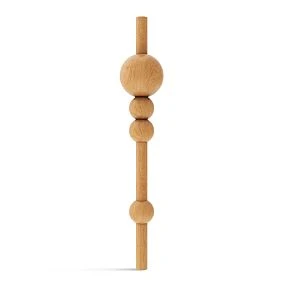
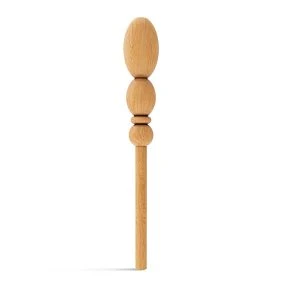
The main visual tool of a turned leg is its profile: bead, sphere, neck, transitions. Such a leg can be made very expressive without any carved ornament at all. In the section Turned Legs supports are collected, from simple cones to multi-tiered profiles.
A turned leg is axially symmetric and has no front side, so it is convenient to place on furniture that is walked around. Its silhouette reads from a distance, and even in partial shade the beads and narrowings are visible.
Rhythm of the profile
How a leg "sounds" in a composition is determined by the rhythm of its transitions. A leg with one large bead is calm. A leg with three or four transitions is rhythmic and adds a classic character to the furniture. A leg with a dozen small transitions is fragmented and merges into texture at a distance. Choose the rhythm for the distance from which the furniture is viewed.
Price range
In the "Classic" collection, turned legs start at 650 rubles (MN-027), 820 (MN-024), 870 (MN-023) and go up to 3,510 (MN-029). A simple shape is inexpensive, a complex one is more expensive. Pay for rhythm only where it will be visible.
Geometric decorative support
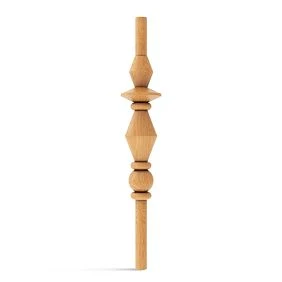
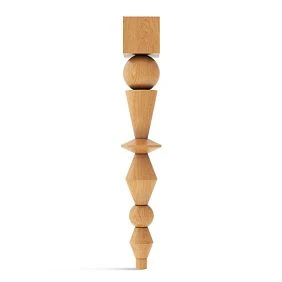
Especially relevant for modern furniture, minimalism, art deco, and furniture with smooth fronts. Section geometric legs combines straight, conical, and faceted shapes.
The decorative quality of such a leg is created not by ornament, but by the angle, proportion, facet, unusual cross-section, or combination of materials. Sharp edges reveal any sanding defect, so the "Prestige" level is often justified for them (hand sanding without additional finishing).
Price examples
In the "Modern" collection, geometric models start at 590 rubles (MN-146), 680 (MN-193), 1,190 (MN-192), 1,280 (MN-186), 2,770 (MN-186-1), and go up to 8,010 (MN-186-2). In the "Art Deco" collection, at the time of checking, the list included carved MN-044 (from 1,940 rubles) and geometric MN-054 (from 3,570) and MN-049 (from 3,450), all in stock.
How to choose
Evaluate the ratio between the leg cross-section and the body: thin geometry under a massive body looks weak, while a thick one under a light body feels heavy. Check the orientation of the facets relative to the body facets: even a slight rotation is immediately noticeable. Make sure the shape echoes the lines of the front.
Decorative ball-shaped leg
A good concrete example of how one geometric idea already makes a leg a strong visual element. Leg MN-220 in the "Modern" collection costs from 1,670 rubles. According to the description in the product card, it is a spherical support about 105 mm high for poufs, low cabinets, and small cupboards, made of oak or beech, without painting. Recommended felt glide FUR-027 (55 rubles). The larger and more expensive spherical model MN-235 in the collection costs from 9,510 rubles.
Let's look at four questions that arise with the ball.
Scale. A 100 mm diameter sphere under a 300 mm wide cabinet is too massive and feels heavy. The same sphere under a 900 mm cabinet looks proportionate. Rule: the larger the sphere, the larger the cabinet should be.
Relation to the cabinet. A sphere feels heavier than a cone of the same diameter because the entire volume is gathered into a single form. It gives furniture solidity and a "homely" feel, but it clashes with light, airy forms.
Repetition of form. Four identical spheres create a steady rhythm. If the furniture has sphere handles or round appliqués, the leg's form will support them. If the furniture has many straight lines, the sphere will become a contrast.
Four identical elements. A sphere is axisymmetric along all axes, so it does not need to be oriented. This simplifies assembly and reduces the risk of error.
About floor support
The sphere rests on the floor with a small area, so a glide is important for protecting the surface and ensuring stability.
MN-233: when a turned leg becomes a designer piece
Leg MN-233 in the "Modern" collection it costs from 2,380 rubles (in the chest of drawers section from 2,200, in the console section from 2,380: the "from" price depends on the page). According to the description in the product card, it is a cone-shaped wooden leg, visually resembling a garland of spheres with a diameter that decreases from top to bottom. There are four sizes: 198, 247, 443 and 635 mm in height, with a main part diameter of 72 mm and a top diameter of 36 mm. Material: oak or beech, unpainted. It is designed for tsarga-free constructions and light loads and is suitable for coffee tables and side tables. Hardware: M8x60 stud (72 rubles), FUR-001 (117) and FUR-012 (152) kits, FUR-017 mounting plate at 10 degrees from 330 rubles. We did not separately verify the wording "designer" in the product card, so we rely on its description.
This is a perfect example for the query "designer furniture legs." Unusual profile: a sequence of spheres tapering downward. Massiveness: the 72 mm diameter at the base is noticeable. Form in action: a garland of spheres gives rhythm and softness. And the need to check the size relative to the cabinet: at 635 mm high it is already a table leg, while at 198 mm it is the leg of a low side table.
What it shows
The same shape in four heights solves four different tasks. That is why the choice of height is determined by the furniture, not by the shape. A 198 mm leg and a 635 mm leg look like different products.
Limitation
Light loads — an important caveat. For heavy furniture, look for more substantial shapes or check with the manager. The manufacturer states a general minimum vertical load of 100 kg per leg, but for a specific shape the actual stability depends on the joint.
Cabriole: a decorative leg with direction
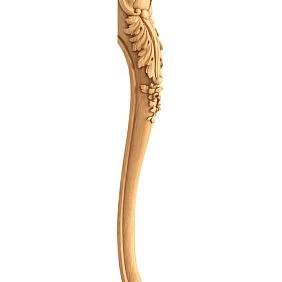
A cabriole should not be perceived as a simple vertical block. It has an S-shaped curve, a visual overhang, a direction, and a front side. That is why its position on furniture is checked with a template.
Leg MN-144 in the list it is priced from 3,140 rubles. According to the description, this is an elegant cabriole leg made of solid wood in a neoclassical style, with an S-shaped double curve, intended for legless constructions and high loads. Applications: poufs, benches, sofas, chests of drawers, sideboards, cabinets. The advertising text lists sizes of 200, 240, and 270 mm; verify them against the size chart. Recommended hardware: M8x60 stud (72 rubles), FUR-001 and FUR-012 kits, FUR-027 (55) and FUR-021 (130) glides.
How it works in a composition
A cabriole adds grace and direction to furniture. The curve draws the eye away from the carcass downward and outward, so a carcass on cabriole legs seems lighter and “lifted.” But the overhang of the lower part beyond the carcass projection is noticeable from the side. Check with a template whether the leg extends beyond the overall dimensions and whether it obstructs passage.
About orientation
The four cabriole legs must be positioned with the same orientation relative to the corners. Usually the curve is directed outward from the center. If the leg is asymmetrical, symmetrical furniture may require pairs of left and right legs; check with the manager.
Sculptural leg: when the support becomes the main decor
Sometimes a leg almost turns into a sculptural detail. The leg MN-046 is listed from 16,100 rubles. According to the description, it is handmade, with graceful curves and a carved lion's head, made of oak or beech, without staining. Fasteners are not included; the FUR-022 foot pad is recommended (170 rubles). See the dimensions in the table on the product page.
Such a leg requires four conditions. Free space around it: there should be no other expressive details nearby. Calm neighboring decor: the other furniture elements should be quieter. The right scale: the lion's head should read clearly but not overpower the body. Controlled finishing of the relief: deep recesses need to be painted without clogging the pattern.
Price as a signal
A set of four MN-046 costs at least 64,400 rubles. Even more expensive is the individual carved support MN-244 (from 143,160 rubles), which is essentially a standalone piece. At such a price, the leg must be the center of the design, otherwise the budget is wasted.
Principle of hierarchy
If a leg with a lion's head attracts attention, the overlays, handles, and moldings nearby should be simpler. Otherwise, the piece loses hierarchy and looks overloaded.
Wood and metal in one leg
A metal element in a wooden leg is a separate subgroup. In the "Modern" collection, such legs are represented by items MN-199 (turned with metal decor, from 2,750 rubles), MN-152 (with polyurethane decor, from 2,160), MN-148 (with decor, from 1,350), and MN-149 (with decor, from 1,470). Link to MN-149 in your plan it is called a leg with metal decor, but in the list it is simply listed as "with decor," so check the insert material on the product page. We have not opened the product page; see the dimensions there.
If a leg has a metal element, it can be supported by handles, lighting fixtures, furniture hardware, or a mirror frame. Then the metal becomes a recurring motif. But there should not be too many metal accents: one or two groups, coordinated in color and sheen.
Material coordination
A brass insert on a leg next to black handles and chrome hinges looks random. Decide on the metal in advance: brass and bronze are warm, black and graphite are neutral, chrome is cool. Choose one or two and stick with them throughout the furniture.
Practical advantage
Metal on the bottom edge protects the wood from wear. But it also adds height, so check the final height taking the insert into account.
Classic decorative legs
We don't list everything one by one, but describe the character. Classic legs are built on smooth profiles, turning, carving, cabriole and floral motifs. Section Classic collection at the time of checking shows a wide range: turned MN-027 (from 650 rubles), MN-024 (from 820), MN-023 (from 870), MN-155 (from 870), MN-028 (from 1,170), MN-025 (from 1,390), MN-026 (from 1,430), MN-082 (from 1,450), MN-093 (from 1,660), MN-083 (from 1,800), MN-099 (from 2,010), MN-183 (from 2,430), MN-178 (from 2,480), MN-179 (from 2,740), MN-029 (from 3,510); carved MN-005 (from 2,310), MN-041 (from 2,400), MN-078 (from 2,750), MN-071 (from 3,230), MN-032 (from 4,280), MN-077 (from 4,530), MN-079 (from 5,970), MN-033 (from 7,540); geometric MN-084 (from 1,760), MN-030 (from 1,700), MN-072 (from 3,990), MN-013 (from 3,730), MN-031 (from 4,260), MN-139 (from 9,630) and carved support MN-244.
For a classic dresser, sideboard or armchair, choose a turned or carved leg with a smooth transition. Classic style allows for massive profiles, but the leg should be in scale with the body.
How not to overdo it
Classicism easily slides into clutter. Choose one motif (acanthus, cabriole, the rhythm of turned beads) and repeat it gently. If the facade has an acanthus applique, a leg with a plant motif will support it.
Decorative legs in Art Deco style
Art Deco is built on geometry, rhythm, verticality, metal, and the contrast of materials. In the Art Deco collection at the time of checking, the list includes the carved MN-044 (from 1,940 rubles, a bestseller), the geometric MN-054 (from 3,570) and MN-049 (from 3,450), all in stock. We covered the MN-054 and MN-049 cards in another article: both are geometric, made of oak or beech, without staining.
The focus of Art Deco is clean lines and repetition. Legs with facets and bevels, black or dark stains, metal inserts, and contrast with a light body create the signature look. The finish plays a big role: deep black, dark walnut, and brass accents reinforce the style, while a faded light finish washes it out.
What to consider
Art Deco geometry demands precision: sharp edges and symmetry reveal any unevenness. That is why the quality of sanding and an even coating matter. Check the sample in the light.
Modern decorative legs
In modern furniture, decorativeness is expressed not through ornament but through tilt, proportion, facet, an unusual cross-section, or a combination of materials. The “Modern” Collection includes modern legs MN-241, MN-237, MN-238, MN-243, MN-226, turned legs MN-220, MN-221, MN-233, MN-239, MN-217, MN-222, MN-234, MN-094, MN-145, MN-194, geometric legs MN-186, MN-192, MN-146, MN-206, MN-205, MN-193, as well as table bases STL-041 (from 46,700 rubles) and STL-042 (from 46,460).
Modern decorativeness is often built on a minimum: one expressive line, an unusual angle, or a contrast of materials. A leg without ornamentation, but with a precisely found proportion, works better than any carving.
Mistake of the modern style
Avoid random “embellishments”: rings, balls, and inserts without an idea weaken the purity of the form. If you choose simple geometry, perfect it with the quality of sanding and color.
Leg color: continuation of the body or contrast
Color determines whether the leg reads as part of the body or as an independent element. There are four schemes.
In the color of the body. The leg becomes part of a unified silhouette. This is a calm solution that works when the accent is needed elsewhere.
Natural oak and a painted body. Emphasis on material: warm wood under a painted body creates a contrast of textures.
Dark leg and light body. Graphic contrast: the legs read as lines and “draw” the silhouette. It works well in Art Deco and modern furniture.
Metal and wood. A modern accent: metal acts as a detail, wood as a warm base.
How to check
Make a test color patch on a whole leg and place it next to the cabinet. Look at it under the lighting in which the furniture will stand. The shade changes with side lighting and with different wall colors.
A single system
If the legs are painted together with the cabinet, use one system. The manufacturer offers a sequence for lacquer and enamel: dust removal, priming, sanding after the primer dries, two finish coats with drying between coats.
Beech or oak for a decorative leg
In short. Beech is a dense, non-porous wood that the manufacturer recommends for products to be finished with enamel. It is chosen when the main focus is enamel, color, and patina. Oak is a dense, porous wood with a pronounced texture, often used with a semi-transparent finish. It is chosen when the design is built on texture, natural wood, oil, clear lacquer, or tinting.
For a decorative leg, the species affects how the shape is perceived. Under enamel, only the silhouette works, and beech shows it cleanly. Under oil, the grain pattern is added, and oak makes the leg richer. But also more delicate: the expressive texture of oak on a carved leg can compete with the relief.
Glue-up grade and sanding
For an opaque finish, choose "for enamel"; for a semi-transparent finish, choose "for tinting." "Standard" is machine sanding, "Prestige" is detailed hand sanding with no need for additional work. For decorative shapes with complex relief, "Prestige" is justified.
Price difference
The difference between species depends on the model: see the size chart in the product card. Do not choose oak for enamel just for prestige: the texture will disappear.
A leg can be beautiful on its own and still not suit the furniture
One of the most important sections. A catalog photo shows the item. The craftsman must evaluate the item within the composition. Check the facade, handles, cornice, overlays, body height, color, and scale.
Example. The sculptural leg MN-046 is beautiful in the catalog. But on a dresser that already has carved overlays, figured handles, and a profiled cornice, it will turn the composition into a catalog of decor. On a simple smooth dresser, the same leg will become the focal point.
Checklist questions
-
Does the leg's motif duplicate other details?
-
Does the scale of the leg match the mass of the body?
-
Is the color coordinated with the facade and hardware?
-
Is the leg readable from the distance at which the furniture will be seen?
-
What happens if you remove the other decor: does the leg win or lose?
Overload test
Photograph the layout with templates of all decorative elements and remove half. If the composition has improved, keep removing. Often the best result is one expressive detail and everything else calm.
How to check a decorative leg with a 1:1 template
Sequence: item code, dimensions, contour, paper template, fitting under the cabinet, front view, side view, approval. Especially important for cabriole legs, wide turned legs, sculptural supports, and asymmetrical models.
Draw the leg contour at full size: front view and side view. Cut it out of cardboard. Place the templates at the future support locations. Check the overhang of the lower part beyond the cabinet projection, the position relative to the front, and the symmetry of the offsets. Step back three meters and assess the proportion. Take a photo.
What is visible on the template
The maximum profile diameter, which is not visible on a drawing with a single axis. The cabriole overhang. The ratio of leg mass to cabinet mass. The distance to the wall and neighboring furniture.
About height
Place a ruler and assess the final height of the furniture with the leg. For a chest of drawers, cabinet plus leg; for a table, leg plus tabletop plus joint. Take into account the glide: felt FUR-027 (55 rubles) and FUR-028 (70), round FUR-021 (130) and FUR-022 (170).
One trial leg before ordering a set
For the workshop, the sequence is: sample, fitting, test finish, approval, four, eight, or twenty pieces. Real scale, profile, surface, color, and installation are checked.
The sample price for expensive shapes is noticeable: MN-046 from 16,100 rubles, MN-235 from 9,510, MN-241 from 13,240. But a mistake in a series of eight chests of drawers with four MN-241 legs would cost at least 423,680 rubles. Simple legs like MN-145 from 540 rubles are cheap to sample.
Conditions
The catalog ships items from one piece, so a sample can be taken without any obligation for a production run. In-stock items ship within three business days (most are stored unsanded), while the rest are prepared in 5–10 business days. Plan your sample in advance.
Calculating the difference
A set of eight cabinets on four legs gives 32 legs. On the neutral MN-145 (from 540 rubles), that's 17,280 rubles; on the accent MN-233 (from 2,380), 76,160 rubles. The difference is 58,880 rubles. That's the price of the accent, and it's worth being aware of when choosing the role of the leg. Prices are "from."
Specification
Record the code, article number, material, finish, and quantity: LEG-01, STAVROS, MN-233, oak, unfinished, 4 pcs. Add dimensions, glue grade, sanding level, hardware, status (SAMPLE or APPROVED), and orientation.
Where to buy decorative furniture legs
The order of purchase follows the concept: the role of the leg, shape, style, article number, sample, set.
-
Wooden furniture legs: general catalog.
-
Unpainted legs: for your own finishing.
-
Collections: "Classic", "Art Deco" и "Modern".
Order conditions
Items ship from a single unit. Delivery is available across Russia and the CIS via CDEK and DPD; pickup is also possible. Showrooms are located in St. Petersburg and Moscow, with production in St. Petersburg. Cutting items to size is not performed. Custom items and required sizes are made only for bulk orders. The manufacturer paints items for orders from 150,000 rubles. Before ordering, it is recommended to prepare a design project: drawings can be downloaded on the website. Check the current price and availability in the product card.
What to clarify with the manager
Availability of the complete set in a single delivery, exact dimensions and maximum diameter, hardware kit, permissible load for the selected shape, availability of left and right pairs for asymmetric models, insert material for decorative legs.
Craftsmen's questions
What types of decorative furniture legs are there?
Turned, carved, geometric, cabriole, ball-shaped, sculptural, and combined with metal or polyurethane. What makes a leg decorative is its role in the composition, not the technology.
Where to buy decorative wooden legs?
In the STAVROS catalog in the section Wooden furniture legs and subsections by types and collections. Orders are possible from one piece.
How does a decorative leg differ from a regular furniture support?
By its role. A regular support is neutral and supports the composition, while a decorative one becomes an accent or part of the style. Technically, these can be similar products at different prices.
Does a decorative leg have to be carved?
No. A turned leg with a rhythmic profile, a geometric one with an unusual cross-section, or a combination of wood and metal can be expressive.
Which legs should I choose for modern furniture?
Geometric and modern models from the "Modern" collection, such as MN-146, MN-186 or MN-205, as well as understated turned ones like MN-145. Decorative appeal is achieved through proportion and quality of craftsmanship.
Which legs suit a classic dresser?
Turned and carved from the "Classic" collection, and cabriole like MN-144. Consider the scale, coordination with other decor, and height.
What are shaped furniture legs?
Legs with a non-standard shape: turned, curved, carved, sculptural or combined. This describes the result, not a separate technology.
How to choose the size of a decorative leg?
Compare the height, maximum cross-section and character of the profile with the dimensions of the cabinet. Useful guidelines: the share of the cabinet height that the leg accounts for, and the share of the cabinet width that the legs occupy. Check with a 1:1 template.
What to choose: beech or oak?
Beech for enamel, color and patina; oak for designs on the texture, for oil, lacquer and tinting. Choose the gluing grade to match the finish.
How to check a leg on furniture before buying a set?
Make a 1:1 template, order one leg, try it against a mock-up, do a test stain and evaluate it under real light. Only after that should you order the set.
Prices and composition of the "Classic", "Art Deco", and "Modern" collections, as well as ordering terms, glue joint grades, sanding levels, and finishing sequence, have been verified against the STAVROS catalog at the time of preparation. Data for MN-233, MN-220, MN-144, and MN-046 are taken from previous checks of their product pages. Calculations and proportion metrics are approximate.