Article Contents:
- Which elements change the appearance of a staircase
- What decor does not replace
- A new balustrade or decor for an existing staircase
- The staircase is being designed from scratch
- The railing already exists
- Only an accent is needed
- Balusters as the rhythm of the railing
- Turned balusters
- Carved newels
- Flat and geometric shapes
- How to assess the rhythm in advance
- Wooden post as the main accent
- Starting, turning, and ending post
- Turned, carved, turned-and-carved
- Post with a pronounced finial
- When a carved post is not needed
- Handrail: the line that brings the decor together
- Massiveness and proportions
- What is in the catalog
- Finials: a small detail that completes the composition
- Finial shapes and their character
- Choose after the post
- How to select carved elements in a single style
- Repeat the motif, not the shape
- One ornament on the staircase
- Scale
- One accent, the rest is support
- Checking "on paper"
- Beech or oak: which wood to choose for decor
- Oak
- Oak
- Ash
- General rule
- Finishing that needs to be planned in advance
- Dimensions matter more than a photo: compatibility check
- Three common mistakes
- Dry fitting
- What to do if the style and size don't match
- A set, not a random collection of parts
- A conditional example: a staircase with one turn
- When a set isn't needed
- Specification before ordering
- How to count the quantity
- Unified finishing system
- What to buy in one order
- When to consult instead of buying
- Mistakes when choosing decor
- Additional decor and what you don't need
- When decor is unnecessary
- Questions and Answers
The staircase is installed, the flights are aligned, the steps are in place. Yet the railing looks as if it was assembled from leftovers of different projects. The reason is usually the same: the balusters were chosen from one factory's catalog, the newel post was taken from another, and the handrail was ordered as "something simpler." Each part on its own is fine. Together they don't read as a single composition.
The decor of a wooden staircase is almost entirely concentrated in four zones: balusters, newel posts, the handrail line, and finials. The staircase structure can be anything: straight, with a turn, or with winder steps. The character of the railing is defined by these four groups of ready-made elements, not by the stringers or the steps. This text is about how to choose them so that they come together into an ensemble and match each other in size. How the staircase is built, how to calculate the steps, and how to install the railing are not covered here: there are separate materials for that. If you need not just the decor but a complete set of staircase railing components, open the article about components for wooden staircases.
Which elements change the appearance of the staircase
Look at any wooden staircase from a distance of five or six meters. The eye will first catch on the newel post at the start of the flight, then read the rhythm of the verticals and travel along the handrail line. The finial, small in volume, will put a full stop at the end of this movement. The steps and the stringer barely participate in this sequence: they form the background.
Hence the practical takeaway. If you need to change the look of a staircase without rebuilding it, work with four zones:
-
balusters set the rhythm and density of the railing;
-
posts provide vertical accents at the start, at the end, and at the turns;
-
the handrail connects everything into a single line;
-
finials complete the top of the post and determine what the silhouette will be.
All four groups belong to ready-made wooden elements: you can select them by product code, check them by dimensions, and order them as a set. In the category wooden staircase components STAVROS they are presented in separate sections: posts, balusters, handrails, and wooden finials. The manufacturer specifies the species oak, beech, and ash.
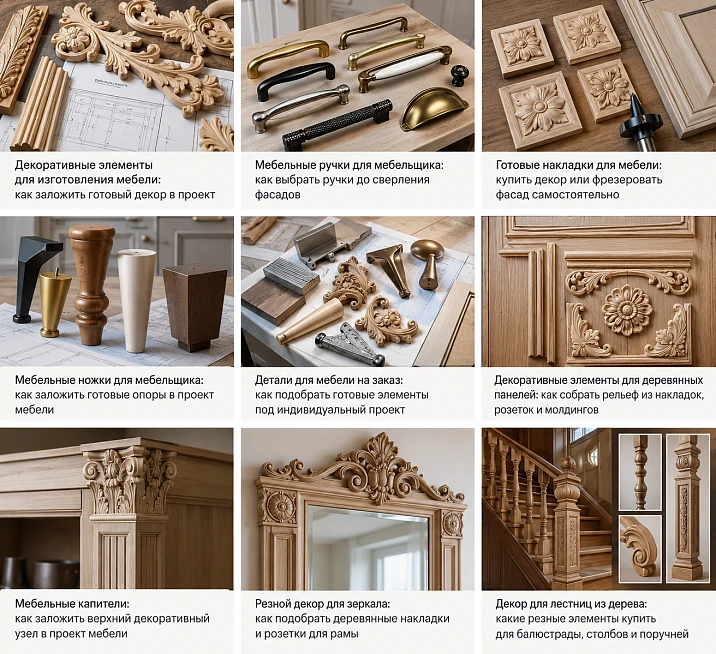
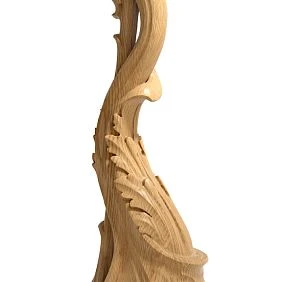
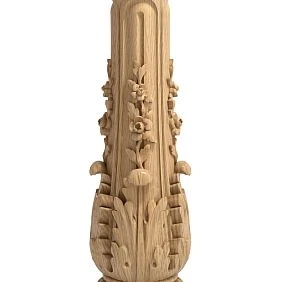
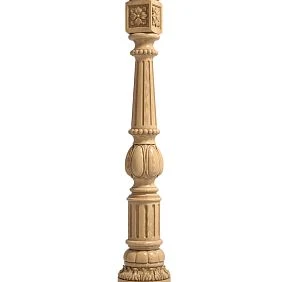
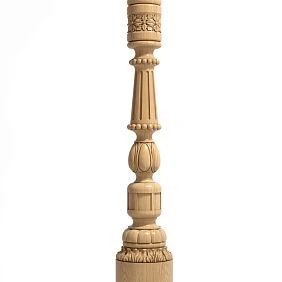
Carved elements for staircases are understood broadly here. Carved refers to items with relief: leaves, acanthus, grapevine, fluting. Figured turned parts, where the pattern is set by the lathe profile, are essentially close to them as well. Even a completely smooth geometric part remains decorative if its shape was chosen to match the style. Therefore, the word “carved” in a search does not always mean relief. Many people are simply looking for “beautiful, not store-bought” parts, but they still need to be chosen using the same algorithm.




What decor does not replace
Decor does not fix structural mistakes. If a post is not vertical and the spacing of the balusters is poorly chosen, even the most expressive carving will not hide it. It will only draw attention to the defect. Before buying decorative parts, make sure the base of the staircase has been approved and the geometry of the railing has been determined.
Our factory also produces:
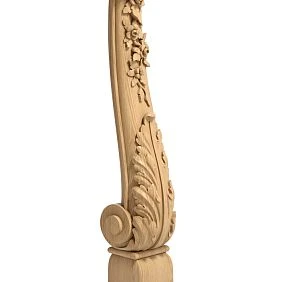
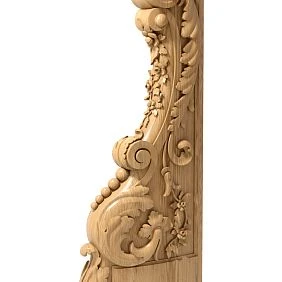
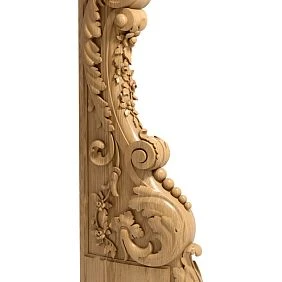
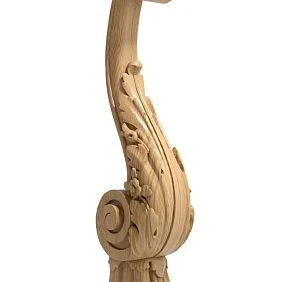
New balustrade or decoration of an existing staircase
The task of "buying decoration" comes in three types. The type you choose determines exactly what you will be ordering and how much compatibility you will need to check.
Get Consultation
The staircase is designed from scratch
This is the most flexible case. You can select balusters, posts, handrail, and finials all at once, and verify the height and cross-section before the staircase itself is manufactured. Here it is worth ordering a complete set from a single collection: posts and balusters in the same series share a unified decorative motif, and a number of STAVROS posts, according to the manufacturer's description, come with a matching finial.
There is one mistake in this situation. The customer chooses a staircase from a picture and only learns the post dimensions after the landing for it has already been designed. The post then has to be either trimmed at the base or the joint has to be redone. The order should be reversed: first the post and its base, then the staircase layout.
The railing already exists
Here the choice is limited by what is already installed. Not everything can be replaced, only the visually significant parts. Usually this means the starting post, corner posts, finials, and sometimes some of the balusters.
Keep one thing in mind. A finished railing has its own height and its own handrail cross-section. The new post must match them, otherwise the handrail line will either have a step in it or require reworking the joint. So before ordering, measure what is installed: the height from the landing to the top of the handrail, the cross-section of the existing posts and balusters, and the width of the handrail. Write down numbers, not impressions.
You only need an accent
This is the least expensive scenario, and it is often the most rewarding. Calm, simple balusters stay, while the starting post is replaced with an expressive carved one, with a matching finial. The composition gains a center, and everything else works as support. This approach is justified if the railing is already assembled and you are satisfied with the quality of the parts.
There is also the opposite situation, when an accent is unnecessary. A small straight staircase to the second floor of a dacha with a narrow flight and a simple handrail will not support a massive carved post. It will "eat up" the passage and look out of place. In such cases, it is better to settle on a turned post of modest proportions or a geometric option.
Balusters as the rhythm of the railing
A baluster is repeated dozens of times, so its shape determines the overall impression more strongly than any individual detail. On a flight of fourteen steps, it is easy to count up to twenty or thirty balusters, and together with the landing their number increases. A shape that looks neutral in a small photograph turns into a pattern over such a length.
You should choose a baluster not by asking "which one is more beautiful," but by asking "which one suits the post and handrail that have already been determined." These are fundamentally different questions. There is no universal answer to the first. There is always an answer to the second, and it is verified by dimensions and by style.
Turned balusters
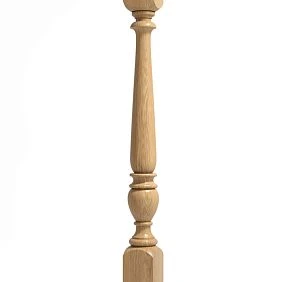
The shape is produced by turning, so all cross-sections are round, and the design consists of spheres, rollers, necks, and transitions. This is the most common option for classic interiors. It combines well with turned posts and with carved ones, if the carving does not have very large relief.
A turned baluster is read by its silhouette. If the profile is too complex, with a dozen small transitions, it shimmers when repeated. For long flights, it is wiser to choose a piece with two or three large profile elements and calm transitions.
Carved balusters
Here the design is applied to the surface: leaves, vines, flutes, acanthus. The expressiveness is higher, but the expenditure of visual attention is also higher. If the entire staircase is made up of carved balusters, the starting post should either repeat their motif or be noticeably calmer.
The most common difficulty with carved details is related to light. Relief a few millimeters deep almost disappears under diffused frontal lighting. Near a window, with side light, shadows reveal every line of the carving. This means that evaluating a carved baluster from a catalog photograph is not enough. Consider where the light falls on the staircase, and decide whether you need carving where it will be in shadow.
Flat and geometric shapes
Geometric balusters are suitable for calm and modern solutions: square or round cross-section, clear edges, minimal profiling. In this case, posts need the same geometric shapes. The STAVROS catalog identifies geometric posts as a separate product type, and the collection filter allows you to find a modern series.
A geometric shape does not mean an easy choice. This is where it is easiest to make a mistake with scale: a thin baluster next to a thick square post looks fragile, while a massive baluster next to a thin handrail presses down on it. When decor is built on pure geometry, size relationships become the main design tool.
How to assess the rhythm in advance
Take a tape measure and mark on the floor or wall the distance between the future verticals, taking into account the actual width of the baluster. Then step back three to four meters. If a narrow gap remains between the parts compared with their width, the railing reads as a solid wall. If the gap is twice as wide as the part itself, the railing looks airy. You can check this with paper strips glued to the wall. This way you will see the proportion before ordering, not after installation.
You can choose wooden balusters by size and shape in the section wooden balusters for staircases. Quantity calculation, installation spacing, and mounting are described in detail in the article about wooden balusters and posts for stairs, so these questions are not repeated here.
A wooden post as the main accent
If a baluster creates repetition, then a post creates emphasis. It is single, it is taller than everything else, and it stands at the key points of the staircase. It is precisely on it that the gaze lingers longest, which is why the post is most often called the “face” of the railing.
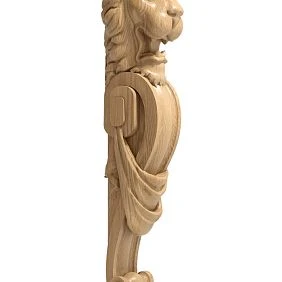
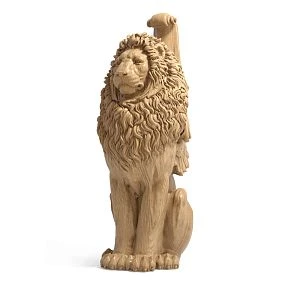
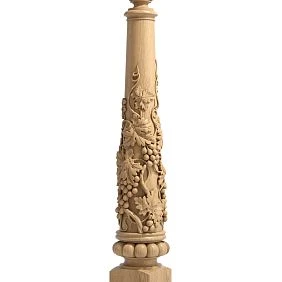
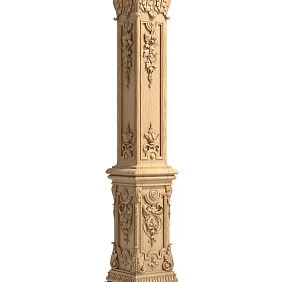
According to the STAVROS catalog, the section presents 37 models of posts for stairs. The manufacturer divides them by collections: “Grapes,” “Classic,” “Russian Style,” and “Modern.” There are three types of products: turned, carved, and geometric. Posts with left and right turns and models in the form of lion sculptures are mentioned separately. Prices in the list start from 13,470 rubles for L-055 and go up to 93,640 rubles for L-065 (data at the time of checking; before ordering, check the current price in the product card).
A spread of more than six times in price clearly shows what the choice is about. A simple turned post solves the task of an initial accent. A complex carved one, with acanthus and a shaped finial, solves the task of a formal staircase in a large hall. They are not interchangeable, and you cannot “save money” by moving from the second to the first: what will change is not the budget, but the very character of the staircase.
Starting, turning, and ending post
The roles of posts differ, and the requirements for them should differ as well.
The starting post stands at the first step. It is seen first, the composition begins with it, and here the greatest expressiveness is acceptable. This is usually where a carved model or a post with a large finial is placed.
The turning post is located on a landing or at the break point of a flight. It connects two directions of the handrail, so its cross-section and fit under the handrail are more important than its decorative quality. If the turn is made at 90 degrees, handrails come into it from two sides. In that case, the carving should leave a free face for adjoining.
The ending post completes the upper flight. It is often more modest than the starting one, but it should not contradict it. A carved start and a bare rectangular finish look like different staircases joined by accident.
Turned, carved, turned-and-carved
A turned post is produced by lathe machining. This is a simple and stable silhouette, suitable for small square staircases. A carved post is made by hand or on a CNC milling machine, and it has a complex silhouette with rich decor.
Between them there is an intermediate group: a turned body with carved inserts or flutes. It is useful in two situations. First: the staircase is classical, but you do not want rich carving. Second: you have already installed carved balusters and are looking for a post that does not argue with them, but supports them.
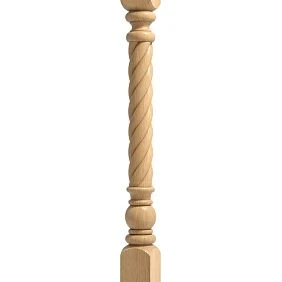
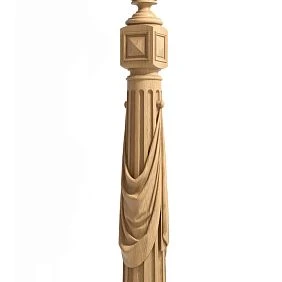
There are also twisted posts and posts with flutes. They work well where vertical hatching is needed: longitudinal lines enhance the sense of height, so in a low hall such a post visually “pulls up” the space.
Post with a pronounced finial
Some models were designed together with a matching finial, and this makes selection noticeably easier. If the post you have chosen has a paired finial, look at it first: it has already been matched in scale and fit. More about finials below.
When a carved post is not needed
A carved post should not be chosen in three situations. First: the staircase is narrow, and the post stands in an area where a person passes right up against it, and the relief catches on clothing. Second: the interior is built on smooth surfaces and straight lines, and any relief will fall out of style. Third: the railing is already densely filled with carved balusters, and adding another strong accent is pointless, because the accent stops being an accent.
You can choose posts for a specific staircase in the section Wooden posts for the staircase. The filters offer sizes A, B and C, product type and collection, so you can immediately narrow the selection by dimensions, not just by appearance. For comparison: post L-012 costs from 35,010 rubles, while L-017 costs from 56,730 rubles. The difference between them is determined not only by size, but also by the complexity of the pattern.
Handrail: the line that brings the decor together
The handrail is longer than all the other elements and is at eye and hand level. It is perceived not as a detail, but as a line. Therefore, when selecting decor, its task is not to stand out, but to connect. You can install the most expressive post, but if the handrail has a disproportionate profile, the whole composition will fall apart.
Safety and installation instructions are deliberately omitted here. This is a separate matter with its own standards. For the decorative task, six parameters are important.
-
Profile shape: round, oval, with a ledge, with a recess for the palm.
-
Massiveness: thickness and width relative to the post.
-
Alignment with balusters: the top cut of the baluster must match the bottom plane of the handrail.
-
Alignment with posts: the handrail "meets" the post at a certain height and at a certain angle.
-
Species and finish: the handrail, posts, and balusters should read as one group.
-
Visual continuity: a line without a step from the starting post to the ending post.
Massiveness and proportions
There is a simple observation that is easy to verify. A thin handrail next to a massive carved post looks unfinished: the mass at the entry and at the exit do not correspond to each other. A massive handrail next to thin turned balusters looks overloaded, as if a heavy roof has been placed on light legs. If the post has large decor, the handrail should have a noticeable cross-section. If the balusters are thin, the handrail should also be moderate.
What is in the catalog
The handrail section in the STAVROS catalog is small: at the time of checking, it contains four items. These are handrail PR-004 from 5,960 rubles, sub-rail strip PR-003 from 870 rubles, spliced handrails PR-002 from 12,350 rubles and PR-001 from 14,100 rubles. This is an important circumstance for planning. With such a choice, it is more logical to choose posts and balusters, and then select a handrail from the available options, rather than the other way around. If the required profile is not available, the manufacturer, according to the description on the website, offers custom manufacturing to dimensions and drawings, but the terms need to be clarified with managers.
The word "spliced" means that the handrail is glued from several parts along its length or cross-section. For a decorative task, this is more of a plus: it is less prone to deformation, and the grain pattern comes out more even. Check how the spliced handrail looks in the product card and compare it with the other parts.
The sub-rail strip PR-003 belongs to a different category. It is not a handrail, but an element that covers the top end of the balusters and serves as a base under the handrail. When choosing, it is worth clarifying whether it is needed in your scheme, and not replacing a full-fledged handrail with it.
You can view all items in the section Wooden handrails for stairs.
Finials: a small detail that completes the composition
The post is chosen, but the end remains on top. A bare cut, even a neat one, leaves a feeling of incompleteness. The finial fills this moment. It is small in size, but it defines the silhouette of the post against a wall or window.
STAVROS singles out finials into a separate category, where they are presented not only for staircases: the same shapes are used in beds, fireplaces, cornices, cabinets and portals. For a staircase project this is a plus, because the choice is wider than in a narrow line "only for posts".
If we take only the price, the spread is also telling. In the list, finials start from 1,380 rubles for L-022, L-057 costs from 1,560 rubles, L-007 from 1,660 rubles. Large and complex items are more expensive: L-066 from 10,870 rubles, L-064-2 from 12,970 rubles, L-105 from 22,530 rubles (data at the time of checking). Catalog filters allow you to choose the shape (square or round), type (turned or carved), collection and width.
Finial shapes and their character
Ball. A universal option: it does not set the style, it simply closes the end. Suitable for turned posts and for calm geometric ones.
Turned shape. Onion, vase, pear: a profile that continues the line of the post itself. Such a finial reads as part of the post, not as a separate detail.
Figurative finial. Pinecone, pineapple, flower, shishak. Such shapes have a historical basis and look good on classic staircases. When choosing, make sure they do not clash in style with the carving of the post.
Carved finial. An element with relief, leaves, vine. It should be chosen carefully, because it increases the overall richness of the decor. If the post is already carved, it is better to choose a simpler finial.
A laconic cap. A flat or slightly beveled plane with a small profile. It suits modern and geometric designs.
Choose after the post
The rule is simple: the finial is chosen to match the post, not the post to match the finial. There are two reasons. First, the fit of the finial is determined by the upper part of the post: its cross-section, the presence of a tenon or a platform, and its diameter. Second, scale. If the width of the finial significantly exceeds the width of the post, it looks like a hat that does not fit. If it is noticeably smaller, it gets lost.
Check this in the product card. For the post, look at dimensions A, B, and C and the geometry of the upper part; for the finial, look at width B. For questionable combinations, request a drawing from the manager. Separately clarify the connection method: not all finials in the catalog are intended for installation on a tenon, and the fit must be checked against the card of the specific item.
Forms, sizes, and styles of finials are described in detail in the article about wooden finials for posts, and the items themselves are collected in the section Wooden Caps.
How to select carved elements in a single style
The words “classic” and “modern” describe an era, not compatibility. Two classic details may not go together, and two different ones may get along quite well. What is needed is not a list of styles, but an algorithm.
The order is as follows: starting post, then baluster, then handrail, then finial, then additional decor. Each subsequent element is checked against the previous one.
-
Identify the starting post. It is the main focal point, and it sets the tone.
-
Find a baluster that echoes the post's motif or quietly yields to it.
-
Choose a handrail by its visual weight: it should match the post, not the baluster.
-
Choose a finial scaled to the post.
-
Only then decide whether additional decor is needed.
Repeat the motif, not the form
Matching the exact same shape rarely produces a beautiful result. Repeating the motif works much better. The motif can be:
-
flutes, longitudinal grooves;
-
leaf or acanthus;
-
geometric rhythm of facets;
-
turned transition between the bead and the neck;
-
grapevine, if the "Grape" collection is selected.
For example, the post has flutes, and the baluster body also has longitudinal grooves, only smaller. The forms are different, the motif is one, and the eye perceives this as a system. But if the post has leaves and the baluster has grooves, the motifs compete.
One ornament on the staircase
Do not mix two competing ornaments. A leaf and a vine in one railing already create tension, and then a geometric relief on the handrail is added to them. Leave one main ornament and one secondary one, and the secondary one should be noticeably calmer.
Scale
A large carved post next to thin simple balusters looks like products from different projects. The reason is the difference in mass: the post visually weighs twice as much as the entire row of balusters. Balance not the decor, but the weight itself. Either choose a baluster with a more pronounced body, or a simpler post.
There is also the opposite case: a massive carved baluster next to a thin, elegant post. It also does not work, because the repeating element "pulls" attention to itself, and the post loses its role as an accent.
One accent, the rest is support
If there are several accents (a carved starting step, carved balusters, a shaped finial, a decorative strip), they begin to interrupt each other. Determine the main one. Usually this is the starting post. Choose everything else so that it supports it.
This same rule eliminates unnecessary costs. The accent needs to be paid for once, and the rest can be chosen from simpler options.
Checking "on paper"
Print out photos of the elements at the same scale, using the real heights from the product cards, and arrange them on a table. A post with a finial, next to it two or three balusters, and above them a handrail line cut out of cardboard. This kind of mockup takes ten minutes and reveals half the problems: balusters that are too light, conflicting ornaments, and the different "weight" of the parts.
Beech or oak: which wood to buy decor in
The choice between the two species does not come down to hardness or price. It is tied to what you plan to finish the staircase with. Decide on the finish first, then the species.
Beech
Beech has a uniform, fine structure and a calm grain, without pronounced large pores. That is why it takes opaque finishes well: enamel, paint. If a white or colored staircase is planned, beech provides an even surface, and the relief of the carving reads clearly because it is not broken up by the grain pattern.
Beech is also suitable when uniformity is needed: if there are many parts and they must look identical, beech's calm structure smooths out the differences between the blanks.
Oak
Oak has a pronounced texture with noticeable pores and characteristic rays. It comes into its own when the wood remains visible: under oil, clear lacquer, or stain. Here the texture itself becomes part of the decorative solution.
The limitation follows from the same property: opaque enamel on oak hides its main advantage, and the large pores sometimes still show through. That is why oak under white enamel is chosen less often, and only deliberately.
Ash
The manufacturer also lists ash among the species. It too has a noticeable texture, is lighter than oak, and is often used to replace oak when a light tone is needed. But check the specific models and availability in the species in the product card, because not every item is produced in all species.
General rule
| Situation | What is more logical to choose | Why |
|---|---|---|
| White or colored enamel | Beech | Smooth surface, crisp carving relief |
| Oil or clear lacquer, visible grain | Oak | The pronounced pattern becomes part of the decor |
| Tinting to a dark tone | Oak or beech | Depends on the desired pattern: oak pores will show through, while beech will take the tone more evenly |
| Different parts should look the same | Beech | A calm structure evens out the differences between blanks |
One condition is mandatory: all railing elements must be made of the same species or of species that read the same after finishing. If the post is oak under oil and the balusters are beech under the same oil, the difference in grain will be noticeable. Mix species only when the finish is opaque and completely hides the wood.
A finish that needs to be planned in advance
Carved relief is easier to coat before assembly, not after. If you have deep carving, a brush does not always reach into it, and after installation it is inconvenient to get to narrow spots. There is another practical detail: thick enamel clogs fine relief. Lacquer and oil preserve crispness.
A patina in which the relief is emphasized by a dark tone while the raised areas remain lighter creates an aging effect and works well with the carvings in the catalog. However, it requires a smooth base and careful work, so decide in advance who will carry out the finishing.
Dimensions matter more than photos: compatibility check
The same style does not yet mean structural compatibility. And vice versa: two parts that fit in size do not yet form a good decorative ensemble. These are two different questions, and they must be answered separately.
The compatibility check consists of eight parameters.
-
Element height. For a post, this is the full height from the base to the top; for a baluster, the height between the handrail and the support.
-
Cross-section. The cross-sectional dimensions of the post and baluster, and the width and thickness of the handrail.
-
Base size. How the post rests on the floor or step.
-
Geometry of the upper part. What is on the top end: a platform, tenon, or groove.
-
Mounting point. Where the baluster fits and where the finial fits.
-
Handrail parameters. Profile, width, bottom plane, groove.
-
Connection method. Tenon, dowel, embedded, overlay method.
-
Actual dimensions per the drawing. Not "about 900", but the number from the drawing or product card.
STAVROS catalog cards contain dimensions A, B, and C, and the filters allow you to select products by them. Use them not only for searching, but also for verification: write the values into a table before ordering.
Three common mistakes
First: checking only by height. The post height matched, but the cross-section turned out to be a third larger. As a result, the post goes beyond the dimensions of the platform or does not fit into the opening.
Second: checking the finial by width without verifying the fit. The width matches, but the connection method is different. The finial has to be glued instead of mounted on a tenon, and reliability drops.
Third: measuring from a photo. The scale in a photo is arbitrary, and a part 1000 mm high and a part 800 mm high can look almost identical if there are no objects nearby for comparison.
Dry fitting
Before final installation, lay out the elements on the floor in the order of installation. Attach the handrail to the posts, place the balusters in position without glue, and look at the line. This is called a dry fit. It takes about an hour and reveals mismatches that are not visible on paper: the angle at which the handrail enters, the gap between the baluster and the handrail, and differences in height.
What to do if the style and size do not match
Three solutions are possible. First: replace the element with one that fits the size while preserving the motif. Second: trim the mounting seat, but only if this is structurally permissible, and preferably in agreement with a craftsman. Third: order the product in the required size according to custom drawings. The catalog pages mention this possibility, but subject to a minimum production run, so for a single staircase this option is not always available.
A set, not a random collection of parts
The table shows what each group is responsible for and what to check before ordering.
| Element | What it is responsible for | What to check before ordering |
|---|---|---|
| Baluster | Fence rhythm | Shape, height, cross-section |
| Pillar | Main vertical accent | Height, cross-section, style |
| Handrail | Unifying line | Profile, size, compatibility with the post |
| Finial | Post finishing | Fit, scale, shape |
| Additional decor | Accents | Size, ornament, installation location |
When assembling a set, think not about the number of elements, but about their interconnections. Each connection must be verified: baluster with post, post with handrail, handrail with baluster, finial with post. These are four pairs, and each has its own criterion.
Conditional example: staircase with one turn
Let's imagine a staircase with two flights and a landing. You need a starting post, a turning post on the landing, and an ending post at the top. Three posts in total. If you choose one model for all of them, for example L-055 (from 13,470 rubles), the posts will cost at least 40,410 rubles. Three finials are added to these. If you choose model L-057 (from 1,560 rubles), that's another 4,680 rubles. Total for posts and finials is about 45,090 rubles, excluding balusters and handrail.
This is a sample calculation to show the order of magnitude. The real budget depends on the chosen models, wood species, and size. Prices are listed as "from", and on the product page they may differ depending on the finish.
Now the same set, but with an accent. We take an expressive starting post, for example L-012 (from 35,010 rubles), and a simple L-055 for the turning and ending posts. The posts cost 35,010 plus 2 at 13,470, that is 61,950 rubles. The difference compared to identical posts is approximately 21,540 rubles. For this money you get one readable accent and an overall more complex pattern. If the budget is limited, this is a reasonable compromise.
When a set is not needed
It is not always worth buying all four groups at once. If you have a good handrail and balusters that suit you, and only the start of the staircase does not, limit yourself to a post and finial. If the railing is modern and laconic, you can skip finials altogether: a post with a flat top surface looks complete.
Specification before ordering
An order without a specification turns into a chain of clarifications: how many, what size, what color, for what place. A specification eliminates this in advance and allows the manager to quickly check the set.
Order format: product code, element type, size, wood species, quantity, installation location, finish.
Example order table:
| Position | What we record |
|---|---|
| Balusters | Model, quantity, height, cross-section |
| Starting post | Product code, dimensions A, B, C, wood species, turning direction if required |
| Turning post | Product code, quantity, dimensions |
| End post | Product code, dimensions |
| Handrail | Profile, length, wood species |
| Finials | Model, quantity, width |
| Finishing | A unified coating system for all parts |
Pay attention to the direction of the turn. The catalog mentions models with left and right turns. If the post is asymmetrical, you need a specific side, and a mistake at this stage is costly. Clarify in advance how the right and left sides are determined: relative to the person going up the stairs, or relative to the observer below.
How to calculate the quantity
Posts are counted by points: start, turns, end. Finials equal the number of posts if each needs a cap. The handrail is calculated by length with an allowance for trimming, especially if there are corner joints. Balusters are calculated separately, by installation spacing, and this calculation is covered in detail in the article about balusters, so we do not duplicate it here.
A practically important point: the handrail allowance. Mathematically, the length of the flight plus the landing may "match" the length of the blank. In reality, when cutting at an angle at the joint with a turning post, part of the length is lost, and without an allowance it will not be enough. Take an allowance for both the cut and the fitting.
A unified finishing system
Write down on a separate line what will coat all the parts. The reason is that different batches of enamel or oil produce different shades. If the posts were painted from one can and the balusters a month later from another, the difference will be noticeable. It is better to finish everything with one batch and in one go, or buy a sufficient volume of material in advance.
Also check availability. In the STAVROS catalog, products are listed either as "In stock" (with separate filters for St. Petersburg and Moscow) or with a lead time of "5-10 days." If some items are in stock and some are made to order, plan the installation so you do not have to wait for the last item.
What to buy in one order
The order sequence is determined by the logic of subsequent assembly. First the posts, then the finials for them, then the balusters and the handrail.
To get an overview of the entire range, open Buy staircase components. If the posts are determined, proceed to the section buy wooden posts. They are matched with Wooden Caps. The rhythm of the fence is set by wooden balustersand the line is closed by Wooden handrails.
The recommended purchase order is as follows:
-
Posts, because all other dimensions depend on them.
-
Finials for the selected posts.
-
Balusters, coordinated with the post in motif and height.
-
Handrail including cross-section and length.
-
Finishing materials.
Before ordering, check the current price and availability on each product's page. If the set includes items marked "5-10 days", confirm the lead time for the entire order at once.
When you should consult instead of buying
There are situations where ordering from the catalog without a consultation is risky. A staircase of non-standard shape, for example spiral or with winder steps. A railing with complex geometry and several turns. Restoration where the existing pattern needs to be replicated. In these cases, first send the dimensions and photos to the manager, and then determine the order contents.
Mistakes when choosing decor
Below are the mistakes that happen most often. Each has a cause and a way to prevent it.
Mistake one: buying from a photo without checking dimensions. The cause is that the image does not convey scale. The consequence: the part does not fit the cross-section. How to avoid: write down dimensions A, B, C from the product page and compare them with on-site measurements.
Mistake two: several strong accents. The cause: the desire to use everything you like. The consequence: the railing is overloaded, and no single element stands out. How to avoid: choose one main element and adjust the others to match it.
Mistake three: different wood species under a transparent finish. The cause: trying to save money or use what is available. The consequence: the difference in texture is noticeable even after tinting. How to avoid: a single species or an opaque finish.
Mistake four: choosing the finial before the post. Cause: the finial is appealing on its own. Consequence: the width or fit does not match. How to avoid: select the finial based on the top part of the chosen post.
Mistake five: ignoring light. Cause: evaluating from catalog photos. Consequence: the carving relief disappears under real lighting or, conversely, appears too harsh. How to avoid: assess where the light falls on the staircase and choose the relief depth accordingly.
Mistake six: ordering without extra allowance for the handrail. Cause: calculating by length without accounting for trimming. Consequence: not enough length for the final section. How to avoid: add allowance for cutting and fitting.
Mistake seven: incorrect turning direction. Cause: not understanding that the post is asymmetrical. Consequence: the pattern faces the wrong way. How to avoid: check with the manager how the side is determined and record this in the specification.
Additional decor and what is not needed
Sometimes after the posts, balusters, handrail, and finial, there is a feeling that the composition is missing something. Before adding details, ask: what exactly is missing, rhythm, accent, or completeness? Often the answer is that one of the main elements was chosen poorly, and additional overlays only mask this.
If you decide to add something, follow a few rules. Additional decor should repeat an existing motif, not introduce a new one. It should be placed where a person will see it, not where it is hidden by furniture. Its size should match the scale of the post.
The STAVROS carved decor catalog also includes other groups: brackets, capitals, rosettes, overlays. Some of them can be used as additional accents in the staircase area interior. But check that they actually match in motif and wood species. Simply having “classic” style in the collection name does not guarantee compatibility of specific parts.
When decor is unnecessary
Decor is unnecessary if the staircase is technical: basement, attic, service passage. It is unnecessary if the main requirement for the railing is safety and ease of maintenance. It is unnecessary if the budget does not allow buying quality elements: it is better to install a simple, well-made structure than cheap, low-quality relief.
Questions and answers
What decorative elements are used for a wooden staircase?
Main groups: balusters, posts, handrails, and finials. Additionally, overlays, brackets, and other carved decor elements are used. For appearance, the first four matter most.
Which carved elements for a staircase can be bought ready-made?
The STAVROS catalog offers posts (37 models at the time of checking), balusters, handrails, and wooden finials. Posts can be turned, carved, or geometric, and finials come in square and round shapes.
How to match balusters to a wooden post?
First choose the post, then find a baluster that repeats its motif or quietly yields to it. Check the height and cross-section in the product cards and assess the mass ratio: a thin baluster next to a massive post looks weak.
Do posts and balusters need to be bought from the same collection?
It is not mandatory, but it simplifies the task: the motif and scale are already coordinated. If you take them from different collections, check that the motifs and sizes match manually, preferably with a dry fit.
What to choose for a staircase: beech or oak?
Beech is better for enamel and a uniform surface, oak for oil, lacquer, and tinting where the texture remains visible. Decide based on the finish: first the coating, then the species.
How to match a wooden finial to a post?
Focus on the upper part of the selected post: the cross-section, the fit, and the connection method. The width of the finial should be proportionate to the post. If the post has a matching finial, start with that.
Can only the balusters be replaced on a finished staircase?
Yes, if the new balusters match the old ones in height and in the mounting joint. Be sure to measure the existing ones and check them against the product card. If the fit differs, the joint will need to be modified.
How do I check the dimensions of the elements before ordering?
Write down dimensions A, B, and C from the product cards, and check the height, cross-section, base size, and the geometry of the upper part. Then do a dry fit on site or on a mock-up. If in doubt, request a drawing from the manager.
Which staircase components are best purchased at the same time?
Posts and finials, because they are matched by fit. It is also best to order the handrail and balusters at the same time so that the wood species and finish match by batch. Only items that do not affect the overall pattern can be left for a separate delivery.
How can I assess whether a carved post will suit a small staircase?
Measure the width of the passage next to the post and see how much remains after installation. If the passage becomes cramped or the relief is at the level of clothing and hands, choose a turned or geometric model.
What should I do if the required size is not in the catalog?
Check with managers about the possibility of custom manufacturing. According to the description on the website, it is possible based on dimensions and drawings, but subject to a minimum order quantity, so for a single order it is worth discussing the terms in advance.
Where to buy wooden stair decor?
In the STAVROS online store in the section staircase components made of wood. Contact us to confirm shipping to your destination. and to CIS countries is carried out by transport companies. Before ordering, check the current price and availability on the product page.