




























































Article Contents:
- What is a balustrade and how is it different from regular railings
- Historical context without unnecessary words
- Key difference from just a "fence"
- Where wooden balustrades are used: eight scenarios
- Staircase in a country house
- Double-height space and second-floor gallery
- Balcony of a country house
- Open terrace
- Hall with Grand Staircase
- Usable roof and porch
- Staircase on the street
- Commercial interior: restaurant, hotel, showroom
- What is included in the balustrade kit: complete system composition
- Balusters
- Support columns
- Handrail
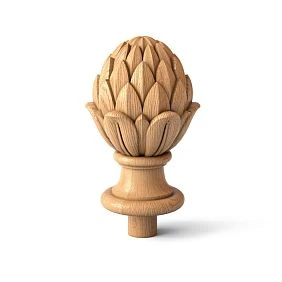
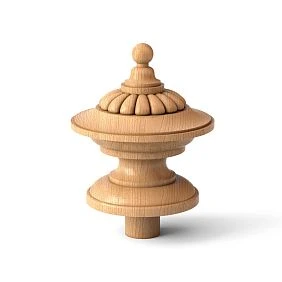
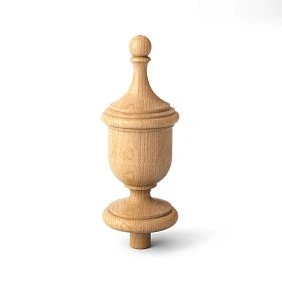
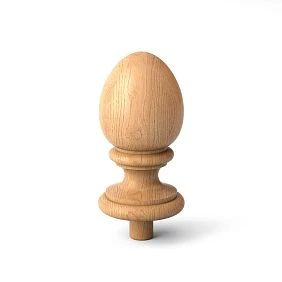
- Post Caps
- Under-baluster rail
- Handrail turning and connecting elements
- Fastening Elements
- How to choose balusters for a balustrade: shape, rhythm, scale
- Turned balusters: classic rhythm
- Carved and turned-carved balusters: maximum expressiveness
- Straight square balusters: strictness and minimalism
- Flat shaped balusters: silhouette ornament
- Baluster spacing: safety and rhythm
- Support posts and handrails: why they cannot be chosen separately
- Why the post and baluster are one pair
- Why the handrail requires coordination
- Post finial: the final chord
- Stair balustrade: height, proportions, style
- Stair railing height
- How the balustrade works on the flight
- Number of elements per flight: calculation example
- Balustrade style matching the staircase style
- Balustrade for double-height space and gallery: space, safety, image
- Why a balustrade for a double-height space is a special case
- Gallery railing height
- Visual lightness vs. safety
- Style solution for a double-height hall
- Balustrade for terrace and balcony: material and wood protection
- Why wood is suitable for an outdoor balustrade
- How to protect a wooden balustrade on a terrace
- Wood species for outdoor balustrade
- Proportions of a terrace balustrade
- Material: beech, oak and other wood species for balustrade
- Beech: precision and versatility
- Oak: character and durability
- Ash: a balance between beech and oak
- Which wood species to choose: a practical rule
- How to choose a balustrade to match your home style: seven style solutions
- High classicism and historical stylization
- Neoclassicism
- Modern classicism
- Country house in Russian style
- Scandinavian Style
- English cabinet and hunting style
- French Provence and countryside romance
- How to calculate a balustrade for a staircase: a precise algorithm
- Step 1. Draw a staircase diagram
- Step 2. Determine the post positions
- Step 3. Calculate the number of balusters
- Step 4. Calculate the length of the handrail
- Step 5. Account for turning elements
- Example calculation for a U-shaped staircase
- Mistakes when buying a balustrade: eight typical blunders
- Mistake 1. Buying balusters without posts and handrail from the same series
- Mistake 2. Not calculating the length of the railing
- Mistake 3. Underestimating the height of the railing
- Mistake 4. Mixing styles
- Mistake 5. Choosing elements that are too thin for a large-scale staircase
- Mistake 6: Not planning the coverage before installation
- Mistake 7: Not ordering turning elements in advance
- Mistake 8: Not considering the interior around the staircase
- FAQ: Answers to key questions about buying a wooden balustrade
- STAVROS: Wooden balustrade as an architectural solution, not just a purchase
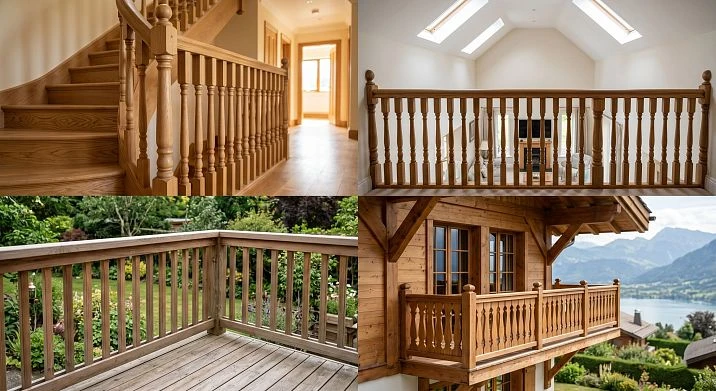
There is one element in a country house that either elevates everything to a new level or reveals the incompleteness of the design. This is the balustrade. The rhythm of balusters along the staircase. The line of the handrail above the double-height space. The wooden railing on an open terrace that connects the house with the garden.
When the balustrade is chosen correctly, it is not a "railing." It is an architectural phrase spoken through the verticals of the balusters, the horizontal of the handrail, and the massiveness of the support posts. And everyone who enters the house hears this phrase.
When it is wrong, all traces of a random choice are visible: balusters of one style, a handrail from another series, posts that "didn't fit" but "will do," and the feeling that this is a set of parts, not a system.
If you decided buy a balustrade made of wood — this article will give you everything you need: understanding the system composition, principles for choosing each element, application scenarios, calculation, and typical mistakes. No fluff, no repetition — only what is really needed when making a purchase.
What is a balustrade and how does it differ from ordinary railings
Many consider "balustrade" and "railing" to be synonyms. This is not the case.
Railings are a functional barrier. A handrail on brackets attached to a wall or floor. Minimal set: support + horizontal rail. Safe, utilitarian, without architectural pretensions.
A balustrade is a system of decorative fencing with balusters. It includes:
-
a row of vertical posts (balusters) with decorative relief
-
support pillars at key points
-
a handrail resting on the balusters and pillars
-
a lower support structure (sub-baluster rail, stringer, or step)
The balustrade serves a fencing function — but at the same time is a decorative architectural element. It is the rhythm of the balusters, their shape, the proportions of the pillars, and the profile of the handrail that create the visual image associated with classical, neoclassical, or country architecture.
Historical context without unnecessary words
The balustrade appeared in European architecture during the Renaissance — as an element that simultaneously enclosed and adorned. Italian villas, French castles, Russian estates — everywhere the balustrade was a marker of the building's architectural culture. Today wooden balustrade it remains the same: a railing system with dignity.
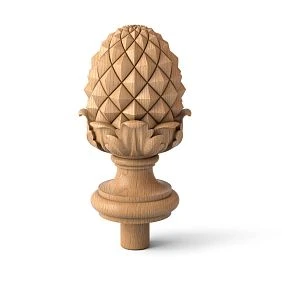
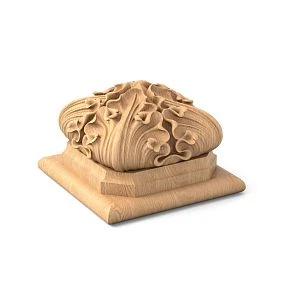
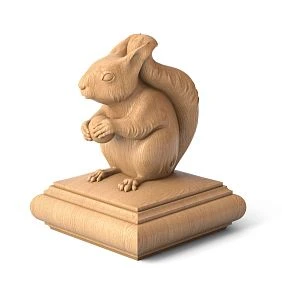
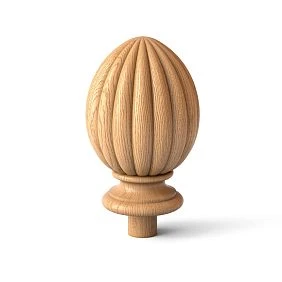
Our factory also produces:
The key difference from a simple "fence"
Handrails can be installed in a day: brackets on the wall, a pipe on top. A balustrade needs to be designed: determine the height, baluster spacing, post locations, handrail profile, and tinting. This requires several hours of work on paper — and yields a result that lives in the house for decades.
Get Consultation
Where wooden balustrades are used: eight scenarios
wooden balustrade is universal — it works in a wide variety of spaces and conditions.
Staircase in a country house
The most classic application. A staircase balustrade is the entire railing of the flights: from the bottom step to the top landing. Here, the balustrade works in three dimensions: it is visible from the side (the rhythm of balusters along the flight), from below (the handrail as an inclined line), and from above (the view from the second-floor gallery).
Double-height space and second-floor gallery
A balustrade along an open walkway or second-floor gallery is one of the most visually expressive scenarios. The railing above a double-height stair hall is visible from multiple points simultaneously and serves as the main architectural accent of the hall.
Balcony of a country house
Wooden balustrade for a balcony — a traditional solution for classic and country style. Balusters, handrail, corner posts — all made of solid wood, in a tint coordinated with the house facade. Important: for an open balcony — wood with an atmospheric protective coating.
Open terrace
On the terrace, the balustrade serves both decorative and functional roles: it fences off height differences, creates a "frame" for the terrace, and connects it with the house architecture. For the terrace — a wide spacing of balusters (possibly with horizontal rails) or a rarer rhythm of large elements.
Hall with a grand staircase
In a city mansion or country house with a grand hall, the balustrade is a central interior element. It is by this that the guest assesses the class of the house in the first seconds. Here, appropriate are carved balusters, massive posts, a wide shaped handrail.
Usable roof and porch
On the porch of a country house, the wooden balustrade continues the facade theme: porch posts, handrails, step railings — all made of the same material and in the same tint as the trim and facade decor.
Outdoor staircase
An external staircase of a country house leading from the entrance group to the garden or pool. The balustrade here is part of the landscape architecture. Wood with good protective coating against moisture and UV.
Commercial interior: restaurant, hotel, showroom
In a restaurant with a staircase or on a hotel balcony, a wooden balustrade is a brand interior element. Classic style, dark tinting, expressive balusters. It creates an image that the guest remembers.
What is included in the balustrade kit: complete system composition
To buy a balustrade correctly, you need to understand the composition of the system as a whole.
Balusters
Wooden balusters — the basis of the rhythmic row of the railing. Vertical posts with a decorative profile: turned, carved, flat, or rectangular. It is the shape of the balusters that sets the style of the entire balustrade.
Standard height of the working part of the baluster: 800–900 mm. Total length (with tenons for fastening): 900–1,050 mm. Cross-sectional size: 35–65 mm depending on the series.
Supporting posts
Massive vertical elements at key points: start of the flight, end, turn, landing. The post bears the structural load of the handrail. Cross-sectional size: 80×80 – 130×130 mm. Height: from the step level to the top of the handrail + finial (40–150 mm above the handrail).
Handrail
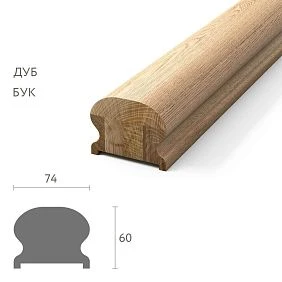
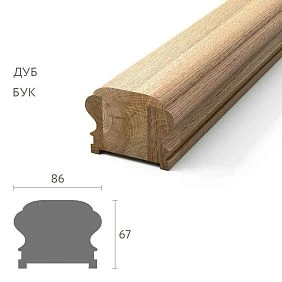
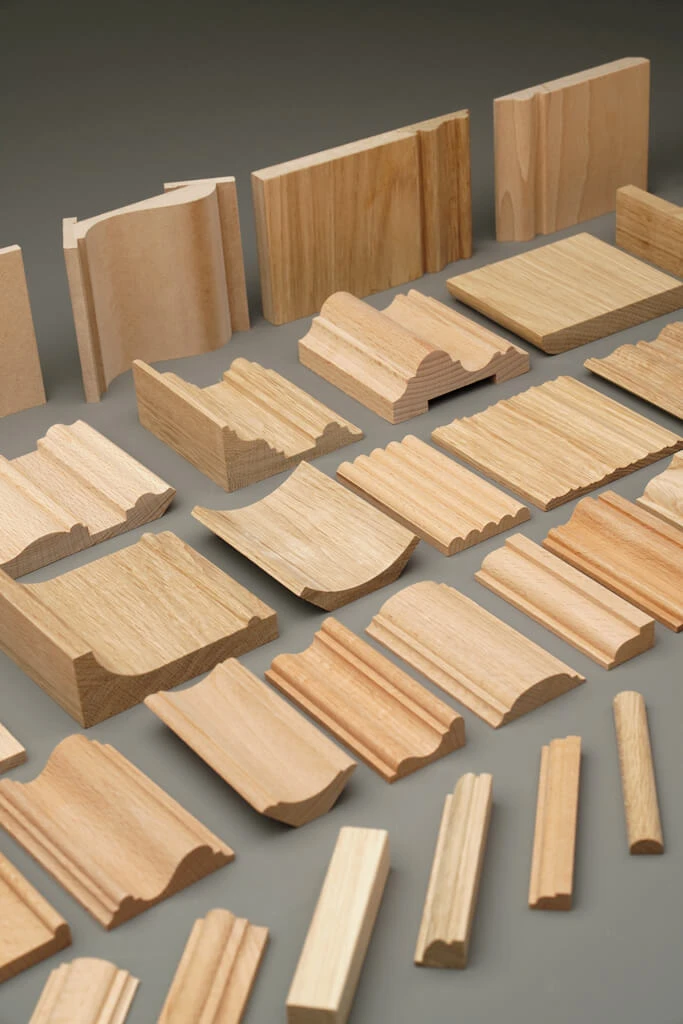
A horizontal or inclined (along the flight) profile that lies on top of the balusters and posts. Shape: oval, rectangle with rounded corners, shaped profile. Cross-sectional width: 45–70 mm.
Post finials
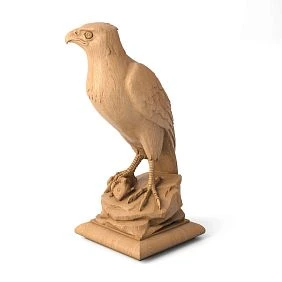
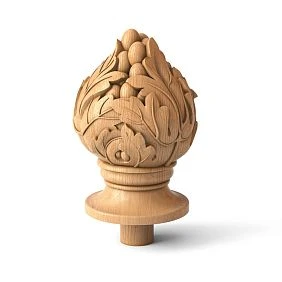
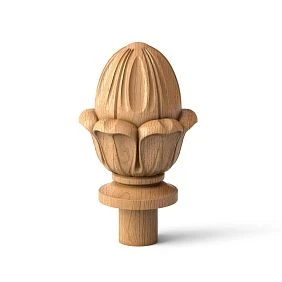
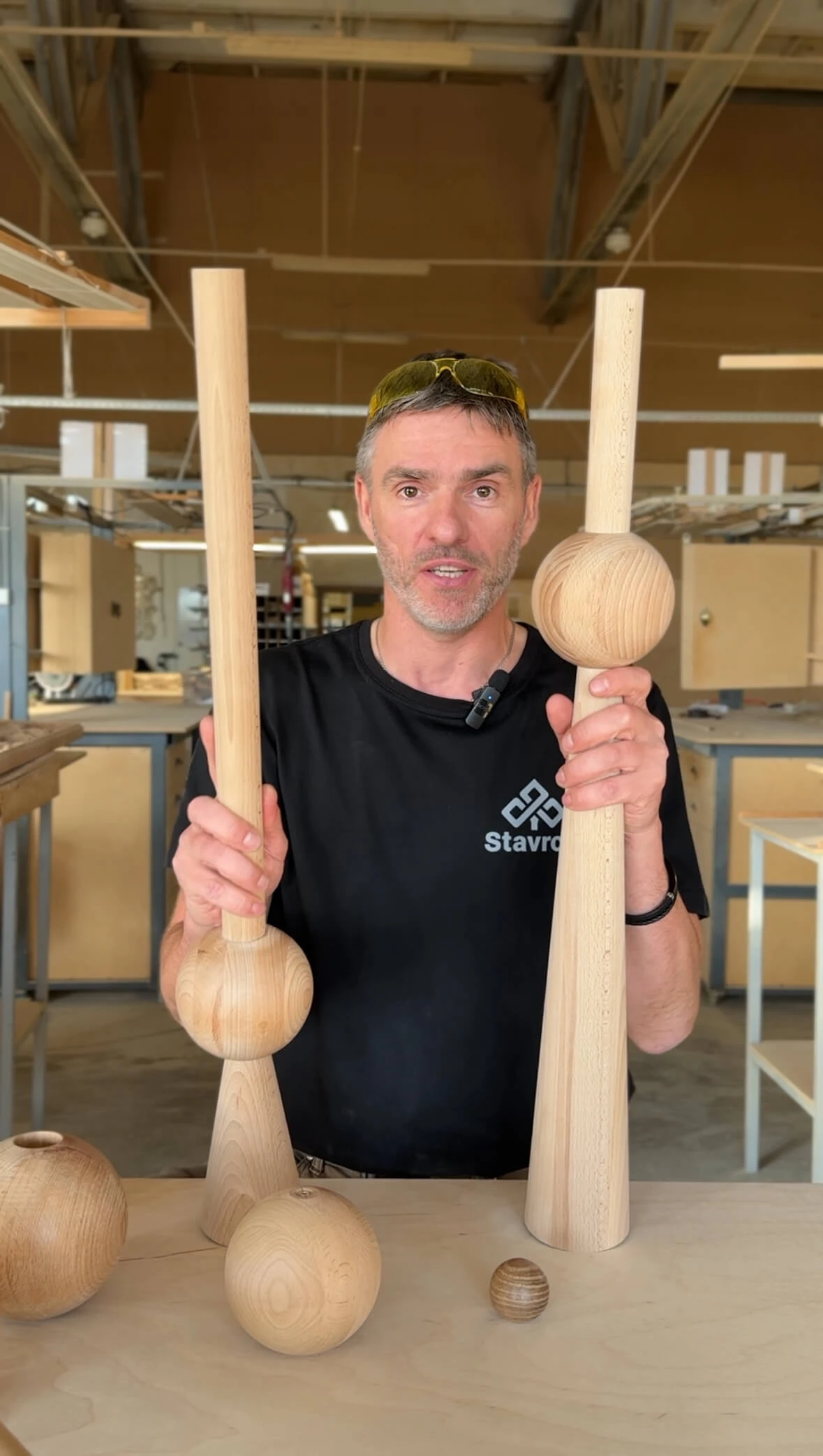
Decorative top elements of the post: ball, cone, pyramid, "onion" with a carved belt. The finial is installed above the handrail and serves as the visual "point" of the post.
Under-baluster strip
A horizontal rail under the balusters — creates a base for even installation and hides the bases of the balusters. Installed on steps or stringers.
Handrail turning and connecting elements
On the landing and at the turn of the flight, the handrail changes direction through special turning blocks: a 90° "knee", smooth curved transitions. These elements are ordered separately and for a specific turning angle.
Fastening Elements
Screws, mounting bolts, metal studs for attaching balusters to the step, anchors for posts. Some fasteners come in the kit, some are purchased separately.
How to choose balusters for a balustrade: shape, rhythm, scale
Balusters for staircase — the most "expressive" element of the balustrade. They determine the style of the entire system.
Turned balusters: classic rhythm
Turned profile — spheres, vases, barrels, rollers — this is the classic of balustrades. Expressive relief, play of light and shadow in side lighting. For classic and neoclassical interiors, for halls with stairs, for country houses in a classic style.
Size range of turned balusters: 35–65 mm in diameter of the largest part. For small stairs in an apartment — 35–45 mm. For a grand staircase in a mansion — 50–65 mm.
Carved and turned-carved balusters: maximum expressiveness
carved balusters — this is a combination of a turned shape with ornamental carving: belts with leaves, spirals, geometric patterns. Each baluster is a small sculpture.
For grand staircases, halls with high ceilings, country houses in Russian or European classical style. They create the image of an "expensive staircase" — even if the other interior elements are relatively restrained.
Straight square balusters: strictness and minimalism
A straight post with a square or rectangular cross-section without decorative relief. For modern classic, Scandinavian style, loft, modern country house without historical references. Cross-sectional size: 40×40 — 60×60 mm.
Flat shaped balusters: silhouette ornament
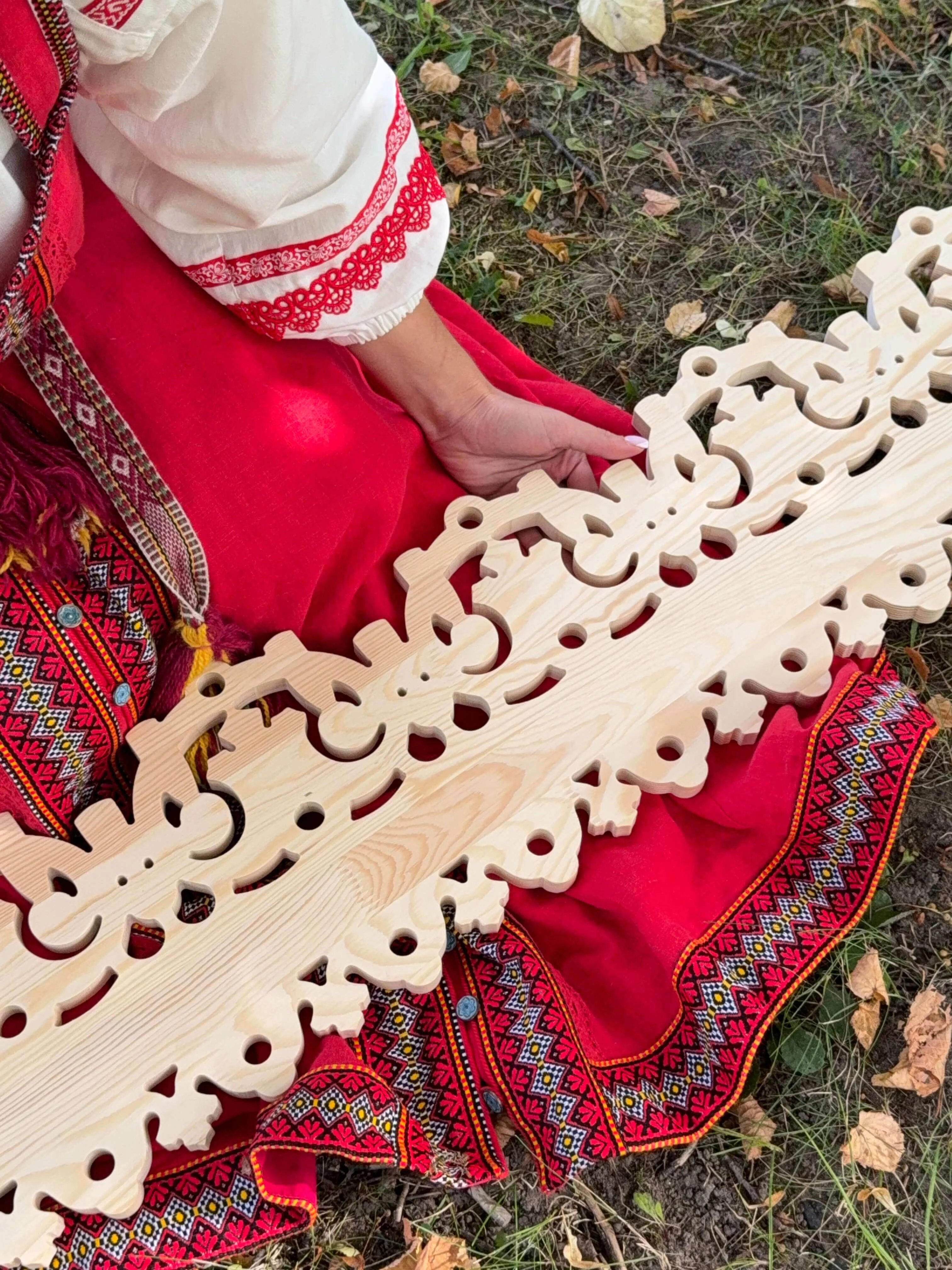
Flat balusters are cut from a board: when viewed from the side — an ornamental silhouette, when viewed from the front — a flat post. Effective in combination with turned posts. For classic and traditional interiors.
Baluster spacing: safety and rhythm
Clear distance between balusters: no more than 100–120 mm (for child safety). Center-to-center spacing: baluster width + 100–120 mm.
Example: baluster 45 mm + spacing 110 mm = 155 mm between centers. For a step width of 300 mm: 300 / 155 ≈ 2 balusters per step.
For balconies and terraces without children — the clear spacing can be increased to 150–200 mm, creating a "lighter" feel.
Support posts and handrails: why they cannot be chosen separately
This is not just a recommendation — it's a principle, violating which ruins all the work.
Why a post and a baluster are one pair
The post should be proportionally larger than the baluster: 1.5–2 times in cross-section. Baluster 45 mm → post 80–100 mm. Baluster 55 mm → post 100–120 mm.
If you buy balusters from one series and posts from another, the difference in profile, proportions, character of relief, and tinting will create the feeling that the railing was "assembled from leftovers."
All components for wooden staircases must be from the same style series — this is the first and main rule for buying a balustrade.
Why the handrail requires coordination
The handrail is a horizontal accent that runs along the entire balustrade. Its profile must belong to the same style code as the balusters.
Turned balusters with balls and fillets → handrail with a shaped profile (ogee, quarter round, compound profile).
Straight square balusters → handrail with a rectangular or slightly rounded profile.
Carved balusters → handrail with a richer profile, possibly with a band.
Handrail grip width: optimally 45–55 mm. Too narrow (30 mm) — hand slips. Too wide (70 mm) — uncomfortable to hold.
Post finial: the final chord
The finial is installed above the handrail level and serves as a visual "point" for each post. For classic style: a ball or "onion" with a carved belt. For modern classic: a cone or flat pyramid. For minimalism: a flat cut without a finial.
Finial height above handrail: 40–100 mm for residential interiors, 100–150 mm for grand halls.
Balustrade for stairs: height, proportions, style
The staircase is the main scenario for the balustrade. Here everything must work: safety, comfort, proportions, style.
Stair railing height
Standard handrail height above the step: 900 mm (measured vertically from the front edge of the tread to the top point of the handrail). For homes with children — 850–900 mm. For grand halls — up to 1,000–1,100 mm.
Important: 900 mm height is the minimum safe height; reducing it is not recommended.
How the balustrade works on a flight of stairs
On an inclined flight of stairs, balusters stand vertically, while the handrail follows the angle of the staircase. The angle of residential staircases is 30–45°. This means the top end of the baluster is cut at this angle for a tight fit against the handrail.
On the landing between flights, the handrail is horizontal, and turning elements are needed here: a 90° "knee" or a curved transition.
Number of elements per flight: calculation example
Flight: 14 steps, step width 270 mm. 2 balusters per step = 28 balusters.
Posts: bottom (1) + top (1) + intermediate if necessary. Total minimum 2 posts per span.
Handrail: inclined length = √(14×270)² + span height²) ≈ 3,800–4,200 mm depending on the angle. Order with a margin of 300–400 mm.
Balustrade style matching the staircase style
Oak steps in dark stain → balusters and handrail in oak or beech with the same stain. White steps → white or contrasting dark balustrade. Light ash steps → balustrade in natural ash or light honey stain.
Staining of steps and balustrade — in the same color or in a deliberate two-tone solution. Accidental mismatch of shades is the most noticeable mistake.
Balustrade for a double-height space and gallery: space, safety, image
A double-height space is a tall hall where both floors are visible simultaneously. The railing of the second-floor gallery is visible from many points — from below, from the side, and from the gallery itself.
Why a balustrade for a double-height space is a special case
An ordinary staircase balustrade is primarily visible from the side — along the flight. A gallery balustrade is visible from below and above. This means: the rhythm of the balusters must be expressive when viewed from below. The lower ends of the balusters, the bottom rail, the tinting of the lower part — all of this must look neat.
Gallery railing height
For a gallery above a space with a fall height of more than 1 meter — the handrail height from the gallery floor level: at least 900–1,000 mm. For a fall height of more than 3 meters (typical double-height space) — recommended height is 1,000–1,100 mm.
Visual lightness vs. safety
For a double-height space, a 'light' balustrade that does not obstruct the view is often desired. Here, straight square balusters with a wide spacing (120–140 mm clear) are optimal — safe and visually transparent. Or turned balusters of medium diameter (45 mm) with a spacing of 130 mm.
Important: even with a desire for 'transparency', a clear spacing of more than 150 mm is unsafe for homes with children.
Stylistic solution for a hall with a double-height space
A grand hall with a double-height space requires a balustrade with a statement: carved balusters with an expressive relief, massive pillars with spherical tops, a wide oak handrail. This is not a "railing" — it is an architectural installation.
Balustrade for terrace and balcony: material and wood protection
An open space imposes specific requirements on a wooden balustrade — the wood here operates under different conditions.
Why wood is suitable for an outdoor balustrade
Solid wood is a natural material that organically exists in an outdoor environment. A wooden balustrade on the terrace creates a connection between the house and the garden that neither metal nor plastic can create.
With proper protection, wood outdoors lasts 15–25 years without replacing the main elements.
How to protect a wooden balustrade on the terrace
Antiseptic impregnation is the first and mandatory layer. Protection against fungus, blue stain, insects. Applied before any top coating.
Top coating:
-
Oil with UV protection — to preserve the natural appearance of the wood. Requires renewal every 2–3 years
-
Exterior varnish provides a more durable coating, but peels off when damaged.
-
Paint (enamel) offers maximum protection and full color coverage. For classic-style facade balustrades, use white enamel.
Structural protection:
-
Ends of parts (the most vulnerable area) — protect especially carefully.
-
Lower parts of balusters in contact with steps — prevent water stagnation.
-
Gap between the handrail and roof/canopy — provide water drainage.
Wood species for outdoor balustrades
For open spaces, the best choice is oak or ash: dense species that absorb moisture slowly and hold the coating well. Beech is less preferable for outdoor use: it absorbs moisture faster and is more prone to deformation.
Balustrade proportions for a terrace
On an open terrace, the balustrade is perceived in perspective — along the long facade. Rhythm is important here: too frequent creates a 'grille' feel, too sparse loses decorative appeal. The optimal spacing for a terrace is 130–160 mm clear.
Material: beech, oak and other species for balustrade
Choosing a species is a choice between the character of the product, its appearance and its area of application.
Beech: precision and versatility
Beech is a dense, homogeneous wood with a fine-grained texture. It turns excellently: turned beech elements have a clear relief, sharp edges, and flawless shape. It accepts any tinting — from light honey to dark chocolate.
For turned and carved balusters under tinting or white enamel, beech is the optimal choice. Beech texture is neutral: it does not 'noise' in tinting, allowing the shape of the element to read clearly.
Beech is recommended for interior balustrades. For open spaces, it is less preferable.
Oak: character and durability
Oak is a heavy, hard material with an expressive structure, large pores and characteristic 'mirrors'. Oak tinting is always expressive: dark oak with an oil finish creates a powerful, solid image.
For grand staircases, halls with high ceilings, and study spaces, oak is the obvious choice. For open balconies and terraces, it is also optimal due to its natural moisture resistance.
The only downside of oak: higher price and difficulty of processing. Carved oak balusters are noticeably more expensive than beech ones.
Ash: a balance between beech and oak
Ash is a dense wood with straight grain and an expressive but calmer pattern than oak. It accepts tinting well and is resistant to mechanical loads. For light natural interiors, ash with an oil finish is especially beautiful.
Which breed to choose: a practical rule
| Scenario | Recommended breed |
|---|---|
| Classic staircase in the interior | Beech or oak |
| Grand hall with double height | Oak |
| Modern classic, white enamel | Beech |
| Terrace, open balcony | Oak or ash |
| Budget option for painting | Beech |
| Study, dark tint | Oak |
How to choose a balustrade to match the house style: seven style solutions
The balustrade must belong to the same style code as the entire house. This is not a wish — it is a law of architectural consistency.
High classic and historical stylization
carved balusters With ornament. Massive posts 100–120 mm with spherical finial and carved belt. Wide handrail with shaped profile. Dark oak or "old walnut" tint. Second-light gallery railing is a mandatory element.
Neoclassicism
Turned balusters with moderate relief. Square posts with lightweight overlays. Handrail with "oval" or "quarter-round" profile. White enamel or natural oak. Clear geometry without ornamental excess.
Modern classic
Straight balusters with square cross-section — 40×40 or 50×50 mm. Square posts without decorative overlays. Handrail with rectangular profile. White matte enamel or "wenge" tint — contrasting with white walls.
Country house in Russian style
Balusters with traditional ornamental turning or carving. Posts with overlays in folk motif. Natural light oil-based tint. Open terrace with the same balustrade — a unified whole of facade and interior.
Scandinavian style
Narrow straight balusters 40×40 mm with maximum spacing (130 mm clear). Straight posts without finial. Handrail — rectangular, wide, light ash without tint, oil-finished. No ornament.
English study and hunting style
Dark oak, turned or carved balusters with classic relief. Handrail wide, massive. Tint: dark tobacco or mocha. Library gallery railing — an iconic image.
French Provence and country romance
White enamel, turned balusters with rounded relief, handrail with smooth shaped profile. Open terrace with the same balustrade. Wooden flower boxes on the handrail — an additional touch.
How to calculate a staircase balustrade: precise algorithm
Step 1. Draw a diagram of the staircase
Mark all flights, landings, turns, and the length of each section. This is the basis of the calculation.
Step 2. Determine the positions of the posts
-
Bottom starting post: 1 pc.
-
Top finishing post: 1 pc.
-
At each turn or landing: 1–2 pcs.
-
Intermediate (on long flights >1,200 mm without a post): as needed
Step 3. Calculate the number of balusters
By number of steps: number of steps × 2 = number of balusters (2 balusters per step).
Check by step: span length / (baluster width + clear step). If the result is larger, take the larger value.
Step 4. Calculate the handrail length
Length along slope = √(horizontal span length² + span height²).
For horizontal sections (landings, galleries) — horizontal length.
Sum all sections. Add 15% margin.
Step 5. Account for turning elements
Each 90° handrail turn is one turning element. Each transition from an inclined handrail to a horizontal one is a "knee" of the corresponding angle.
Example calculation for a U-shaped staircase
-
2 flights of 10 steps each
-
1 landing
-
Step width: 270 mm
Balusters: 10 × 2 × 2 = 40 pieces + landing (length 1,000 mm / 155 mm = 7 balusters) = 47 pieces → order 52 (with 10% spare).
Posts: lower (1) + lower flight turn (1) + upper flight turn (1) + upper (1) = 4 posts.
Handrail: each span √(10×270)² + 2100²) ≈ 3,400 mm × 2 = 6,800 mm + landing 1,000 mm = 7,800 mm. With spare: 7,800 × 1.15 = 8,970 mm → 9 linear meters.
Mistakes when buying a balustrade: eight typical blunders
Mistake 1. Buying balusters without posts and handrail from the same series
Different series — different proportions, different relief characters, different tints. Result: the balustrade looks like a 'random set'. Rule: all elements from one catalog, one series.
Mistake 2. Not calculating the railing length
'I'll buy approximately' — and end up buying from another batch with a different tint shade. Calculate precisely: diagram + calculation + 10–15% spare.
Mistake 3. Underestimating the railing height
900 mm is the minimum. Less is unsafe. "I don't have children" is not an argument: the house is built for decades.
Error 4. Mixing styles
Turned balusters with classic relief + straight square posts + handrail with Art Deco geometric profile — three styles in one railing. One style for the entire balustrade.
Mistake 5. Choosing elements that are too thin for a large-scale staircase
A 35 mm baluster in a hall with a 5 m ceiling visually disappears. An 80 mm post on a grand staircase with a width of 1,800 mm is not massive enough. The scale of elements is proportional to the scale of the space.
Mistake 6. Not planning the coating before installation
Coating an installed balustrade with varnish or oil is inconvenient: the brush doesn't reach the joints, painting the handrail at height is awkward. Finish coating — before or immediately after installation.
Mistake 7. Not ordering turning elements in advance
Installation proceeds normally — and suddenly it turns out that the turning "knee" for the required angle is not in stock. Order turning elements simultaneously with the handrail.
Mistake 8. Not considering the interior around the staircase
Balustrade of dark oak + white walls + white floor = contrast (intentional — good, accidental — not). The tint of the balustrade should be coordinated with the architraves, baseboards, parquet, and furniture in the hall.
FAQ: answers to the main questions about buying a wooden balustrade
What is included in a wooden balustrade?
Balusters, support posts, handrail, post caps, bottom rail, handrail turning elements. All components for wooden staircases — in one STAVROS catalog.
How is a balustrade different from railings?
Railings are a minimal functional barrier without balusters. A balustrade is a system with a rhythmic row of balusters, support posts, and a handrail. It serves as a barrier and is an architectural element of the space.
Where to buy a wooden balustrade?
In the STAVROS catalog: staircase components — balusters, posts, handrails, decorative elements. A detailed article on choosing — wooden balustrade.
Which balusters to choose for a balustrade?
Depends on the interior style: turned balusters for classic and neoclassical, Carved — for formal halls, straight square ones for modern classic and minimalism, flat shaped balusters — for traditional interiors.
Are support posts necessary?
Yes, absolutely. Posts are the structural "anchors" of the balustrade: the start of the span, the end, every turn, every landing. Without posts, the handrail won't hold securely.
How to calculate the number of balusters?
Number of steps × 2 = minimum number of balusters. Or: span length / (baluster width + clear spacing 100–120 mm). Add 10% reserve. Landings are calculated separately.
Yes. For a double-height space, turned or straight balusters with a clear spacing of 120–130 mm are recommended. Handrail height — 1,000–1,100 mm. All elements from the same series, stain matched to the hall interior.
Yes. For the double-height space, turned or straight balusters with a clear spacing of 120–130 mm are recommended. Handrail height — 1,000–1,100 mm. All elements from the same series, tint coordinated with the hall interior.
Can a wooden balustrade be used on a terrace?
Yes. For an open terrace — oak or ash with weather-resistant coating: antiseptic + oil with UV protection or outdoor varnish. Baluster spacing — 130–160 mm clear.
What is better for a balustrade: beech or oak?
Beech — for interior balustrades under any tinting and white enamel. Oak — for grand staircases, dark natural tints, open balconies and terraces. Both are strong and durable with proper care.
How to choose a balustrade to match the house style?
Determine the style code (classic, neoclassical, modern classic, Scandinavian), select the baluster type consistent with that style, choose posts and handrail from the same series, coordinate the tint with parquet, trim, and furniture. All elements for a wooden staircase — in the STAVROS catalog.
STAVROS: wooden balustrade as an architectural solution, not just a purchase
Buying a wooden balustrade correctly means buying a system. Not balusters separately, not a handrail of a "similar profile", not posts that "were available". But a complete set where each element is coordinated with the others by wood species, tint, proportions, and style.
This is exactly what distinguishes a railing that lives in the house and delights for 30 years from one that is "tolerated" and planned to be redone at the next renovation.
STAVROS offers a full range staircase components: balusters of all types — from turned to carved и flat, — support posts, handrails and decorative elements made of beech, oak and ash. Everything is coordinated into style series. Contact us to confirm shipping to your destination.
STAVROS — because a balustrade is built once, and it must be right from the first glance.