
































































Article Contents:
- How outdoor balusters differ from indoor ones
- Temperature Fluctuations
- Moisture and precipitation
- Ultraviolet
- Biological threats
- Conclusion: outdoor balusters require a different approach
- Where wooden outdoor balusters are used
- Porch
- Terrace
- Balcony
- Veranda
- Gazebo
- Which baluster shapes look best outdoors
- Square and rectangular balusters
- Flat balusters
- Turned round balusters
- Carved balusters outdoors
- Size Matters
- Why is tree protection important for street fencing
- Three levels of protection
- Which compounds work for outdoor balusters
- Rule of two surfaces
- How to choose installation spacing for safety
- Safety standards
- Calculating spacing along axes
- Flat balusters: a different logic
- Railing Height
- Which handrails and posts are needed in the set
- Handrail for street fencing
- Pillars for outdoor fencing
- Bottom trim
- Flat balusters for terrace and balcony
- What is a flat baluster
- Advantages of flat balusters for outdoor use
- Flat balusters: installation
- Wood species: what to choose for outdoor use
- Larch: the leader for outdoor use
- Oak for outdoor use
- Pine: with reservations
- Comparative table of wood species for outdoor balusters
- Mistakes when buying outdoor balusters
- Mistake one: buying interior balusters for outdoor use
- Mistake two: installation without protective treatment
- Mistake three: balusters that are too thin
- Mistake four: using regular interior varnish outdoors
- Mistake five: metal fasteners without anti-corrosion protection
- Mistake six: baluster spacing over 150 mm when children are present
- How to extend the service life of a wooden fence
- Annual inspection
- Recoating
- Updating decorative finishes
- Proper roofing as the best protection
- House style and choosing balusters: tips for combinations
- House made of timber or logs
- House made of aerated concrete or brick with a wooden veranda
- House in Scandinavian style
- Manor house with a front porch
- Where to buy balusters for terrace and porch
- What is important when choosing a supplier
- STAVROS: wooden balusters for outdoor and interior
- Frequently Asked Questions
- Can beech balusters be installed on an open porch?
- What is the best way to treat outdoor balusters?
- What baluster spacing is safe for children?
- Should I choose flat or turned balusters for a terrace?
- How long will oak balusters last outdoors?
- Do I need stainless steel fasteners for outdoor balusters?
- Where can I buy wooden balusters for a terrace with Contact us to confirm shipping to your destination.?

A wooden railing outside the house is the face that greets everyone who approaches your home. A porch with carved balusters, a terrace with neat railings, a balcony with a rhythmic wooden fence — all of this creates that first impression that cannot be erased. But an outdoor railing is not just decor. It is a structure that works in the open air: under rain and frost, under direct sun and during thaws. And here, mistakes in selection are costly.
wooden balusters for terrace — this is a separate topic, fundamentally different from choosing balusters for an indoor staircase. Different requirements for wood species, different logic for protective treatment, a different shape that is organic outdoors. Let's break it down honestly: what works, what doesn't, and why.


How outdoor balusters differ from indoor ones
This is a fundamental question that determines everything else. Many buyers come with the logic, 'I bought the same balusters as for the staircase in the house and installed them on the porch.' After two or three years — cracks, darkening, swelling at the joints, loose tenons. Why?




Temperature fluctuations
An outdoor baluster experiences temperature fluctuations from -30°C to +40°C and more over a year. That's a difference of 70 degrees. Wood expands and contracts as a result. Softwoods like pine and spruce "work" actively under such changes: they swell, crack, and lose shape at connection points.
Hard, dense woods like oak and larch are significantly more stable. Their shrinkage under temperature changes is less, the structure is denser, and the fibers hold their shape.
Our factory also produces:





Moisture and precipitation
An open porch and terrace regularly get wet: rain, snow, condensation. Wood absorbs moisture, swells, and shrinks again when drying. Each "wetting-drying" cycle is stress for the structure. An unprotected baluster begins to delaminate along the fibers after 10-15 such cycles.
Get Consultation
Ultraviolet
Direct sunlight is the worst enemy of unprotected wood. UV rays destroy the surface layer of fibers, making the wood gray, rough, and brittle. An unprotected pine baluster on an open porch acquires a characteristic gray-black hue after two seasons, and the surface becomes "fuzzy."
Biological threats
Outdoors, wood comes into contact with soil, leaves, moss, and insects. Damp wood without protective impregnation is a breeding ground for fungus and mold. The areas of the lower tenons of balusters, where they enter the horizontal bottom rail, are especially vulnerable.
Conclusion: outdoor balusters require a different approach
Correct wooden balusters for staircases for outdoor use — it is:
-
The right wood species with natural moisture resistance
-
The right shape — without moisture accumulation points
-
The right protective treatment before installation
-
The right fasteners — made of stainless steel or with anti-corrosion coating
Where wooden outdoor balusters are used
Before choosing the shape and material, it is important to understand: in what context will your balusters be used. A porch and an open terrace are different operating conditions.
Porch
The porch is the most heavily used area. It is a point of daily traffic: people enter and exit several times a day, lean on the railing with heavy bags, and hold on especially tight in winter. The porch is usually open — without a canopy or with a small awning that only protects from direct precipitation from above.
A baluster for the porch should be:
-
Maximum strength in terms of wood species
-
Resistant to lateral loads
-
Protected with antiseptic and moisture-resistant coating
-
Securely fastened — with metal hardware
Terrace
A terrace is an outdoor area along the house, often under a canopy or with a light roof. Operating conditions are milder than on an open porch: direct precipitation is limited, but humidity is still present. Buy wooden balusters for a terrace — means choosing products with good moisture resistance, but allowing a slightly more decorative approach to shape.
On a terrace, balusters function more as a decorative element of the space: here people relax, drink tea, and enjoy the view. The terrace railing is a frame through which they look at the garden or landscape. It should be beautiful.
Balcony
A balcony is a special case. If the balcony is open (without a roof), the conditions for wood are harsh: direct rain, snow on the balcony floor surface, condensation on the handrail. If the balcony is glazed or has a canopy, the conditions approach indoor ones.
Flat balusters for a balcony They are especially popular in this context: they create a more "closed" railing that is visually appropriate on small balconies, and are easier to maintain than turned round posts.
Veranda
A veranda is a glazed or semi-glazed space adjacent to the house. Conditions are close to indoor ones, but temperature fluctuations are still present (especially if the veranda is unheated). The same balusters that are suitable for an indoor staircase are suitable for a veranda, provided they have high-quality protective treatment.
Gazebo
A gazebo is another context for outdoor wooden balusters. The gazebo railing operates under the same conditions as a terrace. Carved wooden pillars for a gazebo — a separate item: they bear the main load and become the main decorative accent of the entire structure.
Which shapes of balusters look best outdoors
Outdoor aesthetics are not the same as interior aesthetics. Outdoors, scale works differently, silhouettes are read differently, and natural light has a different effect. A baluster that looks exquisite in a living room interior may appear small and insignificant outdoors.
Square and rectangular balusters
wooden balusters for terrace in a square section — this is a classic of outdoor wooden railing in Russia. Square profile 50×50 or 60×60 mm:
-
Has good structural rigidity against bending
-
Easy to treat with protective compounds (flat faces without deep grooves do not retain moisture)
-
Easy to install
-
Reads well at street scale — clear silhouette, clear rhythm of the railing
Square balusters are organic for any style: traditional wooden house, country cottage, Scandinavian architecture, modern house with wooden accents.
Flat balusters
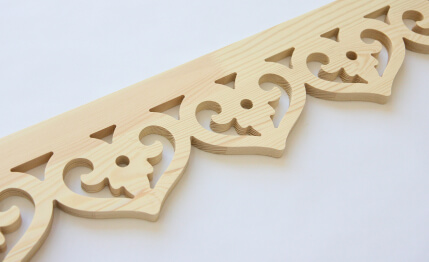
Buy flat balusters — means choosing a product that resembles a figure cut from a board: a flat silhouette with a decorative contour. A flat baluster is mounted "in the plane" of the railing, creating a more closed structure with a rhythmic ornament.
Flat balusters are a characteristic element of folk wooden architecture, "sawn" carving. A wooden house with flat carved balusters on the porch is an image that is recognizable and beloved. They look especially organic on houses in the style of a Russian dacha, in wooden houses made of timber or logs.
An important advantage of a flat baluster is that the large surface area allows for a complex decorative silhouette without volumetric carving: a contour cut with a router or jigsaw defines a shape that reads as an ornament when viewed from outside.
Turned round balusters
Turned balusters with a classic profile — rollers, necks, smooth transitions — look festive and traditional outdoors. They are more appropriate on covered verandas and glazed terraces where conditions are milder.
On an open porch, turned balusters work well provided they have good protective treatment. The main nuance: deep grooves and narrow necks of the profile are potential zones for moisture retention. Water gets into the groove, sits there, expands when freezing, and tears the fibers. Therefore, for open outdoor conditions, square balusters are more reliable than turned round ones.
Carved balusters outside
Carved balusters with volumetric ornament — for special occasions: the main porch of a large wooden house, the terrace of a country estate, a gazebo in ethnic style. This is a decorative statement that is appropriate where the house itself has architectural ambitions.
Carved balusters outdoors require the most thorough protective treatment: the ornament creates many small surfaces with different angles to rain and sun. An untreated carved baluster outdoors is a baluster that will soon need to be replaced.
Size Matters
Outdoor scale requires larger elements than interior scale. A 40×40 mm baluster looks appropriate in a room. Outdoors, where the space is open, such a baluster looks thin and flimsy. Minimum for outdoor railing: cross-section 50×50 mm for square balusters, 60×60 mm for carved and turned ones. Posts — from 100×100 mm and larger.
Why wood protection for outdoor railing is important
Protective treatment is not an option, not "for beauty", not "can be done later". It is a mandatory condition, without which outdoor wooden balusters will not last even five years in normal condition.
Three levels of protection
Level one: antiseptic. Deep impregnation with an antiseptic composition destroys spores of fungus and mold that are inevitably present outdoors. The antiseptic is applied before any finish coating, penetrating deep into the fiber structure. Without antiseptic, even the most beautiful baluster will become covered with blue and black spots after a few years.
Level two: moisture protection. Weather-resistant impregnation or treatment creates a barrier against water penetration into the fibers. This can be oil with wax, alkyd impregnation, or a specialized weather-resistant system. The moisture-protective composition must "breathe" — not create an impermeable film, but allow the wood to exchange moisture with the air without swelling.
Level three: finish coating. Varnish, paint, oil, or glaze. The finish coating for outdoors must be weather-resistant, with a UV filter. Regular interior varnish outdoors cracks and peels off after one or two seasons.
Which compositions work for outdoor balusters
Alkyd impregnations-antiseptics (like Pinotex, Belinka, Tikkurila Valtti) — good value for money. They penetrate the wood, contain fungicides, and have a network of UV-filtering pigments.
Wax oils for exterior use are a more natural option. They work well for hardwoods (oak, larch). They require renewal every 1–2 years, but are easily refreshed without removing the old coating.
Decorative glazes are semi-transparent compositions with pigment. They allow the wood texture to show through while protecting against moisture and UV. A popular solution for outdoor balusters.
Opaque paint provides maximum surface protection and hides the texture. It is good for pine balusters where texture is not a priority, and reliable protection is more important than decorativeness.
The rule of two surfaces
The baluster must be impregnated on all sides, including the ends of the tenons, before installation. After installation, the ends are hidden in the grooves and are no longer accessible for coating. However, the ends are the areas of most active moisture penetration into the fibers. Impregnating the ends before installation is a mandatory step.
How to choose the installation step for safety
The spacing of balusters on a porch and terrace is not only an aesthetic issue but also a safety one. Especially when it comes to homes with children.
Safety standards
According to current building codes (SP 17.13330 and related), the clear distance between railing elements in residential buildings should not exceed 100–120 mm. This rule comes from practice: a child can push their head through or get stuck in an opening wider than 120 mm.
For adult spaces without children, a clear step of up to 150 mm is allowed — this is strictly for decorative and functional considerations.
Calculation of spacing along axes
If the baluster has a cross-section of 50 mm and the required clear spacing is 100 mm, then the spacing along the axes of the balusters is: 100 + 50 = 150 mm.
Number of balusters for a railing section 3,000 mm long between two posts: 3,000 / 150 = 20 balusters. Plus a small adjustment for even distribution.
Flat balusters: a different logic
for flat balusters The spacing is calculated the same way, but the visual effect is different: flat elements create an almost continuous "fence" with decorative openings between them. This is both beautiful and safe for children.
Railing height
For terraces, porches, and balconies at a height of more than 0.6 m above ground level, the railing height must be at least 900 mm (for residential buildings). For balconies at a height of more than three stories, it must be at least 1,100 mm.
The height is measured from the floor level of the platform (porch, terrace) to the top plane of the handrail.
What railings and posts are needed in the set
Wooden baluster for a staircase on a porch Always works as a system. One baluster is nothing. A system of balusters, handrail, and posts is a railing.
Handrail for outdoor fencing
An outdoor handrail is a linear element on which all balusters rest from above. Its requirements outdoors are higher than indoors:
Size. For outdoors — a handrail at least 60–70 mm wide and 40–50 mm high. A thin handrail easily deforms from temperature changes and load.
Profile. The handrail profile must prevent water accumulation on the top surface. The best option for outdoors is D-shaped or rounded on top: water flows off the rounded surface without pooling.
Wood species. The same as for balusters. For outdoor handrails — oak or larch.
Posts for outdoor fencing
Carved wooden staircase posts Outdoors, these are the anchors of the entire system. They bear the main load from wind gusts, accidental impacts, or full body weight support.
Requirements for outdoor posts:
-
Cross-section at least 100×100 mm (preferably 120×120 mm)
-
Attachment to the supporting structure via a metal shoe or stud, not just glue
-
Protective treatment of the entire surface, including the bottom end that contacts the metal shoe or is buried in the anchor
Carved wooden pillars for a gazebo — a separate category for objects with decorative ambitions. A carved post at the entrance to a terrace or gazebo creates a grand architectural accent.
Bottom rail
On terraces and porches, balusters are often mounted between the top handrail and the bottom horizontal rail. The bottom rail is a horizontal beam or board to which the bottom tenon of the baluster is attached. It must be securely fastened to the load-bearing posts or deck beams.
Flat balusters for terrace and balcony
Flat balusters are a special type that deserves a separate discussion. This is not just a "different shape." It is a different structural principle and a different aesthetic.
What is a flat baluster
Flat baluster — this is a product cut from a board (typically 20–25 mm thick) with a decorative contour profile. Unlike a turned or square baluster, it is flat and installed "facing" the observer.
The shape of a flat baluster is defined by a contour cut: standard options include trapezoidal, with smooth cutouts on the sides, figured with rounded curls, and geometric with a straight stepped contour.
Advantages of flat balusters for outdoor use
Fewer moisture retention zones. Flat surface without deep grooves and narrow necks — wood dries faster after rain. This is important for durability.
Ease of processing. A flat baluster is easier to uniformly impregnate and paint on all sides. There are no deep relief areas that are difficult to reach with a brush.
Unique aesthetics. Flat balusters create a "lattice" effect of the railing — when viewed from different angles, the railing looks either more open or almost closed. This is a play of silhouette and light that looks very organic in an outdoor context.
Folk character. In Russian wooden architecture, flat carved balusters are a tradition rooted in folk architecture. Houses with such balusters look appropriate and "at home" in the Russian landscape.
Flat balusters: installation
Flat balusters are mounted through the top and bottom ends — using a self-tapping screw or a stud. Important: since the flat baluster stands "face" rather than "edge", you need to ensure that the top and bottom horizontal elements (handrail and bottom rail) have a groove or hole of the required size.
Details on mounting options — in the article install balusters to the floor and handrails.
Wood species: what to choose for outdoor use
For outdoor use, the list of suitable species is significantly shorter than for interiors.
Larch: the leader for outdoor use
Larch is the best choice for outdoor conditions. Density 600–700 kg/m³, high resin content — a natural antiseptic that protects the wood from within. Larch does not rot even with constant contact with moisture. That is why the piles under old St. Petersburg buildings, which have stood in water for hundreds of years, are made of larch — and are still intact.
The only nuance: larch has a characteristic yellowish color, which when treated with oil acquires a honey-golden tone. This is beautiful — but not for all interior schemes.
Oak for outdoors
Oak is an excellent choice for outdoor fencing. Its natural resistance to moisture and biological threats is well known. Oak is dense, with minimal shrinkage, and durable.
Under oil, oak balusters on the terrace will age beautifully: the tone becomes deeper, the structure more expressive. This is a "living" wood that only improves with age.
Pine: with reservations
Buy wooden balusters for terrace made of pine — is possible, but with mandatory reservations. Pine is soft, actively reacts to moisture, and is prone to rot. For an open porch without good roofing — not the best choice.
If the budget is limited and the porch is under a canopy — pine with high-quality treatment with weather-resistant impregnation and alkyd glaze gives an acceptable result with periodic coating renewal every 2–3 years.
Comparative table of wood species for outdoor balusters
| Species | Moisture resistant | Biologically resistant | Hardness | Durability | Price |
|---|---|---|---|---|---|
| Larch | Very High | Very High | High | 40–60 years | Medium |
| Oak | High | High | Very High | More than 50 years | High |
| Ash | Medium | Medium | Very High | 25–35 years | Above average |
| Beech | Low | Low | High | Not recommended | Medium |
| Spruce | Low | Low | Low | 10–15 years (with maintenance) | Low |
Mistakes when buying outdoor balusters
Practice shows: most problems with outdoor wooden fences occur at the selection stage, not installation. Here are specific mistakes — and how to avoid them.
Mistake one: buying interior balusters for outdoor use
"I'll take the same ones as for the staircase in the house — it's also wood." But interior beech balusters are generally not designed for outdoor conditions. Beech is hygroscopic and does not tolerate constant humidity well. After two seasons — cracks and darkening.
Solution: explicitly specify "for outdoor use" when ordering and clarify which wood species the manufacturer recommends for this context.
Mistake two: installation without protective treatment
"I'll install it first, then paint it." But the ends of the tenons are already hidden in the grooves and inaccessible. And it is the ends that are the areas of maximum moisture absorption. Rule: all surfaces, including ends, are treated with antiseptic and impregnation before installation.
Error three: too thin balusters
A 40×40 mm baluster on an open porch of a large country house. Visually, it does not fit the scale. Functionally, it is not rigid enough under lateral load. For outdoor use, minimum 50×50 mm, preferably 60×60 mm.
Error four: regular interior varnish for outdoor use
Interior polyurethane varnish applied to outdoor balusters looks beautiful until the first winter. During freezing and thawing, the varnish film peels off, water gets underneath, and the deterioration process accelerates. Only weather-resistant compounds with UV protection should be used for outdoor applications.
Error five: metal fasteners without corrosion protection
Regular steel screws or studs outdoors result in rust stains on the baluster after one season. For outdoor installation, only stainless steel or galvanized fasteners should be used.
Error six: baluster spacing over 150 mm when children are present
A clear spacing of 180–200 mm looks beautiful and 'airy'. But a child can get stuck. For homes with children, the maximum clear spacing is 100–120 mm.
How to extend the service life of a wooden railing
A wooden railing outdoors is not 'install and forget'. It is a living material that requires periodic attention. But this attention is minimal—and it pays off with decades of beauty.
Annual inspection
Once a year — in spring, after the snow melts — inspect the fence. What to look for:
-
Cracks on the surface of balusters (especially in tenon areas and joints)
-
Darkening, signs of blue stain or mold (gray-green coating)
-
Looseness of balusters in connections
-
Condition of the coating: cracks, peeling, wear
Recoating
Most weather-resistant impregnations require renewal every 2–4 years, oils every 1–2 years. Renewal does not require removing the entire coating: just wash the surface, let it dry, and apply a new layer.
Repairing minor damages
Small cracks on a baluster are normal for outdoor wood. They need to be cleaned, treated with an antiseptic, and filled with acrylic sealant. The sealant keeps moisture out and prevents the crack from expanding.
Surface gray coating is a sign of UV degradation of the top fiber layer. It is removed by sanding with fine sandpaper (220 grit) and re-impregnation.
Proper roofing as the best protection
The most effective protection for outdoor fencing is not impregnation, but a canopy. If the porch or terrace has a roof with sufficient overhang, direct rain and snow do not fall on the balusters. This radically extends the service life: fencing under a canopy lasts 2–3 times longer than open fencing.
House style and choice of balusters: advice on combinations
Wooden outdoor balusters are part of the architectural image of the house. A mismatch between the style of the fencing and the style of the house is a mistake that immediately catches the eye.
House made of timber or logs
The classic option is square balusters 60×60 mm from the same species as the log house, or from larch. Flat carved balusters in a folk style are another suitable option, creating the image of a traditional wooden house.
House made of aerated concrete or brick with a wooden veranda
Here, the wood in the fencing is a contrasting warm accent. Turned or square balusters made of oak with a dark tint work well. They create a feeling of "real wood" against the background of neutral walls.
House in Scandinavian style
Clean lines, geometry, light tones. Square balusters without decoration, a handrail of a strict rectangular profile, posts of square cross-section. Everything is made of ash or larch with a light natural oil.
Manor house with a front porch
Carved pillars at the entrance, classic turned balusters, shaped handrail. Oak or larch. This is an architectural statement suitable for large formal projects.
Where to buy balusters for terrace and porch
The right answer starts with the right question: are you looking for a seller or a manufacturer? A seller resells someone else's product without a guarantee of consistent quality. A manufacturer controls the entire cycle — from wood selection to final sanding.
What is important when choosing a supplier
Wood species and moisture content. Clarify: what wood species are the balusters made from? What is the moisture content? Is there kiln drying? Without these answers, you risk getting raw material that will deform after installation.
Dimensional accuracy. The tenon diameter must exactly match the groove in the handrail. For outdoor balusters — with a tolerance of no more than 1 mm. This is checked against documentation or a sample.
Completeness of assortment. The supplier should offer not only balusters but also handrails, pillars, bottom rails, and fasteners. A complete order from one supplier eliminates incompatibility.
Processing recommendations. A good supplier will explain which compound and in what order to treat the balusters for a specific application. If these recommendations are missing, it's a warning sign.
STAVROS: wooden balusters for outdoor and interior use
STAVROS is a manufacturer of solid wood products, whose production program covers all formats of wooden balusters: square and rectangular, classic turned, Flat balusters for balconies and terraces, carved and turned-carved for formal objects.
The STAVROS assortment includes — Buy wooden balusters for a terrace in square cross-section variants, optimal for outdoor use. All products are made from kiln-dried wood with controlled humidity of 8–12%. Dimensional accuracy ensures compatibility with handrails and posts from the same production program.
STAVROS offers a complete fencing kit: wooden balusters for staircases, Carved wooden staircase posts, handrails and accessories — all from one production system. This eliminates compatibility issues and guarantees stylistic unity.
Order with Contact us to confirm shipping to your destination. Permanent warehouse stock. Professional consultation on choosing the wood species and shape for a specific project.
Choose STAVROS — and your porch, terrace, or balcony will get a railing that will last for decades and age beautifully with the house.
Frequently asked questions
Can beech balusters be installed on an open porch?
Not recommended. Beech does not tolerate constant humidity and temperature changes. For an open porch — larch or oak.
What is the best way to treat outdoor balusters?
For open conditions — weather-resistant antiseptic + alkyd azure or oil with UV filter. Interior varnish is not suitable for outdoor use.
What is the safe spacing of balusters for children?
Clear distance between balusters — no more than 100–120 mm for homes with children.
Should I choose flat or turned balusters for a terrace?
For an open terrace, flat balusters are more practical: they dry faster and are easier to process. For a covered terrace under a canopy — any shape to your taste.
How long will oak balusters last outdoors?
With proper protective treatment and periodic coating renewal — 30–50 years or more.
Is stainless steel fastening necessary for outdoor balusters?
Absolutely. Regular steel rusts outdoors, leaves stains on wood, and loses strength. Only stainless steel or high-quality galvanization.
Where to buy wooden balusters for a terrace with Contact us to confirm shipping to your destination.?
The STAVROS catalog offers a full range of wooden balusters for outdoor and indoor use with Contact us to confirm shipping to your destination. Always in stock, with consultation on selection.