Article Contents:
- Buy stair balusters
- Which stair balusters to buy: starting point
- Wooden stair balusters: why solid wood is unrivaled
- Types of stair balusters
- Turned balusters
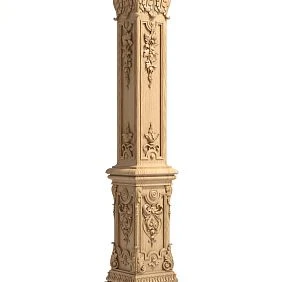
- Carved newels
- Flat balusters
- Oak balusters
- What affects the price of balusters
- How to calculate the number of balusters for a staircase
- Balusters, posts, and railings: how to assemble the right set
- Wooden staircase as an architectural statement: style and balusters
- Mistakes when buying balusters: learn from others' mistakes
- Where to buy balusters for stairs with quality guarantee
- FAQ: Answers to Popular Questions
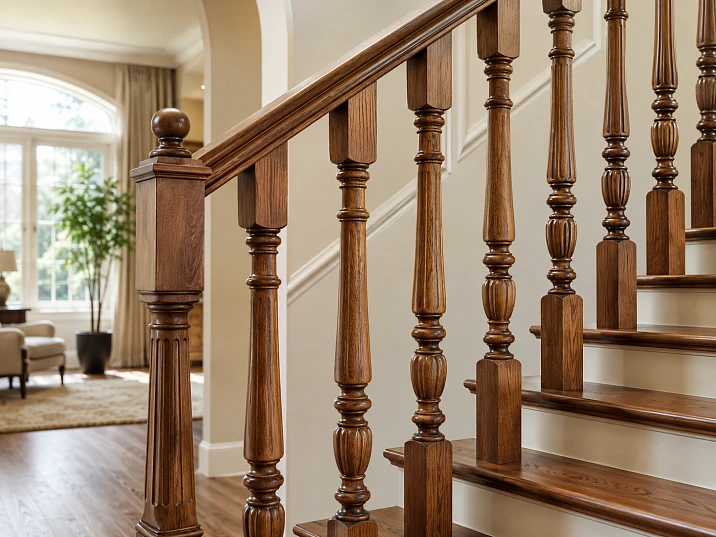
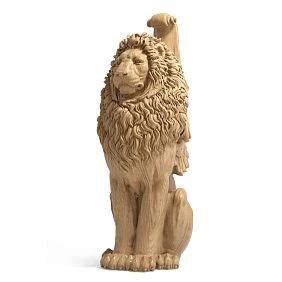
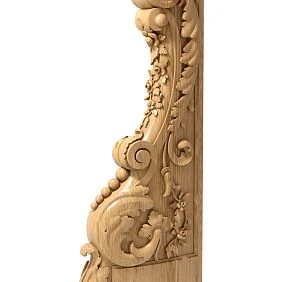
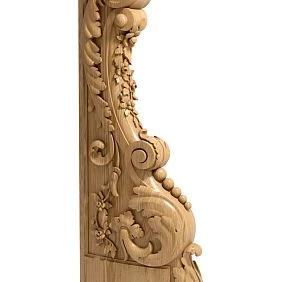
Buy balusters for stairs
There are things in a house you notice immediately upon crossing the threshold. The staircase is one of them. And not the structure itself of steps and stringers, but its character, its silhouette, its rhythm. This rhythm is set by Balusters for staircase — vertical railing posts that stand in a row, hold the handrail, and turn an ordinary flight into an architectural statement.
Buying balusters for stairs today is not as simple a task as it seems at first glance. The market is saturated with options: pine, oak, beech, carved profiles, turned shapes, flat silhouettes, different heights and cross-sections. Choosing from this variety what suits your specific staircase, your interior, your budget means understanding the topic deeply. This article is written precisely for that purpose.
Everything is covered here: what types of wooden balusters exist, how they are classified by shape and finish, what affects the price, how to calculate the quantity for a flight, what mistakes are most often made when buying, and where to buy wooden balusters for stairs with a quality guarantee. Read sequentially — by the end, you will have a clear picture and a concrete action plan.




Which balusters for stairs to buy: starting point
Before moving on to types, styles, and prices, we need to agree on the most important thing: a baluster is a structural element. Not just decor, not just a beautiful detail, but a railing post that bears load, holds the handrail, and ensures safety for everyone using the stairs. This means the choice cannot be based solely on the visual impression from a picture.
Where to buy balusters for stairs — a question that has several answers. But the correct answer always includes one criterion: the manufacturer must work with certified solid wood and produce products with precise geometric parameters. Only then will the baluster stand straight, not pull the handrail to the side, and not create 'wandering' gaps in the railing.
What needs to be determined before purchasing? The list is compact, but each item is fundamental:
-
Fence height. The standard for residential stairs is from 900 to 1000 mm from the step surface to the top of the handrail. The baluster height must correspond to this parameter, considering the fastening at the bottom (into the step or into the sub-baluster) and at the top (into the handrail or into the support beam).
-
Installation spacing. The distance between balusters according to safety standards is no more than 150 mm in the clear. This eliminates the risk of a child getting stuck between the posts.
-
Shape and style. Determined by the interior style, the wood species of the steps and handrails, and the color scheme of the room.
-
Material. Oak, beech, pine — each species provides different characteristics of strength, workability, and appearance.
-
Quantity. Calculated along the flight, considering the spacing, number of landings, and a reserve.
Only after answering these questions does it make sense to move on to choosing a specific model. buy balusters for the staircase with the necessary parameters is much easier when you know exactly what you are looking for.
Our factory also produces:
Wooden balusters for stairs: why solid wood is beyond competition
Buying wooden balusters for stairs means betting on a material that has been proven by millennia of architectural practice. Wood remains the main material for stair balustrades in private homes, cottages, and high-class apartments for a reason. It has properties that no synthetic analogue can replicate.
The first property is warmth. A wooden staircase feels different from a metal or concrete one. A hand sliding along a wooden handrail senses a living material. This is not a metaphor — it is the physiology of perception, confirmed by research in neuroaesthetics.
The second property is compatibility. Wooden balusters They perfectly match wooden steps, wooden handrails, wooden floors, and doors. When all elements are made from the same wood species or from closely toned species, the interior gains a wholeness that cannot be achieved by mixing materials.
The third property is workability. A wooden baluster can be trimmed to height, the cut area filled, painted in the desired shade, stained, varnished, oiled, or waxed. Metal or plastic does not offer such flexibility.
The fourth property is durability with proper care. Buying wooden balusters for stairs made of oak or beech means getting products that, under normal use, last for decades without replacement.
Today, you can buy wooden balusters for stairs in several wood species options. Pine is the most affordable but has a soft structure and requires careful use. Beech is denser, turns well, and provides a smooth surface. Oak is a premium choice: hard, durable, with expressive annual rings. Oak withstands heavy loads without deformation and gives the staircase a high status overall.
Buying wooden balusters for stairs made of oak is not just about aesthetics. Oak hardly absorbs moisture, is resistant to abrasion, and has natural antiseptic properties. That is why oak balusters are recommended for high-traffic interiors: mansions, large family country houses, hotels, and representative residences.
Selecting balusters to match the color of the steps and floor is a separate design task. If the steps are oak with a walnut stain, the balusters should be either the same shade or one shade lighter for contrast. Dark balusters against a light wall background create a graphic, almost calligraphic rhythm. Light balusters on dark steps give a soft, airy impression. Both options work, but the decision should be intentional, not random.
Get Consultation
Types of balusters for stairs
Turned balusters
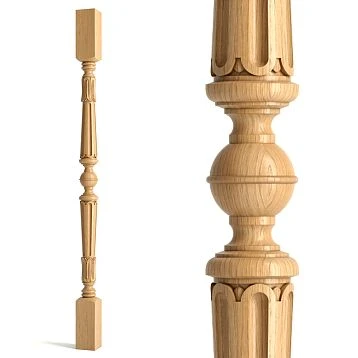
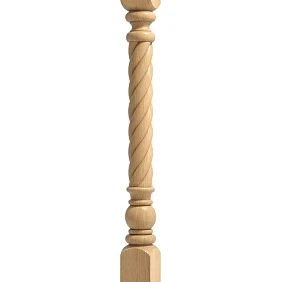
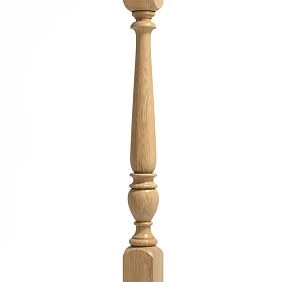
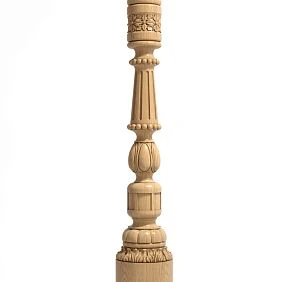
A turned baluster is a classic that has stood the test of time. The shape is created on a lathe: the workpiece rotates, the chisel removes material, and from a cylindrical blank emerges a profile with vases, necks, cones, and straight sections. It is this rhythm of forms along the vertical axis that makes the turned baluster so recognizable.
Turned wooden balusters are suitable for a wide range of interiors: classic, neoclassical, country, Provence, rustic, Scandinavian style in a warm interpretation. They are universal in the sense that they do not claim excessive decorativeness and do not compete with other interior elements — they create rhythm and a frame.
The height of standard turned balusters is from 900 to 1000 mm, the diameter at the widest point is from 45 to 80 mm. The lower and upper tenon (mounting element) allows installing the baluster into the step and handrail without additional brackets. This simplifies installation and gives the railing a neat appearance without visible fasteners.
For the correct rhythm of the railing, turned balusters are installed with equal spacing — typically one or two per step. Two balusters per step create a denser, visually protected barrier and are recommended for homes with children.
Carved balusters
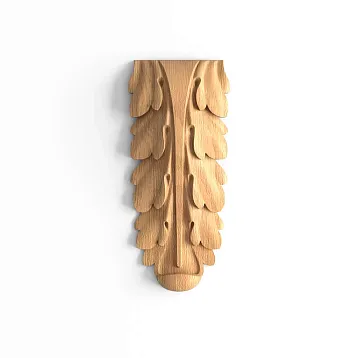
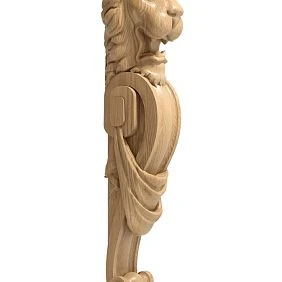
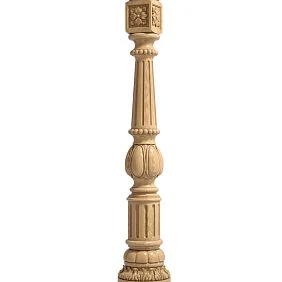
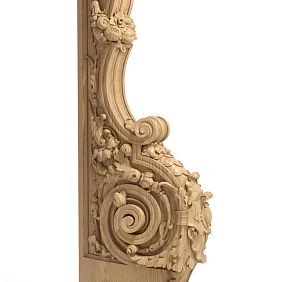
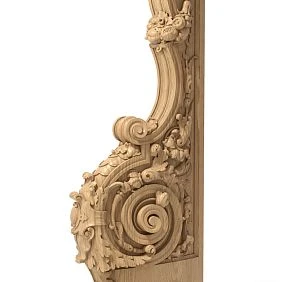
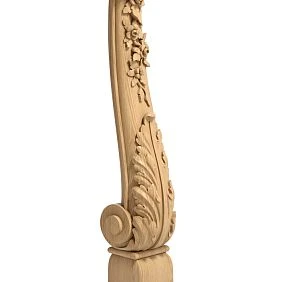
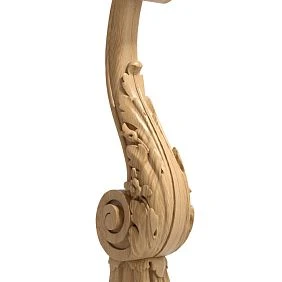
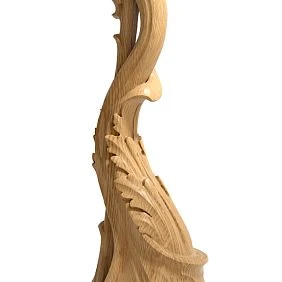
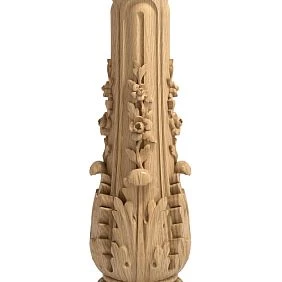
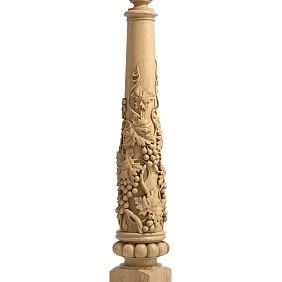
carved balusters — this is no longer just an architectural element, it is a work of applied art. They are created using CNC milling: three-dimensional processing allows reproducing the most complex ornaments — flutes, acanthus leaves, grapevines, geometric arabesques, rocaille curls, classic capitals.
Carved wooden balusters are appropriate where the staircase itself is the main architectural accent of the space. These are country estates with high ceilings, mansions with classic interiors, halls with columns and cornice profiles, historical interiors under restoration. Where everything is large-scale and expressive, the carved baluster sounds as it should.
An important technical detail: carved balusters in most cases combine turning and milling. The main cylindrical volume is created on a lathe, after which individual zones are processed with a cutter according to a given program. This allows obtaining both a smooth rotational profile and sharp relief details of the ornament — simultaneously.
The price of carved balusters is higher than turned ones. This is objective: the complexity of processing, machine cycle time, and material consumption for complex shapes are significantly greater. But in a project where the staircase is the central element, saving on balusters means devaluing the entire concept.
Flat balusters
Flat balusters made of wood — a fundamentally different approach to railing. If a turned and carved baluster works in three-dimensional volume, then a flat one works in silhouette. This is a profile cut or milled from a board: figured, openwork, or geometric.
Flat balusters create a completely different visual effect. A row of flat balusters with the same profile looks like a graphic ornament — especially when looking at the staircase from the side. This is rhythm without volume, a drawing without shadow, a railing without weight. That is why flat wooden balusters are popular in Scandinavian minimalism, modern classic, and light interiors with natural-toned wood.
Technically, flat balusters are cut from a board of the required thickness — typically 20–30 mm — using a jigsaw or milling machine according to a template. The size of the profile can be very different: from simple geometric shapes with cutouts to complex plant ornaments. Installation of flat balusters is slightly different from turned ones: fastening is done through a pin or bolt in the lower and upper parts.
Buying flat wooden balusters is the right choice for those who want an expressive decorative railing without overwhelming volume. They pair well with straight solid wood handrails and square posts.
Oak balusters
Let’s focus separately on oak as a material that deserves special attention. Buying oak balusters for a staircase means choosing the top quality level in the wooden product category. Oak is a hardwood with a density of about 700–750 kg/m³, making it almost twice as heavy as pine and noticeably denser than beech.
What does this mean in practice? An oak baluster does not deform under load, does not crack with humidity changes, and does not scratch from accidental impacts. The oak surface takes any coating beautifully: oil-wax highlights the fiber structure, clear varnish creates color depth, stain gives dark, rich tones. Oak can be tinted to wenge, walnut, mahogany, or left in its natural color — milky-honey with thin gray annual ring stripes.
Buying oak balusters and placing them on a staircase means creating a railing that will look equally dignified in five years and in twenty-five years. It is an investment in quality that fully pays off with service life and unchanging appearance.
The price of oak balusters for a staircase is higher than that of beech or pine ones. In the stavros.ru catalog, the cost of a wooden baluster starts from 1,990 rubles for simple turned models and reaches 7,000–7,500 rubles and above for complex carved profiles. To calculate the final budget, multiply the price of one baluster by their quantity and add the cost of posts, handrails, and fasteners.
What affects the price of balusters
One of the most common questions when buying staircase fittings: why do prices for "identical" balusters differ several times among different manufacturers? The answer lies in ten key factors.
Wood species. Pine is the most affordable. Beech is the mid-price category. Oak, ash are premium. The difference in raw material cost is naturally reflected in the price of the finished product.
Baluster size. A tall baluster of 1200 mm costs more than a standard 900 mm one, all else being equal: more material, more processing time.
Processing type. Turned baluster is the simplest and fastest process. Carved requires an additional milling stage. Flat requires specific cutting. Each additional processing stage increases the cost.
Profile complexity. The more transitions, vases, and ornamental elements, the longer the machine cycle and the higher the price. A simple turned baluster with two vases and a straight neck costs significantly less than a baluster with five profile elements and carved ornamentation.
Processing category. Balusters in the "Standard" category are ready for finishing — they have been sanded and calibrated. The "Prestige" category involves finer sanding, possibly additional manual surface finishing. This affects the price.
Presence of coating. A baluster without coating is cheaper: it is ready for self-finishing. With coating (varnish, oil, enamel) — more expensive, but it can be installed immediately.
Order volume. When ordering a set for an entire staircase (30–50 balusters or more), manufacturers often offer more favorable terms than when purchasing individually. This should be considered when planning the budget.
Compatibility with handrails and posts. If you purchase balusters and related staircase components from one manufacturer, this reduces the risk of mismatches and may result in a more favorable final price.
Delivery. For regions far from production, the delivery cost may be comparable to the price of several balusters. The total project cost must be calculated including transportation.
Individual requirements. Non-standard height, non-standard cross-section, custom profile — all of this goes beyond the standard price list and is evaluated separately.
| Factor | Impact on price |
|---|---|
| Wood species (pine → oak) | +40–120% |
| Profile complexity | +30–80% |
| Carved processing | +50–100% to turned |
| Category "Prestige" | +15–25% to "Standard" |
| Finish | +10–20% |
| Single purchase vs set | −10–15% for wholesale orders |
Prices in the STAVROS catalog start from 1,990 rubles per wooden baluster (model L-019) and vary depending on the model, wood species, and processing category. The transparent price per unit allows you to accurately calculate the budget for the entire set before placing an order.
How to calculate the number of balusters for a staircase
This is a practical question that most buyers do not find an answer to until placing an order — and then either buy more in a hurry or end up with excess. However, the calculation is simple if approached methodically.
Step 1. Measure the length of the flight of stairs. This is the horizontal projection of the flight — the distance from the first to the last step horizontally. For a straight flight with 12–14 steps, the standard flight length is 3.5–4.5 meters.
Step 2. Determine the installation spacing. According to safety standards, the gap between balusters must be no more than 150 mm. The optimal spacing is 120–150 mm "clear". Add the thickness of one baluster (usually 40–70 mm depending on the model) to this value. The final spacing "center to center" is typically 160–220 mm.
Step 3. Count the number of balusters per flight. Divide the flight length by the "center-to-center" spacing. For example: 4000 mm ÷ 180 mm = 22 balusters per flight.
Step 4. Account for intermediate landings. If the staircase has two flights with a landing between them, the landing also needs railing. Railings around the landing perimeter require additional balusters. At least 4–6 pieces for a standard landing.
Step 5. Account for posts. The starting and ending post of each flight "take up" the space of a baluster — they need to be counted separately. Posts are not included in the baluster count.
Step 6. Select the handrail. The handrail length is the flight length plus overhangs beyond the first and last step (usually 150–200 mm on each side). At a turn, a separate element or an angled handrail turn is needed.
Step 7. Include a reserve. It is recommended to add 5–10% to the calculated number of balusters — to account for trimming during installation, replacement of damaged elements, or future additions to the railing. This is especially important: if a specific model is discontinued in a year, finding an exact match will be difficult.
Example calculation for a two-flight staircase:
-
Flight 1: 4000 mm ÷ 180 mm = 22 balusters
-
Flight 2: 3800 mm ÷ 180 mm = 21 balusters
-
Landing: 6 balusters
-
Total: 49 balusters + 10% reserve = 54 balusters to order
Balusters, posts, and handrails: how to assemble the right set
A stair railing is a system. Balusters are important in it, but they only work in conjunction with other elements. balusters and posts — this is the load-bearing frame of the railing. The handrail is the horizontal connecting element. And all of this must form a single whole.
Posts are the corner and start-end supports of the railing. They are attached to the steps or floor much more rigidly than balusters, take the main load when a hand rests on the handrail, and create the "nodal points" of the entire structure. Wooden posts are produced with square or round cross-sections, most often 80×80 mm or 100×100 mm. Their style should match the style of the balusters: if the balusters are turned, the posts should also have turned decor in the upper part.
Handrails, or railings, are the element that the hand rests on when moving along the stairs. They should be smooth, comfortable to grip, without sharp edges. Wooden handrails are produced in several profiles: round, oval, "wave", shaped. For most household stairs, an oval or shaped handrail with a width of 60–70 mm is optimal — it is comfortable in the hand and looks good from the side.
Handrails and balusters made from the same type of wood create a unity of material that is visually read as the integrity of the design. If the balusters are oak, the handrail should be oak. If the balusters are beech, the handrail should be beech. Mixing species is only acceptable as a deliberate design technique with a clear logic of contrast.
Fastening elements — pins, bolts, sub-baluster rails, support platforms — are also part of the system. Proper fastening ensures the rigidity of the railing and hidden installation without visible metal parts. When ordering from STAVROS, fasteners are included in the kit.
If you are leading a project from scratch, it makes sense to plan the entire kit at once: balusters, posts, handrails, fasteners — from one supplier. This guarantees geometric compatibility of all elements, unity of species and tone, and also simplifies logistics.
Wooden staircase as an architectural event: style and balusters
There are houses where the staircase is not just a vertical communication between floors, but a real architectural manifesto. Entering the hall and seeing a wide wooden flight with turned oak balusters, with massive posts, with a handrail the color of dark walnut — this is a completely different feeling than climbing a metal staircase with chrome-plated pipes.
A wooden baluster in a classic interior is a continuation of the entire design concept: door trims, cornice profiles, baseboards, window slopes. When all wooden elements are made from the same species and finished in the same tone, the interior becomes a work of art. That is why architects working with suburban construction always recommend selecting balusters at the very beginning of finishing design — not after, not on a "residual principle."
For classic interiors with high ceilings, stucco molding, and oak parquet flooring — carved balusters with flutes and capitals. For a wooden house in country or rustic style — simple turned balusters made of pine with an oil finish. For a modern country cottage with large windows and light walls — flat balusters with a geometric profile made of light oak or beech.
There is no "wrong" choice of baluster shape — there is a choice that does not match the concept. And it is this mismatch that immediately catches the eye when looking at the finished staircase.
Mistakes when buying balusters: learn from others' blunders
Over years of practice, a consistent list of mistakes emerges that are repeated with enviable regularity. All of them are fixable — but at the cost of additional expenses and wasted time. It is better to know them in advance.
They buy balusters without calculating the installation step. As a result, either there are not enough balusters and an urgent reorder is needed, or there are too many and some go to waste without use. A correct calculation takes 15 minutes — this time pays off.
They do not account for the railing height. A 900 mm baluster, when mounted through a 40 mm high sub-baluster, will give an actual railing height of 940 mm. This is important if regulations require exactly 900 mm from the step surface. You need to calculate as a system, not separately.
They do not match the style of balusters to handrails and posts. A carved baluster with a square plain post — dissonance. A thin turned baluster with a massive handrail — visual imbalance. All elements must form a single ensemble.
They mix different wood shades without a system. Balusters made of pine with a yellow tone and a handrail made of dark oak — this is not contrast, it is a mistake. Contrast should be intentional and with clear logic: light and dark, natural and painted — but not random.
They compare only the price of one baluster. The real cost of the railing is the price of the entire set: balusters × quantity + posts + handrails + fasteners + delivery. You need to calculate the final figure, not the unit cost.
They do not check whether the shape matches the style of the staircase. The staircase already exists, the steps are already laid — and then it turns out that the chosen balusters are completely "wrong" in character. Solution: always look at the whole, not at the individual element.
They do not consider installation and fastening. Balusters with a top tenon require a groove in the handrail. Balusters with a bottom tenon require a hole in the step. Flat balusters are fastened with a stud or bolt. If the fasteners are not included in the order, installation will stop halfway.
They buy without a reserve. Trimming during installation, accidental chipping, the need for replacement after a few years — all of this requires identical balusters. If the model is discontinued, finding an exact match is nearly impossible. A reserve of 5–10% is a mandatory rule.
They do not calculate the total cost of the set. Cheap balusters combined with expensive posts and handrails made of elite oak — this is an unbalanced budget. All items need to be planned in a single calculation.
Where to buy balusters for stairs with quality guarantee
Buying wooden balusters for stairs is a task that is correctly solved only with a manufacturer specializing in solid wood. Not at a home improvement hypermarket with five models in the entire assortment, not on a marketplace without the ability to check the geometry of the product, but with a company that works with wood as its primary material and is responsible for each product under the manufacturer's name.
STAVROS is a Russian manufacturer of wooden products for stairs and interiors, operating since 2002. The catalog features over 50 models of wooden balusters made of solid oak, beech, and pine: turned, carved, flat, in the "Standard" and "Prestige" categories. Prices start from 1,990 rubles per baluster and are transparently listed on the website.
wooden balusters for staircases in the STAVROS catalog are supplied with fasteners, with precise geometric parameters, in neat packaging. Delivery — throughout Russia and CIS countries. Pickup — from warehouses in Moscow and St. Petersburg.
For a complete stair railing, it is worth immediately forming a set: balusters and posts, handrails, fastening elements. All items from one source — this is not just convenience, it is a guarantee of compatibility and unity of design.
If you have a non-standard project — a staircase with an unusual slope, a large number of flights, a specific style, or size requirements — STAVROS specialists will help with calculations and selection. The catalog with prices and specifications is available online: you can choose a model, calculate the quantity, and place an order without a single call.
FAQ: Answers to popular questions
Where to buy balusters for a staircase?
You can purchase wooden balusters for a staircase with quality guaranteed in the STAVROS catalog — either online with Contact us to confirm shipping to your destination., or by pickup from a warehouse in Moscow or St. Petersburg. Before purchasing, it is important to determine the material, type of baluster, height, center-to-center spacing, and total quantity for your staircase.
Which wooden balusters for a staircase should you buy?
The choice depends on the style of the staircase and interior. For classic and neoclassical styles — turned or carved oak balusters. For modern minimalism — flat balusters with a geometric profile. For country or rustic styles — turned pine balusters with an oil finish. The key is unity with handrails, newel posts, and the overall design concept.
What affects the price of balusters for a staircase?
The final cost is influenced by the wood species, height and cross-section of the baluster, type of processing (turned, carved, flat), sanding category ("Standard" or "Prestige"), presence of coating, and order volume. When purchasing a set for the entire staircase, the final price per unit may be lower than when buying individually.
How Many Balusters Are Needed for a Staircase?
The calculation is based on the length of the flight and the installation step "center-to-center" (usually 160–220 mm). Divide the flight length by the step — you get the quantity per flight. Add balusters for landings and include a 5–10% reserve. For a two-flight staircase of average length — typically from 45 to 60 balusters.
Which wooden balusters to choose: carved, turned, or flat?
Turned — a universal choice for most styles: classic, Scandinavian, country, neoclassical. Carved — for expressive decorative staircases with an artistic accent. Flat — for a graphic, rhythmic railing in modern minimalism and light interiors. All three types are made from solid wood and are available in the STAVROS catalog.
Can I buy balusters individually?
Yes. STAVROS supplies wooden balusters from one piece, which is convenient for replacing a single element, a trial order, or adding to an already installed railing.
Is coating required for balusters or can I buy them without?
Balusters without coating are ready for self-finishing: painting, tinting, varnishing. This is preferable if you need to match the color of the steps or handrail exactly. Balusters with coating (varnish, oil) are convenient for immediate installation without additional work. Both options are available in the catalog.
How to connect balusters to the handrail and steps?
For turned balusters, upper and lower tenons are used, which fit into pre-drilled holes. For flat balusters, pins or bolted connections are used. Under-baluster supports are additional support profiles fixed to the steps, into which the lower tenons of the balusters are inserted. The exact type of fastener depends on the baluster model and is specified when ordering.