Article Contents:
- Buy wooden molding: choice for facades, glass, walls and furniture
- What is wooden molding and why it's not just a batten
- Where is wooden layout used
- Furniture fronts
- Glass doors and inserts
- Interior Doors
- Wall Panels
- Mirrors and decorative frames
- Niches and partitions
- Wooden molding for furniture facades
- Imitation of frame-and-panel construction
- Dividing the facade into sections
- Combination with decorative overlays and rosettes
- Styles in which facade layout works
- Layout for glass, mirrors, and doors
- Decorative glass division
- Mirror design
- Interior door
- Difference from glazing bead
- Flat, shaped, corner, radius: which to choose
- Flat wooden layout
- Shaped wooden layout
- Corner wooden layout
- Radius wooden layout
- Semicircular wooden layout
- How to choose the size of a wooden layout
- Checklist for Choosing the Size
- Wooden layout 30 mm: when it is the right choice
- Material: oak, beech, MDF
- Oak layout
- Beech layout
- MDF as an alternative
- Uncoated solid wood: freedom of finishing
- How not to confuse a layout with a baguette, molding, or glazing bead
- How professional wooden layout differs from construction batten
- Profile Accuracy
- Quality of sanding
- Wood species
- Assortment of profiles
- Ready for finishing
- Wooden layout: how it works in real interior projects
- Provence style kitchen
- Classic style library
- Wall panels in the bedroom
- Interior door "custom joinery style"
- What to buy together with wooden layout
- Components for working with wooden decor
- Installation and finishing materials
- Furniture components
- Mistakes when buying wooden layout
- Buying layout without understanding the task
- Using construction batten instead of decorative profile
- Do not account for the thickness of the facade or glass
- Mix different types of wood
- Choose a profile that is too wide for a small facade
- Do not allow for cutting waste
- Not Considering the Finish
- Confuse the layout with the glazing bead when choosing for glass
- Buy a profile without a layout diagram
- Why STAVROS
- FAQ
- How is a wooden layout different from a batten?
- Where is a wooden layout used?
- Which layout should I choose for a furniture facade?
- What to choose for a corner: a layout or a wooden corner piece?
- Can I paint a wooden layout?
- Where to buy a wooden layout in Saint Petersburg and Moscow?
- How much layout is needed for a furniture facade?
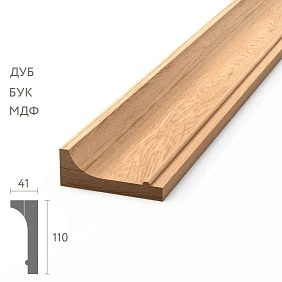
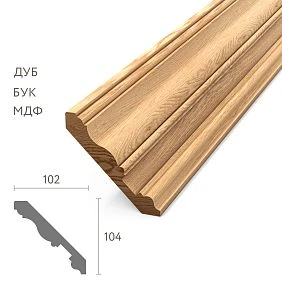
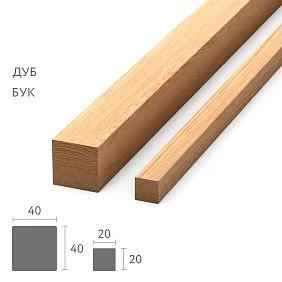
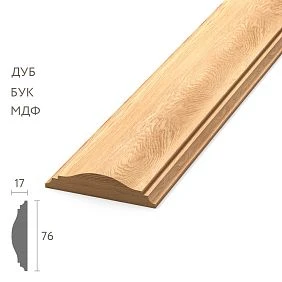
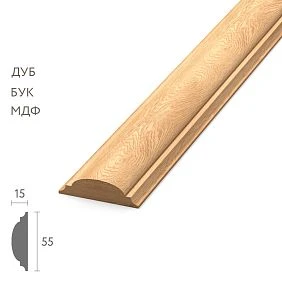
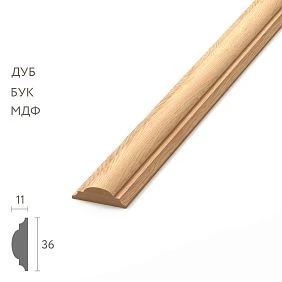
Buy wooden layout: choice for facades, glass, walls, and furniture
There are interior details that don't catch the eye — but it is they that create that very feeling of "luxury". A thin line on a furniture facade. A light relief transition between panel planes. A neat frame around a glass insert in a door. Buying a wooden layout means getting just such an element: unobtrusive, precise, and truly professional.
This article is not written for those looking for "a slat for boards". It is for those who design furniture, decorate interiors, assemble a cabinet with character, or make a door with a decorative stained glass window. A wooden layout is one of the most versatile and underestimated elements of professional decor, and the right choice here decides everything.




What is a wooden layout and why it's not just a slat
Confusion in terms is a chronic disease of the decorative profile industry. "Slat", "layout", "molding", "baguette", "glazing bead" — these words are often used as synonyms, although each has its own constructive logic. Let's sort it out once and for all.
A slat is a simple linear profile, most often of rectangular cross-section. It is a construction or technical element: lathing, frame, slatted panel. Wooden planks in the STAVROS catalog — it is a specific product with clear cross-section parameters, used in interior solutions and for forming slatted panels.
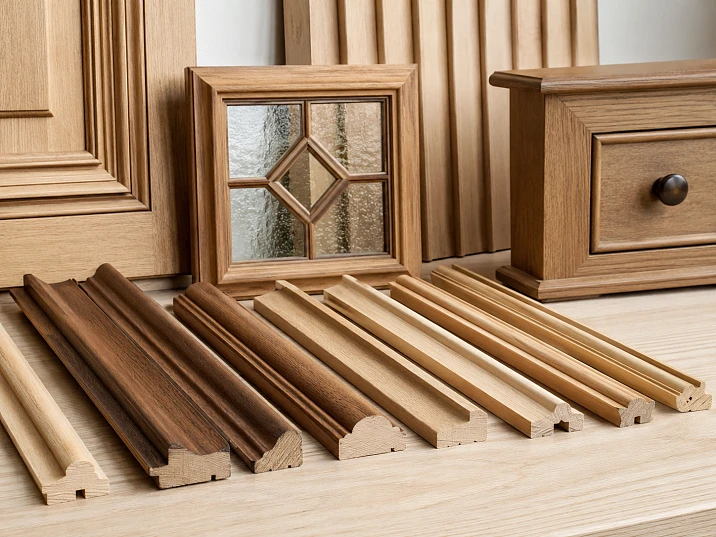
A layout is a functional decorative profile. It divides the surface into sections, covers joints, holds glass or a mirror, and frames the transition between planes. A layout is not just a complex-shaped batten; it is an element with a purpose.
Molding is a decorative line for visually dividing walls, facades, and ceilings. It works as an independent decor — creating relief where there is no structural joint. View Wooden moldings STAVROS can be found in the solid wood products section.
A baguette is a frame-type profile, classically used for framing paintings, mirrors, and panels. Wooden Picture Frame differs from a layout by a more pronounced decorative relief and a focus specifically on frame structures.
A glazing bead is a narrow profile for mechanically fixing glass in a groove. Its purpose is not decorative but structural. More details on the differences can be found in the article about wooden glazing bead on the STAVROS website.
Buying a wooden layout means choosing an element that combines a structural function with a decorative effect. It is more significant than just a "batten" and more precise than "molding." That is why the layout deserves a separate, careful discussion.
Our factory also produces:
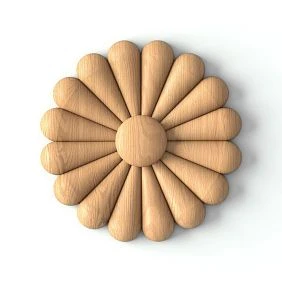
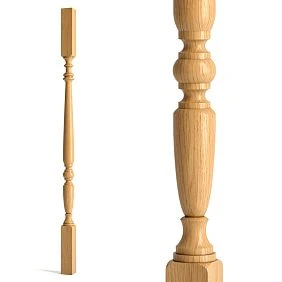
Where wooden layout is used
The right question before purchasing is not "which layout to choose," but "where will it work." The answer to the second question automatically narrows the choice to the required profile, material, and size.
Get Consultation
Furniture facades
The most widespread and visually striking application. The layout transforms a flat MDF facade into a product with character: it creates an imitation of a frame-and-panel structure, divides the surface into sections, and adds shadows and volume. A living room wardrobe, kitchen set, chest of drawers, bedroom closet — everywhere the layout creates the effect of expensive joinery without actually complicating the structure.
Glass doors and inserts
The layout for glass in doors serves a dual role: it holds the glass in the opening and frames its perimeter. With a properly selected profile, the glass insert looks not like a "hole covered with glass," but like a stained-glass partition or a classic window frame.
Interior doors
On the door leaf, the layout creates a visual division — an imitation of panels, frame inserts, and decorative rectangles. This is a classic technique in styles such as Provence, neoclassicism, and Art Deco. A smooth MDF door, after applying a shaped layout, takes on the appearance of a handcrafted joinery product.
Wall panels
Decorative wall panels are one of the main trends in modern residential interiors. The layout organizes a geometric division: vertical and horizontal lines divide the wall into cells, creating the effect of expensive paneling. corner wooden paneling STAVROS is disassembled separately — for working with niches, panels, and internal corners.
Mirrors and decorative frames
A mirror without a frame is a household item. A mirror in a wooden layout is an interior item. The layout frames the perimeter, sets the style, and visually increases the weight of the product. For mirrors, shaped or semi-circular layouts with pronounced relief are often chosen.
Niches and partitions
In niches, the layout performs an architectural function: it frames internal corners, covers ends, and creates smooth transitions between planes. In partitions, it divides the surface into sections and sets the rhythm.
Buying a wooden layout for a specific task means understanding at the selection stage which of these applications it will work for. This determines everything: profile, size, material, installation method.
Wooden layout for furniture facades
A furniture facade is the face of a cabinet, kitchen, library, or dresser. It is what people see first. And it is here that wooden furniture inlay works most powerfully — transforming the standard into the individual.
Imitation of a frame-and-panel construction
A frame-and-panel facade is a classic of joinery: a frame made of bars with an insert panel inside. In production realities, such a facade is complex and expensive. Inlay glued onto a smooth facade creates the same visual effect at significantly lower costs. The thin profile forms a shadow, the shadow forms relief, and the relief creates the impression of a multi-component construction — although in fact it is a single MDF board with wooden profiles on the surface.
Dividing the facade into sections
A large facade without division looks heavy and monotonous. Horizontal and vertical lines of inlay divide it into zones, create visual rhythm, and make the product light. This works both in small cabinets and in wardrobes up to the ceiling.
Combination with decorative overlays and rosettes
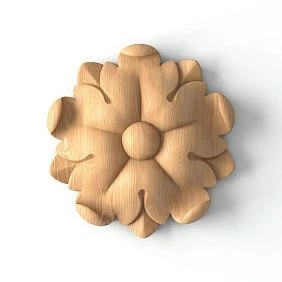
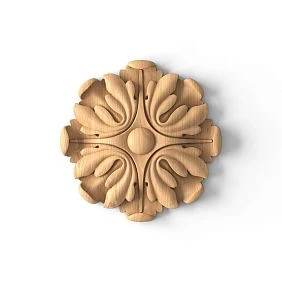
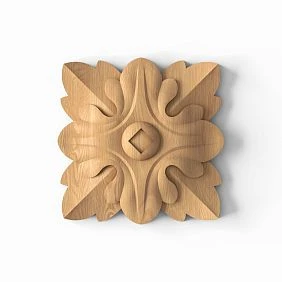
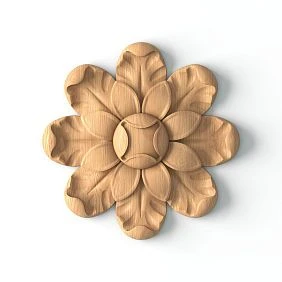
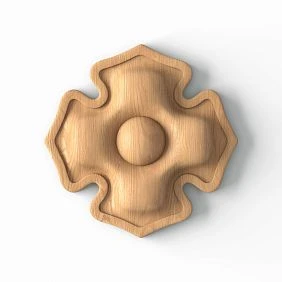
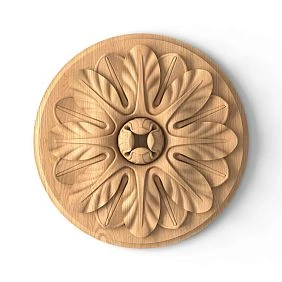
Inlay on a facade is not a solitary element. It becomes part of a system when placed in the corners of frames Wooden sockets or Decorative wooden inlays. It is this combination that turns an ordinary cabinet into a product perceived as a bespoke author's work.
Styles in which facade inlay works
Wooden inlay fits organically into classic, neoclassical, Provence, chalet, English style, and art deco. In modern interiors — in the directions of "warm minimalism" and "new classic" — inlay is used concisely: one horizontal or vertical line dividing the facade strictly in half. This is the very "expensive and unobtrusive" look.
Buy figured wooden inlay means choosing a profile with pronounced relief for classic and neoclassical tasks. Buy flat wooden inlay is needed when calm geometry without extra volume is required.
Layout for glass, mirrors, and doors
Working with glass and mirrors is a separate professional field where layout plays a key role. Here it doesn't just decorate — it constructs.
Decorative glass partitioning
In furniture, doors, and partitions, glass is often fixed without a frame — simply inserted into a groove. Layout turns this technical solution into a decorative one: it frames the glass perimeter, divides a large panel into cells, creates an imitation of mullions or stained glass partitioning.
This is especially effective in kitchen cabinets with glass fronts, bookcases with glazed sections, and doors with decorative inserts. Thin wooden layout for glass — 8–12 mm wide — creates precise geometry that won't be noticed but will be felt.
Mirror framing
A mirror without a frame is functional but impersonal. Layout gives the mirror a frame without a bulky molding: a light profile around the perimeter creates a boundary between the mirror and the wall, adds completeness, and forms an accent. For dressing rooms, hallways, and bathrooms — this solution is both practical and stylish.
To frame a mirror, layout is glued around the perimeter or assembled into a frame with 45° corner joints. The second option requires precise cutting, but the result is a flawless joinery frame with no visible connections.
Interior door
A smooth white MDF door is a neutral solution that doesn't irritate but also doesn't delight. Three or four rectangles of layout glued to the front surface turn it into a 'joinery-style' door. The effect is disproportionately large relative to the cost.
Important: door layout must withstand vibration from opening and closing. The glue should be applied in a continuous strip, not at points — so the profile doesn't 'rattle' upon impact. Details on installation are in the installation materials section on the STAVROS website.
Difference from glazing bead
A glazing bead is a profile for mechanical fixation of glass; it fits into the groove and holds the glass from falling out. A layout is a decoration on or around the glass, bearing no structural load for fixation. They must not be confused: if you need to fix the glass in the groove, you need wooden trim. If you need to decorate the perimeter — a wooden layout for glass.
Flat, shaped, angled, radius: which one to choose
The profile type is the first and main selection parameter. It's easy to make a mistake here: choosing something too flat where relief is needed, or too voluminous where restraint is required.
| Layout type | Where to use | What it's for |
|---|---|---|
| Flat | Facades, wall panels, doors in minimalist style | Calm geometry, precise division without extra volume |
| Decorative | Classic and neoclassical furniture, walls, doors | Decorative relief, light and shadow effect |
| Corner | Internal and external corners of niches, panels, cabinets | Joint closure, corner protection, neat transition |
| Radius | Arches, rounded elements, non-standard shapes | Smooth transition without breaks on curved surfaces |
| Semicircular | Facades, frames, panels, classic-style furniture | Pronounced volumetric chiaroscuro effect |
Flat wooden trim
Buying a flat wooden trim is the right solution for modern interiors where geometric rigor is valued. Profile width — from 6 to 30 mm, cross-section rectangular or close to it with a minimal chamfer. A flat trim does not "scream" — it organizes the space unobtrusively, like proper punctuation in a text.
Typical applications: wall panels in the "squares on the wall" style, cabinet fronts in the Japandi or Scandinavian minimalism direction, glass inserts in furniture with aluminum or white coating.
Decorative wooden molding
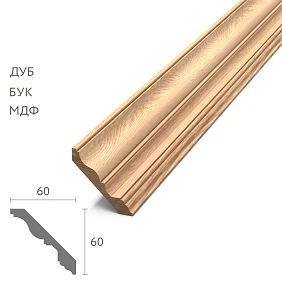
Decorative Wooden Tiling — is a profile with a complex cross-section: rounded edges, steps, fillets, flanges. It creates that very "expensive" light-and-shadow effect on the facade. It is worth buying decorative wooden molding for classic tasks: kitchen facades in Provence style, cabinets in English style, chests of drawers in neoclassicism, decorative frames on walls.
You need to buy decorative wooden molding with an understanding of the relief: the more complex the profile, the stronger the shadow, the more pronounced the volume. For small facades, choose a moderate relief. For large cabinets and wall panels, you can take a more voluminous profile.
Corner wooden molding
corner wooden paneling — is an L-shaped profile for installation on internal or external corners. It solves a problem that often arises when paneling walls: how to neatly close a corner without a gap, without a visible end.
It is worth buying corner wooden molding when installing slatted and smooth wall panels, in cabinets with corner sections, when decorating niches. Also, corner molding protects the ends from mechanical damage — this is especially relevant in children's rooms and high-traffic areas.
Radius wooden molding
Buying radius wooden molding is a specific task, but it occurs regularly when working with non-standard projects. Arched openings, rounded corners, oval frames — everywhere where the surface is not straight, a profile with a radius bend is needed. Radius molding is either bent from thin solid wood (beech bends well with steaming) or cut along a curve from veneered blanks.
Semicircular wooden molding
Buying a semicircular wooden layout is a choice for those who want volume without a complex profile. The semicircular cross-section creates an expressive line with a soft shadow on both sides. It's the "third option" between flat (restrained) and shaped (complex): there is volume, but it's not aggressive.
The semicircular profile works especially well on light, solid-color facades — the shadow it casts is pronounced and very photogenic.
How to choose the size of a wooden layout
Mistakes with size are the most costly. A layout that doesn't match in width or profile height either gets lost on the facade or looks rough. Here's a practical checklist.
Checklist for choosing the size
-
Determine the task — joint, frame, facade, glass trim, or wall panel. The task dictates whether you need a narrow or wide layout, flat or voluminous.
-
Measure the working area. The layout should be proportional to the surface: on a small facade 400 mm wide — a profile up to 20 mm, on a large cabinet — up to 30–40 mm.
-
Determine the relief height. For shadow depth, a profile height of at least 5–8 mm is needed. A flat layout gives minimal shadow — this is a conscious choice, not a drawback.
-
Check the thickness of the facade or glass. For glass — it's important that the layout covers the mounting gap. For a door leaf — that the profile does not protrude beyond its edges.
-
Consider the final finish. If the layout will be painted — take it with a small margin in width: a layer of enamel slightly smooths the relief. If varnished — the profile looks more pronounced.
-
Don't take a layout that is too wide for small furniture. A wide profile "eats up" the proportions of a small product — the facade starts to look overloaded.
-
Do not take a too flat profile for a formal interior. A minimalist flat layout in a classic hall will look poor — here you need Decorative Wooden Tiling with a pronounced relief.
-
Allow for trimming waste. Corner joints at 45° and connections to other profiles require trimming. Allow at least 10–15% of the calculated length.
Wooden layout 30 mm: when it is the right choice
Buy wooden layout 30 mm is a popular query. Width 30 mm is a universal "working" size: wide enough to be noticeable, and narrow enough not to overload a medium-sized facade. This size works well on cabinets 500–900 mm wide, on wall panels with standard height, on doors with moderate division.
Material: oak, beech, MDF
The choice of material determines not only the appearance, but also durability, finishing capability, and behavior under operating conditions.
| Material | When to choose | Advantages |
|---|---|---|
| Oak | Premium furniture, natural finish, oil, varnish | Pronounced texture, high hardness, noble appearance |
| Beech | Painting, enamel, tinting, neat closed relief | Dense uniform structure, ideal surface for enamel |
| MDF | Painted walls, panels, budget furniture tasks | Perfect geometry, does not swell, easy to paint |
| Solid wood without coating | Individual hand finishing | Can be tinted, stained, varnished, oiled |
Oak layout
Oak is a wood with character. Its texture is large, expressive, with "mirrors" on the radial cut. Buying an oak layout is a solution for interiors where wood remains visible: natural varnish, oil, tinting in dark tones. In classic and modern projects with natural wood, this is the first choice.
Beech layout
Beech is dense, even, with a fine texture. That is why it is ideal for painting: a beech profile after sanding and priming accepts enamel without pores or gaps, with a perfectly smooth finish layer. Buying a wooden beech layout is a choice for white, cream, pastel interiors where the enamel is visible, not the wood texture.
MDF as an alternative
MDF is not wood, but profiles made from it are geometrically stable: they do not warp, crack, or change size with humidity changes. For wall panels in apartments with unstable climates, this is a pragmatic choice. Trim products made of oak, beech, and MDF in the STAVROS catalog allow you to choose the right material for a specific task.
Uncoated solid wood: freedom of finishing
An uncoated wooden layout is a "blank slate." It can be tinted in any shade, coated with oil for a natural look, varnished with different levels of gloss, or painted with enamel to match the color of furniture or walls. A wooden layout for painting is exactly this option: solid wood without a finish layer, ready for individual treatment.
How not to confuse a layout with a baguette, molding, or glazing bead
This question arises for everyone who is dealing with interior decor for the first time. Let's examine the differences in detail.
A baguette is a frame profile. Its logic is a closed frame: a painting, mirror, or panel. Wooden Picture Frame in the STAVROS catalog is designed specifically for such tasks. It can be wide, narrow, with patina, with gilding, or in natural wood — but it is always the framing of a closed image's perimeter.
A molding is a linear decorative element. It creates a relief line on a wall, ceiling, or facade where there is no structural joint. A molding does not hold glass or cover a corner — it simply adds a decorative line. More details are in the section of wooden moldings of the catalog.
Glazing bead — a narrow profile of small cross-section (3×6, 4×8, 6×12 mm) for mechanical fixation of glass. It is recessed into the groove and presses the glass against the seating surface. The glazing bead cannot be replaced by a layout: it has a different geometry and a different task.
Layout — it is both a structure and a decor simultaneously. It can be flat (organizes space), shaped (adds relief), corner (closes a joint), radius (goes around a curve). The layout works as a part of the system, not as an independent accent.
Understanding these differences is not academic pedantry, but a practical necessity. Buying a decorative wooden layout instead of the required glazing bead means redoing everything from scratch.
How professional wooden layout differs from construction batten
The question is honest — and the answer to it must also be honest. In construction hypermarkets, there are wooden strips and battens. They are cheaper. Why can't you just take them?
Profile accuracy
Construction batten is cut for technical needs: lathing, formwork, frame. The geometry of its cross-section is approximate. Tolerances in width and height can reach 1–2 mm per linear meter. For decorative work, this is a disaster: joints do not match, corners do not work out, the result looks like it was made 'roughly'.
Professional layout is processed on calibrated machines with a tolerance of no more than 0.1–0.2 mm. This is what allows making perfect corner joints at 45° without gaps.
Sanding quality
Construction batten is planed but not sanded. For painting or varnishing, it needs to be sanded yourself: first with grit 80, then 120, then 180. This is time and consumables. Professional layout is supplied already with a finish sanding, ready for primer and finishing.
Tree species
In the construction section, it is most often pine, spruce, or unnamed 'coniferous wood'. For decorative work, this is unpredictable: pine resins, warps with humidity, does not hold a thin profile without chips. Professional wooden layout made of solid wood — oak, beech, ash — is stable, predictable, holds its shape.
Assortment of profiles
In a hardware store, there is a batten: rectangular. At most, a few sizes. Professional wooden trim for interiors means dozens of profiles: flat, shaped, semi-circular, corner, with a fillet, with a rebate, with a chamfer. It is from this variety that the desired result is assembled.
Ready for finishing
A construction batten requires serious preparation before painting. A professional profile, as a rule, is already suitable for immediate priming and painting — saving labor and time.
The conclusion is simple: buying solid wood trim from a specialized supplier is not an overpayment, it is buying the right tool instead of an unnecessary one. Buying wooden trim at STAVROS means getting a product ready for use straight out of the packaging.
Wooden trim: how it works in real interior projects
Abstract reasoning is good. Concrete examples are better.
Provence-style kitchen
Kitchen facades — white enamel, shaped handle, backsplash of subway tile. To give the smooth white facade the desired "rustic" volume, a frame of shaped beech trim for painting is glued onto it. Inside the frame is a slightly tinted insert or simply a deeper shade of the same enamel. Result: a facade that looks like real joinery with a frame-and-panel construction.
Classic-style library
Bookcases with glazed sections. The glass in the opening is held by a glazing bead, but around each section is a frame of flat wooden trim 25 mm wide. The frames are painted in the color of the body, creating clear geometry, making the display case look like an antique secretary. Additionally, in the corners of the frames are small Decorative wooden inlays.
Wall panels in the bedroom
Wall behind the headboard. Rectangles of flat wooden trim 15 mm wide are glued onto a primed painted wall — a geometric pattern of vertical and horizontal lines. The trim is painted the same color as the wall, but with a deeper gloss level. Effect: the wall is "structured," the interior looks expensive — even though the entire material is an estimated 15–20 linear meters of profile.
Interior door "made to look like joinery"
Standard MDF door, height 2000 mm. Three rectangles of semi-circular trim are glued onto the front surface: two at the top — vertical, one at the bottom — square. The trim is painted with white enamel along with the door. Result: a budget door takes on the appearance of a product costing several times more.
What to buy together with the wooden layout
If you have already decided to buy wooden trim, see what is needed for a full result.
Accessories for working with wooden decor
-
Wooden moldings — for visual division of walls and decoration of transitions
-
Wooden corner pieces — for corners of niches, cabinets, and panels
-
Wooden planks — for slatted panels and frame solutions
-
Decorative wooden inlays — for corner accents of frame systems
-
Wooden sockets — for the center of frames and corner inserts
-
Wooden Picture Frame — for framing mirrors, paintings, and panels
Installation and finishing materials
-
Installation adhesive — transparent TYTAN Prof.classic Fix or KUDO HIGH TACK depending on the profile weight; both are available in the section Mounting and finishing materials
-
Sealant — for sealing corner joints and wall connections
-
Finishing putty — for smoothing connection points
-
Oil or varnish — for final protection of unfinished wooden inlays; Rubio Monocoat oil is available in the installation materials section
Furniture components
If the inlay is mounted on furniture fronts, it is logical to complete the look with proper furniture handles — wooden handles, in the same wood species or combined with metal. The STAVROS catalog offers solid wood handles without coating, for enamel and varnish — in styles from minimalism to classic.
Mistakes when buying wooden inlays
Each of these mistakes is a real story that craftsmen and designers regularly make. Let's break them down honestly.
Buying layout without understanding the task
"I'll buy it, then figure it out" is the main mistake. Layout for painting is a different material and profile than layout for oil. Layout for glass has a different width than for wall panels. Start with the task, not with browsing the assortment.
Using construction batten instead of decorative profile
This has already been detailed above. Let's add one thing: this is not only an aesthetic mistake but also an economic one. The time spent on sanding, priming, and correcting a cheap batten will ultimately cost more than the price difference with a professional profile.
Not accounting for the thickness of the facade or glass
The layout profile must be selected for the actual thickness: too thin — it sinks into the plane of the facade, too high — it protrudes beyond its edge. Measure before purchasing.
Mixing different wood species
Oak and beech in one interior are acceptable with a well-thought-out combination. But oak and pine next to each other often look cheap due to the difference in texture and density. If you are buying layout for existing furniture, check the species.
Choosing a profile that is too wide for a small facade
A layout width of 40 mm on a facade width of 350 mm is no longer a division but fragmentation. The proportions are disrupted. Rule: the width of the layout should not exceed 1/8 of the width of the surface being divided.
Do not add extra allowance for cuts
45° angles require trimming. Overlap occurs at joints. Minimum allowance is 15% of the calculated footage. If the layout is wooden 30 mm, buying it "flush" will almost certainly not be enough.
Do not account for finishing
If the layout will be painted, take a slightly larger width: the paint layer partially smooths out the relief. If it remains natural, the width works exactly as in the catalog. Important: unpainted layout must be checked for moisture before installation — overdried wooden layout will slightly expand when installed in a room with normal humidity.
Confusing layout with glazing bead when choosing for glass
If the task is to fix the glass in the groove, you need wooden trim. If you need to frame the glass from the outside — layout. These are different products with different structural functions.
Buying profile without a layout diagram
"I'll buy it and lay it out on the facade as I like" — this is not an approach, it's a lottery. A layout diagram is a sketch where all lines, dimensions, angles, and profile quantities are marked. Without a diagram, it's impossible to accurately calculate the footage and predict the proportions of the result.
Why STAVROS
Why is it worth looking for wooden layout here, and not in the first construction store you come across?
Specialized assortment, not a "carpentry section". In the catalog molded products from oak, beech and MDF STAVROS — slats, corners, moldings, cornices, baseboards, architraves, profiles of various shapes. This is not a random set — it is a professional toolkit for decorators and furniture makers.
Individual cards with application descriptions. For each item — a real product card indicating purpose, dimensions and compatible use. No need to guess — information is open.
Ability to assemble a complete set. Wooden profile + Wooden corner pieces + Decorative Inserts + Wooden sockets + mounting glue — everything in one order. Contact us to confirm shipping to your destination. via CDEK and DPD.
Real expertise. STAVROS has been operating since 2002. Among the completed projects are the Konstantinovsky Palace, the Hermitage, the Alexander Palace, and the Trinity-Izmailovsky Cathedral. This is not a marketing claim — it is a history of working on projects where the highest demands are placed on wooden profiles.
Articles that help you choose. The website features detailed expert materials: about shaped wooden profiles, about corner profiles, oh furniture decorationThis is not an advertisement — it's real help in making a choice.
If you are engaged in classic furniture, updating your wardrobe or assembling a kitchen with character — the wooden molding from the STAVROS catalog will be the element that elevates the result to the next level.
FAQ
How is wooden molding different from a batten?
A batten is a straight linear profile for construction and technical tasks. Wooden molding is a functional decorative profile with a specific cross-sectional shape. It divides the surface into sections, covers joints, holds or frames glass and mirrors. A batten organizes the structure, molding organizes the space and creates decor.
Where is wooden molding used?
On furniture fronts — to imitate a frame-and-panel construction. On doors — to create panel divisions. On wall panels — for geometric segmentation. Around glass and mirrors — for framing. In niches and cabinets — to cover corners and edges. It is one of the most versatile elements of interior decor.
Which molding to choose for a furniture front?
For a calm modern front — flat wooden molding, width 15–25 mm. For a classic or neoclassical front — decorative wooden profile with a pronounced profile. Width — no more than 1/8 of the facade section width.
What to choose for the corner: trim or a wooden corner piece?
For closing and protecting the corner — Wooden angle or an L-shaped wooden corner trim. For a decorative accent on the plane near the corner — shaped or flat trim. The task determines the tool.
Can wooden trim be painted?
Yes. Uncoated wooden trim can be painted with enamel, tinted with stain, coated with varnish of any gloss level, or treated with oil. Before finishing — check sanding (grit 180), dust off, prime. Beech trim is the best choice for enamel, oak trim for oil and varnish while preserving texture.
Where to buy wooden trim in Saint Petersburg and Moscow?
At STAVROS — showrooms in Saint Petersburg and Moscow. You can buy wooden trim in St. Petersburg and Moscow both through the online catalog with pickup and with delivery via CDEK or DPD to an address. Order — from one item.
How much trim is needed for a furniture facade?
Calculate the perimeter of each frame you plan to create on the facade. Add up all perimeters. Add 15% for trimming and miter cuts. If the facade has several frames with 45° corner joints — add another 5–10% margin. A trim layout diagram is a must for accurate calculation.
Wooden layout is not what you see. It is what you feel. A thin line on the facade, a neat transition between planes, a clean corner in a niche — all of this works at the level of perception, creating an impression of "expensive and professional," even when the viewer cannot explain why exactly. Buying the right wooden layout means making this invisible contribution to the quality of the result.
STAVROS company has been operating since 2002. Over two decades — restoration of the Konstantinovsky Palace, work with the Hermitage, the Alexander Palace, the Trinity-Izmailovsky Cathedral, the Sheremetyev Mansion. Today, STAVROS is wooden moldings, carved decor, furniture components, and installation materials with Contact us to confirm shipping to your destination. Rating 5.0, over 260 reviews, showrooms in St. Petersburg and Moscow. Buying wooden layout means turning to those who know why it is needed.