Article Contents:
- Turned furniture leg MN-183 145×92×60 mm: what exactly can you buy
- Beech MN-183
- Oak wooden leg MN-183
- Height 145 mm
- Dimensions B=92 and D=60 mm
- Antique bronze
- Built-in caster
- The table is constantly being moved closer to the sofa
- The table is being moved between two zones
- You need to regularly clean under the furniture
- The table is turned around for guests
- When the caster is not needed
- Surface cleanliness
- Condition of the roller
- Weight of the finished table
- Varnish or oil on the parquet
- Why “wheel” does not mean “does not scratch”
- Roller diameter
- Radius
- Clearance of the metal tip
- Carpet edge shape
- Anti-slip backing
- Carpet softness
- Approach direction
- Why "approximately" is especially dangerous here
- Why you can't calculate the roller using D=60 mm
- Why you can't measure the wheel by the screen
- What to do instead
- Roller diameter
- Work surface width
- Roller material
- Swivel capability
- Floor covering restrictions
- Option A. Get all parameters from the manager
- Option B. Buy one MN-183 as a physical sample
- Cost of such a test
- What can be tested with one leg
- What cannot be tested with one leg
- Step 1. Make a small rigid frame
- Step 2. Load it in a controlled manner
- Step 3. Start with parquet
- Step 4. Approach the edge of the carpet straight
- Step 5. Approach at a slight angle
- Step 6. Drive back off the carpet
- Step 7. Repeat several cycles
- Step 8. Inspect the roller and parquet
- Smooth edge
- Rigid vertical edge
- Thick rubber underlay
- Soft pile
- What to tell the seller
- What happens
- What the user feels
- Why the problem is not about the diameter
- What to do
- Tabletop 20 mm
- Tabletop 30 mm
- Tabletop 40 mm
- Why this is important
- What to measure next to the sofa
- Another example
- Commercial output
- What stability depends on
- Why a small tabletop may not always be more stable
- Why a wide tabletop also does not guarantee stability
- Why the absence of brake data is important
- What to do if fixation is critical
- What to ask the seller
- The table is indeed moved every day
- The user does not want to lift furniture
- Cleaning requires constant access
- The wheel passed the surface test
- Antique bronze supports the interior
- The table always stands in one place
- There is a deep carpet on the floor
- There are several high crossings on the route
- Furniture needs to be as immovable as possible
- Antique bronze does not suit the interior
- The table can be easily lifted with two hands
- Beech for covering enamel
- Oak for visible texture
- The same roller is tested regardless of the wood type
- Price difference of the set
- What it's convenient to pair with
- When metal can conflict
- Can the metal tip be repainted
- Oak
- Oak
- Why the price of a test leg is justified
- Why you don't need to automatically buy a fifth as a spare
- What FUR-012 solves
- What it doesn't solve
- Why FUR-012 shouldn't be considered mandatory for any tabletop
- Beech + 4 FUR-012
- Oak + 4 FUR-012
- What to evaluate
- Sand
- Crumbs after renovation
- Metal shavings
- Why the wheel doesn't "roll over" any particle
- Practice before the daily route
- Why a carpet also carries dirt
- Before the test
- Use an inconspicuous area
- Even better — a spare board
- Check in side light
- Do not repeat dozens of cycles at once
- Why the test should be done with real load
- Example
- Why this is sometimes better than buying another leg
- Supports too close to the center
- Supports too close to the edge
- Four rollers must work in coordination
- Marking
- General principle
- What to Check
- What to check after assembly
- Why not wait for squeaking
- Two orders increase logistics
- How to compare
- Why it's better to test in the same version
- Next step
- Mistake 1. Assuming any wheel can handle 8 mm
- Mistake 2. Guessing the diameter from a photo
- Mistake 3. Not considering the shape of the carpet edge
- Mistake 4. Checking only the climb, but not the descent
- Error 5. Check only direct access
- Error 6. Not asking about the material of the roller
- Error 7. Promising that parquet cannot be scratched
- Error 8. Buying four legs before testing
- Error 9. Testing one leg with only the weight of the table
- Error 10. Considering A=145 mm as the final table height
- Error 11. Ignoring the absence of a confirmed brake
- Error 12. Considering FUR-012 mandatory
- Error 13. Buying FUR-012 and a separate pin simultaneously without reason
- Error 14. Not checking rollers after use
- Error 15. Making the table too heavy
- Error 16. Leaving two legs on the carpet and two on the parquet without checking
- Error 17. Buying oak for the floor
- Error 18. Considering MN-183 an analog of a cart
- Point A — parking by the sofa
- Section 1 — movement on parquet
- Point B — edge of the carpet
- Section 2 — movement on the carpet
- Point C — chair
- Return route
- Question before purchase
- Why
- What not to do
- Why one test leg is not 'extra'
- What to check before such a scenario
- An alternative may be better if
- Effort on parquet
- Effort on threshold
- Effort on carpet
- Why you can time it
- What to Check
- Why
- What not to do
- What to keep in the passport
- What can be done safely
- Check after 2–4 weeks
- For oak
- Therefore, the test should be gentle
- What is the size of MN-183?
- Does MN-183 have a wheel?
- What color is the metal tip?
- What wood is MN-183 made from?
- What is the quality of the sanding?
- Is MN-183 suitable for a coffee table?
- Can MN-183 be used on parquet?
- Will MN-183 roll over a carpet edge of 8 mm?
- What is the wheel diameter of MN-183?
- Why can't the diameter be determined from a photo?
- What material is the wheel made of?
- Is the wheel swivel?
- Does MN-183 have a brake?
- Can I first buy one MN-183 for testing?
- How to test the wheel on a carpet?
- Is it necessary to test under load?
- Why should the edge of the carpet be photographed from the side?
- What to do if the carpet gets crumpled by the wheel?
- What to do if the roller moves on parquet but gets stuck in the carpet?
- How to calculate the finished height of a coffee table?
- Can I simply add the thickness of the tabletop?
- Which fasteners are suitable for MN-183?
- What is included in FUR-012?
- How much does FUR-012 cost?
- How much do four FUR-012 cost?
- How much does a set of four beech MN-183 cost?
- How much does an oak set cost?
- How much will it be with four FUR-012?
- What to choose — beech or oak?
- Can MN-183 be used with a stone tabletop?
- Do I need to buy a spare fifth leg?
- When is a regular fixed leg better?
- Where to buy legs for a coffee table?
- Where to buy MN-183?
- How to order four MN-183?
- How to check the current price?
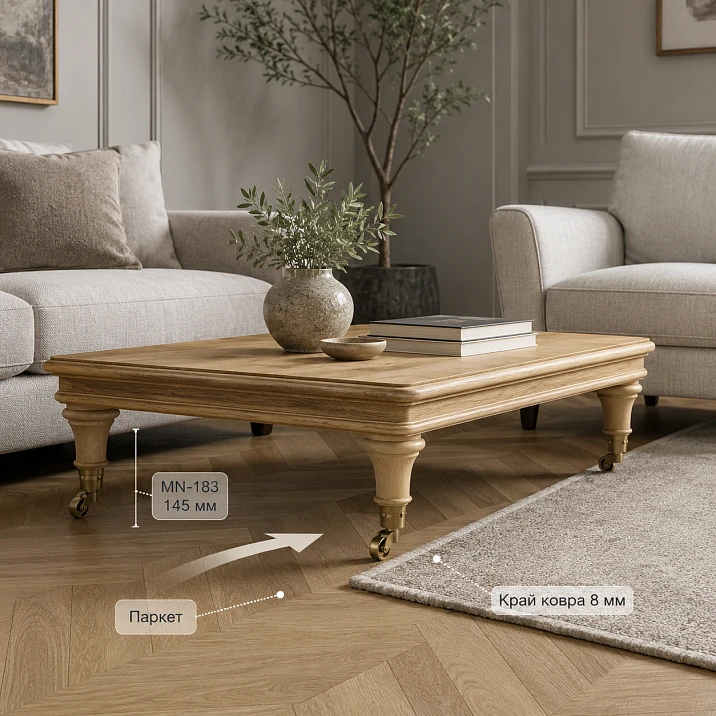
Eight millimeters is not a "small threshold" until the diameter of the wheel itself is known.
This is exactly where it is easy to make an expensive mistake. In the photo of MN-183, you can see a metal tip in "antique bronze" color and a built-in wheel. It seems that for a coffee table that moves every day from the sofa to the armchair, such a leg solves everything: no need to lift the furniture, no need to drag a wooden support across the parquet, just give the table a slight push.
But in the room there is a transition from hard parquet to carpet, the edge of which is about 8 mm higher. And the MN-183 card does not publish three parameters without which it is impossible to honestly promise that the wheel will pass this transition:
-
roller diameter;
-
width of its working surface;
-
the material by which the wheel contacts the floor.
There is also no separate confirmation that the caster is specifically designed to overcome a vertical threshold of 8 mm. Therefore, the conclusion "there is a wheel — so it will roll over the carpet" would be a fabrication.
For MN-183, the correct order is the reverse: first, the caster itself and the actual edge of the carpet are checked, then four legs are purchased.
The current product card confirms something else about MN-183:
-
leg size — 145×92×60 mm;
-
material — beech or oak;
-
grinding quality — "Prestige";
-
metal tip — "antique bronze";
-
a caster is built into the tip;
-
the model is allowed for coffee tables, dressers, benches, and ottomans;
-
beech at the time of check — 2,430 ₽;
-
oak — 3,240 RUB;
-
the recommended fittings include FUR-001-1, FUR-001, and FUR-012.
That is, the product is suitable for a mobile coffee table. Only the specific passability of the route “parquet → carpet edge 8 mm → carpet” has not been confirmed.
If this transition is a daily part of use, four MN-183 units should not be bought blindly. First, you need to get the roller parameters from the seller or physically test one leg. The product page allows shipping from one piece, so a test scenario here is economically reasonable.
A set of four legs costs:
-
beech: 4 × 2,430 = 9,720 RUB;
-
oak: 4 × 3,240 = 12,960 RUB.
If after purchase it turns out that the roller hits the carpet edge, the table will have to be lifted each time — and the main function of MN-183 will be useless exactly in the place for which it was chosen.
Therefore, the central answer of the article is:
MN-183 is worth buying for a mobile coffee table only after checking the specific wheel on your parquet-to-carpet transition. The presence of a roller by itself does not prove that it will overcome the 8-millimeter edge.
When this test is passed, you can buy turned legs MN-183 with a caster already as a functionally confirmed set.
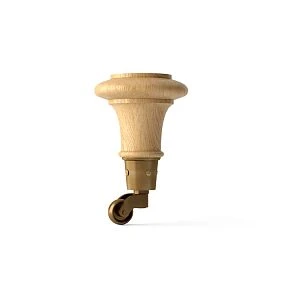
Turned furniture leg MN-183 145×92×60 mm: what exactly can be bought
MN-183 is not an ordinary turned leg to which a separate roller from the catalog was later added. The caster is already included in the metal lower assembly of the product, so its geometry and appearance are part of the model itself.
| Parameter | MN-183 |
|---|---|
| Height A | 145 мм |
| Size B | 92 мм |
| Dimension D | 60 мм |
| Material | Beech / Oak |
| Sanding quality | «Prestige» |
| Metal | Antique bronze |
| Bottom element | built-in caster |
| Beech | 2,430 ₽ at the time of check |
| Oak | 3,240 ₽ at the time of check |




Beech MN-183
Beech is rational if the leg will be painted with opaque enamel or if a more affordable solid wood is needed.
For a mobile table, the wood species does not determine the carpet's passability. It determines the appearance of the wooden part and the finish system.
Our factory also produces:



Oak wooden leg MN-183
Oak has a more pronounced texture and is better suited when the wood is planned to be left visible or tinted.
But the oak version does not automatically get a "better wheel." The roller function needs to be checked independently of the wood species.
Get Consultation
Height 145 mm
This is the height of the model itself according to the card.
It is not equal to the finished height of the coffee table. The tabletop, subframe, or other structure, as well as the actual mounting scheme, are added to it.
Dimensions B=92 and D=60 mm
They are important for the scale of the leg and the top assembly.
If the coffee table is small, the 92-millimeter geometry may visually appear large. Therefore, mobility cannot be assessed separately from the proportion of the finished product.
Antique bronze
The metal tip is not a hidden technical detail. It is visible under the furniture and becomes part of the design.
If the room already has brass, bronze, aged metal, or warm hardware, MN-183 can fit well into the interior.
If all other metals are cool and minimalist, "antique bronze" may look like a random accent.
Built-in caster
This is the main functional difference of the model.
But the card does not provide a separate technical table for the caster. Therefore, the buyer must distinguish between two levels of data:
confirmed: the caster is present;
not confirmed: specific diameter, width, material of the working surface, allowable threshold, presence of a brake.
This boundary is fundamental for an honest article.
Buy table legs with a caster: when mobility is really needed
If the user wants legs for a table to buy, a caster only makes sense for a real moving scenario.
The table is constantly moved closer to the sofa
For example, in the morning the table stands in the center of the room, in the evening it is moved closer to the sofa.
MN-183 here solves a clear task: furniture should change position without lifting.
The table is moved between two zones
An open kitchen-living room may have a sofa and an armchair on different sides.
The coffee table actually works as a mobile surface.
Need to regularly clean under the furniture
If the table stands on ordinary wooden legs, it has to be lifted or pulled.
A wheel can simplify service.
The table is turned around for guests
Mobility helps quickly change the composition.
When the caster is not needed
If a coffee table stands in one place for years, the built-in roller turns from an advantage into an extra mechanism.
In such a project, it is worth comparing a regular fixed wooden support.
MN-183 and parquet: what the card confirms, and what needs to be checked separately
The very fact of a caster makes moving more convenient, but it does not provide a universal guarantee for any parquet.
Surface cleanliness
Sand under the roller can act as an abrasive.
The wheel does not eliminate the need for cleaning.
Roller condition
If hard crumbs have stuck to the working surface or it is damaged, the risk of marks increases.
Weight of the finished table
A heavy tabletop presses the roller harder against the floor.
The MN-183 card does not provide a universal table of "maximum table weight per roller," so such figures cannot be invented.
Varnish or oil on parquet
Two parquet floors made of the same wood can behave differently due to the finish.
If the coating is expensive or recently restored, a real test is especially important.
Why “wheel” doesn’t mean “doesn’t scratch”
Floor damage depends not only on the roller material, but also on dirt.
Even a soft material with a trapped grain of sand can leave a mark.
Carpet with an 8 mm edge: why carpet height alone isn’t enough for an answer
The main buyer question:
will the MN-183 caster get over an 8 mm edge?
There’s no answer on the product card because the obstacle height is only one parameter.
Roller diameter
The larger the wheel, the easier it usually is to overcome a small threshold, all else being equal.
But the diameter of MN-183 isn’t published separately.
Radius
For geometric assessment, the radius relative to the obstacle is exactly what is needed.
Without it, pseudo-precise calculation is impossible.
Free clearance of the metal tip
Even if the roller can rise, the tip body must not hit the carpet earlier.
Carpet edge shape
8 mm can look like:
-
smooth edge;
-
almost vertical step;
-
beveled edge;
-
Soft pile transition.
These are four different tasks.
Anti-slip backing
It can make the edge stiffer and higher.
Carpet softness
The wheel partially sinks into the pile.
After climbing onto the carpet, resistance may increase sharply.
Approach direction
Straight and diagonal approaches give different sensations.
Therefore, the real test should replicate the table's actual route.
Why you can't invent the diameter of the MN-183 caster wheel in the article
This is a fundamental point.
The card confirms the dimensions of the leg itself: 145×92×60 mm. But there is no separate roller size in the published table.
This leads to a simple rule: you cannot turn a product photo into a pseudo-engineering drawing.
Incorrect:
"From the photo, the wheel is about 30 mm, so it will overcome 8 mm."
Such a conclusion is based on an unknown value.
Correct:
"To assess the threshold, you need the real wheel diameter. It's not in the card, so first request the technical dimension or physically check one leg."
Why "approximately" is especially dangerous here
The difference between a roller of, say, 20 and 40 mm can radically change behavior on the same carpet edge.
If a user pays almost 10–13 thousand rubles for four legs, there's no point in saving five minutes on requesting parameters.
Why you can't calculate the roller using D=60 mm
D refers to the geometry of the leg, not to the guaranteed wheel diameter.
Even if the wheel visually fits within this size, the actual working circumference may be smaller.
Why you can't measure the wheel by the screen
The photo may be:
-
at an angle;
-
with perspective;
-
cropped;
-
without scale;
-
with optical distortion.
What to do instead
Get the real X — the roller diameter.
Only after this can the threshold geometry be discussed.
Buy wooden table legs: what five parameters to request from the seller per MN-183
If the task is — Buy wooden table legs specifically for a mobile coffee table, the request to the seller must be technical.
Not:
"Is the wheel good?"
But specifically:
-
roller diameter;
-
width of the work surface;
-
roller material;
-
swivel wheel or fixed;
-
are there any restrictions on the type of flooring/threshold.
Roller diameter
Needed to assess the obstacle.
Working surface width
Affects contact with soft carpet and parquet seams.
Roller material
Helps understand the nature of contact with parquet.
Swivel capability
For a coffee table that frequently changes direction, this is especially important.
If the wheel works only in one plane, the rotation of the entire piece of furniture may occur differently than the user expects.
Floor covering restrictions
If the manufacturer or seller knows of restrictions, it is better to obtain them before ordering.
Buy one MN-183 for testing or four at once
For this topic, one test caster is not over-insurance, but a reasonable commercial strategy.
The card allows ordering from a single piece.
Option A. Get all parameters from the manager
If the diameter, roller material, and its operating scheme are documented, a physical test can become an additional, not mandatory, step.
Option B. Buy one MN-183 as a physical sample
This is a strong option if:
-
the carpet edge is non-standard;
-
the parquet is expensive;
-
the table will be moved every day;
-
the roller is the main reason for purchase.
The cost of such a test
Beech — 2,430 ₽.
Oak — 3,240 ₽.
Yes, that's money.
But a mistake with four legs costs 9,720 or 12,960 ₽ plus time, delivery, and possible project rework.
What can be checked with one leg
-
real roller size;
-
material;
-
free play;
-
visual scale;
-
carpet edge clearance in a test mock-up;
-
contact with parquet.
What cannot be checked with one leg
-
stability of the finished four-legged table;
-
behavior of the entire tabletop when rotated;
-
load distribution;
-
real dynamics of a large object.
That is, one leg responds to the roller, not the entire structure.
How to run the MN-183 test on a real carpet before assembling the entire table
The test should not turn into an experiment where one leg is loaded with a random weight and pulled by hand.
A stable mock-up is needed.
Step 1. Make a small rigid frame
It should hold one or more supports without skewing.
Step 2. Load it in a controlled manner
Not the weight of the entire future table, if the system is not designed for it.
The task is to check the nature of the passage, not to break the leg.
Step 3. Start with the parquet
Check:
-
smoothness of rolling;
-
noise;
-
traces;
-
direction of the roller.
Step 4. Drive straight to the edge of the carpet
This is the basic route.
Step 5. Drive up at a slight angle
The coffee table rarely moves strictly in a straight line.
Step 6. Move back off the carpet
The descent may behave differently than the ascent.
Step 7. Repeat several cycles
A single successful move does not always reflect real-world usage.
Step 8. Inspect the roller and the parquet
We look for:
-
dirt;
-
a mark;
-
scratch;
-
deformation;
-
sticking.
Why the test should be done with a clean carpet and clean parquet
Otherwise, you are not testing the wheel, but the sand.
A hard particle can distort the result:
-
increase resistance;
-
scratch the floor;
-
get stuck in the roller.
Why the real edge of the carpet matters more than the 8 mm figure
Two carpets with the same height can have a completely different threshold.
Smooth edge
The wheel gradually rises.
Hard vertical edge
Need to overcome almost a step.
Thick rubber backing
The edge may be hard and not compress.
Soft pile
The wheel sinks after the rise.
Therefore, you need to measure not only the height, but also the profile of the edge from the side.
How to take the edge profile of a carpet
Simple method:
-
place a ruler vertically at the edge;
-
measure the height;
-
take a photo from the side;
-
estimate the length of the bevel;
-
check for the presence of a backing.
What to tell the seller
A photo with a ruler and a question:
"Can the MN-183 roller pass such a transition at a coffee table? What is the roller's diameter and material?"
This is much more useful than the general question "is it suitable for a carpet."
Why a carpet may bunch up in front of the wheel
If the edge is soft and not secured, the roller may not climb onto it but instead push the carpet.
What's happening
Kant is folding into a crease.
What the user feels
The table is pushing against.
Why the problem isn't about the diameter
Even a sufficiently large wheel can push the soft edge.
What to do
Check the carpet fixation and anti-slip underlay.
The carpet is secured with double-sided tape: does it help
It can make the edge more stable.
But the specific method of fixation must be compatible with the parquet.
The article does not recommend sticking random tape to an oiled surface.
If the carpet lies on a thin underlay
The actual difference is higher than the thickness of the pile itself.
You need to measure the assembled stack.
If the carpet edge is 8 mm only in the center
The corner may be higher.
The entire trajectory along which the table moves is checked.
If the table passes the same spot every day
It is this area that will experience maximum load.
This is convenient for control, but increases cleanliness requirements.
Legs for a coffee table: consider not only the roller but also the overall height
If you need to buy legs for a coffee table, A=145 mm by itself does not determine the height of the table.
Simplified formula:
H of finished furniture = support height + mounting assembly + underframe/apron + tabletop.
Tabletop 20 mm
If there are no other elements:
145 + 20 = 165 mm.
Tabletop 30 mm
145 + 30 = 175 mm.
Tabletop 40 mm
145 + 40 = 185 mm.
These figures show that MN-183 is a very low support for a typical coffee table if used without an additional underframe.
Why this is important
Perhaps the design of MN-183 implies a structure where part of the height is formed by the body or apron.
Therefore, before purchasing four legs, you need to obtain a ready-made side cut of the furniture.
What to measure next to the sofa
-
seat height;
-
armrest height;
-
the desired tabletop surface;
-
The thickness of the tabletop;
-
the height of the stretcher frame.
Why 145 mm cannot be considered a "low table" without a project
The same MN-183 can be placed under:
-
a massive cabinet;
-
a soft bench;
-
a low coffee table.
The card allows different applications.
Therefore, the finished height is a function of all the furniture.
Reverse calculation of the required subframe
Suppose the user wants a table surface at 430 mm.
Tabletop 30 mm.
MN-183 — 145 mm.
Then the remaining structure should provide:
430 − 145 − 30 = 255 mm.
This is already a significant height of the body/subframe.
If there is no such element in the design, MN-183 may turn out to be too low.
Another example
Target height 350 mm.
Tabletop 40 mm.
Required construction:
350 − 145 − 40 = 165 mm.
This is closer to a possible low apron/cabinet.
Commercial conclusion
MN-183 should be purchased after checking not only the roller, but also the overall height of the furniture.
Why the MN-183 caster does not mean the table is automatically stable during use
Mobility and stability are different properties.
The wheel helps move the table, but the finished item must still stand steadily when a cup, laptop, or tray is placed on it.
What stability depends on
-
width and length of the tabletop;
-
distance between four supports;
-
height of center of gravity;
-
mass of tabletop;
-
mass of objects on it;
-
stiffness of the subframe;
-
MN-183 mounting;
-
free play of rollers.
Why a small tabletop may not always be more stable
If the legs are close together, the support contour is narrow.
Even a heavy low table can be sensitive to lateral impact.
Why a wide tabletop also does not guarantee stability
If the supports are deeply recessed inward, the edge of the tabletop gets a large cantilever overhang.
Therefore, you need to check the top view.
Do the MN-183 wheels need a brake
The MN-183 card does not describe a separate stopper or brake.
So, in the finished article you cannot write:
-
"the wheels are fixed";
-
"pressed the brake and the table stands";
-
"the roller has a lock."
These functions are not confirmed.
Why the absence of brake data is important
A coffee table can:
-
stand on a slightly inclined floor;
-
move when accidentally pushed;
-
shift if a person leans on it with a hand;
-
roll when the carpet is rearranged.
What to do if fixation is critical
If the table must be absolutely stationary most of the time and move only occasionally, MN-183 needs to be checked especially carefully.
Perhaps a regular leg and a separate solution for rare movements would be better.
What to ask the seller
Does the built-in wheel of MN-183 have a locking/stopping mechanism? If not, how does the manufacturer recommend using this model on a coffee table?
When is MN-183 better than a regular fixed wooden leg
The table is indeed moved every day
This is the main scenario.
The built-in wheel is used regularly, not remaining a decorative rarity.
The user does not want to lift the furniture
For example, the tabletop is heavy or the item is wide.
Cleaning requires constant access
The table is quickly moved away and brought back.
The wheel has passed the coating test
Without this, advantages remain theoretical.
Antique bronze supports the interior
Function and design coincide.
When the wheel becomes an unnecessary complication
The table always stands in one place
Then the roller is hardly used.
There is a deep carpet on the floor
A small wheel can constantly experience great resistance.
There are several high thresholds on the route
Each threshold becomes a separate test.
Need maximally stationary furniture
The absence of a confirmed stopper becomes critical.
Antique bronze does not suit the interior
Then the functional leg begins to create a stylistic conflict.
The table can be easily lifted with two hands
If the item is small and light, a built-in wheel may not provide significant benefit.
How to understand if mobility is actually needed
Before ordering, draw the actual route.
For example:
-
parking near the sofa;
-
movement of 700 mm on parquet;
-
carpet edge 8 mm;
-
move another 500 mm along the carpet;
-
turn 30–45°;
-
stop at the armchair.
If such a route is performed every day — MN-183 really solves the task.
If movement is 100 mm once a month, the built-in roller no longer seems mandatory.
Beech MN-183 or oak: the material does not solve the roller problem
If you need Buy wooden furniture legs, the wood species is chosen after functional testing.
Beech under covering enamel
If the table is painted, beech is rational.
Oak for visible texture
If the legs must be natural or tinted, oak adds pronounced texture.
The same roller is tested regardless of the wood type.
The wheel is in a metal tip.
There is no reason to assume that the oak version handles carpet better.
Price difference of the set
Beech:
4 × 2 430 = 9 720 ₽.
Oak:
4 × 3 240 = 12 960 ₽.
The difference:
3,240 ₽ for four legs.
This money buys a different wood type, not a different roller geometry.
Antique bronze MN-183 and room hardware
The metal tip is visible from below and moves with the table.
It becomes part of the visual image.
What it is convenient to associate it with
-
bronze handles;
-
aged brass;
-
warm metal of lamps;
-
decorative hinges;
-
chair legs;
-
mirror frames.
When metal can conflict
If the interior is built on:
-
polished chrome;
-
cold stainless steel;
-
in matte black metal without warm accents.
Can the metal tip be repainted?
The article should not promise such a possibility without manufacturer data.
The buyer should assume the standard antique bronze.
Buy furniture legs MN-183: how much does a set of four cost?
For the current card:
Beech
4 × 2 430 = 9 720 ₽.
Oak
4 × 3 240 = 12 960 ₽.
Why the price of the test leg is justified
If the carpet is a critical daily threshold, one beech leg for 2,430 ₽ can prevent a mistake of almost 10,000 ₽.
Why you don't need to automatically buy a fifth as a reserve
The built-in metal component makes MN-183 an expensive spare part.
A reserve only makes sense for a commercial property, a series, or complex finishing.
FUR-012 for MN-183: when to include fasteners in the same order
The MN-183 card recommends FUR-012 along with other fastener options.
The current FUR-012 card confirms:
-
kit size 60×13×13 mm;
-
price 152 ₽;
-
round mounting plate d37 mm;
-
internal thread M8;
-
stud/self-tapping screw M8×60.
You can buy FUR-012 kit for attaching furniture legs, if this specific assembly is confirmed by the furniture designer.
What FUR-012 solves
Top connection of the wooden leg to the furniture structure.
What it does not solve
-
carpet clearance;
-
roller stability;
-
braking;
-
parquet protection;
-
table height automatically.
Why FUR-012 should not be considered mandatory for any tabletop
Card MN-183 shows several hardware options.
So, the final mounting method depends on the specific base.
Price of four FUR-012
If the project uses one set per leg:
4 × 152 = 608 ₽.
Then the conditional product budget:
Beech + 4 FUR-012
9 720 + 608 = 10 328 ₽.
Oak + 4 FUR-012
12 960 + 608 = 13 568 ₽.
This is not the full cost of the table.
Not included:
-
countertop;
-
stretcher frame;
-
finish;
-
assembly;
-
Delivery.
Why the top mounting is especially important for a leg with a caster
A regular fixed leg mainly receives vertical load and lateral forces from use.
The wheel support additionally receives dynamic loads when starting, stopping, and overcoming a threshold.
This does not mean that FUR-012 is automatically the best fastener.
This means that the top joint must be calculated, not chosen "out of habit."
Approach to the carpet: what happens to the load on the leg
When the wheel hits the edge, the user continues to push the table.
An additional horizontal force appears.
If the roller does not lift, this force is transmitted:
-
into the metal tip;
-
into the wooden leg;
-
into the top mounting;
-
into the stretcher.
Therefore, constantly "forcing" the wheel through an unsuitable threshold is a bad mode even if the structure doesn't break immediately.
Why you shouldn't help the table with a kick
This increases the dynamic load.
If the roller doesn't pass with a gentle push, the solution needs to be reconsidered.
How to determine successful passage of 8 mm
Good result:
-
the table moves without impact;
-
the wheel lifts smoothly;
-
the carpet doesn't bunch up into a fold;
-
the metal case does not catch the edge;
-
no need to lift the table;
-
after several cycles there are no traces.
Bad result:
-
a jerk is needed;
-
the roller jams;
-
the carpet moves forward;
-
the leg hits;
-
the user is forced to lift the edge of the table.
If the roller passes straight but does not pass at an angle
In a real room this is a serious limitation.
The table does not move on rails.
Therefore, testing should be done in at least two directions.
If the roller goes onto the carpet but moves poorly on it
The threshold is passed, but the mobility function still suffers.
Soft pile creates resistance.
What to evaluate
Whether constant significant effort is needed after the carpet.
If yes, MN-183 is only suitable for moving on parquet, not for the full route.
Parquet and MN-183 roller: why route cleanliness matters more than expensive wheel material
The user may spend time choosing wood, hardware, and finish, but get floor damage from a single small particle.
Sand.
Quartz particles are hard.
If a grain of sand gets under the roller, it is pressed against the parquet by the weight of the table.
Crumbs after renovation
Especially dangerous in a new apartment, where furniture is installed immediately after finishing.
Metal shavings
May remain after assembly.
Why the wheel does not "roll over" any particle
A small roller can pinch it between itself and the floor.
Practice before the daily route
If the table moves along the same strip of parquet every day:
-
this strip is easier to keep clean;
-
can be quickly visually inspected;
-
less risk of unexpected abrasive.
Why the carpet also carries dirt
Sand can come off the pile onto the parquet during movement.
Therefore, the junction zone of the coverings requires particularly good cleaning.
Oil parquet and MN-183: how to conduct a safe test
Before the test
Check that the coating is fully ready for use according to the oil manufacturer's recommendations.
Use an inconspicuous area
Better under a future table.
Even better — a spare board
If it remains after styling.
Check under side light
A thin scratch may not be visible from above.
Do not repeat dozens of cycles at once
First one.
Inspection.
Then several.
Why the test should be done with real load
An empty mock-up barely presses on the roller.
But you cannot overload one leg with the full weight of the future table without a safe structure.
What to do if the parquet already has minor marks
You need to choose an area without fresh scratches, otherwise the test result cannot be distinguished from old defects.
If the roller leaves a stripe but not a scratch
This could be:
-
dirt;
-
transfer of substance from the working surface;
-
change in gloss;
-
actual damage.
There is no need to polish the floor immediately.
First, determine the nature of the mark according to the coating instructions.
If the carpet lies only partially on the route
You can try changing the trajectory of the table so that the rollers do not pass over the edge.
Example
The table moves parallel to the carpet, not across it.
Then the main 8 mm problem disappears.
Why this is sometimes better than buying another leg
The interior function is preserved.
There is no need to replace the MN-183.
If the carpet can be moved by 100–150 mm
The transition can leave the working trajectory.
This is a simple designer way to solve the mechanics.
If the carpet is the central element of the room
Its position cannot be changed.
Then MN-183 must confirm passability, or another type of support is selected.
If the edge of the carpet has a removable border
A smoother profile can be considered.
But any change to the carpet must be safe for the parquet and the textile itself.
Why the article does not recommend a specific ramp or overlay
No data on the carpet construction.
A homemade strip can:
-
look bad;
-
scratch the parquet;
-
slip;
-
become an obstacle.
Buying legs for a tabletop: how to check the placement of four MN-183
If you need buy legs for the tabletop, mobility depends not only on the wheel, but also on the plan of the supports.
Supports too close to the center
The table is easier to tip over when loaded on the edge.
Supports too close to the edge
The wheel may protrude visually or catch on legs.
Four rollers must work in coordination
If the geometry of one differs, the table may pull to the side.
Marking
Before drilling the tabletop, apply:
-
four axes;
-
distances from edges;
-
diagonals;
-
fastening points.
Why four legs are not always automatically the right number
For a regular coffee table, four supports are a natural scenario.
But a large, heavy object may require a different design.
The article should not promise that four MN-183s fit any tabletop.
Very heavy stone tabletop: when MN-183 cannot be purchased without a separate calculation
The caster makes the furniture mobile.
A heavy slab increases:
-
load on rollers;
-
inertia when stopping;
-
horizontal forces;
-
mounting requirements.
Without data on the roller's permissible load, it is impossible to honestly recommend such a combination.
Glass tabletop
The top mounting needs to be decided separately.
FUR-012 does not automatically mean compatibility with glass.
Solid wood tabletop
Requires consideration of seasonal wood movement and the mounting scheme.
The wheel doesn't solve the top structure here either.
MDF or plywood tabletop
Another fastening unit.
General principle
Bottom mobility and top connection are designed separately.
If the coffee table has a lower shelf
It increases mass and shifts the center of gravity.
It may also interfere with leg installation.
If the table has soft upholstery around the perimeter
MN-183 can be used closer to a pouf-style construction.
Then the wheel is partially hidden.
What to check
Doesn't the fabric catch on the roller?
If the table has a tall body above the legs
MN-183 becomes only the lower part of the total height.
Mobility is preserved, but the center of gravity rises.
Why a tall body on small casters requires special caution
During a sudden stop, the upper mass continues moving by inertia.
This does not automatically mean a dangerous design, but it should be checked.
Can you lean on a coffee table with your hand when getting up
One should not assume that a mobile table is supportive furniture.
If the wheel has no brake, such use is especially risky.
Why the absence of a stopper changes user habits
A person can get used to a regular stationary table and lean on it.
MN-183 require
Why a mobile table requires more careful fastening than a static one
During movement, repeated horizontal impacts occur.
When stopping, the opposite ones occur.
At the threshold, a brief impact occurs.
If the top plate or the pin has play, daily movement will reveal it faster.
What to check after assembly
-
whether the leg rotates;
-
is there no play;
-
the fasteners did not loosen after the first weeks;
-
no crack appeared in the subframe.
Service check after a month
After several dozen movements, the components need to be inspected again.
This is especially useful for a new product where the furniture operates in mobile mode for the first time.
Why not wait for the creak
A creak is already a manifested symptom.
It is better to detect loosening earlier.
Delivery conditions for furniture legs
Before ordering four MN-183, it is useful to check delivery conditions for furniture legs.
Especially if first one test part is ordered, and then three more.
Two orders increase logistics
The test strategy reduces technical risk, but may increase delivery cost.
How to compare
C test = one leg + first delivery + three legs + second delivery
versus
C full order = four legs + one delivery + risk of incompatibility.
The solution depends on the delivery price and the importance of the 8 mm threshold.
When four at once is cheaper rationally
If the seller confirmed all roller parameters and the workshop already has a physical sample MN-183.
When one test is more profitable
if:
-
roller unknown;
-
non-standard carpet;
-
daily transition is critical;
-
returning four parts is difficult.
Production lead time for oak MN-183
According to the inspection plan, the oak item can go into production in 5–10 working days.
This is important if first one test beech leg is purchased, and then the project switches to oak.
Why it is better to test in the same version
If the metal component is the same, the roller function may match.
But without confirmation, do not build the process on an assumption.
If the final furniture is oak, it is better to clarify with the seller the identity of the rollers in both wood types.
What to do if the roller only passes 8 mm when the table is empty
This is a negative result.
The table in use will be loaded.
Next step
Test in a safe mockup with a more realistic load.
Do not buy four legs based on an empty sample.
What to do if the roller passes with cups, but not with a heavy laptop and books
This means mobility depends on the load.
The user must decide whether this mode is acceptable.
If the coffee table is often loaded with a tray
Check it in its typical state.
If there is decor on the table
Before moving, it is better to remove tall vases and fragile items.
The wheel makes movement easier, but does not make it vibration-free.
Moving over the edge of a rug and a cup of coffee: a bad combination
Even a smooth wheel creates a slight vertical impulse.
If the table is used as a mobile serving item, the threshold must be crossed especially gently.
When MN-183 does not replace a serving cart
For a serving cart, mobility is a central engineering function.
A coffee table on decorative legs with a caster is a different type of item.
Do not transfer expectations of a professional cart to the MN-183.
When the MN-183 is particularly well suited
-
small table;
-
moderate weight;
-
frequent short movements;
-
flat hard floor;
-
one proven soft transition;
-
suitable interior with antique bronze.
When it is worth comparing with another model
-
high carpet;
-
the roller does not pass the threshold;
-
a brake is required;
-
the table is heavy;
-
a different height is needed;
-
bronze is not suitable.
Why mobility may be more important than the breed
If the roller does not perform its function, the argument "beech or oak" loses its meaning.
Therefore, the order is:
-
roller;
-
table height;
-
mounting;
-
wood species;
-
finish.
Mistakes when buying MN-183 for parquet and carpet
Mistake 1. Assuming any caster can pass 8 mm
Reason: the obstacle seems small.
Consequence: the table hits the carpet.
How to prevent: get the diameter or a test.
Mistake 2. Guessing the diameter from a photo
Reason: want to make an accurate calculation.
Consequence: false confidence.
Mistake 3. Not considering the shape of the carpet edge
Reason: measured only the height.
Consequence: the soft edge crumples or the hard edge blocks the roller.
Mistake 4. Checking only the lift, but not the descent
Reason: it seems that it will be easier to go back.
Consequence: the table gets stuck when returning.
Mistake 5. Check only the direct approach
Reason: the test is too laboratory-like.
Consequence: the real diagonal route does not work.
Mistake 6. Not asking about the material of the roller
Reason: the wheel is perceived as a single category.
Consequence: unknown contact with expensive parquet.
Mistake 7. Promising that the parquet cannot be scratched
Reason: the wheel replaces the sliding of the leg.
Consequence: sand under the roller leaves a mark.
Error 8. Buying four legs before testing
Reason: one piece seems like an extra delivery.
Consequence: 9–13 thousand rubles end up in the wrong set.
Error 9. Testing one leg with the weight of the entire table
Reason: want to simulate the load.
Consequence: a dangerous uncalculated experiment.
Error 10. Considering A=145 mm as the finished table height
Reason: the tabletop and the underframe are forgotten.
Consequence: the furniture turns out to be the wrong height.
Error 11. Ignore the absence of a confirmed brake
Reason: habit of office casters.
Consequence: the table turns out to be more mobile than expected.
Error 12. Consider FUR-012 mandatory
Reason: it is recommended by the card.
Consequence: fasteners are bought without checking the tabletop.
Error 13. Buy FUR-012 and a separate stud simultaneously without a reason
Reason: it was not noticed that the stud is already included in the kit.
Error 14. Do not check casters after use
Reason: the mechanism seems maintenance-free.
Consequence: dirt or wear appears late.
Mistake 15. Making the table too heavy
Reason: a beautiful massive tabletop.
Consequence: mobility worsens and dynamic loads increase.
Mistake 16. Leaving two legs on the carpet and two on the parquet without checking
Reason: furniture stands on the border of coverings.
Consequence: tilt and different resistance.
Mistake 17. Buying oak for the floor
Reason: oak parquet.
Consequence: furniture finish does not match the rest of the interior.
Error 18. Treat MN-183 as an analog of a cart
Reason: built-in wheel.
Consequence: excessive mobility and load are expected from a coffee table.
When MN-183 should NOT be purchased yet
Do not order four pieces if:
-
roller size is not confirmed;
-
work surface material is unknown, and parquet is sensitive;
-
carpet edge is not measured;
-
route is not checked;
-
the tabletop is still changing;
-
final height is not calculated;
-
Top mounting is not approved;
-
A guaranteed brake is needed, and its presence is not confirmed;
-
A heavy stone countertop is assumed without calculation;
-
The buyer expects that any wheel works equally well on parquet and carpet.
When four MN-183 units can already be ordered
-
The MN-183 card has been verified.
-
Dimensions 145×92×60 mm are suitable.
-
Roller parameters have been received.
-
The parquet and its finish are known.
-
The carpet and the actual edge have been measured.
-
8 mm transition tested.
-
Movement across the carpet itself checked.
-
Final table height calculated.
-
Positioning of the four supports approved.
-
Stability verified.
-
Beech or oak has been selected.
-
Antique bronze suits the interior.
-
Top mounting selected.
-
Quantity — four.
-
price and availability re-checked.
How to make a decision in one evening: a route test instead of long arguments about the caster.
Even if the roller's technical parameters were obtained, it's still useful to run a short route test.
It must replicate real-world usage.
Point A — parking by the sofa
The table is in its normal position.
Checked:
-
does it not move away from a light touch;
-
is it convenient to roll it up to the seat;
-
does the leg not catch the rug from the side.
Section 1 — movement on parquet
Rate:
-
force;
-
noise;
-
straightness;
-
traces.
Point B — edge of the rug
This is where the main question is decided.
The wheel should pass without impact and without needing to lift the table.
Section 2 — movement on carpet
No less important than the lift itself.
If the table becomes almost impossible to roll after the threshold, mobility only works halfway.
Point C — chair
Check stopping and stability.
Return route
Repeat everything in reverse.
If the table is used this way daily, this test provides much more information than a dozen general reviews of furniture casters.
What counts as a successful MN-183 test
Not just "one-time pass".
A successful result is when:
-
movement starts without a jerk;
-
the roller leaves no marks;
-
the 8 mm transition passes smoothly;
-
the carpet does not bunch up;
-
the metal tip does not hit the edge;
-
the table moves over the carpet without excessive resistance;
-
returning to the parquet is also smooth;
-
the table does not roll away on its own in the working position.
If at least one item is constantly violated, four MN-183 units should only be purchased after an additional decision.
What to do if the roller passes 8 mm only when approaching strictly perpendicular
This may be acceptable if the user is always willing to align the table in front of the carpet.
But for occasional furniture, such use is often inconvenient.
Question before purchase
Is the person ready to "align" four rollers on the threshold every day?
If not, it is better to look for a more passable mobile system or change the route.
What to do if the carpet shifts and the roller does not lift
The problem is not solved by greater force.
Options:
-
it is more reliable to secure the carpet in a way acceptable for parquet;
-
change direction of movement;
-
remove transition from route;
-
choose a different furniture support.
What to do if the roller moves perfectly on parquet but gets stuck in the pile
MN-183 remains convenient on hard floors but stops being mobile on the second part of the route.
If the carpet occupies 70–80% of the area, this is critical.
If the wheel only goes onto the carpet by 100–150 mm, the scenario may remain acceptable.
What to do if the table sometimes needs to be placed entirely on the carpet
Check all four rollers on a soft base.
Why
The wheels may sink in slightly.
The finished table height will decrease by an unspecified amount.
What not to do
Do not compensate for this with random shims under individual legs.
What to do if the carpet is very soft but the edge is low
The threshold height is no longer the main problem.
The main one is rolling resistance within the pile.
What to do if the carpet is low but has a rigid edging
On the contrary: movement across the carpet is easy, but the threshold is difficult.
When to choose regular legs and simply lift the table
If the table:
-
light;
-
small;
-
moves rarely;
-
carpet is complex;
-
stability is more important than mobility.
The built-in wheel doesn't have to win.
When MN-183 is especially justified
if:
-
table is truly mobile;
-
route is short;
-
roller passes 8 mm;
-
the parquet passes the test;
-
the carpet does not create much resistance;
-
the bronze suits the interior;
-
the final height of the furniture is calculated.
Commercial fork: one test leg or four at once
Let's summarize the decision in a table.
| Condition | 1 test MN-183 | 4 at once |
|---|---|---|
| Roller diameter not published | reasonable | Risky |
| Non-standard carpet | reasonable | Risky |
| The workshop has a sample | not required | Possible |
| The seller provided a full drawing of the roller | possibly not needed | reasonable |
| Expensive parquet | strong argument | only after coating test |
| The project timeline is very short | adds a stage | Faster |
| Expensive delivery | more expensive logistically | more profitable with one delivery |
Why one test leg is not "extra"
It can become one of the four final ones if it fully matches in material and finish and the project allows it.
That is, after a successful test, three more are purchased.
What to check before such a scenario
Clarify that the next batch will be the same model and metal version.
Buy furniture legs: when a general catalog is more useful than persistence with MN-183
If the test fails, you can buy furniture legs of another construction.
There is no need to force MN-183 to work just because you liked the bronze.
An alternative may be better if
-
need a larger roller;
-
a brake is needed;
-
a different height is required;
-
need a completely stationary table;
-
the carpet is too high.
How to place an order for MN-183 after a successful test
The specification must cover both the furniture and its operation:
MN-183 / 145×92×60 mm / beech or oak / Prestige / metal tip “antique bronze” / built-in wheel / 4 pcs. / coffee table / parquet + carpet / carpet edge about 8 mm / roller tested on site / final table height ___ mm / top fastener FUR-___
If FUR-012 is selected:
FUR-012 / 4 pcs. / plate d37 M8 + stud M8×60 / assembly approved by the designer.
After that, you can order four MN-183.
Mobile magazine table MN-183 passport
| Parameter | Value |
|---|---|
| Leg | MN-183 |
| Size | 145×92×60 mm |
| Material | Beech / Oak |
| Metal | Antique bronze |
| Quantity | 4 |
| Roller diameter | ___ mm |
| Roller width | ___ mm |
| Roller material | ___ |
| Swivel | ___ |
| Lock | confirmed / no data / absent |
| Parquet | ___ |
| Carpet | ___ |
| Drop | about 8 mm |
| Direct approach test | passed / not |
| Diagonal approach test | passed / not |
| Movement over carpet | Normal / heavy |
| Finished table height | ___ mm |
| Top mounting | ___ |
| FUR-012 | Yes/No |
| Kit price | ___ |
Such a passport makes the purchase repeatable and helps understand years later why exactly MN-183 was chosen.
How to check the route not only by "will pass / won't pass", but by effort and time
For everyday furniture, the binary result is not important, but repeatability is.
If the table once passed over the carpet after a strong push, technically the obstacle is overcome. For real use, this is a poor result.
It is useful to evaluate three things.
Effort on the parquet
The table should start moving without a noticeable jerk.
Effort at the threshold
The increase in resistance should be brief and controlled.
Effort on the carpet
After overcoming the edge, the table should not turn into an object that has to be pushed with both hands.
Why you can time it
For example, the route from the sofa to the armchair takes:
-
4 seconds without a carpet;
-
12–15 seconds with struggling at the threshold.
This is not an “ergonomic standard,” but a simple household indicator of how well the roller function matches real habits.
Testing with a cup of water: why it shouldn't be done as the first test
It seems logical to place a cup on the table and check smoothness.
At the first stage, this is an unnecessary risk.
First, you need to make sure that:
-
the rollers pass the threshold;
-
the table doesn't jerk;
-
there's no sudden turning.
Only after a successful empty and safely loaded test can you evaluate normal use with objects.
If a laptop constantly sits on the coffee table
It adds mass and is sensitive to vibration.
A threshold that an empty table passes easily may feel stronger under real load.
What to check
-
whether the tabletop bounces;
-
whether the table drifts to the side;
-
whether there is a strong jolt when coming off the carpet.
If the table is used for serving
Mobility becomes functionally more important, but the requirements for smoothness are higher.
Why
Cups and dishes may be placed on the tray.
What not to do
Do not consider MN-183 a serving cart without testing.
How to assess route changes after rearranging furniture
Today the carpet lies between the sofa and the armchair.
In a year it may be turned or replaced.
The mobile table must either remain functional or have a clear limitation.
What to save in the passport
A photo of the original route and the threshold measurement.
This is useful if later a question arises about why the table started moving worse.
The caster wheel and pet fur
Fur can wrap around or collect near the roller, especially if the design has exposed axles or gaps.
Card MN-183 does not describe maintenance of the roller itself, so a specific disassembly procedure cannot be assigned.
What can be done safely
Regularly inspect the visible part and remove accessible dirt without interfering with the mechanism.
If the roller starts rotating worse after a month
Do not increase force.
First, check:
-
dirt;
-
hair;
-
threads;
-
damage;
-
loosening of the top mounting.
If the cause is not obvious, it is better to contact the seller or furniture maker.
Why the mobile leg requires more attention after the first weeks
A fixed support may not show minor assembly play for years.
The wheeled one receives repeated movements.
If the top node is assembled poorly, play will show up faster.
Check after 2–4 weeks
Check all four mounting points.
If one leg differs in free play, don't wait for the problem to worsen.
How to calculate the economics of a test leg, considering it will be part of the final set
Let's say the final version is beech.
The first MN-183 costs 2,430 ₽.
After a successful test, you need to buy three more:
3 × 2 430 = 7 290 ₽.
Total goods are still:
2 430 + 7 290 = 9 720 ₽.
That is, the test leg itself is not an additional cost of the product if its condition after testing allows it to be used in the finished table.
Only the following becomes additional:
-
separate delivery;
-
time;
-
possible test frame.
This makes the “1 + 3” scenario much more rational than it seems.
For oak
1 × 3 240 + 3 × 3 240 = 12 960 ₽.
The result is the same as buying four at once.
When a test leg is better not to be placed in the final table after testing
If it received:
-
roller damage;
-
scratches;
-
traces of harsh testing;
-
altered finish.
Then it becomes a sample, not a working support.
Therefore, the test should be gentle
The goal is to check, not to "break to the limit".
Control matrix before ordering four MN-183
| Check | Result |
|---|---|
| Roller diameter obtained | Yes/No |
| Roller material confirmed | Yes/No |
| Swivel confirmed | Yes/No |
| Lock confirmed or absence accepted | Yes/No |
| Carpet threshold measured | ___ mm |
| Edge shape checked | Yes/No |
| Parquet test passed | Yes/No |
| Direct approach passed | Yes/No |
| Diagonal approach passed | Yes/No |
| Exit passed | Yes/No |
| Movement on carpet is acceptable | Yes/No |
| Table height calculated | Yes/No |
| Fastening approved | Yes/No |
| Beech/oak selected | Yes/No |
| Antique bronze fits | Yes/No |
If there are "no" answers in the first ten lines, buying four legs for appearance's sake is premature.
Final practical check in the room
Before finalizing the order, it is useful to test the route without the table: walk it yourself and mark the places where the wheel should change direction, go onto the carpet, and turn around near the chair. If there is a cable, a furniture corner, a carpet fold, or a narrow passage on the path, these obstacles need to be added to the test. Sometimes it is the actual trajectory, not the 8 mm threshold itself, that shows that a mobile coffee table will require a different solution.
FAQ
What is the size of MN-183?
145×92×60 mm.
Does MN-183 have a wheel?
Yes. The card confirms a metal tip in "antique bronze" with a wheel.
What color is the metal tip?
Antique bronze.
What wood is MN-183 made from?
made of beech and oak.
What is the quality of the sanding?
"Prestige".
Is MN-183 suitable for a coffee table?
Yes, the card directly classifies the model as a coffee table along with other furniture.
Can MN-183 be used on parquet?
The card provides for mobile operation, but specific parquet needs to be checked in practice. Sand and dirt can damage the surface regardless of the roller.
Will MN-183 go over an 8 mm carpet edge?
According to the published card, this cannot be guaranteed: the specific roller diameter and allowable threshold are not specified.
What is the wheel diameter of MN-183?
The specific diameter is not published in the available card. It needs to be requested from the seller or measured on a physical leg.
Why can't the diameter be determined from a photo?
Perspective and lack of scale make such a calculation unreliable.
What material is the wheel made of?
It is not separately confirmed in the published plan data. This parameter needs to be requested.
Is the wheel swivel?
There is no confirmed separate description of this function in the plan and card. Need to clarify.
Does the MN-183 have a brake?
A separate lock is not described in the card. It cannot be claimed that it exists.
Can I first buy one MN-183 for testing?
Yes. The card allows shipping from one piece, so for a critical transition from parquet to carpet, this is a reasonable scenario.
How to test the wheel on carpet?
On a stable test setup: first move on parquet, then approach the edge straight and diagonally, reverse off, and several cycles.
Is it necessary to test under load?
Yes, but the load must be safe and controlled. You cannot accidentally load one leg with the full weight of the future table.
Why should the edge of the carpet be photographed from the side?
Because 8 mm can be a smooth bevel or a rigid step — these are different obstacles.
What to do if the carpet is crumpled by the wheel?
Do not increase force. Check the carpet fixation, direction of movement, or another support.
What to do if the roller rides on parquet but gets stuck in the carpet?
Assess how much of the route goes over the carpet. If movement there is constantly heavy, MN-183 does not fully solve the task.
How to calculate the final height of a coffee table?
Add 145 mm to the height of the subframe/body, tabletop, and the actual mounting scheme.
Can I simply add the thickness of the tabletop?
Only if there are no other elements between the leg and the top surface.
Which fasteners are suitable for MN-183?
The card recommends several options, including FUR-001-1, FUR-001, and FUR-012. The specific one is chosen based on the design.
What is included in FUR-012?
Round mounting plate d37 mm with M8 thread and M8×60 stud/self-tapping screw.
How much does FUR-012 cost?
152 ₽ at the time of checking.
How much do four FUR-012 cost?
608 ₽.
How much does a set of four beech MN-183 cost?
9,720 ₽ without top fasteners and finishing.
How much does the oak set cost?
12 960 ₽.
How much will it be with four FUR-012?
10,328 RUB for beech and 13,568 RUB for oak at the time of verification.
What to choose — beech or oak?
After functional testing of the roller. Beech is rational under enamel, oak — if natural texture is needed.
Can MN-183 be used with a stone tabletop?
Only after a separate structural calculation and confirmation of the permissible load of the rollers/fasteners.
Do I need to buy a spare fifth leg?
Not automatically. The cost is high, and the reserve must have a specific purpose.
When is a regular fixed leg better?
If the table barely moves, a brake/maximum immobility is needed, or a carpet makes the roller useless.
Where to buy legs for a coffee table?
In the STAVROS profile category for coffee tables.
Where to buy MN-183?
In the exact card MN-183.
How to order four MN-183?
After checking the roller, specify the size, breed, quantity, purpose, floor covering, and approved fasteners.
How to check the current price?
Open the card immediately before payment: price and availability may change.
Final algorithm before purchasing four MN-183
-
Confirm that the coffee table is indeed moved every day.
-
Measure the actual route.
-
Record the type of parquet and its finish.
-
Measure the edge of the carpet not only by height, but also by shape.
-
Request the diameter of roller MN-183.
-
Request the width of the roller.
-
Request the material of the working surface.
-
Clarify whether the roller is swivel.
-
Clarify the presence/absence of a stopper.
-
If data is insufficient — buy one test MN-183.
-
Check movement on parquet.
-
Check for marks on a hidden area.
-
Check direct access to the carpet.
-
Check the diagonal entrance.
-
Check the reverse exit.
-
Check movement along the carpet itself.
-
Repeat several cycles.
-
Calculate the finished table height.
-
Check the table next to the sofa and armchair.
-
Approve four support points.
-
Check stability.
-
Choose birch or oak.
-
Approve antique bronze in the interior.
-
Select the top mounting.
-
If FUR-012 is used, include four sets.
-
Check current prices.
-
Check availability and production date.
-
Verify delivery.
-
Prepare the specification.
-
After assembly, repeat the route test on the finished table.
Conclusion
MN-183 is interesting not just because it has a decorative caster. Its value only appears when mobility is truly needed every day and the roller follows the specific route of your room.
For parquet, the advantage is obvious: the table doesn't have to be dragged across the floor on wooden legs. But this doesn't guarantee protection from damage — sand or a hard particle under the roller remains an abrasive. The cleanliness of the route and the condition of the wheel matter no less than the material of the roller itself.
The main unknown in the original task is the carpet edge of about 8 mm. The MN-183 card confirms the built-in caster, but does not separately publish its diameter, width, working surface material, or allowable obstacle height. Therefore, an honest answer "will definitely pass" based on one card is impossible.
This is exactly where one test MN-183 makes sense. For beech it costs 2,430 ₽, for oak — 3,240 ₽. This is much cheaper than a mistake with a set of four legs for 9,720–12,960 ₽. On a physical sample, you can measure the roller, check the parquet, direct and diagonal approach to the carpet, reverse exit, and resistance on the pile.
But even a successful video is only half the solution. MN-183 has a height of 145 mm, so the final height of the coffee table depends on the subframe and tabletop. Without an additional body, the simple sum with a 20–40 mm tabletop gives only 165–185 mm, so the structure needs to be calculated as a whole.
Stability is checked separately. The card does not describe a stopper, so it cannot be promised that the table will be rigidly fixed like a cart with brakes. If the item needs to be absolutely stationary most of the time, a regular support may be better.
FUR-012 can be included in the order if this specific mounting scheme is confirmed by the designer: the set costs 152 ₽ and includes a round plate d37 M8 with a stud M8×60. Four sets add 608 ₽ to the product estimate.
The final choice of MN-183 should be built in the following sequence:
roller → carpet edge → parquet → route → final height → stability → fastening → beech/oak → order.
If the roller smoothly passes 8 mm, rolls normally on the carpet, leaves no marks on the parquet, and the finished table is stable and has the correct height, you can buy turned legs MN-183 with a caster with a set of four.
If the wheel hits the edge, requires a jerk, or gets stuck in the pile, the presence of beautiful antique bronze should not force the use of an unsuitable mobile support. In this case, it is better to change the route, the carpet, or the leg model itself before the coffee table is assembled.