Article Contents:
- Why RM-018 turns a mirror into an architectural object
- Confirmed specifications of RM-018
- RM-018 should not be bought as a small mirror over a random dresser
- How to read the size 1783 × 962 mm
- Depth 52 mm: why flat marking is not enough
- Art nouveau lilies: what defines the ornament
- Full-size mock-up on the wall
- Which viewpoints to check
- Bedroom: large mirror without a salon feel
- Boudoir and dressing room: almost full-length item
- Living room and hall: vertical axis of the wall
- Above the console: how to connect two items
- Next to the door and wardrobe
- Beech or oak for RM-018
- Standard or Prestige
- White enamel, color, patina, or visible wood
- Why a test coat is mandatory
- How to order a mirror according to RM-018 drawing
- Why the external dimension does not equal the mirror surface
- What to coordinate with the glass workshop
- Wall mounting: first the base, then the fasteners
- Hinge position and marking
- Can RM-018 be placed on the floor
- Delivery route
- Lighting and sconces
- What to pair with art nouveau lilies
- How not to confuse art nouveau with heavy classic
- What to buy together and what to prepare
- When RM-018 is suitable
- When it's better to choose a different frame
- Mistakes when ordering RM-018
- Assessing size from a photo
- Order mirror by external dimension
- Do not check reflection
- Choosing wood type only by name
- Consider Standard as low quality
- Plan free-standing installation on floor without fixing
- Purchase mounting hardware before checking wall and weight
- Do not check delivery route
- Overload wall with other ornaments
- Do not specify completeness
- What size is the RM-018 frame?
- Is RM-018 suitable for a full-length mirror?
- What style is RM-018 made in?
- What is depicted in the ornament?
- What to choose: beech or oak?
- Can the frame be painted white?
- Can the oak RM-018 be tinted?
- How to find out the size of the mirror glass?
- Can I order a mirror sized 1783 × 962 mm?
- Is the mirror included?
- Is the standard mirror thickness specified?
- How to mount a large frame on the wall?
- Can the frame be placed on the floor?
- What to choose: Standard or Prestige?
- Is RM-018 suitable for a bedroom?
- Can two sconces be installed on the sides?
- How is a large frame delivered?
- How much does RM-018 weigh?
- Can RM-018 be used in a bathroom?
- Where to order RM-018?
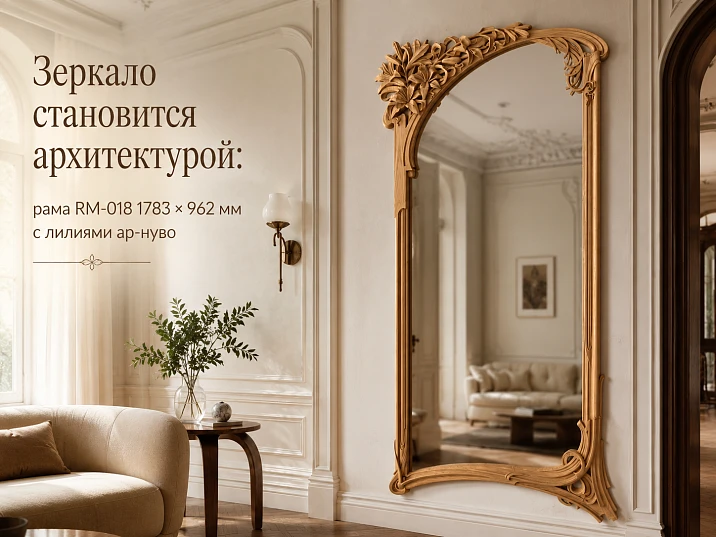
Buy RM-018 frame in beech or oak it's worth it when the mirror should become not a small accessory above a chest of drawers, but a large architectural center of the room: vertical dimensions 1783 × 962 mm, deep carved profile and art nouveau lilies form an independent composition. Such an item helps to gather a bedroom, boudoir, dressing room, living room, or hall around one expressive axis, but requires precise checking of the wall, mirror panel, finish, mounting, and delivery route before placing an order.
RM-018 cannot be judged only by the photo in the product card. On screen, it's hard to feel the height of almost 1.8 m, width of almost 1 m, and the impact of the floral ornament on neighboring furniture. After installation, the frame occupies a significant part of the wall, reflects the window, lights, and passages, and enters into a dialogue with doors, moldings, and textiles. A scale error here is more costly than when buying a neutral molding: an unsuccessful location cannot be fixed by simply shifting it a few centimeters.
Before ordering, it's useful to transfer the outer contour of 1783 × 962 mm onto the wall with painter's tape, check the top and bottom points, place a real console or chest of drawers next to it, open the door, assess the light, and only then choose beech or oak, Standard or Prestige, the finish system, and installation method. Separately, you need to request a drawing of the mounting contour: the outer size of the wooden frame does not equal the size of the mirror panel.
Why RM-018 turns a mirror into an architectural object
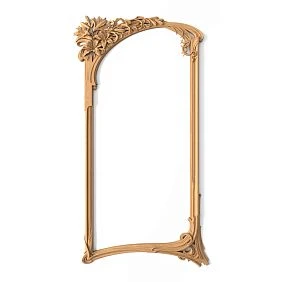
An ordinary thin frame emphasizes the mirror's edge and tries not to compete with the interior. RM-018 works differently. Carved lilies, smooth stems, and a floral pattern form a vertical decorative field that is perceived even before the reflection. Therefore, the mirror becomes not like a functional panel, but part of the interior architecture—an expressive portal around which furniture, light, and free space are arranged.
The height of 1783 mm enhances this effect. Even if the mirror panel turns out to be smaller than the outer dimension, the overall silhouette remains almost full-length. The frame can set the central axis of the wall, support the symmetry of two sconces, or connect a console with the upper part of the composition. For the solution to look cohesive, neighboring items should not accidentally overlap the carving or compete with it in scale.
Before purchasing, it's useful to understand how the profile of a wooden frame changes the interiorFor RM-018, this question is especially important: the profile depth of 52 mm and the complex contour create a noticeable chiaroscuro, so the same finish will look different under frontal and side lighting.




Confirmed specifications of RM-018
| Parameter | Confirmed value | What to check before ordering |
|---|---|---|
| Model | RM-018 | Verify the article number in the request and drawing |
| External size | 1783 × 962 mm | Transfer the contour to the wall at a 1:1 scale |
| Profile depth | 52 мм | Account for the protrusion relative to the wall and adjacent objects |
| Additional drawing parameters | 58 and 39 mm | Do not assign meaning to them independently; verify the designations on the current drawing |
| Material | Beech or oak | Match the wood species with the future finish and furniture |
| Surface preparation | Standard or Prestige | Choose considering transparent or opaque coating |
| Ornament | Carved lilies and plant lines | Check combination with other patterns in the room |
| Stylistics | Art Nouveau, Modern | Coordinate with furniture, lighting and wall decor |
| Manufacturing | Custom Order | Clarify current deadline, price and terms in the product card or with the manager |
| Mirror panel and completeness | Require confirmation for a specific order | Request drawing, mounting outline and kit composition before ordering glass |
Dimensions 1783 × 962 × 52 × 58 × 39 mm should be perceived as a set of confirmed model parameters, but you should not independently assign purpose to the last two values without an actual drawing. For the buyer, three different contours are critical: the outer frame dimension, the mirror seat, and the position of fasteners. They solve different tasks and do not replace each other.
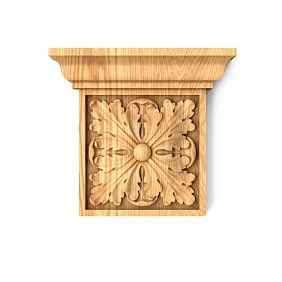
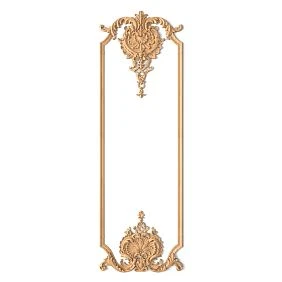
Our factory also produces:
RM-018 cannot be purchased as a small mirror over a random dresser
A common mistake is to see a beautiful carved fragment, choose an empty wall section, and only after delivery notice that the frame is wider than the furniture, almost touches the ceiling, or blocks the door opening. The height of 1783 mm requires determining the lower mark in advance. If the frame is installed above a console, the top may rise too high; if it is lowered closer to the floor, you need to check the baseboard, outlets, and passage.
The width of 962 mm also changes the composition. Over a narrow cabinet, the frame may look randomly overhanging, and next to a wide dresser, it may lose centering. The correct furniture is selected not by the principle of "approximately the same width," but by the overall axis, offsets, tabletop height, and how much free wall remains on the sides.
The floral ornament enhances the visual mass. Even if the outer rectangle fits, the lilies may end up too close to a sconce, door casing, or adjacent molding. Therefore, the tape outline is supplemented with paper silhouettes of protruding decorative areas.
Get Consultation
How to read the size 1783 × 962 mm
1783 × 962 mm is the external dimension of the wooden frame. It is needed for wall planning, delivery route, packaging, and overall scale. This size cannot be used as a custom size for the mirror panel: the mirror is installed in a separate mounting contour inside the profile.
For the wall, it is useful to mark not only the rectangle but also the axis. The vertical axis shows whether the center of the frame aligns with the center of the console, bed, wall section, or group of lights. Horizontal marks fix the lower boundary, eye level, and top point. This immediately reveals whether the ornament goes too close to the ceiling and whether a comfortable reflection zone remains.
If you need general guidelines before trying a specific model, you can study general rules for choosing a mirror frame size. But the final decision on RM-018 is made only after a full-size outline in the specific room.
Depth 52 mm: why flat marking is not enough
The tape on the wall shows height and width, but does not convey the profile protrusion. The depth of 52 mm creates a shadow, changes the side view, and affects adjacent elements. A frame next to a door casing may protrude more than expected; a sconce installed close will start illuminating the carving at a sharp angle; a curtain may catch the decorative edge.
For a volumetric check, a short cardboard mockup with a depth of 52 mm is made and applied at several points: near the top ornament, on the sides, and near the bottom. This test is especially useful in a narrow passage, near a cabinet, and next to a hinged door.
Depth must be considered both during cleaning and installation. Leave access for a hand and tool between the frame and adjacent furniture, and design the mounting so that the object does not accidentally rest on a protruding baseboard or decorative panel.
Art Nouveau lilies: what defines the ornament
The lily is one of the characteristic plant motifs of Art Nouveau. In RM-018, it does not look like a separate overlay: the flowers and stems are integrated into the overall plasticity of the frame. The line grows, bends, and directs the gaze upward, so the verticality is perceived more strongly than with a regular rectangular border.
Art Nouveau values natural rhythm, smooth transitions, and asymmetrical living movement. This distinguishes the model from a heavy Baroque frame with many curls and from a strict classical frame with a repeating geometric pattern. To understand how Art Nouveau differs from Baroque, Rococo, and Empire style, it is useful before choosing adjacent decor.
In a room with RM-018, there is no need to literally repeat lilies on every object. It is enough to support the smooth line of the form, the wood shade, the soft pattern of the textile, or the metal of the lamps. An excessive number of different colors and plant ornaments makes the composition fragmented.
Full-size mock-up on the wall
- Determine the intended axis of the frame.
- Mark the outer contour 1783 × 962 mm with painter's tape.
- Fix the bottom and top points.
- Add paper silhouettes of the most protruding carved areas.
- Place nearby furniture that will be in the finished interior.
- Open doors, cabinet doors, and curtains.
- Check the reflection of the window, passage, and lights.
- Evaluate the contour from the entrance, from the center of the room, and from the main point of use.
- Take photos during the day and under artificial lighting.
- Only after approving the location, proceed to the mirror and mounting.
The fitting answers not only the question "does the frame fit." It shows whether the item becomes part of the architecture or looks randomly attached to the wall. In a photo, the outline may appear large, but in a room with a tall door and wide furniture, it will turn out proportional. In another room, the same size will cover too much of the wall space.
Which viewpoints to check
| Point | What to evaluate | Typical mistake |
|---|---|---|
| Room entrance | Centering and first visual accent | The frame appears shifted relative to the wall |
| Center of the room | Overall scale and combination with furniture | The ornament overloads the composition |
| In front of the mirror | Reflection height and ease of use | The usable area is positioned too high or too low |
| Side passage | Depth of 52 mm and safety | The carved edge protrudes into the path of movement |
| Next to the window | Reflection of light and the street | An unwanted bright area falls into the mirror |
| In the evening light | Shadows on the carving and highlights | The lamp either blinds or hides the ornament |
Bedroom: a large mirror without a salon feel
In the bedroom, RM-018 can become a vertical center of the wall next to a dresser, vanity table, or dressing area. To prevent the piece from looking overly formal, the background is kept calm, and furniture is chosen with smooth lines and moderate decor. What matters is not a literal stylistic copy of lilies, but the overall feeling of gentle movement.
Placement opposite a window provides plenty of daylight, but simultaneously reflects the bed, doorway, or a bright area of the street. The full-size outline is supplemented with a photo from the intended viewpoint. It is useful to check the reflection at different times of the day, because morning light and evening illumination create different highlights on the mirror and carving.
If the mirror is placed near the bed, consider the walkway and night lighting. Wall sconces should not shine directly into the eyes through the reflection. The carved profile should not be positioned in an area where it is regularly brushed by textiles, cabinet doors, or dresser handles.
Boudoir and dressing room: an almost full-length piece
The height of 1783 mm allows RM-018 to be used as a large vertical mirror, but the actual reflection area depends on the inner panel and installation height. Calling the model a full-length mirror without a drawing and fitting is not possible. For the buyer, what matters is not the external size, but the position of the mirror contour relative to the floor and eye level.
In the dressing room, the frame can stand next to a bench or console, but cabinets should not overlap the side ornament. Check the opening of all doors and drawers. If the space is narrow, the depth of 52 mm becomes more important than the external width, since the profile protrudes into the walkway.
In the boudoir, more decorative finishes are acceptable: light enamel, patina, emphasis on carving, or wood tinting. The specific coating system is agreed upon based on the selected wood species and a test sample, not from a photo of a finished interior.
Living room and hall: vertical axis of the wall
In the living room RM-018 works well on a free wall where there is enough air around it. Above a wide console, the frame unites the furniture and the upper part of the wall. In a symmetrical composition, sconces can be placed on the sides, but the distance to the carving is determined from a real mockup.
In the hall, a mirror helps expand the sense of space, but it reflects the front door, stairs, and passages. You need to choose in advance which reflection a person will see first. A beautiful ornament does not compensate for an unfortunate view in the mirror, so the viewpoint is checked before ordering.
For the public zone, the reliability of fastening and protection against tipping are especially important. The mass of the finished structure is not confirmed in the initial data, so the fasteners are selected after obtaining the actual parameters of the frame, mirror, and backing.
Above the console: how to connect two objects
The console and frame must share a common axis. If the furniture is significantly narrower, there should be sufficient clearance on the sides so the frame does not appear to be randomly overhanging. If the console is wider, its edges should not conflict with the side lilies. A good composition is built on the ratio of widths, not on mandatory full alignment.
The height of the tabletop determines the lower mark of the frame. A visual gap is left between the objects, but a universal distance is not assigned: it depends on the ornament, decor on the console, and wall height. A full-size outline allows you to place real vases, lamps, or other items and check if they block the mirror.
It is better to leave one or two calm objects on the console. Many small decorative items next to carved lilies create noise and complicate maintenance. If table lamps are needed, their height and reflection are also checked in the mockup.
Next to the door and cabinet
Open the door to its full angle and mark the handle's trajectory. Even if the panel does not touch the frame, a person may hit the protruding profile when passing through. For a built-in wardrobe, check not only the door but also the drawers, lighting, and top cornice.
If the wardrobe is almost up to the ceiling, RM-018 should either support its verticality or deliberately differ. A random difference of a few centimeters between the top marks often looks like an installation error. It is useful to photograph the contour tape together with the wardrobe from a distance, rather than evaluating them separately.
The plant ornament should not be squeezed between the trim and the furniture. A free strip of wall on the sides is needed for reading the silhouette and for safe access during installation.
Beech or oak for RM-018
| Criterion | Beech | Oak |
|---|---|---|
| Visual character | Smoother and calmer structure | Pronounced texture and natural pattern |
| Opaque finish | Suitable for white or colored enamel after agreed preparation | Possible, but hides a significant part of the textural advantage |
| Transparent finish | Provides a restrained wood background | Emphasizes pores and pattern |
| Staining | Requires a test sample for an even result | Allows active work with the texture |
| Combination with furniture | Convenient next to painted furniture and beech | Logical next to oak furniture and oak veneer |
| The main question | Is a smooth surface and emphasis on carving needed | Should the wood become part of the image |
The choice of wood species cannot be reduced to saying one is better than another. Beech is suitable when the shape of the lilies, the color of the enamel, and the soft patina are more important. Oak is chosen when the texture should participate in the composition and echo the furniture or doors.
After selection, you can choose execution RM-018 and clarify the available parameters of the specific order. It is important that the wood species is agreed upon before the color and finishing technology are approved.
Standard or Prestige
Standard and Prestige are surface preparation quality options. They cannot be described as "bad" and "good." The choice depends on the future coating, requirements for fine carving, and how closely the viewer examines the frame.
For dense opaque enamel, some wood features are hidden, but the base quality still affects the evenness of highlights and the readability of the ornament. For clear varnish, oil, or tinting, the preparation is especially noticeable because the surface is not covered by color.
Prestige makes sense to discuss for complex finishing and interiors where carving is viewed up close. Standard may be rational for a project with its own technological preparation. The exact choice is coordinated with the finisher and manager before production.
White enamel, color, patina, or visible wood
White enamel emphasizes the silhouette and makes lilies more graphic. On a light wall, the frame may be perceived as part of the architecture; on a colored wall, as an independent object. Beech is often considered for this solution, but the final finishing system must be compatible with the material.
Colored enamel connects the frame with furniture or wall panels. A deep shade enhances shadows in the carving, while a light shade makes the object lighter. Choosing a color from a small fan is not enough: a test sample on a profile with similar depth and relief is needed.
Patina accentuates recesses but can overload the plant pattern. It is applied after a test sample. Transparent oak finish reveals the texture and makes the frame warmer; tinting is compared with furniture under the same lighting.
Why a test sample is mandatory
RM-018 has deep relief, so color on a flat board does not show the result. Highlights appear on convex areas, shadows in recesses, and patina or semi-transparent tinting changes contrast. Even the same color code looks different on a smooth wall and carved wood.
The test sample must consider the wood species, preparation quality, and planned finish. It is viewed next to the wall, textiles, furniture, and lamp metal. Daylight and evening light can give different shades, so the sample is not approved in a single random lighting.
The approved sample is fixed with a photo and system description. This helps avoid a situation where the designer, finisher, and client mean different results when referring to "light oak."
How to order a mirror according to drawing RM-018
The mirror panel cannot be ordered by the external dimension of 1783 × 962 mm. First, you need to obtain the current drawing or DWG, determine the seating contour, panel thickness, edge processing, and interaction with the backing.
In the general materials of the STAVROS frame category, a 5 mm thick mirror, 6 mm MDF backing, hinges, and a DWG template are mentioned, but the configuration of a specific RM-018 order must be confirmed separately. The category description cannot be automatically applied to each model.
Before transferring data to the glass workshop, it is useful to study what is included in the design of a wooden mirror frame, and then request specifically the RM-018 documentation.
Why the external dimension does not equal the mirror panel
The wooden profile covers part of the mirror edge and forms the seating area. If the glass is ordered by the external size, it will not fit into the frame. Even subtracting the conditional profile width on each side does not provide a reliable result: the internal contour may have a complex shape, and the dimensions of 58 and 39 mm cannot be interpreted without markings.
The mirror manufacturer must work from the approved file, not from a photo or a manager's retelling. The drawing version is fixed in the order. After receiving the frame, it is advisable to re-check the fit before final assembly, if this is provided for by the project process.
What to coordinate with the glass workshop
- actual mounting outline;
- mirror sheet thickness;
- mirror type and acceptable options;
- edge processing;
- technological gaps;
- face side orientation;
- top and bottom marking;
- compatibility with the substrate;
- fitting and final assembly procedure;
- packaging and transportation of the canvas.
A lightened, regular, or other mirror is selected according to the project and confirmed feasibility. The article does not specify a particular type as mandatory for RM-018.
Wall mounting: first the base, then the fasteners
A large wooden frame with a mirror cannot be mounted using a universal scheme. The wall material, presence of cladding, hidden wiring, actual weight, position of standard hinges, and type of anchors must be known to the installer.
A wall made of concrete, solid brick, hollow block, or a framed partition requires different solutions. Even a strong base may have weak decorative cladding. The fastening must transfer the load to the load-bearing part, not just to the plaster or panel.
The actual weight of the finished structure must be requested or determined before installation. It is not specified in the initial data, so any numerical recommendations for anchors would be fabricated.
Position of hinges and marking
Before drilling, check the position of the fastening elements on the specific frame. Do not transfer dimensions from a general diagram of another model. Mark the top and bottom, and reapply the outline to the wall.
Marking is checked by level and diagonals. For a large item, a small error is noticeable relative to doorways, the console, and the ceiling. If the wall is uneven, the installer decides how to ensure stable contact without twisting the frame.
Can RM-018 be placed on the floor
Visually, a nearly full-height frame can look beautiful when resting on the floor, but the initial data does not confirm that the model is designed for free-standing floor installation. Even if the bottom touches the floor, the structure must be protected from tipping over.
The solution is coordinated with the installer: they check the baseboard, stability, center of gravity position, possibility of hidden fixation, and protection of the carved edge. You cannot simply lean the frame against the wall based on an interior photo.
Delivery route
The external size of 1783 × 962 mm must be compared with doorways, staircases, elevators, corridor turns, and the area in front of the installation site. Packaging is considered separately: it increases dimensions and may affect the ability to safely turn in a tight space.
They check not only the door width but also the ability to turn the frame. A narrow passage after a turn can become an obstacle, even if individual openings are wide enough. If the mirror is transported separately, a separate route is planned for it, and a safe temporary storage location is ensured.
The delivery and packaging method is clarified before ordering. A specific option cannot be promised without confirming the card and logistics. For a large item, this issue is part of the purchasing decision, on par with material and finish.
Lighting and sconces
Two sconces on the sides support vertical symmetry but should not overlap the lilies. Paper mockups of the lights are placed along with the frame outline. The height, shade direction, and reflection of the source in the mirror are checked.
Top directional lighting emphasizes the carving but can create a heavy shadow under the ornament. Soft side lighting reveals the volume more gently. A light fixture in front of the user's eyes through reflection reduces comfort, even if it beautifully illuminates the wood.
Electrical outlets are planned before the final wall finish. Concealed wiring is considered when drilling for fasteners. If the lights are already installed, their position becomes part of the full-size fitting.
What to pair with Art Nouveau lilies
| Element | A successful combination | What to avoid |
|---|---|---|
| Furniture | Smooth lines, moderate botanical decor | Several competing carved styles |
| Handles | Calm brass, bronze, or wood as per design | Oversized geometric hardware next to lilies |
| Wall moldings | A minimalist profile that supports the axis | Intricate ornamentation close to the frame |
| Textiles | Soft botanical pattern or solid fabric | Many small contrasting colors |
| Lamps | Smooth shape and coordinated metal | Sources overlapping the thread |
| Console | Proportional width and common axis | Randomly narrow cabinet without compositional connection |
Supporting the style does not mean literally repeating lilies. It is much more important to connect the character of lines, wood tone, metal, and light. Then the frame remains the main motif, and other objects help it unfold.
How not to confuse Art Nouveau with heavy classicism
RM-018 is decorative, but its plasticity is built on a growing natural line, not on the dense symmetry of the classical order. In the Baroque environment, there are many curls, cartouches, and rich gilding; in Empire, strict axes and symbolic motifs are important; Art Nouveau strives for fluidity and living asymmetry.
This does not mean that the frame can only be used in a historically accurate interior. It suits a modern interpretation of Art Nouveau, eclecticism, and soft classicism, if there is enough calm background around and not too much competing decor.
What to buy together and what to prepare
| Position | What it's for | What to confirm | Route |
|---|---|---|---|
| Frame RM-018 | Forms the architectural center of the composition | Beech or oak, Standard or Prestige, current price and lead time | View dimensions and price of RM-018 |
| Mirror panel | Provides the functional part | Contour, thickness, edge, and compatibility per drawing | Order based on confirmed DWG |
| Underlayment and accessories | Participate in assembly | Composition of the specific order kit | Check with the manager |
| Fastening | Transfers load to the wall | Wall material and actual weight | Selected by the installer |
| Finishing materials | Form color and protection | Compatibility with beech or oak | According to the approved color sample |
| Different frame size | Needed if RM-018 does not fit | Dimension, style and profile | Catalog of wooden mirror frames |
When RM-018 is suitable
- there is a free vertical wall wider than the external dimension;
- the mirror should become the main decorative object;
- the interior supports Art Nouveau, modern or soft eclecticism;
- a nearly full-length vertical composition is needed;
- there is an option to order a mirror by drawing;
- the wall allows for professional mounting;
- the delivery route has been checked in advance;
- finishing approved on the sample.
This model is especially appropriate where the client is ready to allocate a full wall to it, rather than looking for leftover space between a cabinet and a door. The strong frame requires a deliberate setting.
When it's better to choose a different frame
RM-018 is not suitable for a small wall, a narrow passage, a minimalist interior without support from decorative molding, or an area where the carving will be regularly bumped. A location with a low ceiling is also questionable if the upper ornament feels visually cramped.
If the project needs a neutral thin border, the active lilies will be superfluous. In this case, it is more reasonable to choose a frame of a different size and a calmer profile.
A room with direct constant water exposure requires separately approved protection, materials, and installation. Without confirmation, the suitability of RM-018 for such an area cannot be promised.
Mistakes when ordering RM-018
Estimating size from a photo
The card does not convey the height of 1783 mm and depth of 52 mm. A 1:1 outline is mandatory because the large frame interacts with the entire wall.
Order mirror by external dimension
1783 × 962 mm — frame size, not glass. Installation drawing required.
Do not check reflection
After installation, a door, bright light, or unwanted area may appear in the mirror. Fixing this without moving the frame is difficult.
Choose wood type only by name
Beech and oak give different finish character. A test sample on the selected material is needed.
Consider Standard as low quality
This is a preparation option evaluated relative to the future finish and project requirements.
Plan for free-standing installation on the floor without fixation
Large structures must be protected from tipping, even if they visually rest on the floor.
Purchase fasteners only after checking the wall and weight
Anchors are selected based on actual conditions, not the general product name.
Do not check the delivery route
The overall frame can fit through the door, but cannot turn around in the corridor or on the landing.
Overload the wall with other ornaments
Lilies need a calm background and free space, otherwise the carving loses expressiveness.
Do not specify completeness
The mirror, backing, hinges, and drawing need to be confirmed for the specific order.
Checklist before ordering
| Check | The result that needs to be recorded |
|---|---|
| Article number | RM-018 |
| External dimension | 1783 × 962 mm transferred to the wall |
| Depth | 52 mm verified with a 3D mockup |
| Material | Beech or oak |
| Preparation | Standard or Prestige |
| Finishing | Trial paint approved |
| Mirror | Installation drawing received and outline confirmed |
| Package contents | Mirror, backing, hinges, and documentation clarified in writing |
| Wall | Material and mounting scheme determined |
| Mass | Actual value of finished structure received |
| Route | Doors, stairs, elevator, and turns checked |
| Commercial terms | Current price, deadline, packaging, and delivery clarified |
What to pass to the designer, glazier, and installer
| Participant | What they receive | What it is responsible for |
|---|---|---|
| Designer | External contour, fitting photo, selected finish | Placement, scale, lighting, and interior compatibility |
| Glass workshop | Current DWG, thickness, and edge requirements | Fabrication of the panel according to the seating contour |
| Finisher | Wood species, preparation quality, and approved sample | Compatible finish system |
| Installer | Frame, hinge layout, wall data, and actual weight | Fasteners, marking, lifting and safety |
| Customer | Specification and commercial terms | Approval of material, finish, set and location |
Frame acceptance before finishing and installation
First, the model, external dimensions, material and preparation option are checked. The frame is inspected under side lighting, checking carved lilies, edges and the absence of visible damage. Oak and beech sections are compared for tone and texture.
Then the drawing, top and bottom orientation, seating area and position of fastening elements are checked. Any discrepancies are recorded before mirror installation and coating application.
Actual quality criteria for a specific execution are clarified in the order documents. The article does not establish its own tolerances.
Acceptance after finishing
The coating is evaluated under daylight and artificial light. There should be no accidental unpainted areas, excessive filling of recesses, or differences not specified by the sample on the carving. Transparent finish must preserve the agreed character of the wood.
Before installation, it is checked that the coating does not interfere with mirror seating and the operation of fastening elements. If the frame and glass are assembled by different contractors, the sequence of operations is agreed upon in advance.
How to choose a wall for RM-018
The suitable wall must be not just wider than 962 mm. The sides of the frame need a background where the silhouette of the lilies is readable. If the carving almost touches a corner, trim, or cabinet, the outer contour loses smoothness and looks cramped. Therefore, the layout marks not only the frame but also the free margins around it.
The second check is the functionality of the wall. Outlets, switches, ventilation grilles, and light outputs should not end up behind the profile or in close proximity to the carving. Relocating engineering points must be coordinated before finishing the room.
The third check is the load-bearing capacity of the base. A beautiful partition wall may be made of a lightweight partition where embedded elements need to be provided in advance. The decision is made before ordering, not on the day of installation.
Height of the lower point
The lower mark determines which part of the figure the mirror will reflect and how the frame relates to the furniture. When installed above a console, the lower part is raised higher than when placed almost on the floor. One universal distance is impossible here: the inner contour of the mirror needs to be seen on the drawing.
It is useful to mark three levels on the wall: the floor, the intended bottom of the frame, and the lower edge of the mirror panel. Then a person of different height stands in front of the layout and evaluates the reflection. Such a test shows more than a verbal description of "almost full-length."
Upper point and ceiling
The top of RM-018 should not accidentally hit a ceiling cornice, ventilation grille, or decorative band. If the gap between the lilies and the ceiling is too narrow, the item looks cramped. Too large an empty area, on the contrary, may weaken the vertical connection.
If there is ceiling decor, its rhythm is compared with the frame. A simple line can support Art Nouveau, while a rich classical cornice may start to conflict with the floral ornament. A full-size photograph helps to see this conflict before purchase.
Window reflection
A mirror opposite the window increases the amount of light and visually expands the room. But it also reflects frames, curtains, the neighboring house, and the bright sky. If the window is not aligned on axis, the reflection can make the composition restless.
Before approving the location, photograph the wall from the future user's point of view in the morning, afternoon, and evening. The sun's position changes, so a beautiful daytime reflection can sometimes turn into a blinding glare. The light transmittance of the curtains and their movement are also taken into account.
Reflection of a door and passage
A mirror often doubles a doorway, creating the feeling of an additional passage. In a hallway this can be useful, but in a bedroom it can be distracting. It is especially important to check whether an open wardrobe, utility area, or bathroom entrance is reflected.
The position of the frame can be adjusted along the axis or height, but only while the fasteners are not installed. Therefore, the reflection is evaluated simultaneously with the outline, not after choosing the finish.
RM-018 and wall moldings
If there is already a frame layout on the wall, RM-018 should occupy a separate field or be integrated
RM-018 and wooden panels
On a wooden panel, an oak frame can blend into the background or, conversely, be emphasized by contrasting tinting. The same species name does not guarantee a shade match: veneer, solid wood, grain direction, and finish yield different results.
Before ordering, compare actual samples. If the frame should stand out, make the difference intentional — by tone, gloss, or wood species. An accidental near-match often looks worse than an obvious contrast.
Commercial interior: salon, boutique, hotel
In a beauty salon, boutique, or hotel lobby, RM-018 can become a photogenic centerpiece and support a memorable space image. But commercial use requires particularly careful checking of passages, touch frequency, cleaning, mounting, and people's reflections.
Do not place the mirror where queues or furniture constantly block the lower ornament. Choose lighting so that the reflection is comfortable for visitors and the carving retains its volume. Coordinate the protective coating and care solution with the finisher.
How not to lose lilies in dark trim
Dark color enhances architecturality, but in low light, small carved areas may blend together. Examine the test sample not only up close but also from a distance of three to five meters. Side lighting helps reveal the profile, while even front lighting makes it calmer.
Semi-gloss finish emphasizes convexities, matte reduces glare. It is impossible to declare one option correct in advance: the result depends on the wall color, light sources, and desired expressiveness.
How not to make a light frame look flat
White or cream enamel can unify the frame with the wall, but with the same matte finish, the relief sometimes becomes less noticeable. This is solved not by mandatory patina, but by light, gloss difference, or a slight tonal contrast.
Patination is applied only after a sample. Too dark patina around every detail turns smooth Art Nouveau into harsh graphics and can age the item more than the project requires.
Gilding and metallic accents
Gilding or a metallic effect can emphasize lilies, but such a finish is not confirmed as a ready-made standard card option. It is considered a project system that needs to be agreed upon in terms of material and technology.
Partial highlighting of the relief looks calmer than a full glossy coating. If the room has brass sconces and handles, metal shades are compared on samples: too yellow and too cold tones nearby may conflict.
Care for a carved frame
Deep carving collects more dust than a smooth baguette. Access for care is considered already during placement: the frame is not squeezed between a cabinet and a wall. The cleaning method depends on the finish coating and must be agreed upon with the finisher.
Do not use any random aggressive compound or excessive moisture. First, determine the type of coating, then choose a gentle care method. Special attention is paid to the upper lilies and recesses, which are rarely visible from below but are noticeable in side light.
Order scheme in one document
| Specification section | What to record |
|---|---|
| Product | Frame RM-018 |
| Dimension | 1783 × 962 mm, depth 52 mm |
| Material | Beech or oak |
| Preparation | Standard or Prestige |
| Finishing | Description and code of the approved sample |
| Mirror | DWG version, thickness, and edge treatment |
| Package contents | Confirmed list of elements |
| Installation | Wall type, fastener position, installer |
| Logistics | Address, delivery route, opening restrictions |
| Commercial terms | Current price, lead time, packaging, and delivery |
A single document reduces the risk that the designer approved beech, the finisher waits for oak, and the glazier received an old version of the drawing. The specification version and approval date are fixed before the order is launched.
How to check the drawing before transfer
The drawing must clearly show the outer contour, the mirror seating area, the top and bottom of the product, control dimensions, and designations of additional parameters. If letters or dimensions are not explained, they should be clarified with the manufacturer, not interpreted independently.
The file is saved without unauthorized scaling. When printing, the control dimension is checked with a ruler to ensure the paper template is not reduced. The original digital file and accompanying specification are transferred to the glass workshop.
Checking the mirror before final assembly
After manufacturing the panel, the orientation, edge, and fit to the mounting contour are checked. The fitting is carried out in safe conditions without damaging the frame finish. If the project includes a backing, its thickness and position are considered simultaneously.
A minor discrepancy cannot be corrected by forced pressing or random trimming of the wooden frame without approval. The cause is determined based on the drawing and actual dimensions.
Checking the finished composition before drilling
Immediately before installation, the contour is marked again on the wall. By this time, furniture, lighting, and finishes may have changed. A re-check prevents installation based on outdated visualization.
The installer shows the client the lower and upper marks, the axis, and the position of the mounting points. After written or explicit approval, drilling proceeds. This procedure is especially useful for large and prominent frames.
Safe lifting
The number of people and lifting equipment is determined by the installer after obtaining the actual weight and route conditions. A large frame must not be lifted by protruding elements or have its carving rested on a hard floor.
The installation area is cleared of furniture, finishes are protected, and temporary soft supports are prepared. If the mirror is installed separately, the lifting order of the frame and panel is coordinated in advance.
Photo protocol for complex projects
For expensive finishes and multiple contractors, it is useful to photograph stages: full-size marking, approved color sample, drawing marking, frame acceptance, trial mirror fitting, and finished mounting. Photos do not replace documents but help reconstruct the sequence of decisions.
Photos are signed with the date and specification version number. This eliminates disputes about which shade or position was approved.
How to order RM-018 on STAVROS
The customer journey begins not with choosing a color, but with checking the space. Transfer the dimensions 1783 × 962 mm to the wall, assess the depth of 52 mm, and ensure the frame fits the delivery route. Then choose beech or oak and the surface preparation level.
In the card, you can View dimensions and price of RM-018Current cost, production time, delivery, and configuration may change, so they are fixed when placing the order.
Before manufacturing the mirror panel, request a drawing and confirm the kit composition. Coordinate the mounting with the installer after receiving data on the wall and the weight of the finished structure.
Proportion control relative to a person
It is useful to evaluate a large frame not only next to furniture but also next to a person. Ask one of the future users to stand in front of the outline, then photograph the scene from a distance. This makes it clearer how high the top line is, where the mirror begins, and whether the lower part seems too heavy.
For a family with different heights, several positions are checked. If the mirror is to be used both for the face and for evaluating clothing, it is important to see the actual reflective area. The external height alone does not guarantee this.
Axis control relative to the bed or passage
In the bedroom, the frame is often attempted to be placed in the center of a free wall section, but the visual center of the room may pass through the bed, rug, or a group of lights. These axes are compared on the plan. A slight offset is acceptable if it is explained by furniture, but a random shift becomes noticeable from the entrance.
In the hallway, the axis is checked relative to the main direction of movement. The mirror should not force a person to sharply deviate to the side or create a feeling of an obstacle in a narrow passage.
How to check the thread scale without a ready-made frame
One rectangle from the tape is not enough to evaluate the lilies. From a printout or photo of the drawing, you can prepare large paper silhouettes of the top and side elements, maintaining the scale. They will not convey depth, but will show how much wall space the ornament occupies.
If an exact outline is not available, you should not draw arbitrary flowers. It is better to limit yourself to the external dimensions and request an up-to-date drawing from the manufacturer. A fictional silhouette creates false confidence.
Coordination with ceiling and floor decor
The lower part of the frame may end up next to a high baseboard, and the upper part next to a ceiling cornice. These elements affect the vertical gap and overall saturation. If both profiles are complex, RM-018 may lose its independence.
On the mockup, the height of the baseboard and the lower line of the cornice are marked. If the frame should visually connect them, the distances are made deliberate. If it exists separately, a calm background is left around it.
Coordination with door casings
The casing next to RM-018 should not accidentally repeat the width of the profile. Almost identical but differing lines create a feeling of error. It is better to either clearly separate the elements with a free wall, or connect them with color and overall style.
The top marks are compared especially carefully. A lily located slightly above the casing may look dynamic, while a coincidence along a random line is unconvincing. The solution is checked with a photo of a full-size outline.
When a designer's involvement is required
Self-fitting is sufficient for a simple bare wall. The designer is especially useful if there is built-in furniture, complex moldings, multiple light fixtures, active wallpaper, or door portals nearby. In such a composition, you need to coordinate not only the size but also the hierarchy of accents.
The designer does not replace the engineer or installer. They are responsible for placement, scale, and appearance, while the fastening and mirror require technical data.
When professional measurement is needed
Professional measurement is justified for uneven walls, complex cladding, hidden wiring, narrow delivery routes, and non-standard installation heights. The specialist records actual dimensions, not just design values.
Measurements are taken after the main surfaces are ready or taking future layers into account. The thickness of the panel, plaster, or molding can change the position of the frame relative to the wall and furniture.
What to document in the order in writing
- model RM-018;
- beech or oak;
- Standard or Prestige;
- approved finish or delivery without finish, if confirmed;
- kit composition;
- mirror drawing version;
- current price and lead time;
- packaging, delivery and acceptance conditions.
A written specification reduces the risk of discrepancies between verbal consultation, invoice and the work of multiple contractors.
How to compare RM-018 with other frames without cannibalizing the choice
The comparison should be based not on the principle of "better or worse", but on the task. RM-018 is chosen for a large vertical composition with lilies and pronounced Art Nouveau. Another model may be more suitable for a narrow wall, a neutral interior or a small mirror above furniture.
В wooden frames for mirrors and paintings you can compare dimensions, profile and decorative richness. A wide catalog does not replace a full-size check of a specific model.
Final check before payment
Before payment, open the RM-018 card again and check the article number, material, preparation option, current price and lead time. Make sure the mirror drawing refers to the selected version, and the installer has received the wall data.
The check takes less time than redoing the mirror or finding a new place for a large frame. After it, the order becomes not an emotional purchase based on a photo, but a manageable interior project.
Finished product passport
After receiving the frame, it is useful to compile a single project passport: product card, invoice, mirror drawing, finish description, acceptance photos, and mounting diagram. These materials will be useful for the installer, owner, and specialist who will later service or move the product.
The passport is especially important if the mirror is ordered separately. It shows which DWG version was used, which panel is installed, and which fixing method was chosen. Without such a history, subsequent repairs turn into a re-investigation.
Marking of packaging and parts
The packaging must clearly indicate top and bottom, the front side, and the area where the product should not be lifted. If the frame, mirror, and backing are delivered separately, they are marked as parts of one order. This reduces the risk of mixing up components on site.
When unpacking, protective elements are kept until acceptance is complete. Carved lilies are not used as handles for carrying, and the frame is not placed with its decorative edge on a hard surface.
If the project changed after ordering
Moving a socket, replacing a console, or the appearance of a new cornice can change the composition. Before installation, full-size marking is repeated and it is checked whether the chosen axis is preserved. The frame cannot be installed based on an old visualization if the actual interior is already different.
If the new location is not suitable, alternative walls are compared, and only then the mounting diagram is adjusted. Changing the mirror's position may require a new calculation of light and reflection.
Why RM-018 requires a clear background
The free space works like a pause around the intricate carving. It allows you to see the silhouette of the lilies and does not mix them with the architraves, paintings, and furniture facades. For a large frame, the empty part of the wall is not a lost space, but a necessary element of the composition.
If the wall must accommodate additional items, first determine the main accent. RM-018 can coexist with small decor, but does not have to share the center with a large painting or a second active mirror.
Why an informed order is more profitable than a random purchase
Full-size fitting, mirror drawing, and wall inspection require preparation, but prevent more costly mistakes: unsuitable canvas, inability to bring in, conflict with furniture, and incorrect fasteners. The buyer understands in advance what each contractor is responsible for.
RM-018 reveals its value precisely in a coordinated project. When the size, wood species, finish, reflection, and installation are interconnected, the large wooden frame truly turns the mirror into architecture, rather than just occupying an empty wall.
FAQ: questions about the RM-018 frame
What size does the RM-018 frame have?
The confirmed external size is 1783 × 962 mm, profile depth is 52 mm. Additionally, the specifications include parameters of 58 and 39 mm, the meaning of which should be checked against the drawing.
Is RM-018 suitable for a full-length mirror?
In terms of external height, the frame is close to a full-length format, but the usable reflection area depends on the internal canvas and installation height. A drawing and fitting are needed.
What style is RM-018 made in?
The model belongs to Art Nouveau, or Modern style, and uses floral ornament.
What is depicted in the ornament?
The carving uses lilies and smooth plant lines.
What to choose: beech or oak?
Beech is suitable for a smooth surface and covering finish, oak — when visible texture is important. The decision is confirmed by a test sample.
Can the frame be painted white?
White enamel is possible with a compatible preparation and coating system. The technology is coordinated with the finisher.
Can the oak RM-018 be tinted?
Oak is suitable for tinting, but the shade and uniformity are first checked on a sample.
How to find out the size of the mirror panel?
You need to get the current drawing or DWG of the mounting contour. The outer frame size is not used for ordering glass.
Can I order a mirror with dimensions 1783 × 962 mm?
No, that's the outer frame dimension. The panel has a separate mounting size.
Is a mirror included in the set?
The configuration of a specific order RM-018 must be confirmed in the card or with a manager. General category data cannot be automatically transferred to the model.
Is the standard mirror thickness specified?
STAVROS general materials mention a 5 mm mirror, but for RM-018 the thickness and mounting need to be confirmed separately.
How to secure a large frame to the wall?
The installer selects the fasteners based on the wall material, actual weight, hinge position, and base condition.
Can the frame be placed on the floor?
Even with visual floor support, the structure must be protected from tipping over. The feasibility of such a scenario is agreed upon with the installer.
What to choose: Standard or Prestige?
The choice depends on the future coverage and surface requirements. Standard should not be considered automatically insufficient.
Is RM-018 suitable for a bedroom?
Yes, if there is a free wall, convenient reflection, safe passage, and stylistic connection with the furniture.
Can two sconces be installed on the sides?
This scenario can be considered, but the distance, height, and reflection of sources are checked on a full-size mockup.
How is the large frame delivered?
The packaging and delivery method should be clarified when ordering. Before placing an order, check doors, elevator, staircase, and turns.
How much does RM-018 weigh?
The weight is not confirmed in the provided data. For installation, the actual value of the frame along with the mirror and backing must be obtained.
Can RM-018 be used in the bathroom?
Constant exposure to water requires specially coordinated protection, finishing, and installation. Without confirmation, such use cannot be promised.
Where to order RM-018?
The model is presented in the STAVROS card. Before ordering, check the material, preparation, mirror drawing, configuration, price, and lead time.
Conclusion
RM-018 is not a neutral frame, but a large vertical frame where the mirror becomes architecture. External dimensions 1783 × 962 mm, depth 52 mm, lilies and Art Nouveau plant motifs require a free wall, thoughtful lighting, and connection with furniture.
A conscious order consists of several decisions: full-size fitting, choice of beech or oak, Standard or Prestige, approval of finish, obtaining the mirror installation drawing, checking configuration, wall, and delivery route. It is especially important not to confuse the external frame dimension with the glass size and not to choose fasteners without the actual weight of the structure.
After checking these parameters, you can order the frame with Art Nouveau lilies at STAVROS and provide accurate data to each contractor. Then RM-018 will not be a random decorative item, but a central part of the interior, coordinated in scale, material, reflection, and installation.