


























Article Contents:
- Slat panel PAN-003 1000×11 mm: which dimensions are confirmed now
- Mirror 1200 mm and two PAN-003 on the sides: first build the entire composition
- Can PAN-003 1000 mm wide be cut exactly into two parts of 500 mm each
- Where does the 500 mm center line run
- If the cut goes through the fabric base
- If the line runs through the slat
- Option 1. Mirror symmetry
- Option 2. Keep factory outer edges
- PAN-003 from MDF for painting: how to get two side strips the same color as the walls
- Why the longitudinal cut should be done before final painting of PAN-003
- Price of slat panels: why a cheap option can become expensive after incorrect cutting
- The mirror is already ordered: why changing its size for PAN-003 is usually too late
- Bottom joint of PAN-003 with the baseboard near the console
- When one PAN-003 can really be enough
- When it's better to buy two PAN-003
- Why two PAN-003 of 500 mm each cannot be considered symmetrical just by the number of slats
- How to check symmetry on the floor before installation
- If one PAN-003 matches the pattern, but the wall is uneven: is a second panel needed
- Final purchasing specification for PAN-003 for the mirror area
- Short conclusion
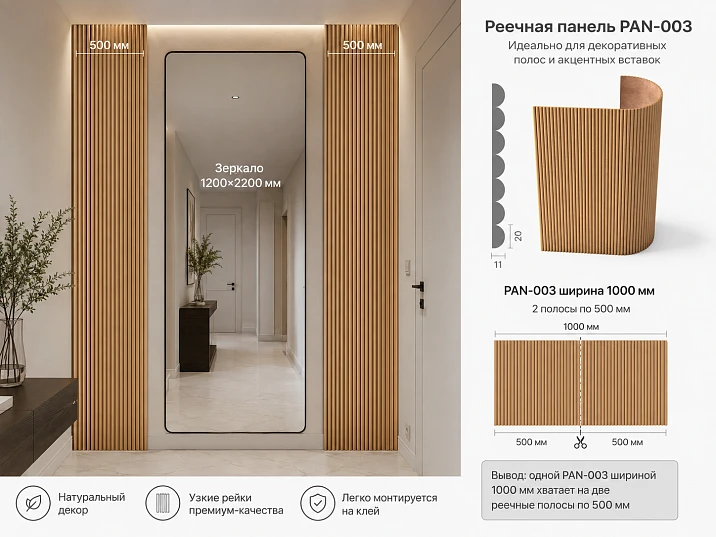
The mirror is already selected: 1200×2200 mm. According to the project, two vertical slat strips of 500×2200 mm should go to the left and right of it. PAN-003 has an actual width of 1000 mm, so the first arithmetic looks almost perfect:
500 + 500 = 1000 mm.
This gives rise to a natural buyer conclusion: why buy two full-size PAN-003 panels if one panel with a width of 1000 mm can be cut lengthwise exactly in half?
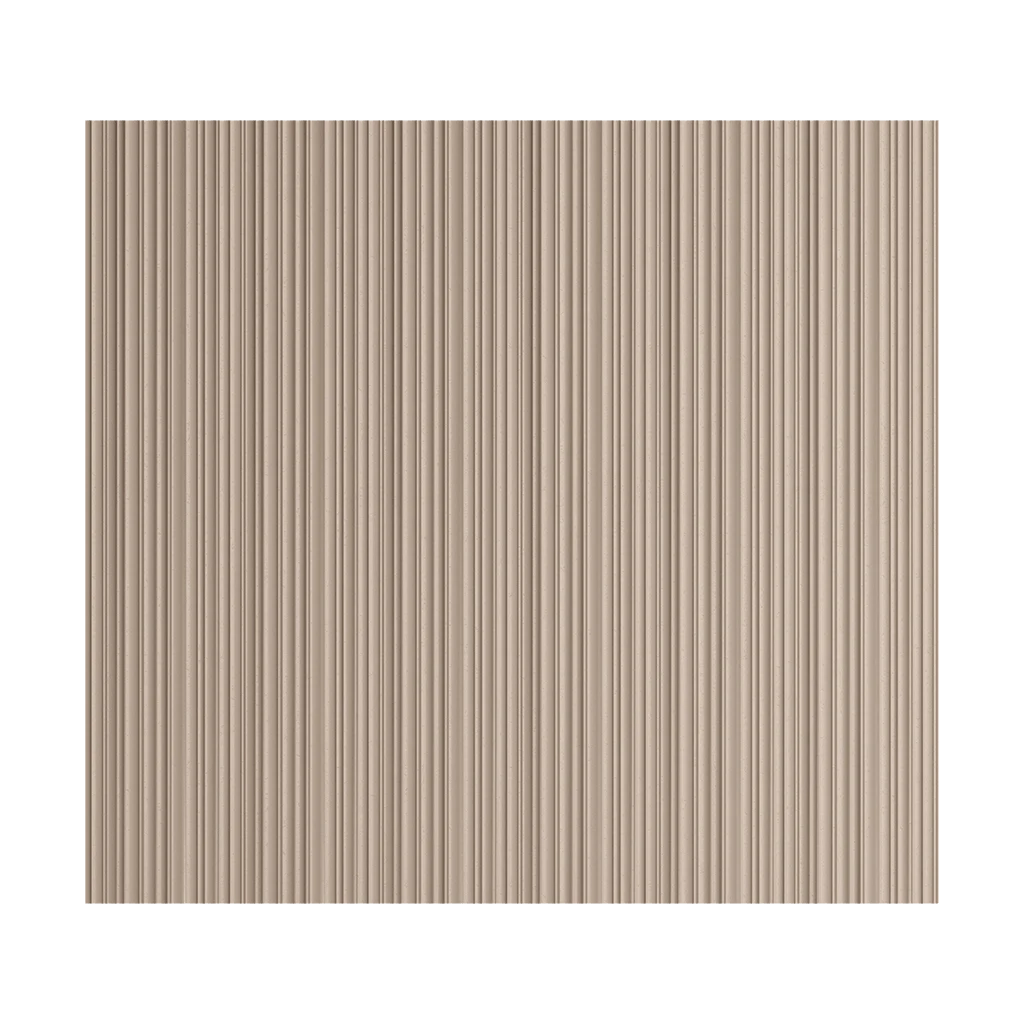
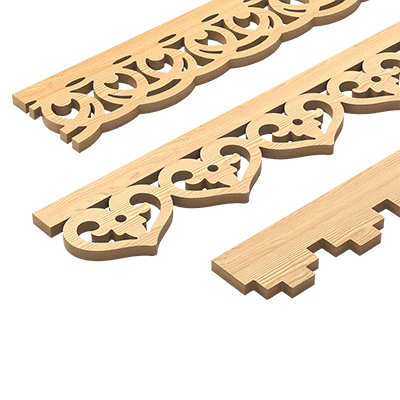
By pure width geometry, the idea is possible. But PAN-003 is not a homogeneous sheet where any cutting line is equivalent to the neighboring one. It is a slat panel on a fabric base with a repeating decorative rhythm. The central 500 mm line can pass:
-
along the gap between the battens;
-
close to the side edge of the decorative profile;
-
along the glazing bead itself;
-
at the point after which the left and right halves get different visible edges.
Therefore, the direct answer is:
one PAN‑003 with a width of 1000 mm may be enough for two strips of 500 mm each only after checking the actual pattern of the module, the position of the central longitudinal cut, and which edges of both halves will face the mirror. The formula 1000 = 500 + 500 confirms the amount of material by width, but does not guarantee a symmetrical decorative result.
For a 1200 mm mirror, symmetry is especially sensitive. The entire composition has a strict central axis:
500 + 1200 + 500 = 2200 mm.
If on the left side of the mirror a full batten starts, and on the right side there is a fabric gap or an incomplete profile, the eye notices the discrepancy immediately. The mirror itself amplifies the effect: it reflects the adjacent rhythm and makes the differences even more noticeable.
Before purchasing one panel, you need to go through a sequence:
-
confirm the current PAN‑003 with a width of 1000 mm;
-
obtain a real sample of OPAN‑003 or a full-size drawing of the rhythm;
-
draw a center line at 500 mm;
-
see exactly what it intersects;
-
determine which edge of each half will face the mirror;
-
check the symmetry of the two inner edges;
-
only after that decide — one PAN‑003 or two;
-
separately choose a length of 2670 mm for MDF or 2400 mm for beech/oak;
-
calculate the remainder for a height of 2200 mm;
-
decide on the outer ends, the bottom, and the connection with the baseboard.
If the project is still comparing different slat panels, you can buy slat panels for walls for interior finishing after checking the real profile. If the model is already approved, further calculation should be performed specifically for PAN-003.
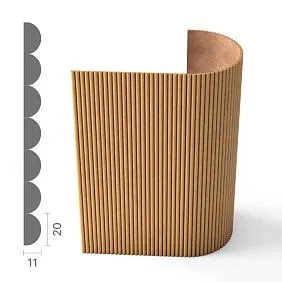
Rack panel PAN-003 1000×11 mm: which dimensions are confirmed now
The direct card of PAN-003 at the time of final check shows the following relevant for the mirror zone execution:
| Execution | Dimension A×C×L | Price at the time of check | Status at the time of check |
|---|---|---|---|
| MDF, Prestige | 1000×11×950 mm | 9,880 RUB | In stock |
| Primed MDF | 1000×11×950 mm | 15,990 RUB | Custom Order |
| Beech | 1000×11×950 mm | 18,470 RUB | In stock |
| Oak | 1000×11×950 mm | 31,080 RUB | Custom Order |
| MDF, Prestige | 1000×11×2670 mm | 26,410 RUB | In stock |
| Primed MDF | 1000×11×2670 mm | 1000×11×2400 mm | Custom Order |
| Beech | 42,010 RUB | 71,680 RUB | Custom Order |
| Oak | 42,010 RUB | Prices, availability, and delivery times change; they must be re-checked before payment. | Custom Order |
The card additionally shows a short MDF PAN‑003 1000×8×740 mm. This is a different depth option, so for the article about two strips 2200 mm high, it is not included in the main comparison of PAN‑003 11 mm.
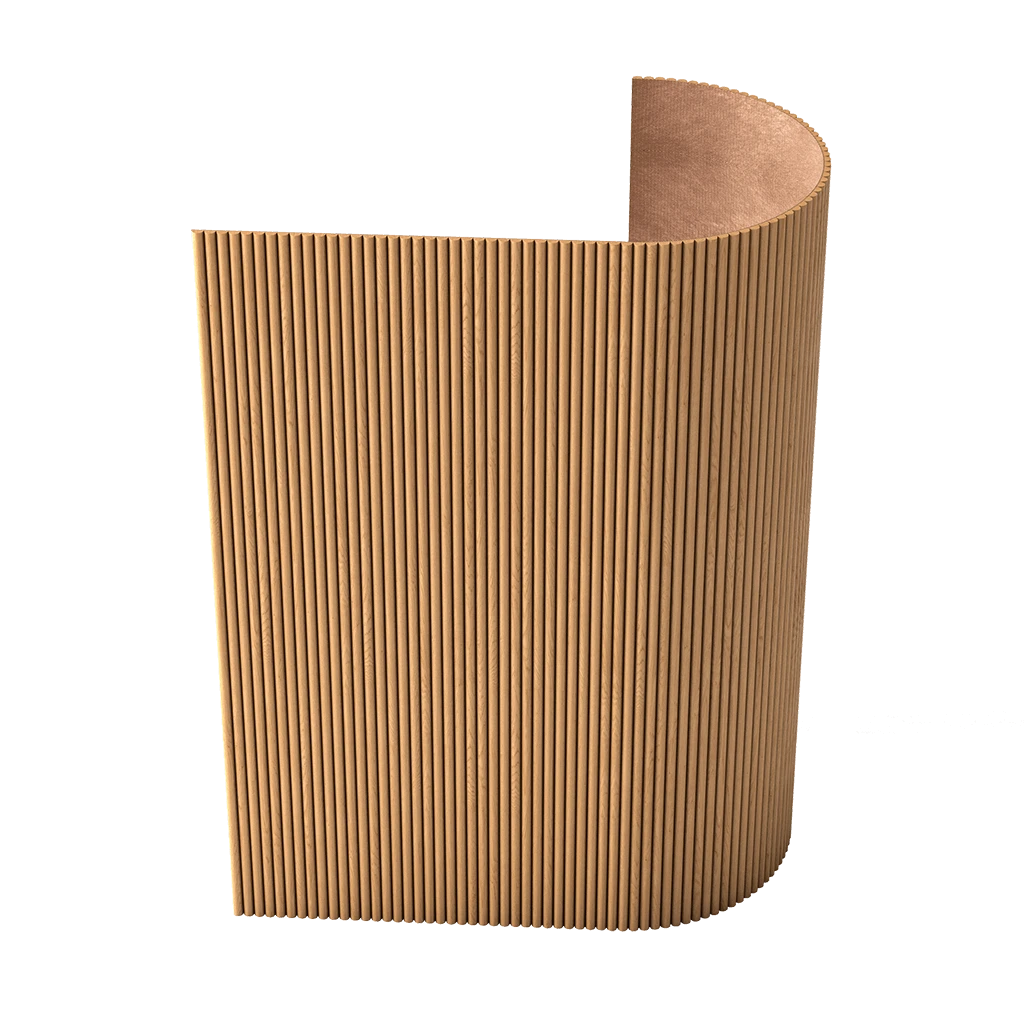
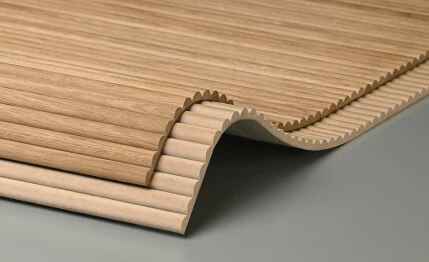
has a fabric base, allows cutting with carpentry tools, and is made of MDF, beech, and oak. For MDF, there is also a primed version.
Current Slatted panel PAN-003 has a fabric base, allows cutting with carpentry tools, and is produced from MDF, beech, and oak. For MDF, there is also a primed version.
Why the 1000 mm width is the main parameter of this article
The site already has a separate article about changing the width of PAN‑003 from 1010 to 1000 mm. This general question is not repeated here. For the mirror scenario, a specific consequence is important:
two design strips of 500 mm each mathematically occupy the entire current panel width of 1000 mm without a nominal remainder.
This makes the topic borderline. In regular cutting, a designer often leaves a few millimeters for trimming. Here there is no such freedom: if both strips must be exactly 500 mm of finished width, the central cut and the two outer edges must use the entire original width.
Why the 11 mm depth is also important near the mirror
The 11 mm relief creates a noticeable side shadow. The inner edge of each strip will be located next to the mirror, so you need to check:
-
whether PAN‑003 protrudes too sharply above the mirror plane;
-
whether there is a decorative gap;
-
how the reflection of the side profile looks;
-
what covers the fabric base on the longitudinal edge.
These issues cannot be resolved from the frontal image alone.
Why is the 950 mm height not the main one here?
For 2200 mm strips, the short 950 mm format would require at least horizontal division. The main goal of the article is to obtain solid vertical strips. Therefore, the following are compared:
-
MDF 2670 mm;
-
beech/oak 2400 mm.
Mirror 1200 mm and two PAN-003 on the sides: first, we build the entire composition
Before ordering the panel, you need to check not just the two strips, but the entire wall around the mirror.
Base decorative width:
500 + 1200 + 500 = 2200 mm.
If the composition is centered on a wall with a width of, for example, 3000 mm, the free margins on the edges:
3000 − 2200 = 800 mm.
With symmetry:
800 / 2 = 400 mm of smooth wall on the left and right.
This is already a different visual result than if the mirror and panels occupy almost the entire wall.
What needs to be applied to the front elevation
-
mirror 1200×2200;
-
left slat strip 500×2200;
-
right strip 500×2200;
-
console or cabinet;
-
switches;
-
sockets;
-
wall sconce;
-
baseboard;
-
top lighting;
-
outer edges of PAN‑003.
Why the console can change the width of the strips
If the cabinet under the mirror is 1800 mm wide, and the PAN‑003 + mirror composition is 2200 mm, the slatted fields extend 200 mm beyond the furniture on each side.
This can be beautiful, or it can look random. This means the 500 mm width must be confirmed not only by the panel cut but also by the furniture composition.
Why sconces are especially critical
If the lights are placed symmetrically on the sides of the mirror, their axes may fall:
-
in the center of the slat strip;
-
on a slat;
-
in the gap between slats;
-
on the future longitudinal edge.
Before cutting PAN‑003, the rhythm must be aligned with the electrical layout.
Our factory also produces:
Can PAN-003, 1000 mm wide, be split exactly into two 500 mm parts
This is the main technical question of the article.
Mathematics:
1000 = 500 + 500.
But real longitudinal cutting requires answering at least four questions.
Get Consultation
Where does the 500 mm center line run?
On the physical PAN-003, you need to measure 500 mm from one factory edge and see what is under the line.
Possible options:
-
fabric base between two slats;
-
side edge of the slat;
-
center of the decorative bead;
-
transition zone of the pattern.
If the cut passes through the fabric base
This is the most convenient scenario: both halves can get a clean decorative edge without sawing the rail itself.
But even here, you need to check which sides of the two halves will be mirrored. One may start from a full rail, and the other from a wider field of fabric.
If the line runs along the rail
Then a literal division of "500/500" damages the decorative profile.
There are options:
-
change the width of the strips;
-
shift the center line;
-
buy two panels;
-
use one panel, but make the strips unequal in original width and then symmetrically finish the other edges.
You cannot automatically cut the rail in half and consider the result ready.
If the line runs too close to the rail
After cutting, the fabric base may remain too narrow for a neat edge or installation.
A physical sample and coordination with the installer are needed.
Why clean 500 mm may be impossible from a single panel without compromise
If a nice cut falls, for example, at 492 mm or 508 mm, the designer gets a choice:
-
change two strips to 492/492;
-
make 508/508 from two panels;
-
leave one strip at 492 and the other at 508 — which will break symmetry;
-
buy two PAN‑003 and form identical strips from factory edges.
That is why buying one panel before checking the rhythm is premature.
Why two mathematically identical PAN-003 strips can look different
Even if physically two pieces 500 mm wide were obtained, their pattern may be different.
Strip A
The inner edge at the mirror starts:
-
with a full semicircular batten.
Strip B
The inner edge at the mirror starts:
-
with a gap between battens.
By tape measure, both strips are 500 mm.
By perception, they are different.
Why the mirror amplifies the mismatch
The mirror sets a strict vertical axis and reflects adjacent elements. If the inner edges are not in phase, the difference becomes a visual "skew," even though the geometry of the wall itself is perfect.
What should be symmetrical
Not necessarily every millimeter of the pattern, but it is desirable to align:
-
the first slat at the mirror;
-
the width of the field before it;
-
the last element on the outer edge;
-
the number of full slats;
-
the direction of the wood grain.
Why two separate panels give more freedom
From each, you can choose the same factory edge as the inner edge at the mirror and then trim the outer one.
This is more material-intensive, but symmetry is easier to achieve.
From which edge should the PAN-003 pattern be counted — from the mirror or from the external wall?
After confirming that the panel can in principle be split lengthwise, a design choice emerges: which side matters more for symmetry.
Option 1. Symmetry from the mirror
Both strips are designed so that the edges closest to the mirror look identical.
This is the most logical scenario for a hallway, because the mirror is the central object.
Check:
-
same type of the first element;
-
same distance from the mirror to the first slat;
-
same number of full repeats;
-
coincidence of the internal shadow rhythm.
The outer edges may get different trimming relative to the wall.
Option 2. Keep the factory outer edges
Sometimes it's easier to leave two factory edges as outer ones and get inner edges after a central longitudinal cut.
Advantages:
-
outer ends are neater;
-
less processing at the boundary with the wall.
Cons:
-
two edges at the mirror depend on the central cut and may look non-identical.
Option 3. Symmetrical trimming of two strips
If the central line of 500 mm is inconvenient, the design width can be changed.
For example:
-
480 + 1200 + 480;
-
520 + 1200 + 520.
The main compositional width will become:
2160 mm or 2240 mm instead of 2200.
If the wall and furniture allow such a change, a small adjustment can result in a much cleaner slat edge.
Why you shouldn't decide based only on saving one panel
One PAN‑003 may be cheaper than two, but if it means the two sides of the mirror get different edges, the savings become visible every day.
Why you need to check the OPAN-003 sample before buying one PAN-003
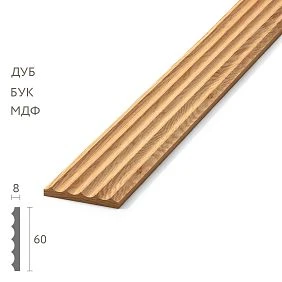
The current OPAN‑003 has dimensions of 200×11×310 mm and is made from MDF, beech, and oak.
buy an OPAN-003 sample useful not only for evaluating color.
On it, you need to check:
-
the actual slat pitch;
-
the gap between slats;
-
depth of 11 mm;
-
shape of the side face;
-
type of fabric;
-
possible nature of the longitudinal cut.
Sample limitation
The width of OPAN‑003 is 200 mm, so it does not show what exactly is on the 500 mm axis of the full-size panel.
It is needed for understanding the module.
For the final decision, the following is still required:
-
drawing of the full-size PAN‑003;
-
or a real panel;
-
either confirmation from the manufacturer/craftsman along the cutting line.
Why a sample is especially useful for natural wood
To the left and right of the mirror, the wood will be perceived as a paired decorative element.
On OPAN-003 you can check:
-
oak versus beech;
-
transparent finish;
-
tinting;
-
reflection in the mirror.
Current sample price
At the time of checking:
-
MDF — 550 RUB;
-
beech — 1,020 RUB;
-
oak — 1,730 RUB
Compared to the price of the full-size oak PAN‑003, this is a reasonable safeguard against a mistake in the material.
PAN-003 made of MDF 2670 mm: how much will remain after strips 2200 mm high
For MDF long format:
1000×11×2670 mm.
If both strips run the full height of the mirror at 2200 mm, one section 2200 mm long is used.
Nominal remainder:
2670 − 2200 = 470 mm.
After longitudinally dividing the entire width into two strips, the remaining height is approximately:
1000×470 mm
before accounting for final edge trimming.
What can be done with the remainder of 1000×470 mm
It may come in handy:
-
for a test paint sample;
-
for a furniture facade;
-
for a local insert;
-
as a repair reserve;
-
for a small area near the console.
When the remainder has no practical value
If the interior does not contain other PAN-003, the 470-mm piece may remain only as a sample.
This is normal. There is no need to invent a use for it for the sake of a formal "waste-free cutting".
Price of PAN-003 MDF 2670
At the time of checking:
26,410 RUB
If one panel really gives two symmetrical strips, this is the product cost of both side zones up to:
-
cutting;
-
painting;
-
delivery;
-
installation.
Primed MDF
Price:
43,700 RUB
It is more expensive, but part of the surface preparation is already done.
For a hallway with painted walls, this can be a convenient option if both strips need to match the exact color.
Wooden PAN-003 2400 mm: oak or beech on the sides of the mirror
Beech and oak have a long format:
1000×11×2400 mm.
For height 2200:
2400 − 2200 = 200 mm.
The remainder is less than MDF, but the main task is solved: the full height is achieved.
Beech
At the time of checking:
42,010 RUB.
Beech gives a calmer natural texture.
Suitable if:
-
a light wooden background is needed;
-
the mirror should not compete with the active oak pattern;
-
light tinting is planned.
Oak
Price:
71,680 RUB
Oak is significantly more expensive, but has a more pronounced texture.
Next to a mirror, it is perceived especially actively, because the reflection visually doubles the pattern.
Why natural strips should be matched as a pair
If one half of PAN-003 has a bright texture and the other is calm, the mirror enhances the asymmetry.
Before longitudinal cutting, you need to check:
-
how the fibers run along the left half;
-
how along the right;
-
which side will become the inner one.
When two separate oak panels are better than one
If one panel after division gives:
-
asymmetrical pattern;
-
uncomfortable edges;
-
one damaged half.
Two panels allow choosing paired zones, but the purchase price increases sharply.
Therefore, for oak, physical inspection before ordering is especially important.
PAN-003 from MDF for painting: how to get two side strips of the same color as the walls
MDF is convenient when slatted fields should be not a wood accent, but part of the color architecture of the hallway.
Regular MDF
Before covering paint, the surface is prepared according to the accepted painting system.
Primed MDF
Reduces the volume of some preparatory operations, but fresh longitudinal edges after cutting still require local processing.
Why the longitudinal cut is especially important under enamel
After splitting one PAN‑003 into two parts, two new side edges appear.
They must:
-
be even;
-
not fray;
-
receive primer;
-
have the same finish.
If one edge faces the mirror, the defect will be more noticeable.
Color with mirror
Exact RAL or NCS does not guarantee identical perception.
The 11 mm relief creates shadows, so PAN‑003 looks darker/more contrasty than a smooth wall of the same color.
A test patch on OPAN‑003 is needed.
Why the longitudinal cut should be done before final painting of PAN-003
Correct sequence:
cutting → fitting → processing new edges → primer/finish → installation.
If you first fully paint the panel and then cut it:
-
the saw may damage the coating;
-
the edge will require restoration;
-
the two strips may get different gloss on the edges.
For oak and beech
The same rule applies to a clear finish.
First, the final geometry of the strips is formed, then the new edges are tinted.
What is more profitable: to buy one PAN-003 and split it, or to buy two panels
There is no universal winner.
| Criterion | One PAN‑003 | Two PAN‑003 |
|---|---|---|
| Product cost | Below | Higher |
| Edge symmetry | depends on the central cut | more freedom |
| Reserve | Minimal | Large |
| Risk of incorrect cut | affects both lanes at once | localized |
| Wood selection | limited to one panel | you can choose a pair |
| Waste | Smaller | Larger |
| Possibility of factory edges for the mirror | Depends on the scheme | Higher |
When one panel is stronger
-
the central cut runs through the safe zone;
-
the two halves are visually symmetrical;
-
width 500 mm confirmed;
-
budget matters;
-
MDF material under enamel.
When two panels are stronger
-
a 500 mm line cuts decorative profile;
-
perfect symmetry is needed;
-
natural oak requires selection;
-
external edges must also be factory-made;
-
a repair reserve is needed.
The cost of a mistake
If oak PAN-003 worth 71,680 rubles is cut incorrectly, the savings from one panel disappear instantly.
Therefore, "one instead of two" is a strong idea only after verification.
Price of slat panels: why a cheap option can become expensive after incorrect cutting
The buyer often compares only the price of one product panel. For a mirror zone, this is not enough.
The real cost of the solution:
product + longitudinal cutting + processing of new edges + finishing + installation + risk of an additional order.
One MDF PAN-003 2670
Product:
26,410 RUB
If the central cut is confirmed, one panel is potentially enough for both strips.
Two MDF PAN-003 2670
Product:
52,820 RUB.
But there are additional costs:
-
large reserve;
-
freedom to choose edges;
-
the ability to replace one strip separately.
One oak 2400
71,680 RUB
Two oak
143,360 RUB.
The difference is huge.
Therefore, checking the center line is not a minor carpentry operation, but a key commercial stage.
Why “one is cheaper” is still not always true
If one panel is cut unsuccessfully and you have to buy a second one, the result:
-
first panel;
-
its cutting;
-
second panel;
-
re-cutting;
-
Repeat delivery.
The savings disappear.
Why two panels are not always wasteful
If material remains from the second one for:
-
an adjacent niche;
-
a furniture insert;
-
a panel at the console;
-
a repair reserve,
an additional purchase may be rational.
When is it better to make the side strips not 500, but 480 or 520 mm
The number 500 mm is convenient in terms of design and arithmetic, but it should not be a dogma.
If the actual PAN‑003 drawing shows that a beautiful longitudinal section runs not at 500, but, for example, at 480 mm, it is worth checking the entire composition with the new margins.
Strips of 480 mm
Total width:
480 + 1200 + 480 = 2160 mm.
Compared to the original 2200 mm, the composition becomes narrower by:
40 mm.
If the wall is 3000 mm, the free margins increase from 400 to:
(3000 − 2160) / 2 = 420 mm.
The difference is only 20 mm on each side.
It can be almost unnoticeable, and the longitudinal edge of PAN-003 will become significantly cleaner.
Strips of 520 mm
Total width:
2240 mm.
On a wall of 3000 mm:
(3000 − 2240) / 2 = 380 mm on each side.
Again, only a 20 mm change relative to the original layout.
But from one 1000 mm panel, two 520 mm strips can no longer be obtained
520 + 520 = 1040 mm > 1000 mm.
That is, widening the strips automatically moves the project to two PAN-003 units.
Two strips of 480 mm from one panel
480 + 480 = 960 mm.
Nominally remains:
40 mm.
This provides technological freedom and may allow symmetric refinement of the edges.
Practical conclusion
If a beautiful pattern is achieved at 480 mm, one panel becomes even more convenient.
If 520 mm is required, two should be calculated immediately.
The mirror is already ordered: why changing its size for PAN-003 is usually too late
If the mirror is already:
-
manufactured;
-
has backlighting;
-
has holes;
-
has mortgages;
-
related to electrical wiring,
the rack layout needs to be adapted.
Why you shouldn't change the mirror from 1200 to 1180 mm just for an easier cut
The mirror is often the main functional element of the hallway.
Its size is related to:
-
user height;
-
console width;
-
wall center;
-
lighting fixtures.
PAN-003 is a decorative system and should adapt within reasonable limits.
When changing the mirror is still possible
If it has not been ordered yet and the composition is only being designed.
Then you can combine:
-
slat module;
-
mirror;
-
furniture;
-
Light.
But this must be a full-fledged design solution, not an attempt to "save one panel."
How to finish the outer edge of the PAN-003 slat strip
The inner edge at the mirror gets the most attention, but the outer edge is also visible.
Options:
Open finished edge of PAN-003
Suitable if, after longitudinal cutting, the edge:
-
smooth;
-
processed;
-
finished;
-
logically meets the painted wall.
Separate profile
Can be used Wooden trim for frame/end solution.
It can:
-
close the fabric base;
-
set a rigid vertical;
-
connect PAN-003 with the plinth.
The specific profile is chosen based on the layout. You cannot invent a universal profile just because an "end" is needed.
Transition to a painted wall
Sometimes a perfect edge and a thin seam are enough.
Especially for MDF in the color of the wall.
Why outer edges can be more important than inner ones
If to the left/right of the composition there are:
-
switches;
-
doors;
-
a cabinet,
the outer edge ends up in the constant viewing zone.
Is a separate frame around the mirror needed if PAN-003 is already nearby?
PAN-003 on the sides already forms a decorative frame, so a separate frame is not necessary.
There are two different scenarios.
Frameless mirror
Advantages:
-
modern look;
-
PAN-003 becomes the main framing;
-
fewer decorative layers.
It is especially logical if the mirror has:
-
bevel;
-
hidden backlighting;
-
minimal edge.
Mirror in a separate frame
If the interior is more classic, you can to buy a mirror frame and make the mirror an independent object.
Then PAN-003 works not as a frame, but as a background.
Why you don't need to automatically use both the frame and two slat strips
Overload may occur:
-
frame;
-
PAN-003 relief;
-
console;
-
the sconce.
If all elements are active, the mirror loses its visual center.
Bottom joint of PAN-003 with the plinth near the console
Two strips 2200 mm high can:
-
start from the floor;
-
start from the top of the baseboard;
-
end behind the console;
-
reach up to the ceiling line.
This changes the finished height.
If PAN-003 goes from the finished floor
Then 2200 mm are measured from the floor.
The baseboard can:
-
approach the panel from the side;
-
be interrupted underneath it;
-
pass in front of it, if geometry allows.
If PAN-003 starts from the top of the baseboard
For example, a baseboard 120 mm high.
Height of the slat zone up to the 2200 mark from the floor:
2200 − 120 = 2080 mm.
Then the long 2400/2670 still fit, but the offcuts change:
MDF:
2670 − 2080 = 590 mm.
Wood:
2400 − 2080 = 320 mm.
That is, the actual lower mark affects the layout.
Why this size must be approved before purchase
If the designer says "strip 2200", you need to clarify:
-
absolute height from the floor;
-
or the net length of the PAN‑003 itself.
These are different numbers.
How many PAN-003 to order finally: algorithm without a "safety margin percentage"
Mechanical "+10%" here is weaker than a specific check.
Step 1. Confirm the mirror
1200×2200 mm.
Step 2. Confirm the finished strips
For example:
500×2200 mm each.
Step 3. Check the current PAN-003
Width:
1000 mm.
Step 4. Check the center line
It should provide two acceptable edges.
Step 5. Check the height
-
MDF 2670;
-
beech/oak 2400.
Step 6. Decide the inner edges at the mirror
Which strip/gap should be first?
Step 7. Decide the outer edges
Open end or profile.
Step 8. Determine the material
-
MDF;
-
Primed MDF;
-
beech;
-
Oak.
Step 9. Make a test finish
Especially for oak and MDF under enamel.
Step 10. Select one or two panels
Not by 'reserve percentage', but by the real possibility of achieving symmetry.
When one PAN-003 may really be enough
One panel is a rational order if all conditions are simultaneously confirmed:
-
supplied width — 1000 mm;
-
two finish strips really fit into this width;
-
the central longitudinal cut is technologically correct;
-
both halves get an acceptable slat pattern;
-
height 2200 mm fits into 2400/2670;
-
no additional large sections of the same PAN-003;
-
one erroneous cut does not create unacceptable commercial risk.
For MDF
This scenario is especially logical under a covering paint: after longitudinal cutting, new edges can be prepared in a single system.
For oak
Possible, but needs stricter verification:
-
texture;
-
symmetry;
-
edge damage;
-
reserve.
When it is better to buy two PAN-003
Two panels are justified if:
-
the center line of 500 mm cuts the batten;
-
the same factory edge of the mirror needs to be preserved;
-
both strips require independent fitting;
-
the natural material needs to be matched by pattern;
-
the wall is uneven;
-
additional batten sections are needed;
-
the project requires a repair reserve.
Why two panels give a different type of cutting
From each one, you can get one strip of 500×2200 and leave the second part of the width of about 500 mm as a large reserve.
This is more expensive, but technologically much more flexible.
What to send to the STAVROS manager before ordering PAN-003
Need to provide a specific scheme:
-
PAN‑003;
-
material;
-
mirror 1200×2200;
-
left strip 500×2200;
-
right strip 500×2200;
-
selected length 2400/2670;
-
intended longitudinal cut;
-
side facing the mirror;
-
outer end;
-
finish;
-
quantity — 1 or 2;
-
whether OPAN‑003 is needed.
Ready-made wording
"For a mirror 1200×2200 mm, we design two vertical strips PAN‑003 of 500×2200 mm each. We want to check the possibility of obtaining both from one panel 1000 mm wide by longitudinal cutting. We ask to confirm the current pattern/geometry of the module, the admissibility of the longitudinal cut, the selected version ___ with length ___ and the current price/lead time."
After confirmation, you can Buy PAN-003 in the calculated quantity.
Where to buy PAN-003 after cut layout verification
If a general selection is needed first, it is possible Buy slatted panels for wall finishing in the category.
For a broader commercial scenario, the same catalog fits the task Buy decorative slatted panels.
After physical verification of the central cut and material, you can order PAN-003 for the mirror zone as one or two panels according to the approved map.
What happens if the 500 mm line passes directly through the decorative rail
This is a boundary case that needs to be considered before payment.
If the central dividing line of 1000 mm into two halves crosses the profile itself, there are four ways.
Shift the width of both strips
For example, up to 480 mm.
Then from one PAN-003:
480 + 480 = 960 mm.
40 mm of nominal allowance remains.
This allows choosing a beautiful longitudinal cut line while maintaining symmetry.
Buy two PAN-003
Each one forms a single strip with a convenient edge.
This is the most expensive but the most geometrically flexible option.
Keep 500 mm but change the outer edge
If the line at the mirror must be perfect, you can form the inner edges identically and compensate for the missing geometry on the outer side.
But for a single panel, the total width is still limited to 1000 mm.
Divide not by center, but by rhythm
For example:
-
first part 492 mm;
-
second 508 mm.
Mathematically the sum is 1000.
But visually the strips are of different widths. For a mirror with central symmetry this is usually weaker.
Main conclusion
If exactly 500 mm falls into an inconvenient phase, you don't need to forcibly keep the number just because it nicely divides 1000 in half.
Why two PAN-003 of 500 mm each cannot be considered symmetrical just by the number of slats
Even the same number of full slats does not guarantee the same perception.
Causes:
-
on one inner edge a full side face of the slat is visible;
-
on the other — more fabric base;
-
edge elements may have different residual width;
-
the wood grain runs differently.
What to compare instead of the number of slats
It is useful to make a table:
| Parameter | Left strip | Right strip |
|---|---|---|
| Width | 500 мм | 500 мм |
| First element from the mirror | ___ | ___ |
| Fabric field to the first slat | ___ | ___ |
| Number of full slats | ___ | ___ |
| Last outer element | ___ | ___ |
| Outer edge type | ___ | ___ |
If the table is visually symmetrical, one panel really works.
How to check symmetry on the floor before installation
The most reliable way is to first lay out the future two strips horizontally on a clean surface.
After longitudinal cutting
Place both parts:
-
with inner edges facing each other;
-
then turn them the way they will stand around the mirror.
Use the mirror template
Leave 1200 mm between the stripes.
You can use:
-
laser;
-
tape measure;
-
paper template;
-
painter's tape.
View from a distance
Not only from 30 cm.
Check:
-
1 m;
-
2 m;
-
from the entrance to the hallway.
Why this is important
A slight difference in the edge is almost unnoticeable on the table, but next to a large mirror surface it reads much more strongly.
MDF 2670 and oak/beech 2400: which is more profitable specifically for strips 500×2200 mm
In terms of the number of main parts, one long panel of each material potentially covers both strips if the central cut is made correctly.
MDF 2670
One panel:
26,410 RUB
Remainder in height:
470 mm.
Primed MDF 2670
43,700 RUB
The remainder is the same.
Beech 2400
42,010 RUB.
Remainder:
200 mm.
Oak 2400
71,680 RUB
Remainder:
200 mm.
What the buyer chooses
Not the length as such, but with
The actual length of the part is less.
Error 9. Do not coordinate the sconces and sockets
The hole falls on the edge of the rail.
Error 10. Changing the size of an already manufactured mirror for the convenience of the panel
The decor must adapt to the actual architecture.
Error 11. Leaving the longitudinal edge of MDF untreated
Especially noticeable with side lighting.
Error 12. Calculating the area instead of specific strips
The same area may require different commercial cutting.
Error 13. Not marking the left and right strips after cutting
On the object, parts are swapped, and symmetry disappears.
Error 14. Using different batches of natural wood without matching
The left and right zones read as different.
Error 15. Forgetting about future repairs
For a commercial hallway/public area, a reserve may make sense.
When PAN-003 is better not to buy near a mirror
An expert article should allow rejecting a specific solution.
The stripes are too narrow for the current rhythm
If after the mockup 500 mm looks heavy or cuts off the pattern, another panel model may be better.
The central cut is technologically unsuccessful
If one panel cannot be beautifully divided, and two are too expensive, it is worth reconsidering the model.
The 11 mm relief conflicts with the mirror
For example, the mirror is very thin and should look as flat as possible.
Too many other decorative elements
A frame, sconce, console, moldings, and PAN-003 can all overload the wall at the same time.
Natural oak exceeds the budget
MDF under enamel or another panel can solve the composition more cheaply.
If one PAN-003 fits the pattern, but the wall is uneven: is a second panel needed?
There is a separate edge case that is not related to the 500+500 geometry itself.
Suppose the central longitudinal cut is perfect, both strips are symmetrical, but the wall has:
-
local unevenness;
-
plaster difference;
-
different depth on the left and right of the mirror.
Why this is important
PAN-003 has a flexible base and can follow the substrate, but the two strips next to the mirror must visually maintain the same plane.
If the left wall recedes by a few millimeters while the right remains flat, the 11 mm relief will cast different shadows.
What to check before ordering
Place a long straightedge across both areas:
-
500×2200 on the left;
-
500×2200 on the right.
Check:
-
verticality;
-
flatness;
-
difference relative to the mirror.
Is a second panel needed due to an uneven wall
The unevenness itself does not require a second PAN‑003.
It requires base preparation.
But if correcting the wall reduces the finished width of one strip, the original 500 mm must be recalculated before longitudinal cutting.
If the mirror is offset from the center of the wall: the symmetry of the strips can still be correct
The composition 500+1200+500 is symmetrical relative to the mirror, but does not have to be symmetrical relative to the entire wall.
For example, a wall:
3000 mm.
Composition:
2200 mm.
But the mirror is offset due to a door, and the free spaces become:
-
300 mm on the left;
-
on the right 500 mm.
This is not an automatic error.
What matters more
If the mirror is the functional center of the hallway, symmetry of two PAN-003 relative to it may be more important than equal margins to the walls.
When the offset looks random
If there is nothing nearby:
-
doors;
-
wardrobe;
-
console;
-
a light fixture,
that explain the composition.
Why this affects one or two panels
Does not directly affect the quantity, but may change the width of the slat strips.
For example, a designer decides to increase the left strip to 520 mm and leave the right one at 500 mm to compensate for the wall. In this case, one PAN-003 panel 1000 mm wide no longer covers both.
That is, the final width of the strips must be approved on the full wall, not just near the mirror.
Final procurement specification PAN-003 for the mirror zone
Before payment, it is convenient to write down the project in one line:
PAN-003 / MDF 1000×11×2670 mm / mirror 1200×2200 mm / left strip 500×2200 / right 500×2200 / central longitudinal cut confirmed / inner edges symmetrical / outer edge ___ / finish ___ / quantity 1 panel.
For oak:
PAN-003 / oak 1000×11×2400 mm / two strips 500×2200 / wood grain checked / left and right sides marked / finish ___ / quantity 1 or 2 panels per map.
What this specification must prove
-
the width of PAN-003 is current;
-
500 mm is a finished size, not a sketch figure;
-
the cut line is verified;
-
height fits the selected format;
-
outer edge resolved;
-
material approved;
-
quantity follows from the actual cutting layout.
If the specification still contains the phrase:
"We cut in half on site and see there,"
the purchase is not ready yet.
Final check before payment
Consolidate four things on one sheet: the actual width of both strips, the position of the central longitudinal cut, the selected inner edge at the mirror, and the outer end. Then apply OPAN‑003 or the rhythm template to the real wall next to the mirror and lights once more. If after this check at least one strip changes from 500 to 480/520 mm, the quantity and cutting method must be recalculated before ordering. For oak and beech, separately record which half goes left and which goes right, so that after tinting the parts are not swapped and the approved symmetry is not destroyed. For MDF, similarly record the treatment method for fresh longitudinal edges and the finish, so that both sides of the mirror get the same color, gloss, and shadow depth.
Final decision tree: one PAN-003 or two
Step 1. Is the 1200×2200 mm mirror confirmed?
-
no → first final geometry;
-
Yes → continue.
Step 2. Are the strips exactly 500 mm?
-
no → calculate the actual width;
-
Yes → continue.
Step 3. Is the current PAN‑003 with a width of 1000 mm confirmed?
-
Yes → continue.
Step 4. Does the 500 mm center line pass through the safe zone?
-
no → change the width or buy two panels;
-
Yes → continue.
Step 5. Are the inner edges visually symmetrical?
-
no → two panels/different trimming;
-
Yes → continue.
Step 6. Is the material selected?
-
MDF 2670;
-
beech/oak 2400.
Step 7. Does the height of 2200 mm fit?
-
yes, in both long formats.
Step 8. Does the remainder of 470/200 mm have a use?
-
yes → take into account;
-
no → do not count it as savings.
Step 9. Are the outer edges resolved?
-
no → make a mockup;
-
Yes → continue.
Step 10. Only after this, fix one or two PAN‑003.
Cutting control chart before the first longitudinal cut
Before the master cuts PAN‑003 with a width of 1000 mm, it is useful to record a short production sheet.
| Parameter | Value |
|---|---|
| Mirror | 1200×2200 mm |
| Left lane | 500×2200 mm |
| Right lane | 500×2200 mm |
| PAN‑003 | 1000×11×___ mm |
| Material | ___ |
| Center cut line | ___ |
| What is at 500 mm | ___ |
| Inner edge L | ___ |
| Inner edge R | ___ |
| Outer edge L | ___ |
| Outer edge R | ___ |
| Finish | ___ |
| Number of panels | 1 / 2 |
Why the field "what is at 500 mm" is mandatory
It is this that answers the main question of the article.
If there is a fabric gap, one panel has a good chance of producing two strips.
If it is a decorative profile, the project needs to be changed before cutting.
Why the left and right strips should be marked immediately
After longitudinal cutting, the two parts may look very similar.
But if they are swapped, the inner edges of the mirror will become different.
Marking:
-
L — left;
-
R — right;
-
IN — inner edge;
-
OUT — outer.
This is a simple operation that protects the approved symmetry.
What does a mistake cost: one ruined PAN-003 versus buying a second one in advance
For MDF 2670, one panel costs 26,410 rubles.
If one panel is bought to save money and is ruined by the central cut, a new order increases the goods budget to:
52,820 RUB.
Plus, the following are repeated:
-
delivery;
-
time;
-
cutting;
-
finish.
For oak
One panel:
71,680 RUB
Two:
143,360 RUB.
Here, the cost of a mistake is especially high.
But this is not an argument to always buy two
The correct conclusion is different:
the more expensive the material, the more beneficial it is to pre-check the sample, pattern, and cut line.
If the central cut is confirmed, one panel remains the most economical solution.
What to check after longitudinal cutting before finishing
The two strips should be accepted as a separate set.
Geometry
Check:
-
width at the bottom;
-
width at the center;
-
width at the top.
Both must match the project.
Edge straightness
The long edge of 2200 mm near the mirror is especially noticeable.
Even a slight wave will create an uneven gap.
Rhythm
Place both strips next to the mirror template.
Ends
Check:
-
fabric;
-
glazing beads;
-
chips;
-
fresh cut quality.
Only after this, finish
If width correction is required, it is better to do it before enamel or tinting.
FAQ
What is the current width of PAN-003?
For relevant main versions, the card shows 1000 mm.
What is the depth of PAN-003?
Main formats 950/2400/2670 mm have a depth of 11 mm. The card also includes a short MDF 740 mm with a depth of 8 mm, but it does not relate to the main task of 2200 mm strips.
Can PAN‑003 be cut lengthwise?
The card allows cutting with carpentry tools. The specific longitudinal cut line needs to be checked against the actual panel pattern.
Will one PAN‑003 1000 mm be enough for two 500 mm strips?
In width — exactly enough. In decorative pattern — only if the central cut produces two correct and symmetrical edges.
Why doesn't 500+500 guarantee a perfect result?
Because PAN‑003 has repeating slats and a fabric base. The 500 mm line may fall in an inconvenient spot in the pattern.
Can two strips be made symmetrical?
Yes, if the actual rhythm phase allows it. If not, the strip width is changed or two panels are used.
Where to start the pattern — from the mirror or from the wall?
For a mirror scenario, symmetry of the mirror's inner edges is often more important, but the solution is checked on the entire composition.
What is the length of PAN-003 made of MDF?
For a tall solid strip, the 2670 mm format is relevant.
What is the length of oak or beech PAN-003?
2400 mm.
Will 2400 mm be suitable for a strip 2200 mm high?
Yes, in length: nominally about 200 mm remains before accounting for the final cut.
How much will remain from MDF 2670 mm?
About 470 mm in height before accounting for end trimming.
Do I need to buy two panels for spare?
Not automatically. Two are needed if one does not provide correct edges, requires selection of natural wood, or there are additional sections.
Why is OPAN-003 needed?
To evaluate in person the 11 mm depth, material, grain, and finish before purchasing an expensive full-size panel.
How to process the longitudinal edge of MDF?
After cutting, the edge is prepared in the same compatible system as the rest of the paintable panel.
How to match oak strips by grain pattern?
Lay out the material before cutting, evaluate both future halves, and assign the left/right side in advance.
Is a separate frame around the mirror needed?
Not necessarily. PAN-003 can itself work as side framing. A frame is needed if it is a separate design task.
What to do if the 500 mm line passes through a slat?
Do not cut automatically. Compare strips of other widths or a two-panel scenario.
Can you make strips of 480 mm?
Yes, if the overall wall composition allows for reduction. From one 1000 mm panel, two 480 mm strips leave 40 mm of nominal allowance.
Can you make strips of 520 mm?
Yes visually, but two strips require 1040 mm, so they cannot be made from one PAN-003 1000 mm panel.
Where to order PAN-003?
After checking the longitudinal cutting — in the product card of the specific STAVROS item.
Brief conclusion
For a 1200×2200 mm mirror, the idea of buying one PAN-003 for two side strips of 500 mm each is mathematically correct, but not automatically feasible technologically.
By width:
500 + 500 = 1000 mm.
By height:
2670 − 2200 = 470 mm for MDF;
2400 − 2200 = 200 mm for beech and oak.
The main check is not in these formulas, but on the central line of the panel: what exactly crosses the longitudinal cut and which inner edges will the left and right strips receive.
If the line runs through a safe section, the pattern is symmetrical, the height is confirmed, and the outer edges are resolved — one PAN‑003 can indeed replace two and significantly reduce the project cost.
If a 500 mm line cuts the profile, the two halves visually differ, or natural oak requires independent matching, purchasing two panels becomes a more professional solution.
Correct sequence:
mirror → two strips → sample/drawing → center line → edge symmetry → material → length 2400/2670 → outer end → finish → one or two panels → order.
Thus, the solution of "one PAN‑003 instead of two" becomes not random savings, but a verified cut.