















































































Article Contents:
- What is a vertical decorative garland
- Where vertical garlands are used
- On furniture facades
- On doors
- On portals
- On wall panels
- On mirrors and frames
- Polyurethane or wooden garland — which to choose
- Comparison for vertical garland
- Pattern direction: left, right, symmetrical
- How to choose the size of a vertical decorative overlay
- Relief thickness: why it matters more than it seems
- How to combine vertical garland with moldings and other elements
- Installation of vertical decorative garland
- Typical mistakes when buying and installing vertical garlands
- Practical tips: how to choose the right vertical garland
- How to match the style of vertical garland with the interior
- Why choosing vertical decor is convenient at STAVROS
- FAQ: answers to popular questions about vertical decorative garlands
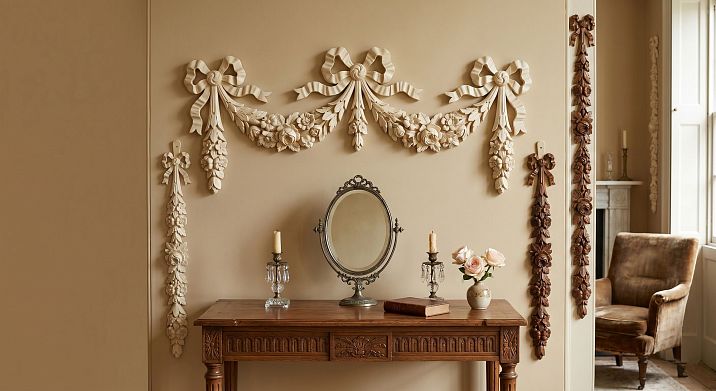
Imagine: a doorway with two thin vertical garlands on each side — and what happens? An ordinary entrance turns into an architectural accent. You place a cabinet with smooth facades next to an identical one — and one looks expensive and unique, while the other just stands there. The difference lies in the vertical decorative garland that runs along the edge of the facade, echoes the door line, and supports the portal axis.
This type of decor is undeservedly overlooked when searching: horizontal overlays, central rosettes, and moldings are more often purchased. But the vertical element — a garland stretched along the axis — remains in the shadows, even though it is precisely what can turn a plane into volume and an object into an image. In this article, we will cover everything: what this element is, where it works, how to choose it, in what material to order it — and what mistakes are most often made when buying.


What is a vertical decorative garland
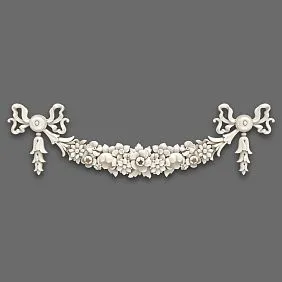
In architectural ornament, the concept of a "garland" has existed for a long time — since the times of Greek friezes and Roman altars. A classic garland is a chain of leaves, flowers, fruits, or ribbons stretched in a certain direction. A horizontal garland decorates a cornice or frieze. A vertical one stretches from bottom to top or top to bottom, following the axis of a column, pilaster, door jamb, or furniture facade.
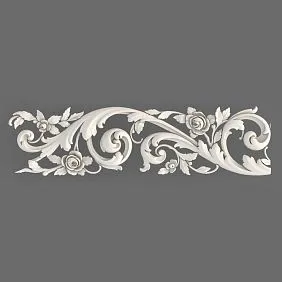
In essence, a vertical decorative garland is a relief overlay with an elongated vertical composition. A plant stem entwined with leaves and flower buds, a laurel branch smoothly rising from the base to the top, intertwined stems with ornamentation — all these are variations of one type of decor that works fundamentally differently than a horizontal overlay or a round rosette.
How does a vertical element differ from a horizontal one compositionally? By the direction of emphasis. A horizontal garland expands, making the surface more extensive. A vertical one elongates, adds height, and accentuates the axis. In small rooms with low ceilings, vertical decor works especially precisely: it optically "raises" the space. In high halls, it emphasizes the architectural scale, creating a sense of grandeur.
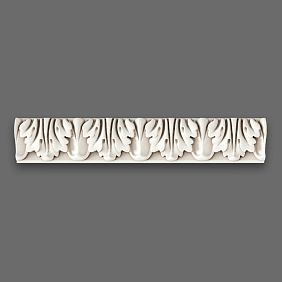
An important difference from molding: molding is a linear profile, a frame element that divides the plane. A vertical garland is an ornament, a living pattern, a volumetric detail with character. It doesn't just divide — it tells a story.
The second key difference from most overlays is pairing. Vertical garlands are almost always used in pairs: left and right, symmetrically on the sides of a door, facade, portal, or panel. It is in a pair that they create a frame, a gateway, a ceremonial accent. One vertical garland is half of a completed idea. Therefore, when thinking about purchasing vertical decor, immediately think in terms of two pieces.




Where vertical garlands are used
The range of applications is wider than it seems. Let's list specific areas — with an understanding of why the vertical element works better there than other forms of decor.
Our factory also produces:



On furniture facades
A cabinet, sideboard, chest of drawers, nightstand, console, decorative bed panel — all these objects have vertical planes that benefit from paired decor on the sides. Imagine a sideboard with four doors: a horizontal overlay in the center of each door is a standard solution. But if you add vertical garlands on the sides of the outer doors, the sideboard acquires a frame, becomes a complete architectural object, not just furniture.
For furniture facades Wooden decorative inlays made of beech or oak — the preferred choice. They are compact, delicate in thickness, and organically accept furniture finishes. Wooden decor N-079-1 in size 211 × 93 × 11 mm — a good example of a vertically oriented overlay for a furniture facade: proportions are elongated, relief is delicate, thickness allows mounting on the door without conflict with hardware.
Scale is a critical parameter. For narrow vertical cabinet stiles — small overlays 111–166 mm. For wide side planes of a sideboard or for the central part of a large facade — overlays 211 mm and larger. Wooden decor N-316 — another option from the STAVROS assortment, which is considered as an element of a vertical composition with an ornamental motif.
Get Consultation
On doors
An interior door is an object that most people take for granted, not seeing the potential for transformation. Yet it is the door leaf that is the most "living" plane in the interior: it is constantly in motion, it is in plain sight, it is perceived from all angles.
A vertical garland on the door is used in several ways. First — on the sides of the central panel: two symmetrical overlays frame the central field, creating a visual accent inside it. Second — along the vertical stiles of the leaf: narrow garlands follow the door line from bottom to top, echoing its vertical axis. Third — as an element in a decorative frame inside the leaf: the garland "lives" inside the molding frame, supporting its central vertical.
For solid wood doors, wooden overlays are organic in material: wood to wood, the same species, the same finish. For MDF doors with an enamel coating — beech in the "under enamel" version: dense paint will hide the joints and make the overlay part of the surface.
On portals
A fireplace portal, door portal, decorative arch, niche framing — these are architectural zones with pronounced vertical stiles. It is here that the vertical decorative garland unfolds in full force: it is placed on the side stiles of the portal, creating a ceremonial framing of the opening or firebox.
For portals molded decoration made of polyurethane is preferable — it withstands the scale of the ceremonial area, provides a large expressive relief, and is easily painted to resemble stone, marble, gold, or neutral white. PU overlays with elongated vertical proportions — this is exactly what is needed for the side stiles of the portal, where a horizontal detail would be inappropriate.
For a fireplace portal, it is important to consider the height of the stile: the vertical garland should occupy no more than 2/3 of the stile's height, leaving visual "breathing room" at the bottom and top. If the garland runs from the base to the architrave, a sufficient scale of the detail is needed, otherwise it will look like a random insert in a large space.
On wall panels
A wall panel with a molding frame is one of the most effective interior techniques of classic style. A horizontal overlay inside the frame is standard. But for narrow vertical panels, which are found in piers between windows, in niches, in corridors — a horizontal garland is not suitable. This is where the vertical element is indispensable: it stretches along the long axis of the narrow field and creates the correct visual balance.
Polyurethane wall decor — a broad category where you can choose both horizontal and vertically oriented elements. For narrow piers 200–400 mm wide, a vertical garland 80–130 mm wide works perfectly: it fills the field without overloading it and creates a sense of architecturally thought-out space.
In symmetrical paired panels — when two identical vertical panels stand on either side of a fireplace, window, or door — a pair of vertical garlands creates a mirror rhyme that "closes" the entire wall composition into a single whole.
On mirrors and frames
A mirror frame in a classic interior is an object with decorative potential that is often underutilized. A horizontal garland at the top or bottom of the frame is a common solution. But vertical overlays on the sides of the frame create a fundamentally different look: they make the mirror resemble a portal, a window into another world, framed by solemn columns of ornament.
A small-format wooden carved overlay is a delicate and appropriate choice for medium-scale frames. A pair of vertical garlands 166 mm high on a mirror frame is subtle, elegant, and emphatically historical. STAVROS carved decor in this context allows you to select elements from the same program used on nearby furniture, creating a unified stylistic solution.
Polyurethane or wooden garland — which to choose
This choice is not decided by the principle of "what is better" — it is decided by the principle of "what is appropriate." Each material has its own area of competence.
Comparison for a vertical garland
| Task | Better to choose |
|---|---|
| Wall, portal, large wall panel | Polyurethane garland |
| Furniture facade, chest of drawers, sideboard, cabinet | Wooden garland |
| Painting in the color of the wall or to match stone | Polyurethane |
| Enamel on furniture, integrate into the furniture program | Wood (beech, "enamel-ready" option) |
| Tinting with visible texture | Tree (oak, tinted variant) |
| Narrow space between windows | Vertical polyurethane decor |
| Paired door or facade design | Identical or mirrored garlands |
| Historical, palace interior | Large relief, polyurethane |
| Modern neoclassicism | Calm pattern, fine detail |
| Solid wood interior door | Wooden overlay in the same species |
| Fireplace or door portal | Polyurethane with deep relief |
| Medium-scale mirror frame | Wooden overlay |
Why is polyurethane preferable for walls and portals? Three reasons. First — scale: polyurethane overlays are produced in larger sizes capable of "holding" a large field. Second — lightness: with an overlay height of 300–500 mm, a polyurethane product weighs significantly less than its wooden counterpart, simplifying installation on a vertical surface. Third — painting: the polyurethane surface is neutral, accepting any enamel, patina, or textured coating without the structure "showing through."
Why is wood preferable for furniture? Also three reasons. First — proportions: wooden overlays are produced in furniture scale, without overloading the facade. Second — material organicity: wood on a wooden or MDF surface is perceived as a single object. Third — finishing options: beech under enamel and oak under tinting are two different aesthetics that cannot be replicated with polyurethane to the same degree of naturalness.
There is a third option — combination. Vertical garlands on the wall panel are polyurethane, painted in the wall color. Vertical garlands on the furniture next to it are wooden, coated with the same enamel. If the finish is uniform, the material difference disappears, and both elements work as a single system. This requires preliminary design, but the result is worth the effort.
Pattern direction: left, right, symmetrical
A key nuance that most buyers ignore on their first order. A vertical garland is not always a symmetrical detail. Depending on the direction of the ornament, it can be:
Symmetrical — the pattern is the same on both sides of the longitudinal axis, the detail looks the same regardless of rotation. Such a garland can be used in any position.
Left and right — the design «looks» in a certain direction. A laurel branch that curves to the left is the left piece. The same branch curving to the right is the right piece. For paired placement on the sides of a door or facade, you need a pair: one left, one right.
Mirror — essentially the same as left/right, but sometimes the manufacturer releases both versions under one SKU with the L and R (Left and Right) markings. In the catalog PU overlays STAVROS you can find exactly this system: for example, positions NPU-273L and NPU-273R are a mirror pair for symmetrical decor.
How to check if you need mirror versions? Imagine the piece glued to the surface. Now imagine a second identical piece next to it, mirrored. If the pattern «converges» in the center — you need a pair of L and R. If the pattern is identical and there is no «mirror convergence» — take two identical pieces. But if the design is asymmetrical — two identical pieces placed side by side will look like they are «running away» in one direction.
How to choose the size of a vertical decorative overlay
Size is where most mistakes happen silently, until the piece is in your hands. A photo in the catalog does not convey scale. A description in millimeters does convey it, but requires understanding in the context of the actual dimensions of your surface.
For furniture facades. The rule of proportion: the height of the garland should not exceed 60–70% of the facade height. For a door 600 mm high — an overlay up to 400 mm. For a door 400 mm high — an overlay up to 260–280 mm. The width of the garland — no more than 25–30% of the facade width: on a door 400 mm wide, an overlay 100–120 mm wide.
For doors. A vertical garland on a standard door leaf 2000 mm high can be from 400 to 800 mm in height — depending on the position. If the garland is placed in the upper third of the leaf, 400–500 mm is enough. If it goes from the middle upward — you need a piece 600–800 mm or several pieces in a set.
For portals. The height of the portal post is the defining parameter. If the post is 1000 mm — the garland on it can be 500–700 mm. You don't need to cover the entire post with decor: «breathing» space around the element is more important than full coverage.
For wall panels. A vertical garland in a narrow panel should occupy 40–60% of the field height. If the panel is 1200 mm high and 250 mm wide, an overlay 500–700 mm high and 80–100 mm wide will be proportional.
Practical tool: make a full-size paper template and apply it to the surface. Five minutes of work — and no doubts about proportions.
Relief thickness: why it matters more than it seems
A parameter that almost always ends up at the bottom of the list when choosing — and in vain. The thickness of the overlay determines how "sculptural" the decor will be.
Wooden overlays on a furniture scale have a thickness of 6–11 mm. This is a delicate relief that adds depth to the surface without creating a feeling of a "stuck-on" object. On a well-lit furniture door, such an overlay reads like carving done directly into the material.
Polyurethane overlays for interior tasks — 20 mm or more. This is already full-fledged stucco with pronounced shadows and plasticity, visible from a distance and creating a volumetric architectural effect. For walls, portals, large decorative panels — this is the correct thickness.
Mistake: placing a 20 mm thick polyurethane overlay on a thin furniture facade next to a handle — and discovering that the part "protrudes" so much that the handle starts to conflict with it. Or, conversely, using a thin 6 mm wooden overlay on a wall panel 3 meters high — and it simply gets lost.
How to combine a vertical garland with moldings and other elements
A vertical garland should never stand in isolation — this is an axiom of classical decor. It is part of a system, and the more thoughtful the system, the more convincing each of its elements.
Moldings made of polyurethane — the first and main addition. They create a frame within which the garland takes its rightful place. Without a frame, a garland on the wall looks like a detail that has lost its context. In a frame — like the central ornament of a well-thought-out composition.
Decor for Molding — corner inserts and ornamental elements that complete the frame at intersection points. In a classical system: molding frame + corner inserts + central vertical garland = a full-fledged wall panel with architectural character.
For portals to garlands, a horizontal element is added on top on the sides — a cornice or architrave overlay. The result is a U-shaped system: vertical posts with garlands and a horizontal "bridge" above the opening. This is a classic solution that works equally convincingly for a fireplace portal, a door opening, and a decorative arch.
Rosettes — symmetrical central elements — are traditionally combined with vertical garlands in door and furniture compositions. A rosette in the center of the panel + vertical garlands on the sides + a molding frame is a classic door panel design scheme that has been used since the 17th century and continues to be used today.
Important: all elements in the system must be coordinated in style and scale. STAVROS carved decor and STAVROS polyurethane decor were developed as compatible programs — elements from both categories can be combined in one project provided there is a unified finish.
Installation of a vertical decorative garland
Installation of a vertical overlay has its own specifics compared to a horizontal one. The main nuances are in working with the vertical direction.
Marking the vertical axis. First of all, draw the central vertical line of the surface. The overlay should be positioned symmetrically relative to this axis or strictly parallel to it at a specified distance. For paired placement: determine the axis of the surface, set off the same distance to the left and right from it — and place the garlands symmetrically.
Height level. Determine the top and bottom points of the garland and mark them on the surface. If the garlands are paired, both should start and end at the same height — use a horizontal level or a laser level.
Applying glue. For polyurethane vertical overlays: apply glue to the overlay in a zigzag or dots, allow open time (2–4 minutes) — and press against the surface. Hold for 10–15 seconds, then if necessary, secure with painter's tape until fully set (30–60 minutes). For wooden overlays on furniture: woodworking PVA or construction adhesive — and light, even pressure without point pressure.
Thin wooden parts. Overlays with a thickness of 6–8 mm require special care: with excessive pressure at one point, the part may crack. Press evenly over the entire surface, use a wide board as a pad.
Painting after installation. It is recommended to install the overlay before final painting — then the paint "blends" it into the surface, hiding the edges. If the overlay is installed on an already painted surface, the joints need to be puttied and touched up to remove the visible border.
Detailed recommendations on the installation technique for polyurethane moldings — in a special article on the STAVROS website, which covers all types of substrates and adhesive compounds.
Typical mistakes when buying and installing vertical garlands
These mistakes occur regularly — among customers of varying experience levels. Knowing them in advance can help avoid costly corrections.
-
Buying one garland where a paired composition is needed. Vertical decor almost always works in pairs. One garland on the side of a door without a mirror image is an unfinished idea.
-
Not checking the pattern direction. An asymmetrical ornament in a paired arrangement requires mirrored versions L and R. Two identical "right" garlands next to each other is a mistake that is hard to fix without reordering.
-
Choosing an overlay that is too short for a tall door. A 200 mm overlay on a door leaf 2000 mm high looks like a small detail lost in a large field.
-
Placing overly large decor on a small facade. A garland 130 mm wide on a door 200 mm wide takes up 65% of the surface — overload.
-
Not accounting for the relief thickness. 20 mm on a thin furniture facade creates a conflict with hardware. 6 mm on a wall panel gets lost in the space.
-
Mixing wood and polyurethane without a unified finish. Two materials in one area without a single finish create a mismatch in texture and color.
-
Forget about moldings. A vertical garland without a molding frame is a detail without context.
-
Don't skip marking. In classic design, symmetry is law. A 5 mm offset is immediately noticeable.
-
Paint the decor after fitting and adjustment. First installation, then painting — not the other way around.
-
Choose only by photo without looking at dimensions in millimeters. A beautiful picture in the catalog gives no information about the actual scale of the detail.
Practical tips: how to choose a vertical garland correctly
Let's organize the recommendations into a working checklist.
-
Determine the location: furniture, door, portal, wall panel, mirror frame. Everything else depends on the location.
-
Think in pairs right away: left and right element, symmetrical placement, equal distance from the axis.
-
For furniture — wooden overlays made of beech or oak, thin, furniture-scale.
-
For walls and portals — polyurethane overlays with deep relief, capable of holding a large field.
-
For natural finishing with visible texture — oak for tinting.
-
For painting to match the wall or furniture color — polyurethane or beech "for enamel finish".
-
Check the pattern direction: symmetrical piece or need L and R versions.
-
Make a full-size paper template and apply it to the surface.
-
Combine the garland with moldings, decor for moldings and cornices — create a system, not a single element.
-
For classic style, a rich ornament is acceptable. For neoclassical, a calm, subtle one without overload.
-
Before ordering, check availability, production time, and delivery conditions — especially important for project purchases.
How to match the style of a vertical garland with the interior
The ornamental motif of the garland is its "voice" in the space. A plant stem with flower buds speaks one language. A laurel branch speaks another. A woven ornament with leaves speaks a third. It is important that the voice of the decor matches the overall tone of the interior.
Classic and Baroque. Rich, dense ornament with pronounced relief, floral elements, intertwined stems. Details are large, relief is deep, space between elements is minimal. Polyurethane is the main material for interior zones, wood for furniture.
Neoclassical. More restrained ornament, "air" around each element, less pattern density. A garland as a single accent in a clean frame, painted in the background color — this is the quintessence of the neoclassical approach to decor.
Empire. Strictness, symmetry, conciseness of forms. Laurel wreaths, military symbols, clear lines. An Empire-style vertical garland is a straight trunk with a geometrically regular ornament, without the "fluidity" of Baroque stems.
Palace interior. Large scale, multi-level compositions, combination of vertical and horizontal elements in a single system. Here the vertical garland is part of a large program: a pair on the portal posts, a pair on the side columns, connected by a horizontal cornice at the top.
Modern classic. Minimum decor, maximum precision. One pair of vertical garlands on the door, painted in the same color as the panel. No contrast, only volume. It is restrained but professional.
Why choosing vertical decor is convenient at STAVROS
When it comes to vertical decorative garland for a specific project, it is important that the supplier can offer not just a "beautiful detail," but an element integrated into the system. This is what makes STAVROS interior decor — here both material programs are available, here you can select overlays, moldings, cornices, rosettes, and corners in a unified stylistic logic.
The STAVROS catalog features overlays with vertically oriented ornaments — both in the wooden program and in polyurethane. Decorative wooden inlays — over 400 models made of beech and oak, including symmetrical and asymmetrical products, as well as mirror pairs for symmetrical placement. molded decoration made of polyurethane — a wide range of overlays, including vertically oriented elements for walls, portals, and decorative panels.
Orders are available from 1 piece with delivery across Russia via CDEK. For mirror pairs, two items — L and R — are ordered in one order. Production to order takes 3–10 business days depending on the item. Showrooms in St. Petersburg and Moscow allow you to see the details in full size and evaluate the relief in person.
FAQ: answers to popular questions about vertical decorative garlands
What is a vertical decorative garland?
This is a relief overlay with an elongated vertical composition — a plant stem, floral ornament, laurel branch, or braided motif — which is installed on furniture, doors, portals, wall panels, or frames. Unlike a horizontal garland, it stretches the surface upward, emphasizing the vertical axis.
Where is it best to use vertical garlands in the interior?
On the side posts of door and fireplace portals, on the sides of furniture facades, inside narrow vertical wall panels, on door leaves, and on the sides of mirror frames.
Can garlands be placed in pairs on the left and right?
Not just possible — necessary. The vertical garland is primarily intended for paired placement. In this case, you need to check whether the part is symmetrical or whether you need to order a mirror pair L and R.
What to choose for furniture — polyurethane or wood?
For furniture facades — wooden carved overlays made of beech or oak. They are proportionate to the furniture scale, thin, and accept enamel and tinting well.
Is the vertical garland suitable for doors?
Yes, this is a classic application. The overlays are placed on the sides of the central panel, along the vertical stiles of the door leaf, or inside the molding frame. Wooden overlays — for solid wood and MDF doors, polyurethane ones — for door portals and trims.
Can the garland be used inside a molding frame?
Yes, that is where it works most expressively. The frame creates context, the garland inside is the semantic center. Choose the garland so that there is at least 30–40 mm between its edges and the molding on each side.
How to choose the size of a vertical decorative overlay?
The height of the garland is no more than 60–70% of the surface height. The width is no more than 25–30% of the surface width. Before ordering, make a full-size paper template and apply it to the surface.
Do I need to buy two identical garlands for symmetry?
Depends on the symmetry of the ornament. If the design is symmetrical, take two identical ones. If the ornament is asymmetrical, you need a mirror pair: one L version, one R version.
Can you paint a polyurethane garland?
Yes, polyurethane accepts water-dispersion and alkyd enamel, acrylic paint, patina, imitation gilding and stone perfectly. Be sure to prime the surface before the final coating.
How to combine a garland with moldings, cornices and other overlays?
Use elements from a single program: moldings, molding decor, corner inserts, cornices — all from one catalog and in one finish. The vertical garland should be scaled in harmony with the moldings: the detail should be neither larger than the frame nor significantly smaller.
A vertical decorative garland is not a random decorative element, but a tool of architectural expressiveness. It works in pairs, it creates an axis, it turns a flat surface into a three-dimensional composition. For walls and portals — polyurethane with deep relief. For furniture and doors — wooden carving from beech or oak. In the STAVROS catalog, you can select both programs, find mirror pairs, coordinate with moldings and cornices — and create an interior where every detail is in its place.
The company STAVROS was founded in 2002 in St. Petersburg and produces molded decoration made of polyurethane и Carved wooden decoration for residential and commercial interiors. Over more than twenty years of work, STAVROS has participated in the restoration of the Konstantinovsky Palace, the Hermitage, the Alexander Palace and other architectural monuments. Delivery across Russia, order from 1 piece, showrooms in St. Petersburg and Moscow.