








































































Article Contents:
- What Is a Decorative Garland in Stucco and Carved Decor
- Polyurethane Garland: When It Is the Best Choice
- Carved Wood Garland: When to Choose Natural Material
- Polyurethane or wood — which to choose
- Comparison of Materials for Decorative Garland
- Where to Use Decorative Garland
- On Furniture Facades
- On a Wall Panel
- On a Fireplace or Door Portal
- On a Mirror Frame
- How to choose the size
- How to choose a finish
- Installation of a decorative garland
- Typical mistakes when buying a decorative garland
- Practical Tips for Selection and Application
- Why you should choose STAVROS
- FAQ: answers to popular questions about decorative garlands
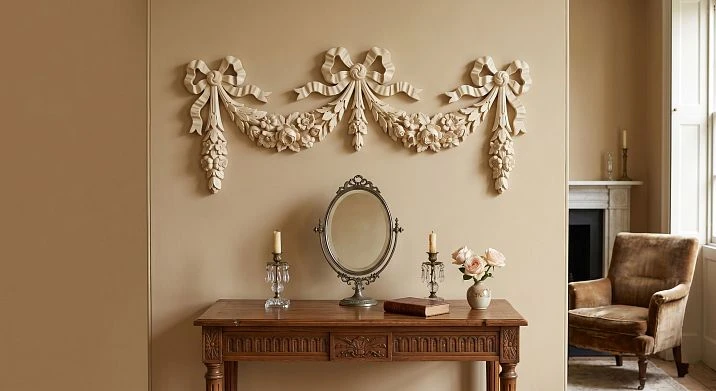
When you hear the word "garland," your imagination immediately conjures up strings of bulbs or paper chains for a holiday. But in the world of classic interior decor, the word "garland" carries a completely different meaning — more ancient, more noble, and infinitely more significant for the space. Decorative polyurethane garland or carved wood — it is a relief ornamental overlay with a floral, ribbon, or drapery motif, which has been used for centuries to decorate furniture, wall panels, fireplace portals, frames, and doorways. It is what turns an ordinary dresser front into an object with history, and a wall panel into an architectural accent.
In this article, we will break down everything you need to know before buying: how a polyurethane garland overlay differs from a wooden one, which material to choose for a specific task, how to properly select the size, finish, and installation method — and what mistakes to avoid in advance.
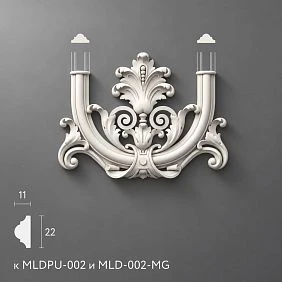
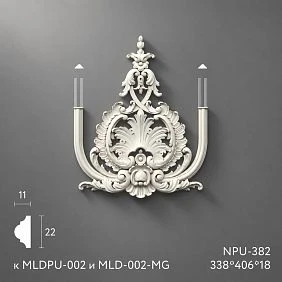
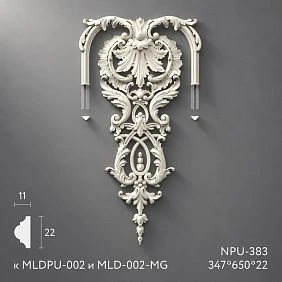
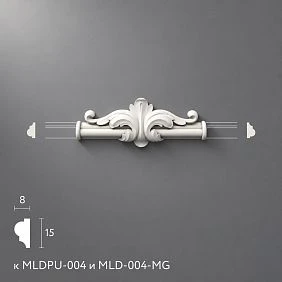
What is a decorative garland in stucco and carved decor
In the classical system of ornament, the garland holds a special place. It is not just a "beautiful curl" — it is a complete decorative motif with a history, proportions, and its own logic of application. The garland as an element of stucco decor came from antiquity: Greek and Roman masters used it on temple friezes, sarcophagi, altars, and villa facades. Later, this motif was adopted by the Renaissance and Baroque, Empire and Classicism — each era reinterpreted the form but preserved the essence.
The essence is simple: a garland is a relief composition of flowers, leaves, fruits, ribbons, or a combination thereof, stretched into a horizontal strip or arc. In the interior, it works as a visual accent that "pulls together" the space: it sets the rhythm, fixes the gaze, and creates a sense of completeness. That is why Molded decor for furniture — garlands, rosettes, cartouches — makes the interior visually more expensive, even when it itself is inexpensive.
It is important to distinguish: a garland is not a molding. A molding is a linear profile, a frame element that divides a plane. A garland is an ornamental insert placed inside a frame, above an opening, on a facade, or as an independent accent. A rosette is a symmetrical central element. A cartouche is a framed field for an inscription or coat of arms. A bracket is a supporting element. A garland, however, is movement, plasticity, rhythm, the life of the ornament.
Where is this element appropriate? Primarily in interiors with a historical character: classic, neoclassical, Empire, Baroque, palace style. But modern neoclassicism and even transitional styles — "quiet classicism," intimate Art Deco, postmodern work with historical details — also readily use Decor for a classic interior garlands. The main thing is to understand why and where.


Polyurethane garland: when it is the best choice
Polyurethane in interior decor is a material that has long proven its worth. It does not need to be defended against skeptics: it is enough to see how accurately it conveys relief, how stable it is in a residential environment, and how convenient it is to install. We are talking about high-density rigid polyurethane, from which they cast polyurethane molding with clear, well-developed details.
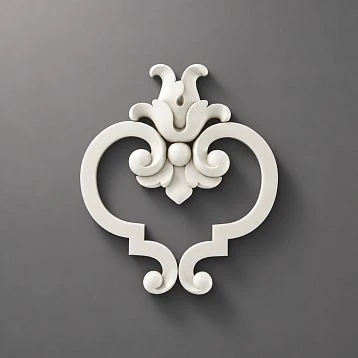
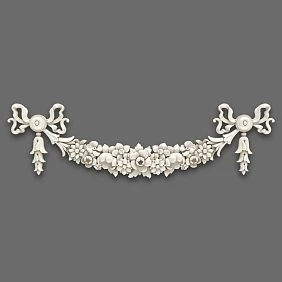
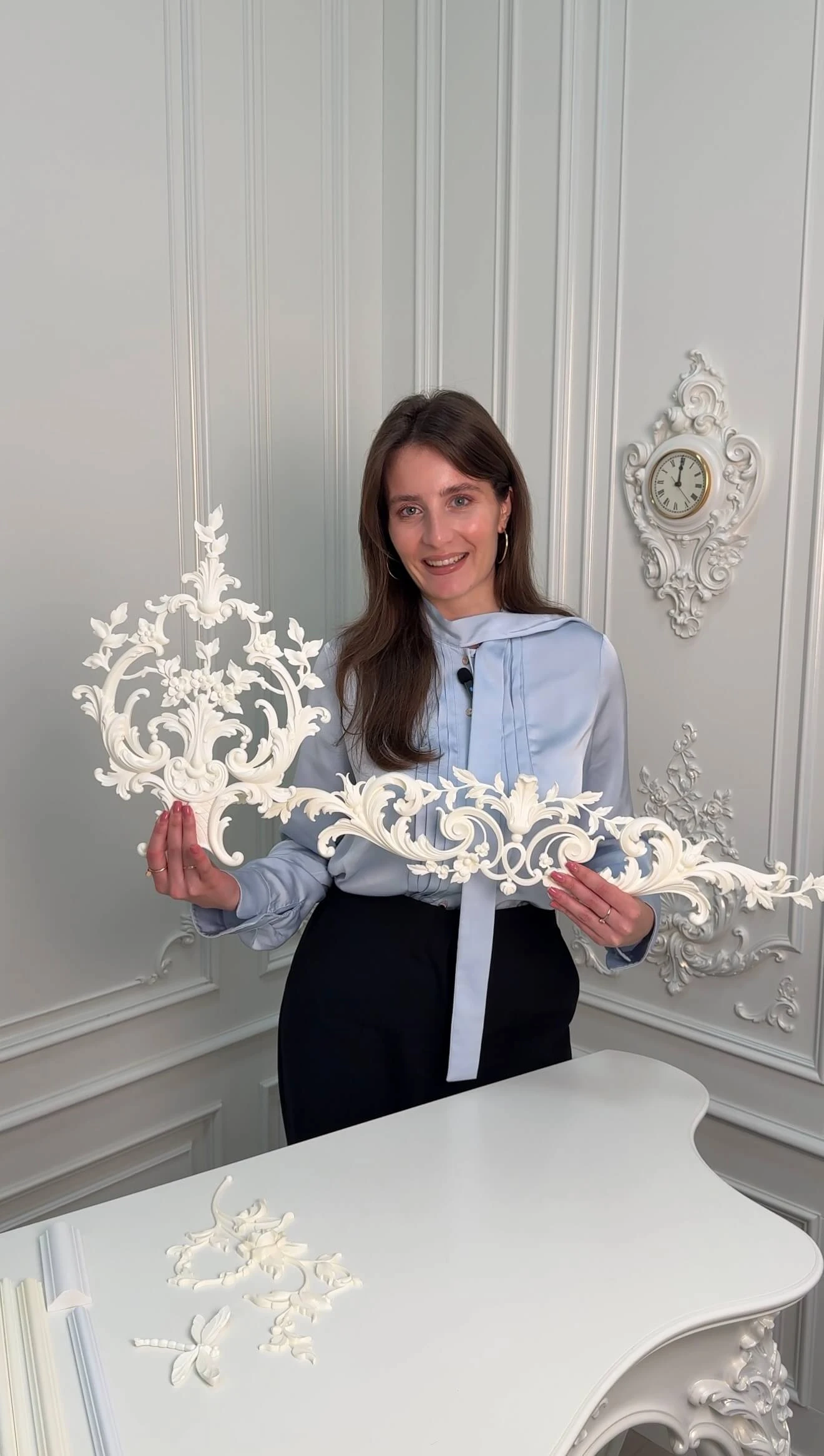
Decorative polyurethane garland NPU-043 is a large expressive overlay with rich relief and a classic floral ornament. The product is available in two sizes: 424 × 130 × 20 mm and 500 × 139 × 20 mm. The 20 mm thickness provides good relief depth — the detail does not look like a flat appliqué, it reads as real stucco. The price starts from 4,980 ₽, production time to order is 3–7 days, Contact us to confirm shipping to your destination. via CDEK.
Where is NPU-043 used? First of all, where scale is needed. A wall panel with a molding frame — the garland fits inside and becomes its center. A fireplace portal — a horizontal insert above the firebox or in the center of the frieze. A large decorative frame for a mirror or painting. A door portal — an insert in the above-cornice field. This decor for a fireplace portal and monumental interior zones where expressiveness visible from a distance is needed.
Polyurethane is lighter than wood at a comparable size, does not react as critically to humidity changes as solid wood, paints well and accepts any finish: enamel, patination, imitation gilding, bronzing. For large interior projects this is especially important — you can set a single tone for the entire stucco program, including Moldings made of polyurethane, cornices, rosettes, decor for moldings — and the garland will fit organically into this system.
Another argument in favor of polyurethane: ease of installation. The part is glued with assembly glue — Tytan, KUDO High Tack or equivalent — without drilling, without fasteners, without the risk of damaging the wall. On a prepared, clean, dry base — be it plaster, drywall or MDF — the overlay holds securely. After installation, the joints are puttied and painted if necessary.
If you are working on a classical or neoclassical project where a large-scale stucco program is important, where walls should "speak" and a portal or panel should impress, a polyurethane garland is your choice without a doubt.
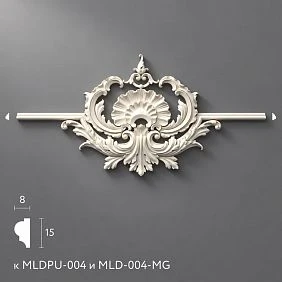
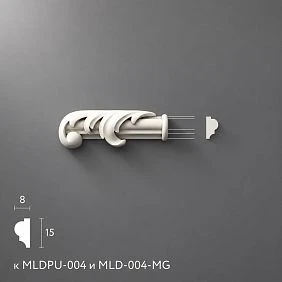
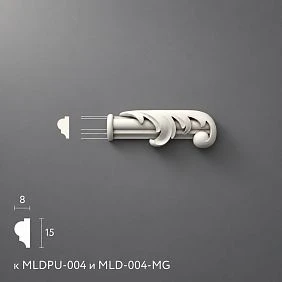
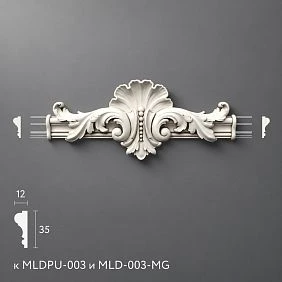
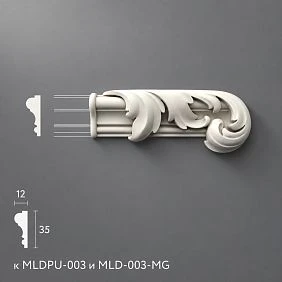
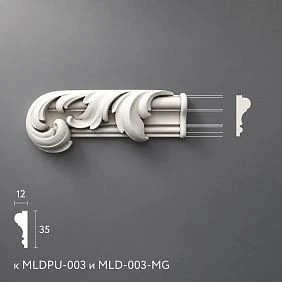
Our factory also produces:


Carved wooden garland: when it is better to choose natural material
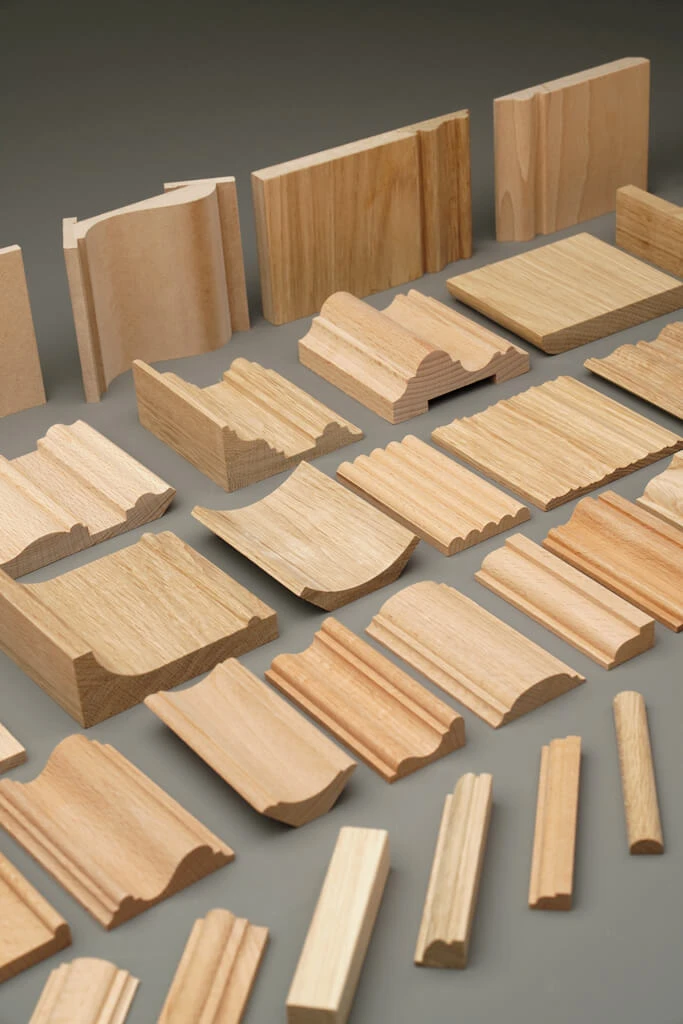
There are situations when polyurethane does not give the desired result — and it is not about quality, but about the task. If we are talking about furniture, thin facade inserts, a small mirror frame or a neat carved accent on a chest of drawers in Provence or classic style — you need carved wooden garlandThe tree here wins not only visually but also physically: it is thinner, more delicate, and more "furniture-like" in scale.
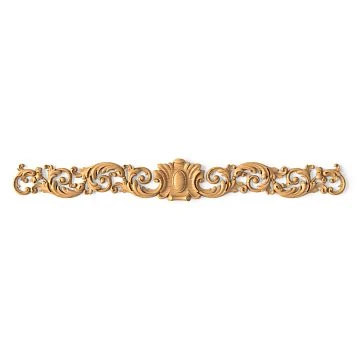
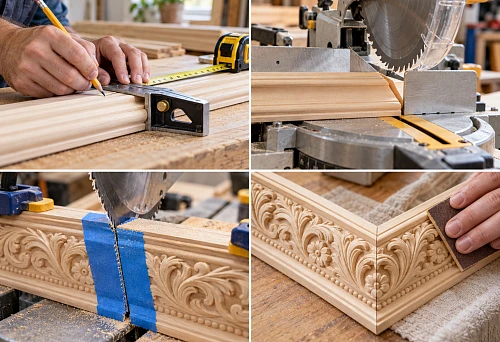
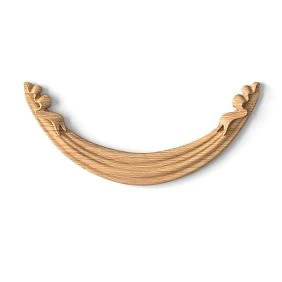
Wooden Decor N-079-1 — this is exactly such a detail. A compact carved overlay with an ornamental motif in the form of a ribbon-like plant pattern, made from beech or oak. Available in three sizes: 111 × 49 × 6 mm, 166 × 73 × 9 mm, and 211 × 93 × 11 mm. Thickness from 6 to 11 mm — the detail is truly thin, designed specifically for furniture use, to fit neatly into the facade without feeling overloaded. Price starts from 1,420 ₽.
Two materials — beech and oak — offer fundamentally different finishing possibilities. Beech is dense, non-porous, homogeneous wood with a fine texture. It is chosen when the finish coating is a dense enamel: it will lay evenly without emphasizing pores, resulting in a smooth and professional facade. Oak is porous, with a pronounced natural texture and characteristic grain. It is chosen for tinting, varnish, stain — where it is important to preserve the liveliness of the wood, its "breath," the individuality of each detail.
Two sanding options — "Standard" and "Prestige" — determine how ready the detail is for finishing immediately upon receipt. "Standard" sanding is machine processing at a reasonable price, a good choice for large runs and projects where the finish coating still requires additional surface preparation. "Prestige" sanding is manual detailed processing: the detail requires no further work, ready for priming and applying the finish almost immediately.
Two options for gluing the blank — "for enamel" and "for tinting" — are about how the lamellas are glued together inside the product. "For enamel" — without matching by color and texture, with possible contrasting joints that will still be hidden by opaque paint. "For tinting" — with matching lamellas by tone and texture, so that the semi-transparent coating does not reveal the "patchwork" nature of the product. This is an important nuance that directly affects the result — and it needs to be considered before purchase, not after.
Wooden Decorative wooden inlays combine well with other carved decor elements in a unified wood-furniture program: you can select overlays, legs, handles, rails in the same material and finish — and achieve a truly cohesive look.
Get Consultation
Polyurethane or wood — what to choose
This question arises for everyone who first encounters the choice of a decorative overlay. There is no definitive answer — and this is not an excuse, but an honest expert position. The right choice depends on the specific task: where the detail is installed, what the surface is, what scale, what finish is planned.
Comparison of materials for decorative garland
| Criterion | Polyurethane garland (NPU-043) | Wooden garland (N-079-1) |
|---|---|---|
| Best use | Walls, portals, large interior zones | Furniture fronts, frames, small accent decor |
| Visual scale | Large relief, expressive stucco | Intimate detail, delicate carving |
| Available sizes | 424×130×20 mm, 500×139×20 mm | 111×49×6 mm, 166×73×9 mm, 211×93×11 mm |
| Finishing | Painting (enamel, patina, gilding) | Enamel (beech), tinting/lacquer (oak) |
| Material | High-density polyurethane | Beech or oak |
| Starting price | from 4,980 ₽ | from 1,420 ₽ |
| Production time | 3–7 days | 3–10 business days |
| When to choose | Need lightweight interior molding with deep relief | Need a natural wooden part for furniture |
Practical guideline: if you are working on a wall, portal, niche, or large-scale decorative frame — look at NPU-043. If you need an accent on a furniture facade, for a small mirror frame, or for a decorative insert in a cabinet or dresser panel — take N-079-1. If the project involves both furniture and walls — you can use both elements, distributing them wisely across zones.
Where to use a decorative garland
A garland is an element with a wide range of applications. But "wide range" does not mean "everywhere and anyhow": each location dictates its own requirements for size, material, and installation method.
On furniture facades
Chest of drawers, wardrobe, sideboard, console, cabinet, classic banquette with paneled doors — all these items potentially benefit from a decorative overlay on the facade. The wooden garland N-079-1 is unrivaled here: it is designed specifically for this scale. The size 111 × 49 mm is suitable for small central inserts in narrow vertical facades, 166 × 73 mm is a universal option for medium doors, 211 × 93 mm is readable on large facades of wardrobes and sideboards.
Important: Decor for furniture facades should be proportionate to the facade itself. A too large detail on a small facade creates an overload effect — it seems that the furniture is "screaming". A too small detail on a wide facade gets lost and looks random. The rule is simple: the height of the overlay should not exceed approximately 1/3 of the facade height, and the width should occupy no more than half the width.
On a wall panel
A wall panel framed with of polyurethane moldings, is one of the most effective techniques in a classic interior. The garland here works as a central accent: it is placed inside the frame, in the middle of the upper or lower field, creating a focal point for the eye. NPU-043 with a size of 500 × 139 mm creates enough visual weight to "hold" the panel even at a height of 3+ meters.
A polyurethane stucco garland for the wall is good because it fits perfectly into the decor system: you can match it with Decor for Molding from the same program, maintaining a unified style and proportions. Walls where stucco works as an architectural element are not retro or kitsch: it is a competent creation of a rich visual field.
On a fireplace or door portal
A fireplace portal is where classical decor truly shines. The horizontal frieze above the firebox, the architrave above the portal, the central insert in the keystone — all are legitimate positions for a decorative garland. Stucco decor for the portal Polyurethane is preferable here: scale, durability, ease of installation on plaster or stone bases.
A door portal follows a similar logic: a garland above the opening is a "crown" that completes the vertical axis. In doorways of classical interiors, a horizontal garland overlay is placed in the center of the above-cornice field. The 500 mm size covers a significant part of the door frieze of standard width, while the 424 mm size is a more intimate option for narrow openings.
On the mirror frame
Mirrors in classical interiors are not just reflective surfaces but full-fledged architectural objects. The mirror frame can feature moldings, corner inserts, central accents — and a garland is appropriate as an accent element at the bottom or top of the frame. The wooden overlay N-079-1 measuring 166 × 73 mm is a delicate option for medium-scale frames. The polyurethane NPU-043 is suitable for large frames in formal areas where expressiveness is important.
How to choose the size
A size mistake is the most costly mistake when buying decor. Order, receive, try — and find that the detail either gets lost or overwhelms everything around. To avoid this, you need to work with actual measurements and understand a few basic principles.
The length of the overlay determines how horizontally "strong" the detail is. For a medium-width furniture facade (300–500 mm), a detail of 111–166 mm is sufficient. For wide facades (600–900 mm), a 211 mm wooden overlay or polyurethane NPU-043 424/500 mm depending on proportions. For wall panels 600–900 mm wide, a 500 mm polyurethane garland fills the field expressively without creating a sense of deficiency.
The height of the overlay is important for balance. NPU-043 with a height of 130–139 mm is a detail with serious "weight": it is noticeable, readable from a distance, and requires corresponding space around it. Wooden overlays with a height of 49–93 mm are an intimate format that works well as a furniture detail or a small wall accent.
Thickness is a parameter often ignored. 20 mm for a polyurethane product is a deep, expressive relief that creates shadows and plasticity. 6–11 mm for a wooden overlay is thin, delicate carving that works up close, does not "protrude" from the furniture surface, and does not conflict with hardware.
Practical tip before ordering: draw the part to scale on a sheet of paper and hold it against the surface. This takes five minutes but eliminates a mistake that cannot be fixed afterward.
How to choose the finish
The finishing question is not the final one, but one of the first. It is precisely how you plan to coat the part that determines the choice of material and blank option. You need to start from the end: what finish will the product have?
Polyurethane molding is universal in this sense: it accepts any water-dispersion or alkyd enamel, patina, stone-effect paint, plaster imitation, or gilding. The surface of polyurethane is fine-porous and neutral — primer will apply without issues, the topcoat will not absorb unevenly. For historical interiors, polyurethane Polyurethane moldings is often painted in "dirty white" or "ivory" with a light patina in the recesses of the relief — this is very authentic and beautiful.
A wooden overlay requires a more careful approach. If the finish is a dense enamel: choose beech, the "for enamel" option. Beech is non-porous, enamel will lay evenly, lamella joints will be hidden under the opaque coating. If the finish is varnish, oil, stain, tinting, including two-tone with brushing: choose oak, the "for tinting" option. Oak with a pronounced texture will come alive under a semi-transparent coating, each detail will be unique.
The scheme for applying the topcoat: dust removal after sanding → even priming → matting (light sanding of the primer for adhesion) → topcoat in 2 layers with interlayer drying. This is the standard sequence for wooden wooden carved decoration, which ensures an even, durable result.
One of the common mistakes is buying "for tinting" but painting with enamel. As a result, mismatched lamellas start to "show through" under an insufficiently dense coating. Or, conversely, choosing "for enamel" and then trying to tint — tonal joints turn into spots. Therefore, planning the finish before purchase is not a perfectionist's whim, but a practical necessity.
Installation of decorative molding
Installing a decorative overlay is not a complicated process, but it requires precision and consistency. Several principles determine the quality of the result.
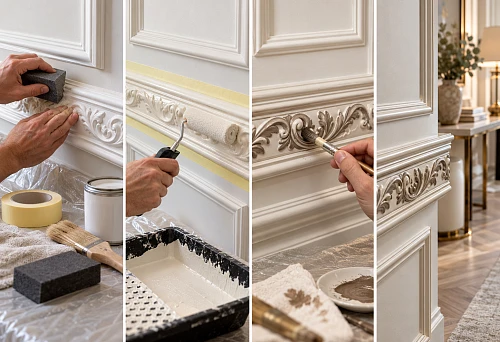
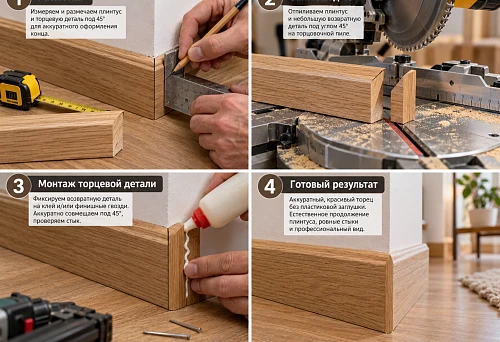
First — marking. Before opening the glue, you need to determine the exact position of the part on the surface. Find the central axis of the facade or wall panel — these are horizontal and vertical lines that intersect at the ideal center point. The garland should be positioned symmetrically relative to this axis. A small pencil mark at the points corresponding to the edges of the part is sufficient.
Second — dry fitting. Attach the part without glue, make sure the position is correct, and evaluate the overall appearance. This is where it becomes obvious if the size is poorly chosen or the axis is shifted. Correcting before installation is easy. Afterward, it is impossible without leaving traces.
Third — choosing the glue. For polyurethane decor, mounting adhesives based on hybrid polymers work well — for example, KUDO High Tack or Tytan Prof Classic Fix. For wooden overlays on MDF furniture facades, woodworking PVA or mounting glue is suitable. Apply glue to the part, press it to the surface, remove it for 3–5 minutes — and then fix it finally, holding for 5–10 seconds. This "open time" technique ensures reliable bonding.
Fourth — surface preparation. The surface must be clean, dry, free of dust and grease. MDF and solid wood are neutral bases. Plaster — you need to ensure it is not crumbling. Drywall is an acceptable base, the glue holds well. Oily coatings or surfaces with silicone primer require mechanical cleaning.
Fifth — wooden overlays are especially delicate during installation: a thin part of 6 mm can crack under excessive pressure. Press evenly, without point pressure. Do not use heavy clamps without pads.
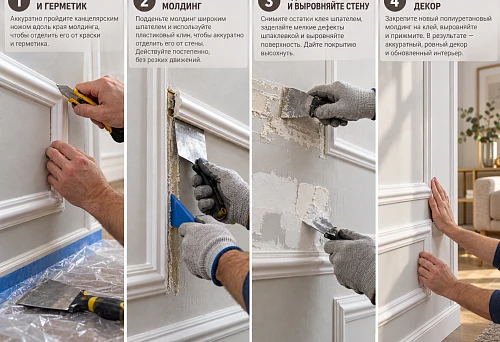
After installation — puttying joints if necessary, smoothing transitions, and final painting. If the part is mounted on an already painted surface, it is important to then "blend" it into the overall tone, leaving no visible boundary between the overlay and the background.
Detailed recommendations on installing polyurethane molding are provided in a separate article — it covers the nuances of working with different bases and types of adhesive compounds.
Typical mistakes when buying a decorative garland
Over the years of working with classic decor, these mistakes keep recurring — regardless of the project level or the client's experience.
-
Choosing an overlay based only on a photo without checking the dimensions. The picture in the catalog doesn't convey the actual scale of the piece. Always take measurements and compare them with the product's dimensions.
-
Ignoring the relief thickness. 6 mm and 20 mm are fundamentally different in terms of the 'in-material' feel. A piece with deep relief on a thin furniture facade can conflict with the hardware.
-
Mixing materials without understanding the task. You can use a polyurethane overlay on a furniture facade, but you need to understand that it will visually appear 'heavier' than a wooden one.
-
Buying a large garland for a small facade. NPU-043 with a height of 130–139 mm on a facade 400 mm high will take up a third of the surface — that's too much for most furniture solutions.
-
Using a small piece on a large wall panel. A wooden overlay of 111 mm on a wall panel 1.5 m high will simply get lost.
-
Not planning the finish in advance. Choosing a blank 'for enamel' or 'for tinting' is a decision made before purchase, not after receiving the product.
-
Not considering the base material. Mounting on loose plaster without strengthening with primer will result in unreliable fastening — the piece may come off.
-
Installing without marking the central axis. A shift of 5–10 mm is immediately noticeable to the eye — symmetry is mandatory in classic design.
-
Placing a garland in isolation, without connection to the rest of the decor. An overlay not linked to moldings, a frame, or the spatial axis looks random.
-
Do not schedule production and delivery into the project timeline. The lead time of 3–7 days plus delivery must be accounted for in the installation schedule, especially for project-specific purchases.
Practical Tips for Selection and Application
If we systematize everything said into actionable recommendations, the result is as follows:
-
First, determine the location: wall, portal, furniture facade, mirror frame, door portal — everything else depends on this.
-
For large interior zones and wall panels, choose the polyurethane garland NPU-043 — it maintains scale and creates an expressive relief.
-
For furniture, frames, and delicate details, choose the wooden overlay N-079-1 — it is proportionate to the furniture facade and provides a natural texture.
-
Plan the finish before purchase: if enamel — beech "for enamel", if tinting — oak "for tinting".
-
Combine the garland with moldings, rosettes, and cornices from the same program — Polyurethane wall decor it works well as a system.
-
Always mark the central axis before installation.
-
For symmetrical compositions — mirror placement of two parts relative to the center.
-
Don't overload the space: a garland as an accent works better than garlands as a "background."
-
For project purchases, immediately clarify availability, production time, and delivery conditions.
-
If the project includes both furniture and walls, use both materials, distributing them wisely according to the tasks.
Why you should choose STAVROS
interior decor store Stavros — this is not just a catalog of items. It is a company with a history that began in 2002 in St. Petersburg, when two artists created a workshop for carved wood decor. Within a year, the team participated in the reconstruction of the Constantine Palace in Strelna, and later in work at the Hermitage, the Alexander Palace, the Trinity-Izmailovsky Cathedral, and other cultural heritage sites.
Decorative Elements for Interior from STAVROS cover both material programs: polyurethane stucco decor and natural carved wood decor. This means that for a comprehensive project, you can select wall stucco, furniture decor, and related elements — moldings, rosettes, cornices, molding decor, legs, handles — from one supplier, in a unified aesthetic logic.
The assortment is designed for different categories of customers: designers and decorators will find professional tools for comprehensive solutions, furniture makers — PU overlays and wooden decor for facades, private buyers — the ability to order from 1 piece with Contact us to confirm shipping to your destination. via CDEK. Showrooms are located in St. Petersburg and Moscow — you can come, see the details in person, compare materials and textures.
STAVROS stucco and carved decor — this is also reliability in terms of timing and quality: in-stock items are shipped within 3 business days after sanding and packaging, custom production takes 3–10 business days depending on the item. For project purchases, this is important: timelines are predictable, risks are minimal.
FAQ: answers to popular questions about decorative garlands
What is a decorative garland in stucco decor?
It is a relief overlay with floral, ribbon, or drapery ornamentation, used as a decorative accent on furniture, walls, portals, frames, and doorways. Unlike New Year's or floral garlands, this is a historical element of classic interiors, originating from ancient architecture.
Where is a polyurethane garland used in interiors?
On wall panels, fireplace and door portals, decorative frames, niches — anywhere a large-scale expressive accent is needed. The polyurethane garland NPU-043, with dimensions of 424–500 mm, is suitable for large interior zones.
How does a polyurethane garland differ from a wooden one?
In scale, material, and purpose. Polyurethane is larger, lighter, for walls and portals, and can be painted any color. Wooden is more delicate, compact, made of natural beech or oak, for furniture and small decorative areas.
What is better to choose for furniture: polyurethane or wood?
For furniture facades, frames, and thin decorative inserts — the wooden overlay N-079-1. It is proportionate to furniture scale, provides a natural texture, and fits organically into the furniture program.
Can a decorative polyurethane garland be painted?
Yes, polyurethane accepts water-dispersion and alkyd enamels, acrylic paints, patina, and imitation gilding well. It is important to prime the surface beforehand for better adhesion.
Is a carved wooden garland suitable for enamel coating?
Yes, but only the beech version "for enamel." Beech is non-porous, so the enamel will lay evenly. Oak is less suitable for enamel — its porous texture will show through the coating. Oak is chosen for tinting, varnish, or oil.
How to choose the size of a decorative overlay?
Base it on the surface dimensions: the height of the overlay should not exceed 1/3 of the facade or panel height. For furniture facades 300–500 mm wide, wooden overlays of 111–166 mm are suitable. For large wall panels, a polyurethane garland of 424–500 mm.
How to order a decorative STAVROS garland with delivery?
On the website stavros.ru select the desired item — NPU-043 or N-079-1 — specify the size, sanding and finishing option, place the order. Contact us to confirm shipping to your destination. via CDEK, from 1 piece. Production time — 3–10 business days depending on availability.
Choose a decorative garland for your project's task: polyurethane for expressive interior stucco on walls and portals, wooden for furniture, frames, and natural carved trim. In the STAVROS catalog, you can select the size, material, sanding and finishing option, as well as all related elements — moldings, rosettes, cornices, decor for moldings — to create a cohesive classical composition. Production in St. Petersburg, Contact us to confirm shipping to your destination., showrooms in both capitals.