









































































Article Contents:
- What are decorative overlays and why are they needed
- Where decorative overlays are used
- On Furniture Facades
- On walls and wall panels
- On doors and portals
- On mirrors and frames
- Polyurethane overlays — when it's the best choice
- Carved wooden overlays — when to choose solid wood
- Polyurethane or wood — which to choose
- Material comparison: polyurethane and wood
- How to choose the size of a decorative overlay
- How to choose an overlay style
- Classic
- Neoclassicism
- Palace interior
- Modern classicism
- How to avoid mistakes when buying decorative overlays
- What to buy together with decorative overlays
- Why it's convenient to choose decorative overlays at STAVROS
- FAQ: answers to popular questions about decorative overlays
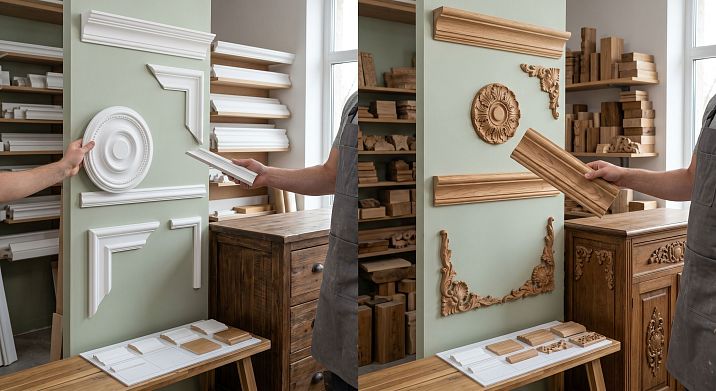
But as soon as the conversation turns to selection, a fork arises: polyurethane or wood? Stucco decor or carved detail? Overlay for a wall or for furniture? This article is not a theoretical overview of materials, but a working selection tool. Here we will break down where and which overlays work, how the two materials fundamentally differ, how to avoid mistakes with size, finish, and composition — and why a properly chosen overlay can change the perception of an entire space.
But as soon as the conversation turns to choice, a fork arises: polyurethane or wood? Molded decor or carved detail? Wall overlay or furniture overlay? This article is not a theoretical overview of materials, but a working tool for selection. Here we will break down where and which overlays work, how the two materials fundamentally differ, how to avoid mistakes with size, finish, and composition — and why a properly chosen overlay can change the perception of an entire space.


What are decorative overlays and why are they needed
A decorative overlay is a ready-made three-dimensional element with a relief surface that is installed on a plane: furniture facade, wall panel, door leaf, fireplace portal, mirror frame, architrave, or ceiling niche. Unlike molding, which creates lines and frames, the overlay works as an ornamental accent — it fixes the gaze, sets the theme, and introduces a semantic center to the surface.
Why is this practically needed? First, it is the most economical way to transform ready-made furniture or a wall without a complete overhaul. An MDF chest of drawers with smooth doors, after installing a wooden carved overlay, acquires a handcrafted character. A wall panel with a molding frame and a polyurethane overlay inside begins to read as an architectural element, not just a painted wall. Second, overlays are a stylization tool. Classic, neoclassical, Empire, Baroque, French Provence, palace interior — each of these styles has its own ornamental language, and a properly chosen overlay speaks that language accurately.
The practical aspect of accessibility is also important: molded decoration made of polyurethane и Carved wooden decoration you can order individually, choose the desired size and finish, get delivery across Russia — and install it yourself or with a craftsman. This is not a restoration project with plasterers and a six-month estimate. This is a specific detail, a specific application, a specific result.
Finally, overlays are a way to create a system. One element on a dresser works as a detail. Three elements on three sections of a sideboard — that's already a rhythm. An overlay on a wall panel surrounded by moldings — that's already interior architecture. It is in this systematic nature that the true value of decorative overlays for furniture and walls lies.




Where decorative overlays are used
Before choosing the material and model, you need to answer the first and main question: where is the overlay placed? The location determines the scale, material, type of relief, and method of attachment. Let's break it down by zones.
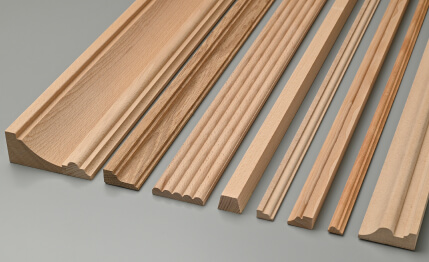
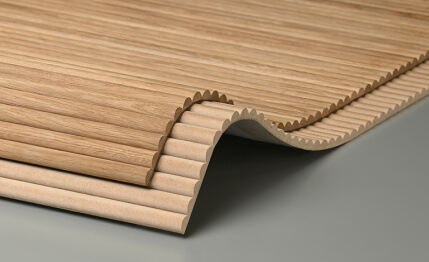
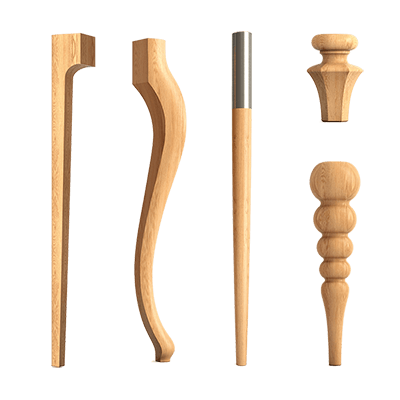
Our factory also produces:


On furniture facades
Furniture is the most "personal" place for a decorative overlay. A wardrobe, dresser, nightstand, sideboard, console, classic bed with a headboard, decorative shelf — all these objects potentially benefit from overlay decor on the facades. The principle of proportionality applies here: the detail should fit the scale of the facade without overloading it.
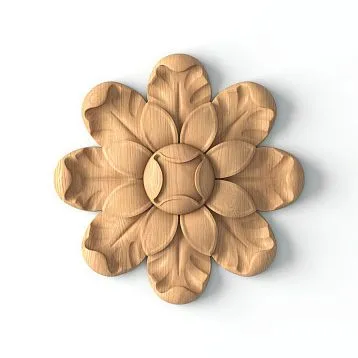
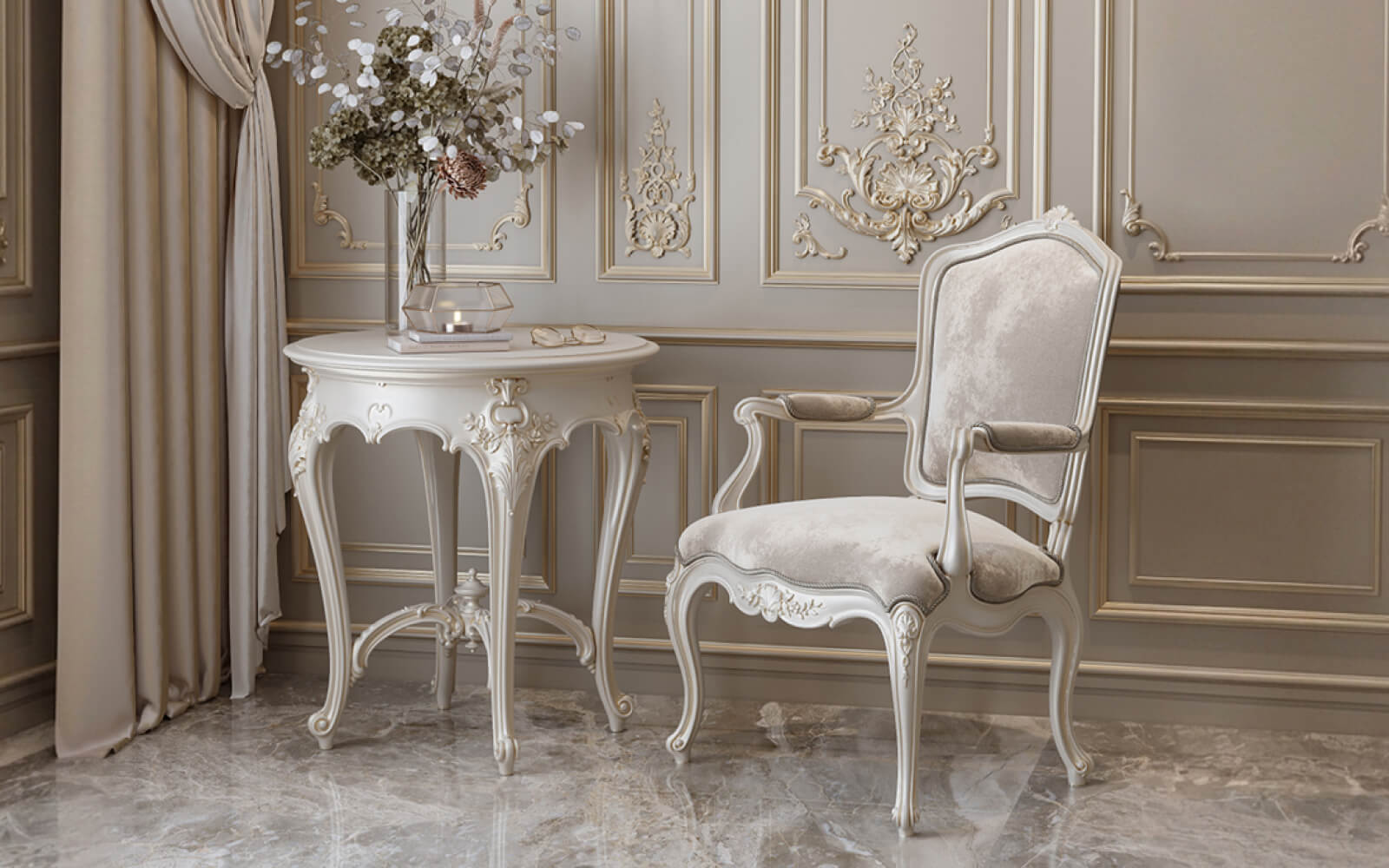
Wooden carved appliqués — the optimal choice for furniture. They are thin (from 6 mm), compact, made from beech and oak, and accept any finish well — enamel, varnish, stain, oil. For classic furniture made of MDF or solid wood, a wooden overlay creates an organic look: it seems as if it was originally part of the piece, not added later.
Polyurethane overlays are also used on furniture, but where a more expressive relief and larger scale of detail are needed: on large wardrobes, sideboards, shelving units, decorative consoles in formal areas. PU overlays are painted in the color of the facade and are perceived as a single whole with the surface.
Get Consultation
On walls and wall panels
The wall is the largest canvas for decorative overlays. The range of applications here is wide: a central accent within a frame of moldings, a horizontal insert in a wall panel, an ornamental element above a console or fireplace, a decorative field in a niche.
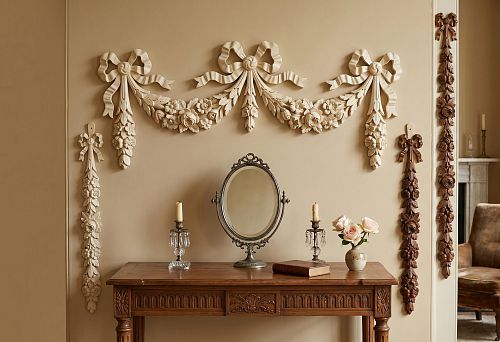
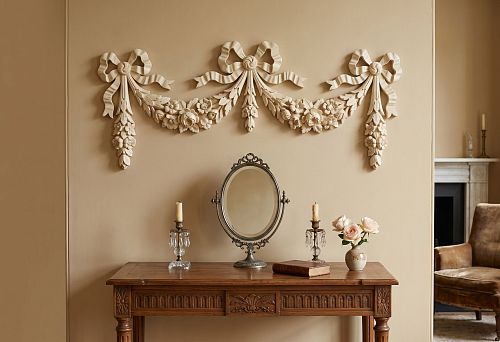
For walls Polyurethane wall decor — the preferred choice for several reasons. Polyurethane overlays are large enough to be read from a distance. They are lightweight, eliminating the risk of detachment on a carefully prepared surface. They accept paint well in the color of the wall — this allows the detail to "blend" into the background, creating an architectural effect without a contrasting accent. Finally, polyurethane is resistant to deformation from temperature and humidity fluctuations, which are inevitable in a living space.
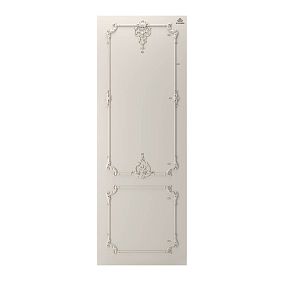
For wall panels, the overlay works as a central ornamental element: a frame of of polyurethane moldings creates structure, and the overlay inside provides its semantic content. Such a system looks expensive and well-thought-out.
On doors and portals
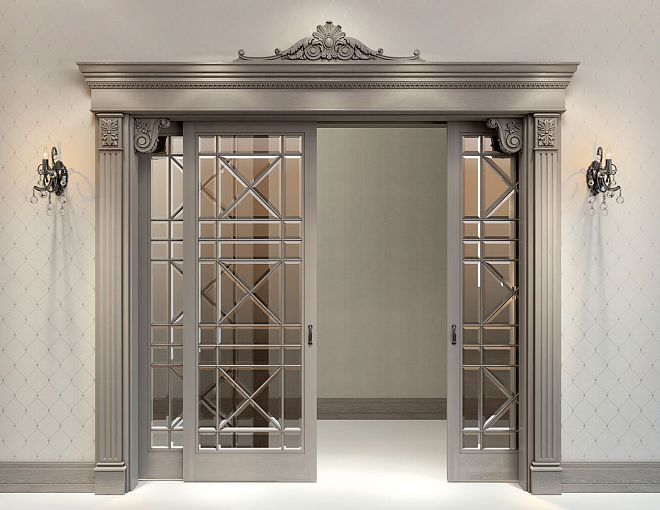
Door leaf, door casing, fireplace portal — these are areas with high visual impact where decor works especially effectively. Overlays are used here in two ways: as insert elements in a door panel (primarily wooden, for joinery products) and as stucco accents on portals and frames (primarily polyurethane, for large architectural zones).
On a fireplace portal, the overlay is traditionally placed in the central part of the frieze — the horizontal strip above the firebox. This is the "crown" of the entire composition, setting its stylistic tone. For door portals, the overlay above the opening works as a keystone: it fixes the center and emphasizes the vertical axis of the entrance.
Wooden carved overlays on solid wood door panels are a classic joinery solution that turns a standard door into a custom piece. STAVROS carved decor in this context means that the door and decor can be made of the same material and finish, without visual discontinuity.
On mirrors and frames
A mirror in a classic interior is not a household item, but an architectural object. The mirror frame can feature moldings, corner inserts, central accents — and an overlay is appropriate here as an ornamental detail in the lower, upper, or central part of the frame.
A small wooden carved overlay is a delicate and suitable option for medium-scale frames. It does not overload the mirror and preserves the visual lightness of the frame. A polyurethane overlay is for large mirrors in formal areas, where the frame itself is a sculptural object.
Polyurethane overlays — when they are the best choice
Discussing polyurethane decor requires immediately dispelling a prejudice: polyurethane in stucco is not a "cheap replacement for plaster" or an "imitation of wood." It is an independent material with its own technological advantages, which in a number of tasks make it simply indispensable.
High-density rigid polyurethane accurately reproduces the relief of the mold: fine details, thin petals, intertwined stems — all of this is conveyed clearly, without blurring. At the same time, the product weighs significantly less than its plaster counterpart, which simplifies installation and reduces the load on the base. The surface of polyurethane is fine-porous, neutral — it accepts primer and any type of finish coating well.
Polyurethane decorative appliques at STAVROS are presented as a separate product category. One of the key elements is a carved overlay NPU-043 in the form of a decorative garland with a classic floral ornament. The product is available in two sizes: 424 × 130 × 20 mm and 500 × 139 × 20 mm. The thickness of 20 mm provides expressive depth of relief — the detail casts shadows and reads vividly, not like a flat appliqué. Price — from 4,980 ₽, production to order — 3–7 days, delivery across Russia via CDEK.
When is a polyurethane overlay obviously the right choice? The answer to this question is based on several criteria. First — scale: if the detail is intended for a wall, portal, or large decorative field where expressiveness from a distance of 2–3 meters is needed, polyurethane performs better. Second — painting: if the finish is a dense enamel in the color of the wall, patina, or imitation of stone, the polyurethane base gives a uniform result without "showing through" the structure. Third — composition: if the overlay is part of a system with moldingscornices, decor for moldings and rosettes from the same material program, polyurethane is convenient because the entire system is painted in a single mode.
The installation deserves a separate mention. Polyurethane overlays are glued with assembly adhesive — no additional fasteners, no drilling. For plaster, drywall, MDF — this is an ideal option. The adhesive is applied to the part, left for a few minutes for open tack, the part is pressed — and after a few hours it cannot be moved.
Carved wooden overlays — when to choose solid wood
There is an argument that is hard to resist: natural wood. Not an imitation, not a textured coating, but a living material with its own history, smell, and tactility. Decorative wooden inlays — is exactly what it seems: solid wood carving, performed on professional equipment with hand finishing.
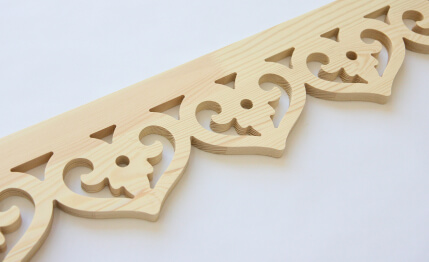
The key position in this category is the carved overlay N-079-1. This is a wooden overlay with an ornamental floral motif — like a decorative garland, but on a furniture scale. It is made from beech or oak in three sizes: 111 × 49 × 6 mm, 166 × 73 × 9 mm, and 211 × 93 × 11 mm. The thickness of the part is 6–11 mm, which makes it ideally proportioned for a furniture facade: it does not protrude, does not conflict with hardware, and fits organically into the plane of a door or drawer. The price starts from 1,420 ₽.
The choice between beech and oak is primarily a choice of finish. Beech is a homogeneous, non-porous wood with a fine structure. It is ideal for dense opaque enamel: the paint lays evenly, without emphasizing pores and texture irregularities. Oak has a pronounced grain, wide pores, and an individual 'face' for each part. It is chosen when it is important to preserve the natural character of the wood: for tinting, oil, stain, or varnish that highlights the texture.
Two sanding options add another degree of choice. 'Standard' sanding is machine processing; the part requires additional surface preparation before applying the finish. A good choice for workshops that will sand the overlay before painting anyway. 'Prestige' sanding is hand finishing; the surface is ready for priming and coating without additional manipulation. For private customers and small projects, this saves time and reduces the risk of errors in the final finish.
The 'for enamel' and 'for tinting' lamination options relate to the method of gluing lamellas inside the product. 'For enamel' — without matching by color and texture: possible contrasts between lamellas will be hidden by the opaque coating. 'For tinting' — with careful matching of lamellas by tone and pattern, so that the translucent coating does not reveal the 'seam' between the blanks. This is a technical nuance, but it directly determines the visual result — therefore, the lamination type is chosen strictly according to the planned finish.
Wooden overlays for furniture are especially advantageous in situations where the entire furniture piece is made of natural wood or high-quality MDF with wood veneer: the overlay becomes an organic continuation of the material, rather than a decorative 'foreign' element. For restoring antique furniture, for producing furniture in a classic style, for custom design projects with an emphasis on natural materials — wooden carved overlays are unrivaled.
Polyurethane or wood — what to choose
This question has no universal answer — and that's an honest stance. The right material is determined by the task, not preferences. Below is a practical table to help you decide without unnecessary doubt.
Material comparison: polyurethane and wood
| Task | Best material |
|---|---|
| Large wall composition | Polyurethane |
| Stucco decor for painting in wall color | Polyurethane |
| Furniture facade made of solid wood or MDF | Wood |
| Finish under dense opaque enamel | Wood (beech) or polyurethane |
| Finish under tinting with visible texture | Wood (oak) |
| Classic wall with molding frame | Polyurethane |
| Mirror frame, chest of drawers, sideboard, console | Wood |
| Fireplace portal or large-scale architrave | Polyurethane |
| Solid wood or MDF door with carving | Wood |
| Decor in a niche or accent panel | Polyurethane |
| Project for restoration of antique furniture | Wood |
| Decorative insert in a small frame | Wood |
There are also situations where both materials are appropriate in one project — and this is not a compromise, but a deliberate decision. The wall panel receives a polyurethane overlay as a central accent, and the nearby chest of drawers gets a wooden carved detail on the facade. Both elements are painted with the same enamel — and read as a single solution, although made from different materials. This works if the finish and scale are thought out in advance.
The main principle: polyurethane for interior scale, wood for furniture scale. If you need expressiveness from a distance — polyurethane. If you need delicacy up close — wood. If in doubt, first determine the location, then choose the material.
How to choose the size of a decorative overlay
Size is the most common cause of error. Choosing a beautiful overlay and ordering it without checking the proportions means risking a detail that either gets lost or overwhelms everything around. Here are a few working principles that eliminate this risk.
The first principle is scale relative to the base. For a furniture facade: the height of the overlay should not exceed 25–30% of the facade height. If a cabinet door is 600 mm, an overlay 150 mm high will look harmonious. An overlay 250 mm high is already too much. For a wall panel: the overlay should occupy no more than 40–50% of the field width inside the frame — otherwise it "suffocates" without space around it.
The second principle is the thickness of the relief in the context of the base. On a smooth MDF facade, an overlay 6 mm thick reads as a thin carved insert — elegant and appropriate. An overlay 20 mm thick on the same facade will already give a stucco effect — expressive, but requiring a larger object. On a wall, the difference between 6 mm and 20 mm is fundamental: the wall needs depth of relief, otherwise the detail simply won't be visible.
The third principle is the central axis and symmetry. In classic design, symmetry is mandatory. Before attaching the overlay, find the horizontal and vertical central axis of the base. The overlay should be located at their intersection or strictly symmetrical relative to one of the axes. A shift of 5–10 mm is visually noticeable — and ruins the entire impression.
The fourth principle is the distance to moldings and adjacent elements. If the overlay is inside a frame of moldings, you need to leave "air" around the perimeter: the distance from the edge of the overlay to the molding should be at least 30–50 mm on each side. A detail pressed tightly against the frame creates a feeling of crampedness.
The fifth principle is repeatability. If overlays are placed on several facades or several panels, they should be the same size and located at the same height. Visual rhythm is one of the main tools of a classic interior. Random variation in sizes destroys this rhythm.
Practical tool: before ordering, draw a template of the overlay at actual scale on thick paper — and apply it to the surface. This takes 5 minutes but eliminates costly mistakes.
How to choose an overlay style
The style of the overlay is not only a visual motif but also the logic of its application. Different stylistic contexts dictate different requirements for the shape, scale, and density of the ornament.
Classic
Classic ornament is built on symmetry, balance, and plant motifs — acanthus leaves, grapevines, laurel branches, floral garlands. Here, a dense, expressive detail with deep relief is appropriate. An overlay in a classic style is the center that "holds" the entire panel or facade. Polyurethane overlays handle classic interior tasks well — large relief reads convincingly. Wooden ones — for furniture classics with an emphasis on the naturalness of the material.
Neoclassicism
Neoclassicism is a more restrained version of classicism: the same principles of symmetry and plant ornament, but without Baroque overload. The overlay here works as a single accent within a clean frame. "Air" around the detail and neatness of the relief are important. For neoclassicism, a good option is when the overlay is painted the color of the wall or facade — it adds volume without creating a contrasting spot.
Palace interior
If the task is to create a grand, monumental space, the overlays should be large, relief, and part of complex multi-level compositions. Several types of decorative elements are used simultaneously here: cornices, moldings, rosettes, overlays, corner elements — and all of this comes together into the architectural program of the wall. molded decoration made of polyurethane in this case — the main material: it allows creating complex systems with a predictable result and without significant weight loads on the wall.
Modern classic
This is a style where classical techniques are used selectively, without total wall coverage with ornament. One overlay on a wall panel, one detail on a chest of drawers, one accent above the fireplace. Here, the overlay is painted in the color of the base and is perceived as an architectural detail, not decor in the usual sense. Neat relief, minimal thickness — and the effect is there, without overloading the space.
How to avoid mistakes when buying decorative overlays
Ten mistakes that occur in real projects — regardless of the client's level and the complexity of the interior.
-
Buying an overlay without checking the actual size. A photo in the catalog does not convey scale. Always compare millimeters with actual measurements of the base.
-
Not considering the thickness of the relief. 6 mm on furniture and 20 mm on a wall are fundamentally different things. Do not confuse them.
-
Choosing a detail that is too large for a small facade. An overlay 130 mm high on a door 350 mm high takes up a third of the surface — this visually overloads the product.
-
Placing a small overlay on a large wall. A wooden detail 111 mm inside a wall panel 1.5 m high will get lost — it simply won't be noticed.
-
Mixing wood and polyurethane without a unified finish. Two materials in one interior work only if the final finish visually equalizes them. Without this — inconsistency.
-
Do not plan finishing until after purchase. Choosing between "for enamel" or "for tinting" is a decision made before ordering. Changing your mind after receiving the wooden overlay is expensive.
-
Do not ignore the base material. Loose plaster, old oil paint, silicone primer — all of these reduce adhesive adhesion. The base needs to be prepared.
-
Do not install without preliminary marking. In classic design, there is no beauty without symmetry. Marking is a mandatory step, not optional.
-
Do not place the overlay as an isolated element without connection to moldings and adjacent details. A standalone overlay looks random. A system is needed: frame, axis, rhythm.
-
Do not fail to account for production and delivery in the schedule. Production time is 3–10 days plus delivery — that's at least 1–2 weeks. In a tight project schedule, this needs to be considered in advance.
What to buy together with decorative overlays
A decorative overlay never works in isolation. It is part of a system, and the system becomes truly expressive when its elements are chosen harmoniously. What should be considered alongside the choice of overlay?
Moldings made of polyurethane — the first and main addition. They create a frame around the wall panel, set the rhythm of horizontal and vertical lines, and define the field within which the overlay works. Without molding, the overlay on the wall is just a detail. With molding, it is the center of the architectural composition.
Decor for Molding — corner inserts and ornamental elements that are installed at the intersection points of moldings. They complete the frame and add decorative weight to it. Together with the overlay in the center of the panel — a complete classic wall program.
Cornices and baseboards from the same polyurethane program — vertical "anchors" of the space. The ceiling cornice and floor baseboard create the boundaries of the wall plane that the overlay decorates. This completes the vertical "section" of the interior from floor to ceiling. All these elements are available in the category polyurethane molding decoration.
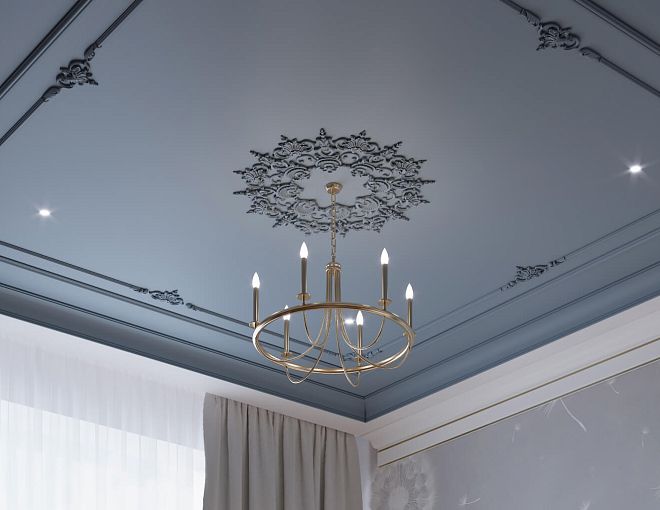
Rosettes — symmetrical round ornamental elements — are traditionally combined with garlands and overlays in a classic wall program. A rosette in the center of the ceiling field, a garland on the wall panel, moldings around the perimeter — these are the three pillars of a classic interior.
For wooden overlays, a logical addition is wooden furniture elements from the same program: legs, handles, slats, corner inserts. STAVROS carved decor — these are not only overlays, but also the entire range of wooden parts for furniture and joinery. Selection within a single material program creates a cohesive look.
Glue and mounting materials are the final line on the shopping list. For polyurethane elements: mounting adhesive based on a hybrid polymer (Tytan, KUDO, Soudal). For wooden furniture overlays: carpenter's PVA or specialized contact adhesive. The right glue is not an option; it is a guarantee that the decor will last a long time.
Why it is convenient to choose decorative overlays at STAVROS
The question of choosing a supplier for decorative overlays is not just about the assortment. It is about reliability, predictability, and professional context. What does "convenient" mean in relation to STAVROS?
Firstly, the catalog interior decoration Stavros presents both material programs: polyurethane stucco decor and wooden carved decor. This means that for a complex project, you don't need to contact different suppliers with different lead times, different packaging formats, and different quality standards. Everything is ordered in one place, coordinated by style and scale, and arrives in one shipment.
Secondly, the assortment covers not only overlays, but also everything needed to create a system: moldings, cornices, baseboards, rosettes, decor for moldings, corner elements, wooden overlays of various sizes and materials. This makes it possible to select elements into a single classical program — not based on the principle of "what was found," but on the principle of "what was intended."
Thirdly, production in St. Petersburg with a history since 2002 is not a marketing declaration, but a practical advantage. The company has gone through restoration projects at cultural heritage sites — the Konstantinovsky Palace, the Hermitage, the Alexander Palace — and understands what quality, precision, and compliance with the task mean. This experience is embedded in the production standard.
Fourthly, you can order from 1 piece with delivery across Russia via CDEK. This is important both for designers purchasing single elements for private projects and for furniture manufacturers working in series. Flexibility in volume is a serious competitive advantage. Showrooms in St. Petersburg and Moscow allow you to see the elements in person, compare textures, evaluate the relief, and make an informed decision.
FAQ: answers to popular questions about decorative overlays
Which decorative overlays are best for furniture?
For furniture facades, it is better to choose wooden carved overlays made of beech or oak — they are proportionate to the furniture scale, organically accept any finish, and create the feel of a natural, artisanal product. Polyurethane overlays are suitable for large furniture pieces — sideboards, consoles, decorative cabinets in formal areas.
Can polyurethane overlays be glued to a furniture facade?
Yes, polyurethane overlays are glued to MDF and solid wood. You need a construction adhesive with good adhesion to smooth surfaces. But it is important to consider the scale: polyurethane overlays are larger than wooden ones, and for standard furniture facades they may be excessive in size.
How do wooden carved overlays differ from polyurethane ones?
First of all — scale and material. Wooden ones are thin (6–11 mm), compact, made of natural beech or oak, for furniture tasks. Polyurethane ones are thicker (up to 20 mm and more), larger, for interior wall tasks. Both types can be painted, but polyurethane is more versatile in terms of finishing, while wood is more attractive with its natural texture.
Which overlays should I choose for enamel?
For dense opaque enamel, both polyurethane overlays and wooden beech overlays in the "for enamel" version are suitable. Beech is a non-porous material, the enamel will lay evenly, without textural irregularities.
Which overlays should I choose for tinting?
Only wooden ones, and necessarily in the "tinted" version — with lamellas matched by tone and texture. The preferred material is oak: its pronounced structure beautifully shows through a translucent coating.
Are decorative overlays suitable for wall panels?
Yes, and this is one of the best applications. A polyurethane overlay inside a molding frame is a classic technique for creating an architectural wall program. The detail is placed in the center of the panel, painted in the wall color or a contrasting color depending on the design concept.
Can wooden decor and polyurethane stucco be combined in one interior?
Yes — provided that the finish visually aligns them. If both materials are painted with the same enamel, their material difference disappears. If one element is tinted wood and the other is painted polyurethane, they will read as different details. The decision is made based on the design task.
How to choose the size of an overlay for a facade?
The height of the overlay should be no more than 25–30% of the facade height. The width should be no more than 50% of the facade width. For precise selection, draw a template to scale and apply it to the surface before ordering.
How to choose an overlay for a classic interior?
Focus on the type of motif: classic — floral ornaments, garlands, scrolls, symmetry. For walls and portals — polyurethane overlays with deep relief. For furniture — carved wooden overlays. All elements should be coordinated in scale, style, and finish.
Where to buy decorative overlays for furniture and walls?
In the STAVROS catalog on stavros.ru: Polyurethane appliqués и Wooden carved appliqués — with descriptions, sizes, finishing options, and the ability to order from 1 piece with delivery across Russia.
If you need to decorate a wall, portal, or large interior panel, choose polyurethane overlays. If you need to decorate a furniture facade, frame, door, chest of drawers, or sideboard, choose wooden carved overlays. If the project is complex and includes both furniture and walls, combine both materials, but plan the scale, final finish, and adjacent decorative elements in advance. In the STAVROS catalog, you can select overlays, moldings, cornices, and everything else to create a cohesive classical system — from a single detail to a complete interior program.
STAVROS has been operating since 2002, producing stucco and carved decor in St. Petersburg, delivering throughout Russia, and has showrooms in both capitals. For over twenty years, STAVROS has participated in the restoration of the Konstantinovsky Palace, the Hermitage, the Alexander Palace, and other cultural heritage sites — this is not just production, it is a school of quality embedded in every product.