























Article Contents:
- Why the material of a baluster matters more than it seems
- What are solid wood balusters
- How a solid baluster is produced
- What the solid structure provides in practice
- Limitations of a solid baluster
- What are glued balusters
- When and why balusters are glued
- What to look for when buying glued balusters
- Solid vs glued: a direct comparison
- Comparison table
- When solid wood is the only right choice
- When glued option is acceptable
- Which wood species to choose for solid balusters
- Beech: practical standard
- Oak: when the staircase is a statement
- Pine: budget option with conditions
- Ash: Scandinavian accent
- Comparison of wood species for solid balusters
- Shapes of solid balusters: what to choose for a staircase
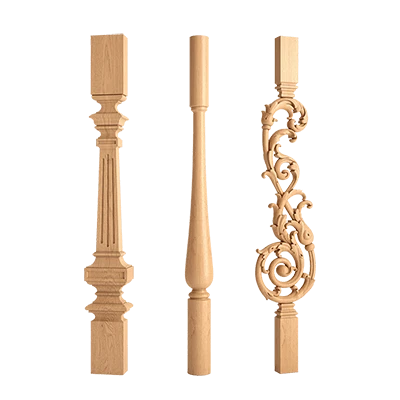
- Turned balusters: classic in different registers
- Carved wooden balusters: sculpture in the railing
- Square balusters: minimalism without compromise
- Flat balusters: wide plane, clean result
- What to buy with solid balusters
- Handrail from the same wood species
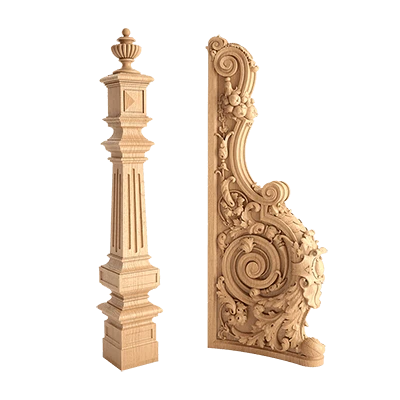
- Solid posts from the same series
- Accessories: don't forget anything
- Price of solid wood balusters
- What determines the cost of a solid baluster
- Approximate prices for solid balusters
- How to calculate the total budget
- How to check the quality of a solid baluster when purchasing
- Visual inspection
- Moisture Check
- Surface inspection
- Mistakes when buying wooden balusters
- Mistake 1: chosen only by price
- Mistake 2: took different wood species for railing elements
- Mistake 3: did not specify the sanding grade
- Mistake 4: bought balusters without posts
- Mistake 5: took non-standard height by eye
- Mistake 6: did not calculate the spare
- Error 7: mixed solid and glued in one batch
- Where to buy solid wood balusters
- About the Company STAVROS
- FAQ: Answers to Popular Questions
- What is better: solid or glued balusters?
- How to distinguish a solid baluster from a glued one?
- Which solid hardwood balusters are better: oak or beech?
- Can solid balusters be coated with varnish?
- What to buy together with hardwood balusters?
- Where to buy solid wood balusters with delivery?
- How much do solid beech balusters cost?
- Do I need to additionally sand hardwood balusters before installation?
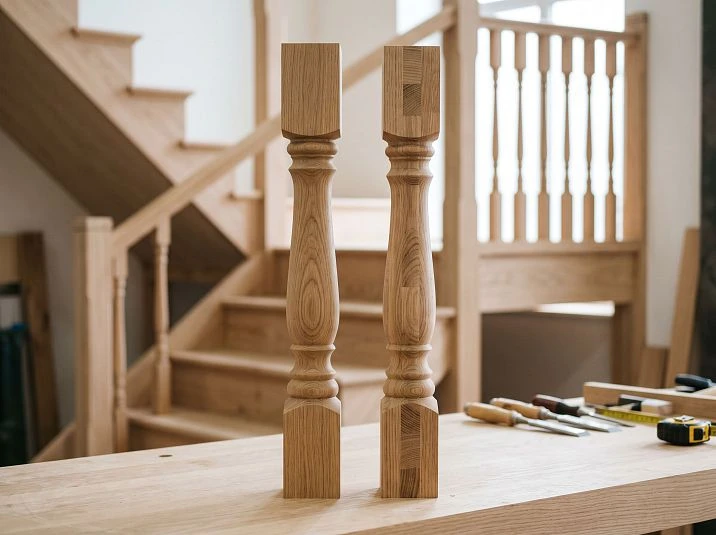
The question "solid or glued" is one of those asked less often than it should be. Most buyers look at the shape, then the price, then think about the color. But it is the structure of the workpiece — solid or glued — that determines how the baluster will behave in a year, three, ten years. How it will respond to moisture and heat. How it will accept the coating. Whether it will withstand the load at the attachment point.
Buy solid wood balusters — means getting a product from a solid workpiece without gluing, with a uniform structure along the entire length. This is the choice of people who build a staircase once and do not plan to return to it with a tool after a season.
This article provides an honest, detailed comparison: what a solid baluster is, what a glued baluster is, the difference in strength, behavior under coating, value for the staircase, and final cost. No marketing simplifications — only what really affects the result.
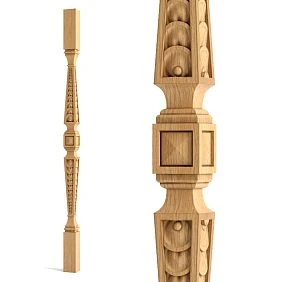
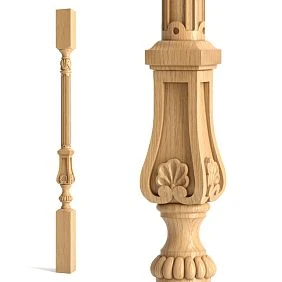
Why the material of the baluster is more important than it seems
A baluster is not just a decorative railing element. It is a working part: it absorbs lateral loads, transfers force to the handrail and step, and works in bending with every accidental impact or hand support. And it does this for decades.
Two externally identical products — a solid and a glued baluster — with the same size and shape will behave fundamentally differently under load, during humidity fluctuations, when applying coating, and during operation in an intensively heated room.
Understanding the difference means making an informed choice, not buying what is cheaper right now.
Buy wooden balusters with an understanding of what they are made of — that is the right starting point.
What are solid wood balusters
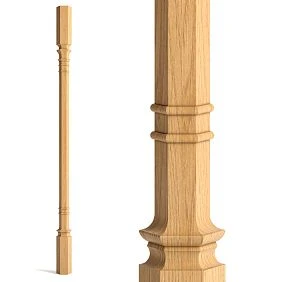
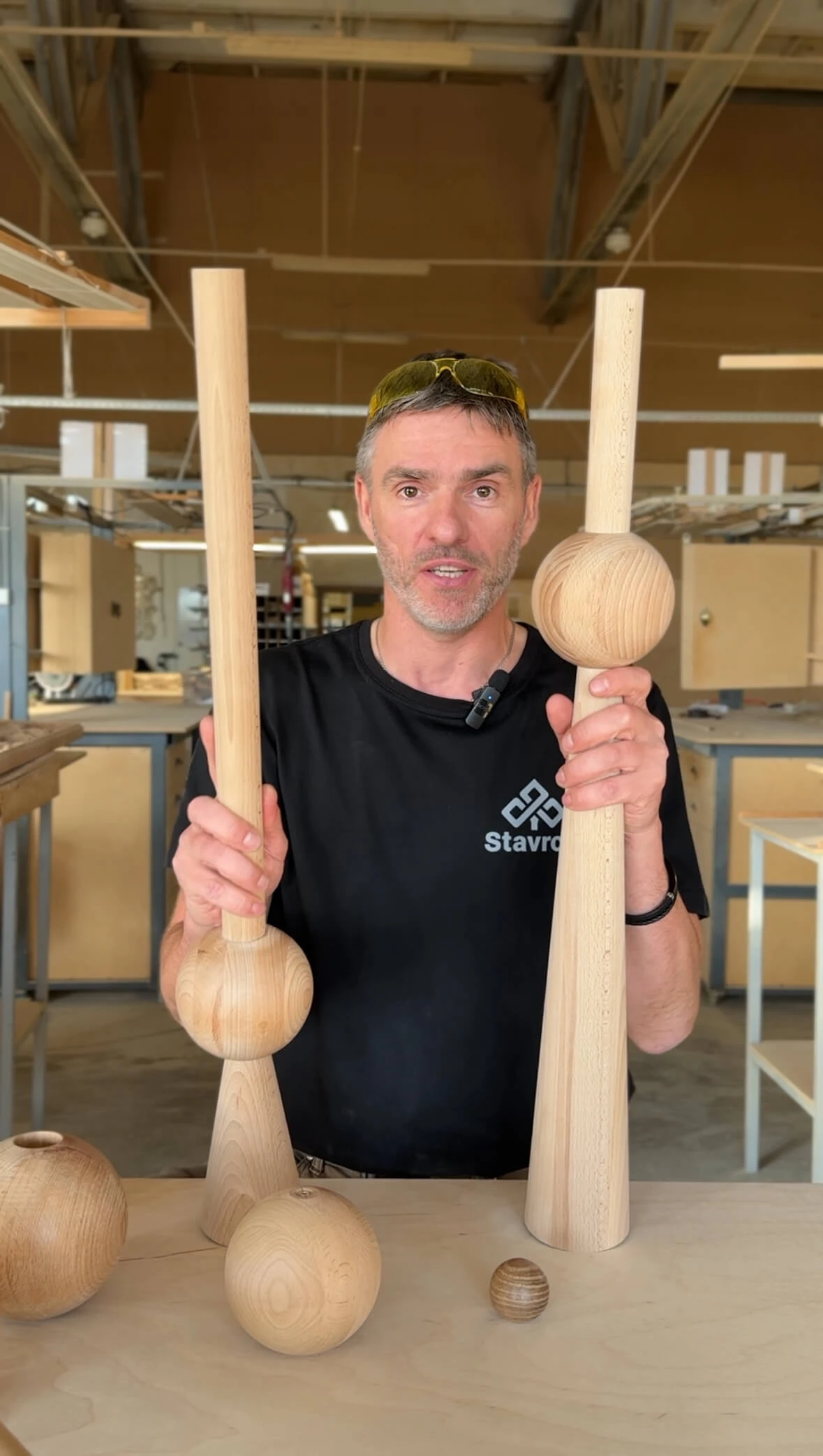
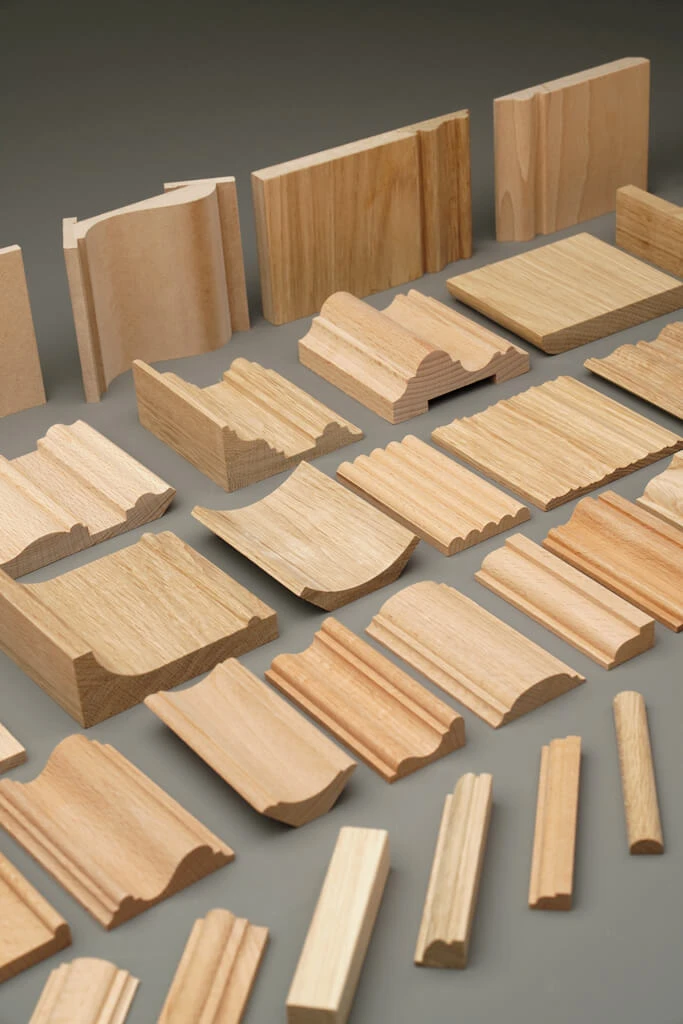
A solid baluster is a product cut or turned from a single wooden workpiece. No joints, seams, or glue layers. One piece of wood from tenon to tenon.
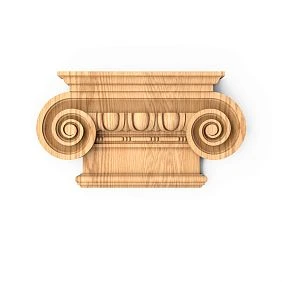
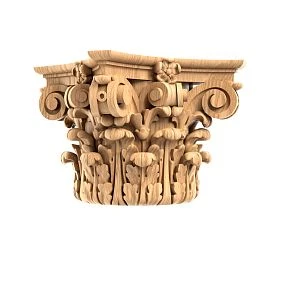
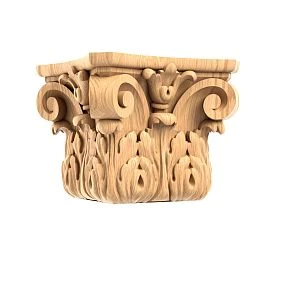
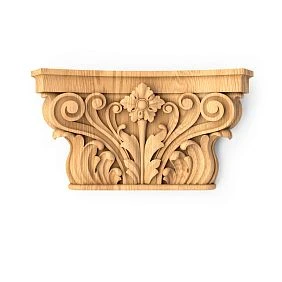
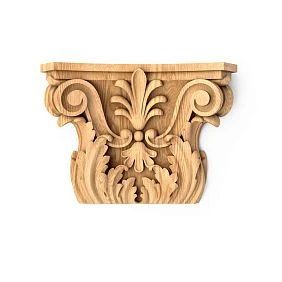
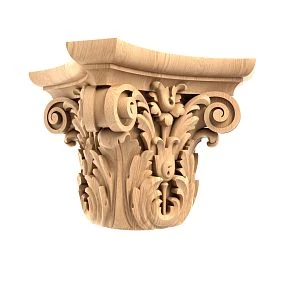
Our factory also produces:
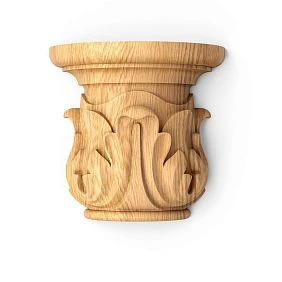
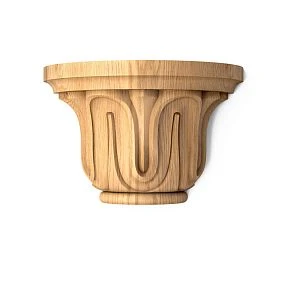
How a solid baluster is made
The blank is a beam of the required cross-section, cut from kiln-dried solid wood. This is followed by turning (for turned and carved shapes), milling (for carved elements), and sanding.
For flat balusters, the blank is a board of the required thickness. The contour is cut on a CNC milling machine. Tenons are on the ends.
Throughout the entire body of the baluster, there is a single structure: uniform density, uniform grain direction, uniform reaction to coating.
Get Consultation
What the solid structure provides in practice
No risk of delamination. In a solid blank, there is nothing to delaminate: there are no glue joints that could crack when the wood deforms due to temperature or humidity changes.
Uniform surface for coating. Varnish, stain, paint — they apply evenly along the entire length. There are no areas with different density or porosity that would absorb the coating unevenly.
Strength along the entire length. Solid fiber — without breaks or reorientations in glue joints. This is especially important in the neck area of a turned baluster: this is where the maximum bending load is concentrated during a side impact.
The tenon is made of the same wood. In a solid baluster, the tenon is turned from the same solid wood as the body. There is no risk of the tenon "coming out" of its part under load or when wet.
Buy solid wood balusters — means choosing a product with a clear, verifiable structure without hidden compromises.
Limitations of a solid baluster
Honesty requires talking about limitations as well.
Blank size. For very large diameters (over 80–90 mm), a solid blank without defects is harder to select. Wide solid hardwood lumber is an expensive blank. Therefore, large decorative posts are often made from glued laminated timber — but this does not apply to standard balusters.
Natural defects. Solid wood is a living material. Knots, resin pockets, slight grain deviations — all of these are part of a solid blank. This is not a defect, but a property of natural material. However, with strict requirements for uniformity (e.g., for large batches under clear lacquer), it is important to clarify the grade of blanks.
Price. Solid hardwood is more expensive than glued wood. This is normal: more valuable raw material, stricter selection.
What are glued balusters
A glued baluster is a product whose body is assembled from several lamellas (planks) glued together along the length or cross-section.
When and why balusters are glued
Gluing makes it possible:
-
Use wider blanks without expensive solid wood
-
Compensate for warping: multidirectional lamellas mutually cancel deformations when humidity changes
-
Produce large batches with more stable geometric tolerances
In the production of furniture panels and glued beams for construction, this is a normal, technologically justified practice. For balusters, the situation is more complex.
What to look for when buying glued balusters
Glue quality. For interior work, PVA class (D2–D3) is acceptable. For balusters in rooms with variable humidity or outdoors, use glue no lower than D4, water-resistant.
Number of lamellas. Two to three lamellas of kiln-dried material is a working option. Many small lamellas with unclear seam geometry indicate low-grade blanks.
Seam placement. A seam passing through the neck area of a turned baluster is a potential failure point under lateral load.
Surface under varnish. On glued balusters, seams are visible under a transparent coating. Often with different lamella tones. This is not critical under opaque paint, but under varnish and stain it is a significant visual factor.
Tone uniformity. Different lamellas from different parts of the blank produce different tones under any coating. Under tinting like "walnut" or "oak," this can appear as spotting.
Solid or glued: direct comparison
Let's not beat around the bush. Here's a table that answers the question honestly.
Comparison table
| Criterion | Solid (massive) | Glued |
|---|---|---|
| Body strength | High (solid fiber) | Depends on glue and lamella quality |
| Tenon strength | Single fiber = reliable tenon | Risk of delamination in tenon area |
| Behavior in humidity | Predictable deformation | Damped by lamellas, but depends on glue |
| Under clear lacquer | Uniform, without seams | Seams and tone differences of lamellas visible |
| For tinting | Uniform tone | Possible spotting |
| Under opaque paint | Excellent | Good (seams hidden) |
| Price | Higher | Below |
| Durability | 20–50+ years with good treatment | Depends on glue quality and conditions |
| Repairability | Resurfacing without risk | Grinding can reach the seam |
When solid wood is the only right choice
A grand staircase under clear varnish. Here, the seams of a glued baluster will be visible. The natural oak grain under glossy or matte varnish is what people choose oak for. The glued version destroys this image.
A staircase in a house with seasonal heating. Strong humidity fluctuations — from 30% to 80% — are a test for glued products. A solid baluster deforms predictably (and reversibly with proper finishing), while a glued one may delaminate.
Thin necks on turned shapes. In the area of the baluster's minimum diameter, the bending load is maximum. Solid wood fiber handles this load better than any glued version.
Outdoor use. Porch, terrace, open veranda — rain, frost, temperature changes. For glued balusters, this is a stress test that not all pass.
When the glued version is acceptable
-
Balusters under opaque enamel in a room with a stable microclimate (18–22°C, 45–55% humidity)
-
Decorative use with minimal load
-
Large volume on a tight budget, where price comes first, not maximum quality
But even in these cases, clarify the glue class and the grade of lamellas.
Which wood species to choose for solid balusters
Wood species is the second most important question after the structure of the workpiece. And here too, there is no universal answer: the right choice depends on operating conditions, type of coating, and budget.
Beech: a practical standard
Buy beech balusters is the choice of people who want a reliable result without overpaying for the most expressive pattern.
Hardness of 3.5 units on the Brinell scale is serious. Walking on beech steps, holding onto beech railings, leaning on beech balusters — this lasts a long time, without dents or scratches.
The structure of beech is dense, fine-pored, and uniform. Under paint or opaque enamel, it is an ideal surface: the paint lays evenly, without spotting. Under tinting, it is a calm, neutral tone without bright contrasts. Under clear varnish, it is a restrained, neat texture without the characteristic "oak" pattern.
No resin. Beech does not exude resin — this is a fundamental advantage over pine. No "breakthroughs" of the coating from the inside, no resin stains under the paint.
Stability. With kiln drying to 8–10% moisture content, beech stably holds its geometry. Torsional deformation is minimal.
Buying beech balusters for an internal staircase under white enamel, colored paint, or tinting is a technically sound solution with a good price.
Oak: when the staircase is a statement
Buy oak balusters — this is a different category. Not just 'more reliable,' but 'of a different level.'
Oak grain. The characteristic 'moiré' feathery pattern in radial cuts, large pores, dark rays on a light background — this is a texture that makes oak one of the most recognizable and valued joinery materials. Under a clear varnish, an oak baluster is a living sculpture.
Hardness 3.7–3.9 units on the Brinell scale. Oak is harder than beech. For stairs with heavy use — this is an additional margin of safety.
Tannins. The natural content of tannins gives oak natural resistance to biological effects. For damp rooms and outdoor use — oak is preferable to beech.
Durability of oak coating. The hardness of the base means that the varnish or oil coating on oak lasts longer: the surface deforms less under loads, and the finish layer does not crack.
Buying oak balusters for a grand staircase, for stairs with clear varnish, for a durable railing in a house with permanent residence — this is an investment that pays off with years of impeccable appearance.
Pine: a budget option with conditions
Pine is an affordable material with clear limitations. For an internal staircase under opaque paint in a room with a stable microclimate — a workable option. For stairs under varnish, for outdoor use, for heavy loads — it is inferior to hardwoods.
The resinous nature of pine when heated (in a room, summer temperatures near the floor can reach 30°C and above) is a real problem for coatings. Resin seeps from within, lifting the coating and creating bubbles.
Ash: Scandinavian accent
Ash under a clear oil or varnish coating features long longitudinal fibers, an almost whitish light surface, and Nordic restraint. For a modern interior in a Scandinavian spirit, ash as the base for solid balusters provides a very fresh, contemporary look.
Ash hardness (3.5–3.8 Brinell units) is comparable to oak. Stability with proper drying is high.
Comparison of wood species for solid balusters
| Parameter | Pine | Beech | Oak | Ash |
|---|---|---|---|---|
| Hardness (Brinell units) | 2,5 | 3,5 | 3,7–3,9 | 3,5–3,8 |
| Under clear varnish | Satisfactory | Good | Excellent | Good |
| Under opaque paint | Satisfactory (resinous) | Excellent | Good | Good |
| For tinting | Weak | Good | Excellent | Good |
| For the street | Satisfactory | Good+processing | Excellent | Good |
| Price (relative) | ×0,4–0,5 | ×0,7–0,8 | ×1 | ×0,8–0,9 |
Shapes of solid balusters: what to choose for a staircase
Shape determines three things: interior style, finishing labor intensity, and price. Let's analyze each shape in the context of solid wood.
Turned balusters: classics in different registers
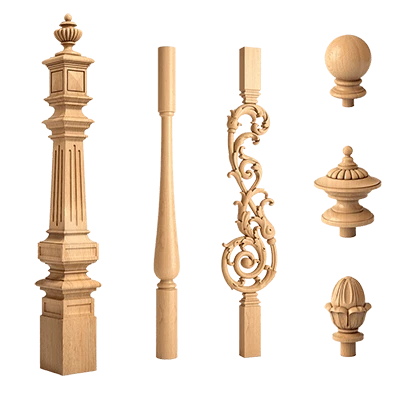
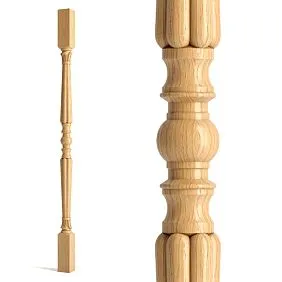
A turned baluster is a body processed on a lathe with the formation of bulges (vases), transitions, and tapers. Body diameter is 45–65 mm, neck diameter is 25–35 mm. The neck is the most vulnerable spot under lateral impact, and here the solid wood fiber gives maximum advantage over glued wood.
Simple turned shape (2–3 elements) — for a country house, pragmatic interior, limited budget. Complex turned shape (5–7 elements) — for a classic and neoclassical staircase in a city or country house.
buy balusters for the staircase in turned execution from solid wood — this is a basic, time-tested choice for a private house.
Carved wooden balusters: sculpture in the railing
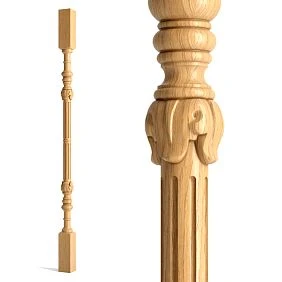
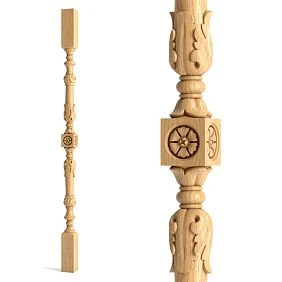
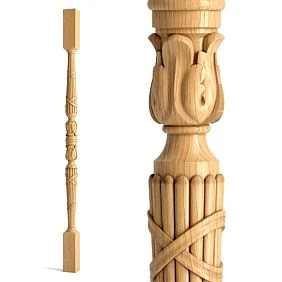
Buy carved wooden balusters — this is a product of complex turning and milling. The body is turned on a lathe, then decorative elements are cut with a CNC milling cutter.
Why is solid wood essential for carved balusters? Because the cutter works in the material — and if a glue joint appears in the cutter's path, it disrupts surface uniformity: different tone, different density. Under light and varnish, this will be visible.
A carved baluster made of solid oak under clear varnish is an image that cannot be replicated in a glued version. Period.
Square balusters: minimalism without compromise
square balusters for stairs made of solid wood — this is a 40×40 or 45×45 mm beam without turning. The simplest shape.
But "simple" here is not synonymous with "cheap": a square baluster made of solid oak with neat chamfers on the edges is a clear geometric element that looks like a deliberate design choice in a modern interior.
Technically, a solid square baluster offers maximum strength for its cross-section: no neck, no stress concentration zone, no possibility for a glue joint. A square tenon does not rotate in the groove. Installation is predictable. Detailed fastening technique is in the instructions for installation of wooden railings and balusters.
Flat balusters: wide plane, clean result
Buy flat balusters made of solid wood — this is a plate 80–120 mm wide and 20–28 mm thick with a decorative shaped contour. The entire width comes from a single board without gluing.
This is fundamentally for transparent coating: the entire width of the baluster is a single wood grain pattern. No vertical seams in the middle, no tone differences. A flat beech baluster under a "whitewashed oak" tint is a neat, Scandinavian-restrained detail.
What to buy together with solid balusters
The logic of a system order applies here just as it does for any type of railing. But for solid balusters made of a specific wood species, the requirements for element compatibility are even stricter.
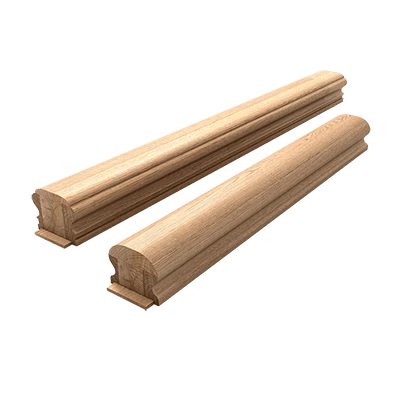
Handrail from the same wood species
buy balusters and handrails from a single piece of lumber, from the same batch — the only way to get an identical tone under any coating. An oak handrail for oak balusters is not a whim, it's the physics of the coating.
The handrail is sold in linear meters and is selected by groove profile. If the balusters have a round tenon of ø25 mm — a handrail with a groove of ø25 mm. This is compatibility that is guaranteed only within a single manufacturer's system.
Posts from the same solid wood series
Buy balusters and posts for a wooden staircase — a system solution that eliminates tonal mismatch and geometric incompatibility.
Wooden stair posts from the same series — these are coordinated proportions, matching decorative style, identical wood species. When applying the same coating, all elements have an identical tone.
Accessories: don't forget anything
Complete list of elements needed together with the balusters:
-
Handrail (linear meters along the perimeter of the fence)
-
Posts (at structural points)
-
Bottom baluster rail (or stair tread routing)
-
M8 studs with nuts and washers
-
Assembly glue (carpentry PVA for indoors, moisture-resistant for outdoors)
-
Post caps
-
Handrail end caps
Staircase Components for Sale One order means one calculation, one delivery, zero compatibility issues.
Price of solid wood balusters
Balusters price — is a variable with five key factors that need to be understood.
What determines the cost of a solid baluster
Wood species. Pine is the base. Beech is 50–70% more expensive than pine. Oak is 2–2.5 times more expensive than pine. Ash is between beech and oak.
Shape. Square baluster — minimum operations = minimum price. Flat — one operation (router). Simple turned — lathe. Complex turned — long machining program. Carved — lathe + router = maximum operations = maximum price.
Height. Standard 900 mm — base price. 1000 mm — +10–15%. Non-standard heights — upon request, price higher.
Blank grade. First grade (minimum defects, clean texture) — more expensive than second. For balusters under clear varnish — first grade is mandatory.
Sanding class. Basic (P80–120) — standard. Finish (P180–220) for varnish — additional cost 10–15%.
Approximate prices for solid balusters
| Shape | Pine | Beech | Oak | Ash |
|---|---|---|---|---|
| Square 45×45×900 | from 700 rub. | from 1,400 RUB | from 1,900 RUB | from 1,600 RUB |
| Flat 900 mm | from 650 rub. | from 1,600 RUB | from 2,200 rub. | from 1,800 RUB |
| Simple turned ø45×900 | from 950 RUB | from 1,900 RUB | from 2,600 rub. | from 2,200 rub. |
| Turned complex ø50×900 | from 1,500 RUB | from 2,800 RUB | from 3,500 RUB | from 3,000 RUB |
| Carved milling-turning | from 2,500 RUB | from 4,500 RUB | from 5,800 RUB | from 4,800 RUB |
Current Balusters buy price — in the STAVROS catalog with filtering by type, wood species, and shape.
How to calculate the total budget
Let's take a typical project: a two-flight staircase in a private house with a second-floor railing.
| Element | Quantity | Price (beech, turned) | Total |
|---|---|---|---|
| Turned beech balusters | 55 pcs. | 1 900 RUB | 104 500 RUB |
| Beech posts 100×100×1200 | 7 pcs. | 4 500 RUB | 31 500 RUB |
| Beech handrail, ø60 | 14 linear meters | 1 800 RUB | 25 200 RUB |
| Fasteners, strips | kit | — | 6 000 RUB |
| TOTAL | ~167 200 RUB |
For oak — multiply by 1.7–1.9. For pine — divide by 2.
How to check the quality of a solid baluster when purchasing
This is an important practical section. How to avoid buying a glued baluster disguised as solid or raw wood disguised as kiln-dried?
Visual inspection
Ends. On the end cut of a solid baluster, growth rings are visible as concentric circles or part of them. A glued baluster will show glue seam lines on the end.
Tenon. On a solid baluster, the tenon's texture smoothly transitions into the body's texture. No horizontal seam lines.
Body. The wood grain along the length of a solid baluster's body is continuous. On a glued baluster, there are transverse lines where lamellas change.
Moisture Check
A raw baluster is heavier than a dry one. If a batch of kiln-dried beech balusters seems surprisingly heavy, ask for a certificate or moisture measurement.
Simple test: take a baluster in your palm. Dry (8–10%) — light, warm to the touch. Damp (above 20%) — heavier, slightly cooler, the smell of fresh wood is stronger.
Surface inspection
Run your palm over the surface of a sanded baluster. Fine scratches from the sander under proper lighting (side light) are normal, but they should be uniform. Deep scratches from P60–80 grit indicate insufficient sanding. Ideal smoothness at P180 — ready for varnish.
Mistakes when buying wooden balusters
Let's look at seven situations that lead to disappointment.
Mistake 1: chosen only by price
Bought the cheapest ones. They turned out to be raw blanks, rough sanding, questionable glue joints in several pieces. After installation and coating — uneven tone, cracks on three balusters after two months, one delaminated at the tenon area.
Solution: regardless of budget, clarify moisture content, grade, and production method (solid or glued).
Mistake 2: bought different wood species for railing elements
Balusters made of beech, handrail made of oak — "same wood, it'll be fine." Under the "walnut" stain, beech gave a light brown color, oak gave a dark brown with pronounced grain. Two noticeably different colors in one railing.
Solution: Buy wooden balusters of the same breed as the posts and handrail.
Error 3: did not specify the sanding grade
We ordered balusters for clear varnish. We received P80 sanding. Under the varnish, marks from the sander are clearly visible. We had to sand each baluster by hand before coating. With a batch of 60 pieces, that's a lost day.
Solution: when ordering for varnish, always specify and order finish sanding P180–220.
Error 4: bought balusters without posts
"We'll find the posts later, they're all standard." Later — a different batch of beech, a different shade under the same stain. Under varnish, it's noticeable. To redo — only remove and replace.
Solution: balusters, posts, and handrails buy in one position, from one batch.
Error 5: took a non-standard height "by eye"
The standard for stair railing is 900 mm of the working part of the baluster. We took 850 mm "because we liked them." Installed — the handrail turned out to be below the regulatory level. For families with children, this is a safety violation.
Solution: determine the height of the baluster based on the staircase design, not on impression.
Error 6: didn't account for spare
Ordered exactly as calculated. Two balusters broke during installation (tenon cracked due to careless hammering), one was damaged during sanding. Reorder — different batch. Slightly different shade.
Solution: always +10% to the calculated quantity.
Error 7: mixed solid and glued in one batch
Ordered solid, some turned out glued (manufacturer didn't specify clearly). Under clear varnish, glue lines visible on some balusters. Inconsistent appearance across the railing.
Solution: order from a manufacturer with clear specification: «balusters from solid wood».
Where to buy solid wood balusters
Buy wooden balusters from a direct manufacturer with a full production cycle — this is the only strategy that eliminates unpleasant surprises after receiving the batch.
What this means in practice:
-
Solid wood guaranteed in specification — not glued, not laminated
-
Kiln drying to 8–10% — no warping or cracks after installation
-
Final sanding to choice — for paint or varnish, no on-site finishing required
-
Free kit calculation — balusters, posts, handrail, fasteners in one specification
-
One batch — the entire system from a single selection, uniform tone under any coating
Buy wooden balusters from solid wood with quality and compatibility guarantee with handrails and posts — in the STAVROS catalog.
About the company STAVROS
STAVROS — Russian manufacturer of solid wood products since 2002. Specialization: components for wooden stairs and railings. Full production cycle — from raw material selection to final sanding.
All balusters in the catalog are made from solid wood: oak, beech, pine, ash. Kiln drying to 8–10% moisture — a controlled process with documented confirmation. CNC machining ensures precision of tenon and geometry, guaranteeing a fit without adjustment.
Assortment — over 50 models of balusters of all shapes, stair posts, handrails in a range of profiles, fasteners and components. All elements are produced with serial compatibility: baluster tenon → handrail groove → post series.
Pickup from Moscow and St. Petersburg. Delivery by transport companies throughout Russia. Consultation on material, shape and coating selection — free. Full kit specification based on your staircase parameters — upon request.
FAQ: Answers to popular questions
What is better: solid or glued balusters?
For stairs with transparent coating (varnish, oil, tint), for outdoor use and for rooms with variable humidity — solid wood is irreplaceable. For opaque paint in a stable climate, glued option is acceptable with quality D3–D4 glue.
How to distinguish a solid baluster from a glued one?
On the end cut of a solid piece — concentric growth rings without seam lines. On the body — a continuous fiber pattern without transverse boundaries. For glued — glue lines are visible on the end, transverse transitions between lamellas on the body.
Which solid wood balusters are better: oak or beech?
Oak — expressive grain, natural durability, premium look under clear coating. Beech — uniform structure, excellent for painting and tinting, more affordable. For a grand staircase under varnish — oak. For a staircase under enamel — beech.
Can solid balusters be coated with varnish?
Yes, and this is the best application for solid wood — especially for oak. The uniform structure without seams provides an even coating, the wood grain is fully revealed. Important: before varnish — final sanding with P180–220 grit.
What to buy together with solid wood balusters?
Handrail, posts, bottom rails, fasteners (studs, nuts, washers), post caps. All from the same wood species, same batch — from one manufacturer.
Where to buy solid wood balusters with delivery?
In the STAVROS catalog: solid wood, over 50 models, oak, beech, pine, ash. Contact us to confirm shipping to your destination. Free kit calculation.
How much do solid beech balusters cost?
From 1,400–1,900 rubles per square or flat up to 2,800–4,500 rubles per complex turned or carved. Current prices — in the stavros.ru catalog.
Do solid wood balusters need additional sanding before installation?
Factory-sanded balusters R120–150 are ready for painting without rework. For clear varnish — specify the sanding class when ordering and, if necessary, request finish R180–220.