























Article Contents:
- Why a narrow staircase requires a special approach to choosing balusters
- Visual volume of elements
- Passage width and psychology
- Light reflection
- Which balusters are suitable for a compact staircase: a breakdown of shapes
- Flat balusters: the best solution for compact railings
- Square balusters: strictness and maximum rigidity
- Simple turned balusters with minimal grips
- What is definitely not suitable for a narrow staircase
- Flat balusters for a narrow staircase: a detailed breakdown
- Geometry of a flat baluster
- Material for flat balusters
- Style of flat balusters
- Square balusters for modern compact railing
- Why square works in small spaces
- Finish for square balusters
- Installation spacing for square balusters
- How to choose height and spacing for a narrow staircase
- Railing height: standards and practice
- Clear spacing: safety vs. visual lightness
- Spacing formula considering baluster width
- Which handrails to choose for a narrow staircase
- Handrail profile: not too thin, not too massive
- Straight or shaped handrail
- Compatibility of handrail with balusters
- Which posts are needed for a narrow staircase
- Cross-section of posts for a compact staircase
- Number of posts
- Post decoration: less is more
- How to choose the material of balusters for a narrow staircase: wood species and color
- Beech: neutral and uniform
- Oak: character and durability
- Pine: for a budget project under paint
- Color: how to choose the right shade for a compact space
- How to calculate the number of balusters for a narrow staircase
- Calculation step 1: measure the length of the flight
- Calculation step 2: choose the clear spacing
- Calculation step 3: calculate the number of balusters
- Calculation step 4: add balusters for the landing
- Calculation step 5: calculate the length of the handrail
- Mistakes when buying balusters for a narrow staircase
- Mistake one: choosing balusters "for growth"
- Mistake two: installing 120×120 mm posts
- Mistake three: too small installation step
- Mistake four: mixing styles
- Mistake five: buying balusters without considering the step material
- Mistake six: forgetting about installation
- Kit for a narrow staircase: what to buy together with balusters
- Mandatory kit
- Additional elements
- Installation features on a narrow staircase
- Installation Sequence
- Working in narrow space
- Where to buy balusters for a narrow staircase: a systematic approach
- FAQ: Frequently Asked Questions About Balusters for Narrow Stairs
- Which balusters are best for a narrow staircase?
- Can carved balusters be installed on a narrow staircase?
- What should the installation spacing be on a narrow staircase?
- What to buy together with balusters?
- Which handrails are suitable for a compact staircase?
- What post cross-section is suitable for a narrow staircase?
- Where to buy balusters for a narrow staircase with a kit calculation?
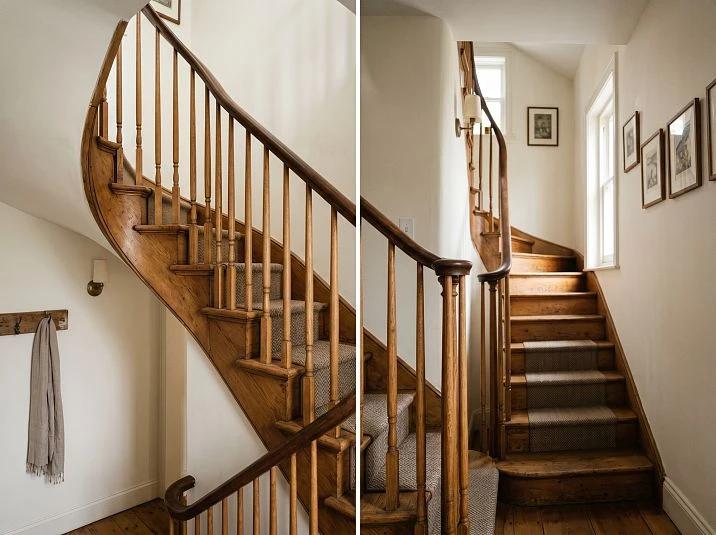
A narrow staircase is not a planning defect or a compromise. It is the reality of most private homes, townhouses, and small cottages where every square meter counts. A staircase 80–90 centimeters wide is an absolutely normal solution for a two-story house. But this is where the main mistake begins: people choose balusters based on photos, focusing on spacious grand staircases with wide flights and massive railings. They install them. And they get a narrow corridor with a wooden "grille" that feels oppressive, clutters the space, and visually reduces an already small passage.
balusters for staircase to buy Doing it right means choosing not just a beautiful element, but one that organically exists in a specific space. For a narrow staircase, this means one thing: lightness, conciseness, correct geometry, and precise installation spacing. Not a gram of visual mass beyond what is necessary.
This article is a detailed breakdown of how to choose and Buy wooden balusters for a narrow staircase so that the railing is safe, visually light, and beautiful — without unnecessary burden on the space.
Why a narrow staircase requires a special approach to choosing balusters
Let's start with a question rarely asked aloud, but one that determines everything: what, actually, makes choosing balusters for a narrow staircase different from choosing them for a wide one?
The answer lies in the physics of spatial perception.
Visual volume of elements
A baluster is a vertical object in space. The thicker it is, the more visual weight it occupies. On a staircase 1,200 mm wide, a baluster with a cross-section of 45×45 mm dissolves into the space — you simply don't notice it as an independent volume. On a staircase 800 mm wide, the same baluster begins to 'read' differently: its presence feels denser, and if there are twenty such balusters, the railing turns into a picket fence.
Our factory also produces:
Passage width and psychology
A person climbing a narrow staircase subconsciously evaluates the width of the passage. The less 'air' there is between the body and the railing, the stronger the feeling of confinement. Massive balusters with deep carving and wide profiles do not physically reduce the passage, but visually they do. This effect is real and important.
Get Consultation
Light reflection
On a narrow staircase, there is often less natural light — especially if it is located deep inside the house. A light, 'open' railing with thin balusters lets light through. A dense, massive one absorbs it and creates shadows that make the space gloomier.
That is why balusters for a narrow staircase — is a separate task requiring a separate approach.
Which balusters are suitable for a compact staircase: a breakdown of shapes
Let's go through the types and honestly say what works on a narrow staircase and what doesn't.
Flat balusters: the best solution for compact railing
Buy flat balusters for a narrow staircase — this is perhaps the most precise solution in terms of balance between aesthetics and space. A flat baluster has a thickness of 20–25 mm with a width of 70–100 mm. Compared to a square or turned baluster of the same nominal cross-section, it takes up significantly less volume "in depth" of the railing — that is, along the staircase flight.
The result: the railing looks like a series of thin vertical plates with plenty of air and light between them. It is light, graphic, and modern.
A flat baluster works well with paint: white, gray, natural wood tone under varnish — all of these work. The wide flat surface provides an even coating without drips or poorly painted curves.
An additional plus for a narrow staircase: Buy flat baluster it can be in a version with a shaped top or bottom edge — this adds decorativeness without increasing volume.
Square balusters: strictness and maximum rigidity
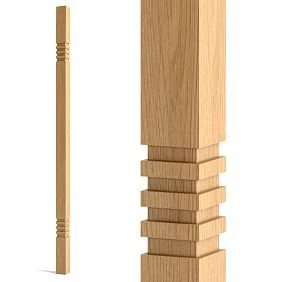
square balusters for stairs — the second most popular choice for compact spaces. A constant cross-section along the entire height without grips or protrusions means minimal visual volume with maximum rigidity.
For a narrow staircase in a modern home, a square baluster 40×40 mm is an ideal choice. It is strict, geometrically clear, and does not demand attention — it simply holds the handrail and marks the boundary of the safe zone.
An important nuance: a square baluster requires precise installation spacing. If the distance between balusters is too small — the row will look dense and crowded. If too large — the railing will lose its sense of integrity. The optimal spacing for square balusters 40×40 mm on a narrow staircase is 120–140 mm in the clear.
Simple turned balusters with minimal grips
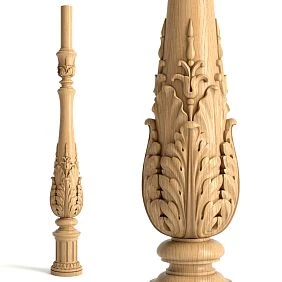
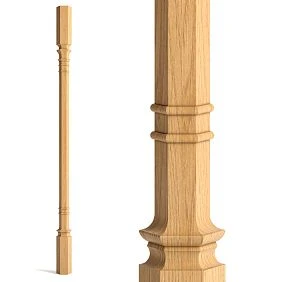
Not all turned balusters are equally good for narrow staircases. Complex profiles with several deep grips and large "barrels" are a visual overload for a compact space. But simple turned balusters with one light grip and smooth lines are quite appropriate.
The rule for a narrow staircase: the simpler the profile of a turned baluster, the more organically it looks in a compact space. One or two grips, a minimum diameter at the narrowest point of at least 35 mm — and the baluster remains rigid but not visually "heavy."
What definitely does not suit a narrow staircase
An honest list of solutions that work against you in a compact space:
-
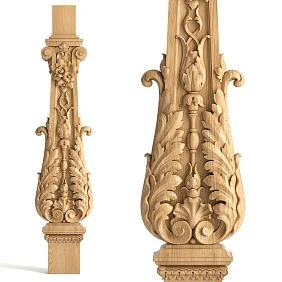
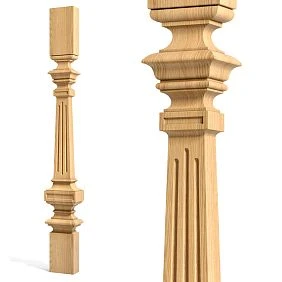
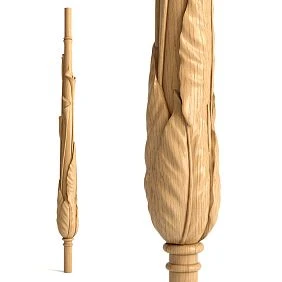
Carved balusters with large ornamentation and deep grooves — overload the railing with details
-
Balusters with a cross-section of 50×50 mm or more are too massive for stairs less than 900 mm wide
-
Structures with a double row of balusters double the visual weight
-
Posts with a cross-section of 120×120 mm or more at each turn eat up the passage width
Flat balusters for narrow stairs: detailed analysis
Since flat balusters are the best choice for a compact staircase, it is worth considering them in more detail. What exactly do you need to know before buying?
Geometry of a flat baluster
Standard parameters:
-
Thickness: 20–25 mm
-
Width: 70–100 mm
-
Height: 900–1,000 mm (standard for residential stairs)
-
Lower tenon: diameter 10 mm, length 60 mm
-
Upper tenon: diameter 10 mm, length 60 mm
With a width of 80 mm and a thickness of 22 mm, a flat baluster occupies only 22 mm of "depth" in a row. For comparison: a turned baluster Ø45 mm occupies 45 mm. The difference is twofold, and it is noticeable on a narrow staircase.
Material for flat balusters
wooden balusters for stairs buy in a flat design, it is best made from beech or oak. A flat pine blank with a high width-to-thickness ratio may "warp" over time — slight curvature along the width may appear. Beech and oak are more stable with a one-sided cross-section.
Style of flat balusters
A flat baluster is a modern, minimalist, sometimes Scandinavian style. It pairs well with:
-
Thin rectangular handrail (45×70 mm or 40×60 mm)
-
Square posts with a cross-section of 80×80 mm
-
Floor coverings in neutral tones
-
Walls without complex decor
For homes with wooden timber or frame interiors — flat balusters in natural lacquer give a feeling of purity and structure without overloading with details.
Square balusters for modern compact railing
Square balusters deserve a separate discussion — precisely because they are often underestimated, considered "too simple." In fact, this is the most honest solution for a modern compact staircase.
Why square works in a small space
A square baluster does not try to attract attention. It simply stands in a row, holds the handrail, and does its job. This very "silence" of decor is its main advantage for a narrow staircase: the railing does not compete with the space but organically integrates into it.
A constant cross-section of 40×40 mm along the entire height means uniform rigidity without vulnerable transitions. At the same time, the visual volume of each baluster is minimal — thinner than that of a turned one with the same nominal cross-section.
Coating of square balusters
A square baluster gives maximum freedom in choosing the finish coating:
-
White glossy paint — makes the railing invisible against a white background, the steps "float" separately
-
Light gray matte paint — Scandinavian minimalism, still relevant in ten years
-
Natural varnish — honest wood texture, warmth without excess
-
Walnut stain — a classic tone for stairs with dark parquet
For a narrow staircase, white coating works especially well: white balusters "dissolve" in the space, and the staircase is perceived as a single light volume.
Installation spacing for square balusters
For square balusters 40×40 mm on a narrow staircase, the optimal clear spacing is 120 mm. At 100 mm spacing, the row becomes dense and slightly heavy. At 150 mm spacing, it becomes sparse and potentially unsafe for children.
How to choose the height and installation spacing for a narrow staircase
Height and spacing are parameters that determine the safety of the railing. On a narrow staircase, they are especially important because any mistake here is doubly noticeable.
Railing height: standards and practice
According to building codes, the minimum railing height for stairs in a residential building is 900 mm from the step level to the top of the handrail. For stairs with an incline angle greater than 45°, it is 1,000 mm.
In practice, for a narrow staircase in a private house, a height of 900 mm is sufficient. Increasing it to 1,000–1,100 mm makes the railing higher and visually heavier. If there are no children in the house, 900 mm is a comfortable and safe height.
Detailed information on how to correctly calculate railing baluster sizes for staircases, is available in a separate article — we recommend studying it before ordering.
Clear step: safety vs. visual lightness
Here a contradiction arises: a smaller step is safer, a large step is visually lighter. How to find a balance?
For a narrow staircase without children: a clear step of 120–130 mm is the balance. The railing looks light but not sparse.
For a staircase in a house with children under 10 years old: a step of no more than 100 mm is a safety requirement, not aesthetics. In this case, to maintain visual lightness, thinner flat balusters are used.
Formula for step considering baluster width
Clear step = Distance between baluster axes – Baluster width
For square balusters 40×40 mm with a distance between axes of 160 mm: clear step = 160 – 40 = 120 mm. This is normal.
Which handrail to choose for a narrow staircase
A handrail is what the hand holds onto. On a narrow staircase, it also visually "covers" the top of the railing. An incorrectly chosen handrail can ruin even perfectly matched balusters.
Handrail profile: not too thin, not too massive
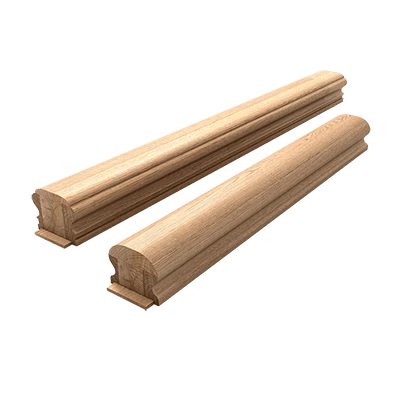
For a narrow staircase, the optimal handrail is a rectangular or oval profile with a width of 45–60 mm and a height of 40–55 mm. A round handrail with a diameter of 45–50 mm also works well.
Avoid handrails with a width of 70 mm or more: on a narrow staircase, they look disproportionate. Thin handrails with a width of less than 40 mm may appear visually elegant but are uncomfortable for the hand — especially when descending.
Straight or shaped handrail
For a compact staircase — a straight handrail without decorative routing. A shaped profile with grooves and cutouts adds visual complexity that is excessive on a narrow staircase. A straight handrail is neutral, light, and works with any style.
Compatibility of the handrail with balusters
The groove of the handrail for the baluster tenon must exactly match the diameter of the tenon. When ordering buy balusters and handrails from one manufacturer, this is automatically resolved. If you buy from different suppliers, check the tenon diameter (standard Ø10 mm) and the handrail groove parameters.
What posts are needed for a narrow staircase
Support posts are an essential element of safe railing. But on a narrow staircase, they require special attention: a poorly chosen post can become the heaviest and most noticeable object in the railing.
Cross-section of posts for a compact staircase
For a narrow staircase, the optimal cross-section of a support post is 80×80 mm. Posts of 100×100 mm are acceptable if the staircase is wide. On a flight with a width of 80–90 mm, a 100×100 mm post starts to "stick out" and visually narrows the passage even more.
No, reducing the post cross-section to 60×60 mm for lightness is not advisable. This is the limit below which load-bearing capacity suffers. Rigidity and visual lightness are not the same thing, and sacrificing the former for the latter is not allowed.
Number of posts
On a narrow staircase, the temptation to save on posts is great — an extra post "eats up" a few more centimeters. But this is not the kind of savings that pays off.
Minimum scheme for a single-flight staircase:
-
Starting post (at the bottom of the flight)
-
Finishing post (at the top, near the transition to the landing)
If the march length exceeds 3 m, an intermediate post is placed in the middle. Without it, the handrail will start to "play" under load.
Buy balusters and posts for a wooden staircase For one manufacturer, it's a unified style, a unified breed, a unified coating tone.
Post decor: less is more
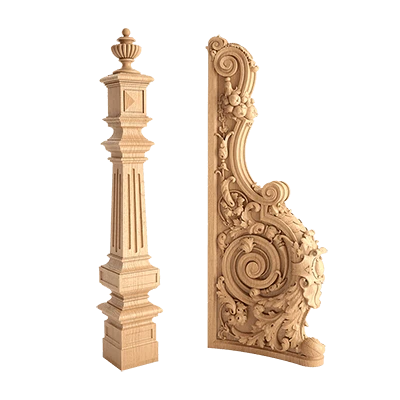
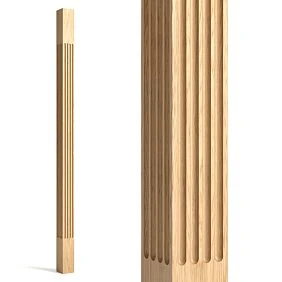
On a narrow staircase, posts with large capitals, carved bases, and multi-tiered elements are overload. The optimal solution: posts with a simple square base and a straight body. If an accent is needed, slightly beveled edges or one decorative groove at a third of the post's height.
How to choose the material of balusters for a narrow staircase: breed and color
On a compact staircase, the color and texture of wood play a special role. The narrow space amplifies the perception of each element, and a mistake in tone is more noticeable.
Beech: neutral and uniform
Beech is a uniform breed with a fine, almost invisible texture. Light, almost whitish tone in its natural state. It accepts stain evenly, without sharp transitions.
For a narrow staircase in a light interior, beech in natural varnish or white stain. The railing literally "dissolves" in the space, without cluttering it.
Oak: character and durability
Oak is a species with a pronounced texture, large rays, and a rich tone. It "makes a statement." On a narrow staircase, this can be both a plus (a distinctive, memorable railing) and a minus (too active a texture in a small space).
Rule: if the entire interior of the house is wood, warm tones, solid wood — oak will fit organically. If the space is light, neutral — beech is better.
Pine: for a budget project under paint
Pine is cheaper. If the budget is limited and a solid paint finish for the balusters is planned, pine is quite acceptable. The softness of the wood requires careful installation: a pin on epoxy, not a self-tapping screw "in a hurry."
For a narrow staircase under white paint — pine Buy wooden balusters is quite reasonable: in the final coating, the wood species is not visible, and the price is significantly lower.
Color: how to choose the right tone for a compact space
Several principles that work:
-
Light tone (natural beech, white paint, light gray) — visually expands the space
-
Dark tone (wenge, dark walnut, mocha) — accentuates the railing, makes it an object, but narrows the space
-
Contrast of steps and balusters — if the steps are dark and the balusters are light, this is a classic move that creates lightness
-
Monochrome — steps, balusters, handrail in a single tone — "dissolves" the staircase in the interior
How to calculate the number of balusters for a narrow staircase
The calculation for a narrow staircase is based on the same formulas as for a wide one, but with one additional parameter — the clear spacing, which needs to be chosen more carefully.
Calculation step 1: measure the length of the flight
Horizontal projection of the flight from the first to the last step. For example, 9 steps of 270 mm tread = 9 × 270 = 2,430 mm.
Calculation step 2: choose the clear spacing
For flat balusters (width 80 mm) — clear spacing 120 mm. For square ones (width 40 mm) — clear spacing 120 mm.
Calculation step 3: calculate the number of balusters
N = L / (b + a)
For flat balusters: N = 2,430 / (80 + 120) = 2,430 / 200 = 12.15 → 13 pieces.
For square: N = 2,430 / (40 + 120) = 2,430 / 160 = 15.2 → 16 pieces.
With 10% margin: flat — 14–15 pieces, square — 17–18 pieces.
Calculation step 4: add balusters for the landing
If the landing at the top of the flight is also fenced, measure its perimeter using a similar scheme and add to the main number.
Calculation step 5: calculate the handrail length
Handrail length = horizontal run / cos(stair angle).
With a horizontal run of 2,430 mm and an angle of 35°: handrail length = 2,430 / cos(35°) = 2,430 / 0.819 ≈ 2,966 mm.
Round up to 3,000 mm + 100 mm margin for trimming = 3,100 mm.
Mistakes when buying balusters for a narrow staircase
On a compact staircase, mistakes cost more: rework in a confined space is more difficult, and mismatches are more noticeable.
Mistake one: choosing balusters "for growth"
"I'll take a cross-section with a margin — let it be more reliable." The logic is clear, the result is bad. Balusters 50×50 mm or turned with a diameter of 55 mm on a narrow staircase create a visual wall. The rigidity of the railing is determined not only by the cross-section of the balusters, but also by the fasteners, installation pitch, and support posts.
Mistake two: installing posts 120×120 mm
On a narrow staircase, a 120×120 mm post takes up almost 15% of the passage width. With two posts (start and finish), that's already 30% of the passage occupied by wood. 80×80 mm is quite sufficient for rigidity.
Mistake three: too small installation pitch
"The more often, the safer." This is true for children's staircases. But a pitch of 80 mm with a baluster width of 40 mm creates a very dense row that looks like a solid wooden panel on a narrow staircase. Safe — but visually extremely heavy.
Mistake four: mixing styles
Flat balusters + carved posts with ornament + handrail with figured profile = three different design solutions in one railing. On a wide staircase, this can create eclecticism. On a narrow one — chaos.
Mistake five: buying balusters without considering the material of the steps
If the steps are made of oak, the balusters should also be made of oak (or in the color of oak). If the steps are painted white, the balusters should also be white. Material mismatch on a narrow staircase is more noticeable than on a wide one.
Mistake six: forgetting about installation
Installation of Wooden Handrails and Balusters on a narrow staircase requires care: working in a tight space is more difficult, and fastening errors are harder to fix here. A stud on epoxy is an absolute minimum. A self-tapping screw 'into the end' without glue is a risk not worth taking.
Kit for a narrow staircase: what to buy together with balusters
On a narrow staircase, 'lest we forget something' is not a joke, but a real problem. Here is a complete list of what needs to be ordered at the same time.
Mandatory kit
-
Balusters of the required type, height, and cross-section — with a 10% margin
-
Handrail of a compatible profile, length as per calculation + 200 mm for trimming
-
Support posts — starting, finishing, and intermediate if necessary
-
Bottom horizontal rail — for aligning the step and fixing the row
-
Fasteners — M10 studs according to the number of balusters, nuts, anchor bolts for posts
Additional elements
-
Decorative post bases — protect the base, improve appearance
-
Handrail corner connector — if there is a turn on the landing
-
End caps — close off the handrail cut with a decorative look
-
Wooden plugs — for masking mounting screws
Staircase Components for Sale from one manufacturer — this guarantees that all elements will speak the same language.
Installation features on a narrow staircase
Installation in a confined space is a separate task. A few tips that really help.
Installation order
-
Install the bottom rail — it will determine the spacing and position of all balusters
-
Drill holes for studs in the steps — strictly vertically
-
Install the posts — first, before the balusters, level them
-
Screw studs into steps
-
Apply epoxy glue into the hole of the lower tenon of each baluster
-
Install balusters sequentially
-
Place the handrail, secure it on the posts
-
Allow 24 hours of curing before loading
Working in narrow space
On a narrow staircase, the drill must be held strictly vertically — a hole deviation angle of just 5° will cause a noticeable tilt of the baluster. Use a jig or a drill guide attachment.
Drilling into the step is best done from below — this makes it easier to control verticality. If the step is thin, use a through hole with a nut tightened from below.
Where to buy balusters for a narrow staircase: a systematic approach
For a narrow staircase, a systematic approach to purchasing is especially important: there is no room for "I'll buy more later" or "it'll do somehow."
STAVROS — manufacturer of wooden staircase components with a full catalog of compatible elements: balusters, posts, handrails, bottom strips, fasteners. All elements are made of dry solid wood with a moisture content of 8–12%, with coordinated dimensions in a unified production system.
For narrow staircases, the STAVROS catalog offers:
-
Flat balusters — lightweight, graphic, ideal for compact spaces
-
Square balusters — strict, rigid, minimalist
-
Posts 80×80 mm — optimal cross-section for a compact staircase
-
Handrails of compatible profiles from the same wood species
-
Full calculation of the kit for your staircase parameters — free of charge
FAQ: frequently asked questions about balusters for narrow staircases
Which balusters are best for a narrow staircase?
Flat or square wooden balusters with a minimum cross-section. buy balusters better from the manufacturer — they will help you choose the right size and compatible set.
Can carved balusters be installed on a narrow staircase?
Yes, if the carving is simple — one or two light belts without large ornamentation. Deep carved profiles with a large volume of decor visually overload the compact space.
What should the installation step be on a narrow staircase?
For a safe and visually light railing — 120–130 mm clear spacing. For staircases with children — 100 mm.
What to buy together with balusters?
Handrail, support posts, bottom rail, fasteners (M10 studs and epoxy glue). wooden balusters for stairs buy and everything else is better in one order from one manufacturer.
What handrails are suitable for a compact staircase?
Handrail width 45–60 mm, straight profile without complex milling. Round handrail with a diameter of 45–50 mm is a classic for a compact staircase.
What cross-section of a post is suitable for a narrow staircase?
80×80 mm is optimal. Sufficient rigidity with minimal visual bulk. 100×100 mm is acceptable, but on a staircase less than 900 mm wide, it looks somewhat heavy.
Where to buy balusters for a narrow staircase with a kit calculation?
At STAVROS — balusters for staircase to buy you can get a free kit calculation for your staircase parameters. Delivery across all of Russia.