




























































Article Contents:
- Why you shouldn't buy balusters for railings at random
- What to measure before buying balusters
- Seven parameters without which you shouldn't open the catalog
- How to choose balusters by height
- Why 'standard height' is a relative concept
- Stair angle and trimming
- How to choose the shape of balusters for railings
- Reading the character of the handrail
- Flat balusters — a special case
- Compatibility table of baluster shape and handrail type
- How to choose material when the railing is already selected
- Wood species matching is not a whim, but a technology
- Oak, beech or pine: what to choose
- Which finish to choose for
- Attaching balusters to railings: options and features
- Top connection — a key joint
- Bottom attachment: step, floor or base
- Fasteners are not a trifle
- What to buy together with balusters
- Complete set for an existing handrail
- Posts: cross-section and height for ready-made railings
- Price of balusters for ready-made railings
- Cost structure
- Final budget
- Mistakes when buying balusters for ready-made railings
- Top 10 situations that lead to rework
- Additional keys: what else is important when choosing
- Surface sanding and degree of readiness
- Wood moisture
- Tenon length and trimming capability
- Where to buy balusters for ready-made railings
- STAVROS catalog: dimensional accuracy and compatibility guaranteed
- Frequently Asked Questions (FAQ)
- About the Company STAVROS
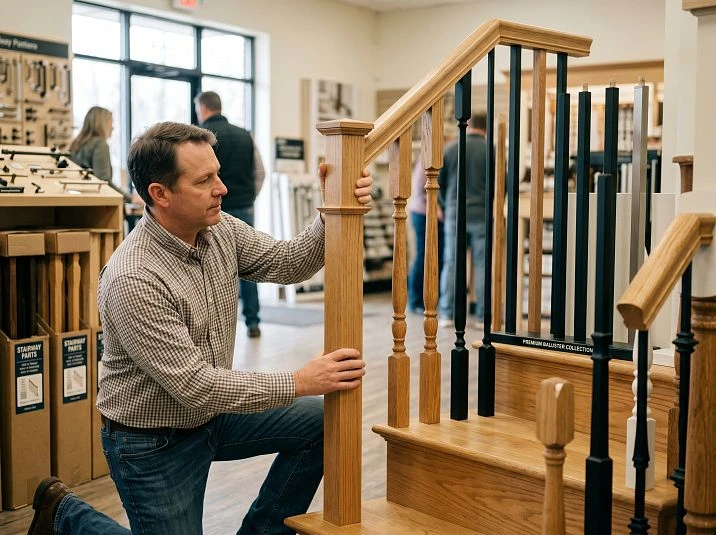
The situation is familiar to many: the handrail has already been chosen, perhaps even installed — and now you need to find balusters that will fit it. It seems simple, right? But it is precisely in this scenario that costly mistakes are most often made: buy balusters "by eye" from a photo — only to find that the height is wrong, the tenon doesn't fit into the handrail groove, and the wood species gives a completely different shade. The result is wasted money, installation delays, and the need to redo what seemed already decided.
This article is written specifically for those who already have the railing but not the balusters yet. There are no general words about the beauty of wood here — only specifics: what to measure, what to look for, which parameters are critical, how to avoid mistakes in selection, and where to ultimately buy balusters and handrails so that everything falls into place the first time.
Why you can't buy balusters for railings at random
There is a common misconception: if the railing and balusters are made of wood, they are compatible. In practice, this is not the case. Wooden staircase components are produced in different lines, with different mounting dimensions, different height standards, and different top tenon profiles. What looks similar externally may not fit together technically — and no amount of "on-site adjustment" will solve this problem without compromising the structural reliability.
The top tenon of the baluster fits into a groove that runs along the bottom plane of the handrail. Standard groove sizes are 12×12 mm, 18×18 mm, 20×20 mm, or Ø18–20 mm for a round tenon. If the baluster was turned to one standard and the handrail was routed to another, they simply won't match, and neither glue nor adjustment will achieve the desired result without risking weakening the joint.
Height is another critical parameter. The baluster doesn't just stand between the step and the handrail: it determines the working height of the railing. Too short — and the handrail will drop below the norm, violating safety requirements. Too tall — it will press against the handrail from below and prevent it from being secured. An exact size is needed — not "about," not "approximately," but specific millimeters.
And third — style. handrails and balusters made of wood must belong to the same visual language. A massive profiled handrail with a deep groove and thin square balusters are not a pair. A narrow modern handrail and lush carved posts with baroque ornamentation are also not a match. Style compatibility is no less important than compatibility of technical parameters.
What to measure before buying balusters
Our factory also produces:

Seven parameters without which you should not open the catalog
If the railings are already installed or at least selected and you have their characteristics, before buying wooden balusters for stairs, you need to take measurements and record the following data.
1. Height from the tread to the bottom plane of the handrail. This is the actual working height of the baluster — the distance from the horizontal surface of the step to where the upper tenon of the post will fit. Usually it ranges from 860 to 920 mm. This value determines what length of the baluster body you need to order.
2. Width of the groove in the handrail. Measure the groove running along the underside of the handrail. Its width and depth determine which tenon is acceptable for your handrail. If the groove is milled for an 18×18 mm tenon, order balusters with exactly that tenon.
3. Thickness and width of the handrail. The visual scale of the baluster should match the cross-section of the handrail. For a handrail 60 mm wide, balusters with a body diameter of 45–55 mm are well suited. For a wide handrail of 80–90 mm, it is better to choose more massive posts.
4. Wood species and handrail finish. Write down: oak or beech, varnish or stain, tint color. This is important for selecting balusters from the same species and with the same finishing compound — otherwise, even with the same type of varnish, the color on oak and pine will give completely different results.
5. Baluster spacing step. If some balusters are already installed, measure the distance between them. The standard is 150–200 mm between posts in the clear. New balusters must follow the same rhythm, otherwise the railing will look uneven.
6. Bottom attachment method. Check how the existing balusters are fixed at the bottom — with a stud into the step, a screw, or a groove in the floor. New products must have a compatible bottom tenon or mounting pad.
7. Number of balusters. Recount the missing posts, add 10% spare for trimming and possible defects.
Only with all this data can you confidently go to the catalog — and look at specific models with an understanding of what exactly fits.
Get Consultation
How to choose balusters by height
Why "standard height" is a relative concept
Manufacturers produce balusters in several standard heights: 900 mm, 1000 mm, and 1200 mm — this is the total length of the product from the base of the bottom tenon to the top of the upper tenon. But this is not the same as the working height of the railing.
The working height is calculated as follows: total baluster length minus the bottom tenon (which goes into the step or floor, usually 40–60 mm) minus the upper tenon (which fits into the handrail groove, usually 40–60 mm). What remains is the "body" of the baluster — the part visible between the step and the handrail.
If you have measured that the distance from the step surface to the bottom edge of the handrail is 840 mm, then you need a baluster whose body (visible part) is about 840 mm. Add the tenons to this, and you get the total length that you need to look for in the catalog.
That is why you should not order balusters just by photo or by a nice model name — you need to look at the technical drawings of the product: total length, body length, and length of each tenon. For each model in a good catalog, these parameters are specified. If they are not, it is a reason to doubt the supplier's quality.
March angle and trimming
If the staircase is inclined (which is most often the case), the bottom end of the baluster needs to be trimmed to match the march angle. This means that the ordered height is the vertical height, not the height along the baluster axis. When trimming at an angle of 30–40°, you will "lose" a few millimeters of body length — keep this in mind when calculating.
For trimming, choose balusters with a sufficiently long bottom tenon (at least 50–60 mm) or with an elongated base that allows cutting at the required angle without affecting the decorative part of the body.
How to choose the shape of balusters for handrails
Reading the character of the handrail
The shape of a baluster is not just a matter of taste. It is an architectural solution that emphasizes or neutralizes the character of the handrail. Let's consider the main scenarios.
A massive handrail with rounded edges is a classic profile for a traditional or Provencal style home. Such a handrail pairs well with turned balusters featuring pronounced body thickenings — "barrels," "spindles," smooth transitions. This is the most common option.
A rectangular handrail without rounding is a strict, modern, minimalist profile. Here, balusters with a clear geometry win out square balusters for stairs, which provide geometric clarity and do not compete with the laconic handrail. A square post with a cross-section of 40×40 or 50×50 mm is an ideal choice for Scandinavian, loft, and modern interiors.
A profiled handrail with a molding — a handrail with worked side edges, often with a small ornamental cross-section. Such a handrail already carries decoration, so it is better to choose moderate balusters — turned without overloading with ornament. If the handrail is already rich in detail, additional carved balusters will create visual noise.
A handrail for a classic interior is wide, with a pronounced profile, often with a lower fillet and rounded edges. For it Buy carved wooden balusters this is a justified choice. A classic handrail requires classic balusters: with flutes, twisted threads, ornamental belts. Without carving, the railing will look unfinished.
Flat balusters are a special case
flat wooden balusters to buy makes sense if the handrail runs not along a stepped flight but along a vertical plane — for example, on a mezzanine floor railing, on a balcony, or in the vertical railing of a stair landing. A flat baluster is a shaped sawn board with a rhythmic ornamental contour, creating a decorative "grille." Its shape is not three-dimensional, so using it on an inclined flight will require additional adjustment of the bottom cut.
Baluster shape and handrail type compatibility table
| Handrail type | Recommended baluster shape | Interior style |
|---|---|---|
| Massive, rounded | Turned with pronounced thickenings | Classic, traditional, Provence |
| Rectangular, without decoration | Square | Minimalism, loft, Scandinavian |
| Profiled with molding | Turned moderate | Neoclassicism, eclecticism |
| Wide Classic | Carved, turned-carved | Classic, baroque, empire |
| Narrow modern | Thin square | Contemporary, high-tech |
How to choose material when the handrails are already selected
Wood species matching is not a whim, but a technology
When the handrail is already purchased, the task becomes more complicated: you need to select balusters not just from wood, but from the same species — or at least from a species with compatible texture and behavior during finishing. Why is this so important?
Different wood species absorb varnish, stain, and oil differently. Beech when coated with 'walnut' stain gives an even warm brown tone. Pine under the same stain gives a spotted result with sharp transitions due to uneven resin content. Oak when varnished retains its characteristic large grain pattern. If the handrail is oak and the balusters are pine, the same finishing compound will produce two completely different colors.
Buy oak balusters under an oak handrail is the only correct solution if you want a uniform result without additional tinting experiments. The same applies to beech: Buy beech balusters under a beech handrail — and you will have a predictable, stable result with any finishing treatment.
Oak, beech or pine: what to choose
Oak is a hard, dense wood with a pronounced texture and a warm golden-brown color in its natural state. It is resistant to mechanical impact and almost not subject to deformation with changes in humidity. This is the material for those who want a railing that will last half a century without losing its appearance. Buy solid wood balusters made of oak means investing money once and not returning to this issue.
Beech is a dense hardwood with a more uniform and neutral texture than oak. It is well suited for turning, allowing for clear ornamental shapes without chipping. It accepts any finishing treatment evenly. It is somewhat cheaper than oak, making it attractive for a large number of balusters.
Pine is a soft and light coniferous wood with a characteristic resinous smell and light color. It is affordable but inferior to hardwoods in durability in areas of high load. Suitable for country houses, attic stairs, and temporary solutions.
Which finish to choose
If the handrail is already varnished, the balusters should also be varnished from the same wood species. If the handrail is stained with a stain, you need to determine the same tone number in advance and apply it to balusters from a compatible wood species. If the handrail is painted with white enamel, balusters can be from any wood species, since the paint completely hides the texture.
White painted railing is a popular choice for country-style kitchens, attic bedrooms, and children's rooms. Here, the wood species is only important in terms of hardness and surface resistance to damage.
Attaching balusters to handrails: options and features
Top connection — key joint
It is the top connection of the baluster to the handrail that most often becomes a problem when the handrail is already installed. There are three fundamentally different scenarios here.
Scenario 1. Handrail removed or not yet installed. This is the ideal option: you insert the top tenons of the balusters into the handrail groove sequentially, apply glue, align the row of posts by level — and only then the handrail is lowered into place and fixed on the support posts. This is the classic, technically correct installation sequence.
Scenario 2. Handrail installed, but without balusters. In this case, balusters can be installed through end insertion into the handrail groove from one end — where the handrail is not rigidly fixed, or through a detachable joint at the support post. It is important that the balusters enter the groove without skew: the tenon should slide freely, not be driven in.
Scenario 3. Handrail rigidly fixed on both sides. The most difficult case. Here you will have to either partially dismantle the handrail, or use metal fasteners: L-shaped brackets or angles that fix the baluster from below to the handrail without inserting the tenon into the groove. This method is less aesthetic, but is used for repairs or retrofitting balusters without completely dismantling the railing.
About all the nuances of the technology How to attach railings to balusters professional instructions explain in detail — they will help you choose the optimal installation strategy for your specific case.
Bottom attachment: step, floor, or base
The bottom attachment of balusters is also important for understanding compatibility with an existing staircase. Three standard options:
Metal pin or wooden dowel. A hole is drilled in the lower end of the baluster, into which an M8–M10 pin or a wooden dowel Ø18–20 mm is glued. The other end of the pin fits into a socket drilled in the step. Everything is glued with PVA glue followed by fixation. The most common and reliable method.
Self-tapping screw from below through the step. Suitable if there is access from below the step. A self-tapping screw Ø5–6 mm, 80–100 mm long, is screwed through the step from the bottom up into the lower end of the baluster. The head is countersunk and hidden. This method is used when it is impossible to use a pin.
Mounting groove in a wooden floor or platform. When installing balusters on a flat platform (not on steps), the lower tenon can fit into a milled groove in the floor surface. Requires precise marking but gives a neat result without visible fasteners.
Detailed technology how to mount balusters to wooden handrails covers all three options with step-by-step descriptions and will help avoid mistakes even during DIY installation.
Fasteners are not a trifle
A separate question: baluster and railing mounting requires a properly selected fastener kit. Use stainless steel pins, not galvanized ones — the latter may cause brown spots under the varnish after a few years. Glue — only PVA-based or special woodworking glues. Mounting foam and silicone are categorically unsuitable here.
What to buy together with balusters
Complete kit for an existing handrail
Once the handrail has been selected, the set of "add-ons" for it is formed as follows.
Balusters. The main item — they are selected according to all the parameters described above: height, shape, wood species, tenon. wooden balusters for stairs buy with a 10% margin added to the calculated quantity.
Support posts. If they are not yet installed — Buy balusters and posts for a wooden staircase they must be purchased at the same time and from the same wood species. The post is a load-bearing element; it holds the handrail and bears the main horizontal load when leaning on it with your hand. Without properly installed posts, even perfectly mounted balusters will not provide a safe railing.
Fasteners. Studs, dowels, glue, screws. It is better to buy them at the same place where you purchase the balusters: the manager knows exactly which fasteners are compatible with a specific model.
Trims and decorative elements. If the ends of the steps are exposed or the junction of the baluster to the step needs covering, wooden trims or fillets will come in handy.
Possibly — a new handrail. Sometimes it turns out that the handrail that seemed "already selected" actually does not match the desired balusters in terms of groove or style. In this case, it is better to replace the handrail immediately rather than adjust everything else to fit it. All Staircase Components for Sale in one place — it is convenient and guarantees compatibility.
Posts: cross-section and height for ready-made railings
Wooden stair posts They are produced in several standard sizes — from 80×80 to 120×120 mm. The choice of cross-section depends on the load, the length of the flight, and the massiveness of the entire railing. For home stairs with a single flight and a handrail up to 70 mm wide, a post of 80×80 mm is sufficient. For wide double flights, landings, and turns under load, a post of 100×100 mm or larger is needed.
The height of the post is selected considering that the finial protrudes 50–100 mm above the handrail — this is a classic technique that "covers" the handrail from above and gives the railing a finished look. If the handrail is already installed, measure its height from the floor and add 80–100 mm — this will be the required height of the post along the working part.
Price of balusters for ready-made handrails
Cost structure
When the handrails are already in place, the costs for the railing consist of several items, and it is important not to underestimate any of them.
Balusters. The cost of one wooden baluster varies depending on the wood species, shape, and size. Simple turned pine products with a height of 900 mm — from 1,490 rubles. Turned and square beech balusters — from 2,200 rubles. Carved and turned-carved beech or oak balusters — from 4,500 to 8,000 rubles and higher, depending on the complexity of the ornament and size. For a typical staircase of 14 steps with two balusters per step, about 30–40 pieces are needed, including a reserve.
Posts. Two to three support posts made of beech or oak with a cross-section of 100×100 mm — from 4,500 to 9,000 rubles per piece. The price depends on the height and complexity of the finial.
Fasteners. Studs, glue, dowels — a set for one baluster costs 80–150 rubles, totaling about 3,000–6,000 rubles for the entire flight.
Installation. If you do it yourself — zero additional costs. Hiring a craftsman to install 30–40 balusters usually costs from 15,000 to 30,000 rubles, depending on the region and the complexity of the staircase.
Final budget
Total budget for balusters with fasteners and posts for a typical staircase of 14 steps (without the handrail, which is already in place):
-
Budget option (pine, turned): 50,000–65,000 rubles
-
Medium (beech, turned): 75,000–100,000 rubles
-
Premium (oak or beech, carved): 120,000–180,000 rubles
The range is wide, but the exact figure depends on the chosen model, number of elements, and delivery region.
Mistakes when buying balusters for ready-made railings
Top 10 situations that lead to rework
Error analysis is not a scare tactic, but a practical tool. Each of the situations listed below is a real scenario that occurs when buying "not by the rules."
1. Buying from a photo without checking dimensions. A photo is not a drawing. A beautiful baluster on a website may have completely different proportions in reality. Always check technical specifications: overall length, tenon length, top tenon diameter.
2. Not measuring the height to the handrail. The most common mistake. "I need standard 900 mm balusters" — and it turns out the distance from the step to the handrail is not 840 mm, but 780 mm, and the posts are too long.
3. Choosing a different wood species. Handrail made of oak, balusters made of pine. Under the same varnish, they will give different colors — and the railing will look like a random set of parts.
4. They don't check the tenon diameter. Tenon standards may differ between manufacturers. Make sure the baluster tenon matches the handrail groove before purchasing, not after.
5. They forget about the reserve. They order exactly as much as needed — and at the first cutting mistake, they are left without the required number of balusters.
6. They don't check the posts. They think: "The posts are already in place" — and don't inspect their condition or whether new ones need to be added for a turn or landing.
7. They mix styles. They take carved balusters with a modern minimalist handrail — and end up with a visual conflict that is expensive to redo.
8. They buy fasteners separately without checking compatibility. Studs of a different diameter, glue of an unsuitable composition — and installation becomes significantly more difficult.
9. They don't account for the cutting angle. On a sloping flight, the bottom end of the baluster is cut at an angle. If you don't include a reserve for cutting in the size, the baluster may end up too short after the cut.
10. They focus only on price. The cheapest balusters may be made of low-quality or overdried wood, leading to cracking and falling out of the mounting spot after a season or two.
Additional keys: what else is important when choosing
Surface sanding and degree of readiness
When ordering balusters, pay attention to the degree of surface readiness: a sanded baluster is ready for finishing immediately, while an unsanded one will require additional manual processing. Most manufacturers supply products in a sanded condition, but it's worth clarifying this in advance — especially when ordering carved models, where sanding in the relief requires manual labor.
Wood Moisture
Wooden balusters should be supplied with a moisture content of 8–12%. Over-dried products (below 6%) are prone to cracking after installation — especially during winter heating. Damp wood (above 14–15%) will shrink and deform after installation, leading to looseness at attachment points. Manufacturers working to standards always control moisture — it is specified in their technical specifications.
Spike length and trimming capability
Pay attention to the length of the lower tenon: for inclined flights, a tenon of at least 50–60 mm is needed so that after trimming to the angle, enough length remains for a secure fit into the step. If the tenon is short, the baluster will hold unreliably, especially under lateral load.
Where to buy balusters for ready-made railings
STAVROS catalog: dimensional accuracy and compatibility guaranteed
When the handrail is already selected and installed, but the balusters are not yet — STAVROS is the place to start searching. Here, balusters for wooden railings are presented in more than 50 models: turned, square, carved, flat, made of oak, beech, and pine.
Each model in the catalog is accompanied by precise technical data: total length, body length, spike lengths, top spike diameter, base width. This allows you to compare the baluster parameters with the groove of your handrail even before ordering — without unpleasant surprises upon receiving the goods.
Balusters for Wooden Railing at STAVROS are produced on CNC lathes, which guarantees the identity of products within a single batch. This is critical when ordering 30–50 balusters: all will be identical in spike diameter, body length, and shape — without manual errors.
The catalog also features buy staircase components which can be simultaneously: posts of several sections, handrails of different profiles, metal and wooden fasteners. Everything — from one system, everything is compatible with each other.
Delivery is carried out throughout Russia by transport companies with reliable packaging of each product. Self-pickup is available in Moscow and St. Petersburg. Company managers will help select balusters for a specific handrail — just provide its brand, groove width, and required railing height.
Frequently Asked Questions (FAQ)
Can I buy balusters for already installed railings?
Yes. The main thing is to measure the distance from the step to the bottom plane of the handrail, the groove width in the handrail, the type of wood, and the method of bottom fastening before ordering. Having this data, it is easy to select compatible balusters in the catalog.
Which balusters are best suited for wooden railings?
Balusters made of the same type of wood as the handrail, with a tenon matching the groove of the handrail. In terms of shape — depending on the style: turned for classic and Provence, square for modern interiors, carved for rich classical ensembles.
What to do if the balusters do not fit in height?
Do not cut them at random. First, accurately measure the distance from the step to the bottom edge of the handrail, then calculate the required length of the baluster body considering the length of the tenons. If the required size is non-standard — contact the manufacturer: many produce balusters to order.
Do I need to buy fasteners together with the balusters?
It is strongly recommended. The fasteners must match the diameter of the bottom tenon of the baluster and the type of surface to which it is attached. Mismatch between the pin diameter and the socket is one of the most common causes of unreliable installation.
How to calculate the number of balusters for a ready-made handrail?
Measure the horizontal length of the flight, divide by the installation step (190–200 mm). Add balusters for the landing and 10% spare to the result. If some balusters are already installed, count only the missing ones and add spare to them.
Can I buy additional balusters of the same model a year later?
Yes, if the manufacturer continues to produce this model. That's why it's better to buy balusters from the manufacturer rather than a reseller: the manufacturer guarantees the reproducibility of the model for repeat orders.
Where to buy balusters for ready-made railings?
At STAVROS — a catalog of balusters made of oak, beech, and pine, including posts, handrails, and fasteners. All products have precise technical specifications, production with CNC size control, and Contact us to confirm shipping to your destination.
About the company STAVROS
STAVROS is a Russian manufacturer of wooden staircase elements with over twenty years of history. It specializes in the production of balusters, posts, handrails, and components from solid oak, beech, and pine. Production lines are equipped with CNC lathes and milling machines, ensuring the precision of each product and full reproducibility of the model for repeat orders.
STAVROS works with both private customers and designers, construction companies, and online stores. The catalog includes over 50 models of balusters in various styles and price categories, from budget pine to premium carved oak. Company managers provide advice on selecting balusters for a specific handrail, help calculate the quantity and completeness of the order, so that everything fits the first time without returns or rework.