























Article Contents:
- Why it's better to assemble a staircase as a kit
- Single wood species — single character
- Single style — single impression
- Dimensional Compatibility
- What is included in a wooden staircase
- Steps
- Risers
- Balusters
- Handrail and railing
- Support columns
- Bottom rail (sub-baluster rail)
- Fasteners and additional elements
- How to match balusters to steps
- Proportions: Massiveness vs. Elegance
- Tone: The Rule of One Color
- Breed: One or Harmonious Combination
- Steps and Risers: How They Affect Baluster Selection
- Step Edge Shape
- Step Thickness and Overhang
- Closed or Open Staircase
- Which Balusters to Choose: A Breakdown by Type
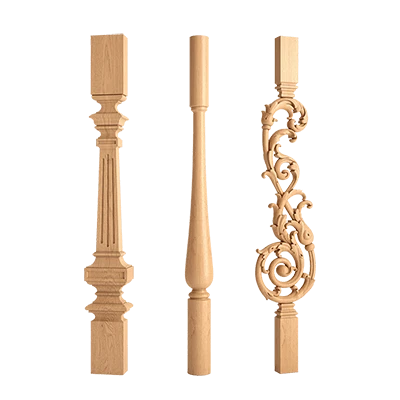
- Carved Balusters: When You Want Truly Beautiful
- Turned Balusters: Timeless Classics Without Excess
- Square balusters: geometry speaks for itself
- Flat balusters: air and light
- How to choose a shape: matching table
- How to choose material for a wooden staircase
- Oak: the standard for steps and railings
- Beech: precision of details and neutral tone
- Ash: elasticity and character of texture
- Pine: affordability and ease of processing
- Solid wood balusters: why solid material matters
- What to buy with balusters: complete list of elements
- Steps
- Risers
- Balusters
- Support columns
- Handrail
- Bottom plank
- Fasteners
- How to calculate a wooden staircase kit
- Step 1: flight parameters
- Step 2: number of steps
- Step 3: step dimensions
- Step 4: number of balusters
- Step 5: handrail length
- Step 6: add landings
- Mistakes when buying staircase elements
- Mistake 1: balusters without steps (or vice versa)
- Mistake 2: different wood species without considering tone
- Error 3: buying balusters individually
- Error 4: not accounting for risers
- Error 5: forgetting about fasteners
- Error 6: estimating the handrail "by eye"
- Error 7: buying posts after balusters
- Types of wooden staircase coatings
- Clear varnish for wood
- Stain plus varnish
- Oil and oil-wax
- Opaque paint
- Installation: sequence and principles
- Correct installation order
- Attaching Balusters to Steps
- Cutting balusters to the angle of the slope
- Frequently Asked Questions (FAQ)
- Can I buy balusters separately from steps?
- How to choose balusters for wooden steps?
- What to buy together with balusters?
- Is it better to buy balusters and steps from the same wood?
- Which balusters to choose for oak steps?
- Which balusters are suitable for beech steps?
- How many balusters are needed for a staircase?
- Where to buy components for a wooden staircase?
- Where to buy balusters, steps, and risers for a wooden staircase
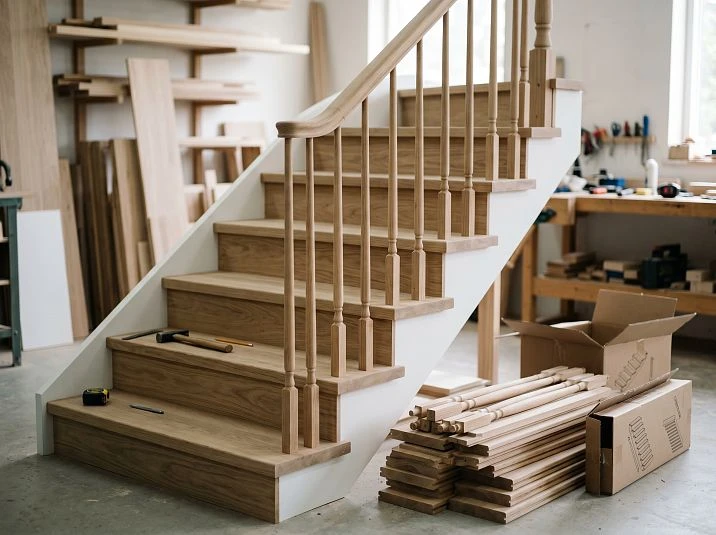
A staircase in a house is not a utilitarian object. It is not just a way to get from the first floor to the second. It is a spatial sculpture, a living structure that guests see, that people touch every day, that children run on and adults climb slowly. And when it is done right, the whole house begins to sound different.
But here is the paradox: most people approach choosing staircase elements as a set of random purchases. Steps — separately. Balusters — separately. Risers — later. They forgot the posts, grabbed the first handrail they saw. As a result, the structure stands, but it feels like it was assembled from whatever was at hand.
This article is about a different approach. About how buy components for a wooden staircase meaningfully: balusters, steps, risers, handrails and posts — in one style, from one wood species, with a unified tone and correct geometry.
Why it's better to assemble a staircase as a kit
This question seems obvious — but only after someone has once assembled a staircase from disparate elements. Let's break down why a systematic approach is not just more convenient, but fundamentally more important.
Unified wood species — unified character
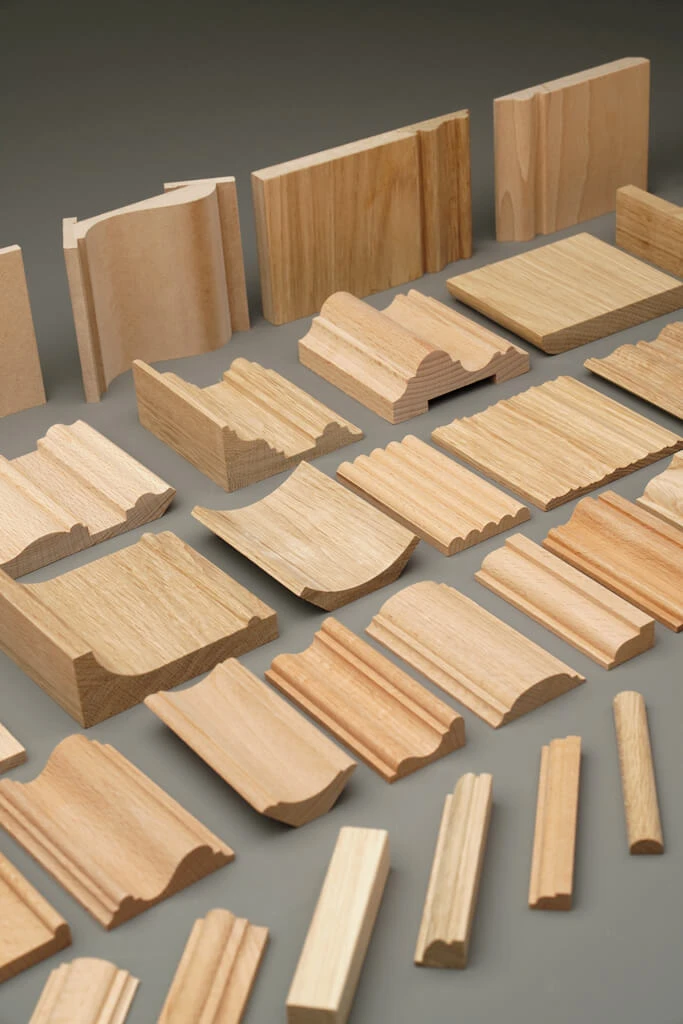
Wood is alive. It expands with moisture, contracts in dryness, and gains tone over time. Different species do this differently. Oak darkens differently than beech. Pine yellows faster than ash. If the steps are from one species and the balusters from another — within a year the staircase will start to 'diverge' in shades, even if everything looks the same today.
Our factory also produces:
Unified style — unified impression
A carved baluster with a simple square riser without a chamfer is like an expensive jacket with wrinkled jeans. Technically it works, but the impression is blurred. The style must be consistent: from the shape of the step to the profile of the handrail. Only then is the staircase perceived as a whole.
Get Consultation
Dimensional compatibility
A step has a certain thickness and overhang (projection). The riser is selected according to the rise height. The baluster is attached to the step via a tenon — and this tenon must exactly fit into a hole of the required diameter. The handrail sits on the balusters — and its groove must align with the top tenon. All of this is a system of interdependent dimensions.
That is why buy staircase components from one manufacturer — this is not just convenience, but a guarantee that everything will fit into place without adjustment or rework.
What is included in a wooden staircase
Before choosing individual elements, you need to see the entire system. Many people know about steps and balusters — and have no idea about half of the rest.
Steps
Horizontal surfaces that are walked on. They bear the most wear. Step thickness — usually 35–40 mm for a wooden staircase. Width — from 250 to 350 mm (depends on the angle of ascent). Overhang (projection over the riser) — 20–30 mm.
Steps experience constant load — both static (person's weight) and dynamic (impact when walking). The material must be durable and resistant to abrasion.
Risers
Vertical panels between steps. They close the space under the step, giving the structure a finished look. The riser sets the rise height — the distance a person lifts their leg with each step. Standard height — 150–180 mm.
Staircases can be open (without risers) and closed (with risers). Open ones look lighter and more modern. Closed ones — more solid and classic. A riser made of the same wood as the step is a must for a cohesive look.
Balusters
balusters for staircase to buy needed in the calculated quantity — considering the step, length of flights and landings. They create the visual rhythm of the railing and ensure safety.
Handrail and railing
The upper horizontal part of the railing. The handrail bears the load when leaning on it. Straight handrail — for straight flights. Corner connectors or curved sections — for landings and turns.
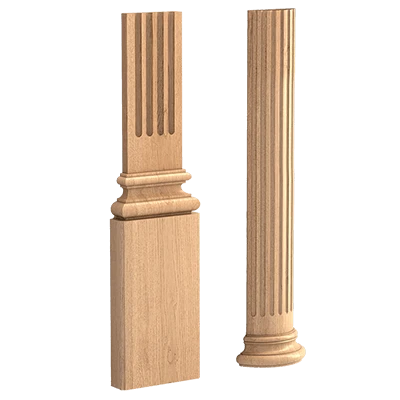
Supporting posts
Vertical load-bearing elements that take the horizontal load from the handrail. Starting, finishing, turning, and intermediate — each in its place.
Bottom rail (sub-baluster rail)
A horizontal profile attached to the steps from below, holding the balusters at equal intervals. Without it, the balusters "wander."
Fasteners and additional elements
Studs, anchors, connectors, end caps, decorative rosettes — all of this constitutes staircase components and is included in the full order list.
How to choose balusters for steps
This is a subtle question. Not "which balusters are prettier" — but "which balusters are suitable for these particular steps." The difference is fundamental.
Proportions: massiveness versus elegance
Thick, heavy oak steps of 40 mm require a proportionate railing. A thin flat baluster against a monumental oak step will look unserious — like a violin in a percussion orchestra. Here you need either powerful turned balusters with a wide body, or a square cross-section of 45×45 mm and above.
And vice versa: on a light pine staircase with thin steps of 35 mm, a carved baluster with rich decor will visually overload the structure. Here, turned or Flat balusters with a minimalist profile.
Tone: the rule of one color
A uniform tone for steps and balusters is not just beautiful. It is a sign of systematic thinking in staircase design. If the steps are stained in a "dark walnut" color, the balusters should be in the same tone. If the steps are in "natural oak," the railing should be in the same register.
Mixing tones creates visual noise. The eye starts to "wander" across the staircase, finding no rest. A uniform tone is peace and completeness.
Wood species: one or a harmonious combination
The ideal option is steps and balusters from the same wood species. Balusters for beech steps should be made of beech. Balusters for oak steps should be made of oak. This ensures the same "behavior" of the wood when temperature and humidity change, and the same result when applying the same coating.
An acceptable combination: steps made of oak, balusters made of beech under the same stain. Beech takes stain slightly differently than oak, but with proper treatment, the difference is minimized. It is important to test on samples before applying to the entire staircase.
An unacceptable combination: steps made of light pine under clear varnish, balusters made of dark oak under "wenge" stain. These are two different worlds in one structure.
Steps and risers: how they affect the choice of balusters
A step is not just a horizontal plane. It is the "face" of the staircase. It is what people look at first, and what they feel with their feet every day.
Step edge shape
The edge (front face of the step) can be:
-
Straight — strict, without rounding
-
Chamfered — cut at a 45° angle
-
Rounded (half-round) — soft, traditional
-
With a cutout — with a decorative profile on the bottom
The more complex the edge profile, the more decorative the baluster should be. A simple straight edge pairs well with both minimalist square and carved balusters. A classic rounded edge is organic with turned and carved balusters.
Step thickness and overhang
The thicker the step and the greater its overhang above the riser, the "heavier" the staircase looks. For such a design, balusters with pronounced volume and weight are suitable: turned or Carved wooden balusters.
Thin steps without overhang — this is a "light" aesthetic. Here, flat or square balusters with minimal decor are logical.
Closed or open staircase
Closed staircase (with risers): the space under the flight is closed. The structure looks monolithic and solid. Classic turned balusters, carved ones, and square ones all work well here.
Open staircase (without risers): air under the steps, transparency, lightness. Here, overly decorated balusters can "overload" the look. Better to use square, flat, or laconic turned ones.
Which balusters to choose: breakdown by type
The shape of a baluster is the language the staircase speaks to the interior. Let's break down each type honestly and in detail.
Carved balusters: when you want something truly beautiful
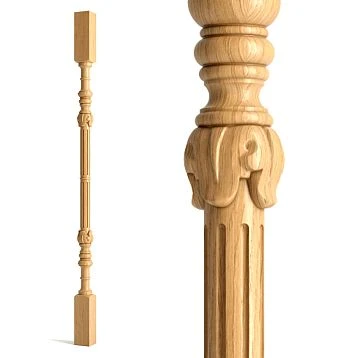
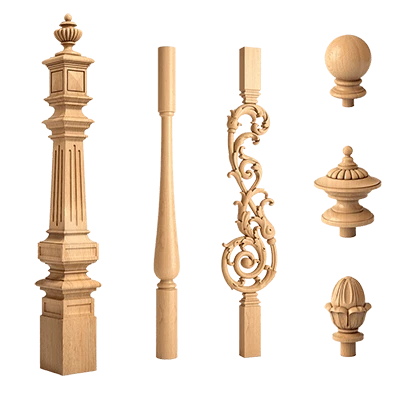
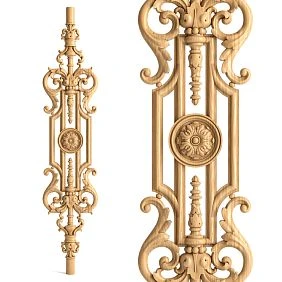
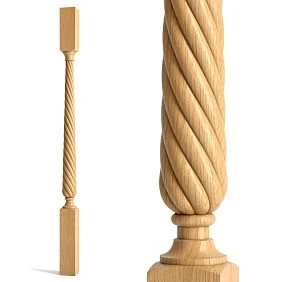
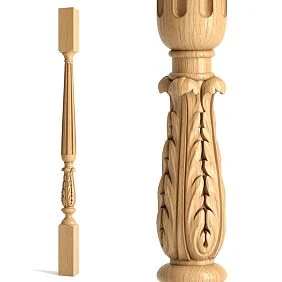
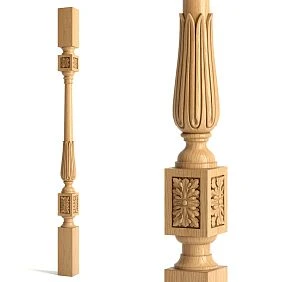
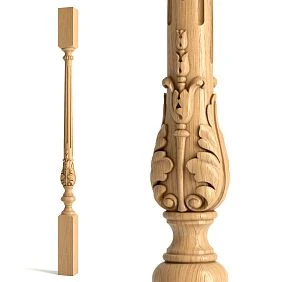
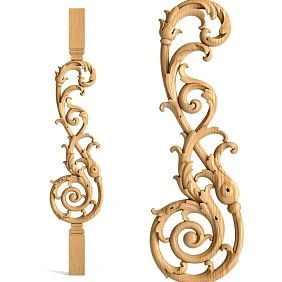
Buy carved wooden balusters — it's about betting on an artistic object in the home. Flutes along the axis, ornamental belts, acanthus leaves, vase-shaped flares—a carved baluster doesn't just stand in the railing; it tells a story of craftsmanship.
For which interiors: classic, baroque, empire, Russian estate style, Victorian style. For steps with a profiled edge and risers with a milled surface.
Important nuance: carved balusters require compatible posts—with capitals, bases, decorative finials. A simple square post next to a richly carved baluster looks like a draft next to a finished work.
Turned balusters: timeless classic without excess
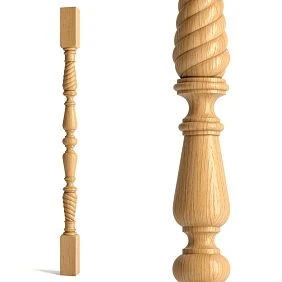
Turned balusters are a time-tested choice. Barrels, vases, cylinders strung on an axis — a familiar, warm, cozy silhouette. wooden balusters for stairs buy in turned execution means choosing what works equally well in both modern and traditional homes.
Turned balusters are versatile in style, affordable in price, and easy to install. For timber houses, country style, cottages, and country residences — this is an organic, "right" choice.
Square balusters: geometry speaks for itself
square balusters for stairs is minimalism elevated to a principle. No extra lines, no decorations. Only the vertical, the space between it and the next vertical — and the rhythm of this alternation.
Square balusters work well in modern interiors: minimalism, Scandinavian style, Japanese interior, modern classic. Finish — matte varnish or white paint. Steps — with a straight edge, without excessive decor.
Flat balusters: air and light
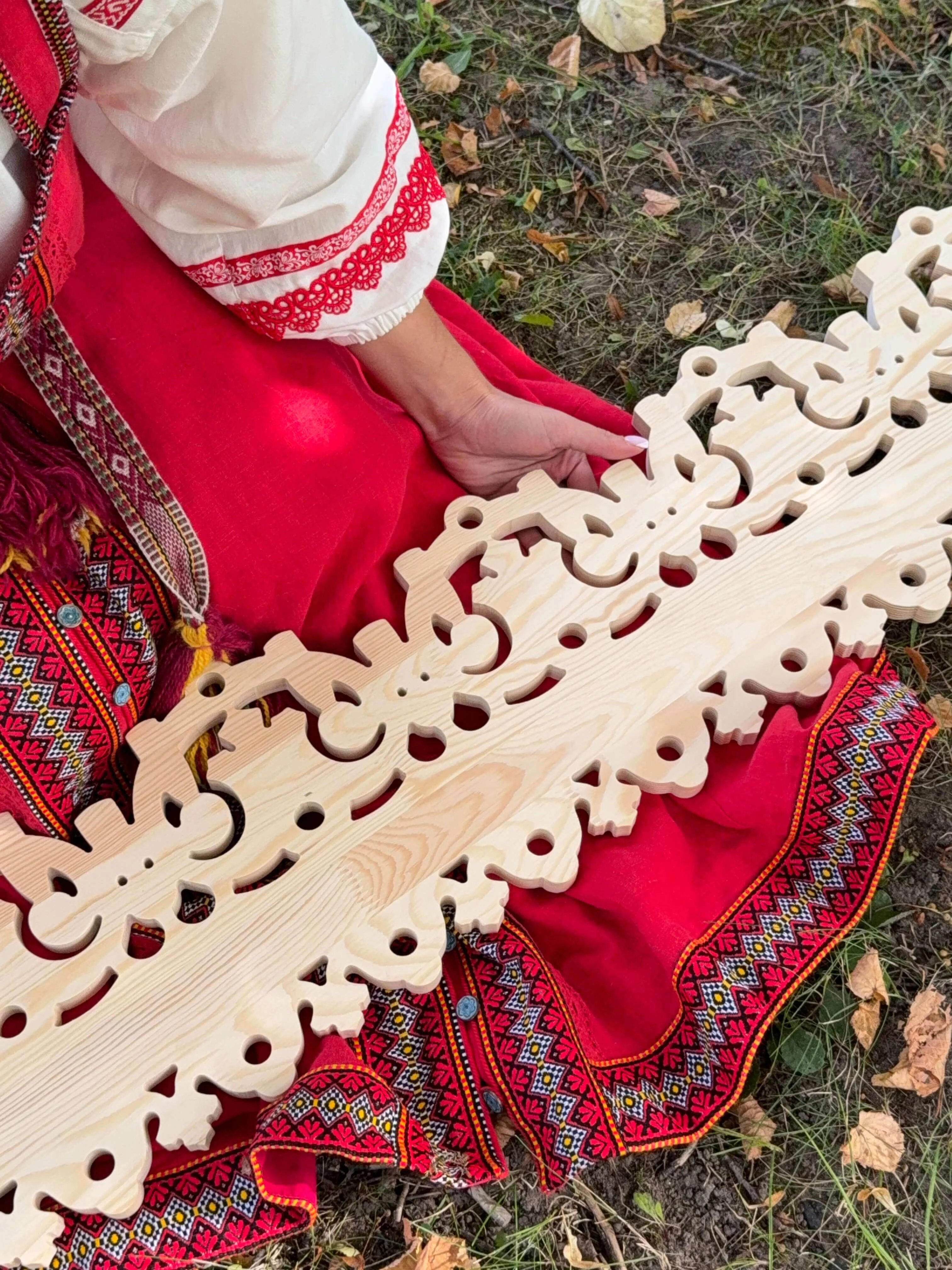
Buy flat balusters is for those who want the lightest possible railing. A flat baluster is almost a silhouette, a thin outline. It doesn't take up space — it hints at the railing, creates rhythm without mass.
Good for country houses, open staircases, narrow hallways, interiors with limited space. Easy to paint — flat surfaces are faster and smoother to paint.
How to choose a shape: correspondence table
| Baluster type | Interior style | Step type | Finish |
|---|---|---|---|
| Carved | Classic, baroque, empire | Massive with chamfer | Glossy or semi-glossy varnish |
| Turned | Country, traditional, wooden house | Any | Varnish, stain, oil |
| Square | Modern, minimalism, Scandinavian | Straight edge | Matte varnish, paint |
| Flat | Country house, loft, modern | Light open staircase | Paint, matte varnish |
How to choose material for a wooden staircase
Material is the core of everything. The durability of the steps, the precision of the baluster profile, and the final appearance of the finished staircase depend on the wood species.
Oak: the standard for steps and railings
Oak is the first choice for those building a staircase once and for all. Hard, dense, with a pronounced texture — it is both beautiful and practical. Oak steps withstand decades of intensive use. Buy oak balusters — means getting products with clear edges, a smooth surface, and a beautiful golden-brown texture.
Oak accepts any coating well: clear varnish highlights the texture, stain adds depth of color, and opaque paint creates a modern, strict look. The only downside is that oak is more expensive than pine and beech.
Beech: precision of details and neutral tone
Beech is close to oak in hardness but has a more uniform, "calm" structure without pronounced grain. That is why Buy beech balusters it is preferred by those ordering complex carved or turned shapes: the profile turns out clear and even.
The color of beech is light beige, almost neutral. Under clear varnish, it has a soft, "quiet" look. Ideal for modern interiors in light tones.
Ash: elasticity and texture character
Ash is a light-colored wood with clear straight grain and a warm grayish tint. In terms of strength, it is comparable to oak. Ash steps look great under a clear matte varnish — the texture "plays," creating the feeling of living wood.
for Buy balusters and posts for a wooden staircase made of ash — an excellent choice for light Scandinavian interiors.
Pine: affordability and ease of processing
Pine is the most affordable option. Soft, light, easy to paint and varnish. For country houses and budget projects, it is a reasonable choice. The main drawback: softness. Pine steps scratch and wear more noticeably than oak ones.
For steps in a residential house with heavy use, it is better to protect pine with a hard parquet varnish or oil with hard wax.
Solid wood balusters: why solid material matters
Buy wooden balusters from solid wood — this is a choice in favor of a monolithic piece of wood without gluing or veneering. Solid wood does not delaminate, has no visible joints, and behaves predictably with changes in humidity. For balusters, this is especially important: a turned or carved profile on a solid piece looks completely different than on a glued product.
What to buy together with balusters: a complete list of elements
This is a practical checklist. Print it out, check the boxes.
Steps
-
Quantity = number of risers in a flight of stairs
-
Size: width per design, thickness 35–40 mm, depth (horizontal) 250–320 mm
-
Material: same wood species as balusters
Risers
-
Quantity = number of steps (for closed staircase)
-
Height 150–180 mm (per design)
-
Thickness 20–25 mm
-
Material: same wood species
Balusters
-
Quantity per calculation (spacing 100–150 mm clear)
-
Height: from tread surface to bottom edge of handrail
-
Shape: carved, turned, square or flat
Supporting posts
-
Start (1 pc.) + finish (1 pc.) — mandatory
-
Turning — according to the number of corners
-
Intermediate — when span length exceeds 1.5–2 m
Handrail
-
Length = total length of all runs + 10% allowance
-
Profile: round, semi-round or rectangular
-
Corner connectors or bent sections — according to the number of turns
Bottom strip
-
Length = total length of flights
-
One plank per flight
Fasteners
-
Studs for balusters (d 10–12 mm, L 70–100 mm)
-
Anchor bolts for posts
-
Wood screws
-
Metal connectors
-
End caps for posts
-
Decorative rosettes
All of this is in the section of stair components on the STAVROS website — conveniently cover the entire list with one order.
How to calculate a wooden staircase kit
Correct calculation saves money and nerves. Let's break it down step by step.
Step 1: flight parameters
Need to know:
-
Floor height (from floor to floor) — H
-
Staircase rise angle — α
-
Staircase width — B
Step 2: number of steps
Rise height of one step — standard 160–175 mm. Number of steps N = H / h, where h is the rise height.
Example: floor height 2800 mm, h = 175 mm → N = 2800 / 175 = 16 steps.
Step 3: step dimensions
Tread depth G = (600 − 2h) / 1, where 600 mm is the average human step. At h = 175 mm: G = 600 − 350 = 250 mm. This is the minimum comfortable tread depth.
Step 4: number of balusters
Length of the horizontal projection of the flight L = N × G.
With N = 16, G = 250 mm: L = 4,000 mm.
Number of balusters = L / (baluster width + clear spacing)
With baluster width 45 mm and spacing 120 mm:
4000 / (45 + 120) = 4000 / 165 ≈ 24 balusters per flight.
Add 10% reserve = 27 pieces.
Step 5: handrail length
The handrail does not run horizontally, but at the angle of the flight. Handrail length = L / cos(α), where α is the angle of the flight.
With L = 4,000 mm and α = 35°: handrail length = 4000 / cos(35°) ≈ 4882 mm ≈ 5 linear meters with a margin.
Step 6: add landings
Horizontal landings are a separate calculation. They require balusters in the horizontal railing, additional posts, and handrail sections.
Mistakes when buying staircase components
Here are real, typical mistakes — not made up, but forged from the practice of hundreds of projects.
Mistake 1: balusters without treads (or vice versa)
A person buys beautiful balusters without having a tread sample on hand. Then it turns out: the shade is different, the wood species is different, the tenon size does not match. The rule is simple: always have a tread sample (or at least its exact parameters) with you when choosing balusters.
Mistake 2: different wood species without considering the shade
"We need beech balusters — cheaper, and oak steps." This solution is viable, but only with a covering coating. Under clear varnish, beech and oak will yield different results even with the same stain.
Mistake 3: buying balusters one by one
One SKU, one batch — this is important. Balusters from different batches may have slight differences in tone and size. On a staircase where all balusters stand side by side, these differences will be visible.
Mistake 4: not accounting for risers
You ordered the steps — and forgot about the risers. As a result, the structure is either open (though designed as closed), or the risers had to be bought from another seller with a different tone.
Mistake 5: forgetting about fasteners
Pins, anchors, connectors — all of this is ordered last, when installation has already begun. Stainless steel fasteners — only from the factory or a specialized supplier, not from the nearest hardware store.
Mistake 6: estimating the handrail "by eye"
The length of the handrail along the horizontal projection and along the inclined plane are different numbers. Whoever forgets this when calculating ends up short of material at the most inconvenient moment.
Mistake 7: buying posts after balusters
The starting and finishing posts are the first elements of installation. They need to be ordered together with the balusters, not after. Because the post sets the vertical line from which the entire railing is built.
Types of wooden staircase coating
The coating is the last, but no less important choice. The durability, appearance, and tactile feel of the entire staircase depend on it.
Clear varnish for wood
Preserves and emphasizes the texture. For oak and ash with a pronounced structure, it is an ideal choice. Parquet varnish with a hardness of at least 4H on the pencil scale is used on the steps. Interior varnish is applied to the balusters in two to three coats with intermediate sanding.
Stain plus varnish
Stain (tinting) changes the color of the wood without hiding the texture. It allows you to make pine look like oak, beech like dark walnut. Important: stain enhances the differences between wood species. If the balusters are made of beech and the steps are made of oak, the difference under stain will be more noticeable than without it.
Oil and oil-wax
Oil penetrates the wood structure without creating a film. The surface "breathes" and retains its natural appearance. Oil-wax gives a slight silky sheen. Tactilely, it is the best feeling among all coatings. It requires periodic renewal — once every year or two on the steps.
Opaque paint
Completely hides the texture. It is chosen to achieve a uniform tone when using different wood species. White or gray balusters on white risers are a popular solution for Scandinavian interiors. The paint for the steps must be special — with high abrasion resistance.
Installation: sequence and principles
Installing a wooden staircase is a job that requires patience and precision. An incorrect sequence of actions leads to rework, and rework leads to material loss.
Correct installation order
-
Install the stringer or string (load-bearing structure of the flight)
-
Secure the risers
-
Lay the treads
-
Install the support posts
-
Secure the bottom rail
-
Install the balusters (from bottom to top, along the flight)
-
Lay the handrail
-
Finishing: joint putty, sanding, coating
Detailed step-by-step instructions on installation of wooden railings and balusters will help you understand the details — we recommend studying it before starting work.
Attaching balusters to steps
Each baluster is attached via a stud into the step from below. The hole diameter matches the stud diameter exactly, with minimal clearance. Epoxy glue is used for reliable fixation. The upper end of the baluster fits into the handrail groove with a tenon or is fastened with a self-tapping screw through a decorative rosette.
Trimming balusters to the angle of inclination
On a sloping flight, the top end of each baluster is cut at the angle of the handrail slope. Without this, the handrail will have gaps. The angle is determined by the project or by the installed outer balusters with a taut string.
Frequently Asked Questions (FAQ)
Can I buy balusters separately from the steps?
Yes, you can. But before purchasing, be sure to clarify: the wood species of the steps, their thickness, and coating tone. The diameter or shape of the baluster tenon and the seat in the handrail. The style and size of the support posts. Without this data, the risk of incompatibility is very high.
How to choose balusters for wooden steps?
Three key principles: same wood species or a harmonious combination, same coating tone, proportionate dimensions. Massive steps — more expressive balusters. Light staircase — simple flat or square balusters.
What to buy together with balusters?
Mandatory minimum: support posts, handrail, bottom rail, fasteners (studs, anchors, connectors). Recommended: steps and risers from the same manufacturer, decorative overlays, end caps.
Is it better to take balusters and steps from the same wood?
Yes, this is the optimal option. One species — identical behavior when humidity changes, identical result when applying coating, guaranteed color consistency.
Which balusters should I choose for oak steps?
For oak steps, oak balusters are optimal — turned or carved for classic style, square for modern interiors. Beech under the same stain is acceptable. Pine with oak under clear varnish is not recommended: textures and tones are too different.
Which balusters are suitable for beech steps?
Beech balusters are ideal. Ash under the same stain is acceptable. For modern light interiors, beech steps with beech square balusters under matte varnish give excellent results.
How many balusters are needed for a staircase?
Standard spacing is 100–150 mm clear. For a straight staircase with 16 steps at 120 mm spacing and a baluster width of 45 mm, about 24 balusters are needed per flight plus balusters for the landing. Exact calculation uses a formula considering actual staircase parameters.
Where to buy components for a wooden staircase?
At STAVROS you can select balusters for staircase to buy from oak, beech, ash, and pine — in one style, with compatible posts, handrails, and fasteners. Professional kit calculation is free.
Where to buy balusters, steps, and risers for a wooden staircase
To conclude this conversation, let's say the main thing: a staircase is too important an element of a home to be assembled from random parts. It lasts for decades. Everyone who enters your home sees it. It is touched every day—and that touch should be pleasant.
STAVROS is a manufacturing company with its own full-cycle production of wooden staircase components to buy in one place. Here—over 50 models of balusters, a wide selection of posts, handrails of various profiles, treads and risers made of oak, beech, ash, pine. All elements are a unified system with proven compatibility of sizes and styles.
What sets STAVROS apart from a retail building materials store:
-
Manufacturing from dry solid wood with moisture control
-
Unified system of compatibility for all railing elements
-
Possibility of custom sizes for a specific project
-
Professional calculation of the kit—managers will help compile an accurate order list
-
Delivery across all of Russia: from Moscow and St. Petersburg to remote regions
A wooden staircase made correctly is an investment that never goes out of style. It gets better with age: the wood gains character, patina, history. And this history begins with the right choice of material and manufacturer.