
























Article Contents:
- Why buyers look for balusters from the manufacturer
- The story with the intermediary
- The story with the assortment
- The story with completeness
- The story with quality
- How buying from the manufacturer differs from a store and marketplace
- Scenario one: construction hypermarket
- Scenario two: marketplace (Ozon, Wildberries, Yandex Market)
- Scenario three: manufacturer
- What balusters can be bought from the manufacturer: a complete overview
- Carved balusters: for those who want the real thing
- Turned balusters: tradition and reliability
- Square balusters: geometry over decoration
- Flat balusters: lightness and air
- Beech and oak balusters: on the matter of wood species
- How to check the quality of balusters before buying
- Geometry: measurement, not impression
- Tenons: without cracks or bevels
- Sanding: run your hand over the surface
- Batch uniformity
- Material moisture content
- Absence of major defects
- Why it's important to buy a set, not just balusters
- Three incompatibilities that kill a project
- What a system order should include
- How to calculate the number of balusters before ordering
- Initial data for calculation
- Formula for calculating the number of balusters
- Calculation of handrail length
- Calculating the Number of Posts
- What determines the price of wooden balusters from the manufacturer
- Wood species: the main factor
- Shape: complexity of turning and milling work
- Height and Cross-Section
- Order volume
- Completeness: one order is cheaper than several
- What mistakes are made when buying balusters
- Mistake one: choosing only by photo
- Mistake two: buying balusters without considering the railing height
- Mistake three: mixing different styles on the same staircase
- Mistake four: not counting balusters for landings
- Mistake five: buying 'the same' from different suppliers
- Mistake six: forgetting about fasteners
- When ready-made balusters are better, and when individual selection is better
- Ready-made models: for most projects
- Custom order: for non-standard situations
- How to Choose a Manufacturer of Wooden Balusters: Evaluation Criteria
- Criterion One: Having Your Own Production
- Criterion Two: Catalog Consistency
- Criterion Three: Readiness for Custom Orders
- Criterion Four: Technical Support When Choosing
- Criterion Five: Pricing Transparency
- STAVROS Catalog: What You Can Buy from the Manufacturer
- Balusters: Wide Range of Shapes and Wood Species
- Support columns
- Staircase Components
- STAVROS: Buy Wooden Balusters from the Manufacturer with Contact us to confirm shipping to your destination.
- FAQ: Frequently Asked Questions
- Why Is It Profitable to Buy Balusters from the Manufacturer?
- Is it possible to buy only balusters from the manufacturer?
- Which balusters are best to buy for a wooden staircase?
- What to buy together with balusters?
- How to check that the balusters are made of solid wood and not from a cheap glued blank?
- How to find out the manufacturer's price?
- Does the manufacturer deliver balusters to the regions?
Imagine a situation: a person sees beautiful balusters on a marketplace. The price is nice. The photos are great. They order. They receive. And only then do they discover that the balusters do not match the height of the already purchased handrail, the wood species is not what was stated in the description, the tenon is loose in the groove, and three out of twenty have obvious defects. Sound familiar? This happens regularly — that's why experienced builders and designers have long understood one simple rule: balusters from the manufacturer are a fundamentally different level of purchase.
Not "cheaper," not "faster" — but systematically better. Because the manufacturer knows their product inside out, is responsible for dimensions, compatibility, and quality, and most importantly, can offer the entire staircase kit in one place. Without random selection, without incompatible parts, without stress during installation.
This article is about how the market for wooden balusters works, how buying directly from the manufacturer differs from shopping on a marketplace or in a building hypermarket, and how to choose a manufacturer you can trust.
Why buyers look for balusters from the manufacturer
The query "balusters from the manufacturer" is not just a synonym for the word "cheaper." It is based on a specific logic, and it is precise.
The story with the intermediary
Any retail store, marketplace, or construction market is a link between the factory and the end customer. Each such link adds its own margin to the price. Sometimes small, sometimes very noticeable. When purchasing 30–40 balusters, a difference of 200–500 rubles per piece turns into an overpayment of 6,000–20,000 rubles just for the right to buy through an intermediary.
But it's not just about the money.
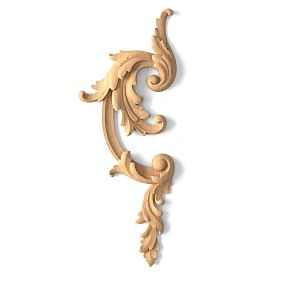
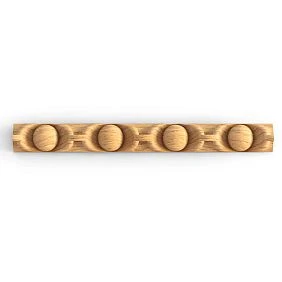
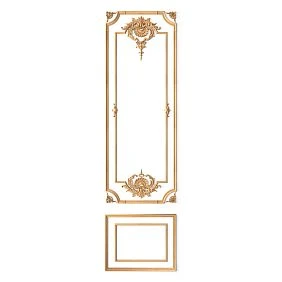
Our factory also produces:

The story with the assortment
A store or marketplace sells what is profitable to keep in stock. As a rule, these are a few of the most popular models, one or two types of wood, standard sizes. If you need a baluster 960 mm high instead of the standard 900 mm, the store will throw up its hands. The manufacturer can make the required size.
Get Consultation
The story with completeness
The marketplace sells balusters. Separately, the handrail. Separately, the posts. Moreover, from different suppliers with different size tolerances, different wood species, different tones. Assembling a unified system from this is a challenging task.
Buy wooden balusters from the manufacturer means getting an element for which compatible railings, posts, and fasteners from the same system are known in advance.
The story with quality
The manufacturer bears direct responsibility for the quality of its product. An intermediary can refer to the supplier. A marketplace can refer to the seller. The manufacturer cannot refer to anyone. It is their name, their reputation, their returns.
How buying from a manufacturer differs from a store and a marketplace
Let's break down three purchase scenarios specifically — not in favor of any one option, but honestly, with all the pros and cons.
Scenario one: a home improvement hypermarket
Pros: you can see it in person, touch it, take it immediately.
Cons: limited assortment (usually 3–5 models), no staircase consultant, no way to select compatible railings and posts from the same system, price is inflated due to retail space rent and logistics.
Scenario two: marketplace (Ozon, Wildberries, Yandex Market)
Pros: large selection for one query, often low price.
Cons: different sellers, different quality standards, photos don't match reality, no guarantee of batch uniformity (20 pieces from one order may come from different batches), hard to find a compatible set, returns are difficult if size doesn't match.
Scenario three: manufacturer
Pros: uniform quality standard across the entire batch, possibility of custom sizes, compatible catalog (balusters + railings + posts in one system), direct communication with a calculation specialist, product responsibility.
Cons: there isn't always a showroom 'near home'; sometimes you have to wait for production or delivery.
For a person building a staircase in their home—not a temporary one, not a country house one, but a home staircase for decades—the choice is obvious. Buy balusters from the manufacturer — this is not just savings. It's an investment in reliability and aesthetics.
Which balusters can you buy from the manufacturer: a complete overview
A good manufacturer is not just one model in one size. It's a catalog covering all styles, all wood species, all functional requirements. Let's break down the main categories.
Carved balusters: for those who want the real thing
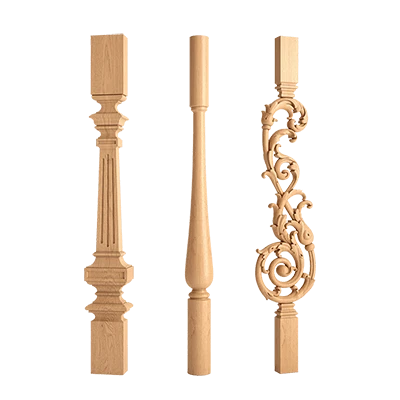
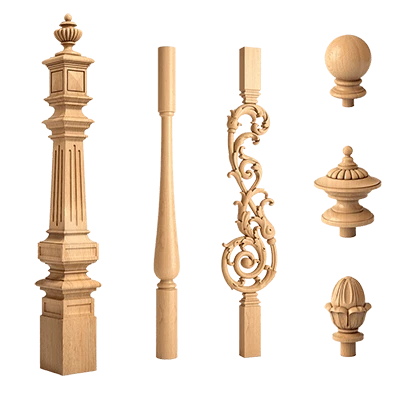
Buy carved wooden balusters From the manufacturer means getting a product where every decorative element is reproduced with the precision of a lathe and milling machine. Flutes, acanthus leaves, vase-shaped flares, ornamental bands—all this is not the handiwork of a craftsman in a garage, but precise industrial production with repeatability within ±0.5 mm.
A carved baluster is a choice for classic interiors, for homes with stucco and oak parquet, for people who don't want to see the staircase as just a functional object. It's architectural decor.
Wood species: oak, beech. Height: from 900 to 1,000 mm standard, non-standard by order. Finish: varnish, stain, oil—by choice.
Turned balusters: tradition and reliability
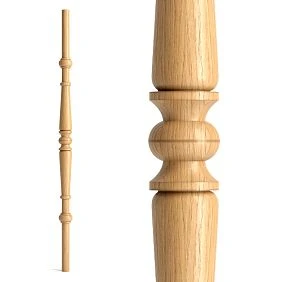
Turned balusters — barrels, cylinders, vases on a single axis — are the visual language of a classic wooden staircase. Recognizable, warm, time-tested. The manufacturer offers several profile options: with one grip, with two, with an elongated upper part, with an emphasis on the middle element.
Turned balusters are produced on a CNC lathe — this guarantees geometric uniformity of the entire batch. All 30 balusters from the order will be identical, accurate to fractions of a millimeter.
Square balusters: geometry versus decoration
square balusters for stairs — this is minimalism as a principle. Constant cross-section of 40×40 or 45×45 mm along the entire height, straight edges, no decorations. For modern interiors, this is the "right" choice. Matte varnish or white paint, square posts, rectangular handrail — and the staircase becomes part of the architecture, not a separate object.
The manufacturer produces square balusters on planer-thicknessing equipment with precise cross-section calibration. All edges are strictly straight, all angles are strictly 90°.
Flat balusters: lightness and air
Buy flat balusters the manufacturer offers several options for width and thickness. A flat baluster is a thin profile with a width of 70–100 mm and a thickness of 20–25 mm. It is "transparent" to the eye, does not overload the space, and is well suited for small hallways and country houses.
A flat baluster paints perfectly: wide, even surfaces accept paint uniformly, without drips or unpainted areas.
Balusters made of beech and oak: on the question of wood species
Buy beech balusters from the manufacturer means getting a homogeneous, dense material with a clear profile and a neutral light tone. Beech is good for modern interiors, for coating with stain in any shade, for neutral Scandinavian solutions.
Buy oak balusters — a choice for those who build for the long term. Oak is stronger, with a pronounced texture, with a warm golden-brown hue under clear varnish. For classic interiors, it is the first choice.
Buy solid wood balusters — this means obtaining a monolithic element without gluing or veneering. It is the solid array that ensures uniform material behavior under changing humidity and a predictable result when applying any coating.
How to check the quality of balusters before purchasing
Buying is easy. Making sure you bought correctly is a bit harder. Here are specific criteria used to check the quality of wooden balusters.
Geometry: measurement, not impression
Place the baluster on a flat surface. It should not "lean" to any side — this means the axis is straight. Measure the cross-section at several points along the height: deviation should not exceed ±1 mm. For turned and carved balusters, check the minimum diameter at the grips.
Tenons: without cracks or bevels
The lower tenon of the baluster goes into the step. The upper one goes into the handrail. Both tenons must be straight, without cracks, without chips on the end. A crack in the tenon means future breakage during installation or an unreliable fit.
Tenon diameter — check with the manufacturer. Standard is Ø10–12 mm with a length of 60–70 mm.
Sanding: run your hand over the surface
Run your palm over the surface of the baluster. There should be no rough fuzz, unsanded transitions, or "steps" at profile change points. A good baluster after sanding with 80–120 grit is ready for primer application without additional finishing.
Batch Uniformity
When receiving a batch, lay out 5–7 balusters next to each other on a flat surface. They should all be visually identical: the same profile, the same height, the same wood tone. If the batch contains noticeably darker or lighter specimens, this is a sign of mixing different batches or different blanks.
Moisture content of the material
You can and should check the wood moisture content with the manufacturer. The norm for interior products is 8–12%. Above 14% means a risk of shrinkage and cracks after installation. A serious manufacturer stores finished products in a climate-controlled warehouse and can provide moisture data for the batch.
Absence of major defects
Knots, resin pockets, fungal blue stain, fiber tear-outs during processing — all of this is acceptable in construction timber, but not in decorative balusters. The manufacturer has outgoing quality control: products with critical defects are rejected.
Why it's important to buy a complete set, not just balusters
This is a fundamental point worth repeating — because the mistake of "buying only balusters" is made constantly.
Three incompatibilities that ruin a project
Tenon and groove incompatibility. If the baluster tenon is Ø12 mm and the handrail groove is designed for Ø10 mm, you'll have to modify it manually. With 30 balusters, that's several hours of extra work and a risk of damaging the material.
Height incompatibility. A 900 mm baluster + 55 mm handrail + 40 mm bottom rail = a railing height of 995 mm from the step surface. If you were counting on 950 mm, you'll have to recalculate or trim.
Style incompatibility. A turned baluster with a simple square post and a smooth handrail is three different style languages in one structure. The eye finds no peace.
What a system order should include
buy balusters and handrails from one manufacturer is the first step. A complete system order includes:
-
Balusters of the required type, height, and cross-section
-
Handrail of a compatible profile and cross-section
-
Support posts (starting, ending, corner)
-
Bottom horizontal rail
-
Fasteners: studs, anchors, connectors
-
Decorative elements: post bases, end caps, rosettes
Buy balusters and posts for a wooden staircase in one order is not just convenience. It is a guarantee that all parts of the structure will speak the same language: one wood species, one tone, one dimensional tolerance.
How to calculate the number of balusters before ordering
The manufacturer will calculate the kit for you — if you provide the correct data. But it's useful to understand the calculation logic yourself.
Initial data for calculation
To place an accurate order, you need to know:
-
Number of stair flights
-
Horizontal length of each flight (in millimeters)
-
Length of horizontal railings on landings
-
Number of turns and angles
-
Railing height (from stair surface to top of handrail)
-
Desired clear spacing between balusters
Formula for calculating the number of balusters
N = L / (b + a)
Where:
-
L — run length (mm)
-
b — baluster width or diameter (mm)
-
a — clear spacing (mm)
Example: run 3,800 mm, baluster width 45 mm, spacing 120 mm.
N = 3,800 / (45 + 120) = 3,800 / 165 ≈ 23 balusters.
With 10% margin: 23 × 1.1 = 25–26 pieces.
Handrail length calculation
The handrail runs at the angle of the flight, not horizontally. Therefore, its length is always greater than the horizontal projection:
L_handrail = L_horiz / cos(α)
With a horizontal length of 3,800 mm and an angle of 35°: L_handrail = 3,800 / 0.819 ≈ 4,640 mm.
Post quantity calculation
-
Minimum 2 posts for each straight flight
-
One post for each turn
-
Intermediate posts — every 1.5–2 m of run
For a single-flight staircase: start + finish = 2 posts. If the flight length is more than 3 m — add an intermediate one.
What determines the price of wooden balusters from the manufacturer
The question about price is the most common after "what types are there." Let's honestly break down the pricing structure.
Wood species: the main factor
| Species | Relative price | Hardness | Application |
|---|---|---|---|
| Spruce | Basic | Low | Budget projects, country house |
| Beech | +30–50% to pine | High | Residential buildings, good result for stain |
| Oak | +60–100% to pine | High | Premium staircases, durability |
| Ash | +50–80% to pine | High | Light interiors, elasticity |
Balusters price starts from 1,500–1,900 rubles per unit for pine and reaches 6,000–9,000 rubles for an oak carved baluster.
Shape: complexity of turning and milling work
Square baluster — minimal processing, minimal price for processing (price is mainly determined by material cost). Turned — lathe, slightly more expensive. Carved — additional milling or manual finishing, significantly more expensive with a complex profile.
Height and Cross-Section
A 1,000 mm baluster requires more material than a 900 mm one. A baluster with a 50×50 mm cross-section requires more than a 40×40 mm one. The larger the product, the higher the cost.
Order volume
The manufacturer is always ready to discuss a discount on a large order. 10 balusters — one price. 50 balusters — a noticeably different price. When ordering a complete set (balusters + posts + handrail), the total savings compared to retail prices can be 15–25%.
Completeness: one order is cheaper than several
If you order balusters, handrails and Wooden stair posts in one order — logistics is one, packaging is one, delivery is one. It's cheaper than three separate shipments.
What mistakes are made when buying balusters
Let's look at specific scenarios — not abstract «mistakes», but real situations.
Mistake one: choosing only by photo
The photo on the manufacturer's website is a good reference. The photo on the marketplace is not a guarantee. The real color of the wood may differ from the image depending on the grade of the workpiece, lighting conditions during shooting, and image processing. Always request real photos of a specific batch or a sample from the manufacturer.
Mistake two: buying balusters without considering the height of the railing
A 900 mm baluster with a 55 mm handrail and a 40 mm bottom rail gives a railing of 995 mm from the step level. If the project called for 950 mm, you will have to cut all the balusters. And that means redoing the tenons on the bottom end.
Mistake three: mixing different styles on the same staircase
Square balusters + carved posts + handrail with ornamental profile — three different style languages. Either everything in one key, or a deliberate contrast worked out by the designer. Random mixing always looks random.
Mistake four: not counting balusters for landings
They count for flights, forget for landings. A landing — horizontal railing — requires as many balusters as an inclined flight of the same length.
Mistake five: buying "the same" from different suppliers
"The same" balusters from two different manufacturers are almost always different tenons, different tones, different results under the same coating. One manufacturer — one result.
Mistake six: forgetting about fasteners
Ordered balusters, handrail, posts. Fasteners — not ordered. Then it turned out that M10 studs were needed, but the nearest store only had M8. Or the required amount of epoxy glue was not in stock. Fasteners are part of the kit, not an afterthought.
When ready-made balusters are better, and when — individual selection
This is a question that arises for those who build or restore a non-standard staircase.
Ready-made models: for most projects
Standard staircases in private homes and cottages fit perfectly within the parameters of the ready-made catalog. Height 900–1,000 mm, cross-section 40×40–45×45 mm, standard pitch — this covers 95% of all projects. A ready-made model from the manufacturer's catalog is faster, cheaper, and easier to install.
Custom order: for non-standard situations
Custom selection is needed in several situations:
-
Restoration of an old staircase: need to recreate lost balusters with a specific historical profile. A manufacturer with a good milling setup can reproduce the required shape based on a sample or drawing.
-
Non-standard dimensions: floor height of 3,200 mm or staircase angle of 42° require balusters of a different height or a special end cut.
-
Unique design project: an architect has developed a custom baluster profile — the manufacturer can produce it according to specified parameters.
-
Special wood species: if the project requires balusters made of ash or thermally modified wood — not all manufacturers work with such blanks.
About how it works production of stair components — from idea to finished product — is worth reading separately: it helps to understand what makes up the price and why it differs among manufacturers.
How to choose a manufacturer of wooden balusters: evaluation criteria
There are many offers on the market. How to distinguish a serious manufacturer from a reseller who calls themselves a manufacturer?
First criterion: having your own production
A serious manufacturer can show a workshop — a real one, with equipment. CNC lathes, thickness planers, milling centers. A reseller calling themselves a manufacturer will only show a warehouse.
Second criterion: catalog consistency
If the manufacturer's catalog includes balusters, posts, handrails, and buy staircase components they are in a unified system — this is a sign of systematic production. If "balusters are available, but handrails are not" — it's likely a middleman.
Third criterion: readiness for custom orders
A real manufacturer doesn't say "we only have this." They say "we have this, and we can make this to order." Production flexibility is a sign that you are dealing with a factory, not a warehouse.
Fourth criterion: technical support during selection
A good manufacturer doesn't just take an order — they help you form it correctly. A staircase components manager should be able to calculate the number of balusters based on staircase parameters, select a compatible handrail, and warn about possible incompatibilities.
Criterion five: pricing transparency
Prices in the catalog, clear cost structure, clear separation of "unit price" and "price when ordering from N pieces". No "call us for details" instead of a price list.
STAVROS catalog: what you can buy from the manufacturer
Speaking about buying directly from the manufacturer, it is necessary to specifically mention what is available in the catalog.
Balusters: a wide range of shapes and wood species
STAVROS manufactures wooden balusters from the manufacturer in four main types: carved, turned, square, and flat. Wood species: pine, beech, oak, ash. Sizes: standard 900–1000 mm, non-standard — by agreement. All products are made of dry solid wood with controlled humidity.
Supporting posts
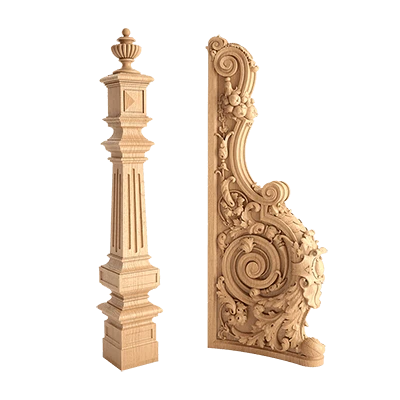
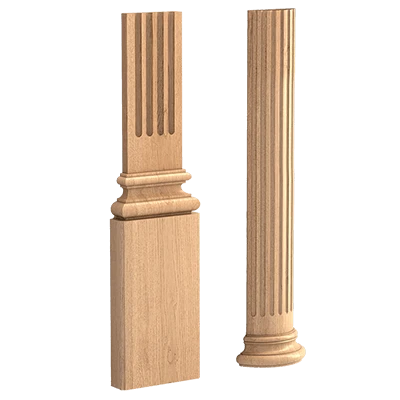
Buy balusters and posts for a wooden staircase in the STAVROS catalog means getting starting, finishing, and corner posts designed in a unified system with balusters. Section 80×80 and 100×100 mm, decorative options with bases and capitals.
Staircase components
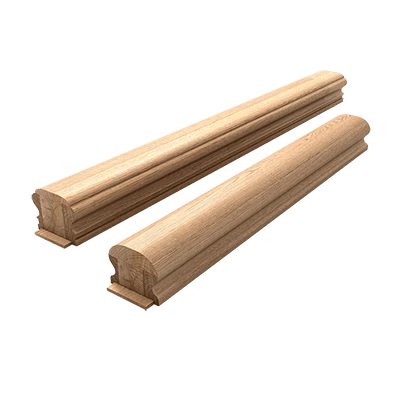
Staircase Components for Sale from STAVROS — these are not just balusters and posts. These are handrails of various profiles, bottom rails, corner connectors, stainless steel fasteners.
STAVROS: buy wooden balusters from the manufacturer with Contact us to confirm shipping to your destination.
A staircase is one of those elements of a house that does not forgive random selection. It stands in the middle of the space, visible from everywhere, touched every day. And if done right, it becomes one of the best interior solutions.
STAVROS is a full-cycle manufacturing company. Own woodworking shop, drying chambers, finished product warehouse, unified catalog of compatible elements. Balusters from the manufacturer here is not a slogan, but a reality: from blank to finished product — one production address.
What makes STAVROS the choice for those who build seriously:
-
Dry solid wood with 8–12% moisture content — no shrinkage after installation
-
Unified system: balusters, posts, handrails, and hardware with coordinated dimensions
-
Full calculation of the kit based on staircase parameters — free service
-
Custom sizes and profiles — made to order
-
Delivery across all of Russia — from Moscow and St. Petersburg to remote regions
Buying from the manufacturer means knowing who made your staircase, from what, with what precision, and with what responsibility.
FAQ: Frequently Asked Questions
Why is it profitable to buy balusters from the manufacturer?
Three reasons: price without intermediary markup, a systematic catalog of compatible elements, and direct responsibility for quality. Buy wooden balusters from the manufacturer means getting a guarantee of batch uniformity and the ability to select a complete set in one order.
Can you buy only balusters from the manufacturer?
Yes, you can. But if the staircase is still being built, it makes sense to immediately select compatible handrails and posts. The manufacturer will advise which elements are compatible with the chosen balusters.
Which balusters are best to buy for a wooden staircase?
Depends on the style: carved for classic, square for modern interior, turned for traditional, flat for a light and airy railing. By wood type: oak for durability and pronounced texture, beech for a clear profile and neutral tone.
What to buy together with balusters?
Mandatory: handrail, support posts, bottom rail, fasteners. Optional: buy staircase components in a single order is a guarantee of compatibility.
How to check that the balusters are made of solid wood and not a cheap glued blank?
The end of a solid baluster shows annual rings without glue seams. On a glued one, glue lines are visible. A good manufacturer specifies this in the product specification.
How to find out the manufacturer's price?
Balusters price specified in the STAVROS catalog. It also includes prices for handrails, posts, and other components. To calculate a complete set for a specific staircase, contact the manager: consultation and calculation are free.
Does the manufacturer deliver balusters to the regions?
STAVROS delivers throughout Russia. Delivery methods: transport company or pickup from the warehouse.