























Article Contents:
- Why a light staircase requires precise selection of balusters
- Which balusters are suitable for a white staircase
- Shape as the main argument
- Balusters for white painting: what is important to know before buying
- Surface decides everything
- Priming and preparation for painting
- Balusters for varnish and natural wood
- When wood speaks for itself
- Stain "light oak" and "bleached wood"
- How to choose material for a light staircase
- Beech vs oak: what to choose for a light interior
- Pine for a light staircase
- How to choose railings and posts for a light staircase
- System unity — not just words
- Handrail for a light staircase
- Posts for a white and light staircase
- Which baluster shapes are best for a light interior
- Turned balusters: a universal choice
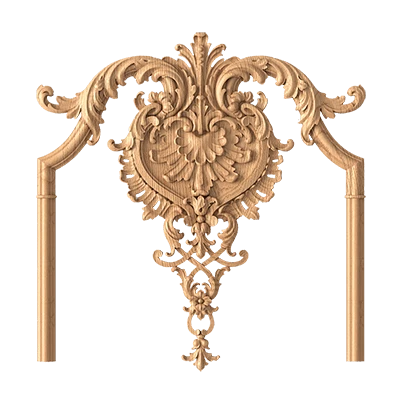
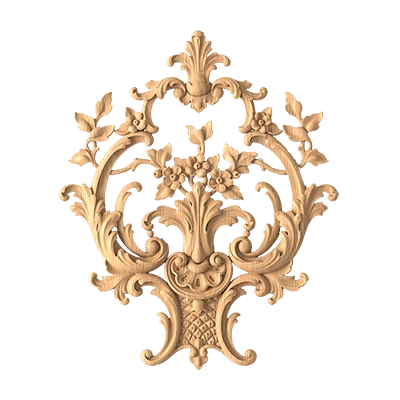
- Carved balusters for neoclassical style
- Square balusters for modern and Scandinavian style
- Flat balusters: lightness and decorativeness
- How to calculate balusters for a light staircase
- Accurate calculation without unnecessary overpayments
- Example calculation
- Price of balusters for a light staircase
- Cost depending on choice
- Mistakes when choosing balusters for a light staircase
- What ruins the idea of a light railing
- Additional elements for a light staircase
- What else is included in the full set
- Where to buy balusters for a light staircase
- STAVROS: a catalog for those who choose consciously
- Frequently Asked Questions (FAQ)
- About the Company STAVROS
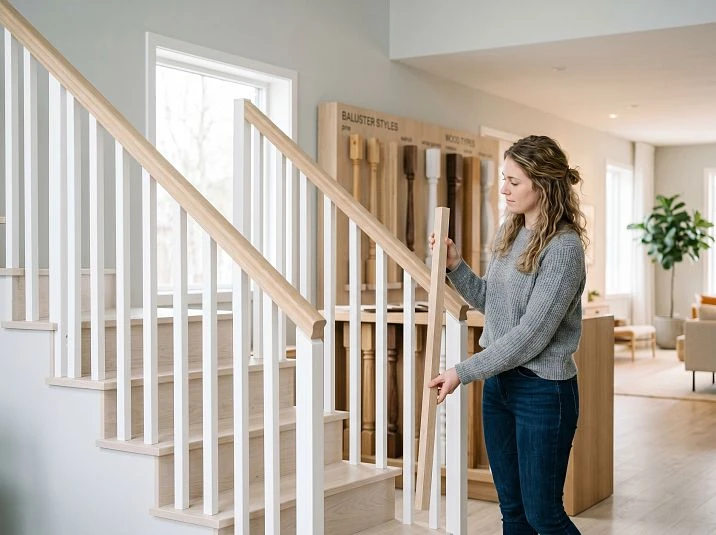
A light home is a special conversation. Everything is on display here: proportions, textures, play of shadows, quality of every surface. And the staircase in such a home is not just a way to go from floor to floor, but an architectural detail that cannot be hidden and cannot be done carelessly. That is why, if you are thinking about which balusters for staircase to buy for a light, white or beige interior, this is already a serious question requiring a serious answer.
Balusters for a light staircase are not just posts under the handrail. They are the rhythm that sets the mood for the flight. They are the shape that either easily breathes in the space or overloads it. They are the finish that either blends into the interior as a whole or stands out as an alien note. There is no room for approximation here.
Why a light staircase requires precise selection of balusters
A dark staircase forgives a lot: in a rich saturated color, details are leveled out, minor flaws go into the shadows, the overall silhouette works as a single dark volume. A light staircase is a completely different matter. On a white, milky, beige or natural background, literally everything stands out: every thickening of the baluster, every transition of shape, quality of sanding, installation rhythm, difference in post thickness. Even a minor defect on the surface under white paint becomes noticeable — unlike dark varnish, where it would be lost.
This is not a reason to panic — it is a reason for precise selection. A light staircase with properly selected balusters looks incredible: airy, elegant, light. It visually expands the space, raises the ceilings, and creates a feeling of that special spaciousness that is sought after today in neoclassical, Scandinavian, and modern classic interiors.
It is important to understand: Buy wooden balusters for a light staircase means solving several tasks at once. The shape must be appropriate. The material must accept the final coating well. The surface must be smooth and clean. And the entire set — balusters, posts, railings — must form a single, harmonious system.
Which balusters are suitable for a white staircase
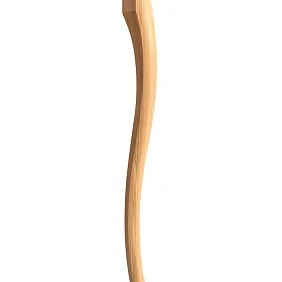
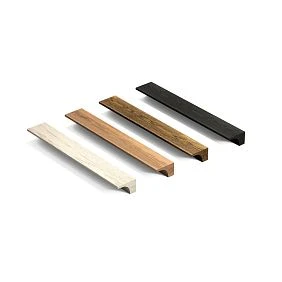
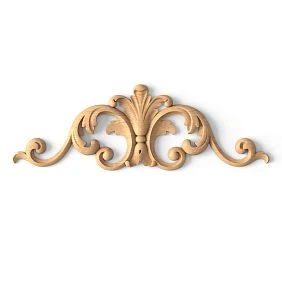
Our factory also produces:
Shape as the main argument
In a light interior, the shape of the baluster is what remains when color fades away. White paint evens out all surfaces in tone, and the silhouette comes to the forefront. That is why for a white staircase it is especially important to choose a shape that will look beautiful in any lighting: both on a bright sunny day when light falls directly, and in the evening when there is only one light source and shadows become sharp.
Shapes with clear transitions, pronounced thickenings, and clear geometry work well in white. Overloaded shapes with many small details that merge into a messy relief when painted work poorly.
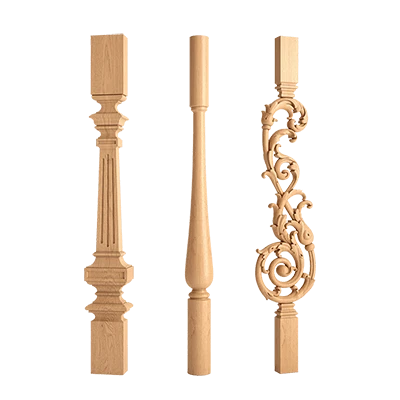
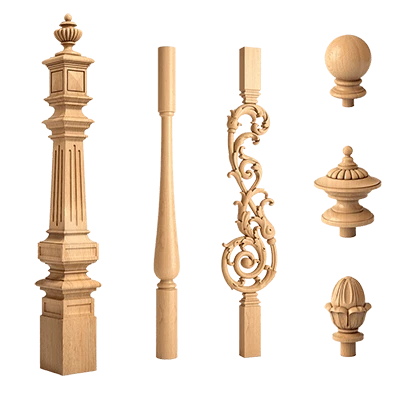
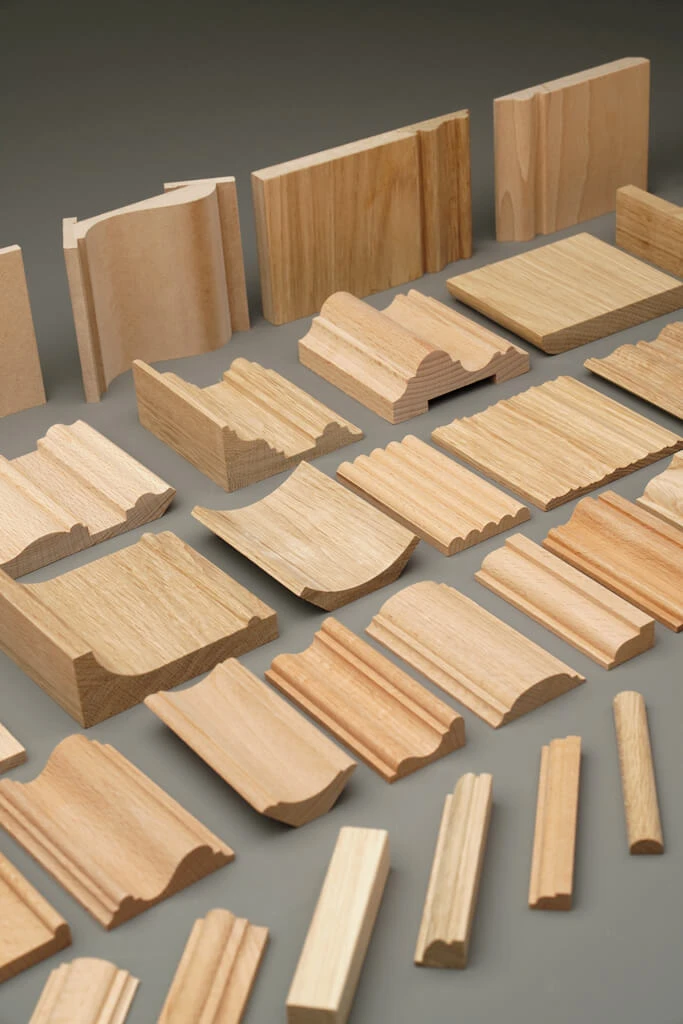
Four main types that are most often chosen for light staircases:
-
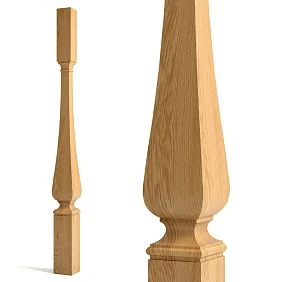
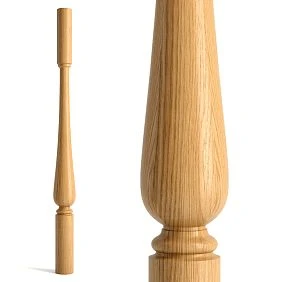
Turned with pronounced thickenings — a classic that looks equally good under varnish, stain, and white paint. Smooth transitions create a beautiful play of light and shadow without overloading the shape.
-
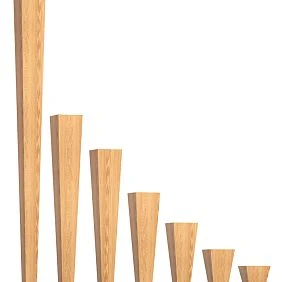
Square — strict geometry, zero extra details. Ideal for Scandinavian and modern interiors where the staircase should be light and unobtrusive.
-
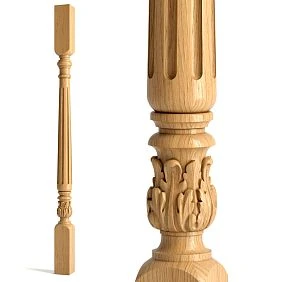
Carved — for neoclassicism and modern classic, where a white staircase is a deliberate accent of rich detail.
-
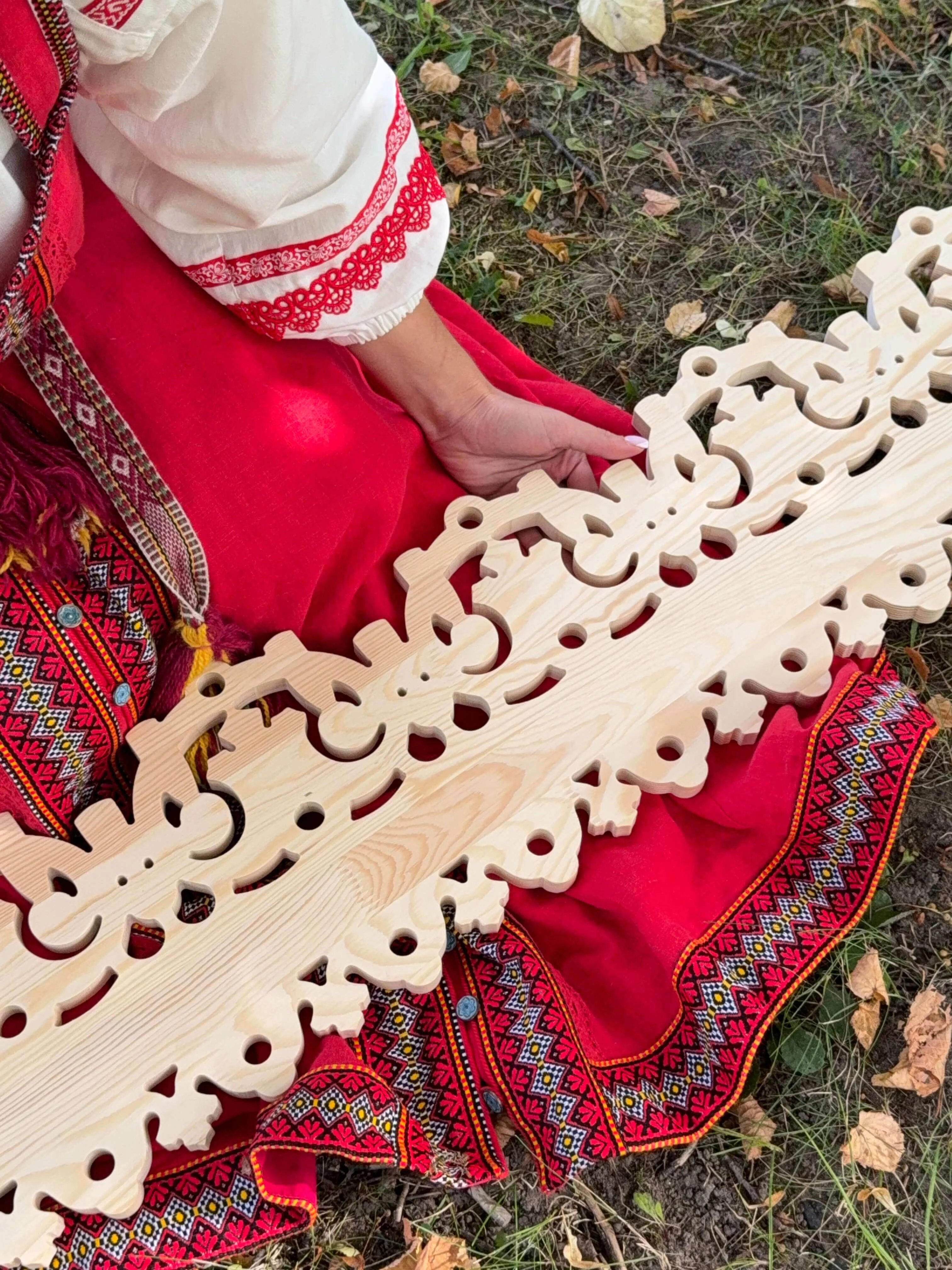
Flat — for vertical railings and non-standard structures where rhythm without volume is needed.
More details about each of these types are below. But first — about what 'balusters for white painting' means from a technical point of view.
Get Consultation
Balusters for white painting: what to know before buying
The surface decides everything
When a baluster is painted white, the paint does not hide defects — it highlights them. Any hairline crack, end chip, fuzziness after poor sanding, or turning unevenness becomes a noticeable flaw under glossy white enamel. That is why the quality requirements for balusters for painting are higher than for products for varnish or stain.
What to check when ordering:
Sanding. The surface must be sanded to a grit of at least P150–P180. Coarse marks from P80 or P100 under white paint will create a grainy texture that cannot be hidden even with three coats of enamel.
Cleanliness of ends. The ends of tenons are particularly vulnerable: end grain quickly absorbs moisture from the paint and raises the grain. Before painting, the ends need to be primed separately. Good manufacturers make ends cleanly, without splits.
Absence of resin pockets. If you choose pine balusters for white painting, make sure there are no resin pockets on the surface — places where resin seeps out. Under paint, the resin will continue to "work" and eventually show through as a stain. For white painting, beech is significantly preferable to pine for this reason.
Moisture content. The normal range is 8–12%. Over-dried balusters will crack after applying enamel that contains solvent or water.
Buy wooden balusters For painting, the best are made of beech or oak — both species have a smooth, uniform structure, do not produce resinous exudates, and accept primer and enamel well. The final surface after painting comes out smooth, matte or glossy — depending on the chosen composition — without stains or unevenness.
Priming and preparation for painting
Before applying white enamel, the wooden baluster requires preliminary preparation. Standard scheme:
-
Sanding with P150 grit over the entire surface
-
Application of acrylic primer-filler — to fill small pores
-
Light re-sanding with P220 grit after the primer has dried
-
Application of a final coat of white enamel (alkyd or acrylic — depends on operating conditions)
-
If necessary — a second final coat after the first has completely dried
Without this preparation, white paint will apply unevenly: wood pores will show through, and the fiber texture will be visible under the coating. This is acceptable under varnish, but categorically undesirable under pure white enamel.
Balusters for varnish and natural wood
When the wood speaks for itself
Not every light staircase is white. A huge segment of modern interiors is built on the natural color of wood: light beech, bleached oak, ash, maple. This is warmth without heaviness, naturalness without roughness. In such interiors, white paint would be a mistake — here you need a clear varnish or oil that preserves the texture and allows the wood to "breathe."
For stairs finished with natural varnish, the requirements for wood species become higher: now not only the evenness of the surface is important, but also the beauty of the texture itself. Oak under a clear varnish gives an expressive large grain pattern with a warm golden-ochre tone. Beech is more restrained, with a neutral light brown palette and uniform structure. Both materials are excellent under varnish — and both look fundamentally different than under paint.
buy balusters finishing with natural varnish means betting on the honesty of the material. It is a worthy, confident choice that requires neither masking nor additional tricks. Natural wood itself is a design statement.
Stain "light oak" and "bleached wood"
A separate popular option for light interiors is stain in tones of "light oak", "natural", "bleached wood" or "Scandinavian gray". This is not white paint and not clear varnish: tinting slightly changes the color of the wood while preserving the texture. The result is a light, almost watercolor shade of the surface that fits perfectly into Scandinavian and Nordic interiors.
For tinting in light tones, beech works well: its neutral texture without a sharp pattern gives an even, predictable result. Oak with a light stain retains its characteristic pattern, which adds texture to the surface. Pine under a light stain can give an uneven result — it is better to test in advance.
How to choose material for a light staircase
Beech vs oak: what to choose for a light interior
This question arises in almost every project. Both materials are suitable for light staircases, but behave differently — and it is important to understand this difference before purchasing, not after.
| Parameter | Beech | Oak |
|---|---|---|
| Texture | Uniform, neutral | Expressive, with a large pattern |
| Color in its natural form | Light brown, warm | Golden ochre |
| For white painting | Excellent — smooth surface | Good — large pores require primer |
| For light varnish | Neutral, restrained | Expressive, with character |
| For light stain | Uniform, predictable | Textured, with a lively pattern |
| Hardness | High | Very High |
| Price | Medium | Above average |
The conclusion is simple: if you need balusters for white painting — beech will be more convenient to work with and will give a more even result. If you want to preserve the texture and choose natural varnish or light tinting — oak will provide a richer visual picture.
Pine for a light staircase
Honest answer: pine is not the best choice for a light staircase with white paint or natural varnish in a residential house. Resin content creates problems during painting, softness of the structure leads to rapid mechanical wear of the surface. On a country house staircase or in the attic — it is acceptable. In a residential house with high traffic — it is better to invest a little more and take beech.
How to choose railings and posts for a light staircase
System unity is not just words
Balusters for a light staircase cannot be chosen in isolation from the rest of the railing. In a light interior, where every detail is visible, inconsistency between balusters and handrails is particularly noticeable. Handrail of one shape, balusters of another, post of a third — this is not eclecticism, it is a mistake.
buy balusters and handrails for a light staircase it is better to order from one source. This guarantees:
-
Matching wood species (identical absorption of the finish coating)
-
Compatibility of dimensions (the baluster tenon fits into the handrail groove without adjustment)
-
Unity of style (proportions, shape character, scale of decor)
-
Same wood moisture content (same behavior during finishing and use)
Handrail for a light staircase
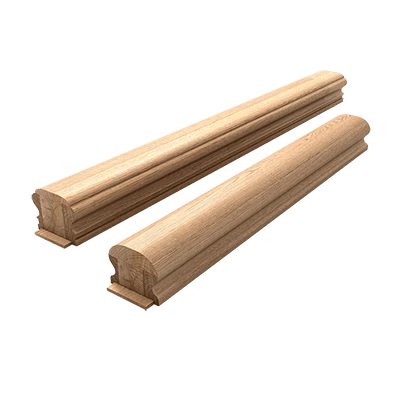
The handrail is the only railing part that is constantly touched by hand. For a light staircase, it is especially important to choose a handrail with the correct width and edge rounding: a narrow, sharp handrail is uncomfortable and looks fragile, while one that is too wide visually overloads the railing.
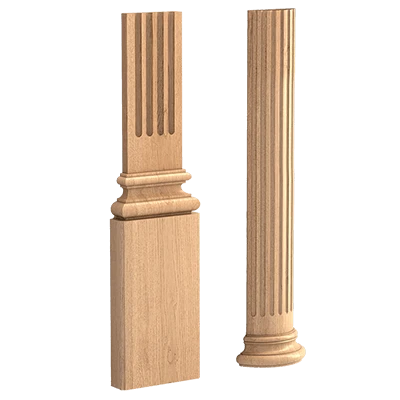
The optimal handrail width for a residential staircase is 60–70 mm. The profile should have rounded upper edges, without sharp corners. Such a handrail provides a feeling of reliability when leaning and looks proportionate both with light square balusters and with more massive turned posts.
Posts for a white and light staircase
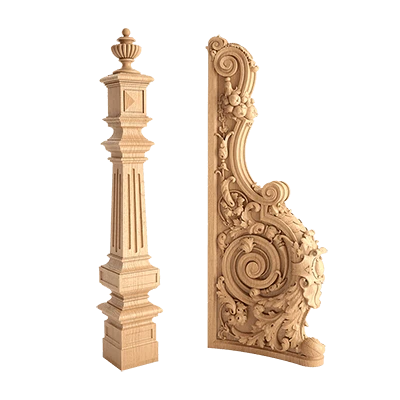
Buy balusters and posts for a wooden staircase for a light interior means choosing posts that do not overwhelm the railing with their scale. The principle of proportionality applies here: light square balusters require posts with clean geometry at the top, without excessive decor. Turned classic balusters pair with posts having a turned top in the same rhythm of form.
Wooden stair posts are available in sections from 80×80 to 120×120 mm. For a light staircase in a medium-sized private house, a post with a section of 80×80 or 90×90 mm is sufficient — it does not overload the railing and looks good next to balusters 40–50 mm thick.
Which baluster shapes are better for a light interior
Turned balusters: a universal choice
A turned baluster is timeless. Smooth transitions from the rounded body to thin necks, a symmetrical shape that can be trimmed from below to any stair angle — all this makes turned products the most versatile choice for a light staircase in any style.
Under white paint, a turned baluster creates a beautiful chiaroscuro effect: convex parts reflect light, recesses give soft shadow. A railing made of such balusters "lives" under any lighting direction — both in natural daylight and under spotlights in the evening.
Balusters price for turned beech models starts from 2,200 rubles per product with a height of 900 mm — this is one of the most affordable categories with high material quality.
Carved balusters for neoclassicism
Neoclassicism is a style where a light staircase becomes a real statement. White walls, stucco cornices, classic arches, neutral marble, and — a staircase with carved balusters painted milky white. This combination works flawlessly and remains one of the most sought-after in premium-class interior design today.
Buy carved wooden balusters for a neoclassical light staircase means choosing models with moderate ornamentation: fluting, twisted thread, acanthus belts. An important rule for a white staircase: the ornament should not be too fine. Under white paint, too fine a relief "paints over" and loses clarity. Choose ornaments with sufficient relief depth — at least 3–5 mm — then they will remain readable even under the coating.
Square balusters for modern and Scandinavian style
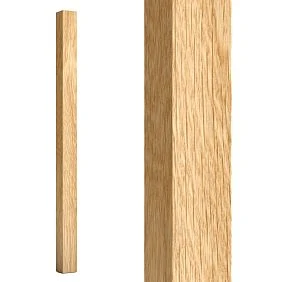
Scandinavian interior is about honesty. Nothing extra, nothing random. A white staircase in a Scandinavian home should be light, almost weightless: light steps, white balusters without ornament, a thin handrail. It is here that square balusters for stairs they find themselves in their absolute element.
A square baluster with a cross-section of 40×40 mm and a height of 900 mm is pure geometry, almost sculptural abstraction. Under white paint, it turns into a simple vertical element that does not attract attention to itself but works with rhythm — even, calm, convincing. For Scandinavian and minimalist interiors, this is the only correct choice.
A modern interior with a predominance of straight lines, metal, and glass also pairs beautifully with square balusters. They work especially well in combination with metal support posts or glass inserts in the railing — when the staircase is multi-material but monochrome.
Flat balusters: lightness and decorativeness
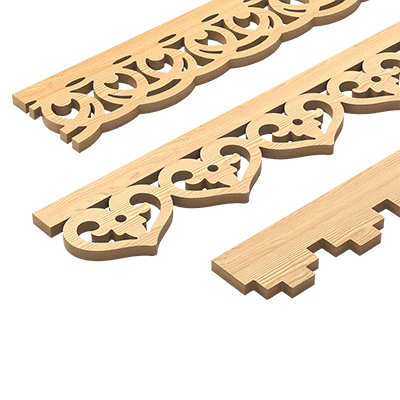
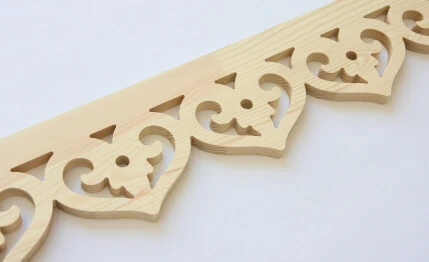
Buy flat balusters for a light staircase makes sense in several scenarios. The first is a vertical railing on a landing or mezzanine floor, where there is no inclined flight and the balusters stand on a level floor. Here, a flat baluster with an ornamental contour creates the effect of an openwork wooden "grille," which in white looks airy and elegant.
The second scenario is wooden houses in country or Provence style, where the staircase is deliberately made "folk," light, without a heavy classical form. Flat balusters with a figured contour in this context provide exactly the effect of coziness and simplicity that is the essence of these styles.
How to calculate balusters for a light staircase
Accurate calculation without unnecessary overpayments
A light staircase is not the case where you can take "with a large margin": extra balusters will lie in the corner until the next renovation. But buying fewer than needed is also a mistake: a reorder a month later may yield balusters from a different batch with slightly different sanding or wood shade, which is critical for products under natural varnish.
Basic calculation scheme:
-
Measure the horizontal projection of each flight (not along the slope, but horizontally).
-
Determine the installation step. For a residential staircase with children, the gap between balusters should be no more than 120 mm. With a baluster thickness of 40 mm, this gives a center spacing of about 160 mm.
-
Divide the length of the flight by the step — you get the number of gaps. Number of balusters = gaps + 1.
-
Add balusters on horizontal landings with the same step.
-
Add 10% to the final number — this is a reserve for trimming, damage during transportation, and possible installation errors.
-
Count the support posts: one at the beginning and end of each flight, plus at turns.
Example calculation
Let's take a two-flight staircase with a landing: first flight — 8 steps (horizontal projection 1,800 mm), landing — 1,000 mm, second flight — 6 steps (1,400 mm). Installation step — 160 mm, baluster thickness — 40 mm.
-
First flight: 1,800 / 160 = 11 gaps → 12 balusters
-
Landing: 1,000 / 160 = 6 gaps → 7 balusters
-
Second flight: 1,400 / 160 = 9 gaps → 10 balusters
-
Total: 29 balusters + 10% reserve = 32 pieces
-
Posts: 4 pieces (beginning and end of each flight + turn on the landing)
It is more convenient to calculate all this together with a manager, having prepared a staircase diagram in advance. Staircase Components for Sale one order is optimal from the point of view of both logistics and compatibility of all elements.
Price of balusters for a light staircase
Cost depending on choice
It is more appropriate to ask about the price not for a single baluster, but for a set: it is as part of the set that the project budget is formed. Approximate ranges by category:
Turned beech balusters, height 900 mm — from 2,200 to 3,500 rubles per piece. For a two-flight staircase of 32 balusters — from 70,000 to 112,000 rubles for balusters only.
Square beech balusters, 40×40 mm, height 900 mm — from 1,800 to 2,800 rubles. Slightly more affordable than turned ones, while not inferior in appearance in modern interiors.
Carved beech or oak balusters, height 900 mm — from 4,500 to 9,000 rubles depending on the complexity of the ornament. For a classic neoclassical staircase with 32 balusters — from 144,000 rubles.
Flat beech balusters — from 2,000 to 4,000 rubles, depending on the complexity of the shaped contour.
Beech posts, 80×80 mm — from 4,500 to 7,000 rubles per piece. Four posts — an additional 18,000–28,000 rubles to the budget.
Handrails — from 1,200 rubles per linear meter for beech. For a two-flight staircase, total about 6–8 linear meters — from 7,200 to 12,000 rubles.
The final turnkey budget (excluding labor) for a light staircase with 14 steps averages:
-
Budget set (square beech balusters): 90,000–120,000 rubles
-
Mid-range (turned beech): 110,000–155,000 rubles
-
Premium (carved oak): 200,000–280,000 rubles
Mistakes when choosing balusters for a light staircase
What ruins the idea of a light railing
1. They buy balusters without considering the final coating of the handrails. If the handrail is already coated with a specific brand of white enamel, and the balusters are painted with a different compound, the shades of white may differ. One "white" can be cool, another warm. For a perfect match, it's better to paint the entire railing with one compound in one session.
2. They mix different wood species in one railing. A handrail of oak, balusters of beech, a post of pine — under white paint this is invisible, but when finishing with varnish or stain, it will give three different shades on one structure. This looks amateurish.
3. They choose a shape that is too heavy. Massive turned balusters with large spheres and lush ornamentation in a Scandinavian or minimalist home is a visual mistake. The shape should match the scale of the interior.
4. They don't check the sanding before painting. They take products "as is", without additional surface preparation — and get a porous, rough surface under white paint that cannot be fixed without completely removing the coating.
5. They forget about the 10% reserve. This is especially critical when finishing with natural varnish: a batch reordered a month later may have a different texture shade, which will be noticeable in the finished railing.
6. They don't consider lighting. Square balusters under direct overhead light cast sharp shadows on the steps. In some interiors this is beautiful, in others it's uncomfortable. Assess the placement of light sources in your stair space before purchasing.
7. They buy based on photos with a dark background. Balusters that look beautiful on a dark staircase in a website photo may look completely different on a light one. Ask for photos specifically in white or natural finish.
Additional elements for the light staircase
What else is included in the complete set
In addition to balusters, handrails, and posts, a light staircase also requires several additional details that are often forgotten when budgeting.
Risers. In staircases with closed risers, they create a unified "façade" of the flight. For a light staircase, they are painted the same color as the balusters — or left in natural wood if the steps are also natural.
Treads. If the steps are painted or varnished, treads made of the same wood species will give the flight a finished look. For light staircases, choose light treads — this maintains a uniform tone.
Wall-mounted handrail bracket. If the staircase runs along a wall on one side, a wall-mounted handrail bracket is installed along the wall for safety. It should also match the main handrail in shape and color.
buy staircase components It is most convenient to have everything in one place — this way you are guaranteed to get a compatible set without needing to search for or modify anything.
Where to buy balusters for a light staircase
STAVROS: catalog for those who choose consciously
If you are building a light-colored home and want a staircase that will be an organic part of it — rather than a random set of wooden parts — STAVROS is where you should look for a solution. Here you will find a full range of wooden balusters for staircases intended for painting, varnishing, staining, and tinting: turned, square, carved, and flat models made of oak, beech, and pine.
Each product is manufactured on CNC lathes and milling machines. This ensures precise dimensions, consistent shape within a batch, and predictable results during final finishing. For light-colored staircases, where uniformity of coating is not an option but a requirement, such manufacturing precision is critically important.
The catalog features Wooden balusters for any style of light interior: from minimalist square posts for a Scandinavian home to richly ornamented carved models for classic neoclassicism. Also here are posts, handrails, and all necessary staircase components in a unified style and from the same wood species.
Frequently Asked Questions (FAQ)
Which balusters are best for a white staircase?
For a white staircase intended for painting, it is better to choose wooden balusters made of beech: the even structure without resin pockets provides an ideally smooth surface for enamel. In terms of shape — turned for classic and neoclassical styles, square for minimalism and Scandinavian style, carved for a rich classic interior.
Can I buy balusters for painting?
Yes. All wooden balusters are supplied either unsanded or sanded — both types can be painted. For painting white, additional priming is recommended to prevent the wood grain from showing through the final coat of enamel.
Which balusters should I choose for a staircase in Scandinavian style?
Square beech balusters, height 900–1000 mm, cross-section 40×40 mm. No ornamentation, for white matte enamel. Handrail — rectangular profile, width 60–70 mm. The result is a light, clean, honest railing.
What is the difference between beech and oak for a light staircase?
Beech is more neutral and even, ideal for white painting. Oak is expressive, with a large grain pattern, better suited for natural varnish or light tinting. Both materials are high-quality and durable.
Do I need to buy handrails and posts together with the balusters?
Absolutely — especially for a light staircase. All elements must be from the same wood species so that the finish coating applies evenly and the color matches.
How to calculate the number of balusters for a light staircase?
The horizontal length of the flight is divided by the installation step (160–200 mm). Add balusters for landings and a 10% reserve. It's best to perform the calculation together with a manager, having a staircase diagram with step markings.
Where to buy balusters for a light wooden staircase?
At STAVROS — a complete catalog of balusters made of oak, beech, and pine for light staircases for painting, varnishing, and tinting. Turned, square, carved, and flat models, posts, handrails, and accessories with delivery across all of Russia.
About the company STAVROS
STAVROS is a Russian manufacturer of wooden staircase elements, operating since 2002. The company specializes in the production of balusters, posts, handrails, and accessories from solid oak, beech, and pine. The production is equipped with high-precision CNC machines, ensuring dimensional compliance with the drawing and product consistency within each batch.
STAVROS supplies products to both private customers and design studios, construction companies, and interior studios across Russia and CIS countries. The catalog features over 50 models of balusters in various styles, from minimalist square to richly decorated carved items. The company's team provides advice on selecting elements for a specific staircase style, helps calculate the set, and places an order with full compatibility of all components — so your light staircase turns out exactly as you envisioned.