Article Contents:
- Why balusters start to wobble: analysis of causes
- First cause: weak or incorrect fastening
- Second cause: too large installation spacing
- Third cause: thin balusters with high railing height
- Fourth cause: incompatible handrail
- Fifth cause: lack of support posts or their unreliable fastening
- Sixth cause: damp or low-quality wood
- Which balusters to choose for a reliable railing
- Cross-section: the main parameter of rigidity
- Baluster height and mounting zones
- Geometry: straightness and absence of twisting
- Quality of ends and tenons
- Why the entire set matters, not just the balusters
- Handrail as a connecting element
- Bottom rail as a foundation for uniformity
- Support posts as a load-bearing structure
- Fasteners as the nervous system of the structure
- How to choose material for reliable balusters
- Oak: density and stability
- Beech: precision and uniformity
- Ash: elasticity without brittleness
- Pine: only for moderate conditions
- Solid wood vs. glued product
- Which baluster shapes best maintain rigidity
- Square balusters: maximum rigidity with equal cross-section
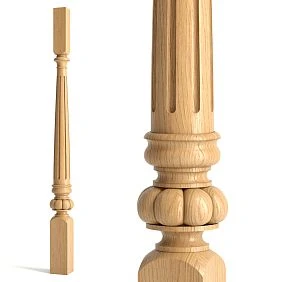
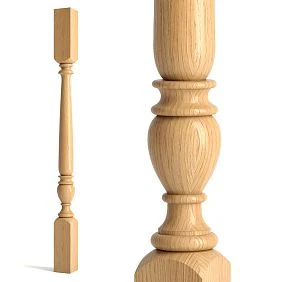
- Turned balusters: rigidity depends on undercuts
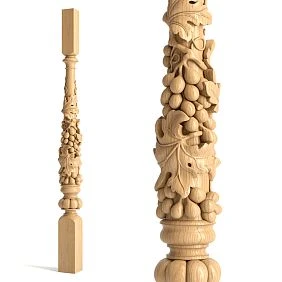
- Carved balusters: beauty requires calculation
- Flat balusters: width compensates for thickness
- What fasteners are needed for balusters: full breakdown
- Double-ended threaded stud
- Wooden dowel (peg)
- Hidden fastener (invisible connector)
- Top mounting through the handrail
- Attachment to the string (not to the steps)
- Role of support posts in railing rigidity
- Why posts are mandatory
- Cross-section and height of posts
- Methods of attaching posts
- How to calculate the number of balusters for a reliable railing
- Calculation step 1: determine the length of all runs
- Calculation step 2: select the clear step
- Calculation step 3: count the number of balusters
- Calculation step 4: landings and turns
- Calculation step 5: number of posts
- Mistakes when buying balusters for a reliable fence
- Mistake 1: buying balusters without a handrail from the same system
- Mistake 2: not specifying the tenon diameter
- Mistake 3: saving on fasteners
- Mistake 4: too large a step
- Mistake 5: not buying posts right away
- Error 6: choosing a baluster shape without considering the minimum cross-section
- Error 7: buying raw wood
- Additional elements for rigid fencing
- Bottom rail: connector
- Decorative bases and capitals for posts
- Handrail connectors at an angle
- Installation of balusters: principles of rigid assembly
- Correct Sequence
- Cutting to the angle of the flight
- Step spacing control
- Where to buy balusters, railings, and fasteners for a reliable staircase
- Frequently Asked Questions (FAQ)
- Which balusters are best to buy so they don't wobble?
- Why do balusters wobble after installation?
- Can I buy balusters without fasteners?
- What should I buy along with balusters for a reliable railing?
- What installation spacing for balusters ensures a rigid railing?
- Are intermediate posts needed on a long flight?
- Where to buy reliable balusters for stairs with delivery?
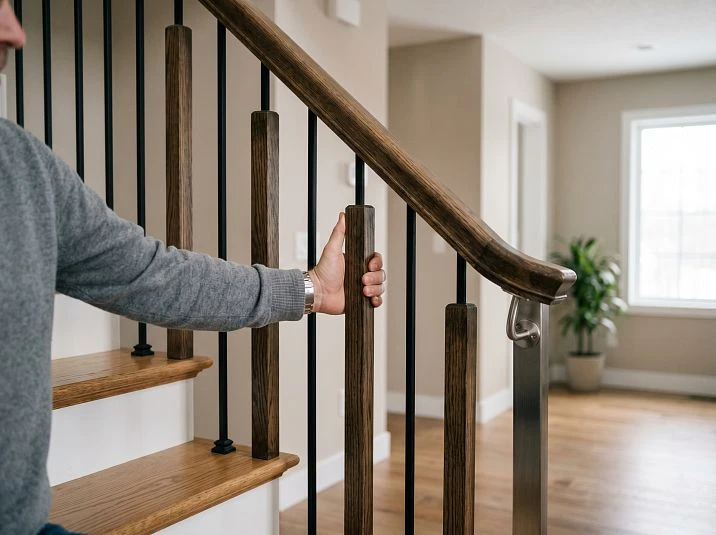
There is one thing that annoys more than a creaking step. It's a wobbly baluster. You grab the handrail and feel the railing gently sway toward you. Once. Twice. After a year, there's noticeable play; after two, adjacent elements become loose; after three, the entire structure behaves like a house of cards in a draft.
This is not an exaggeration. This is the reality of tens of thousands of staircases that were beautifully designed and carelessly executed. Beautiful balusters for staircase to buy — is half the battle. It's important to buy them correctly: the right thickness, the right height, with the right seating, compatible handrails, reliable fasteners, and proper support posts. Then the railing won't wobble after a year or even twenty years.
That's exactly what this article is about. No lyricism, just specifics. About why balusters start to wobble, what to choose to prevent this, and how to assemble a truly rigid, safe, and durable staircase railing.
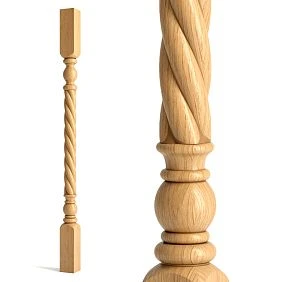
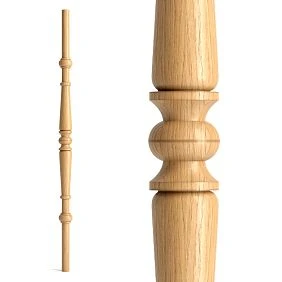
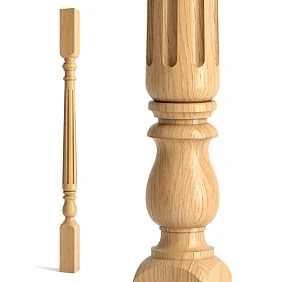
Why balusters start to wobble: analysis of causes
Before choosing, you need to understand what to protect against. Baluster wobbling is always a consequence of one or more specific causes. And almost never an accident.




First cause: weak or incorrect fastening
This is the most common cause. The baluster is attached to the step at the bottom and to the handrail at the top. If a self-tapping screw without glue is used at the lower point, after 50–100 load cycles it begins to loosen the mounting hole. The wood in the fastening area gets 'broken,' the hole enlarges, and the baluster starts to wobble.
Proper fastening is not just 'something metallic.' It is a threaded rod with threads on both ends, screwed into the step with epoxy compound. Or a large-diameter wooden dowel with PVA glue. Neither option 'breaks' the mounting hole—they work on compression and retention, not on shear.
Details on methods of fastening balusters and railings are described in a separate article—we recommend studying it before purchasing and installation.
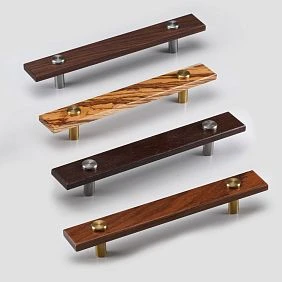
Our factory also produces:
Second cause: too large installation spacing
The larger the distance between balusters, the higher the amplitude of handrail sway under lateral load. If the clear spacing exceeds 150 mm, the handrail starts to 'breathe' with every touch. The normal spacing is 100–130 mm. On children's stairs and with high railings, it should be even smaller.
Get Consultation
Reason three: thin balusters with a high railing height
A baluster with a cross-section of 30×30 mm and a height of 1,000 mm is too thin an element. The height-to-thickness ratio is critical: when the norm is significantly exceeded, the baluster starts to act like a spring — it flexes elastically under lateral load. Formally, it is not loose, but the railing "gives."
Minimum cross-section for a residential staircase:
-
Height up to 800 mm — cross-section from 35×35 mm
-
Height 800–950 mm — cross-section from 40×40 mm
-
Height 950–1100 mm — cross-section from 45×45 mm
Reason four: incompatible handrail
A handrail that is not rigidly fixed to the support posts turns into a "lever." Any force from the hand is transmitted to the nearest balusters — and they start to wobble along with it. The handrail must be securely fastened to the starting and ending posts, and for long spans, also to intermediate ones.
Reason five: lack of support posts or their unreliable fastening
A baluster is not a load-bearing element. It holds the handrail "in line" but does not take on horizontal load. Support posts are what provide the structure's rigidity. If the posts are missing or fastened superficially, the railing will lose rigidity, and no quality of balusters will fix this.
Reason six: raw or low-quality wood
Wood with moisture content above 12–14% 'behaves' as it dries: cracks appear, dimensions change, gaps in mounting points increase. A baluster that was tightly installed at the time of mounting starts to loosen after six months — simply because the wood has dried out.
Only dry solid wood with a moisture content of 8–12% guarantees that mounting points will remain tight after installation.
Which balusters to choose for a reliable railing
Now — to the selection. What exactly to look for when purchasing to ensure Buy wooden balusters reliable, not just beautiful.
Cross-section: the main parameter of rigidity
The cross-section of a baluster is the first thing to look at in the catalog. Not the shape, not the decor, not the price — but the size of the cross-section. It determines whether the baluster will be rigid or flexible.
For residential staircases in a private house:
-
Square cross-section — minimum 40×40 mm. Optimal — 45×45 mm.
-
Turned baluster — body diameter at the thinnest point (the so-called "narrowest section") — at least 35 mm.
-
Flat baluster — thickness at least 20 mm with width from 70 mm.
Do not confuse the overall workpiece size with the actual minimum cross-section. For a carved or turned baluster, the most vulnerable area is the narrow section. It is there that the greatest bending moment occurs under lateral load.
Baluster height and mounting zones
Standard height of a wooden baluster for stairs — 900–1,000 mm. The height is selected considering:
-
Railing height per project (at least 900 mm from the stair tread surface)
-
Handrail thickness (subtracted from the total height)
-
Height of the bottom rail or sub-baluster board (subtracted from the bottom)
Mounting zones — top and bottom tenons — must have a diameter of at least 10–12 mm and a length of 50–70 mm. A thin tenon with a diameter of 8 mm easily breaks during installation and does not provide the necessary retention.
Geometry: straightness and absence of twisting
Before purchasing — or when receiving a batch — check each baluster for straightness. Place it on a flat surface: the baluster should not "lean" to either side. A twisted or curved element will create misalignment in the row and increase the load on the fasteners.
Quality of ends and tenons
The ends must be even, the tenons without chips or cracks. A tenon with a crack will break at the first load. Before installation — inspect each part. This is not pedantry, but basic precaution.
Why the entire set matters, not just the balusters
This is the key idea of the article, and it's worth repeating: a baluster alone does not create a rigid railing. Rigidity is a property of the system. And the system consists of several interdependent elements.
Handrail as a connecting element
The handrail unites all balusters into a single horizontal beam. If the handrail is rigidly fixed to the posts, it transfers the load to them, relieving the balusters. If the handrail lies loosely or is only secured with screws without support on the posts, the balusters take on the entire horizontal load.
buy balusters and handrails in one order — means getting compatible elements with matched groove and tenon dimensions. This is critical for a rigid connection of the upper part of the baluster to the handrail.
Bottom rail as a foundation for uniformity
The bottom horizontal rail (sub-baluster rail) holds the balusters at equal spacing and prevents their lateral displacement. Without this rail, each baluster works independently — and the play in one gradually "infects" the neighboring ones.
Support pillars as a load-bearing structure
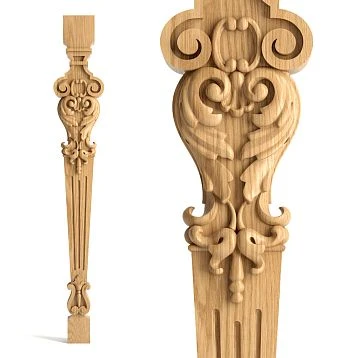
Buy balusters and posts for a wooden staircase It needs to be done simultaneously — these are not two separate questions, but one systemic issue. The pillars are the foundation of the fence. The balusters are its infill.
Fasteners as the nervous system of the structure
Properly selected fasteners transmit force without loss and without damaging the mounting points. Incorrect ones accumulate play and destroy everything around. Fasteners are not something to skimp on.
How to choose material for reliable balusters
The hardness, density, and stability of wood directly affect the durability of the fence. Let's break down the species honestly and specifically.
Oak: density and stability
Oak is the first choice for critical structures. Brinell hardness is about 3.7 HB. Density is 700–750 kg/m³. With proper drying, it hardly warps. Oak tenons do not break during installation, and mounting points do not 'wear out' from load.
Buy oak balusters — means getting an element that will retain its geometry and fit tightness for decades. The price is higher than pine, but lower than exotic woods.
Beech: precision and uniformity
Beech is slightly softer than oak, but surpasses it in structural uniformity. There are no hidden knots, and minimal density variation within a single workpiece. Beech tenons hold their size precisely, and the mounting seats are tight and stable after installation.
Buy beech balusters — a good choice for those who value joint accuracy and a uniform coating tone.
Ash: elasticity without brittleness
Ash is an elastic species with high bending resistance. Ash tenons withstand impact during installation better than oak ones. With sufficient cross-section, an ash baluster practically does not deform under lateral load.
Pine: only for moderate conditions
Pine is softer. Hardness is about 1.6–2.0 HB. The mounting seat in a pine step wears out over time with intensive use. For critical staircases in a residential house, pine should only be used with reinforced fasteners — threaded rod and epoxy glue, no compromises.
Solid wood vs. glued product
Buy wooden balusters from solid wood — is a monolith, without seams or glue zones. When humidity changes, a solid baluster behaves uniformly along its entire length. A glued baluster with poor factory processing may start to delaminate along the seam after 2–3 years.
For balusters, solid wood is preferable.
Which baluster shapes best maintain rigidity
A question rarely asked, but important. The shape of the baluster affects not only the appearance, but also the load distribution inside the element.
Square balusters: maximum rigidity with equal cross-section
square balusters for stairs have a constant cross-section along the entire height. There are no "narrowings", no zones with reduced cross-section. Therefore, with the same nominal size, a square baluster is stiffer than a turned or carved one.
For children's stairs, for rooms with active use of the railing, for high railings — square balusters are preferable from a rigidity standpoint.
Turned balusters: rigidity depends on narrowings
A turned baluster is barrels and cylinders strung on an axis. At the points of narrowing, the cross-section is minimal. This is where the greatest bending moment occurs. The deeper the narrowings and the smaller their minimum diameter, the higher the flexibility of the baluster.
Rule: the minimum diameter in the narrowing of a turned baluster must be at least 35 mm for a height of 900–950 mm. This is the working minimum for a residential staircase.
Carved balusters: beauty requires calculation
Buy carved wooden balusters — this is the most spectacular, but also the most demanding solution in terms of calculation. A carved profile with deep grooves can create zones with a very small cross-section. Such balusters should be made from hardwoods — oak or beech — with a minimum cross-section in narrow places of at least 30 mm.
Flat balusters: width compensates for thickness
Buy flat balusters — means choosing an element with a small thickness but sufficient width for rigidity "in the plane" of the fence. A flat baluster is rigid in one direction (perpendicular to its plane) and less rigid "along" the row.
When using flat balusters, the bottom rail is mandatory — it provides stability in the transverse direction.
What fasteners are needed for balusters: a complete breakdown
Fasteners are what you buy last and regret first. Let's honestly review all the options.
Double-ended threaded stud
The best option for attaching a baluster to a wooden step. A metal stud with a diameter of 10–12 mm, with M10 or M12 threads on both ends. One end is screwed into the step, the other into the bottom end of the baluster.
Mandatory: the mounting hole is filled with epoxy compound before installing the baluster. This eliminates play even if the mounting point becomes worn.
baluster and railing mounting using studs with epoxy is the industry standard, ensuring zero play for the entire service life of the staircase.
Wooden dowel (peg)
A classic option for joining wood to wood. A dowel with a diameter of 16–20 mm, length 100–120 mm. Installed with PVA D3 or D4 (waterproof) glue. Provides a very rigid connection without requiring metal.
Disadvantage: when dismantling, the dowel joint cannot be disassembled without destruction. For permanent structures — excellent. For temporary ones — not suitable.
Detailed breakdown attach balusters to treads and handrails with step-by-step instructions — a must-read before installation.
Hidden fastening (invisible connector)
A modern option for stairs where fastener aesthetics are important. The metal L-shaped or T-shaped bracket is hidden inside the baluster and step. There are no visible fastening elements on the outside.
Requires precise milling of the groove for the bracket. Strength — high when executed correctly. Installation — more complex than with a stud.
Materials on modern methods of fastening wooden balusters from dowels to invisible fastening will help you figure out which option is suitable for your project.
Fastening from above through the handrail
The top tenon of the baluster fits into the groove of the handrail from below and is secured:
-
With glue (PVA or epoxy)
-
With a self-tapping screw from the side through the handrail with a decorative cap
-
With a hidden metal pin through the handrail from above with a wooden plug
Glue is the cleanest option, but creates difficulties when replacing an individual baluster. A self-tapping screw with a cap is a practical compromise.
All the nuances how to mount handrails to balusters — in a separate professional article.
Attachment to the string (not to the steps)
If the staircase design involves attaching balusters to the side string, a different approach is used: the baluster is attached through a groove in the string or through a hidden metal bracket. This method is used in staircases with strings (as opposed to staircases with stringers).
The role of support posts in the rigidity of the railing
If a baluster is a soldier in formation, then a support post is the commander who holds the entire formation. Remove the commander — the formation collapses. That's exactly how the railing system works.
Why posts are mandatory
When a lateral force is applied to the handrail, the entire load is distributed throughout the system. Part of it is taken by the balusters — through bending. The larger part should be taken by the support posts — through a rigid base. If there are no posts or they are weak — all balusters work in bending simultaneously, and none of them can handle it.
Wooden stair posts are installed at strictly defined points: the beginning and end of each flight, each turn, each landing, every 1.5–2 m of the run.
Cross-section and height of posts
For a residential staircase, the minimum cross-section of a support post is 80×80 mm. The optimal is 100×100 mm. With a cross-section of 60×60 mm, the post loses rigidity under moderate lateral load — especially at heights over 1,000 mm.
Post height = railing height + embedment depth into the step or floor. Embedment depth must be at least 100–150 mm. Without sufficient embedment, the post is just a beautiful wooden stake stuck into the surface.
Methods of fastening posts
Sleeve anchor (embedded part) — a metal plate with a tube, embedded into the floor or monolithic step during construction. The post is inserted into the tube and fixed with bolts. This is the most rigid option. Used with concrete or wooden floors.
Bolted connection through a base plate — a 150×150 mm metal plate is attached to the step or floor with four anchor bolts. The post is attached to the plate by welding or bolts. Good rigidity, detachable connection.
M16 stud through the step — the stud passes through the step and is tightened with a nut from below. The post is placed onto the stud and secured through the mounting hole. A simple and fairly reliable method for wooden stairs.
How to calculate the number of balusters for a reliable railing
Calculation is not a formality. It is a tool for saving and a guarantee of the correct result.
Calculation step 1: determine the length of all runs
Add up the horizontal projection of all flights and landings with railing. This is the total length L.
Example: one flight L₁ = 4,200 mm, landing L₂ = 1,000 mm. Total L = 5,200 mm.
Calculation step 2: choose the clear spacing
For a residential staircase — 100–130 mm. For a children's staircase or when increased safety is required — 80–100 mm.
Let's take a spacing of 120 mm, baluster width of 45 mm.
Calculation step 3: calculate the number of balusters
N = L / (b + a), where b is the width of the baluster, a is the clear spacing.
N = 5,200 / (45 + 120) = 5,200 / 165 ≈ 31.5 → 32 balusters.
Including a 10% margin for trimming and possible defects: 32 × 1.1 = 36 pieces.
Calculation step 4: landings and turns
At turns, balusters are installed on both sides of the post — one on each side. On landings, they are placed closer together, according to safety standards.
Calculation step 5: number of posts
-
Two posts for each straight flight (start + end)
-
One post for each turn
-
Intermediate posts — every 1.5–2 m of run
For the example above: 1 flight + 1 landing = at least 3 posts (starting, turning, finishing).
Mistakes when buying balusters for a reliable railing
A real list of mistakes — not theoretical, but forged from practice.
Mistake 1: buying balusters without a handrail from the same system
Two sellers, two SKUs, two batches — a guarantee of incompatibility between the tenon and groove. Buy wooden balusters for staircases and the handrail in one order, from one manufacturer.
Mistake 2: not specifying the tenon diameter
"Standard tenon" is a myth. Different manufacturers use tenons of Ø8 mm, Ø10 mm, Ø12 mm. If the handrail has a groove for Ø10 mm, but the baluster tenon is Ø12 mm — you'll have to modify it manually. Ask about the tenon diameter and handrail groove parameters before placing an order.
Mistake 3: saving on fasteners
Buying balusters for 150,000 rubles and getting fasteners for 500 rubles at the nearest market means ruining the entire project with low-quality fittings. Only stainless steel studs, only high-quality glue.
Mistake 4: too large spacing
"It'll do, the distance is fine" — a phrase said before the first complaint. A clear spacing of 150 mm is the maximum. If you want a truly rigid railing, go for 100–120 mm.
Mistake 5: not buying posts right away
We ordered balusters and a handrail. We forgot about the posts. They come separately. They receive a different batch, a different wood species, a different tone. The result is a visible mismatch at key points of the railing.
Mistake 6: choosing the shape of the baluster without considering the minimum cross-section
A beautiful, intricate, narrow-waisted pine baluster is a decorative element, not a load-bearing one. Shape is secondary. The cross-section at the thinnest point is primary.
Mistake 7: buying raw wood
Moisture content of 16–20% — the baluster will start to crack and shrink after installation. The seating points will separate. The railing will rattle within six months. Demand a wood moisture certificate from the seller or check with a moisture meter.
Additional elements for a rigid railing
There are details that are not obvious — but they are the ones that bring the railing to a systemic result.
Bottom rail: unifier
The bottom horizontal rail unifies the balusters from below, aligns the spacing, and prevents lateral displacement. Without it, each baluster works autonomously — and even with perfect top and bottom fastening, a "drift" of the row is possible.
Cross-section of the bottom rail: 40×40 mm or 30×50 mm. It is attached to the steps with self-tapping screws after pre-drilling.
Decorative bases and column capitals
Not just beauty — but also additional protection of the column base from moisture and mechanical damage. The wide base evenly distributes the load on the step surface.
Handrail connectors at an angle
On stair landings, the handrail changes direction. For this, angular metal connectors or wooden angular sections are used. A rigid turn — without bending and without a weak glue joint.
Installation of balusters: principles of rigid assembly
Installation is where theory meets practice. Installation of Wooden Handrails and Balusters requires not haste, but consistency.
Correct sequence
-
Mark the location of all balusters and posts along the cord
-
Drill mounting holes — strictly vertically
-
Install and secure the posts — check with a level in two planes
-
Secure the bottom rail
-
Install balusters from bottom to top — one after another, gluing the seating areas
-
Place the handrail on top of the balusters, secure it to the posts
-
Wait 24 hours before applying load — for glue polymerization
Cutting to the angle of the flight
On a sloping flight, each baluster is cut at the top to match the handrail angle. The angle is determined using a template — the first and last balusters are installed, a string is pulled, and all intermediate ones are cut along it. This is precise work, not "by eye."
Step spacing control
After installing every 5–7 balusters, check the clear step spacing. A small deviation accumulates into an error that becomes visible in the final result.
Where to buy balusters, railings, and fasteners for a reliable staircase
The honest answer to this question is simple: from a manufacturer with a full cycle and a systematic catalog. Not at the market, where today there is one supplier and tomorrow another. Not at a home improvement store, where balusters are just another item on the price list.
STAVROS is a manufacturing company that makes wooden Staircase Components for Sale can be in a unified system: balusters, posts, handrails, bottom rails and fasteners with coordinated dimensions and a single style.
What STAVROS gives the buyer:
-
Dry lumber with controlled humidity of 8–12% — no surprises after installation
-
Compatible sizes — the baluster tenon fits exactly into the handrail groove without modification
-
Wide selection of shapes and wood species — oak, beech, ash, pine; turned, square, carved, flat balusters
-
Professional calculation of the set — managers will help calculate the number of elements for a specific staircase
-
Contact us to confirm shipping to your destination. — from Moscow and St. Petersburg to Siberia and the Far East
Frequently Asked Questions (FAQ)
Which balusters are best to buy so they don't wobble?
Choose wooden balusters for stairs buy from hardwoods — oak or beech. Cross-section at least 40×40 mm, minimum diameter at the narrowest point — at least 35 mm. Tenon — diameter 10–12 mm, length 50–70 mm. Mandatory — support posts and proper fasteners.
Why do balusters wobble after installation?
Most often — weak fastening (self-tapping screw without glue), too large spacing, raw wood with subsequent shrinkage, or lack of support posts. Less often — too thin cross-section of the baluster.
Can I buy balusters without fasteners?
You can. But this is only reasonable if you already have the correct fasteners and you know exactly the installation method. If you are buying for the first time — order balusters together with fasteners in one order.
What to buy together with balusters for a reliable railing?
Mandatory list: support posts, handrail of compatible cross-section, bottom rail, threaded rods M10–M12, epoxy glue or PVA D4 glue, decorative caps. Preferably — components for wooden staircases from one manufacturer.
What spacing of balusters ensures a rigid railing?
100–130 mm clear spacing. At 150 mm — the railing becomes noticeably "softer" under lateral load. For children's stairs and increased safety requirements — 80–100 mm.
Are intermediate posts needed on a long flight?
Yes, definitely. When the span length exceeds 1.5 m without an intermediate post, the handrail begins to sag and "play" in the center. An intermediate post is installed every 1.5–2 m of the run.
Where to buy reliable balusters for stairs with delivery?
At STAVROS — buy balusters from oak, beech, ash and pine with Contact us to confirm shipping to your destination. Full set calculation — free when ordering. All elements from one system with guaranteed compatibility.