








































































Article Contents:
- Why the type of staircase affects the choice of balusters
- How a staircase on a stringer differs from a staircase on a bowstring
- Which balusters to choose for a staircase on a stringer
- Design features and selection logic
- Shape, thickness, and height of balusters for a stringer
- Attaching balusters on a stringer
- Which balusters to choose for a staircase on a bowstring
- Specifics of a bowstring construction
- Requirements for balusters for a bowstring staircase
- Recommended models for a bowstring
- How to choose handrails and posts
- A railing system is a set
- Handrails and their compatibility with balusters
- How to choose material for the entire railing
- Wood is a natural choice for a residential home
- Under varnish, stain, or paint?
- How to calculate the number of balusters
- Calculation formula for a flight
- Allowance and trimming
- Example calculation for a standard staircase
- Price of a railing set
- What Makes Up the Cost
- Estimated cost
- Errors when buying balusters
- What most often goes wrong
- How to properly attach balusters
- Carved and turned balusters: when to choose
- Turned — universal classic
- Carved — for decor connoisseurs
- Flat balusters
- Where to buy balusters for a staircase on a stringer or string
- STAVROS catalog: complete set for any design
- Frequently Asked Questions (FAQ)
- About the Company STAVROS
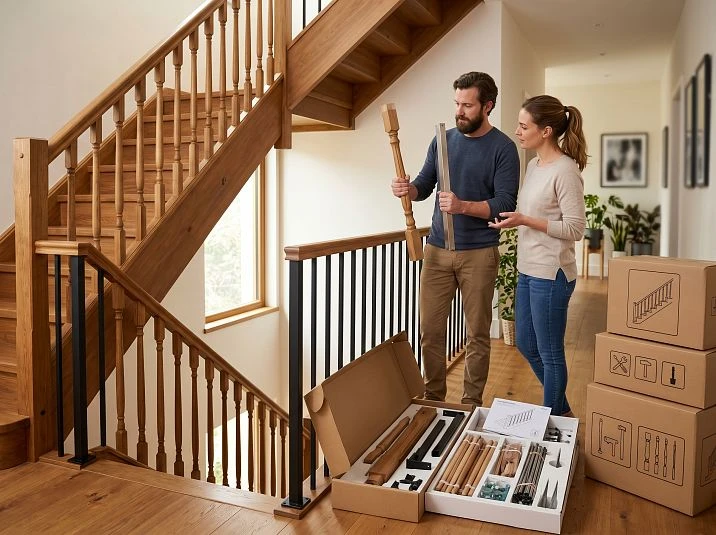
A staircase is not just a functional structure, but an architectural accent that shapes the character of the entire interior. And if you are thinking about which balusters to buy for your staircase, it means your project has already reached the stage where general thoughts give way to specific decisions. One of the key ones is the type of load-bearing structure: is your staircase on a stringer or on a string? The answer to this question determines not only the method of attachment, but also the shape of the balusters, their height, installation spacing, and compatibility with the handrail.
Why the type of staircase affects the choice of balusters
Many buyers look at a baluster as a separate decorative element — a beautiful turned or carved post that needs to be placed along the flight and screwed to the handrail. This is fundamentally the wrong approach. A baluster is an element of a system, and its behavior in this system is entirely determined by what it is attached to at the bottom.
A staircase on stringers and a staircase on a stringer are two different worlds in terms of railing installation. In the first case, the load-bearing beams (stringers) are located under the steps and are visible from the side. The steps lie on top of the stringers, and the lower end of the baluster rests directly on the tread. In the second case, the steps are clamped between two side stringers — they are inserted into grooves or fixed on ledges inside the side board. Here, the baluster can be attached either to the step itself or directly to the stringer, and this fundamentally changes the logic of selecting the entire railing.
That is why, before buy balusters and handrails, it is necessary to clearly understand the structure of your staircase. Otherwise, there is a high risk of buying everything separately and then discovering that the parts do not fit each other either in height or in the method of fastening.




What is the difference between a staircase on stringers and a staircase on a stringer
To put it simply: a stringer is a spine, a stringer is a frame. In a staircase on stringers, the main load-bearing load is transmitted through the toothed beams from below, and the steps "lie" on them openly, like shelves on brackets. The side edge of the step is visible, the structure looks light and airy, and the railing is installed precisely from the step.
In a staircase on a stringer, the steps are "hidden" inside the side boards — the stringers. From the outside, only the smooth plane of the stringer is visible, the steps appear to be built-in. The structure is more closed and monolithic. Balusters can be attached either to the steps (through the top plane) or to the stringer itself, depending on the design solution.
The fundamental difference when choosing a railing is this: on a stringer, the baluster is installed on the horizontal surface of the tread and cut from below at the angle of the staircase flight. On a stringer, two options are possible — installation on the tread (as on a stringer) or direct attachment to the inclined plane of the stringer, in which case the lower end of the baluster must be cut at a more precise slope angle. This affects both the height of the product, its mounting dimensions, and the choice of fastening method.
To avoid confusion with these details, it is more convenient to consider each type of structure separately — and that is exactly what we will do.
Our factory also produces:
Which balusters to choose for a staircase on a stringer
Get Consultation
Design features and selection logic
A staircase on a stringer is one of the most common types in private housing construction. Its characteristic feature is the open side ends of the steps, which create an expressive graphic rhythm of the flight. This is a visually light, dynamic structure, and the railing for it should match this character.
Here, balusters are installed directly on the treads. This means that the lower end of each post rests on the horizontal surface of the step, and the cut is made at the angle of the flight — so that the handrail placed on top runs evenly and without differences. That is why for staircases on a stringer, it is especially important to know the angle of the flight in advance and take it into account when ordering.
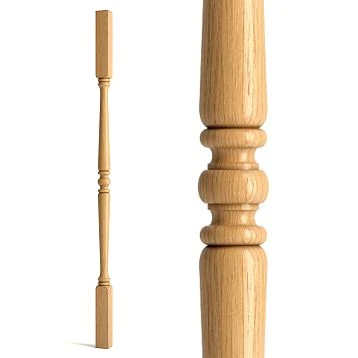
For a stringer, turned balusters with a symmetrical body shape work well — they look the same from any viewing angle, and cutting the lower tenon at the required angle is easy to do on site. Buy wooden balusters choosing a turned shape means getting a universal element that fits organically into the stringer structure without extra adjustments.
Shape, thickness, and height of balusters for a stringer
The standard working height of a baluster for a staircase is from 900 to 1000 mm for the finished product. In practice, when installed on a stringer, the actual height of the post from the step surface to the lower edge of the handrail is about 850–900 mm. This is the recommended railing height according to GOST and safety standards.
The thickness of the baluster affects the installation spacing and the visual density of the railing. For residential staircases, the rule is followed: the gap between adjacent balusters should not exceed 120–150 mm. This is critically important if there are children in the house. With an average post thickness of 45–50 mm, the installation spacing is 150–170 mm, and as a result, there are two balusters per step — a classic scheme.
wooden balusters for stairs buy for a stringer, it is recommended in the following shape options:
-
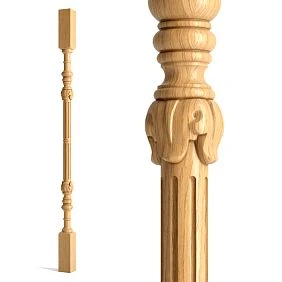
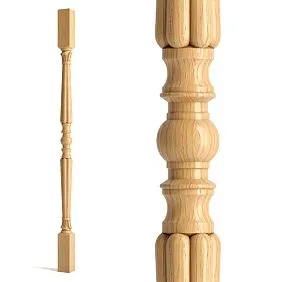
Turned — laconic, with smooth transitions, versatile for any style
-
Square — strict, geometric, look good in modern interiors
-
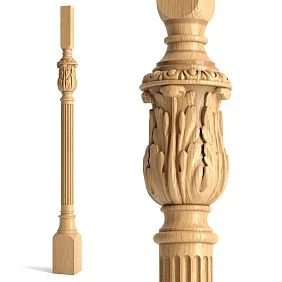
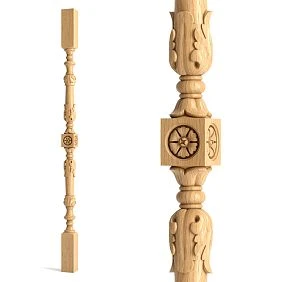
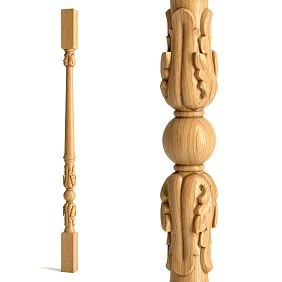
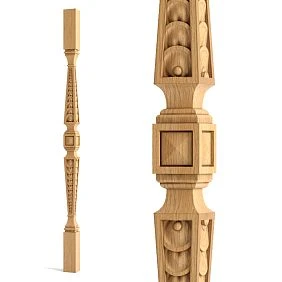
Carved — with decor in the form of fluting, twisted thread, acanthus elements, for classic and Empire style
-
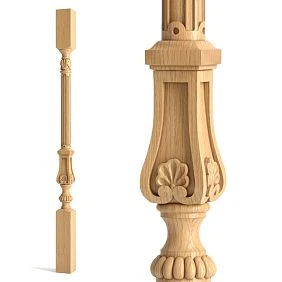
Combined — combine a turned body and carved decorative overlays
For interiors in loft, minimalist, or Scandinavian style, these are optimal square balusters for stairs, which provide clear geometry without unnecessary decorations.
Attaching balusters to the stringer
On a staircase with a stringer, the baluster is attached to the step in one of three ways:
-
On a pin — a hole is drilled in the lower end of the baluster and in the step, a metal pin or wooden dowel is glued in. This is the most common and reliable method.
-
On a screw from below — through the step from bottom to top, with a concealed head. Used less frequently, requires access to the underside of the step.
-
Special fasteners — metal brackets, mounting plates, anchor bolts. Used in non-standard situations when other methods are not applicable.
More about the correct technology baluster and railing mounting is discussed in detail in expert materials that will help you choose the optimal method for your project.
Which balusters to choose for a staircase on a stringer
Specifics of the stringer construction
A staircase on a stringer is structurally more complex, and its railing requires more careful design. The main difference here is that the side stringer is a full-fledged structural element that bears the load and simultaneously shapes the appearance of the flight. Balusters must be installed on the stringer in such a way that the fastening does not compromise its integrity and load-bearing capacity.
There are two fundamentally different approaches to installing railing on a stringer. The first is attaching balusters to the treads (the same as on a kosour). This is a simpler option that does not require cutting the lower end to the angle of the stringer, and can be implemented with almost any standard-shaped balusters. The second is attaching directly to the stringer, where the lower tenon of the baluster fits into a groove or hole in the side board. This method is more complex but looks monolithic and reliable.
Requirements for balusters for a stringer staircase
When choosing wooden balusters for a staircase on a stringer it is important to consider several parameters that are not as critical on a kosour:
Landing spot. If the fastening goes into the string, the baluster tenon must exactly match the hole diameter. Standard tenon — Ø18 or Ø20 mm. A non-standard tenon will require additional on-site adjustment.
Height. On the string, the actual railing height may differ from the height on the stringer because the string itself has a certain thickness and height. It is necessary to consider at what level the lower end of the baluster will be — on the surface of the step or on the side board.
Installation step. When mounting on a string, the step is dictated by the location of the steps, but if the fastening goes directly into the string, you need to provide a sufficient offset from the edge of the step so that the baluster does not end up on the end of the board.
Compatibility with handrail. A string staircase often has a handrail that runs parallel to the string, meaning the handrail slope matches the flight incline. The baluster must accurately accommodate this angle — and here symmetrical turned posts win again.
Recommended models for string
Buy wooden balusters for a string staircase, the best are from the following categories:
-
Turned with a symmetrical body pattern — they look the same at any cutting angle
-
Thin square — for modern structures with metal inserts
-
Carved with vertical ornament — for classic interiors where the string may also have decorative treatment
Important rule: the shape and style of the balusters must match the shape of the string. If the string is profiled — rounded, equipped with a molding, or has a decorative contour — the balusters should also carry an element of decoration. A simple smooth string pairs well with minimalist square posts.
How to choose railings and posts
A railing system is a set
One of the main principles when designing a staircase railing is: balusters cannot be bought separately from other elements. Handrails, posts, and fasteners are a single structural system where all elements influence each other. Mismatched profiles, different wood species, different thicknesses — all this creates eclecticism that destroys the integrity of the interior.
Buy balusters and posts for a wooden staircase It is recommended to do it simultaneously, in one order, and from the same type of wood. Support posts are installed at the beginning and end of each span, secure the handrail, and bear the main load on the railing. Their cross-section and height must be strictly coordinated with the parameters of the balusters: a post that is too thin against massive balusters looks flimsy, while one that is too thick feels heavy and overloads the space.
Wooden stair posts They are produced in different cross-sections — from 80×80 to 120×120 mm and larger, with turned, carved, or smooth top finials. The post finial is an important detail: it secures the handrail, forms the turning angle, and serves as a decorative accent for the entire structure.
Handrails and their compatibility with balusters
The handrail is the part that the hand touches. It should be not only beautiful but also comfortable: profile width 60–70 mm, rounded without sharp edges, uniform sanding. The handrail is chosen based on the thickness and profile of the balusters: if the baluster has a top tenon with a diameter of 18 mm, the handrail must have a groove exactly for this size.
For stairs on stringers, the handrail runs along the inclined line of the flight. For stringer structures with a landing, the handrail may have a horizontal section on the intermediate landing — this requires corner adapters and turning elements. All this must be planned in advance when assembling the set.
How to choose the material for the entire railing
Wood is a natural choice for a residential home
Wooden balusters and handrails are not just a tribute to tradition. Wood creates a special atmosphere of warmth and liveliness in the home that neither metal, plastic, nor glass can convey. At the same time, properly selected and treated solid wood will last for decades without losing its appearance.
Buy oak balusters — means choosing the hardest and most wear-resistant option among hardwoods. Oak holds its shape perfectly, does not deform from humidity, and is easily tinted to any shade. This is a material for those who build for the long term and want a railing that will not require replacement in five to seven years.
Buy beech balusters — is a more affordable but equally worthy choice. Beech has a uniform dense structure, turns and cuts well, and accepts varnish and stain without uneven absorption. For turned and carved balusters, beech is one of the best materials because it allows for clear ornamentation and a smooth surface.
Pine is a budget option with a soft structure and a resinous smell. It is good for country houses and verandas, but in residential interiors with heavy use, it falls short of hardwoods in durability.
Under varnish, stain, or paint?
All three finishing options are possible, and the choice depends on the interior, wood species, and personal preferences. Varnish preserves the natural color and texture of the wood, highlighting its natural beauty. Stain allows you to give the balusters the desired shade — from light honey to dark wenge — without losing the grain pattern. Paint makes it possible to create a neutral white or colored railing, popular in Scandinavian and Provencal interiors.
It is important to remember: it is better to select the material for the entire railing at once. Different wood species react differently to the same compounds, and what gives a beautiful shade on beech may look completely different on pine. Therefore, Buy solid wood balusters it is recommended to order together with handrails, posts, and fasteners from the same batch and the same wood species.
How to calculate the number of balusters
Calculation formula for a flight
The question "how many balusters do I need?" seems simple at first glance, but in practice it causes many mistakes when purchasing. Let's figure it out methodically.
For a straight flight of stairs, the basic calculation scheme is as follows:
-
Measure the horizontal projection of the flight — the distance from the first step to the last step horizontally.
-
Determine the spacing for installing balusters. The standard is no more than 150 mm between adjacent balusters in the clear. With a baluster thickness of 45 mm, this gives a center spacing of about 195–200 mm, i.e., approximately 2 balusters per step with a standard tread of 280–300 mm.
-
Divide the length of the flight by the spacing — you get the number of gaps, the number of balusters equals the number of gaps plus one.
-
Add balusters for the landing (horizontal section) to the resulting number.
-
Count support posts separately — at least one at the beginning and end of each flight, plus posts at turns and landings.
Stock and trimming
Always take balusters with a 5–10% allowance. Trimming the bottom tenon to match the stair angle may result in minor losses — especially if the angle is non-standard. Additionally, during transportation, there may be damage to ends or tenons, which are easier to replace from the allowance than to reorder.
For a staircase on a stringer with side mounting, the calculation is slightly different: here, the spacing is dictated by the stringer geometry and step placement, not by an arbitrary spacing. Therefore, it is better to first create a layout diagram of the balusters on paper, and then calculate the quantity.
Example calculation for a standard staircase
Let's take a typical staircase to the second floor: 14 steps, horizontal flight length — 3200 mm, plus a landing of 1200 mm, two support posts.
-
On the march with a step of 195 mm: 3200 / 195 ≈ 16 gaps → 17 balusters, with two per step = 28 pieces (14 steps × 2)
-
On the platform with a length of 1200 mm and a step of 195 mm: 6 balusters
-
Total balusters: 34 pieces + 10% stock = 38 pieces
-
Support posts: 2–3 pieces (start of march, end of march, turn)
-
Handrail: length along the slope + horizontal section on the platform
Actual Staircase Components for Sale most convenient to order as one set, after clarifying all dimensions with the manager.
Price of the railing kit
What makes up the cost
When it comes to price, many make a typical mistake: they only look at the cost of one baluster and multiply by the quantity. In fact, the total cost of the kit includes several components:
Balusters. The price depends on the type of wood, shape (turned ones are cheaper than carved ones), size, and processing category. Simple turned pine balusters start from 1,990 RUB per piece. Carved or turned-carved models made of beech or oak range from 4,500 to 7,500 RUB and higher, depending on the complexity of the ornament.
Posts. Support posts are larger and more massive elements, and their price is proportionally higher. One oak post with a cross-section of 100×100 mm will cost significantly more than one baluster of the same material.
Handrails and railings. Handrails are sold by linear meter. The cost depends on the profile, width, and type of wood. An oak handrail with a width of 70 mm costs differently than a pine profile of the same size.
Fasteners. Pins, dowels, screws, PVA glue — all of this is included in the estimate. It's good if the seller offers ready-made buy staircase components included with fasteners.
Installation work. If you install it yourself, you save money; if you hire a craftsman, include the work in your budget.
Estimated cost
For a standard staircase with 14 steps, beech turned balusters, a handrail, and two posts, the total cost of the set (excluding labor) averages 60,000–110,000 RUB, depending on the chosen models. Choosing carved oak or beech balusters will increase this figure. Choosing pine turned models will decrease it.
Mistakes when buying balusters
What most often goes wrong
Experience shows: most problems with stair railings arise not during installation, but during the purchase stage. Here are typical mistakes that cost time, money, and nerves.
They buy balusters without considering the type of staircase. This is the most common mistake. Balusters are ordered based only on appearance or price, and only later do they find out that the standard size lower tenon does not fit the fastening method in the specific structure.
They don't count the posts. They order balusters, handrails, fasteners — and forget about the support posts. As a result, they need to place an additional order, wait for delivery, and delay installation.
They don't check the height. The standard 900 mm baluster is not a universal size. On different staircases, the actual height from the tread to the top of the handrail can vary, and the balusters need to be cut. If this is not taken into account when ordering, the product will either be too short or require inconvenient cutting at the very base.
They mix wood species and styles. Buying balusters of one model and a handrail from another supplier, made of a different wood species and style, means getting a railing that will look like a random set of parts.
They ignore compatibility with the handrail. The diameter of the upper tenon of the baluster must match the width of the groove in the handrail. A mismatch of even 2 mm leads to the need to adjust each attachment point.
They buy without a reserve. For a large staircase, you need to take +5–10% of the calculated quantity. Otherwise, if one baluster is damaged or a cutting error occurs, you will have to place an additional order.
How to properly attach balusters
Proper technology attach balusters to treads and handrails — is a topic for a separate detailed analysis. In short: a stud is glued into the lower end of the baluster with PVA glue, the other end of the stud is inserted into a drilled socket in the step. Glue is applied both to the stud and into the socket. The baluster is set strictly vertically using a level and fixed until the glue gains strength.
The upper end of the baluster is also attached to the handrail — either through a tenon that fits into a groove from below, or through metal fasteners. All joints are coated with glue. When properly installed, the final structure can withstand loads of tens of kilograms without any play.
A detailed step-by-step guide on how How to attach railings to balusters, will help avoid common installation mistakes and make the railing reliable from the first attempt.
Carved and turned balusters: when to choose
Turned — universal classics
Turned balusters are the foundation of any manufacturer's assortment and the most popular type of product. The body shape is created on a lathe: smooth transitions from a round or faceted section to a thin neck and back to a massive base. Such balusters look organic in classic, traditional, Provencal, and colonial interiors.
Buy turned wooden balusters — means getting a product with clear geometry, ready for finishing. Sanding is done directly on the lathe and does not require additional manual refinement.
Carved — for connoisseurs of decor
Buy carved wooden balusters is worth it for those who want to create a rich, saturated interior with a distinct character. These are products with 3D milling elements — flutes, twisted thread, relief leaves, ornamental belts. Styles range from Baroque and Rococo to Renaissance and Neoclassicism.
Carved balusters require more careful maintenance during finishing: the recesses and reliefs must be evenly impregnated with varnish or oil so that the coating is applied without gaps. However, a finished railing made of carved balusters looks like a work of applied art — and that is exactly how it is perceived.
Flat balusters
flat wooden balusters to buy makes sense for stairs with non-standard geometry — for example, for book-shaped stairs, swing structures, or vertical railings on landings. Flat Baluster is essentially a sawn board with a figured contour cut out using a template. It creates a rhythm of vertical elements without a voluminous turned body and works well in wooden interiors in country or ethnic style.
Where to buy balusters for a staircase on a stringer or bowstring
STAVROS catalog: a complete set for any design
If you are looking for wooden balusters for a staircase that fit a specific type of structure — a stringer or bowstring — and want to buy not just a few posts, but a complete railing set, then this is where you should start your search.
Staircase Components for Sale at STAVROS means gaining access to a catalog featuring over 50 models of balusters made of oak, beech, and pine, support posts of several sizes, handrails and railings of various profiles, as well as a full range of fasteners and mounting components.
The production has been operating since 2002 and is equipped with CNC lathes and milling machines, which guarantees dimensional accuracy and repeatability of shape within a single order. This is especially important when ordering a large batch of balusters for a long flight: all products from one batch will be identical in shape, tenon diameter, and body height.
In the catalog you can find Buy oak balusters, beech or pine models in turned, carved, square, and flat versions. Filters by type, shape, and material allow you to quickly select suitable models without scrolling through the entire catalog.
Delivery is carried out throughout Russia and CIS countries. Self-pickup is available from warehouses in Moscow and St. Petersburg. Packaging is multi-layered — corrugated cardboard, bubble wrap, stretch film — so that every product, even those with thin carved elements, arrives intact.
Frequently Asked Questions (FAQ)
Which balusters are best for a staircase on a stringer?
Turned or square wooden balusters of standard height with a lower tenon Ø18–20 mm are optimal. They are easily installed on treads, simply cut to the angle of the flight, and are compatible with most handrails. Carved models are also used on stringers if the interior requires richer decoration.
Is there a difference between balusters for a stringer and a bowstring?
The baluster itself can be externally identical — the difference lies in the installation method. On a stringer, the lower end is cut to an angle and attached to the tread. On a bowstring, installation is possible both on the tread and directly into the bowstring — through a groove or hole. Therefore, before purchasing, it is important to understand exactly which method will be used for installation in your specific case.
What to buy together with balusters?
For a complete railing, you need: balusters, support posts, handrails, fasteners (studs, dowels, glue, screws), as well as corner and turning elements for the handrail if the staircase has a landing or turn. It is best to choose all elements from the same type of wood.
Can I buy balusters without fasteners?
Technically — yes. But this is only advisable if you know exactly which fasteners your craftsman uses and what holes he drills for the tenons. In most cases, it is more convenient to buy everything together: this eliminates the situation where the purchased studs turn out to be a different diameter.
How to calculate the required number of balusters?
General formula: (horizontal length of the flight / installation step) + 1. Standard step is 190–200 mm. Add balusters for the landing to the result and add a 10% reserve. For an accurate calculation, it is better to draw a diagram of the staircase with markings of the steps and installation points for each baluster.
Which material to choose — oak, beech, or pine?
For high-traffic living spaces — oak or beech. Oak is harder, more wear-resistant, and has a pronounced texture. Beech is softer, easier to turn, and slightly more affordable. Pine is for country houses and budget solutions. It is recommended to make the entire railing from one type of wood.
Where to buy wooden balusters for a staircase on a stringer or bowstring?
The STAVROS catalog offers a full range of balusters, posts, handrails, and components for wooden staircases to buy can be purchased with Contact us to confirm shipping to your destination. The production has been operating since 2002, and products are made from solid oak, beech, and pine with precise adherence to dimensions and shape.
About the company STAVROS
STAVROS is a Russian manufacturer of decorative elements and components for wooden staircases with over twenty years of experience. The company specializes in manufacturing balusters, posts, handrails, and railing elements from solid oak, beech, and pine. The production facility is equipped with modern CNC lathes and milling machines, ensuring the precision of each product and the ability to fulfill orders of any volume.
STAVROS works directly with customers throughout Russia and CIS countries, offering competitive prices without intermediary markups. The catalog features over 50 models of balusters in various styles, materials, and sizes. Company managers will help calculate the number of elements for a specific staircase, select compatible models, and place an order considering the type of construction — stringer or bowstring.