Article Contents:
- What does "furniture without an apron" mean and why it changes the choice of legs
- Why MN-146 is suitable for apronless modern furniture
- Eight heights — not eight ready-made purposes
- MN-146 for a chest of drawers and cabinet: light silhouette without a weak bottom
- How to check drawer opening
- Four or more supports
- Banquette: small furniture with serious requirements
- Tabletop overhang and leg placement
- Why long legs are more sensitive to play
- 1. Base material
- 2. Thickness and condition of the part
- 3. Presence of inserts
- 4. Distance to the edge
- 5. Access after assembly
- 6. Geometry of all reference points
- When beech is practical
- When oak is more expressive
- What to check in the fastening unit
- Need to assemble a ready-made chest of drawers
- Designing a table without a traditional underframe
- Assembling a modern ottoman
- Updating a sofa
- Creating a unified furniture collection
- 1. Buying legs before the base drawing
- 2. The absence of a crossbar is mistaken for the absence of a support frame
- 3. Height is assigned by the name of the object
- 4. Quantity is determined by symmetry
- 5. Doors and drawers are not checked
- 6. All legs are oriented differently
- 7. Materials and finishes are mixed
- 8. The foot pad is not considered in the height
- 9. Load is replaced by a general promise of strength
- 10. Access to the fastening is not left
- 1. What does furniture without a stretcher mean?
- 2. What type of furniture is MN-146 intended for?
- 3. What sizes are available?
- 4. Can 740 mm be considered the finished table height?
- 5. What height is suitable for a sofa?
- 6. How many legs are needed for a dresser?
- 7. What to choose — beech or oak?
- 8. Can MN-146 be ordered for painting?
- 9. How is MN-146 attached?
- 10. Can the leg be attached directly to the bottom of the slab?
- 11. What is the FUR-023 foot pad for?
- 12. Will the foot pad fix an uneven floor?
- 13. Why is it important to turn all legs the same way?
- 14. Can one article be used for the entire furniture collection?
- 15. What should be prepared before contacting STAVROS?
- 16. Where can I see the current options for MN-146?

In furniture without a bottom frame, supports cannot be hidden behind the apron. They remain visible, are perceived as part of the silhouette, and simultaneously bear the load from the body, seat, or tabletop. Therefore, the MN-146 furniture leg cannot be chosen just by photo and suitable height. Before purchasing, it is necessary to check the base, mounting method, number of support points, facade opening, and final proportions of the item.
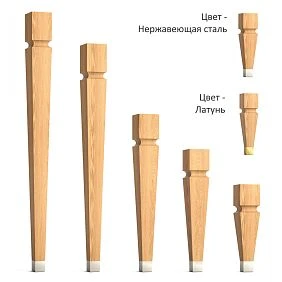
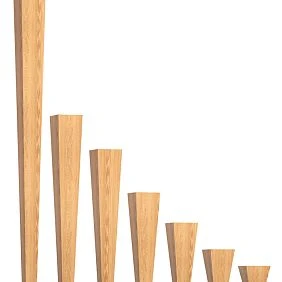
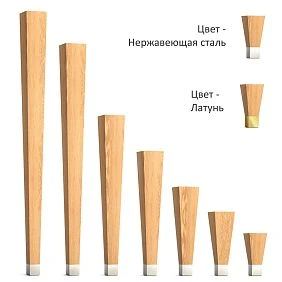
The geometric furniture leg MN-146 is designed for frameless constructions of ottomans, tables, sofas, dressers, and cabinets. Its four-sided conical shape looks concise and does not require a decorative frame to hide the upper part of the support. The line offers eight heights — 80, 120, 180, 250, 350, 430, 650, and 740 mm — with a constant size B of 60 mm. You can choose beech or oak, "Prestige" sanding quality, preparation for enamel or tinting.
The variety of sizes does not mean that each height is pre-assigned to a single piece of furniture. MN-146 80 mm does not automatically become a "sofa leg," and MN-146 740 mm is not a universal support for any table. The size is chosen by calculating the entire structure: the height of the body, the thickness of the tabletop or seat, the position of the mounting unit, the expected load, and the required clearance above the floor.
Main task before ordering
First, determine where and how the load will be transferred, and only then look at the dimensions of MN-146 and choose the material. In frameless furniture, a solid base is more important than a beautiful sketch: the absence of a frame does not mean that the leg can be attached at any point on the bottom.
What does "furniture without a frame" mean and why does it change the choice of legs
A frame is a horizontal part that connects legs or posts under a tabletop, seat, or body. In a classic table, four frames form a rectangular frame, help maintain geometry, and distribute forces between supports. In an ottoman or sofa, such a frame can be part of the load-bearing structure. In cabinet furniture, the lower strapping sometimes simultaneously supports the bottom and visually hides the connection point of the legs.
A frameless construction is arranged differently. There is no visible connecting frame between the legs, so each support is attached to the body, embedded part, mounting plate, hidden under-table, or other load-bearing base. The construction may look lighter, but the requirements for the upper node of the leg become stricter. The load should not fall on a thin decorative panel, weak edge, or area of the bottom not designed for point force.
The absence of a frame gives the designer more freedom. Under the table, there is additional legroom; the dresser shows a clean clearance; the sofa appears less massive; and the ottoman gets a modern graphic silhouette. Along with freedom, the ability to hide inaccuracies disappears. If one leg is shifted by a few millimeters, installed at a different angle, or differs in shade, it is noticeable. If the fastening is not rigid enough, the frame will not help dampen lateral swaying.
Therefore, furniture legs without a stretcher are chosen not as a separate decor, but as part of the support system. You need to answer four questions in advance: where is the load-bearing layer; how does the leg connect to it; what prevents rotation and wobbling; how is the load distributed among all supports. Only after this are the height, wood species, and finish evaluated.




Why MN-146 is suitable for modern furniture without a stretcher
MN-146 has a clear geometry: a square cross-section at the top and a smooth taper towards the floor. This shape is well readable from a distance and does not require additional carving, fluting, or complex profiles. The support can complement a modern, Scandinavian, neoclassical, or restrained transitional interior — the result depends on the furniture proportions, color, and combination with facades.
The constant size B 60 mm is especially important for designing a collection. Different heights of MN-146 can be used in several pieces while maintaining a unified character of the legs. For example, a low cabinet, a bench, and a table will differ in function and height, but the square top part and conical line will create kinship. However, you cannot mechanically transfer one mounting scheme to the entire line: the higher the support, the stronger the lateral forces, and the more carefully the base needs to be designed.
Beech and oak allow solving two different finishing tasks. Beech is usually chosen when the legs and body are planned to be covered with opaque enamel. Oak is appropriate when it is important to preserve the natural wood grain under tinting. This is not a strict rule for any project, but a practical logic of choice: the leg material should work together with the material of facades, handles, tabletops, and other visible wooden parts.
The "Prestige" sanding provides a prepared surface, but the future finish still requires a unified technical map. You cannot paint the body with one system and the legs with another, then expect a complete match in shade and gloss. A test coating on the selected wood species helps verify the color before processing the entire set.
| Parameter | Confirmed data MN-146 | What this means for the buyer |
|---|---|---|
| Type | Geometric four-sided conical furniture leg | The support remains expressive without a carved stretcher and is suitable for minimalist furniture |
| Purpose | Stretcherless constructions of benches, tables, sofas, dressers, and cabinets | A self-supporting base must be designed for each support |
| Heights A | 80, 120, 180, 250, 350, 430, 650 and 740 mm | You can select a support for different items, but the purpose is determined by the calculation of the entire furniture |
| Size B | 60 mm for all eight heights | It is convenient to maintain a unified visual style in the furniture collection |
| Materials | Beech and oak | Beech is convenient to consider under enamel, oak — under a finish with visible texture |
| Sanding quality | «Prestige» | The surface is prepared for further coordinated finishing |
| Finishing scenarios | Under enamel and under tinting | The option must be chosen together with the wood species and finish of the entire item |
| Fastening | The card specifies stud M8×60, FUR-001 and FUR-012 | Fastener compatibility is checked by the material and structure of the base, not just by the leg article |
To purchase a specific model, open the card and select height MN-146 after checking the project. If the shape fits, but a different cross-section, profile, or mounting method is required, it is wiser to go to the catalog of unpainted STAVROS legs and compare options, rather than adjusting an unsuitable part.
Our factory also produces:
Eight heights are not eight ready-made assignments
The most common mistake when choosing MN-146 is trying to turn the size range into a ready-made table "80 mm for a sofa, 180 mm for a chest of drawers, 740 mm for a table." Such a scheme is convenient but incorrect. The same piece of furniture can have different body heights, bottom thickness, tabletop seating, and clearance requirements. Additionally, the upper part of the leg is not always fully exposed: the design may include a platform, embedded part, or partial recessing.
Correct calculation starts with the finished height of the item. For a table, this is the distance from the floor to the top surface of the tabletop. For a bench or sofa, it's the seating height including the frame, padding, and soft layers. For a cabinet or chest of drawers, it's the position of the work surface, drawers, and base gap. For a wardrobe, it's the total height, stability, and access to upper sections.
It's convenient to calculate using simple logic: subtract the thickness of the top part and the body height from the required finished height, then account for the mounting assembly. Compare the resulting value with the available sizes of MN-146. If there is no exact match, do not blindly saw off the leg or compensate for tens of millimeters with random spacers. Change the body design, element thickness, choose a different size, or a different model.
Example of logic, not a finished specification: for a cabinet, first determine the surface height relative to the bed or sofa, then subtract the body height. If the remainder is close to 120 or 180 mm, check whether the calculation accounts for the thickness of the mounting platform and the bottom gap. Only then choose the leg size.
| Height group | What tasks can be considered | What to check | Main risk |
|---|---|---|---|
| 80 and 120 mm | Low lift of the body, sofa, cabinet, or wardrobe above the floor | Accessibility for cleaning, opening facades, visibility of fasteners | Choose a size based on a familiar range without checking the final height |
| 180 and 250 mm | Pronounced clearance for chests of drawers, cabinets, upholstered furniture, low benches | Bottom rigidity, lateral forces, need for intermediate supports | Make a heavy body visually light but structurally unstable |
| 350 and 430 mm | Benches, seats, and special furniture structures | Seat thickness, seating height, frame, and dynamic load | Consider the leg length equal to the finished seat height |
| 650 and 740 mm | Tables, consoles, and tall structures per project | The thickness of the tabletop, the position of the user's legs, the spacing of the supports, and the rigidity of the fastening | Installing long legs directly into a weak base and getting wobbling |
This table helps narrow down the choice but does not replace a drawing. A tall leg creates a larger lever arm for lateral force: a push on the edge of the tabletop or the movement of a seated person puts more stress on the upper joint. Therefore, MN-146 650 and 740 mm require particularly careful design of the fastening. Low options have a smaller lever arm but may be unsuitable due to facades, baseboards, cleaning equipment, or cabinet proportions.
Get Consultation
MN-146 for a dresser and nightstand: a light silhouette without a weak bottom
On a dresser or nightstand, legs visually separate the cabinet from the floor. Even a rectangular object with smooth facades begins to be perceived as full-fledged furniture, rather than a heavy box on a plinth. The conical geometry of MN-146 supports this effect: the upper part looks confident, while the taper reduces the visual mass near the floor.
However, cabinet furniture creates a complex load. The weight is distributed not only over the frame but also over the contents. Drawers open and shift part of the mass forward. A nightstand may be leaned on by hand, and heavy objects may be placed on a dresser. If the rear legs are fastened in a strong area, but the front legs fall into a thin panel near the facade, the item can become skewed even with equal leg lengths.
Before buy legs for a dresser, take measurements of the lower part of the cabinet. Mark the side panels, internal partitions, reinforcements, and areas where the bottom can actually transfer the load. The leg should be placed not just "closer to the corner," but under a load-bearing element or a specially prepared insert.
How to check drawer opening
The facade has a bottom edge, a handle, or a grip profile, and the leg has a top platform and possible mounting hardware. These elements must not intersect. The drawing should show the edge of the drawer in the open position and check whether the support interferes with the movement of the guides, adjustment, or removal of the drawer.
Special attention is required for dressers with facades extending all the way to the bottom. Visually, you want to place the front legs closer to the front plane, but this can block technical access or weaken the edge. Sometimes it is safer to slightly recess the supports while maintaining sufficient overhang for stability. The specific distance is determined by the design, not by a universal template.
Four or more supports
Four legs are not suitable for every body. A long cabinet, wide chest of drawers, or wardrobe with heavy contents may require intermediate support points. Without them, the bottom sags, the guides lose their geometry, and the load on the corner fasteners increases. The quantity is determined by the width and depth of the body, the material, the location of partitions, the weight of the furniture and its contents.
An intermediate support should not be a random part of a different shape. If it is visible, the set should remain visually cohesive. If it is hidden deeper under the body, you still need to ensure the same actual height and correct contact with the floor. The support layout is best included in the specification at the same time as ordering the legs.
MN-146 for a wardrobe: center of gravity is more important than a nice gap
A wardrobe on visible wooden legs looks lighter and more architectural, but its center of gravity is higher than that of a chest of drawers. The greater the body height and filling depth, the stronger the stability requirements. An open door creates an additional moment, a pull-out basket or drawer shifts the mass forward, and an uneven floor causes some supports to take increased load.
Therefore, MN-146 for a wardrobe is considered only together with the entire stability system. The base width, body depth, method of wall attachment, presence of internal partitions and intermediate supports are checked. Tall legs should not be used for visual effect if they compromise the safety of the item. For a tall wardrobe, wall attachment and structural calculation may be a mandatory part of the project.
In the section wooden legs for wardrobe models are collected according to the relevant application scenario. This is a convenient starting point for comparison, but the filter by purpose does not replace checking the specific body. One wardrobe may be a lightweight display case, another may be deep and completely filled with books; their support layouts cannot be the same just because both items are called wardrobes.
Before ordering, check the door hinges and the trajectory of the bottom edge of the facade. If the door opens close to the floor or has a protruding decorative element, the position of the front leg should allow free movement. For hinged doors, the load on the front corners when opening is important. For a wardrobe with drawers, stability when they are pulled out simultaneously is important. All these scenarios are better seen on a drawing before manufacturing than corrected after finishing the legs.
MN-146 for a sofa and bench: the load is constantly changing
Upholstered furniture experiences dynamic loads. A person does not sit strictly vertically or always in the center. They sit on the edge, shift their weight, stand up, move the sofa, lean on the armrest. Lateral forces are especially noticeable in a bench: this compact item is often used in the hallway, where people sit on it sideways while simultaneously leaning with their hand.
Therefore, legs for a sofa without a lower stretcher must connect to a rigid frame, not to decorative upholstery or a thin board. In upholstered furniture, it is important to know where the frame bars run, how the spring or webbing elements are secured, and whether access to the fasteners remains after upholstery. Sometimes it is easier to prepare the upper assembly before tightening the fabric than to try to install hardware through the finished bottom.
To compare options for upholstered furniture, open the section buy wooden legs for sofa. MN-146 is valuable because it maintains a modern geometry in several heights, but the specific size is chosen based on the finished seating position. You need to add up the height of the leg, frame, padding, and soft layers in the working state. The thickness of an unloaded cushion alone does not indicate the actual seat height.
Bench: small furniture with serious requirements
A bench seems like a simple item: a seat and four legs. In a stretcherless design, the simplicity is deceptive. If the supports are screwed only into a thin base, sitting on the edge creates a wobbling moment. If the legs are too close to the center, the item is easier to tip over. If they are too far apart and extend beyond the seat's footprint, a person may hit them with their foot.
In the section wooden legs for bench you can view other shapes and compare them with MN-146. For a modern bench, a geometric support is especially appropriate when the upholstery is solid-colored, the contours are straight, and the decor is based on proportions and material. For complex classic upholstery with tufting or a carved apron, a different model may be required.
A height of 350 or 430 mm cannot be assigned to a bench without considering the seat. A thick soft padding adds tens of millimeters and partially compresses when sitting. The project should include two values: the unloaded height and the calculated seating height. This helps avoid a situation where the finished bench ends up higher than a chair, lower than a console, or inconvenient for putting on shoes.
MN-146 for the table: free legroom requires a rigid top node
A table without an apron looks lighter and provides more space under the tabletop. Knees don't hit the frame, an armchair is easier to slide in, and a thin tabletop visually separates from the supports. In such a project, the long MN-146 fully reveals its geometry: the cone is visible from the top platform to the floor.
But the absence of aprons removes elements that traditionally connect the legs to each other. Therefore, stability must be ensured by the tabletop, a hidden underframe, a metal frame, inserts, or specially designed mounting nodes. A thick tabletop cannot be considered automatically suitable for direct attachment: the material, grain direction, distance from the edge, thread type, and force distribution are important.
Before legs for a table to buy, determine the finished table height and tabletop thickness. With a selected leg height of 740 mm, the top surface will be 740 mm higher by the thickness of all elements located above the leg. If the tabletop and mounting layer together add a noticeable amount, the final ergonomics may change. The 650 mm option, on the contrary, should not be chosen just because it leaves a 'margin': you need to check that the table does not end up too low.
Tabletop overhang and leg placement
A large overhang makes the edge visually light but reduces the distance between supports. A too small overhang widens the base, but the legs may interfere with those sitting at the ends. For a dining table, you need to model not only the top view but also the position of chairs, knees, and feet. For a desk, consider cabinets, cable channels, and the ability to slide in a chair. For a console, check the stability of a narrow item against the wall.
A round tabletop creates a separate challenge. A four-sided leg defines distinct directions, so the rotation of each support must be the same. If the square top platforms are rotated arbitrarily, visual noise appears under the circle. It is convenient to mark from the axes of the tabletop, not from its curved edge.
Why long legs are more sensitive to play
Even a small gap in the attachment of a long support is more noticeable than with a low leg. The top node acts as a point around which rocking occurs. The farther the floor is from this point, the greater the visible movement of the lower end. Therefore, after assembling the table, not only vertical load but also lateral force in several directions is checked.
If the project cannot ensure rigid attachment of each leg, it is better to change the design: add a hidden frame, reinforce inserts, choose a ready-made underframe or a different model. The external cleanliness of an apronless table should not be achieved at the cost of stability.
What to check in the cabinet before purchasing MN-146
Purchasing legs should complete the design of the lower assembly, not start it. A good check takes less time than fixing a split bottom, misaligned facades, or mismatched holes after painting. Below are the parameters that need to be transferred from general considerations to a specific drawing.
1. Base material
Solid wood, plywood, MDF, particleboard, and a combined frame hold fasteners differently. You cannot transfer the mounting scheme from solid wood to a panel base just because the furniture looks the same externally. The project must specify the actual material at the installation location, its thickness, and its position relative to the edge.
2. Thickness and condition of the part
A new, flat panel and an old bottom after several repairs are different bases. Cracks, broken holes, delamination, signs of moisture, and local sagging cannot be covered by a mounting plate without assessment. During restoration, the structure is first repaired or reinforced, and then new attachment points are marked.
3. Presence of embedded parts
An embedded part distributes the load and creates a reliable place for threads or a mounting plate. In new furniture, it is convenient to plan it in advance. In an existing cabinet, reinforcement can sometimes be added from the inside if access is not blocked by drawers, guides, or upholstery. It is important that the embedded part is part of the structural scheme, not just a small block glued to a thin panel.
4. Distance to the edge
The desire to place the leg as close to the corner as possible is understandable: the base becomes wider, and the cabinet visually more stable. But fasteners near the very edge can split the wood or destroy the panel. The exact distance depends on the material, fastener diameter, and assembly design. It should be assigned by the designer or the craftsman responsible for assembly.
5. Access after assembly
A removable leg is useful when transporting a table or sofa, but only if the mounting point is accessible. Check whether the node is covered by a blind bottom, fabric upholstery, built-in drawer, or equipment. If maintenance is only possible before final assembly, this must be indicated in the process sequence.
6. Geometry of all support points
Four or six mounts must be in the same plane. If the body is twisted, legs of equal length will not automatically fix it. First, check the diagonals, base plane, and partition positions. A foot pad can solve a minor floor contact issue but should not mask a serious body defect.
Minimum data set for the craftsman
Furniture dimensions; weight of empty body and estimated content weight; base material and thickness; partition and insert layout; number and coordinates of legs; selected MN-146 height; mounting type; disassembly requirements; floor covering type; finish option.
How many legs are needed: why the answer cannot be obtained from a photo
The question "how many legs are needed for a dresser, table, or sofa" seems simple only until a real drawing appears. Four supports is a common scheme, but it does not automatically become correct. A long body may sag in the middle, a heavy tabletop may transfer a large load to corner joints, and a cabinet with filled shelves may shift its center of gravity when doors are opened. Therefore, the number of MN-146 legs is determined not by the model's appearance, but by the furniture's load-bearing structure.
For a compact bench, four support points often look natural, but the craftsman still checks the frame rigidity and the distance between legs. For a long cabinet or dresser, an intermediate support under a partition may be needed. For a table, not only the length and width of the tabletop matter, but also its material, thickness, underframe placement, expected load, and the ability for a person to sit comfortably on each side. For a sofa, the load constantly changes: people sit on the edge, move, stand up, leaning on the armrest. Here, it is especially dangerous to assign a scheme based only on a symmetrical picture.
There is also a visual aspect. An additional central leg can improve the body's performance but ruin the rhythm of exposed supports if placed randomly. In frameless furniture, all elements are visible, so the structural solution must be coordinated with the composition. The intermediate support is placed along the structural axis, linked to a partition or insert, and checked to ensure it does not interfere with cleaning, robot vacuum, user's legs, or opening the bottom drawer.
Correct order: first calculate the body and load, then assign the number of supports and attachment points, after that choose the height and material MN-146. The reverse sequence — buying four legs and then trying to adapt furniture to them — creates unnecessary constraints and increases the risk of rework.
Beech or oak: choice not only by wood grain
MN-146 is available in two species — beech and oak. Both allow for precise geometric shapes, but reveal themselves differently in finishing and interior. The species cannot be chosen separately from the body: even a well-made leg will look out of place if its color, texture, and gloss level are not coordinated with the facades, countertop, sofa frame, or other exposed wooden parts.
When beech is practical
Beech is often chosen for a project under enamel. Its calm, relatively uniform surface helps achieve an even color and does not distract from the strict four-sided shape. This is convenient when the legs must match the painted body, support the color of the facades, or become a neat contrast without a pronounced wood grain. But the same color name does not guarantee a match: enamel on solid wood and on board can be perceived differently due to primer, surface preparation, and lighting. Therefore, it is advisable to approve the finish sample together with the entire set.
When oak is more expressive
Oak is appropriate when the wood is not intended to be completely hidden. When tinted, its grain remains part of the design and makes simple geometry deeper. This version works well next to an oak countertop, framed facades, wooden handles, or exposed frame elements. The main task is to coordinate the tone. The leg and body do not have to be absolutely identical, but the difference should look intentional. An accidental transition from warm oak to a cool gray shade is more noticeable precisely because the apron does not cover the upper part of the support.
| Criterion | Beech | Oak |
|---|---|---|
| Main visual effect | Calm surface, focus on shape and color | Pronounced wood texture and depth of tinting |
| Typical finishing scenario | For enamel, when a smooth specified color is needed | For tinting, when the wood grain should remain visible |
| What to coordinate with | With facades, painted frame, wall color, and hardware | With countertop, frame, veneer, other solid wood parts |
| What to check before ordering | Primer and enamel system, gloss level, color reference sample | Tone, direction of visual texture, compatibility with other wood |
The "Prestige" grinding prepares the part for further work, but does not replace the coordination of the final finish. This is especially important for a set of several legs: the material, preparation option, and future finish must be the same throughout the entire batch. Mixing beech and oak in one set without a specially intended contrast is not advisable — differences will show under enamel, and even more so under transparent or semi-transparent finishes.
Mounting MN-146: an open support requires hidden precision
The model card mentions the M8×60 stud and fasteners FUR-001 and FUR-012. These are useful guidelines, but they do not replace the design of the assembly. The same leg article can be installed under a massive tabletop, a reinforced cabinet bottom, or a soft furniture frame — the bases are different, so the mounting work differs.
The main principle is simple: the fastener must transfer the load to the load-bearing part of the body. It should not be held only by a thin decorative panel, a loose edge of the board, or a layer of upholstery. In a frame-less design, there is no lower frame that could distribute forces between adjacent legs, so each mounting point is considered as an independent power unit connected to the overall geometry of the furniture.
When choosing a mounting method, the possibility of disassembly is considered. For a large table, removable legs facilitate transportation and passage through doorways, but the detachable assembly must remain rigid after reassembly. For a sofa or bench, it is important to prevent gradual loosening from lateral loads. For a cabinet, check whether the fastener creates protrusions inside the lower compartment and whether it interferes with the contents.
The material helps to compare options in detail and understand why play cannot be eliminated only by strong tightening how to choose a furniture leg mount and check the mounting assembly. For a project with MN-146, this information should be applied together with the drawing of the specific base.
What to check in the mounting assembly
- whether the leg axis coincides with the calculated load transfer point;
- is the thickness and strength of the mounting plate sufficient;
- is there an embedded part or reinforcement in the frame;
- is the hole not too close to the edge;
- can the fastener be tightened and serviced after assembly;
- does the mating part not rotate inside the housing;
- is the orientation of the four faces preserved for all legs;
- does the fastener not change the final height or visible gap under the housing.
The last point is especially important for the geometric model. A round turned leg can be rotated around its axis almost imperceptibly. For the MN-146, the faces create a directional pattern, so after tightening, all supports must face the same way. The position must be considered already when preparing the threaded part, plate, or other mating part.
Floor contact: when a square foot pad FUR-023 is needed
The lower end of the leg is a small area that affects the appearance, ease of movement, and condition of the floor covering. For the MN-146, it is logical to consider a square foot pad because it supports the geometry of the support itself and does not create an accidental round accent. Confirmed Square furniture foot FUR-023 size 25 × 25 mm has a height of 5 mm, is attached with a self-tapping screw, and is designed to facilitate moving furniture while protecting the floor.
The furniture foot is not a universal remedy for uneven floors. It helps organize contact and reduce direct friction of the wood, but does not fix a skewed body, different leg lengths, or incorrectly chosen support points. Before installation, you need to check whether the 25 × 25 mm area fits the lower end of the selected height MN-146, where the self-tapping screw will go, and whether there is a risk of splitting the wood.
You also need to consider the additional 5 mm in the total height. For a low sofa, this value may be almost visually imperceptible, but when accurately calculating the fit, the gap under the facade, or the interface with a table, it cannot be ignored. If the furniture is on a sensitive covering, the final choice of furniture foot is coordinated with the floor type and movement mode.
What to buy together with MN-146
Furniture without a frame is rarely assembled from a single beautiful part. The buyer needs a coordinated set: supports of the same height and wood species, a suitable mounting unit, if necessary floor protection, and a proven body scheme. Accompanying elements are chosen not to increase the order, but so that the furniture does not have to be redone after finishing.
| What to add | Why | For which scenario | What to Check |
|---|---|---|---|
| Set MN-146 of one specification | Get the same height, material, preparation, and geometry | Any furniture with several exposed supports | Quantity according to the project, height, beech or oak, finish |
| Fastening by base structure | Transfer load to the load-bearing part and eliminate play | Table, sofa, bench, chest of drawers, wardrobe | Base material, embedded parts, access after assembly |
| Floor protection under MN-146 — FUR-023 | Reduce direct friction of the leg end against the coating and facilitate movement | Furniture that is periodically moved | Compatibility, screw fastening, 5 mm height addition |
| Control sample of finish | Match the color and texture of the legs with the body | Enamel on beech or oak tinting | Primer, color, gloss level, lighting |
| Other unpainted wooden legs | Compare geometry, heights, and support character before project approval | When MN-146 does not fit in shape or proportions | Purpose, cross-section, height, and attachment method of the alternative |
When ordering a set, it is better not to distribute decisions across different stages. For example, first buy the legs, then after painting the body choose the fasteners, and add the floor protector at the site. Each late element can change the fit, height, or appearance. It is more reliable to fix the assembly composition in the specification before finishing begins.
How not to confuse MN-146 with a simply similar conical leg
In the photo, many geometric supports seem interchangeable: a flat top, tapering downward, four faces. But for the project, it is not the general silhouette that matters, but the combination of parameters. MN-146 has a constant size B 60 mm and eight height options. This alone means that a random blank with a similar profile may differ in mounting area, taper angle, face proportions, and visual weight.
The first difference is the purpose for frameless constructions. The leg must look finished from all open sides and function as a visible part of the furniture. A support designed for installation behind a frame may have geometry that looks good only partially. The second difference is the precision of the set. Even a small difference in cross-section or face slope becomes noticeable when four legs stand in a row. The third is confirmed material options and surface preparation. It cannot be assumed that any similar wooden blank will behave the same under the chosen enamel or tint.
Before replacing MN-146 with another model, not only the height is compared, but also the upper mounting part, base size, direction of edges, method of fastening, and the role of the support in the specific furniture. When a different character is required — more decorative, turned, massive, or, conversely, visually light — it is more reasonable to open the catalog of unpainted STAVROS legs and choose the model deliberately, rather than substituting the article with an approximate analogue.
Practical selection of MN-146 for different tasks
Need to raise an existing chest of drawers
First, check whether the existing bottom allows point fastening. In mass-produced furniture, the thin bottom panel sometimes only serves an enclosing function and is not designed to transfer the entire weight through four points. Reinforcement connected to the sides or partitions will be required. Then, calculate how the new height will change the position of the top surface, access to drawers, and stability. Only after this is the MN-146 of the required size selected. For comparing solutions, it is useful to look at supports for case furniture and buy legs for a chest of drawers according to project parameters.
Designing a table without a traditional underframe
Here, one cannot interpret the absence of a stretcher as the absence of a rigid system altogether. The tabletop still needs a scheme that limits deflection and prevents the legs from wobbling. This could be an internal frame, embedded parts, metal reinforcement, or another calculated solution. The position of the supports is checked relative to overhangs and legroom. In the section where wooden legs for tabletops and legs for tables, MN-146 can be compared with other forms without mixing the general request with the task of a specific article.
A modern ottoman is being assembled
For an ottoman, not only the seat height and beautiful silhouette are important. A person often sits closer to the edge, so the frame experiences uneven load. The legs need to be connected to the power frame, not just to the decorative bottom. If there is a drawer under the seat, its movement and access to the fastening are checked. To select geometric supports for the seat and wooden legs for the ottoman should be done before approving the thickness of the soft layer, because the final seating height is made up of all parts of the structure.
The sofa is being updated
When replacing low supports with higher ones, not only the appearance changes. The shoulders of lateral load increase, the seat rises, and the lower part of the frame becomes more noticeable. The new leg must be attached to the power part hidden under the upholstery. Sometimes for this you have to partially disassemble the bottom of the sofa and add an embedded part. In the catalog you can compare Wooden legs for sofas, but the final decision is made after inspecting the frame.
A unified furniture collection is being created
The eight heights of MN-146 allow you to support one geometric style in different items: a low cabinet, a chest of drawers, an ottoman, a sofa, a table, or a wardrobe. But the collection is not built on the principle of "each item gets the next height from the list." For each product, the final mark, load, and base are calculated separately, and then it is checked how the supports look next to each other. Unity is created by shape, material, finish, and the rhythm of the edges; the difference in heights is subordinated to the function of the furniture.
How MN-146 changes the interior
An open geometric leg makes furniture visually lighter: air appears between the body and the floor, the contour of the object is better read, and cleaning is simplified. But this effect only works with the correct proportion. A support that is too high under a heavy cabinet creates a feeling of instability, while one that is too low under a massive chest almost disappears and does not reveal the shape.
In the living room, MN-146 can connect a sofa, console, and coffee table through the repetition of one geometry. It is not necessary to make all items the same color: for example, oak legs can support the tabletop, while painted ones can support the body. In the bedroom, open supports on a bench and nightstand help maintain lightness, especially next to a tall upholstered bed. In the hallway, a tall cabinet on legs is convenient for cleaning, but requires particularly careful checking of stability and wall mounting, if provided by the design.
In a study, a strict four-sided shape suits a desk and a low cabinet, without turning the interior into a set of decorative details. In a commercial space — a salon, showroom, or hotel — the supports remain visible and participate in the perception of furniture from different angles. Here, batch repeatability, repairability of the fastening, and the durability of the chosen finish under usage conditions are important.
Mistakes when ordering MN-146 that become visible after assembly
1. Buying legs before the base drawing
A beautiful SKU sets the direction but does not replace the project. Without the dimensions of the mounting platform, it is impossible to confidently determine the fasteners, edge offset, and number of supports. First, a body diagram is needed, then the leg specification.
2. The absence of an apron is mistaken for the absence of a load-bearing frame
Apronless furniture looks freer, but the loads do not disappear. They must be handled by a hidden structure: a reinforced bottom, frame, embedded parts, or another calculated assembly. Fastening to a single thin panel is dangerous even with a high-quality leg.
3. Height is assigned based on the item's name
You cannot assume that 80 mm always suits a sofa, and 740 mm suits any table. The final mark depends on the body, tabletop, soft layer, foot pad, and user requirements. Each of the eight heights is a part dimension, not a ready-made purpose.
4. The quantity is determined by symmetry
Four corners do not necessarily mean four sufficient points. A long dresser or table may require intermediate support. The decision is made based on weight, span, body material, and partition placement.
5. Doors and drawers are not checked
After lifting the body, the lower facade may catch on a protruding leg or mounting plate. The center of gravity of the cabinet changes, and access to the lower drawer of the nightstand changes. Trajectory checks should be on the drawing, not after painting.
6. All legs are oriented differently
Four faces create a directional pattern. If one support is turned differently, it is noticeable at first glance. The orientation is fixed in the drawing and controlled during assembly.
7. Materials and finishes are mixed
Beech and oak differ not only in name. Different textures will show under the coating, and individual batches prepared according to different specifications may differ in color and gloss. The set is ordered with a single specification.
8. The foot pad is not considered in the height
FUR-023 adds 5 mm. For the overall proportion, this is a small value, but for precise clearance, countertop level, or alignment with adjacent furniture, it matters.
9. The load is replaced by a general promise of strength
The permissible weight of furniture cannot be determined solely from the leg material. The entire system works: the body, number of supports, fastening, distances, floor, and load nature. The specific value must come from the project calculation.
10. Access to the fastening is not left open
After upholstering a sofa or installing a blind bottom, tightening the knot may be impossible. The assembly and maintenance sequence is planned in advance, especially if the legs must be removable for transport.
Who MN-146 suits and when it's better to choose another support
MN-146 is especially appropriate in modern furniture, where the leg is not hidden behind a frame and should look like a finished detail. It is chosen for projects with clean geometry, an open bottom, and a clear rhythm of verticals. Eight heights help to use one shape character in different items, and beech and oak provide two finishing directions — even color or visible wood texture.
But this model does not become universal. If the body does not have a solid base, the design must first be reworked. If the interior requires complex carving, a rounded turned shape, or a historical profile, the strict four-sided leg may be too minimalist. If there is little space under the furniture, a tall open support will disrupt the proportion. If the base cannot be reinforced, it is safer to choose a different scheme than to force MN-146 to work in unsuitable conditions.
| MN-146 is worth considering | Better to explore other options |
|---|---|
| Furniture is designed without a visible apron | The leg is almost completely hidden by the high frame |
| A strict four-sided conical geometry is required | A carved, turned, or rounded silhouette is needed |
| There is a calculated mounting platform or embedded plate | Mounting is only possible to a thin non-load-bearing bottom |
| The height needs to be selected within the range of 80–740 mm | A size or cross-section outside the confirmed range is required |
| Beech for enamel or oak for tinting is suitable | The project requires another confirmed wood species or finished coating |
How to order MN-146 on STAVROS without missing data
The transition to purchase begins not with a button, but with a full specification. In the product card you can view the dimensions of MN-146 and choose a geometric leg made of beech or oak. Before placing an order, you need to match the selected option with the furniture drawing and ensure that all project participants understand the notations the same way.
The application specifies the article number, height, size B 60 mm, wood species, surface preparation option, intended finish, and quantity. It is separately recorded who is responsible for the fastening: the cabinet manufacturer, the furniture workshop, or the assembler on site. If the M8×60 stud, FUR-001, or FUR-012 are being considered, their compatibility is confirmed based on the base. The FUR-023 foot is also included in the calculation in advance, not added after the furniture is manufactured.
Example entry in the specification
MN-146, 180 × 60 mm, beech, "Prestige" sanding, for enamel — 4 pcs.
The type of fastening, position of edges, coordinates of supports, and permissible load are based on the cabinet design. The foot and its effect on the finished height are indicated in a separate line.
This format does not assert that four legs are suitable for any chest of drawers or sofa. It separates the confirmed product parameters from design decisions. If the furniture is long, heavy, tall, or has complex filling, the number and placement of supports should be determined by a specialist. Before ordering, it is also useful to check the current options in the product card and, if necessary, provide the manager with a drawing or the main dimensions of the cabinet.
Frequently asked questions about the furniture leg MN-146
1. What does furniture without a stretcher mean?
This is a construction where there is no traditional visible frame connecting the legs under the body, seat, or tabletop. The supports are attached to another load-bearing base: a reinforced bottom, hidden frame, embedded parts, or a calculated joint. The absence of a stretcher does not mean the absence of a structural framework.
2. What furniture is MN-146 intended for?
The model is intended for stretcher-free constructions of banquettes, tables, sofas, chests of drawers, and cabinets. The specific application depends on the selected height, base, attachment, load, and overall geometry of the item.
3. What sizes are available?
Eight heights are confirmed: 80, 120, 180, 250, 350, 430, 650, and 740 mm. Size B remains constant at 60 mm. Before ordering, you should check the selected option in the product card and include it in the furniture drawing.
4. Can 740 mm be considered the finished height of the table?
No. This is the height of the leg, while the finished height depends on the tabletop, mounting joint, possible frame, plate, and foot cap. The convenience of the table is checked based on the complete structure, not just one support dimension.
5. What height is suitable for a sofa?
There is no single value. You need to add up the height of the body, soft layers, leg, and foot cap, then check the seating and stability. A higher support increases the visible gap and the lever arm of lateral load, which may require a reinforced joint.
6. How many legs are needed for a chest of drawers?
The quantity is determined by length, weight, body material, partition placement, and design load. Four legs are not an automatic rule. A long dresser may require one or more intermediate supports.
7. What to choose — beech or oak?
Beech is often convenient for a project under enamel when an even color and smooth surface are needed. Oak is chosen when a noticeable wood texture is desired during tinting. The decision is coordinated with the materials and finish of the entire furniture.
8. Can I order MN-146 for painting?
For this model, the "Prestige" sanding and options for enamel and tinting are confirmed. The specific coating system, preparation, and color are best agreed upon before ordering, especially if the legs must match an already manufactured body.
9. How is MN-146 attached?
The model data mentions an M8×60 stud, FUR-001, and FUR-012. But the appropriate method is chosen based on the material and structure of the base. The fastener must transfer the load to the structural part of the body and remain accessible for assembly or maintenance.
10. Can the leg be screwed directly to the panel bottom?
Only if the bottom is designed as a load-bearing mounting platform. A thin decorative panel or loose edge should not bear the load without reinforcement. Inserts, a frame, or another solution assigned by the furniture designer are required.
11. What is the FUR-023 foot pad for?
The square footpad 25 × 25 × 5 mm is attached with a self-tapping screw, helps facilitate furniture movement, and protects the floor from direct contact with the end of the leg. Its compatibility and impact on height are checked before assembly.
12. Will the footpad fix an uneven floor?
It can improve contact, but should not compensate for a serious misalignment of the body or a difference in support length. First, check the flatness of the furniture and floor, then choose the appropriate solution for the bottom contact.
13. Why is it important to turn all legs the same way?
MN-146 has four faces, so the orientation is noticeable. Different rotation disrupts the rhythm and creates an impression of inaccurate assembly. It is better to mark the position of the faces on the drawing and check before final tightening of the fasteners.
14. Can one article be used for the entire furniture collection?
Yes, eight heights allow supporting the overall geometry in several items. But each size is chosen based on the function and design of the specific furniture. The unity of the collection is created by shape, wood species, finish, and coordinated rotation of the faces, not by mechanical distribution of sizes.
15. What to prepare before contacting STAVROS?
Useful information includes furniture dimensions, a drawing or diagram of the base, the expected number of supports, required height, wood species, finish option, and information about the flooring. For a complex body, you also need to know the weight, location of partitions, and embedded parts.
16. Where to see the current options for MN-146?
Current specifications and selection options are listed in the card of the geometric furniture leg MN-146. Before placing an order, it is worth double-checking the height, material, surface preparation, and quantity, while separating design questions about fastening from product parameters.
Legs are visible — so the design must be precise
MN-146 solves a specific task: it creates an open geometric support for furniture without a traditional apron. The four-sided taper, constant size of 60 mm, eight heights, beech and oak allow the model to be used in various items — from a bench and sofa to a chest of drawers, cabinet, and table. But the variety of sizes does not eliminate calculation. Height is chosen based on the finished geometry, quantity based on load and body, fastening based on the load-bearing base.
Before purchasing, you need to check the mounting plane, embedded parts, distance to the edge, door opening, center of gravity position, access to fasteners, and face orientation. The finish and bottom contact with the floor are agreed upon separately. This approach turns a beautiful leg into a working part of the furniture, rather than a component that has to be adapted after the body is manufactured.
To move from idea to specification, open the card and select the height of MN-146 for furniture without an apron. Record the material, finish, and quantity, and coordinate the mounting scheme with the body design. This way, the finished STAVROS product will maintain precise geometry, and the furniture will retain stability, convenience, and a cohesive appearance.
Final project check before order submission
Even a detailed specification doesn't help if the dimensions in it are not interconnected. Before submitting the order, it's useful to go through the entire furniture item from bottom to top. Start from the floor: will a foot cap be installed, what is its height, does the covering allow movement. Then check the leg itself: is one of the confirmed sizes selected, are the wood species and preparation the same for the entire set, is the face direction fixed. After that, move on to the fastening and body.
At the mounting node level, the material of the platform, its thickness, the position of the embedded part, hole offsets from edges, and the tightening method should be clear. Do not leave the phrase "fastening on site" without a responsible person. On site, it often means the assembler sees the legs for the first time next to painted furniture and is forced to make a structural decision without the ability to reinforce the body. It is much safer to specify in advance who develops the node and at what stage it is checked.
At the body level, check the alignment of partitions, drawers, doors, soft elements, and technological openings. The support should not conflict with the guide, hinge, inner drawer, or upholstery fastener. For a table, separately check the legroom and tabletop overhangs. For a cabinet, check stability with doors open and fully loaded. For a sofa and ottoman, check the frame operation when sitting on the edge, not just with evenly distributed weight.
Complete the check with the overall height. Add up all actual structural parts: leg, foot cap, fastener, body, tabletop or soft layer. Compare the result with adjacent furniture and user height. An error of a few millimeters rarely ruins the composition by itself, but a forgotten tabletop, recessed mounting plate, or extra foot cap can noticeably change the final mark.
Five control questions before ordering
- Does the selected height refer specifically to the leg or does it already include the foot cap and fastener?
- Where is the load transferred: to the structural insert or only to the bottom panel?
- Have the opening of facades, movement of drawers, and access for tightening been checked?
- Are the material, preparation, finish, and orientation of all supports the same?
- Are the number and coordinates of the legs recorded in the drawing, not just in a verbal agreement?
Such a check is especially valuable for frameless furniture: after assembly, there is nothing to hide an inaccurate offset, accidental rotation, or weak mounting platform. But a properly designed MN-146 works in three roles at once — it carries the body, sets the proportion, and forms a visible geometric rhythm. That is why the choice of one model cannot be separated from the project as a whole.
Before approving the set, it is useful to make a simple visual mockup: show the body to scale with the selected support height, mark overhangs and facade lines. Such a sketch does not replace engineering calculation, but quickly reveals compositional errors. It shows whether the furniture has become excessively tall, whether the body is lost over long legs, whether there is enough free space between supports, and whether a consistent rhythm with adjacent items is maintained. For a collection of several products, the mockup helps compare them simultaneously, rather than evaluating each model in isolation.
After visual inspection, the data is transferred to the working drawing and specification without approximate words like "low", "medium", or "high". The exact size, article number, and quantity are specified. This ensures that the manager, case manufacturer, finisher, and assembler work with the same version of the project. The fewer verbal assumptions remain between the selection of MN-146 and installation, the higher the likelihood that the open trestleless structure will look exactly as intended.