








































































Article Contents:
- Wooden table frame STL-026-1: which parameters the product card confirms
- Frame 800×800 for a tabletop 900×900: where the nominal 50 mm comes from
- Why the external frame dimension does not automatically equal the upper support contour
- Why the STL-026-1 drawing matters more than a photo
- Tabletop 900×900: what to check on it before ordering the frame
- The hardware kit is included — but that does not automatically mean compatibility with a third-party tabletop
- The standard ST-026-1 800×800 is a reference point, not a template for 900×900
- When 50 mm can still be used as a working target
- What happens if the upper support contour is smaller than 800×800
- Fastener too close to the edge: why 50 mm may not be enough
- Beech frame under enamel: when to choose this configuration
- Oak STL-026-1 under tinting: when the base texture matters
- Final table height: 740 mm is not yet the height of the finished product with a third-party tabletop
- Why a third-party tabletop cannot be drilled before receiving the frame
- A disassembled frame cannot be used as a mounting template
- Paper template 900×900: what can be checked before the frame is delivered
- Axes matter more than edges: how to actually center 900×900 on the frame
- Already have holes or metal bushings: the decision is made before purchasing STL-026-1
- Diagonal control after assembly: the 800×800 square must actually be a square
- Load of a third-party tabletop: the 900×900 size says nothing about its mass
- Full-size template instead of drilling: a safe intermediate step
- Rounded tabletop corners: 50 mm is measured along the sides, not by the radius
- What to write to the STAVROS manager before paying for STL-026-1
- Which documents to attach to the request
- When STL-026-1 should not be purchased
- Where to buy a table frame after checking the drawing
- Questions before ordering STL-026-1
- What is the size of STL-026-1?
- What materials are available?
- What sanding is applied?
- How is the beech prepared?
- How is the oak prepared?
- Is the frame delivered assembled?
- Is a set of hardware included?
- What is the nominal overhang for 900×900 on 800×800?
- Why can't these 50 mm be considered a guaranteed overhang?
- What is the standard tabletop for STAVROS?
- Can I install 900×900 instead of the standard 800×800?
- What should I request from the manager?
- Can the tabletop be pre-drilled?
- What will be the final table height with a 30 mm top?
- Do I need to consider the tabletop material?
- When is it better not to use 900×900?
- How much does STL-026-1 cost now?
- What should be checked last?
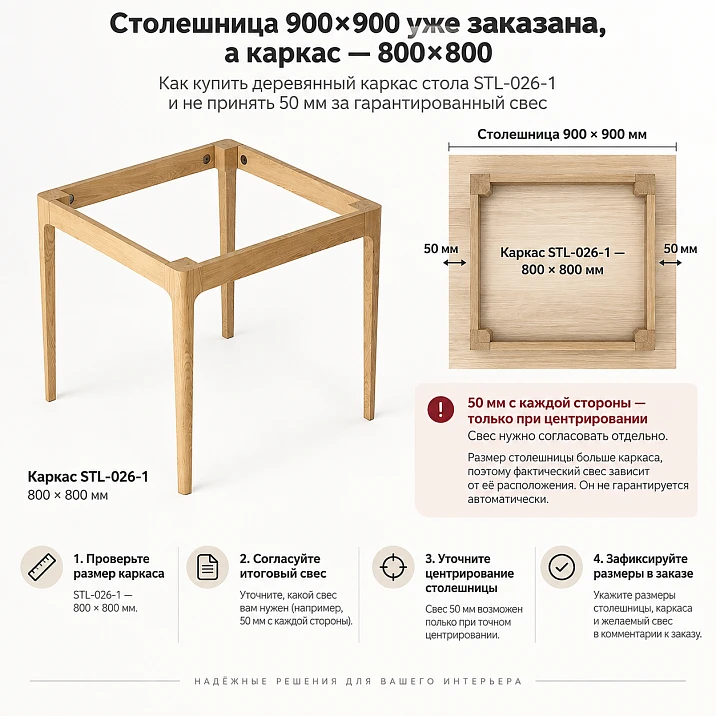
The tabletop has already been made by another contractor: a 900 × 900 mm square. Now a wooden frame is needed for it, and in the catalog, STL-026-1 with a published dimension of 800 × 800 × 740 mm fits the style. Simple arithmetic looks convincing:
(900 − 800) ÷ 2 = 50 mm.
From this it is easy to conclude: if the countertop is placed in the center, you get exactly 50 mm of overhang on each side.
But this is still only the nominal geometric difference in external dimensions. The STL-026-1 card does not state that 800×800 mm is the size of the upper support contour, the coordinates of the extreme mounting points, or the installation template for the tabletop. Therefore, 50 mm cannot be presented as a manufacturer-confirmed overhang.
For a third-party tabletop, the procedure should be different: frame dimensions → drawing of the upper part → mounting scheme → parameters of the tabletop itself → trial centering → only then drilling and final installation.
Wooden table frame STL-026-1: which parameters the card confirms
The current STL-026-1 card confirms the following data set:
| Parameter | Value |
|---|---|
| Dimension A × B × C | 800 × 800 × 740 mm |
| Material | Beech / Oak |
| Sanding | Prestige |
| Beech | Primer for enamel |
| Oak | Preparation for tinting |
| Supply | Disassembled |
| Hardware | the kit is supplied with the frame |
| Made to order | 5–10 days |
| Fresh catalog price | from 33,510 ₽ |
For a non-standard combination with a third-party tabletop, the key fact is not the price, but that the card publishes the overall frame dimension but does not provide a ready answer in the text description for your 900×900 tabletop.
If the base has already been selected, buy wooden table frame STL-026-1 better after checking the drawing and mounting diagram, not just by matching the shape "square to square."




Frame 800×800 under a 900×900 tabletop: where the nominal 50 mm comes from
If you imagine two perfect squares and align their centers, the calculation is indeed like this:
900 − 800 = 100 mm of total difference;
100 ÷ 2 = 50 mm on each side.
This is correct arithmetic for external dimensions.
But it does not prove three things:
- that the upper support area actually measures exactly 800×800 mm;
- that the attachment points are located symmetrically relative to the outer contour;
- that the tabletop can be safely secured with exactly such an overhang.
Therefore, in the article we will refer to these 50 mm as the nominal geometric overhang under ideal centering, rather than the guaranteed mounting overhang.
Our factory also produces:


Why the external dimension of the frame is not automatically equal to the upper support contour
A furniture frame may have legs, aprons, connecting elements, and other parts that form the external size of the product. But the tabletop rests on and is attached to specific upper zones of the structure.
The buyer needs to know:
- where the upper support plane runs;
- how far from the outer edge the aprons are located;
- whether there are corner plates;
- where the holes or other attachment points are located;
- which zones of the lower surface of the tabletop should remain free;
- whether a separate fastening scheme is required.
It is impossible to recover this data from a photo alone.
If the task is — Base for countertop for an already finished top, the actual top geometry matters more than a beautiful match of the numbers 900 and 800.
Get Consultation
Why drawing STL-026-1 is more important than a photo
The photo shows the style: the shape of the legs, proportions, and the general character of the wooden base. For an installer, this is not enough.
Before ordering a third-party tabletop, it is useful to obtain a DWG, PDF, or other confirmed scheme where the following can be read:
- upper contour;
- coordinates of structural elements;
- mounting points;
- actual indents;
- orientation of parts after assembly.
The page STL-026-1 provides a section "Product Drawings". To work with the project, you can also download drawings of STAVROS furniture frames.
If the available drawing does not include the mounting coordinates of a third-party countertop, you need to request them from the manager, rather than drawing them yourself.
Countertop 900×900: what to check on it before ordering the frame
Even an accurate STL-026-1 drawing solves only half the problem. The other half is the countertop itself.
For a third-party top, you need to record:
| Countertop parameter | What to record |
|---|---|
| Dimension | 900 × 900 mm |
| Thickness | ___ mm |
| Material | ___ |
| Bottom surface | smooth / with frame / with cutouts / other |
| Edge | ___ |
| Corner radii | ___ |
| Reinforcement from below | yes / no / unknown |
| Anchors or bushings | Yes / no |
| Pre-drilled holes | coordinates ___ |
| Allowed fasteners | confirmed by the countertop manufacturer |
It is especially important to know the material and construction. The same size 900×900 can be a countertop made of MDF, solid wood, veneered board, stone, or another system. For each, fasteners are selected differently.
The STL-026-1 card does not guarantee that the included hardware is compatible with any third-party countertop.
There is a set of hardware — but that does not mean automatic compatibility with someone else's tabletop.
The description of STL-026-1 explicitly states that the frame is supplied disassembled with a set of hardware.
This is a good fact for standard frame assembly.
But a broader conclusion cannot be drawn from it:
"The box already contains everything needed to attach any 900×900 tabletop."
For a third-party top, you need to separately confirm:
- which fasteners relate to assembling the frame itself;
- which ones relate to attaching the tabletop;
- their diameter and length;
- requirements for the top material;
- minimum allowable thickness;
- are bushings, embedded inserts, or pre-drilled holes needed.
If at least one parameter is unknown, drilling 900×900 in advance is not possible.
The standard ST-026-1 800×800 is a reference point, not a template for 900×900
STAVROS offers its own ST-026-1 countertop measuring 800 × 800 × 25 mm. It is currently available in MDF, Beech/MDF/beech veneer, and MDF/oak veneer.
This shows the standard product logic: the STL-026-1 frame has a published dimension of 800×800, and the proprietary ST-026-1 also has 800×800.
But one cannot conclude from this:
“Since the standard countertop 800×800 fits, any 900×900 will also fit with a 50 mm overhang.”
A third-party countertop differs in size, material, thickness, bottom surface, and fastening preparation.
If a non-standard combination is not mandatory, it can be compared with the standard ST-026-1 countertop 800×800 mm and understand whether an enlarged top is really needed.
When 50 mm can still be used as a working goal
The nominal 50 mm becomes a real design target only after several conditions are confirmed.
First: the tabletop is indeed centered along the external axes of the frame.
Second: the upper support contour allows such centering.
Third: the mounting points are not too close to the edge of the tabletop.
Fourth: the material and thickness of the top allow the selected fasteners.
Fifth: the frame is geometrically assembled correctly, and its actual diagonals and top plane are checked.
Only after this, the entry:
overhang of 50 mm
becomes a parameter of the actual assembly, not arithmetic on paper.
What happens if the upper support contour is smaller than 800×800
Suppose that after receiving the drawing, it turns out that the actual upper support zone is noticeably inside the outer dimension of the frame.
Then the visual overhang of the tabletop relative to the legs may remain close to 50 mm, but the structural extension relative to the support zone will be larger.
This is already a different parameter.
Therefore, it is useful to distinguish:
visual overhang — how much the tabletop protrudes relative to the visible outer contour;
structural extension — how much it protrudes relative to the actual support and fastening zone.
In the article, the second dimension cannot be specified in advance without a drawing.
Fastening too close to the edge: why 50 mm may be insufficient
Even if the tabletop is visually positioned perfectly, the attachment point may end up in an unfortunate location.
For example, the frame hole is located close to its outer edge. After adding the 50 mm countertop, the center of the fastener will be only a small offset from the top edge.
Whether this indentation is sufficient depends on:
- material;
- thicknesses;
- the type of screw;
- the presence of a bushing;
- the direction of fibers for solid wood;
- the edge construction;
- the recommendations of the countertop manufacturer.
There is no universal number here.
Therefore, the hole coordinates should be compared with the actual countertop, not just its external dimensions.
Beech frame under enamel: when to choose this configuration
In STL-026-1, beech is used in the "Prestige" line with "Under enamel" preparation.
This option makes sense if the base must be painted with an opaque finish and the project requires a wooden frame.
However, choosing beech does not resolve the compatibility issue with 900×900. The geometry and mounting are checked independently of the material.
If a finish coating is required, it can be done separately buy materials for finishing the wooden frame and the technology can be coordinated with the finisher.
Oak STL-026-1 for tinting: when the texture of the base matters
The oak version is offered "For tinting." Here, the wood texture can become part of the design.
If a third-party countertop also has a visible wood surface, it is better to compare the two materials using real samples. Absolute matching of color and grain between different products and batches cannot be guaranteed.
Before ordering, you can check the quality of beech and oak and to fix what finish the frame should have.
But even a perfectly matched shade does not compensate for an incorrect mounting joint.
The final table height: 740 mm — this is not yet the height of the finished product with a third-party tabletop.
The STL-026-1 card publishes the frame height of 740 mm.
If the third-party countertop has a thickness T, simple nominal arithmetic gives:
740 + T.
For example:
| Tabletop thickness | The nominal sum is 740 + T |
|---|---|
| 20 мм | 760 мм |
| 25 мм | 765 мм |
| 30 мм | 770 мм |
| 40 мм | 780 мм |
But this is not the final height until the mounting scheme is confirmed. If the countertop sits in a groove, uses an additional pad, or a fastening system of a different thickness, the actual value may differ.
Therefore, for the query "buy frame for kitchen table", the height is calculated after confirming your specific combination.
Why a third-party countertop cannot be drilled before receiving the frame
Drilling the top "according to dimensions from the internet" is risky.
Correct sequence:
- get STL-026-1;
- assemble the frame according to the instructions;
- check squareness and tightening;
- confirm the top geometry;
- install temporary template;
- center the 900×900 tabletop;
- transfer real points;
- compare them with the allowable zones of the tabletop;
- only after this perform holes or install bushings.
If the tabletop is already drilled, before purchasing STL-026-1 you need to compare the existing coordinates with the frame. "Fitting later" may be impossible without visible old holes.
A disassembled frame cannot be used as a mounting template
STL-026-1 is supplied disassembled. This means that individual parts before assembly do not show the actual geometry of the finished base.
You cannot place two side rails and a pair of legs on the tabletop and transfer the holes "approximately in place."
First, the frame is assembled into the correct structure.
After assembly, it is useful to measure:
- both outer sides;
- two diagonals;
- the top plane;
- the position of the mounting points.
If the diagonals differ, the base needs to be straightened before using it as a template.
Paper template 900×900: what can be checked even before the frame is delivered
Before purchasing, you can cut out a 900×900 square from cardboard or thick paper and mark a central 800×800 square on it.
This immediately shows the nominal 50 mm.
On the template, mark:
- outer edge of the tabletop;
- assumed axis of the frame;
- zones for dishes and seating;
- assumed edge of the aprons after receiving the drawing;
- mounting points after confirming the coordinates.
This mockup is useful for visual assessment but does not replace a technical drawing. Its purpose is to show scale and help ask the right questions.
Axes matter more than the edge: how to actually center 900×900 on the frame
The phrase "50 mm on each side" implies that the centers of the two squares coincide.
In practice, centering is better done not from a single edge but along two mutually perpendicular axes.
On the underside of the 900×900 tabletop, mark:
- middle along X — 450 mm;
- middle along Y — 450 mm;
- two center lines.
After assembling STL-026-1, determine the actual axes of the upper structure according to the approved drawing and real dimensions.
Only after aligning the axes, check the overhang on all four sides.
If the craftsman simply measures 50 mm from one edge and fixes the first point, a small geometry error of the frame may accumulate on the opposite side. For example, visually it will be 47 mm on the left and 53 mm on the right.
For the appearance, this may be acceptable or not — the project decides. The main thing is that such a result is no longer "automatic 50 mm".
There are already holes or metal bushings: the decision is made before purchasing STL-026-1
A third-party tabletop sometimes arrives not just ready, but fully prepared for a different base.
On the underside, there may be:
- holes;
- threaded inserts;
- embedded elements;
- metal plates;
- cutouts;
- reinforcement frame.
In this case, the order changes.
First, you need to obtain the coordinates of existing mounting points and overlay drawing STL-026-1 on them. If there is no match, you cannot promise that "we will drill nearby again."
In some materials, new holes are acceptable; in others, they weaken the edge or conflict with an existing embedded insert. This must be confirmed by the countertop manufacturer.
Attempting to fit a new frame to already installed bushings by shifting the base is especially dangerous. Then the nominal 50 mm disappears, and the countertop may end up visually off-center.
Diagonal check after assembly: an 800×800 square must actually be a square.
Since STL-026-1 is supplied disassembled, it is useful to check the assembled geometry before transferring mounting points.
For a perfect 800×800 square, the nominal diagonal is:
√(800² + 800²) ≈ 1131.4 mm.
This figure is not a STAVROS production tolerance. It is needed only as a geometric reference value.
Measure both diagonals of the actually assembled frame. If they differ noticeably, first make sure the structure is assembled and tightened correctly, and only then use it as a template for the tabletop.
Otherwise, the holes will be transferred from a skewed base. After final tightening, the frame will align, and the fasteners will no longer match.
Load of an external tabletop: size 900×900 says nothing about its mass
Two tabletops of the same size can weigh completely differently.
A 900×900 made of a light panel structure and a 900×900 made of thick stone are not the same load task.
In the STL-026-1 card, there is no separate table:
"allowable third-party countertop 900×900 weighing up to ___ kg."
Therefore, you cannot set the load limit yourself.
Before purchasing, you need to inform the manager:
- tabletop material;
- thickness;
- the actual weight, if known;
- the presence of heavy inserts;
- the intended usage scenario.
If the weight is unknown, it is better to request it from the countertop manufacturer.
Size compatibility and load compatibility are different checks. The nominal 50 mm says nothing about the load-bearing capacity of the assembly.
Full-size template instead of drilling: a safe intermediate step
If the drawing has been received, but you do not want to drill the countertop yet, you can make a temporary 900×900 template from thin sheet material or thick cardboard.
The following are transferred onto it:
- the axes;
- actual top contour;
- mounting points;
- zones of the side rails;
- 900×900 edge;
- nominal 800×800 contour.
The template is placed on the assembled frame and checked:
- uniformity of visual overhang;
- alignment of fasteners;
- position of corners;
- absence of conflict with decorative parts;
- convenience of sitting at the table.
After the template is approved, the coordinates are transferred to the actual tabletop.
Thus, the error is detected on cheap intermediate material, not on the already finished expensive top.
Rounded corners of the tabletop: 50 mm is measured along the sides, not along the radius.
A third-party square tabletop may have rounded corners.
In this case, the notation "50 mm overhang" refers to the perpendicular distance between the straight sides of the countertop and the outer contour of the frame when centered.
At the actual rounded corner, the geometric picture is different.
This is visually important: a large radius can expose the corner part of the base more than expected from a simple plan of two squares.
Before ordering, it is worth attaching the actual contour of the 900×900 corner to the frame plan. A single number of 50 mm is no longer enough to assess the appearance.
What to write to the STAVROS manager before paying for STL-026-1
Work order:
STL-026-1 / 800×800×740 mm / beech or oak.
Third-party tabletop: 900×900×___ mm, material ___, already manufactured.
Please confirm the upper support contour of the assembled frame, the layout and coordinates for attaching the tabletop, the type and length of applicable fasteners, as well as the possibility of using the included hardware with the specified third-party tabletop.
Nominally, centering with a visual overhang of 50 mm on all four sides is planned. Please do not consider this a confirmed installation dimension without checking the drawing.
This wording immediately separates known facts from assumptions.
What documents should be attached to the request
To prevent the manager from guessing the design of someone else's tabletop, it is useful to attach:
- top view photo;
- bottom view photo;
- exact drawing 900×900;
- thickness;
- the material;
- corner radii;
- existing holes and embedded elements;
- manufacturer's data for the top;
- assumed finish.
If you need general material about base types, it's useful to first look at table frame or underframe — what's the difference, but the request must still specify a specific STL-026-1.
When you don't need to buy STL-026-1
It is better to refuse the purchase or postpone it if:
- upper support contour is not confirmed;
- existing tabletop holes do not match the frame;
- fastening points end up too close to the edge;
- tabletop material requires a different mounting system;
- The already finished edge does not allow the required overhang;
- final height does not fit the project;
- The countertop must have a different center relative to the base;
- 900×900 creates an undesirable overhang in a specific structure;
- The client is not ready to change the already made holes.
You don't need to buy the frame just because its external size is 100 mm smaller than the countertop.
Where to buy a table frame after checking the drawing
If technical compatibility is confirmed, you can order the specific STL-026-1.
If the project is still choosing a base, buy a table frame better from the general category of furniture frames and under-table supports.
There you can also Buy wooden furniture compare other bases by shape, height, and construction.
Before placing an order, it is useful to check the ordering and delivery conditions for the furniture frame, especially if the tabletop and base arrive from different suppliers.
The main conclusion of this article:
50 mm is the correct nominal calculation of external dimensions, but not a confirmed mounting overhang.
First, the upper support contour and the mounting scheme of STL-026-1 are needed. Only after that does the 900×900 tabletop turn from "similar in size" into a technically verified pair with the frame.
Questions before ordering STL-026-1
What is the size of STL-026-1?
800 × 800 × 740 mm.
What materials are available?
Beech and oak.
What sanding?
Prestige.
How is the beech prepared?
In the current card — For enamel.
How is the oak prepared?
Under tinting.
Is the frame supplied assembled?
No, the card indicates delivery in disassembled form.
Is there a set of fittings included?
Yes, the frame comes with a set of fittings. Compatibility of these fittings with a third-party countertop needs to be confirmed separately.
What is the nominal overhang for 900×900 on 800×800?
By external dimensions — 50 mm on each side with perfect centering.
Why can't these 50 mm be considered a guaranteed overhang?
Because 800×800 is the frame dimension, not the published size of the upper support contour or mounting coordinates.
What is the standard countertop for STAVROS?
ST-026-1 with dimensions 800×800×25 mm.
Can a 900×900 be installed instead of the standard 800×800?
Only after checking the top geometry, mounting, material, and thickness of the third-party countertop.
What should be requested from the manager?
Drawing of the top contour, mounting coordinates, fastener type, and applicability of the complete hardware set.
Can the tabletop be pre-drilled?
It is not recommended. First, it is better to assemble the frame and transfer the actual confirmed points.
What will be the final table height with a 30 mm top?
Nominally 740+30=770 mm, if the mounting scheme does not reduce or increase this sum.
Should the tabletop material be taken into account?
Yes. It affects the permissible fasteners and the mounting assembly.
When is 900×900 better not to use?
If the overhang, fastening, height, or top material are not confirmed for STL-026-1.
How much does STL-026-1 cost now?
Fresh STAVROS catalog blocks as of September 8, 2026 show the model from 33,510 ₽. The exact price of the selected material needs to be checked before payment.
What should be checked last?
The actual assembled frame, the top support contour, the mounting coordinates, and only then the real overhang of the third-party tabletop 900×900.