



























Article Contents:
- Carved wooden bracket KR‑006: what exactly the buyer chooses
- What the product card does not confirm
- Why price should not be the only identifier
- Four types of sameness
- Set passport
- Why it is better to order the entire set at once
- Free height between levels
- Shelf depth and bracket depth
- Full-size template instead of screen-based solution
- Length determines the placement pattern, but not the final quantity
- Shelf thickness affects visual balance
- Six shelves can be identical on the outside and different on the inside
- Shelf list
- Is one spare bracket needed
- Hardware and consumables are counted separately
- When to choose "Standard"
- When to choose "Prestige"
- How to compare the total cost
- Beech for opaque color
- Oak for translucent finish
- Why you cannot mix oak and beech under the same stain
- One control sample for the entire set
- When you cannot split the finish into two batches
- Recalculation and configuration verification
- Pair layout
- Photo documentation and marking
- What to check on the surface
- What loads to describe to the designer
- The wall base is more important than the anchor name
- Visible decor and hidden load-bearing system
- Why glue does not replace fasteners
- One vertical column of six shelves
- Two columns of three shelves
- Three columns of two shelves
- Asymmetric composition with identical KR-006
- Mounting template for repeating supports
- The plinth sets the lower horizontal line
- Slat panel as an active background
- When a different bracket is needed instead of KR-006
- Reverse planning from the installation date
- Why the wall is not finally marked before acceptance
- One order, one revision, one confirmation
- Free height is less than dimension A
- Depth C does not match the desired silhouette
- There is too much ornament
- The wall does not allow creating a reliable joint
- A ready-made support with rated load is needed
- The project requires an exact mirror ornament
- Ready-made specification form
- What not to ask the manager to determine without source data
- What to check in the invoice
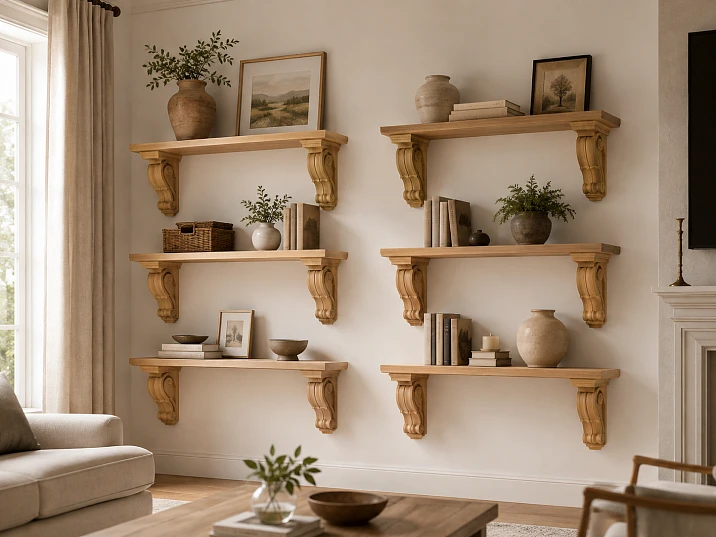
For six identical shelves KR-006, you need to order not as separate items of "two brackets each," but as a single set with one fixed configuration. It records the article number, all three dimensions A × B × C, wood species, sanding quality, gluing grade for future finishing, and the final quantity. If the project provides for two supports per shelf, the purchasing requirement will be 12 items, but this number cannot be taken as a calculation of load-bearing capacity: the quantity and fasteners are confirmed separately for the wall material, shelf dimensions, and actual load.
When you need to buy a shelf bracket in a single copy, an error can sometimes be corrected on site. In a composition of six levels, any inaccuracy repeats: one bracket of a different height shifts the line, oak among beech parts stands out in texture, machine sanding next to hand sanding accepts finishing differently, and mixed-up gluing shows up after applying a transparent coating. Fixing twelve installed supports is more expensive than creating a set passport once.
The main ordering rule is simple: first, one control configuration of KR-006 and the installation project are approved, then it is multiplied by the confirmed number of shelves. The product card helps choose the size, material, and surface preparation, but does not report the allowable load or assign fasteners. Therefore, decorative uniformity and structural reliability are documented in two related but different documents.
After reading, you will be able to choose one of five sizes of KR-006, calculate visual gaps, compile a list for six shelves, not confuse "Standard" with "Prestige," coordinate beech or oak with the future coating, and submit a request to the manager that cannot be interpreted ambiguously.
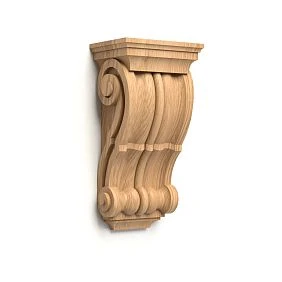
Carved wooden bracket KR-006: what exactly the buyer chooses
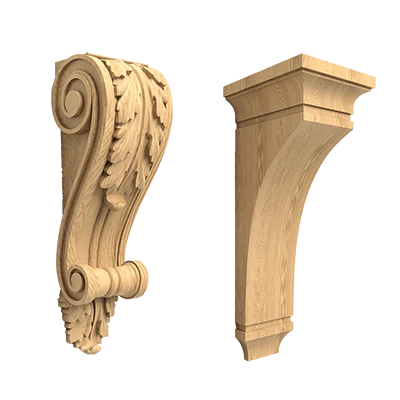
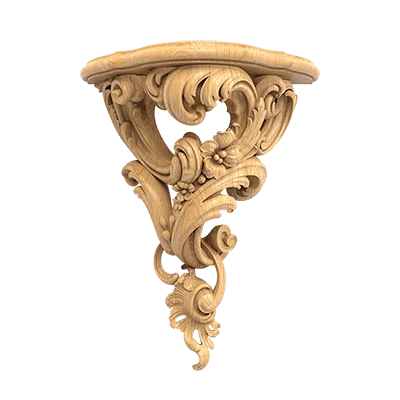
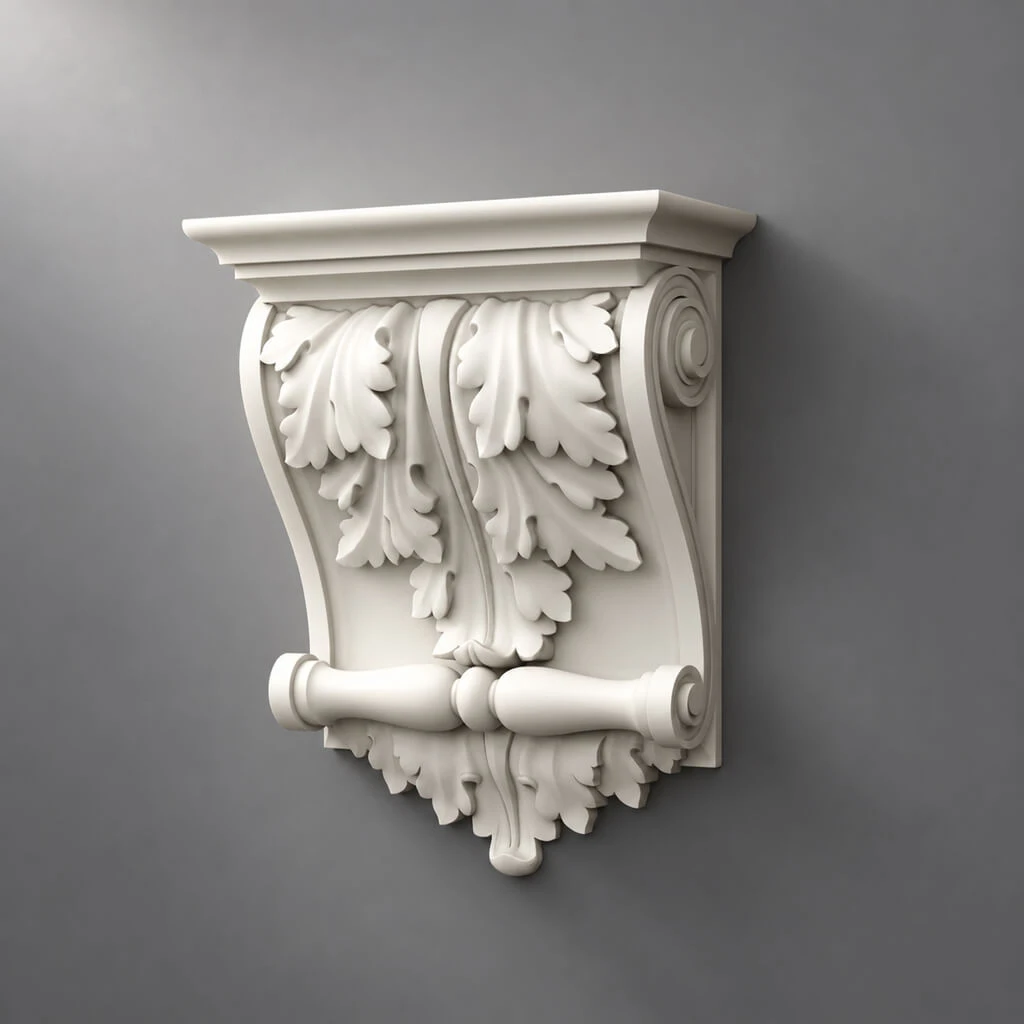
KR-006 is a separate model of a carved wooden bracket. The card presents five sizes, two materials, two sanding qualities, and gluing options for future opaque or semi-transparent finishing. The product is made to order; the average production time is stated as 5–10 days. The time for a specific set is confirmed before payment.
| Parameter | Confirmed options | What to record for six shelves |
|---|---|---|
| Article number | KR‑006 | The same article number in all rows |
| Size A × B × C | 121 × 60 × 43; 141 × 70 × 50; 160 × 80 × 57; 220 × 109 × 78; 262 × 130 × 93 mm | Full set of three numbers, not just height |
| Material | Beech or oak | One wood species for the main set |
| Sanding quality | "Standard" or "Prestige" | One finishing level for all visible parts |
| Regluing quality | Under enamel or under tinting, if available in the selected configuration | Choose by the type of future coating and confirm in the order |
| Production | Made to order, average time 5–10 days | Order the set before final marking and wall finishing |
In the catalog, A denotes height, B — width, C — depth. These axes have different practical significance. Height determines how much space the carved silhouette will take up under the shelf. Width shows the size of the visible support along the wall. Depth sets how far the bracket extends from the vertical plane. The entry "KR‑006, 160 mm" is insufficient: the manager and installer need a line 160 × 80 × 57 mm.
Before buy wooden bracket KR‑006, in the card, the availability of the selected combination of size, material, sanding, and re-gluing is re-checked. The same article number does not mean a single product item: the model has several configurations.
What the card does not confirm
The KR‑006 page does not have a table of permissible loads, installation spacing, maximum shelf length, or a list of fasteners for concrete, brick, aerated concrete, wood, or a frame partition. It also does not specify a universal scheme of "two brackets per shelf." Consequently, the article cannot promise that the selected pair will withstand a certain weight.
Under the order "12 identical brackets," a product task is solved. To get safe shelves, you additionally need a base design, wall fastening, connection to the shelf, and calculation of the expected load. If the load-bearing function is taken by a hidden metal unit, KR‑006 can work primarily as a decorative visible part; if the load is transferred through the wooden bracket, the structure is confirmed by the designer or installation manufacturer.
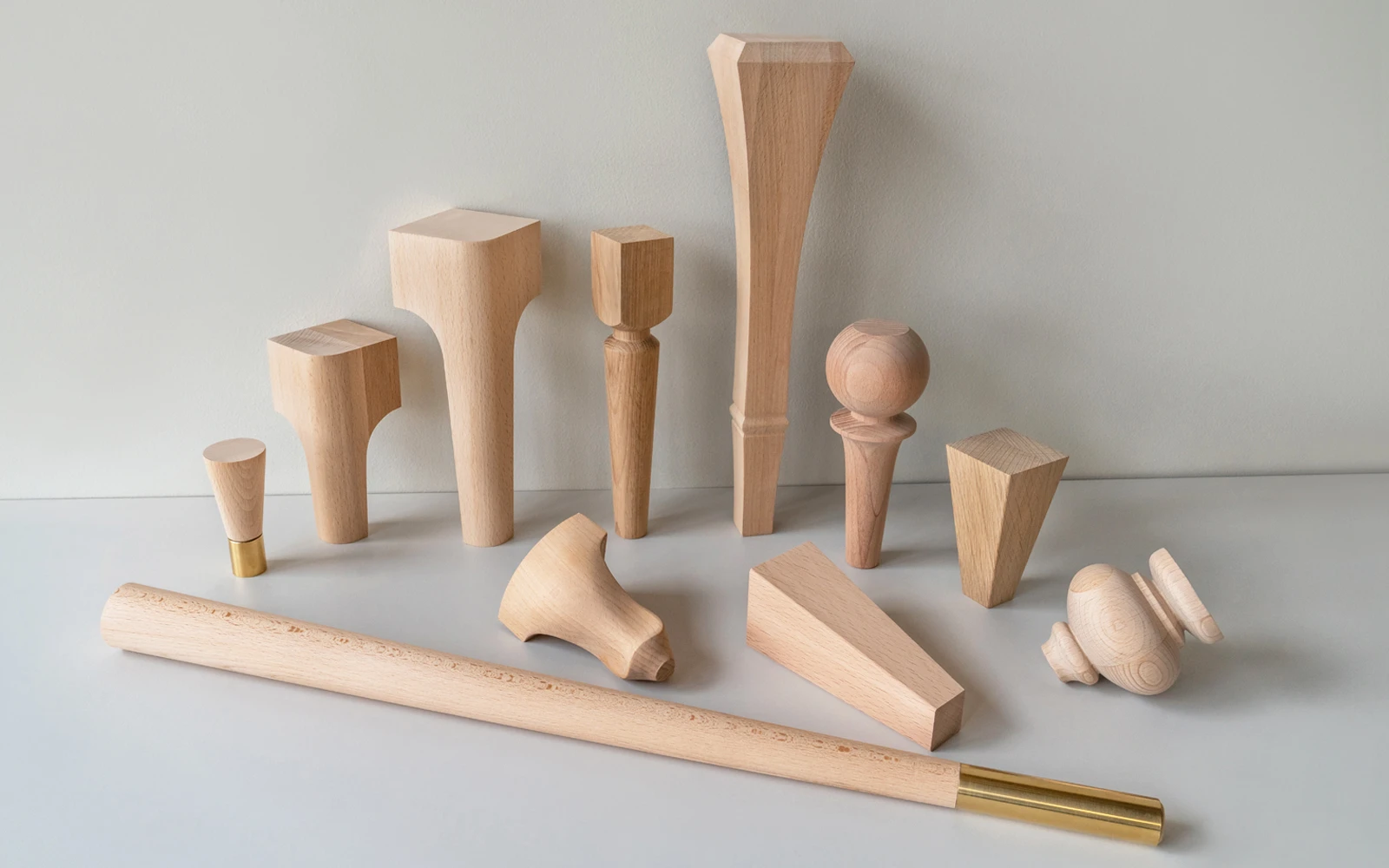
Our factory also produces:


Why price should not be the only identifier
The cost changes with size, material, and sanding quality. In a request, you cannot write "the option that currently costs such and such": the price will update, and the description will become unclear. A reliable identifier is the article number plus the full configuration. The current price is checked in the card before placing the order.
Get Consultation
Why six shelves should be considered one system, not six purchases
A set of repeating shelves is perceived as a grid. The eye compares horizontals, distances between supports, thread scale, and wood shade simultaneously. A deviation that is unnoticeable on a single shelf becomes obvious next to five reference repeats.
The system includes more than 12 visible parts. It includes the shelves themselves, brackets, hidden or exposed fasteners, marks on the wall, finish coating, gaps to adjacent furniture, and items that will be placed on top. If at least one layer is designed separately, symmetry may hold on the sketch but disappear after installation.
Four types of sameness
Commercial sameness means one article number, standard size, material, sanding, and re-gluing. It is verified by order and labeling.
Visual sameness requires a consistent wood grain pattern, finish shade, part orientation, and surface quality. Natural oak or beech does not become graphically identical, but the entire set must be perceived as one batch.
Geometric sameness refers to shelf heights, bracket offsets, distances between levels, and position relative to the common axis of the composition. It is created by layout marking, not by the product card.
Structural sameness means repeating the calculated mounting assembly only where the wall base is truly identical. If half of the shelves land on concrete and half on the cladding of a hidden niche, outwardly identical fasteners may have different internal construction.
Set passport
For the project, it is convenient to introduce an internal designation, for example:
SET-KR006-160×80×57-OAK-PRESTIGE-TINT-12.
Such a code does not replace the official name and is not transmitted as the sole order text. It helps link the drawing, finishing schedule, packaging labels, and installation diagram. The decoding should be nearby:
-
model KR-006;
-
size 160 × 80 × 57 mm;
-
material — oak;
-
sanding — "Prestige";
-
gluing — for tinting;
-
quantity — 12 pieces;
-
finish — per separate finishing card;
-
fasteners — per separate installation project.
If at least one parameter changes after approval, the set receives a new revision. This protects against a situation where a designer replaced oak with beech in the visualization, but the procurement table remained unchanged.
Why it is better to order the entire set at once
Ordering at the same time reduces the risk of mixing different configurations and simplifies batch control. If you first purchase eight items, and then four more a month later, you will need to confirm each option again. For transparent finishes, overall sorting by tone and grain is also important: natural wood still varies, but a single simultaneous acceptance allows you to consciously arrange parts on shelves.
An order "with a reserve" should not be automatic. An additional bracket is useful if complex delivery or finishing makes a repeat purchase expensive, but the reserve increases the budget and requires storage. The decision is made after assessing the risk of damage, the possibility of buying the same configuration, and the acceptability of a natural difference in a new batch.
Five sizes of KR-006: how to keep one ornament and choose the right scale
All five variants retain the common pattern of KR-006 but change the visual mass. The smallest one occupies a height of 121 mm under the shelf and extends 43 mm from the wall; the largest has a height of 262 mm and a depth of 93 mm. The difference along each axis is more than twofold, so the same article can look either like a thin repeating accent or a large architectural console.
| Size A × B × C, mm | B / A | C / A | Visual reading in a series of six shelves |
| 121 × 60 × 43 | 0,496 | 0,355 | The most compact rhythm, more free wall around the carving |
| 141 × 70 × 50 | 0,496 | 0,355 | A slight increase without changing the silhouette proportions |
| 160 × 80 × 57 | 0,500 | 0,356 | Medium scale, well readable at close range |
| 220 × 109 × 78 | 0,495 | 0,355 | A large visible support requiring a larger inter-shelf interval |
| 262 × 130 × 93 | 0,496 | 0,355 | Maximum architectural volume of the model |
The ratios show an important feature: the variants are almost proportional. The width is approximately half the height, and the depth is about 35.5% of the height. This allows you to change the scale without getting a silhouette of a different character. However, the proportionality of the bracket does not guarantee the proportionality of the entire shelf: its depth, thickness, and length must be checked separately.
Free height between levels
Let P — the vertical step between the top surfaces of two adjacent shelves, T — shelf thickness, A — height of KR‑006. Provided that the bracket starts directly under the top shelf, the approximate free zone to the next shelf is:
F = P − T − A.
For example, with a step of 340 mm and a shelf thickness of 30 mm, for size 160 × 80 × 57 there will remain 340 − 30 − 160 = 150 mm. For KR‑006 with a height of 220 mm with the same grid, only 90 mm will remain. This is not an indicator of strength and not a mandatory gap, but a visual and installation check: whether the thread will fit, whether it is convenient to finish it, and whether the composition looks cramped.
If F close to zero or becomes negative, the bracket crosses the zone of the next level. You need to increase the shelf step, choose a smaller size, or change the grid. You cannot compress the carved part in the image without replacing the real standard size.
Shelf depth and bracket depth
Let D — shelf depth, C — depth of KR‑006 from the wall. When aligning the rear planes, the visual front remainder equals D − C. For a shelf with a depth of 220 mm and a bracket of 160 × 80 × 57, it will be 163 mm; with a size of 262 × 130 × 93 — 127 mm.
These figures do not prove which option bears the load. They show the side silhouette: how far the front edge of the shelf protrudes relative to the visible wooden element. Structural support may be supplemented by a hidden metal part or another system. You cannot choose the size based only on the maximum depth of KR‑006.
Full-size template instead of on-screen decision
The photo of the card does not convey scale. Before ordering twelve items, print the side contour of the selected size at 1:1 scale or cut out a rectangular dimension A × C from cardboard. Place it under the actual shelf or against the wall and assess the distance from the floor, adjacent levels, door trim, and furniture.
For the final choice, not only a rectangle is needed. If a drawing of the product is available, prepare a silhouette from it and mark the width B on the front view. Then you can see how two supports fill the shelf length and how many relief details will appear on the entire wall: with 12 brackets, even a compact model creates a strong ornamental rhythm.
How to match KR‑006 with the length, depth, and thickness of the shelf
The shelf size is measured after approving the material and edge. A nominal 200 mm board and a finished shelf with a profiled front edge may have different visible dimensions. In the list, record the length along the wall, actual depth, thickness, weight of the empty shelf, and intended contents.
Length determines the placement pattern, but not the final quantity
For two visible brackets on one shelf, the designer assigns left and right indents. If the shelf length L, and the indent from the end to the support axis is the same E, the distance between the axes is:
S = L − 2E.
On a shelf 900 mm long with an indent of 140 mm, the axes will be 620 mm apart. This is the geometry of the composition, not a mounting standard. The designer must confirm whether two supports are sufficient, whether such a span is acceptable for the shelf material, and where reliable wall sections are located.
If a third support is required, it cannot be automatically placed exactly in the middle. The central point may fall on hidden wiring, a cladding seam, or a void. First, check the base, then align the external rhythm without losing the load-bearing logic.
Shelf thickness affects visual balance
A thin shelf above a large KR‑006 may look like a random line, while a massive one above the smallest may look heavy. The card does not specify a universal proportion. A practical method is to make two paper templates: the bracket profile and the rectangle of the actual shelf. They are viewed from the distance from which the entire wall will be seen.
The bottom bevel is also taken into account. If the front edge drops below the main plane, it may partially cover the top of the carved element. If the shelf has a hidden metal frame, it is necessary to check whether it conflicts with the bracket platform.
Six shelves can be identical on the outside and different on the inside
In one composition, lower levels are sometimes intended for books, upper ones for light decor. Externally, all 12 KR‑006 can remain the same configuration, while hidden fasteners and shelf reinforcement differ. This is a normal solution: the visual system is preserved, the structural one is adapted to the load.
It is wrong to do the opposite — changing the size of KR-006 just because a greater weight is expected on one shelf, if there is no confirmed load table for the model. A larger wooden element visually seems stronger, but such an impression does not replace the calculation of the wall assembly.
How to calculate the number of wooden brackets without under-supply
The number "six shelves" is not yet equal to the product quantity. First, the designer assigns supports for each level. Only after that is the procurement calculation performed. If two visible KR-006 parts per shelf are approved, the base requirement is indeed:
6 shelves × 2 brackets = 12 KR-006.
This formula counts items, not load-bearing capacity. If one long shelf requires three points, the set becomes heterogeneous in quantity, although the bracket configuration may remain uniform. If the load-bearing function is fully performed by hidden supports, the number of KR-006 is determined by the decorative rhythm and the installation scheme.
Shelf list
| Shelf | Length × depth × thickness | Visible KR-006 | Configuration | Hidden reinforcement | Wall base | Status |
| P‑01 | According to the drawing | After calculation | One per set | As per project | Check | Not approved / approved |
| P‑02 | According to the drawing | After calculation | One per set | As per project | Check | Not approved / approved |
| P‑03 | According to the drawing | After calculation | One per set | As per project | Check | Not approved / approved |
| P‑04 | According to the drawing | After calculation | One per set | As per project | Check | Not approved / approved |
| P‑05 | According to the drawing | After calculation | One per set | As per project | Check | Not approved / approved |
| P‑06 | According to the drawing | After calculation | One per set | As per project | Check | Not approved / approved |
The "configuration" column should not be filled with words like "as in the first row" without explanation. It is better to use a single kit code and place its full description above the table. If the file is printed separately, all parameters will remain clear.
Is one spare bracket needed
For 12 installation positions, three solutions are possible:
| Approach | Order | When justified | Limitation |
| Without reserve | 12 | Simple delivery, finishing done neatly, repeat order possible | If damaged, you will need to wait for a new part |
| One reserve | 13 | Complex tinting, long-distance delivery, intensive installation | The additional element must be stored properly |
| Spare pair | 14 | Paired replacement on the same shelf and the natural wood tone are important | Maximum surcharge and balance after the project |
The reserve does not cancel acceptance. An item damaged during delivery is handled as a supply issue, not silently replaced with a spare. Additional parts are needed for future repairs or installation risk, not to compensate for shortages.
If the set is tinted with a translucent compound, it is better to finish the spare simultaneously with the main items. Untreated oak, painted years later with a different batch of material, may differ more noticeably. The finished reserve is marked, packed without contact of face surfaces, and stored in conditions suitable for wood.
Fasteners and consumables are counted separately
The number of brackets cannot be used as a ready-made formula for screws, anchors, or glue. Card KR-006 does not set the number of attachment points and does not include a universal set. The installation list is compiled according to the drawing of a specific assembly:
-
fastening the bracket to the wall;
-
attaching the shelf to the bracket, if provided;
-
hidden supports or plates;
-
spacer elements;
-
plugs or decorative covering of fasteners;
-
materials for marking and surface protection.
Glue from the "buy with this product" block does not become a sufficient mounting method for a loaded shelf. Its application area and compatibility are checked separately. For a load-bearing assembly, a mechanical or other calculated connection is required.
"Standard" or "Prestige": how to choose one sanding level for a set
The official card defines "Standard" as machine sanding with a more affordable price. "Prestige" is detailed manual sanding; the product does not require finishing. This is exactly the quality of surface preparation, not applied enamel, stain, oil, or varnish.
For twelve repeating parts, mixing levels is undesirable. Side light passes across all supports and reveals different surface characteristics. If some brackets require manual finishing on site, the craftsman may alter the sharpness of threads and edge rounding unevenly.
When to choose "Standard"
"Standard" is rational when the project has its own finishing workshop and the technologist has included additional preparation in the process in advance. All 12 or 13 items are processed by one team, with the same sequence of abrasives and under common control. Savings on factory sanding make sense only after accounting for the workshop's working time.
One cannot expect that a painter will automatically fix the carved surface along with applying primer. Excessive manual sanding can smooth out a fine pattern, while insufficient sanding may show through after covering enamel. Before ordering, it is useful to obtain one control part or agree on a quality sample.
When to choose "Prestige"
"Prestige" is suitable if the carving will be visible up close, the object is lit from the side, a translucent coating reveals the surface, or there is no specialist in finishing carved wood on site. For a set, this reduces the amount of heterogeneous manual work after delivery.
The phrase "does not require refinement" refers to the quality of sanding, but does not cancel the finishing coating technology. Before enamel or tinting, the operations specified by the finishing material manufacturer are still performed: dust removal, priming, interlayer treatment, and application of the finish according to the chosen system.
How to compare the total cost
They compare not the price of one part, but two routes:
12 × price of "Standard" + manual finishing of 12 items + quality control
и
12 × price of "Prestige" + standard preparation for coating.
The calculation includes a sample piece, labor in carved recesses, re-checking, and the risk of inconsistent results. If the workshop charges a fixed price for each support, the difference quickly multiplies by 12. Current prices for a specific configuration are taken from the product card and commercial offer, not from an old article.
Beech or oak: how to maintain a single material on all six shelves
Beech and oak are available in the product card, but they behave differently visually. Beech has a dense, non-porous structure and is often used under opaque enamel. Oak is characterized by pronounced porosity and a natural grain pattern that is valued under translucent finishes. This is not a strict rule "one material can be painted, another cannot," but rather a logic of choice based on the desired result.
Beech for opaque color
If 12 brackets are to become white, graphite, green, or match the furniture color under an opaque coating system, beech allows focusing attention on the shape of the carving. In the request, gluing under enamel is usually chosen, but the availability of a specific combination is confirmed in the product card.
Under an opaque coating, the material does not disappear structurally: its properties are taken into account by the technologist. However, the color pattern of the lamellas is not the goal, so overpaying for wood selection by tone for a transparent finish may be irrational.
Oak for translucent finish
If you need to see pores, fibers, and natural variations, oak and gluing under tinting are chosen. The lamellas in such a blank are selected by color and texture, but the official description allows tonal and textural differences. Ordering 12 items in one line does not turn natural wood into an identical printed pattern.
Before finishing, the brackets are laid out as a whole batch and distributed across shelves. Calmer pairs can be placed in the center of the composition, contrasting ones on the outer levels or in less noticeable areas. The decision is made under daylight and artificial lighting, not relying on photos of the packaging.
Why you cannot mix oak and beech under the same stain
The same shade name does not guarantee the same result on different wood species. Porosity and natural color affect absorption and light reflection. After staining, oak will remain more textured, while beech may look smoother. In a repeating grid, the discrepancy will be read as a configuration error.
If the interior requires combining two wood species, it should be a deliberate system: for example, all brackets made of oak, shelves made of beech under opaque enamel. Random alternation of materials within 12 KR‑006 destroys the concept of a single set.
Under enamel or under tinting: this is a grade of gluing, not a finished coating
This line most often causes confusion. "Under enamel" does not mean that KR‑006 is already painted with enamel. "Under tinting" does not mean that stain has been applied to it. The card describes the quality of the gluing of the wooden blank.
For the under-enamel option, lamellas are glued without selection by color and texture; contrasting tonal and textural differences are allowed because the surface is intended to be covered with an opaque material. For the under-tinting option, lamellas are selected by color and texture, although natural variations are still possible. This option is intended for semi-transparent finishing.
| Desired outcome | Preferred order line | What else is required after delivery |
| Opaque enamel | For enamel | Primer and enamel system, color and gloss level chart |
| Stain and clear varnish | For tinting | Sample coating, approved layer sequence |
| Oil with visible texture | For tinting | Absorption and finish test on the same wood species |
| Complex decorative effect | Confirm with technologist | Full sample, because the effect name is not sufficient |
One control sample for the entire set
Before painting twelve items, the technician performs a control test coating on a compatible sample or spare bracket. The color, gloss, degree of pore visibility, and appearance of recesses and edges are approved. A flat board does not always reproduce the coating behavior on deep threads: the compound accumulates in grooves and changes contrast.
The sample is labeled: wood species, sanding, re-gluing, primer, dye, varnish, number of layers, date. The phrase "walnut like on the door" does not give the workshop a reproducible instruction. A physical reference or an accurate material map is needed.
When the finish cannot be split into two batches
If six shelves are on the same wall, it is better to coat all KR‑006 in one cycle. Different enamel mixes, stain holding times, and varnish thickness can produce a noticeable difference. The spare part is also processed together with the main ones, otherwise it will not be a ready replacement.
If the work is inevitably split, the reference, recipe, and process log are kept. Before the second batch, a test is performed and compared under the same lighting where the set will be installed.
How to accept twelve KR‑006 as one batch
Acceptance of the set is carried out before painting and installation. After coating is applied, it is harder to distinguish a manufacturing defect from a finisher's error, and after drilling, returns or replacements become more problematic.
Recount and configuration verification
Each product is checked against the list: KR‑006, full size A × B × C, wood species, "Standard" or "Prestige", re-gluing, quantity. Parts of different sizes cannot be stacked in one pile based on visual similarity. The difference between 141 and 160 mm is noticeable, but in packaging without a ruler it can be missed.
For control, a simple template of the maximum dimension is made or a measuring tool is used. The size is checked along the same axes specified in the card: A — height, B — width, C — depth.
Pairing layout
Twelve brackets are laid out as six future pairs. The overall silhouette, surface, and grain direction are assessed. For oak under a transparent finish, pairing is especially useful: two adjacent supports of one shelf are perceived simultaneously.
It is impossible to promise an identical pattern of natural wood. The goal of acceptance is to detect the wrong wood species, a different configuration, damage, a strong mismatch with the selected sample, or an accidentally included size. Natural differences within a confirmed grade are evaluated before finishing together with the designer.
Photo documentation and marking
After layout, each pair is assigned P‑01…P‑06, and parts are marked L and R as mounting positions, if such designation is needed for the project. These are internal labels, not a statement that KR‑006 is produced as separate left and right articles. Marking is applied in a way that does not damage the face surface and does not show through the coating.
The entire set, each pair, and detected features are photographed. A layout map is given to the finisher. After processing, parts return to their positions; accidental rearrangement can disrupt the pre-assembled wood grain pattern.
What to check on the surface
Look for transport damage, thread chips, deep scratches, dents, traces of contamination, and differences in sanding quality. "Standard" should not be evaluated by "Prestige" criteria, but the entire batch must match the ordered level. A questionable area is photographed and approved before independent refinement.
Load and fastening: why the same KR-006 configuration does not replace calculation
The card confirms the dimensions and variants of KR-006, but does not indicate how many kilograms one bracket can support. You cannot transfer information about furniture legs from the general FAQ to it: this is a different type of product and a different load scheme. You cannot derive load capacity from wood species, price, height, or visual massiveness.
The shelf works as a system: the horizontal panel, visible brackets, the connection between them, the wall fastening, and the base itself. Failure can occur not in the carved wood, but in the anchor, weak plaster, shelf edge, or hidden void in the partition. Therefore, the question of "how many KR-006 to buy" is separated from the question of "how to secure six shelves."
What loads to describe to the designer
For each level, a list of expected contents is compiled. What is needed is not a phrase like "light decor," but a realistic scenario: books in two rows, dishes, a collection, electronics, plants with wet soil, children's items. The shelf's own weight, the weight of items, possible redistribution, and accidental impact during cleaning are taken into account.
You should not plan to use the shelf as a step, seat, or handrail if it was not designed for that. In a home with children, the operational scenario is discussed separately: an accessible lower shelf may receive loads that are not present in the designer's visualization.
The following is passed to the designer:
-
material, length, depth, and thickness of each shelf;
-
estimated weight of contents;
-
number and position of visible KR-006;
-
type and condition of the wall;
-
thickness of finishing layers;
-
presence of hidden studs, embedded elements, or voids;
-
desired method to conceal fasteners;
-
permissibility of additional metal supports;
-
requirements for dismantling.
The wall base matters more than the anchor name
Concrete, solid brick, hollow block, aerated concrete, timber, and framed partitions require different solutions. Even within a single wall, there may be joints, niches, and utilities. Fasteners are selected after inspection, not based on image KR-006.
A layer of plaster or slat panel is not considered a load-bearing base without verification. If there is soft finishing between a wooden bracket and the load-bearing wall, a spacer element may be required to transfer force without crushing. Layout is checked against electrical wiring and pipes before drilling.
Visible decor and hidden load-bearing system
If the calculation does not allow transferring the full load through KR-006, this is not necessarily a reason to abandon the model. A combined scheme is possible: a hidden metal bracket or an internal frame carries the shelf, while carved wooden elements form the external rhythm. Then the fasteners of both systems are designed so that the parts do not conflict.
This approach is especially useful for deep shelves, heavy books, and weak bases. It honestly separates functions: KR-006 remains a decorative item of confirmed configuration, while the load is taken by a calculated system. Externally, six shelves maintain a unified interior.
Material about carved wooden brackets for open shelves helps compare general decorative scenarios. This article answers a different question: how to replicate a specific KR-006 twelve or more times without discrepancies in the order.
Why glue does not replace fasteners
Glue may be part of the installation technology for a decorative element, but the card does not assign it as the only load-bearing method for the shelf. Adhesion depends on the base, preparation, contact area, and operating conditions. A loaded cantilever unit requires a specialist's solution. You cannot glue KR-006 to wallpaper or painted plaster and consider the shelf calculated.
If the fastening must be invisible, this is solved by design: hidden holes, plugs, a mounting plate, or covering with the shelf. Masking should not interfere with inspection and tightening of connections.
How to mark six shelves and maintain a repeating rhythm
Marking begins with the overall composition, not the first shelf. If you install the lower level and then "raise the rest with equal spacing," an error will accumulate. First, transfer the base horizontal line, the extreme boundaries of the entire group, and the axes of each KR-006 to the wall, then check the grid with a laser or other suitable measuring tool.
One vertical column of six shelves
In a narrow niche, six shelves are arranged one above the other. The main parameter is the vertical pitch. P. With identical shelves, all top surfaces must lie on a sequence of marks:
Hₙ = H₁ + (n − 1) × P— distances from the selected base to the same point on the left and right pilaster. The project goal is to make n — level number from 1 to 6.
For example, with the first shelf at mark 500 mm and a pitch of 320 mm, the next levels receive marks 820, 1140, 1460, 1780, and 2100 mm. This is only an example of marking, not a height recommendation. Before approval, check the accessibility of the upper shelves and the free zone under the brackets using the formula F = P − T − A.
A slight deviation of the first mark should not be carried over to all levels. Each height is measured from a common base or a verified laser level, not from the previous shelf.
Two columns of three shelves
For a symmetrical composition, set the central axis of the wall, the width of each shelf L and the gap between the columns G. The total width of the group is 2L + G. The left and right halves are marked mirror-symmetrically relative to the center, but the mounting points are adjusted after inspecting the base.
If the central gap must align with a molding, painting, or furniture, first fix the architectural axis, then the position of the shelves. An error in G is more noticeable than a slight change in the outer margins.
Three columns of two shelves each
With three identical shelves in a row, the total width equals 3L + 2G. Not only is KR‑006 repeated, but also the vertical pair under each shelf. On a long wall, it is important to check the total size: an error of 3 mm in one width or gap can repeat several times.
Marking is done using a common coordinate grid. First, set the axes of the six shelves, then the axes of the brackets within each. This prevents local corrections when one pair is shifted for the sake of a wall seam and disrupts the entire row.
Asymmetric composition with identical KR‑006
Six shelves do not necessarily form a strict matrix. They can have different lengths and be arranged in a stepped manner, while maintaining identical supports. In such a case, unity is created by a single KR‑006 configuration and a repeatable offset from the end, rather than a common axis for all shelves.
Asymmetry requires a more precise drawing. An "artistic" shift made by an installer by eye easily turns into randomness. Each coordinate is specified by a dimension from a common base.
Mounting template for repeated brackets
For one approved configuration, a rigid template is made that shows the contour of KR-006, the axis, the shelf position, and the fasteners
The baseboard defines the lower horizontal line
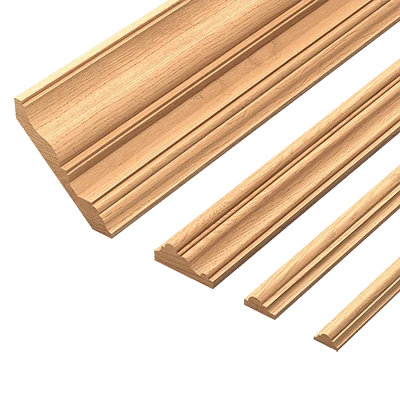
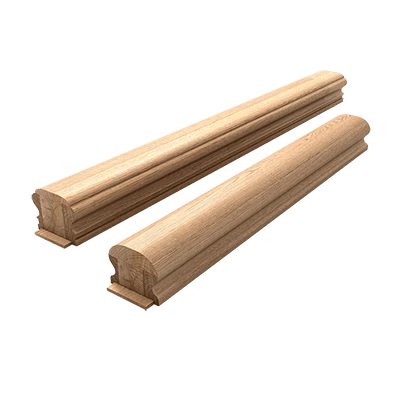
The lower shelf is perceived together with the floor finish of the wall. When deciding to buy wooden baseboard compare the height and shade of the lower line with KR-006. Matching wood species helps but does not guarantee identical color: the profile and carving reflect light differently, and wood batches vary.
The baseboard is not used as a base for marking if the floor is uneven. Shelves are aligned to a common horizontal line, and the visible gap to the baseboard is checked at several points. Sometimes it is better to raise the lower level slightly higher than to follow the wave of the floor.
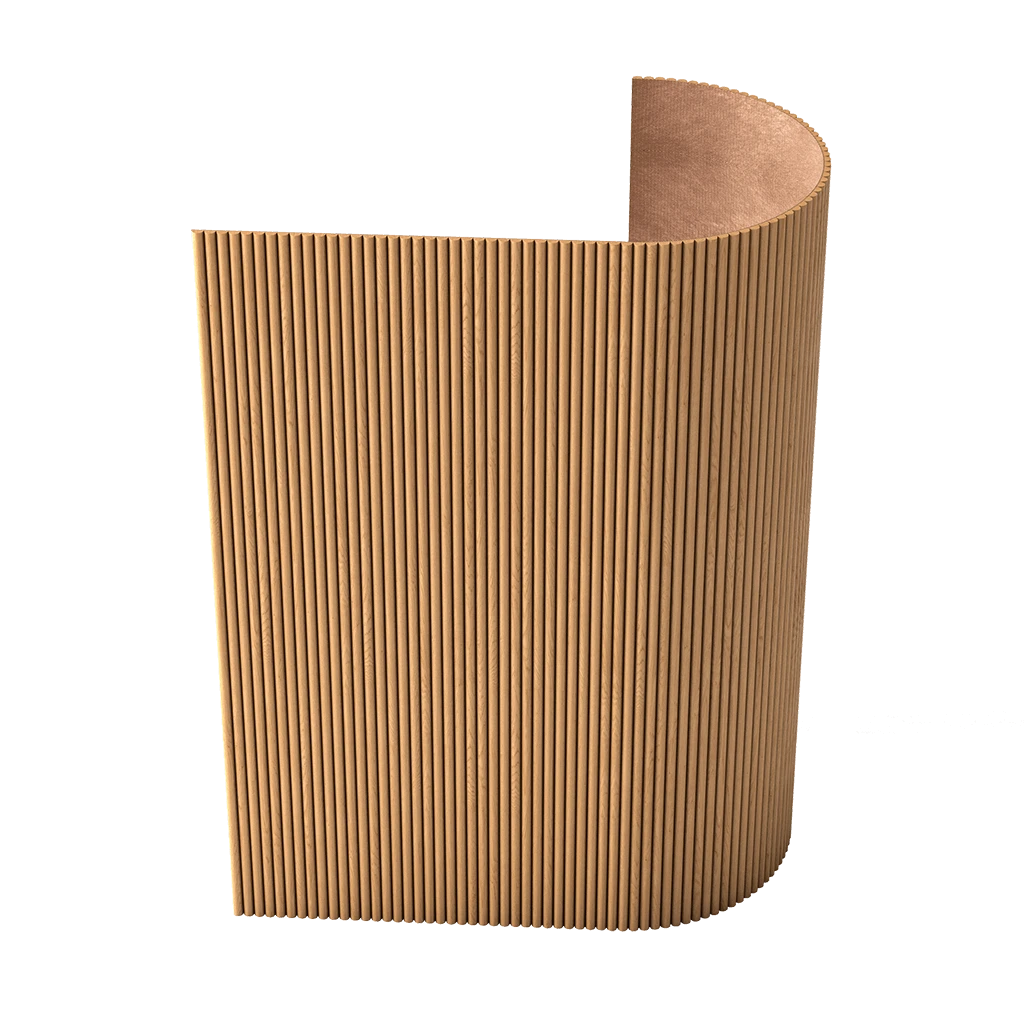
Slat panel as an active background
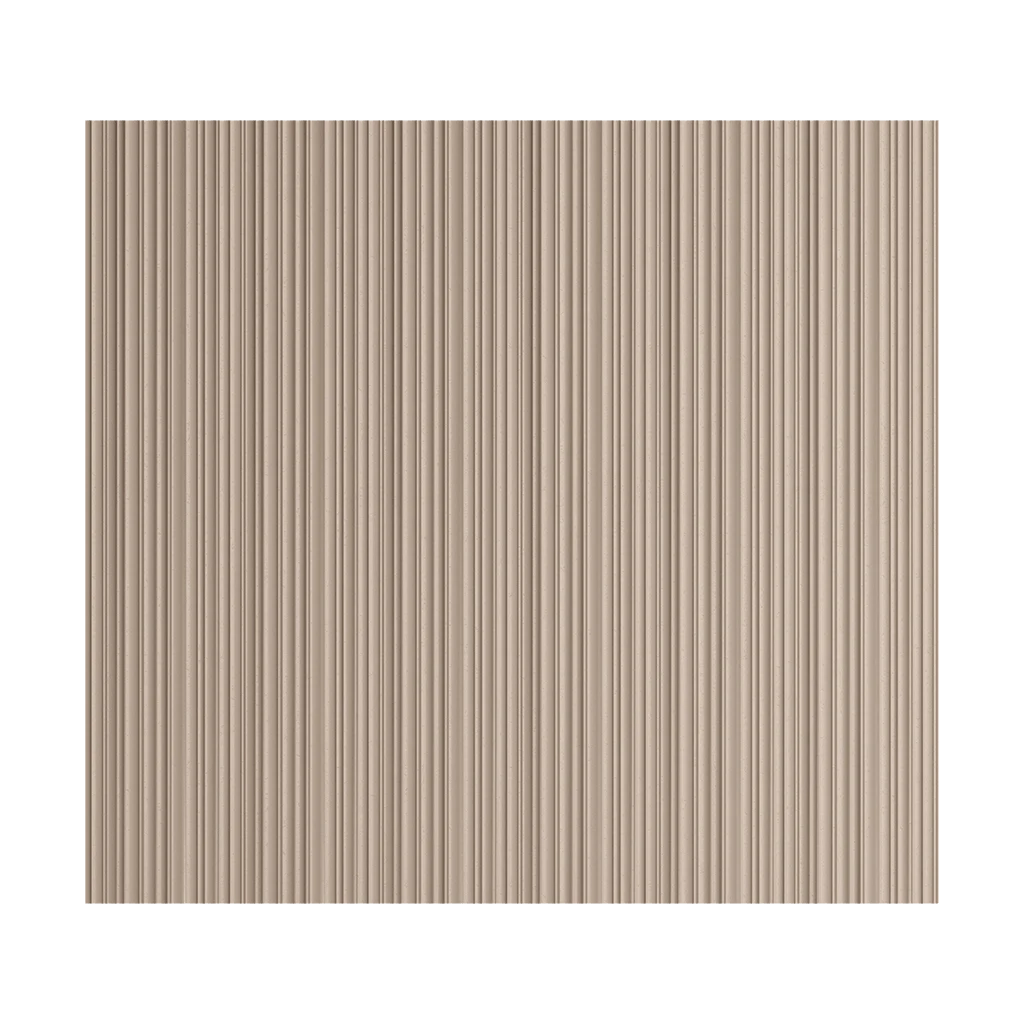
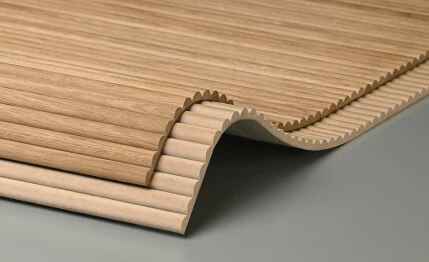
Slats create their own frequent rhythm. Twelve KR-006 add a large carved pattern. For compatibility, a calm interval is needed: the bracket should not accidentally land with one half on the top of a slat and the other in the groove. The fastening goes through to the structural base, and the decorative panel is not considered a wall capable of holding the shelf.
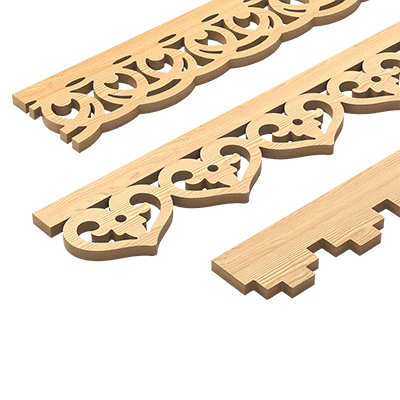
If the background is still being chosen, the section buy slat panels for walls for interior finishing helps compare models. In a finished project, first obtain a sample of the panel, assemble a fragment with the shelf and KR-006, and only then repeat the solution on the entire wall.
When a different bracket is needed instead of KR-006
If the scale doesn't fit, you shouldn't change the shelf size just for the article number. In the section buy wooden bracket for shelf you can compare models by A, B, and C. First, look for suitable geometry and ornament character, then re-check the uniqueness of the configuration for the entire set.
The general selection algorithm is described in the article how to choose a wooden bracket for a shelf and furniture. The KR-006 scenario is already at the next stage: the model is chosen, the task is to order several repeats without discrepancies.
The comparison with a technical angle bracket is discussed separately in the material carved bracket instead of a regular angle bracket. Here, metal reinforcement is not opposed to decor: it can be hidden if required by calculations, keeping KR-006 as a visible part of the composition.
Practical ordering scenarios for KR-006 for six shelves
Six identical bookshelves. Externally, 12 identical KR-006 units are required, but the weight of the books is high and may be distributed unevenly. First, the hidden or open load-bearing system is calculated, then the decorative set is approved. If a third support is needed, it is decided whether it will also be KR-006 or remain hidden to avoid breaking the rhythm.
Two columns of shelves in the living room. The main mistake is ordering the left column before the right one. Even with the same article number, a different size or sanding finish may be selected. A single set is arranged, pairs are laid out, and numbered P-01...P-06 before finishing.
Painted shelves matching the wall color. Beech, "Prestige", and re-lamination under enamel can be a logical configuration if it is available and approved by the technologist. The final color is not automatically included in this line: the coating system is recorded separately, and a color sample is made on a carved specimen.
Oak shelves with visible texture. For KR-006, oak and a tinting option are selected, and the entire batch is sorted by tone before applying stain. Shelves and brackets are best painted in one cycle or a precise reference must be maintained.
Six shelves of different lengths. The KR-006 configuration may remain uniform, but the number of supports and hidden reinforcement are calculated for each line. You cannot simply multiply two parts by six if one shelf is twice as long as the others.
Shelves on two different types of walls. One section is concrete, the other is a framed partition with embedded anchors. The visible brackets are identical, but the internal fasteners differ. The installation sheet links each position to a specific base.
Shelves in a niche. Dimension A is checked against the free height, C against the depth of the niche and shelf, and B against the visible width. If a large KR-006 touches the side wall or the next level, a smaller size is chosen rather than cutting the finished carving.
Composition near a doorway. The outermost bracket must not conflict with the trim, switch, or opening door leaf. A full-size template reveals the conflict before ordering. If it cannot be resolved by a symmetrical shift of the entire group, the shelf lengths are reconsidered.
Serial project for multiple rooms. One configuration passport is repeated across rooms, but each wall is assigned its own installation map. Before purchasing the entire batch, a control assembly is built, the finish is approved, and only then is the order scaled.
Timeline 5–10 days: when to place an order and how to build a project calendar
The card indicates the average production time for KR‑006 to order — 5–10 days. This period cannot be considered the full completion time of the finished wall. After manufacturing, delivery, acceptance, possible painting, coating application, drying, and installation remain. Before production, the configuration selection and wall inspection must be completed.
Reverse planning from the installation date
The calendar is built backward from the desired installation date:
-
Installation and inspection of six shelves.
-
Full completion of the finish coating according to its manufacturer's instructions.
-
Painting or tinting of the entire batch and spare parts.
-
Acceptance, pairing, and surface approval.
-
Delivery of the set.
-
Production of KR‑006 within the confirmed timeframe.
-
Design and payment of the specification.
-
Approval of the sample, material, sanding, and re-gluing.
-
Wall inspection and issuance of the mounting diagram.
If painting is scheduled for the day after the expected delivery, any production delay will disrupt the entire schedule. A time buffer is needed for inspection and resolving issues before irreversible finishing.
Why the wall is not fully marked out before acceptance
Project axes can be marked in advance, but final holes are better drilled according to the accepted part and approved template. The nominal dimension defines the composition, but the mounting project must account for the actual bracket footprint and chosen fasteners. In case of a configuration error, pre-drilled holes complicate correction.
One order, one revision, one confirmation
Before payment, the manager is sent the table and asked to return confirmation with the same parameters. Receiving a message like "12 brackets KR-006 accepted" is not sufficient. The confirmation must include the full size, wood species, sanding, and re-gluing. If there is a reserve, it applies to the same configuration.
Changes after confirmation are recorded as a new revision. A verbal request like "let's go with oak after all" easily gets lost between the invoice, production, and the finisher. The final file has a date and version number.
When KR-006 is not suitable for a composition of six shelves
A single article number does not need to be preserved at any cost. KR‑006 should be replaced or used only decoratively if its geometry, ornament, or mounting logic does not meet the project.
The free height is less than dimension A
With a frequent vertical pitch, large variants of 220 or 262 mm can visually and physically intersect with the next level. Reducing the shelf does not solve the lack of space beneath it. Choose a smaller KR‑006, increase the pitch, or reduce the number of levels.
Depth C does not match the desired silhouette
The largest KR‑006 extends 93 mm from the wall. For a deep shelf, this can leave a large visible front overhang. If the designer wanted a support that almost reaches the edge, the model does not fulfill the intent. This cannot be called a structural flaw without calculation, but the visual mismatch is already enough to choose a different product.
There is too much ornament
Twelve carved elements against a background of active wallpaper, slats, or rich molding can overload the wall. A smaller size does not always solve the problem: the pattern repeats anyway. An alternative is to leave KR‑006 on two central shelves and make the other supports hidden, or choose a calmer geometric model.
The wall does not allow creating a reliable mounting point
If there are no embedded elements behind the finish, the base material is unknown, utilities run through, or fasteners hit a weak edge, postpone the purchase. Decorative appeal does not justify mounting on an unverified wall. A self-made frame or a furniture rack that transfers the load to the floor is possible.
A ready-made support with a rated load is needed
For a commercial facility, archive, store, or other controlled operation, the customer may require documented load-bearing capacity of the finished system. If the KR-006 card does not provide such data, a certified design is selected, or a separate unit is designed and tested. KR-006 can be retained as decor, but it should not be attributed a value it does not have.
The project requires an exact mirror ornament
If the designer needs separate left and right parts, it is necessary to check whether the model is available in such a configuration. The card provided in the task describes KR-006 without separate L/R suffixes. One cannot independently promise a mirror pair or flip the carved element against its mounting surfaces.
Errors when ordering and installing multiple KR-006 units
Error 1: Recording only the height. They order "KR-006 160" without specifying 80 × 57 mm. An ambiguous item appears in correspondence. Prevention — always use A × B × C.
Error 2: Ordering shelves one at a time. The first pair is bought in oak "Prestige", the next in beech "Standard". After painting, differences become apparent. Prevention — a single list and one order.
Error 3: Considering "for enamel" as finished paint. The brackets arrive without the expected color. Prevention — separate the veneering and the finish coating map.
Error 4: Considering "for tinting" as already tinted product. The buyer expects a ready shade, although the designation refers to the selection of lamellas. Prevention — order the finish separately and approve a sample.
Error 5: Mixing "Standard" and "Prestige". Different surface preparation gives an uneven appearance under side light. Prevention — one quality line for the entire set.
Error 6: Considering oak and beech identical under stain. Different wood species retain their own texture and perceive translucent finish differently. Prevention — one wood species for 12 visible supports.
Error 7. Multiply two brackets by six without calculation. That gives 12 items, but a long or loaded shelf may require a different scheme. Prevention — first an installation project for each shelf, then the total.
Error 8. Choose the largest size "for reliability." The card has no link between the size type and the allowable load. A large element overflows the inter-shelf space, and the fastening remains unconfirmed. Prevention — choose geometry by composition, decide strength by calculation.
Error 9. Mark each shelf from the previous one. A small deviation accumulates by the sixth level. Prevention — build all marks from a common base and coordinate grid.
Error 10. Fasten through a decorative panel without an embedded insert. The screw holds in the rail or soft backing. The shelf loosens. Prevention — bring the connection to the load-bearing base or use an independent system.
Error 11. Coat parts before laying out in pairs. After tinting, the most contrasting elements end up next to each other. Prevention — distribute natural wood by P‑01…P‑06 before finishing.
Error 12. Not include a reserve in the overall finishing cycle. The spare bracket remains untreated and later does not match in shade. Prevention — finish the reserve together with the batch.
Error 13. Drill all points using an unchecked template. The error of the first marking repeats 12 times. Prevention — assemble and accept one control unit.
Error 14. Glue loaded shelves according to a recommendation from the related products block. Catalog proximity does not confirm the load-bearing scheme. Prevention — use fastening from the project of the specific wall.
Error 15. Start manual refinement before approval. After self-sanding, it is difficult to prove the original condition. Prevention — photo documentation and contacting the seller before intervention.
Error 16. Not check the opening of a door or furniture. The edge shelf and KR‑006 fall into the path of the panel. Prevention — mark movement zones on the general plan and check with a cardboard mockup.
What to send to the manager before ordering KR‑006
The request should be short but comprehensive. It should include a visualization or wall drawing for context, but product parameters should be written in text and a table. The manager should not have to extract dimensions from the drawing.
Ready-made specification form
| Field | What to fill in |
| Product | Carved wooden bracket KR‑006 |
| Size | A × B × C in millimeters |
| Quantity | Confirmed number of main and spare parts |
| Material | Beech or oak |
| Sanding quality | "Standard" or "Prestige" |
| Re-gluing | Under enamel or under tinting, if available |
| Purpose | Single set for six shelves |
| Production | Please confirm the current lead time for the entire quantity |
| Delivery | Address, recipient, project packaging requirements |
| Additional question | Confirm that all invoice items have one configuration |
Example of a correct line: KR‑006, 160 × 80 × 57 mm, oak, «Prestige», for tinting, 12 pcs., single set for six shelves. If a reserve is needed, it is better to write 12 main + 1 reserve, so that the purpose of the thirteenth part is preserved in the documentation.
What not to ask the manager to determine without source data
The question «which fastener to take?» requires the wall material, finishing layers, shelf, and load. These details can be provided to the manager and available technical information requested, but the final decision must be made by the person responsible for the structure. Similarly, one cannot ask to choose the number of brackets based only on a photo of the wall.
What to check in the invoice
Before payment, compare the article number, all dimensions, wood species, sanding, re-gluing, and quantity with the final tally. Check whether the batch is split into different line items with differing parameters. Separately confirm the production time and delivery.
Questions about ordering wooden brackets KR‑006
How many KR‑006 are needed for six shelves?
If the installation project specifies two visible supports, the base quantity is 12. But the product card does not confirm that two pieces are sufficient for any shelf. First, calculate each structure.
Can I order 11 brackets now and one later?
Technically, a repeat order is possible if the configuration is available, but it is harder to match the set by wood and finish. For a symmetrical wall, it is better to place the main quantity at once.
Which size of KR‑006 should I choose for a shelf 250 mm deep?
Shelf depth alone is not enough. You need to check the height between levels, thickness, length, desired overhang C, and visual scale. Strength is determined by a separate project.
What does the size 160 × 80 × 57 mm mean?
A = 160 mm — height, B = 80 mm — width, C = 57 mm — bracket depth.
Will the smallest KR‑006 fit for books?
The card does not contain the permissible load by sizes. The shelf contents, wall material, span, and fasteners must be assessed by a designer; the size is also chosen based on composition.
How does "Standard" differ from "Prestige"?
"Standard" is machine sanding, "Prestige" is detailed hand sanding that requires no additional finishing. This is not a final paint coat.
What should I choose for white opaque enamel?
Beech and glue-laminated wood for enamel are often chosen, but the specific configuration and coating system are confirmed before ordering. A test sample on a carved surface is needed.
What should I choose if I need to see the oak texture?
Oak with glue-lamination for tinting is intended for semi-transparent finishing. Natural tonal and texture differences are preserved.
Will 12 oak brackets be completely the same color?
There is no basis to promise complete identity with natural wood. The set is laid out, sorted into pairs, and coated in one cycle to achieve a consistent result.
Is fastening hardware included in the confirmed configuration KR-006?
The card does not specify universal fasteners or provide diagrams for different walls. Hardware and hidden reinforcements are included in a separate installation list.
Can KR-006 be installed on a slat panel?
A slat panel can be a decorative layer, but the load must be transferred to a confirmed structural base behind it. Attaching a loaded shelf only to the slats without calculation is not allowed.
Do I need to buy one spare bracket?
This depends on logistics, finishing, and the possibility of reordering. For complex tinting, one ready spare may be useful; it is ordered and finished together with the batch.
Can I change depth C myself?
Trimming changes the geometry, mounting surfaces, and carved pattern. The card offers five standard sizes. Non-standard modifications are discussed with the manufacturer and designer, not performed after purchase without a project.
When should the wall be drilled — before or after delivery?
The general grid is prepared in advance, but the final template is checked on the accepted product and one control node. Before drilling, the wall and communications are inspected.
Can KR-006 sizes be mixed on different shelves?
Only as a deliberate compositional technique. The topic of this article assumes one configuration: the same size simplifies rhythm, ordering, and acceptance. Random mixing looks like a mistake.
Why can't you choose fasteners based on the general article about brackets?
The general article does not know the material and condition of your wall, the weight of the shelves and contents, the number of supports, and hidden layers. A specific object's scheme is needed.
Conclusion: one configuration turns 12 parts into a complete set
For six shelves, it is not enough to write "KR-006, 12 pieces." The full order line includes size A × B × C, beech or oak, "Standard" or "Prestige," lamination for enamel or tinting, and splitting the main quantity with a reserve. All parameters are confirmed with one invoice revision.
The decorative result is checked with a full-size template, a general shelf grid, wood layout in pairs, and a unified finishing map. The structural result is created by a separate installation project: it accounts for the wall, shelves, contents, fasteners, and hidden reinforcement if needed. The KR-006 card does not give the right to promise load capacity or a universal "two supports per shelf" scheme.
First, one control node and one configuration are approved, then they are repeated across the entire wall. If you need to buy wooden brackets for shelves as a single interior set, this order protects the project from twelve similar but not identical parts.