
























Article Contents:
- What is a wooden bracket
- Where wooden brackets are used
- Open shelves in the living room, study, library
- Consoles in the hall and living room
- Fireplace Portal Frames
- Kitchen and bar counters
- Cabinets, sideboards, and libraries
- Furniture portals and frames
- Staircase areas
- How a bracket differs from a leg, capital, and overlay
- Furniture leg
- Capital
- Overlay
- Corsel and modillion
- How to choose the size of a wooden bracket
- Main rule: bracket depth and shelf depth
- Bracket height
- Bracket width (thickness)
- Matching with molding and furniture
- Distance between brackets
- Practical bracket selection table
- Wooden shelf bracket: scenarios and tips
- Office and Library
- Kitchen and dining room
- Entrance Hall and Foyer
- Decorative shelves in the living room
- Wooden bracket for furniture, console, and fireplace portal
- Consoles and sideboards
- Fireplace shelf
- Bar counter
- Carved or smooth bracket: selection principle
- Carved bracket
- Smooth shaped bracket
- Geometric strict bracket
- Material and coating of wooden brackets
- Oak
- Oak
- Spruce and pine
- Finish
- How to combine a wooden bracket with the interior
- Bracket and shelf
- Bracket and wooden molding
- Bracket and moldings
- Bracket and furniture decor
- Load and structural reliability of a wooden bracket
- Wood species and load-bearing capacity
- Grain direction
- Wall mounting
- Check before loading
- Mistakes when choosing a wooden bracket
- Wooden bracket in different interior styles
- Classic and neoclassic
- Country house and rustic style
- Scandinavian Style
- Loft and Industrial Style
- Provence
- Where to buy a wooden bracket
- FAQ: Answers to Popular Questions
- About the manufacturer
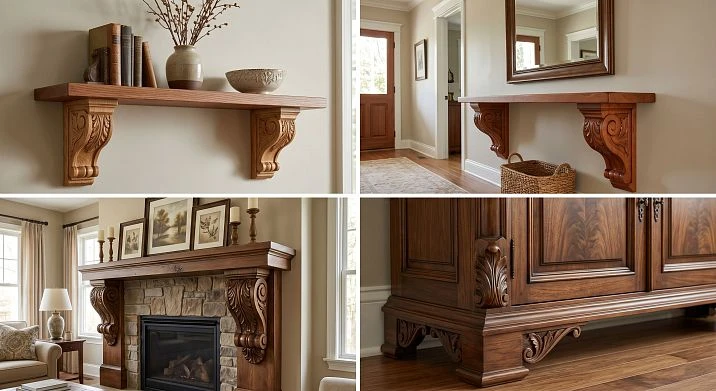
Imagine an open shelf on the wall. It hangs — floats, seemingly without visible support. Or — it rests on two wooden brackets that not only support it from below but are themselves an expressive element: with a figured profile, carved ornament, or laconic geometric break. In the first case, the shelf simply hangs. In the second, it stands. And these are fundamentally different interior sensations.
wooden bracket — is an element that simultaneously solves a structural problem and says something important about the interior. It works as a support and as decor. As a load-bearing element and as an accent. And that is why its selection requires understanding: what size, what shape, what material, for what load, for what interior.
This article is a detailed and honest analysis of the topic of wooden brackets. For those who want not just to "hang a shelf," but to build an interior where every detail is in its place.
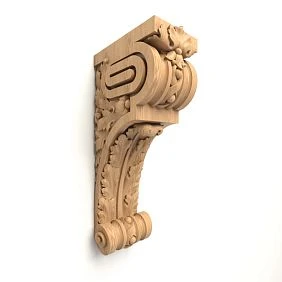
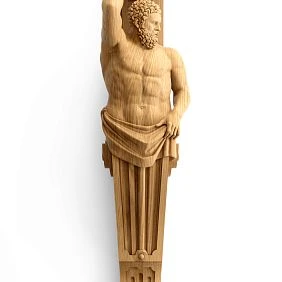
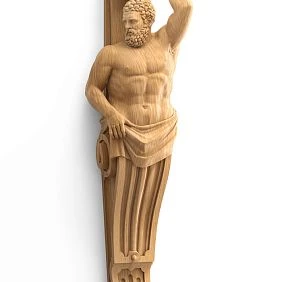
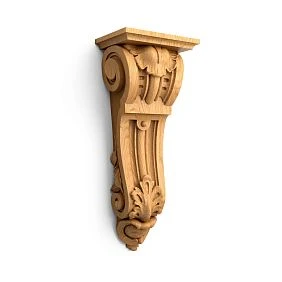
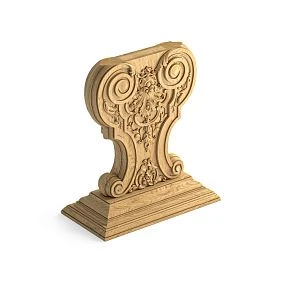
What is a wooden bracket
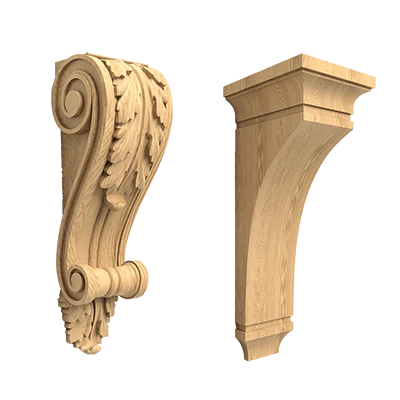
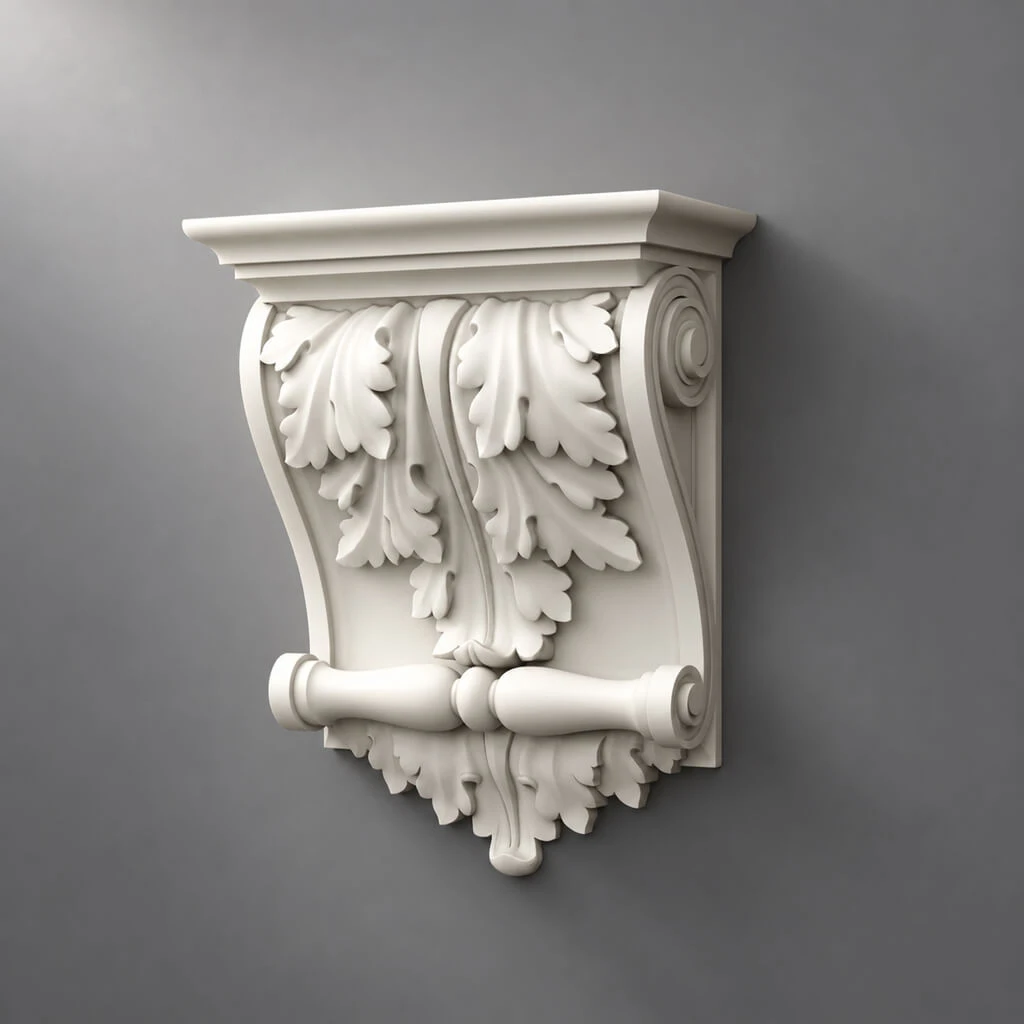
In the strict sense, a bracket is a support element that is attached to a vertical plane (wall, cabinet, portal) and supports a horizontal surface (shelf, console, countertop, crossbar) from below or from the side.
Wooden Furniture Bracket — is the same principle, but made of natural wood and, as a rule, with a decorative function. It doesn't just hold — it decorates. It is visible. Its profile, ornament, and proportions are read from a distance and affect the perception of the entire furniture or interior composition.
Unlike a metal bracket, which is hidden behind a shelf or painted the color of the wall, a wooden bracket is put on display. It is part of the design. Its shape, size, and finish must be coordinated with the furniture, moldings, doors, and the overall style of the space.
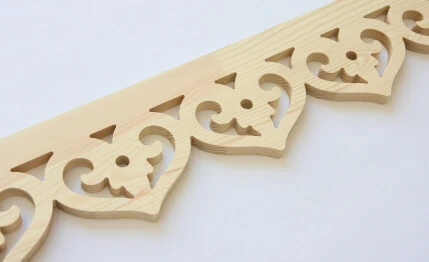
A wooden bracket can be:
-
strictly geometric — an angular profile with clean straight lines;
-
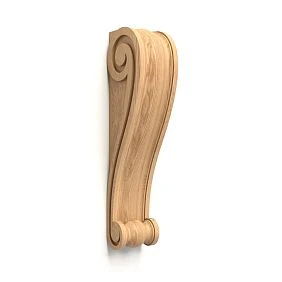
shaped — with smooth curves, rounded edges, a complex silhouette;
-
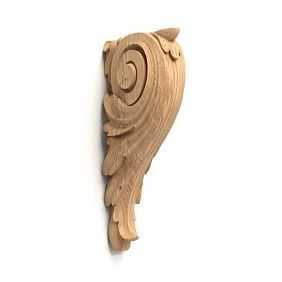
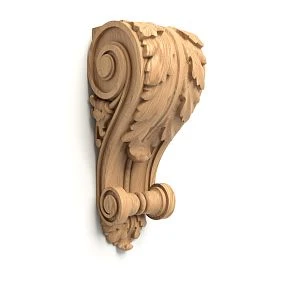
carved — with ornament, leaf carving, or geometric pattern;
-
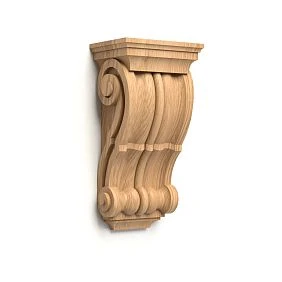
combined — combining a smooth profile and an accent carved element.
Each of these options is for its own interior context. Let's break it down in detail.

Where wooden brackets are used
The scope of application of wooden brackets is much broader than just a "shelf holder in the kitchen." Here's where they work and why.
Our factory also produces:
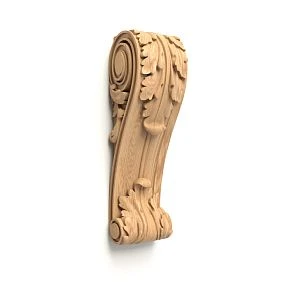
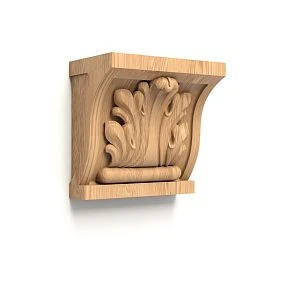
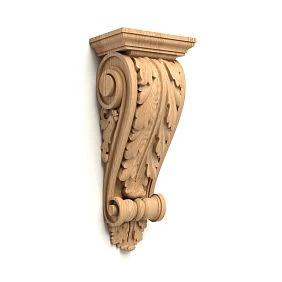
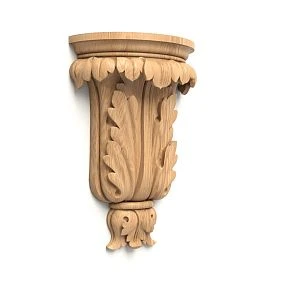
Open shelves in the living room, study, library
This is the most common scenario. A wooden shelf on wooden brackets is a classic for a bookcase, open library, or decorative shelf above the fireplace. Here, the bracket carries a functional load and simultaneously shapes the "leg" of the shelf. In a study with wooden doors and moldings a wooden bracket with a figured profile is an organic part of the decor.
Get Consultation
Consoles in the hall and living room
A console table against the wall — in the hallway or living room — is often supported by brackets. A decorative wooden support for the console here not only holds the tabletop but also sets its style. A thin console on elegant carved brackets is neoclassical. A massive thick tabletop on wide geometric brackets is loft or rustic style.
Fireplace Entrances
In a fireplace portal, wooden brackets often support the upper shelf — the mantel shelf. This is a decorative scenario where the bracket is the center of attention: it is at eye level of a seated person, the ornament is concentrated on it, and the character of the entire portal depends on it.
Kitchen and bar counters
In the kitchen, a wooden bracket supports open shelves with dishes and spices, as well as a bar counter — a hanging or cantilevered countertop extending beyond the main contour of the kitchen set. Decorative Bracket For a bar counter, it is a functional detail visible from all sides: from the living room, from the kitchen area, from the bar stool itself.
Cabinets, sideboards, and bookcases
In case furniture, wooden brackets are used as decorative supports under an overhanging element — the upper part of a sideboard, a protruding cabinet cornice, or a cantilevered shelf above the main body. This gives the furniture an architectural character and completeness.
Furniture portals and frames
A wooden bracket as an element of a door or fireplace portal frame — a supporting decorative element at the bottom of a side post, transitioning from vertical to the horizontal of the upper shelf. Together with carved wooden decor such a bracket creates an architecturally expressive ensemble.
Staircase zones
A wooden bracket under a windowsill or cantilevered shelf in a stair area — a little-known but very organic scenario. In a country house with a wooden staircase and wooden beams, small carved brackets on the landing create a sense of a meticulously crafted space.
How a bracket differs from a leg, capital, and overlay
This question is important not only for understanding terminology but also for choosing the right product. Confusion is common — and leads to buying the wrong one.
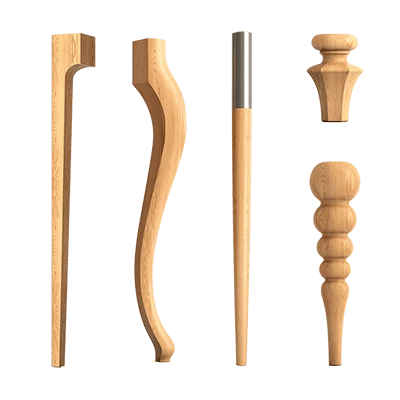
Furniture leg
A leg supports furniture from below, bearing vertical load. It is located under the product, with its support plane being the floor. A bracket is fundamentally different: it attaches to a vertical plane and bears horizontal load. A leg points downward, a bracket points sideways.
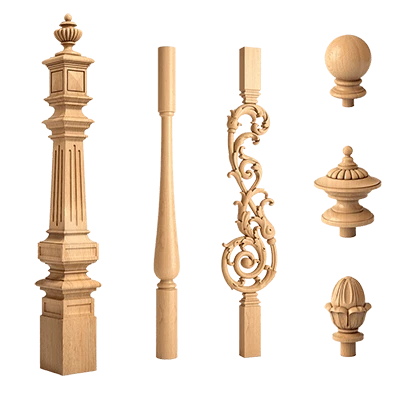
Capital
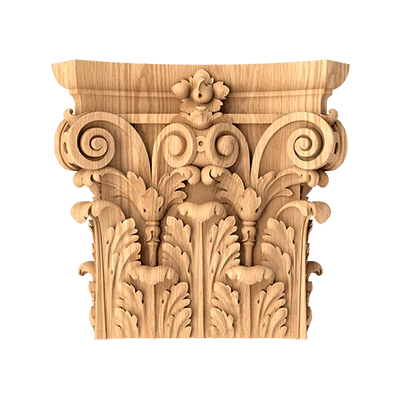
Capital — the upper decorative element of a column or pilaster. It completes the vertical structure from above. A bracket is a transitional support element between a vertical and horizontal surface. They can work together — for example, a bracket under a mantelpiece and a capital on a pilaster nearby — but these are different parts with different functions.
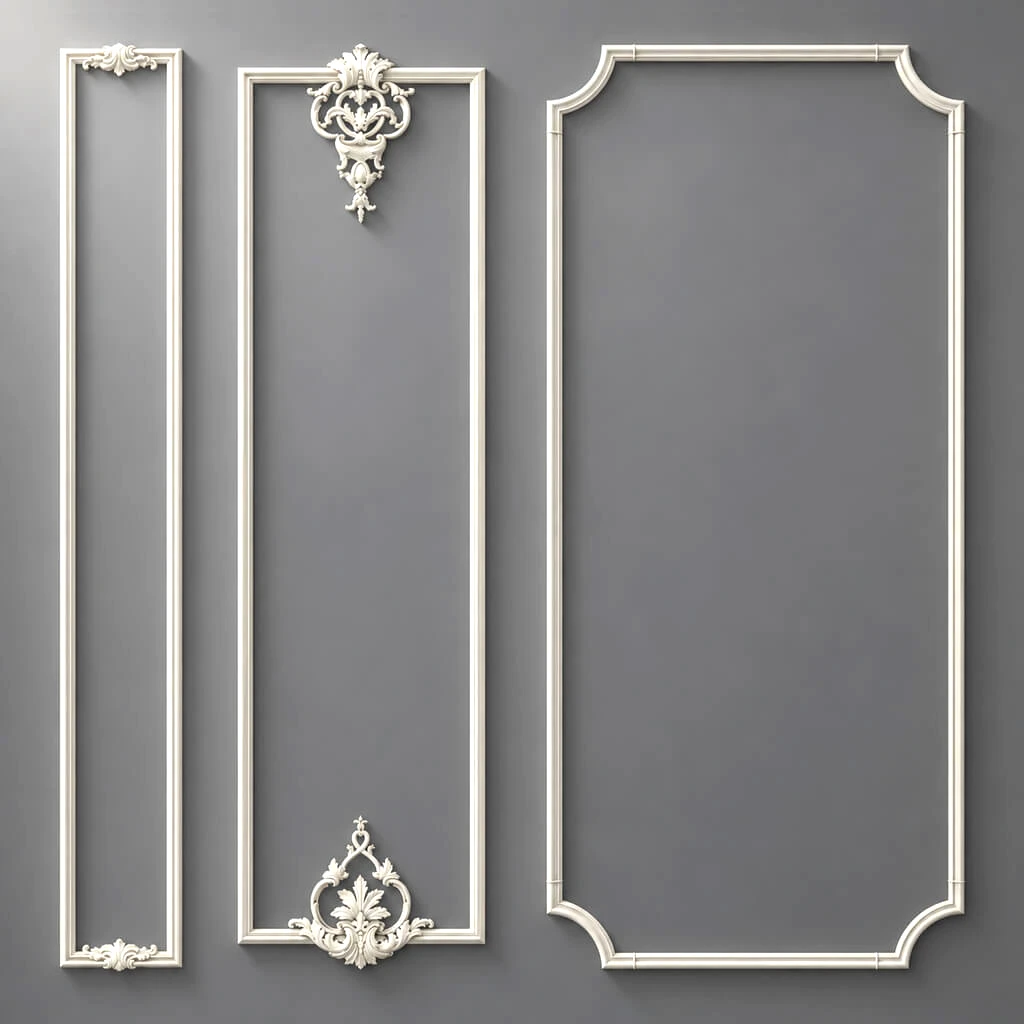
Overlay
decor for furniture — is a flat ornamental element that attaches to the front surface and serves purely decorative purposes. It does not support anything. A bracket, however, bears load — even a decorative one retains the structural triangular shape and functions as a support.
Corsel and modillion
To be precise: in architectural terminology, support elements under a cornice are called modillions (rectangular) or consoles. Bracket is a broader concept in modern Russian, encompassing all types of support decorative parts. In an interior context, a "wooden bracket" is precisely a decorative support that holds a horizontal element.
How to choose the size of a wooden bracket
Size is a critical parameter. A bracket that does not match the size of the shelf or console either looks awkward or fails to handle the load.
The main rule: bracket depth and shelf depth
The bracket must support the shelf at a distance of at least 2/3 of its depth from the wall. That is, for a shelf 30 cm deep, the bracket should protrude from the wall by 20 cm or more. This is a structural requirement: if the bracket is shorter than 2/3 of the shelf depth, the shelf will "nod" forward under load.
Bracket height
Bracket height (vertical dimension) determines its visual weight. For small shelves, 80–120 mm of height is sufficient. For deep consoles and fireplace mantels, 150–250 mm. The greater the overhanging mass, the taller the bracket should be to visually "hold" it convincingly enough.
Bracket width (thickness)
The standard thickness of a wooden bracket is 20–40 mm. A thin bracket (20–25 mm) looks elegant and is suitable for lightweight shelves. A wide one (35–45 mm) is for heavy consoles, fireplace mantels, and bar counters.
Matching trim and furniture
The bracket size should be proportionate to the elements it works with. For a narrow lightweight shelf, a small bracket. For a massive console with a thick countertop, a large and sturdy one. A small bracket under a heavy slab looks unreliable even if it structurally handles the load.
Distance between brackets
For the shelf length, calculate the number of brackets. Standard spacing: one bracket per 50–80 cm of shelf length under light load. Under heavy load (books, dishes, equipment), one per 40–50 cm. The outermost brackets should be no more than 10–15 cm from the shelf ends.
Practical bracket selection table
| Shelf depth | Minimum bracket extension | Recommended bracket height |
|---|---|---|
| Up to 20 cm | 13–15 cm | 80–120 mm |
| 20–30 cm | 15–22 cm | 110–150 mm |
| 30–40 cm | 22–30 cm | 140–200 mm |
| 40–50 cm (console) | 30–40 cm | 180–260 mm |
| Over 50 cm (bar counter) | 40–50 cm | 250–350 mm |
Wooden shelf bracket: scenarios and tips
An open shelf bracket is a thoughtful choice. The shelf "lives" for years, seen and touched every day. The bracket should be selected considering several factors.
Office and library
In a study, a shelf with books is a functional element. The load here is maximum: books are heavy. The bracket for such a shelf should have a depth of at least 70–75% of the shelf depth and be held by reliable fasteners. The material is solid hardwood: oak or beech.
Visually: carved bracket With a figured profile in a study with classic furniture is the right choice. The ornament supports the architectural decor of the room, and the bracket itself declares the thoughtfulness of the interior.
Kitchen and dining room
In the kitchen, a wooden bracket most often supports open shelves with dishes, spices, and cookbooks. Moisture resistance of the coating is important here: the kitchen is a room with high humidity and grease vapors. The bracket must be coated with a high-quality varnish that is resistant to moisture.
Style: in a kitchen with a classic-style wooden set, a figured bracket with smooth lines. In a loft or Provence-style kitchen, a rougher, textured bracket made of solid pine.
Hallway and hall
In the hallway, an open shelf holds keys, mail, and small items. The load is small, but the bracket is in the first impression zone. Its aesthetics are especially important here: it should create the right "first word" about the interior.
A small elegant bracket made of beech with a tint to match the color of the doors is an excellent option for a classic or neoclassical hall.
Decorative shelves in the living room
Shelves with decor, vases, books, candles are a decorative zone. The load is moderate, but visibility is maximum. The bracket here is a full-fledged element of decor. Its shape, style, and coating should be chosen as one would choose a vase or candlestick — with attention to character and details.
Wooden decorative bracket With a carved ornament on a shelf in the living room, it is a small work of applied art that everyone notices.
Wooden bracket for furniture, console, and fireplace portal
Consoles and sideboards
A console table against the wall is one of the most elegant furniture types. If the console "floats" without legs and is held by brackets, their shape determines the entire character of the piece. A wide, massive bracket with an architectural profile makes the console look monumental. A light, graceful bracket with fine carving gives the same console an airy feel.
In a sideboard, the upper part overhanging the lower is traditionally supported by brackets on the sides. This is a classic furniture technique known in the European tradition since the Baroque era. The wood furniture bracket here is not hidden — it is part of the front surface, it is visible, it is appreciated.
Mantel shelf
The mantel shelf above the fireplace portal is a special place for a bracket. Here it is at the eye level of a seated person, near the fire, in a zone of warmth and coziness. This is the "warmest" place in the home. And the bracket here should not just be a support — it should be beautiful.
For a mantel shelf in a classic interior — a carved bracket with leaf ornament or volute. For a rustic country house — a rough, textured bracket made of thick pine wood with minimal processing. Both options are correct — in their context.
An important technical point: the bracket at the fireplace should be made of hardwood — oak or beech — with a lacquer coating resistant to thermal effects.
Bar counter
A bar counter on wooden brackets is a solution found in both home kitchens and restaurants. The bracket for a bar counter bears a significant load: the countertop itself is heavy, plus people lean on it. Both structural strength and aesthetics are important here — the bracket is visible from both sides of the counter.
For a bar counter in a classic interior — a wooden bracket 250–350 mm high with an architectural profile. For a loft-style kitchen — a wide geometric bracket made of oak or pine without ornament, but with expressive wood texture.
Carved or smooth bracket: selection principle
This is one of the key questions. Carving or geometry? Ornament or clean profile? The answer depends on the interior style, element scale, and surroundings.
Carved bracket
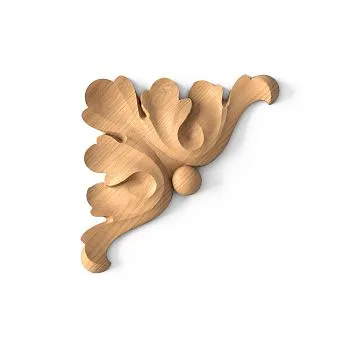
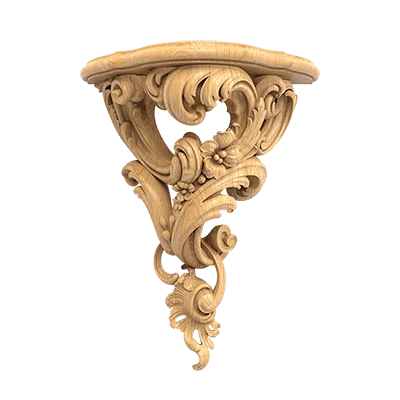
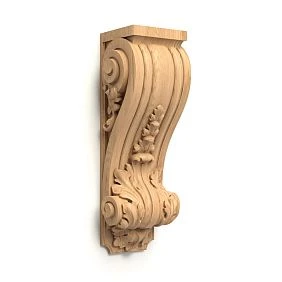
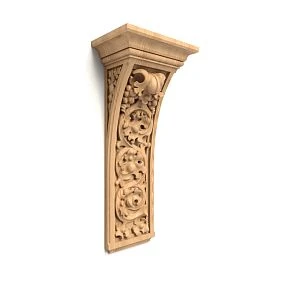
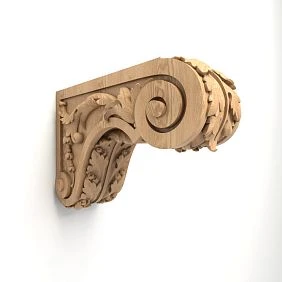
carved bracket with ornament — acanthus leaves, geometric weave, plant shoots, volutes — this is a decoratively expressive element that creates a play of light and shadow and gives a sense of handcraft.
Where it is appropriate:
-
In a classic and neoclassical living room
-
In a study with architectural decor
-
On a mantelpiece
-
In a library with classic furniture
-
In a country house with folk ornament
-
Next to carved decoration walls and furniture
Important condition: a carved bracket requires an appropriate environment. A rich ornament next to a bare wall without any other decorative elements looks random and lonely.
Smooth shaped bracket
A bracket with a clean profile, without carved ornament, but with a beautiful silhouette — curved, beveled, multi-tiered — is the golden mean. It is decoratively expressive through form, not through carving. It is appropriate where an accent is needed without excess: neoclassicism, modern classic, Scandinavian style with wooden accents.
Such a bracket works well for painting: clean silhouette lines under white enamel are elegant and modern.
Geometric strict bracket
A straight angular bracket with minimal decor — for loft, industrial style, modern minimalism with wooden accents. Here the main thing is the texture of the wood and the correct proportions. No carving, no curves: only honest geometry of wood.
Material and coating of wooden brackets
Beech
Dense, homogeneous species with fine texture. Ideal for painting — paint lays evenly, the ornament does not get "blurred". Holds thin carving lines well. Standard choice for most interior brackets. Durable, does not crack, long-lasting.
Oak
Hard, with expressive fiber texture. An oak bracket under natural varnish is monumentality and natural beauty. Dark oak texture works well in studies, hunting interiors, country houses. High strength — for brackets under significant loads.
Spruce and pine
Light softwood species. Amber tone, resinous scent. Excellent for country houses and rustic interiors. Less hard than beech and oak, but sufficient for decorative brackets under moderate loads.
Finish
Clear varnish — preserves the natural color and texture of the wood. For oak, it's the best option: the texture fully comes through. Matte varnish — for classic and country style. Semi-gloss — for more elegant spaces.
Stain and tinting — change color without losing texture. Dark walnut, wenge, rosewood — for studies and dark interiors. Light oak, bleached wood — for Scandinavian and light classic spaces. Tinting allows precise matching of adjacent elements — wooden trim, trims, moldings.
White and colored enamel — a popular choice for neoclassical and Provence interiors. A white bracket on a white wall — a light decorative accent with a soft shadow from the relief. Pastel colors (gray, ivory, beige) — for finely crafted interiors.
Uncoated — for self-painting to match the exact interior color. The primed blank accepts any paint. Ideal when a precise custom color is needed.
How to combine a wooden bracket with an interior
A bracket does not exist in space alone. It is always part of an ensemble. Let's break down what needs to be considered.
Bracket and shelf
Material and finish of the bracket and shelf: ideally, they should be the same. A shelf made of the same wood species with the same finish as the bracket. Contrast is possible: a dark bracket and a light shelf — but only within a clear design concept.
Dimensional correspondence: the bracket should visually "hold" the shelf, not be lost under it. A massive thick shelf requires a large, substantial bracket. A thin light board requires a small, elegant one.
The bracket and Wooden trim
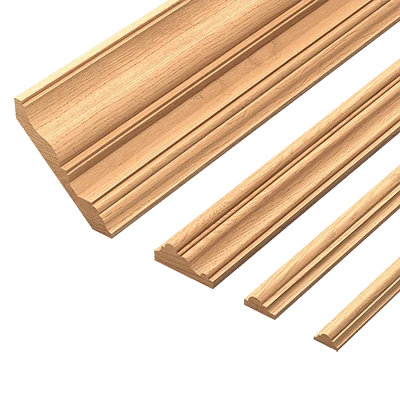
If the interior has wooden moldings — baseboards, moldings, cornices, architraves — the bracket should belong to the same stylistic and tonal world. One wood species, one finish, one level of decorativeness: all carved — all smooth, or a deliberate combination with an understanding of hierarchy.
The bracket and Moldings
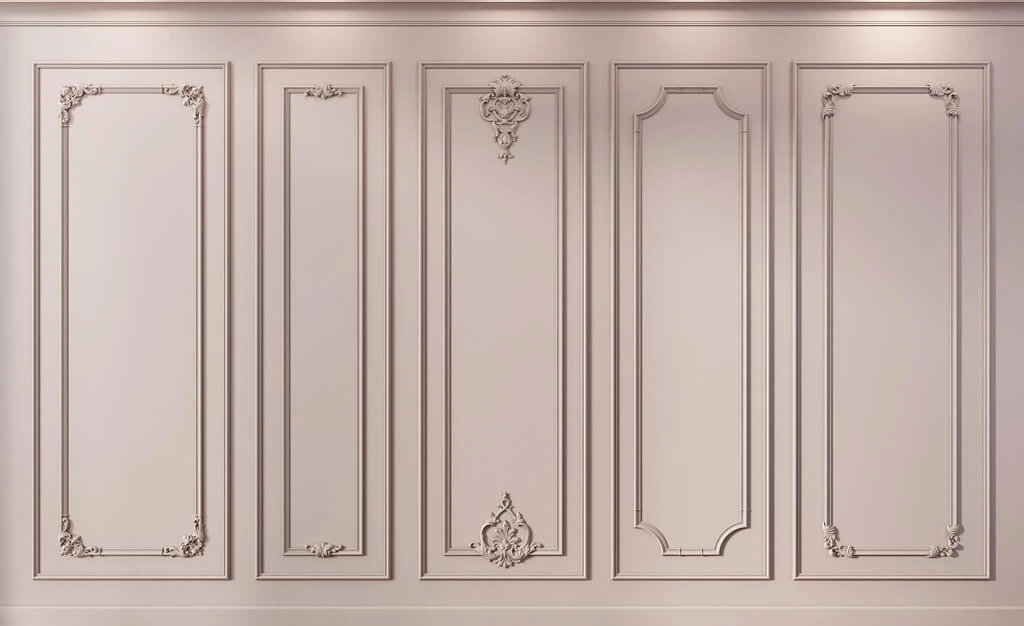
Moldings on the walls create a horizontal rhythm. Shelf brackets create a vertical-horizontal accent within this rhythm. There should be a visual connection between them: a similar profile of the pulls, a similar ornament, the same wood species and finish.
The bracket and decor for furniture
If the furniture has applied decorative elements — carved overlays, ornamental inserts — the brackets on adjacent shelves should support this style of ornament. This creates a visual ensemble where everything is connected and everything "communicates" with each other.
Load and structural reliability of a wooden bracket
Beauty is important. But a bracket is first and foremost a support. And there are fundamental rules here that cannot be ignored.
Wood species and load-bearing capacity
Hardwoods — oak, beech — carry significantly more load than softwoods like pine and spruce. For shelves with books, dishes, heavy items — only oak or beech. For decorative shelves with light decor — pine can be used.
Grain direction
In a good bracket, wood fibers are oriented along the long side (along the projection), not across. Cross-grain is a weak point: the bracket can break "along the grain" even under moderate load.
Wall mounting
A wooden bracket is attached to the wall with through screws through the bracket body into a dowel. For brick and concrete walls — anchor dowels. For a frame wall — fastening to the frame stud. No glue as the primary fastener for load-bearing brackets.
For each bracket — at least two attachment points. For heavy brackets under fireplace mantels and bar counters — three or more.
Pre-load check
After installation, check the bracket without load: press down on it from above with force, simulating the maximum possible weight of the shelf. The bracket should not have any play or creak. If it does, reinforce the fastening before installing the shelf.
Mistakes when choosing a wooden bracket
These mistakes are not theoretical. They are made over and over again. Remember them and avoid them.
Choosing only by appearance. A beautiful bracket that cannot withstand the load is not a bracket. Load capacity is the first selection criterion, only then aesthetics.
Not considering the load. A small bracket made of softwood under a heavy shelf with books. The outcome is predictable. Calculate the load: shelf weight + maximum content weight.
Choosing a bracket that is too small for a deep shelf. The bracket must extend at least 2/3 of the shelf depth. Shorter — the shelf will tip forward.
Do not underestimate the number of supports. One bracket for a long shelf leads to sagging in the middle, deformation, or even breakage. Calculate the spacing in advance.
Do not mismatch the bracket with furniture and trim. A random bracket bought "by eye" that doesn't match the surroundings in tone or style is interior clutter, no matter how beautiful it is on its own.
Do not mix different carving styles. A baroque bracket next to loft furniture. A geometric minimalist one next to classic architraves. The style must be unified.
Do not forget about the coating. A bracket without coating in a bathroom or kitchen will quickly blacken, swell, and lose its shape. Wet rooms require a lacquer coating.
Do not forget to check the mounting method. Some decorative brackets are designed for lightweight decorative installation — they have minimal holes for thin screws. Such mounting is not suitable for load-bearing applications. Check the mounting holes before purchasing.
Wooden bracket in different interior styles
Classicism and neoclassicism
Carved decorative bracket with leaf ornament or curved silhouette. Beech tinted to match doors and moldings. One of the key decorative accents in a classic ensemble along with capitals, moldings, and cornices.
Country House and Rustic Style
Massive bracket made of pine or oak with minimal processing. The wood texture is emphasized, not hidden. Toning with stain is possible to enhance the texture. Slight roughness of forms is acceptable — it is organic in a rustic environment.
Scandinavian style
Small clean bracket with a smooth curved silhouette and no ornament. White or natural coating. At most, a light chamfer on the edge. Minimalism is the main principle here.
Loft and industrial style
Geometric bracket made of thick solid oak. No carving, no soft lines. The angle is straight. The texture is expressive. The coating is dark stain or oil. The fastening is exposed, without concealment.
Provence
A small curved bracket under white or pastel enamel. Light relief — rounded edges, a simple leaf silhouette. This is "rustic classic" — soft, cozy, lived-in.
Where to buy a wooden bracket
When choosing a supplier, key criteria are: specifying the wood species, exact dimensions, coating characteristics, and real photos of the product — not renders.
In the STAVROS catalog Wooden Brackets are presented in several variants: from laconic support brackets to carved decorative forms. Here also — Carved wooden decoration for walls and furniture, decorative inlays for furniture facades, Wooden trim и Moldings — all elements of a unified wooden decor system.
By purchasing brackets in a single catalog with other wooden products, you get a guarantee of matching tones, wood species, and styles. This is the difference between a "set of parts" and an "interior ensemble."
Full catalog wooden products for interiors — from brackets to capitals, from baseboards to cornices.
FAQ: Answers to popular questions
What is a wooden bracket?
This is a decorative and supporting element made of solid wood, which is attached to a vertical surface and supports a horizontal element — a shelf, console, mantelpiece, or bar countertop. It combines a structural function with decorative expressiveness.
Where are furniture brackets used?
On open shelves, consoles, in fireplace portals, in furniture (sideboards, cabinets, libraries), in the kitchen, under bar counters, in hallways and studies.
How to choose a bracket for a shelf?
The bracket overhang should be at least 2/3 of the shelf depth. The spacing is one bracket per 40–80 cm of shelf length, depending on the load. Material for heavy loads — hardwoods: oak or beech.
How does a decorative bracket differ from a regular support?
A metal or plastic support is hidden behind the shelf. A wooden decorative bracket is displayed — it is part of the design, its shape and ornament are part of the interior image.
Is a wooden bracket suitable for the kitchen?
Yes, provided there is a high-quality moisture-resistant varnish coating. In the kitchen, a wooden bracket supports open shelves with dishes, spices, and accessories.
Can a bracket be used for a fireplace portal?
Yes. A wooden bracket under the mantelpiece is a classic technique for portal design. It is important to use a hardwood (oak, beech) with a varnish resistant to temperature fluctuations.
How to choose the bracket size?
Overhang — at least 2/3 of the shelf depth. Height — from 80 mm for small shelves to 300 mm for consoles and bar counters. Refer to the correspondence table above.
Can a wooden bracket be painted?
Yes. Uncoated brackets are primed and painted in any color. Beech takes paint best — a smooth, uniform surface. The profile of the rods becomes even more distinct after painting.
How many brackets are needed for a shelf?
One bracket per 40–80 cm of length. For a 120 cm shelf — at least 2, preferably 3. The outermost ones — no further than 15 cm from the shelf end.
Where to buy a wooden decorative bracket?
In the STAVROS catalog: Furniture Bracket made of solid wood in several styles and sizes with delivery.
About the manufacturer
STAVROS is a Russian manufacturer of wooden decorative and architectural elements for interiors. The company's assortment includes Wooden Brackets, Carved Decor, decorative inlays, Moldings, Wooden trim and the full catalog wooden products for interiors. All products are made from stabilized solid wood with professional finishing. If you are looking for a wooden bracket for a shelf, console, fireplace portal, kitchen, or furniture — in the catalog STAVROS you will find the right shape, size, and finish for your interior.