Article Contents:
- What is a carved wooden bracket and why is it needed in interior design
- Where to use wooden brackets: scenarios and spaces
- Open shelves in the kitchen with wooden brackets
- Wooden brackets for shelves in the living room
- Wooden brackets for the study and library
- Console areas, niches, and wall sections
- How to choose the shape of a decorative bracket
- Silhouette and ornament
- Matching the room style
- Scale and proportions
- How to choose the right bracket size for a shelf
- Bracket depth and shelf depth
- Bracket height
- Distance between brackets
- Shelf thickness and bracket
- Materials of wooden brackets: beech, oak, finishing and painting
- Oak
- Oak
- Wooden brackets for painting
- Wooden brackets for tinting
- Brackets as part of an interior composition: a systematic approach
- Shelf + brackets: a system unit
- Brackets + moldings and cornices
- Brackets + carved overlays and decorative elements
- Brackets + moldings and baguettes
- Brackets + pilasters and consoles
- Wooden brackets in different interior styles
- Classic: carving, symmetry, solid wood
- Neoclassical: restraint and precision
- Provence: lightness, open shelves, white color
- Russian style: expressive carving, ornament, wood
- Commercial interiors: restaurants, offices, boutiques
- Mistakes when choosing wooden brackets for shelves
- Where to buy carved wooden brackets STAVROS
- Frequently Asked Questions
- About the Company STAVROS
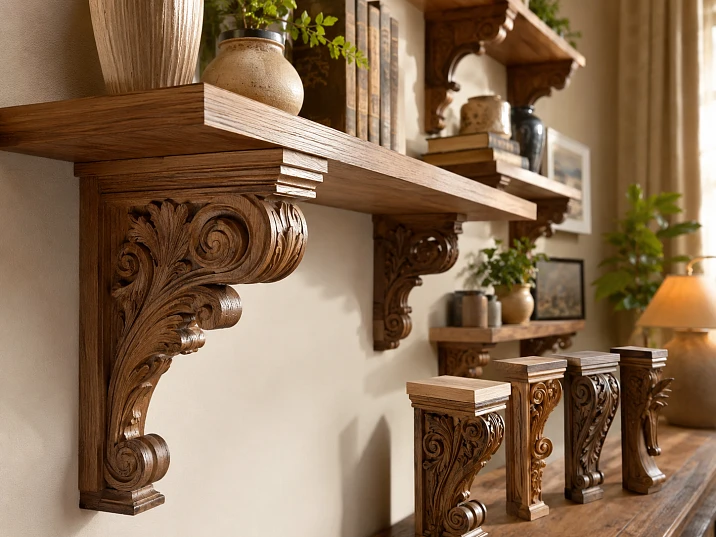
A shelf without a bracket is just a board on the wall. A shelf with a carved wooden bracket is already a statement. An architectural detail that turns utilitarian storage into an element of interior composition. This is exactly the difference — between "holds" and "adorns" — that we will discuss.
When a person is looking for Wooden brackets for shelves, they rarely think only about the load. More often, they are interested in something else: how will it look? Will it fit into a kitchen with classic facades? Will it suit a living room with moldings and cornices? Will it look like a random detail against the backdrop of carefully selected decor?
This article answers exactly these questions. Not "which bracket is stronger," but "which bracket is more correct" — for your space, style, material, and task. Buy wooden shelf brackets — is not difficult. Choosing the one that completes the look, rather than spoils it, is the real challenge.
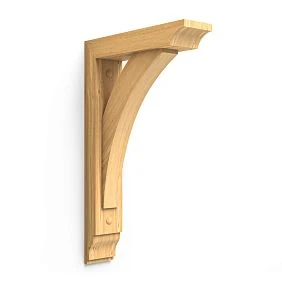
What is a carved wooden bracket and why is it needed in the interior
Let's start with a definition — not a boring one, but a practical one.
In classical architecture, a bracket is a projecting support. A structural element that holds something horizontal: a shelf, a cornice, a balcony, a roof overhang. In interior decor, the bracket has long gone beyond a purely technical function. It has become a decorative accent — an element that is seen, admired, and that shapes the style.
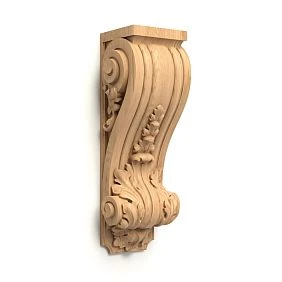
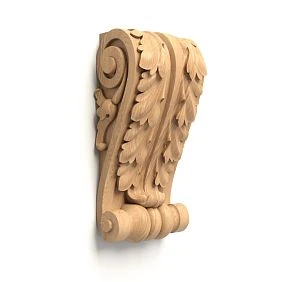
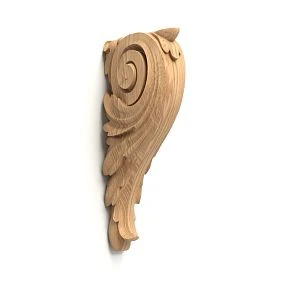
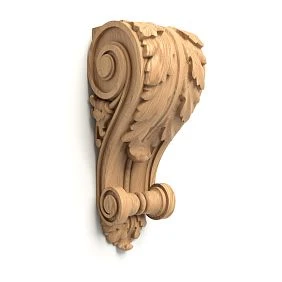
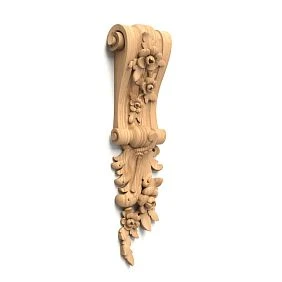
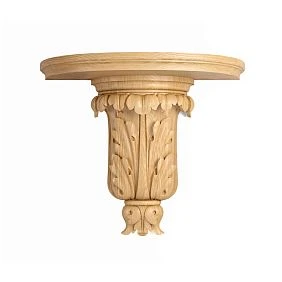
Carved wooden brackets for shelves — these are products made from solid wood with ornamental carving. They perform several roles at once: physically support the shelf, shape the silhouette of the wall composition, create a connection between the shelf and the wall, and add relief and depth to the interior.
What is the fundamental difference between a decorative bracket and a hidden metal fastener? A metal rod in the wall holds the shelf invisibly. This is pure minimalism — the shelf "floats" without visible supports. Beautiful, modern, suitable for Scandinavian and industrial styles.
But when the interior is built on wood, moldings, carving, and classical geometry — hidden fastening looks strange. The shelf "hangs" without context, as if it was left unfinished. Decorative wooden brackets for shelves in such a context are the right answer: they include the shelf in the interior system, making it part of the room's architectural logic.
That is why wooden carved brackets for shelves are so in demand in classical, neoclassical, Provencal, and Russian interiors — where details are not hidden but put on display.




Where to use wooden brackets: scenarios and spaces
Our factory also produces:
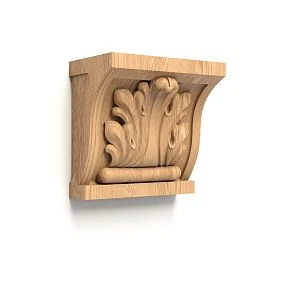
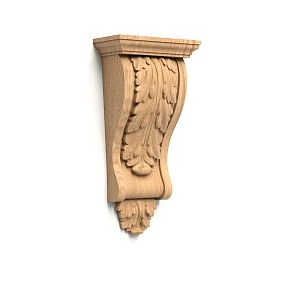
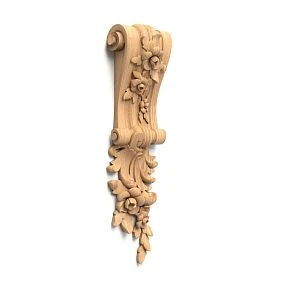

Open shelves in the kitchen with wooden brackets
The kitchen is the most lively place in the house. Here everything must work: look beautiful and be practical. Open shelves in the kitchen with wooden brackets for kitchen shelves — this is a balance between decor and function.
In a classic kitchen with wooden facades, cornices and moldings open shelves on brackets are an organic element. They complement the decor system: cornice strips stretch above the cabinets, below them are shelves on carved supports, and on the shelves are dishes and decorative items. This is a single ensemble, not a set of random elements.
For a Provence-style kitchen, wooden brackets painted white or cream are a classic solution. A shelf made of aged board, brackets with soft ornamentation, all painted in a single tone — this is the very "French" look that designers seek.
An important point for the kitchen: brackets above the work area must be fastened securely and symmetrically. Two supports for a shelf up to 80 cm wide are standard. Three supports are for longer shelves. The spacing between brackets should be uniform — and this is a task of marking, not "by eye."
В in kitchen decor In classic and neoclassical style, open shelves on wooden carved brackets are not only storage but also scenography of the space. On such shelves, clay pots with greenery, antique jars with grains, and beautiful dishes are appropriate. A shelf with brackets becomes a small exhibition.
Get Consultation
Wooden brackets for shelves in the living room
The living room is a space for living and for display. Here, one receives guests, spends evenings, hangs favorite paintings, and keeps cherished items. Open shelves in the living room are display cases, and the brackets that hold them must be worthy of this role.
Bookshelves with wooden carved brackets In the living room of a classic home, this is almost an archetype. Two symmetrical shelves on either side of the fireplace on identical carved supports, with books and sculptures on the shelves. This is an image that has existed for centuries and never becomes outdated because it relies on timeless proportions.
Near the fireplace area, the brackets can be more massive, with pronounced carving, to match the scale of the portal. For a mirror or painting, they are thinner and more elegant, not drawing attention away.
In the TV area, wooden shelf brackets work differently: several shelves at different heights on either side of the television create an asymmetrical or symmetrical composition that 'dresses' the wall and makes it rich. This is especially relevant for living rooms without a niche for the TV, where the wall is flat and needs to be organized with decorative means.
Wooden brackets for the study and library
A study is an interior with a special atmosphere. It is a space of concentration, work, and reflection. Dark wood, heavy books, a leather armchair, and a desk lamp are appropriate here. And open shelves with carved wooden brackets made of beech or oak in a dark tint.
For a library or study with classic decor, brackets are chosen with a more pronounced shape and ornamentation. Models with a figured silhouette are appropriate here, such as an S-shaped, volute, or bracket-shaped contour. Such a bracket, when viewed from the side, reads as an architectural detail continuing the tradition of carved decor.
In an executive's study, wooden brackets for wall shelves in a 'wenge' or 'dark walnut' tint work as an element of status decor. Shelves with books and artifacts on such supports look solid, without pomposity but with dignity.
Wooden trim In the same tone, baseboards, trims, and cornices create a unified finishing system into which the brackets integrate organically.
Console areas, niches, and piers
This is a scenario that is underestimated. A small decorative console in the hallway, a board on two brackets, is both a place for keys and an element of the entrance area design. A shelf in a niche is a way to use hidden space, making it decoratively expressive.
Consoles and Frames — a separate topic in the decor of STAVROS interiors. Decorative brackets here work not as ordinary fasteners, but as part of the image: they support the console from below, create its silhouette, make it "furniture-like", rather than just "a board nailed to the wall".
On a narrow wall between two doors — a shelf on carved brackets turns dead space into an accent. A vase, a book, a candle — and the wall comes alive.
How to choose the shape of a decorative bracket
This is a question that most people solve intuitively — "like / dislike". But behind intuition lies logic, and it's worth knowing.
Silhouette and ornament
The shape of the bracket is determined by its silhouette in profile and the ornament on the plane. There are several basic types:
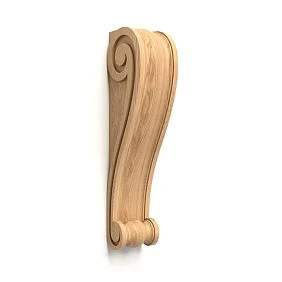
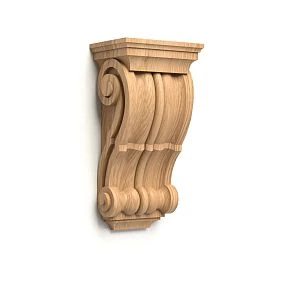
Figurative silhouette — a bracket with a curved contour: S-shaped, volute, with smooth transitions. This is a classic form that originates from architectural brackets of the Baroque and Renaissance. Such a bracket is expressive in profile and works well when seen from the side — for example, on the ends of a row of shelves.
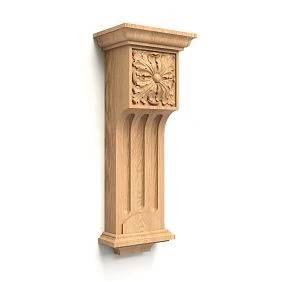
Straight bracket with decor — a geometrically simple, rectangular or slightly curved silhouette with ornamental carving on the surface. Such a bracket is less noticeable in profile but decorative when viewed from the front. Works well for neoclassicism and modern classicism.
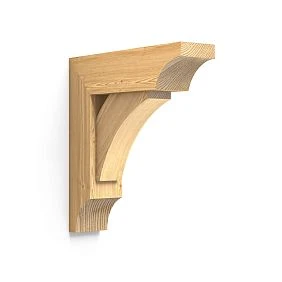
Bracket-shaped bracket — an L-shaped form with decor on the lower shelf. A maximally neutral silhouette that does not draw attention. Suitable for Provence and light classic interiors.
Matching the style of the room
Decorative wooden shelf brackets should "speak" the language of the interior. Baroque carving in a minimalist living room is a visual conflict. A smooth bracket in a lush classic study is a visual void.
The rule is simple: the richer the ornamental decor of the room, the more elaborate the bracket can be. The more restrained the interior, the more concise the shape should be.
Scale and proportions
Wooden decorative shelf brackets come in different sizes. The height of the bracket ranges from 10–12 cm for small shelves to 30–40 cm for massive bookcases. The projection (the depth the bracket extends from the wall) should match the depth of the shelf: the bracket should not protrude beyond the edge of the shelf.
General rule: the bracket should be proportionate to the shelf. A small thin bracket under a heavy wide board is a visual and structural mistake. A massive bracket under a narrow light shelf is an excess that creates a sense of mismatch.
When using two brackets for one shelf, they must be identical — not just similar, but identical in size, ornament, and finish. A pair of decorative brackets where one is slightly higher than the other is a mistake that is immediately noticeable.
How to choose the right bracket size for a shelf
This is a practical section without lyricism — because size mistakes most often lead to rework.
Bracket depth and shelf depth
The projection of the bracket should be equal to the depth of the shelf or slightly less — not more. If the bracket protrudes beyond the edge of the shelf, it visually disturbs: it feels like the shelf "didn't reach" its support.
Standard depths for kitchen shelves: 25–35 cm. For bookshelves and decorative shelves: 20–30 cm. For a decorative console: 15–20 cm. Choose a bracket with a projection 2–3 cm less than the shelf depth — this way the support will be slightly recessed inward, which looks neater.
Bracket height
The height of the bracket (its vertical size on the wall) affects stability and the visual "breathing" space under the shelf. A taller bracket leaves more space between the wall and the bottom surface of the shelf — this is important if items will be placed under the shelf.
The heavier the planned load, the taller the bracket should be — but this is a matter of the specific model's structural characteristics. Check the exact application parameters in the description of the selected product.
Distance between brackets
For a shelf up to 80 cm long, two brackets at the edges with an indent of 5–10 cm from the end are sufficient. For a shelf 80–120 cm long, two brackets, but shifted slightly closer to the center. For a shelf longer than 120 cm, three brackets: two at the edges and one in the center.
Three identical brackets in a row create an even rhythm that looks good on an open shelf with books. Two brackets are used when the shelf serves as a console or decorative platform with a few items.
Shelf thickness and bracket
A thick solid wood shelf (30–40 mm) requires a bracket of corresponding scale. A thin shelf (16–20 mm) pairs well with more elegant, lightweight brackets. This is a matter of proportion: a thick board on thin brackets looks unstable even if it holds securely.
Materials of wooden brackets: beech, oak, finish and painting
Beech
Beech is one of the main materials for carved decor. A dense, homogeneous, easily workable wood with a neutral texture. Beech is excellent for milling and cutting, allowing the reproduction of fine ornamental details without chipping or loss of shape.
Solid wood brackets Beech is the optimal choice for most classic interiors. The neutral texture of beech allows the product to be painted in any color without the wood grain showing through. This makes beech brackets ideal for projects intended for enamel painting.
Oak
Oak is a hardwood with a pronounced texture and characteristic rays on the cut. wooden carved brackets for shelves Oak is a choice for interiors where the wood should be visible: under clear oil, wax, or varnish.
Oak brackets in "natural", "walnut", "tobacco", or "dark oak" finishes are a truly premium element. The texture of oak under side lighting creates a lively surface play that no MDF coating can replicate.
For studies, libraries, and commercial interiors with natural wood, oak is a justified choice.
Wooden brackets for painting
Brackets for painting are products without a finish coating, ready for primer and enamel application. This approach allows for precise color matching for any project.
In monochrome interiors — white kitchen, gray living room, olive hallway — brackets are painted the color of the wall or slightly darker. The shelf stands out with its wood texture, while the brackets "blend into" the wall without drawing attention.
In interiors with contrasts — dark walls and light furniture — brackets in the furniture's tone or contrasting with the wall create an accent. This is a bolder solution requiring precise calculation.
For painting wooden brackets: wood primer → sanding (grit 320) → finish enamel in 2 coats. Acrylic dries quickly, does not yellow. Alkyd gives a harder film. The choice depends on load and operating conditions.
Wooden brackets for staining
Toning + varnish preserves the wood texture while changing the color. Wooden brackets for toning are the optimal choice for interiors where it's important to see the wood, but in the desired shade.
In a classic interior with furniture toned in "Italian walnut," the brackets are toned to match — and the entire system: moldings, cornices, brackets, shelves — reads as a single whole. This is professional work with color that distinguishes a designer interior from an amateur one.
Brackets as part of an interior composition: a systematic approach
A bracket does not exist separately from its context. This is a truth that is easy to understand but difficult to apply without understanding the system.
Shelf + brackets: a unit of the system
A shelf and brackets are a pair. They must be selected together, not separately. A solid oak shelf — brackets from the same solid wood in the same toning. A painted shelf — brackets for the same enamel. A shelf made of aged pine — brackets with an imitation of aging or in a neutral tone.
Mismatch between shelf and brackets in material or tone is one of the most common mistakes. It is especially noticeable when natural wood stands next to painted elements without any color logic.
Brackets + moldings and cornices
If there are Wooden moldings and cornices above the cabinets — the brackets for open shelves must be coordinated with them. This doesn't mean "identical in shape." It means "identical in tone and level of ornamentation."
An intricate carved cornice with a bas-relief ornament — a medium-complexity bracket with characteristic motifs is appropriate nearby. A simple straight cornice — a bracket with a laconic profile and minimal decor is appropriate nearby.
Brackets + carved overlays and decorative elements
carved appliqués on furniture facades and brackets on the wall — these are two levels of decor in one space. They can use the same ornamental motifs — and then a sense of a unified designer project is created.
wooden decorative elements — corner inserts, rosettes, cartouches — can be placed on the wall next to the brackets as additional accents. This is a technique from classical architecture: the bracket support is complemented by a decorative insert above or below it.
Brackets + moldings and baguettes
Wooden trim — baseboards, architraves, layouts — sets the horizontal and vertical rhythm of the space. Brackets are "embedded" into this rhythm: if a horizontal shelf with brackets is at the same height as the upper cornice of cabinets or a horizontal wall molding, a sense of harmonious layout emerges.
Wooden Picture Frame how a frame profile allows you to create a "niche" or frame around a shelf with brackets. This is especially appropriate in a Provencal interior or in an accent zone of a living room: a shelf in a baguette frame is almost a painting.
Brackets + pilasters and consoles
pilasters and columns in a classic interior — architectural elements of vertical rhythm. If pilasters decorate the wall in a living room or study, brackets for shelves can be placed in the spaces between them — and then the entire wall turns into an architecturally organized plane.
Consoles and Frames — a scenario where the bracket works not under a bookshelf, but under a decorative console. A small wooden slab supported by two figured brackets is a console table that is "built into" the wall. Here, the brackets bear the maximum decorative load: they set the style of the entire composition.
Wooden brackets in different interior styles
Classic: carving, symmetry, solid wood
A classic interior is an architectural system: proportions, symmetry, hierarchy of elements. In such a system, shelf brackets are not just supports, but part of the order structure.
For classic interiors, brackets with pronounced carved decor are suitable: acanthus leaves, volutes, cartouches, woven ornaments. The shape is figured, with smooth curves. The material is beech or oak, tinted in "walnut", "golden oak" or "classic".
Symmetry is a mandatory principle. Paired brackets on either side of the fireplace, equal distance from the vertical axis of the wall, a single tone with all the decor of the room — that's the recipe.
in combination with carved shelves STAVROS and carved decoration an interior system is created in which each wooden element enhances the others. This is not a set of details — it is an interior narrative.
Neoclassicism: restraint and precision
Neoclassicism is classicism filtered through a modern lens. Less baroque opulence, more geometric precision. The ornament is not the main character, but a carefully dosed accent.
For neoclassical interiors, brackets with more restrained carving are suitable: geometric motifs, simplified volutes, fluting. The shape is stricter, without excessive curves. Painting white or light gray is standard practice.
Brackets with enamel matching the wall or furniture color are the correct neoclassical solution. The shelf can be made of natural wood — the contrast of warm wood and painted brackets creates a modern but not cold look.
Provence: lightness, open shelves, white color
The Provence style is openness and lightness. Open kitchen shelves on wooden brackets in Provence are almost a mandatory element. Dishes on display, potted greenery, woven baskets on the shelves.
For a Provence interior, brackets with a soft, organic ornament are chosen — without heavy Baroque opulence. A bracket shape, a slight curve, painting in white or linen color with slight distressing. Shelves are made of pine, spruce, or birch with a wax coating.
Wooden shelf brackets in the Provence style are often paired with open kitchen shelves. This is a ready-made solution that can be easily adapted to fit any kitchen size.
Russian style: expressive carving, ornament, wood
The Russian style in interior design is a rich ornamental system. Carving here is not an accent, but a language. Voluminous carved elements, geometric and floral ornaments, warm wood tones.
Wooden brackets for wall shelves in the Russian style are products with maximally expressed carving: through, voluminous, with traditional motifs. Toning — 'walnut', 'mahogany', 'dark cherry'. Shelves are made of solid wood with a similar ornament on the ends.
STAVROS carved decor offers a range covering both classic European motifs and ornaments close to the Russian decorative tradition. This makes it possible to create an authentic look without compromises.
Commercial interiors: restaurants, offices, boutiques
In commercial spaces, wooden shelf brackets serve an additional function: they speak about the brand, the owner's taste, and the establishment's values.
In a restaurant, carved brackets for decorative shelves with bottles or artifacts are an element of atmosphere. In wine cellars wooden shelves on massive brackets are inherently organic. In a boutique, brackets for display shelves create a sense of "homey" comfort that attracts customers.
In an executive office — open shelves on carved oak brackets with dark tinting. In a hotel room with wooden decor — a small console shelf on paired brackets above the desk.
Mistakes when choosing wooden shelf brackets
Eight mistakes that are most often made — and which are easy to avoid if you know about them in advance.
1. Choosing by photo without considering size. A photo of a bracket in a catalog does not give an idea of the actual scale. Always look at the numbers: height, projection, width of the mounting part. Convert to centimeters and imagine it on your wall.
2. Installing a bracket that is too small for a deep shelf. A bracket with a 15 cm projection under a 30 cm deep shelf is a structural and visual mistake. The shelf overhangs the bracket, creating a feeling of instability.
3. Mixing different ornaments in one area. A baroque bracket next to a geometric one is a stylistic conflict. In one area — one ornamental language.
4. Not considering the finish color. A bracket in a "walnut" tint on a white wall under white furniture is an accent that is not in the project. Always match the bracket tone with the overall color scheme.
5. Breaking symmetry. Two brackets under one shelf should be positioned symmetrically relative to the center of the shelf. The indentation from the edge should be the same on both sides. Mark with a tape measure, not "by eye."
6. Not checking the wall material before installation. Even a small wooden bracket requires reliable fastening. Drywall without a metal stud, hollow brick, old plaster — all require special dowels or other solutions. Check the specific base.
7. Using a decorative bracket as a load-bearing structure without verification. A carved wooden bracket is primarily a decorative element. The exact application parameters and permissible load must be clarified for the specific model. Do not place heavy objects on decorative shelves without prior verification.
8. Isolating the bracket from the decor system. A bracket chosen in isolation from the rest of the wooden decor is a random element. Include it in the system: moldings, baseboards, overlays, trim. Then it works, not just "hangs."
Where to buy carved wooden brackets STAVROS
Buy wooden shelf brackets at STAVROS — means choosing from a range of Russian-made products from solid beech and oak. The catalog includes:
-
wooden carved brackets — carved decor, models for open shelves, kitchen, living room, study
-
Solid wood brackets — solid wood products for interiors with natural wood
-
Carved shelves — ready-made solutions in the system with brackets
Additional categories for configuration:
-
wooden moldings, cornices, and baseboards — to complete the system
-
carved appliqués — for ornamental enrichment of facades
-
Wooden trim — for frame systems and transition finishing
-
wooden decorative elements — corner inserts, rosettes, cartouches
-
Carved Decor — full collection
Contact us to confirm shipping to your destination. Warehouses in Moscow and St. Petersburg.
Frequently asked questions
Which wooden brackets are suitable for open shelves?
For open shelves, paired brackets that match the depth and visual weight of the shelf are suitable. In classic and neoclassical interiors, carved models made of beech or oak are optimal. For the Provence style, lighter brackets for painting are better. The shape and ornament should match the style of the room and other wooden decorative elements.
Can carved brackets be used in the kitchen?
Yes, wooden brackets for open kitchen shelves are a classic solution for kitchens in classic, neoclassical, and Provence styles. It is important to choose the bracket finish in advance, which will match the kitchen facades and moldings. The coating must be sufficiently resistant to the kitchen environment: varnish or enamel in 2–3 layers.
How is a decorative bracket different from a regular mount?
A hidden metal mount only solves a technical task. A decorative carved bracket is an architectural element: it supports the shelf, shapes its silhouette, adds relief to the wall, and connects the shelf with the rest of the decor. This is the difference between a "nailed board" and an "interior detail."
How to choose the bracket size for the shelf?
The bracket projection should be equal to or slightly less than the shelf depth. The bracket height should be proportional to the visual weight of the shelf. The distance between brackets depends on the shelf length: for shelves up to 80 cm, two are enough; for longer ones, three. Check the specific model description for exact application parameters.
Can wooden brackets be painted?
Yes, wooden brackets made of beech and oak without a finish can be painted any color. Technology: sanding → primer → enamel in 2 layers. For tinting: stain → varnish. The choice of finishing method depends on whether a transparent wood texture or an opaque color is needed.
What to pair with STAVROS wooden brackets?
With moldings, cornices, baseboards, trim, carved overlays, decorative elements, frames, portals, and furniture facades in the same tint or under the same enamel. Brackets work as part of a system — the more complete the system, the more convincing the result.
Which material is better — beech or oak?
For painting with opaque enamel — beech: a uniform structure without pronounced texture is ideal for paint. For tinting or clear varnish — oak: the pronounced texture reveals itself under transparent coatings and creates a lively, natural look.
Are wooden brackets suitable for commercial interiors?
Yes, especially for restaurants, wine rooms, studies, boutiques, hotel lobbies, and showrooms. In a commercial space, wooden shelf brackets carry not only a functional but also an image load: they create an atmosphere that is impossible with plastic or metal.
About the company STAVROS
A detail becomes decor when craftsmanship stands behind it. And when it is made from the right material by the right hands.
STAVROS is a Russian manufacturer of wooden interior decor. Own production in Russia, materials — solid beech and oak, MDF for painting. The assortment covers all categories of wooden decor: brackets, moldings, cornices, baseboards, carved overlays, shelves, pilasters, columns, decorative elements, millwork, baguettes, slatted panels, furniture legs and handles.
Warehouses and production are in Moscow and Saint Petersburg. Contact us to confirm shipping to your destination. It is possible to select a configuration for a specific project with coordination of tone and shape.
An open shelf with carved wooden brackets is a small architecture inside your home. Choose details that are worthy of it.