Article Contents:
- Answer in one minute: will Duet fit 32 mm holes
- Duet HL-018.1 in numbers: what is confirmed by the product card
- Why Duet is called a pair, not a regular bracket
- Two sizes that buyers most often confuse
- 32 mm — mounting distance
- 130 × 65 mm — external dimensions
- The facade is too narrow
- One part lands on the panel
- The handle crosses the decorative molding
- The old area is damaged
- The adjacent door collides with the handle
- There's little room for fingers
- Smooth surface
- Framed door
- Front with molding
- Radius surface
- Oil
- Clear varnish
- Toning
- Opaque enamel
- Buying only from a photo
- Confusing 130 mm size with 32 mm mounting
- Measure the gap between hole edges
- Consider 'about 32 mm' a match
- Not checking the thickness of the facade
- Mix halves of different pairs
- Install a handle on a frame facade drop
- Drilling without a template
- Buy the remaining handles significantly later
- Install unfinished oak in the kitchen
- Do not count placeholders
- Order exactly by the number of facades
- Retighten fasteners
- Choose color by name
- What is the full size of Duet HL-018.1?
- What is the distance between the mounts?
- Will the handle fit old 32 mm holes?
- How to measure the center-to-center distance of the handle?
- Why can't the free gap be measured?
- What material is the handle made of?
- Is there a ready-made coating for HL-018.1?
- Which version is sold with coating?
- What colors are available for HL-018.1M?
- Why does the handle consist of two parts?
- Can halves from different sets be mixed?
- Is fastening included in the price?
- Are decorative caps needed?
- What is the difference between FUR-032 and FUR-033?
- How many plugs are required for one Duet?
- Is Duet suitable for the kitchen?
- Is the handle suitable for a dresser?
- Can Duet be installed on a framed facade?
- Can the handle be placed vertically?
- What to do if the holes are broken?
- Will Duet cover the traces of the old handle?
- Can new holes be drilled next to the old ones?
- Is a spare handle needed?
- How to choose between HL-018.1 and HL-018.1M?
- Where to look for alternatives with a different mounting?
- Where to buy Duet HL-018.1?

Buy Duet HL-018.1 handle It can be used for a new project or to replace old hardware, but matching two holes does not yet guarantee a successful installation. The distance between mounting centers should be 32 mm, and the full size of the handle is 130 × 65 mm. These are two different values: the first determines the fit, the second determines the actual scale on the facade, grip comfort, and the ability to cover traces of the previous handle.
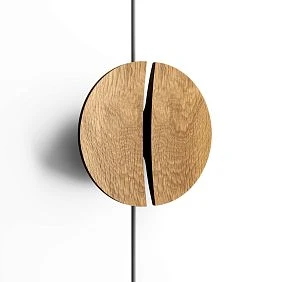
Duet HL-018.1 is made of oak, comes without a ready-made finish, and consists of two matched wooden parts. They form a single concave composition and are made from one blank, so the wood grain and shade within the pair match. This pair should not be perceived as two random overlays: the elements need to be stored, finished, and installed together.
The article is not intended for casual acquaintance with designer hardware. It helps make a decision: whether Duet will fit existing holes, whether the handle will fit on the drawer, whether one half will hit the panel, whether there is enough space for fingers, whether a version with a ready-made finish is needed, and how many sets to order for a kitchen, wardrobe, or dresser.
The main principle is simple: first measure the facade and make a paper template 130 × 65 mm, then choose the finish and complete the fasteners. Only after such a check does the request "buy Duet HL-018.1" turn into an informed purchase, not an experiment on finished furniture.
Answer in one minute: will Duet fit 32 mm holes
Duet HL-018.1 can be considered for an existing 32 mm spacing when the distance between hole centers is indeed 32 mm. You need to measure not the gap between inner or outer edges, but exactly the two center points. On a damaged hole, the center is restored along the original axis, otherwise the tape measure will show a false match.
Six more conditions must be met simultaneously:
-
the holes are on the same line;
-
the facade is wide enough for the 130 × 65 mm dimension;
-
both parts of the handle lie on the same plane;
-
old damage is covered by the new shape;
-
the screws match the thickness of the facade;
-
the adjacent door or drawer opens freely.
If at least one condition is violated, the 32 mm match will not save the installation. The handle may fit on the screws, but look too large, wobble due to a damaged panel, or press against the frame.
Before payment, it is useful to view the drawing of Duet HL-018.1 and apply a full-size template to the furniture. Five minutes of such a check is cheaper than repainting the facade and reordering the hardware.




Duet HL-018.1 in numbers: what is confirmed by the card
| Characteristic | Value | What it means for the buyer |
|---|---|---|
| Model | Duet HL-018.1 | Specific unpainted wooden handle |
| Type | Surface-mounted furniture handle in two parts | The pair forms a single composition |
| Full size | 130 × 65 × 32 × 32 mm | The dimension is checked on the facade at a 1:1 scale |
| Installation | 32 mm between the mounts | They are aligned with the centers of the old holes |
| Material | Oak | The texture can be preserved under a transparent finish |
| Preparation | Prestige sanding | The handle is supplied without a ready finish |
| Construction | Two matched parts from a single blank | Pairs must not be mixed between different sets |
| Shape | A single concave surface | Need to check grip comfort and installation direction |
| Fastening | Included in the price | Screw length is checked against the thickness of the facade |
| Additional hardware | FUR-032 or FUR-033 | Caps cover the screw heads from the inside |
| Alternative | HL-018.1M | Same geometry with a ready-made finish |
The table helps quickly understand the product, but does not replace trying it out. A size of 130 mm does not tell how the handle will look on a drawer 300, 600, or 900 mm wide. A 32 mm spacing does not confirm the condition of old holes. Oak does not determine the future color without a chosen finishing system.
Our factory also produces:
Why Duet is called a pair, not an ordinary bracket
A classic bracket has a single body and two mounting points. Duet is perceived differently: two wooden parts form a joint shape, a visual dialogue arises between them, and the concave surface guides the hand to the center.
Parts of one handle are made from a single wooden blank. This ensures that the grain, shade, and character of the wood are matched. If you mix halves from two sets, the geometry may formally remain, but the wood pattern will no longer look cohesive.
After unpacking, each pair is assigned a code. For a dresser, these can be designations D-01, D-02, D-03. For a kitchen — K-01, K-02, and so on. Both halves are stored in one package, sanded, painted, and returned to the signed packaging at the same time.
This order is especially important with a transparent coating. Under an opaque enamel, the difference in texture almost disappears, but accidentally swapped halves can still differ in direction, position, or shade of primer.
Get Consultation
Two sizes that buyers most often confuse
32 mm — mounting distance
The mounting distance shows the distance between the centers of the fasteners. It is needed for drilling and replacing old hardware. If the previous handle had the same mounting distance, there is a chance to use the existing holes.
130 × 65 mm — external dimensions
The full size determines how much space the handle takes up on the front side. It defines the scale, overlap of marks, position relative to edges, and ease of grip.
You can get a perfect match of 32 mm and still make a mistake. For example, on a narrow drawer 180 mm wide, a 130 mm handle will take up most of the front. On a framed door, one half may land on the stile, and the other on the recessed panel. On paired doors, two large handles can collide.
Therefore Duet handle measuring 130 × 65 mm checked simultaneously by mounting distance and by full contour.
How to correctly measure old holes
Remove the old handle and clean the area. Residues of gasket, paint, and wood dust can prevent you from seeing the actual shape of the hole. Then find the centers.
If the holes are round and undamaged, measurement is done with a caliper or a precise ruler. It is convenient to measure the distance between identical edges of two holes: from the left edge of the first to the left edge of the second. With the same diameter, this value equals the center-to-center distance. But for a beginner, it is safer to mark the centers and check the result in two ways.
Do not measure only the free gap between the holes. For example, with a diameter of 5 mm, a gap of 27 mm may correspond to a 32 mm spacing, but without considering the diameter, the number looks incorrect.
Additionally, record:
-
diameter of each hole;
-
facade thickness;
-
distance to the top and side edges;
-
condition of the wood or board;
-
presence of an old imprint;
-
position relative to the frame.
The detailed principle can be cross-checked with the material on how how to measure the center distance of a furniture handle.
Broken hole: why a tape measure can deceive
An old screw sometimes breaks the hole and turns a circle into an oval. If you measure along the edges, the fit seems larger or smaller. A new handle in such a place does not get stable support: the screw shifts, half of the Duet turns, and a gap appears between the wood and the facade.
Before purchasing, assess whether the base can be restored. The repair method depends on the facade material and finish. Solid wood, MDF, laminated chipboard, and veneered panels have different possibilities. You cannot promise a universal repair with just glue or an insert.
If the damage is hidden under a size of 130 × 65 mm, the aesthetic problem may disappear, but the structural issue still needs to be addressed. The new handle should not be held in place just because its wide shape covers the defect.
When the centers cannot be restored, explore what to do if new holes do not match the old ones, and decide whether to repair the facade or choose a model with a different fit.
When Duet is truly installed without new drilling
Installation into old holes is possible if all parameters match:
| Check | Condition |
| Center-to-center distance | 32 мм |
| Axis | The holes are on the same horizontal or vertical line according to the project |
| Condition | The panel is not damaged and the screws tighten evenly |
| Dimension | 130 × 65 mm fits in the free space |
| Plane | Both parts rest without rocking |
| Thickness | The supplied screws fit the facade |
| Traces | The new handle covers or does not emphasize the old imprint |
| Opening | Adjacent facades do not collide |
| Grip | Fingers fit into the concave zone |
| Style | The scale of the shape matches the furniture |
Even with a complete match, first do a dry fit. Insert the screws without final tightening, check the position of the two parts, open adjacent drawers, and only then assemble the unit completely.
When the 32 mm fit matches, but the handle still does not fit
The facade is too narrow
On a small drawer, Duet takes up an excessively large area. The handle starts to look like an overlay rather than a functional part.
One part falls on the panel
The frame facade has different levels. If the halves lie on the stile and in the recess, they do not form a single surface.
The handle crosses the decorative molding
The existing hole might have fit the previous narrow bracket, but the wide Duet contour overlaps the decor.
The old area is damaged
The size hides scratches, but the screws don't hold in the base.
The adjacent door collides with the handle
This often happens especially in corner kitchens, on paired cabinets, and near drawers.
There's little room for fingers
The concave shape should be comfortable specifically at the given height and orientation. A decoratively correct handle should not force the user to grip with fingertips.
Paper template 130 × 65 mm: fitting before ordering
Cut out a rectangle 130 × 65 mm. Transfer the position of the two mounts and the central axis according to the drawing. If an accurate contour is available, print it at 1:1 scale.
Attach the template to the facade and answer the questions:
-
do calm fields remain around the handle;
-
does it not intersect with the panel;
-
does it cover traces of old hardware;
-
does it not come too close to the edge;
-
is it comfortable to place a palm under it;
-
does the adjacent door open;
-
does it look the same on wide and narrow drawers;
-
is a different orientation not required;
-
does the scale fit the entire set of furniture.
The template should be viewed not only up close. Step back two to three meters. From a distance, it becomes noticeable whether the rhythm is maintained, whether the handle is too large, and whether the axes on several facades align.
Horizontal or vertical installation
Duet can be perceived differently depending on orientation, but the acceptable method should be checked against the drawing and construction. On a drawer, a horizontal composition is natural; on a tall hinged door, a vertical one is possible if the grip remains comfortable.
For horizontal installation, check:
-
the center of the drawer;
-
the height relative to the top edge;
-
the same line on adjacent fronts;
-
the ease of gripping from below or above.
For vertical:
-
the distance to the opening edge;
-
the height from the floor;
-
the symmetry of paired doors.
-
direction of the concave surface;
-
collision of two handles.
You cannot turn one half independently of the other. Duet works as a coordinated pair, so the orientation is changed for the entire set. On the new front, the direction is shown in the drawing. When replacing old hardware, first apply the template and check that the composition does not accidentally look rotated.
Duet HL-018.1 for a dresser: rhythm matters more than one beautiful handle
A dresser rarely consists of a single drawer. The buyer sees a row of handles at once, so an error in the axis or shade repeats and becomes more noticeable. The large Duet shape helps create an expressive front, but requires identical marking on each drawer.
For a dresser, a simple list is compiled:
| Drawer | Front width | Handle axis | Quantity | Note |
| Top left | ___ | According to the drawing | 1 | Check the small front |
| Top right | ___ | According to the drawing | 1 | Symmetric position |
| Medium | ___ | Centered | 1 | Check opening force |
| Lower | ___ | Centered | 1 | Assess 130 mm scale |
Duet HL-018.1 handles for dresser should be ordered in one batch. If one drawer is especially wide and heavy, a single central handle may be inconvenient. In such a case, the designer considers two handles or another type of grip, rather than increasing the force on one Duet without checking.
On a dresser with different drawers, it is useful to make two templates: one for narrow top drawers, the second for wide bottom ones. Sometimes one model works great on large fronts but overloads small ones. Then you can keep Duet on the main drawers and choose a more compact model from the same stylistic logic for the rest.
Duet for wardrobe: paired doors require precise symmetry
On a hinged wardrobe, handles are usually placed close to the central gap. The 130 × 65 mm dimension needs to be checked on both doors at once. A separate template on one door will not show whether the handles will collide when opening.
For a pair, measure:
-
distance from edge to axis;
-
the height from the floor;
-
gap between outer contours;
-
direction of concave surfaces;
-
door trajectory;
-
position relative to panels.
If the old holes on two doors are made asymmetrically, a new large shape will highlight the problem. Sometimes it is better to restore one fit than to repeat a mistake. Discrepancies are especially noticeable on smooth tall fronts, where handles become the only active detail.
In general catalog of wooden furniture handles you can find a model with a different scale or distance between mounts if Duet does not fit the cabinet geometry. This is commercially more reasonable than reworking an expensive door for the sake of one liked shape.
Duet in the kitchen: daily grip tests the design better than any photo
A kitchen handle is opened dozens of times a day. Hands may be wet, and marks remain on the surface. Unpainted oak cannot be installed without suitable finish protection if the furniture is used actively.
In the kitchen, evaluate:
-
ease of cleaning the concave surface;
-
durability of the selected coating;
-
position on upper and lower facades;
-
distance to the countertop;
-
opening of corner sections;
-
collision with adjacent drawers;
-
uniform rhythm of the entire kitchen set.
If the buyer does not plan to finish it themselves, it is more practical to consider Duet HL-018.1M with ready-made coating. Geometry is preserved, and the painting stage is excluded from the project.
In a corner kitchen, the template is applied simultaneously to two intersecting facades. The handle should not hit the adjacent door or obstruct the full extension of the drawer. On upper cabinets, check whether it is convenient to grip the handle from below, on lower ones — from above. The same installation height does not always mean the same convenience, so ergonomics are assessed based on the actual position of the hand.
Wide kitchen drawer: one or two Duet
On a wide front, one handle in the center keeps a clean composition, but force is applied to a single point. Two handles distribute the grip, yet change the rhythm and increase the number of holes.
The solution depends on the width, drawer mass, slides, and user habits. You cannot install two Duet handles just because the front seems empty. First, make two template options and check:
-
distance between handles;
-
symmetry;
-
ease of opening with one hand;
-
position relative to internal mountings;
-
visual balance with adjacent fronts.
On a long drawer, two handles can look convincing if the distance between them is related to internal sections and the overall kitchen rhythm. But if placed too close, two large pairs start to compete with each other. Therefore, the decision is made not based on a photo of a single handle, but on the entire front.
Duet for a cabinet: a small front is especially sensitive to scale
On a bedside or TV cabinet, fronts can be low. A 130 mm handle can become the main decorative element. This is good if the furniture is minimalist and the large form supports the design. On an overloaded framed front, Duet may compete with the profile.
Check the height of the box, the margins at the top and bottom, and the position of the handle relative to the countertop. If the old holes are too close to the edge, the new contour may visually "stick" to the edge.
For small furniture, a paper template is especially important: a product photo does not convey the real scale. If Duet covers more than half of the facade height, the decision should be deliberate, not a random consequence of the 32 mm spacing.
Smooth facade and framed facade: different mounting conditions
Smooth surface
On a flat facade, both parts of Duet get equal support. The main limitations are edges, holes, and adjacent hardware. Here it is easier to control the axis, but a large shape shows any error in the center more clearly.
Framed door
Here there are stiles, rails, and a recessed panel. If the 32 mm spacing falls across the transition, the halves sit at different levels. Spacers should not be used as random compensation without a plan.
Facade with molding
The decorative frame may intersect the outer contour of 130 × 65 mm. Even if the screws pass freely, the handle will look like it is overlaid on top of a foreign pattern. Sometimes it is better to shift the axis or choose a more compact model.
Radius surface
The flat back of the handle may not fit against a curved front. Compatibility requires separate verification. Do not tighten screws to the point of deforming wooden parts.
Handle without coating or finished HL-018.1M: which is more cost-effective
| Criterion | Duet HL-018.1 without coating | Duet HL-018.1M with coating |
| Geometry | 130 × 65 × 32 × 32 mm | Same geometry |
| Material | Oak | Oak |
| Finish | Performed by the customer or a workshop | Ready-made option |
| Color | Individual system | White, black, transparent, or brown |
| Matching to the front | Can be tinted together with the furniture | Need to choose a ready-made color |
| Project timeline | Finishing is added | The handle finishing stage is not needed |
| Risk | Different shade and layer on pairs | Need to check match with the facade |
| For whom | Furniture production, author's project | Customer who needs a ready-made set |
Order the Duet set without coating reasonable when handles should get an individual tone, oil, varnish, or paint along with the furniture. Buy a painted Duet handle easier if the ready palette matches the project.
Financial benefit depends not only on the price of the product. For the version without coating, the budget includes a trial paint-out, materials, labor, and pair control. For the finished version, possible sample matching and verification of color consistency with the facade are included. You need to compare the full path up to the installed handle.
White, black, transparent, or brown Duet
White, black, transparent, or brown Duet allows you to choose a ready-made visual scenario.
A white handle can support a light facade or work as a soft contrast on colored furniture. Black emphasizes the silhouette and is especially noticeable on a light surface. Transparent coating preserves the natural character of oak. The brown option adds a richer wood tone.
The color name does not guarantee a match with other furniture. White, black, and brown coatings differ in shade and gloss. Before a series order, it is useful to compare a sample under real lighting. Daylight, warm backlighting, and cold LEDs change the perception of the same surface.
Unpainted Duet: how to ensure a match between two parts
The two halves are finished simultaneously. They cannot be separated into different paint batches, otherwise the shade or gloss may differ.
Work organization order:
-
assign a code to the pair;
-
photograph the mutual position;
-
check the sanding;
-
perform a test coat;
-
apply the same number of coats;
-
dry under the same conditions;
-
do not change the orientation;
-
return the parts to one package.
When toning, oak can show natural differences. Since both parts are made from the same blank, their matched grain is an advantage to preserve, not destroy by mixing sets.
For a large kitchen or cabinet, it is useful to lay out all pairs on the fronts before painting. Then the craftsman sees the overall rhythm of the wood and can distribute calmer or more expressive areas deliberately.
Oil, varnish, stain, or enamel
Oil
Emphasizes the texture and gives a tactile feel of wood. For the kitchen and bathroom, the system must match the conditions of use. Excess cannot be left in the recesses, otherwise the surface will be sticky or uneven.
Clear varnish
Creates a protective layer and preserves the oak pattern. Runs in the concave part need to be controlled. A layer that is too thick changes the tactility and may highlight dust.
Staining
Allows the handle to be brought closer to the color of the facade or countertop. A test sample is mandatory: oak changes the perception of the tone. Within one pair, the color must be applied identically.
Opaque enamel
Covers the texture and ties the handle to painted furniture. All pairs must have the same coating thickness, otherwise the geometry and grip will be perceived differently.
The card does not assign specific materials. The finisher selects the system based on the wood, conditions, and desired result.
Facade thickness and screw length
Fasteners are included in the price, but the buyer still needs to measure the thickness of the door or drawer. The screw must securely connect the parts, not protrude excessively, and not bottom out before the handle is pressed.
A screw that is too short will not provide sufficient engagement. A screw that is too long may stick out from the inside or require unconfirmed spacers. Thin facades, multi-layer panels, and doors with an inner frame are checked especially carefully.
After a test assembly, the screw is tightened without excessive force. The oak part must not deform, and the facade must not be pulled in. If the included fastener is not suitable in length, a replacement is agreed upon by diameter, thread, head shape, and material. A random self-tapping screw cannot be used instead of the standard screw.
Decorative caps: neat inner side of the facade
Screw heads are visible from inside the cabinet or drawer. For a finished look, the scheme includes decorative caps.
FUR-032 cap in antique bronze color suitable when the internal metal accent should be warm. Nickel cap FUR-033 creates a cool silvery look.
The quantity is counted by screws, not by handles. If one Duet is attached with two screws, twenty caps will be needed for ten handles with a confirmed scheme. Before ordering, check the head type and compatibility.
The cap does not fix an incorrect screw length. First assemble a reliable fastening unit, then cover the head. In drawers, also check that the decorative part does not interfere with the contents and guides.
What to buy together with Duet HL-018.1
| Position | Why | For which project | Internal link |
| Duet HL-018.1 | Main set without coating | Custom finish | Check price and availability of Duet |
| Duet HL-018.1M | Ready finish | Quick replacement or new furniture | Finished version of the Duet handle |
| FUR-032 | Close the screws from the inside | Warm metallic palette | Caps for Duet screws |
| FUR-033 | Close the screws from the inside | Cold metallic palette | cap for M4 screw |
| Another unpainted model | Different fit or scale | Facade where Duet does not fit | Choose another handle with the required fit |
| Handle catalog | Compare types | Cabinet, kitchen, chest of drawers | Compare buttons, staples, and surface-mounted handles |
The set is assembled after the facade list. You cannot first buy plugs and then find out that the screw length or mounting type does not match. For a new project, it is also useful to keep one control set with approved finish and all details.
How to calculate the number of handles for a dresser
Count not pieces of furniture, but facades. A dresser with six drawers requires six sets if each has one Duet. A wide bottom drawer may get two handles, then the quantity increases.
Example:
| Facades | Handles per facade | TOTAL |
| 2 small drawers | 1 | 2 |
| 3 medium drawers | 1 | 3 |
| 1 wide drawer | 2 | 2 |
| Reserve | 1 | 1 |
| Total | 8 |
A spare handle is especially useful for an individually toned set. After a few years, it is harder to reproduce the exact shade and pair from the same batch. The spare is stored with the coating code and a photo of the installed furniture.
How to calculate Duet for a kitchen
Make a list of all facades:
-
lower drawers;
-
swing cabinets;
-
upper cabinets;
-
pencil cases;
-
internal drawers;
-
decorative panels that do not open;
-
built-in appliances;
-
spare position.
Do not place a handle on a blank panel just for symmetry. It must match the function. On built-in appliances, the fasteners and load may differ, so the furniture handle is checked according to the instructions for the specific front.
If the kitchen set has 13 opening fronts and one spare is needed, 14 sets are ordered. Then the number of caps is calculated by the number of screws. The list is divided by orientation: horizontal handles on drawers and vertical ones on doors, if such a variant is approved.
Why it is better to buy the entire set in one batch
One batch ensures a similar oak shade, identical geometry, sanding, and fasteners. For HL-018.1M, coating repeatability is also important.
Buying one test handle is useful before the series, but after approval, the rest should be ordered at the same time. Otherwise, the test sample may differ from a later batch. The list indicates that the first handle is a control one and is included in the overall set or remains a sample.
For a project without coating, all pairs are painted simultaneously. The spare handle is also included in the painting batch. If the kitchen or wardrobe is assembled in several stages, order the full set in advance, rather than splitting the purchase by rooms unnecessarily.
Acceptance of handles after delivery
Check not only the number of packages. Each Duet consists of two parts, so it is important to ensure that the pairs are complete and not mixed.
Upon receipt:
-
verify the article HL-018.1;
-
check the number of sets;
-
inspect the oak;
-
compare the two parts within a pair;
-
check the concave surface;
-
verify the fasteners;
-
note any damages;
-
assign the facade code;
-
keep the packaging;
-
perform a fitting of the control pair.
Do not start painting until the check is complete. After finishing, it is harder to prove initial damage. If one half is missing or noticeably different, the set is set aside separately and not mixed with accepted items.
Storage of paired parts before installation
Wooden elements must not be piled in bulk. Pairs are kept in separate bags with soft padding. Fasteners are stored there or in a labeled container.
Do not apply aggressive tape to the front surface. Marking is placed on the packaging or in an acceptable rear area.
If handles are handed over to the painter, a list is made: pair code, color, coating system, facade, and number of screws. After finishing, the painter returns each pair separately. For a large batch, a shelf with cells is useful so parts do not get scratched or mixed up.
Installation of Duet without misalignment
First, both parts are applied to the facade without final tightening. Check whether they form a single composition, whether the axis matches, and whether a gap occurs.
Tightening one screw completely while the other is loose is undesirable: the half may turn. Fasteners are tightened gradually and evenly.
After assembly:
-
open the facade several times;
-
check the grip;
-
look at the handle from the side;
-
make sure the wood does not wobble;
-
check the internal screw heads;
-
install the plugs;
-
compare the position with adjacent handles.
If one part does not fit, the gap cannot be compensated by over-tightening. The cause should be sought in the surface, hole, or geometry. Strong tightening can damage the oak and the facade.
Replacing an old handle without repainting the facade
Success depends on whether Duet covers the previous imprint. Old handles leave fading, dents, scratches, or a gasket outline. The 130 × 65 mm size can cover some marks, but this is checked with a paper template.
If the new shape is smaller than the old zone, open traces will remain. If larger, it may cover the defect, but you will need to ensure the surface is even.
The color of an unpainted Duet can be matched to furniture, but an exact match with the old coating requires samples. Sometimes a ready contrasting handle looks more honest than an attempt to almost replicate a faded shade. For a painted facade, a sample is made on a separate oak piece, not on the handle itself without approval.
What to do if the holes do not match
Do not widen the hole sideways by eye. An oval slot worsens fixation and may remain visible. Possible options depend on the material:
-
restore old holes;
-
drill new ones after repair;
-
choose a handle with a different mounting;
-
use a model that covers the zone;
-
replace the facade;
-
apply a decorative overlay per the project.
The safest commercial path is find a handle with a different distance between the holesif the repair is complex or risky. The catalog allows you to keep wooden fittings, but choose a more suitable geometry.
How not to confuse Duet with a regular pull handle
A regular pull has a single body. Duet consists of two coordinated parts. This affects storage, marking, and finishing.
A pull can have a long center distance with a narrow outer contour. Duet has a mounting distance of only 32 mm, but an outer size of 130 × 65 mm. Therefore, classifying only by mounting is misleading.
Duet is chosen when a large plastic form and a concave grip are needed. If a long thin rail or a minimal button is required, it is better choose handles for a wardrobe, kitchen, or dresser of a different type.
How not to confuse HL-018.1 and HL-018.1M
The article number without the letter M refers to the version without a ready-made coating. HL-018.1M is a finished painted model. The geometry matches, but the commercial route differs.
For HL-018.1, you need to plan finishing, color testing, drying, and protection of mounting areas. For HL-018.1M, choose one of the ready-made options and check its combination with the facade.
An error in the article number leads either to unexpected painting costs or to purchasing a color that was not planned. In the request, always write the full model designation and the required coating option.
When Duet is especially suitable
The handle is appropriate when:
-
existing holes have a 32 mm spacing;
-
the facade allows for 130 × 65 mm placement;
-
an expressive wooden shape is needed;
-
the project supports a concave composition;
-
oak complements the furniture;
-
there is an option for finishing or choosing HL-018.1M;
-
handles are ordered as a set;
-
internal screws can be covered with caps;
-
Adjacent facades do not collide.
Duet works especially convincingly on smooth
New custom furniture: the handle is chosen before the facade is approved.
In the new Duet project, it is easier to integrate correctly. The constructor pre-sets mounting points at 32 mm, leaves a free field of 130 × 65 mm, and checks the panel thickness. The handle becomes part of the composition, not a late addition.
Before launching facades into production, the following are approved:
-
placement on each type of door;
-
horizontal or vertical orientation;
-
distance to edges;
-
finger space when gripping;
-
oak finish;
-
view of internal plugs;
-
number of spare pairs.
For a kitchen or a large wardrobe, a control facade is made. It is used to check drilling, convenience, and color. Only after the sample is signed are the holes repeated on the entire batch. This approach seems more thorough, but it eliminates serial errors.
Updating finished furniture: traces of old hardware become part of the task
During renovation, the initial conditions are already set. There are holes, the imprint of a previous handle, fading, and possible scratches. The buyer chooses not just a beautiful Duet, but a model capable of working with the existing surface.
First, the old hardware is removed from one facade. Then the area is cleaned and a template is applied. If the outer contour covers the traces, the plane and fasteners are checked. If traces remain, it is decided in advance whether the facade will be locally repaired or repainted.
You should not buy the entire set before a trial installation of one pair. But after confirmation, the remaining handles are better ordered together. The control pair must belong to the same specification and finish.
Duet for commercial interiors
In a showroom, hotel, cafe, or showroom, furniture is opened more often than at home. Not only the appearance matters, but also repeatability, cleanability, and spare stock for replacement.
For a commercial project, a passport is compiled:
-
handle article number;
-
color or coating code;
-
landing 32 mm;
-
facade size;
-
quantity at the site;
-
spare pair number;
-
type of screws and plugs;
-
care instructions.
Unpainted oak without a protective finish is not suitable for intensive use. If your own painting technology is not provided, the finished HL-018.1M reduces the number of production steps.
Grip comfort: the concave shape should work, not just look beautiful
Duet attracts with the plasticity of two parts. But the hand differs among different users, and the position of the handle changes the nature of the grip. On a tall cabinet, a person pulls the handle toward themselves and down, on a lower drawer — up, on a bedside table — almost horizontally.
The check includes:
-
depth of finger access;
-
absence of sharp sensations along the edge;
-
Comfort for right and left hand;
-
Ability to open a heavy drawer;
-
No contact of nails with the facade;
-
Position of the hand next to the adjacent handle.
A paper template shows the scale but does not convey the volume. For a large order, a physical sample is useful. It is installed on a test panel of the same thickness and several people are asked to open a mock facade.
Handle scale on different facade widths
One Duet is perceived differently on facades of 250, 450, and 800 mm. On a small one, it dominates; on a medium one, it becomes a balanced accent; on a wide one, it may look more compact.
Simplified comparison:
| Front width | How 130 mm is perceived | What to check |
| Up to 250 mm | Very large | Doesn't overload the drawer |
| 250–400 mm | expressive | Fields and grip comfort |
| 400–650 mm | Balanced in many projects | Center and effort |
| More than 650 mm | Visually more compact | Is a second handle needed |
This is not a normative table, but a visual assessment tool. Perception is influenced by the facade height, color, frame, and neighboring handles. Therefore, the size range does not replace fitting.
How to count decorative plugs without errors
First, determine the actual number of mounting screws per Duet. Then multiply by the number of sets and add a reasonable object reserve if it is provided for by the purchase.
Example calculation for two screws:
| Handles | Screws for the handle | Plugs | Reserve | Total |
| 6 | 2 | 12 | 2 | 14 |
| 10 | 2 | 20 | 2 | 22 |
| 14 | 2 | 28 | 4 | 32 |
The reserve in the example is an organizational scenario, not a universal standard. The buyer determines it themselves based on the project scale and the possibility of repeat purchase.
If used Caps for Duet screws, the color is chosen not only by the front handle. The inner side of the cabinet, hinges, and other hardware also affect the impression.
Control handle before ordering the series
One sample is needed not just to 'see if you like it.' It undergoes a full check:
-
fit on 32 mm holes;
-
scale 130 × 65 mm;
-
facade thickness;
-
screw length;
-
grip convenience;
-
selected finish;
-
combination with a plug;
-
opening of the adjacent facade;
-
stability after several cycles;
-
visual assessment from a distance.
After approval, the sample is photographed and stored. In serial furniture, it serves as a reference for placement, shade, and quality. If the sample remains on site, its code is included in the general list.
Care for the wooden handle after installation
Care depends on the coating. Unpainted oak after final treatment is wiped using a method compatible with the selected system. Aggressive abrasives can scratch the surface, and excess water can get into the joint with the facade.
The user is given simple rules:
-
remove dirt with a soft cloth;
-
do not soak the handle;
-
do not use hard sponges;
-
do not pull the door by one half to the side;
-
periodically check the fasteners;
-
do not tighten screws without reason;
-
store data about the coating.
If the screw loosens over time, first check the hole and the position of the pair. Simple tightening should not turn into excessive force that would damage the wood.
Common mistakes when purchasing and installing
Buying only from a photo
The photo does not show the scale on your facade. The solution is a template of 130 × 65 mm and a physical sample for the series.
Confusing the 130 mm size with the 32 mm fit
One value is responsible for the outer contour, the other for the holes. Both are mandatory.
Measure the gap between the edges of the holes
The result is an incorrect number. Centers or the distance between identical edges with equal diameters are needed.
Counting "about 32 mm" as a match
Even a slight discrepancy should not be compensated by force, hole expansion, or screw misalignment.
Not checking the facade thickness
The included screw may be unsuitable. Before ordering, measure the panel, inner frame, and additional layers.
Mixing halves from different pairs
The matched texture is lost. Each pair needs a code.
Placing the handle on the offset of a frame facade
Parts do not align to a single plane, start to wobble, and look unassembled.
Drill without a template
The error is discovered after damaging the facade. First a mockup, then drilling.
Buy the remaining handles significantly later
The batch, oak shade, or finish may differ. After sample approval, the set is ordered as a whole.
Install unfinished oak in the kitchen
The surface gets dirty quickly. A coordinated protective finish or ready-made HL-018.1M is needed.
Do not account for plugs
The inner side remains unfinished, and repeated delivery of small hardware delays installation.
Order exactly the number of facades
If damaged, there is no spare pair. The need for a spare is determined before ordering.
Retighten the fasteners
The oak or facade gets damaged, and half of the handle loses its correct position.
Choose color by name
White, black, and brown shades should be matched with the actual facade and lighting.
How to buy Duet HL-018.1 on STAVROS
-
Remove the old handle or prepare a drawing of the new facade.
-
Measure the center-to-center distance.
-
Make a template 130 × 65 mm.
-
Check the flatness and adjacent elements.
-
Choose HL-018.1 without coating or HL-018.1M.
-
Calculate the quantity based on the facades.
-
Add a spare pair if justified by the project.
-
Check the panel thickness and fasteners.
-
Calculate FUR-032 or FUR-033 for screws.
-
Verify the current price and availability.
-
Order the entire set as one batch.
After that, you can Check price and availability of Duet and place an order with a clear specification. If the fit is not suitable, there is no need to adjust the facade at any cost: the catalog has other wooden handles.
Example of a request to a manager
Duet HL-018.1 handles are required for ______. Quantity — ______ sets, including ______ spare ones. Existing spacing is 32 mm between centers. Facade thickness is ______ mm. Need a version without coating / with ready coating. Color of the finished version is ______. Please confirm the fasteners kit, current drawing, and compatibility of FUR-032 / FUR-033 plugs.
The application is accompanied by a photo of the facade, dimensions, template, or drawing. Such a request allows faster order verification and avoids returning to basic questions after payment. For the series, additionally specify the reference sample code and handle orientation.
Questions and answers about Duet HL-018.1
What is the full size of Duet HL-018.1?
The confirmed size is 130 × 65 × 32 × 32 mm. Before purchasing, the buyer needs two groups of numbers: the external dimension 130 × 65 mm and the mounting parameter 32 mm.
What is the distance between the mounts?
For Duet, a 32 mm bore spacing is used. Before drilling, you still need to open the current drawing specifically HL-018.1 and compare the dimension arrows with the facade.
Will the handle fit the old 32 mm holes?
Possibly, if the distance is measured between centers, the holes are not broken, are on the same line, and the full outline of 130 × 65 mm fits on the flat part of the facade.
How to measure the center-to-center distance of the handle?
Measure the distance between the centers of the two holes. With the same diameter, you can measure between the same edges, but it is better to double-check the result.
Why can't you measure the free gap?
It depends on the hole diameter. A gap of 27 mm with holes of 5 mm diameter may correspond to a center-to-center distance of 32 mm, so a single number without the diameter is misleading.
What material is the handle made of?
Made of oak. The wood can be preserved under a clear finish, tinted, or prepared for another agreed system.
Does HL-018.1 have a ready finish?
No. This is a version without a ready finish, intended for individual finishing or work by a furniture workshop.
Which version is sold with the cover?
Duet HL-018.1M with ready-made coating has the same geometry and is offered in ready-made color options.
What colors are available for HL-018.1M?
White, black, transparent, and brown. The current availability of a specific option is checked in the product card before ordering.
Why does the handle consist of two parts?
The two parts form a single concave composition and are made from one wooden blank. This ensures that the texture and shade within the original pair are matched.
Can halves from different sets be mixed?
It is not recommended. Even with similar geometry, the oak grain and shade may no longer match. Pairs are marked immediately after unpacking.
Is fastening included in the cost?
Yes, the fasteners are included in the package. However, the length and compatibility of the screws should still be checked against the thickness of the specific facade.
Are decorative caps needed?
They are needed if the screw heads should be covered from the inside. The choice depends on the desired appearance and fastener compatibility.
What is the difference between FUR-032 and FUR-033?
FUR-032 is finished in antique bronze, FUR-033 in nickel. The choice is linked to the internal metal furniture fittings.
How many caps are required for one Duet?
Based on the actual number of screws. With two fastenings, two caps are usually counted, but the final configuration is checked against the product cards.
Will Duet work for a kitchen?
Yes, if the oak receives suitable protective coating, the handle is comfortable for daily use and does not interfere with adjacent fronts.
Will the handle work for a dresser?
Yes. You need to check the 130 mm scale on each type of drawer, the consistent rhythm, and the opening force of wide fronts.
Can Duet be installed on a framed front?
Only when both parts lie on the same plane. Hitting through the difference between the stile and panel creates misalignment.
Can the handle be installed vertically?
Orientation is checked against the drawing, the facade, and grip comfort. Parts cannot be rotated independently of each other.
What to do if the holes are damaged?
First, restore the strength of the base according to the material's technology, or choose a different mounting. You must not tighten the screw harder in a damaged hole.
Will Duet cover the traces of the old handle?
The 130 × 65 mm size may cover the imprint, but the result is checked with a paper template after removing the old hardware.
Can new holes be drilled next to old ones?
The possibility depends on the material, the distance between holes, and the condition of the panel. Without assessing the base, such a decision is risky.
Is a spare handle needed?
For kitchens, serial furniture, and custom tinting, a spare pair is useful. It is finished together with the main set.
How to choose between HL-018.1 and HL-018.1M?
HL-018.1 is chosen for custom finishing. HL-018.1M is for when the ready-made color is acceptable and you want to avoid separate painting of the handles.
Where can I see alternatives with a different mounting?
В catalog of wooden furniture handles You can compare knobs, brackets, and other overlay models.
Where can I buy Duet HL-018.1?
In the official product card on the STAVROS website. Before placing an order, you need to check the price, availability, mounting hardware, and the required number of sets.
Conclusion: first measure, then handles for the entire project
Duet HL-018.1 attracts not only with oak and a soft concave shape. Its value lies in the coordinated pair of wooden parts that turns an ordinary grip point into a noticeable facade element. But the large form requires precision: the 32 mm mounting must align with centers, the 130 × 65 mm dimensions must fit on the surface, and the fasteners must match the furniture thickness.
To replace old handles, start with measurements and a template. Remove one old handle, assess the holes, apply the full outline, and open adjacent facades. For a new project, place Duet on the drawing next to panels, edges, moldings, and internal details. This order reveals the problem before drilling, not after.
Then choose an individual finish for HL-018.1 or a ready painted model, calculate the number of pairs and decorative caps. Do not mix halves from different sets, do not divide a large order into random batches, and do not leave a spare handle unfinished. All hardware of one piece of furniture must undergo a unified check of color, scale, and installation.
STAVROS combines in one commercial route the card of the unpainted handle, the ready version, a catalog of alternatives, and compatible caps. This approach helps you buy not just a separate beautiful part, but a fully verified set for a kitchen, cabinet, or dresser—without accidental drilling, mixing pairs, or reworking finished facades.
After the final fitting, you can Order the Duet set without coating or choose a ready-made HL-018.1M. The main thing is to buy handles after checking the furniture, but before serial drilling and final assembly.
One model for several rooms: how not to lose the logic of the set
The Duet HL-018.1 can be used not only on one dresser, but also to connect furniture in the bedroom, walk-in closet, study, and kitchen. This repetition creates a recognizable motif, but the same model does not mean the same placement on all facades. The installation height, orientation, and quantity depend on the specific door.
For an apartment or house, a general list is compiled:
| Room | Furniture item | Facades | Orientation | Handle version | Quantity |
| Bedroom | Commode | 6 | Horizontal | HL-018.1 for tinting | 6 |
| Wardrobe | Cabinet | 4 | Vertical | HL-018.1 for tinting | 4 |
| Office | Cabinet | 3 | Horizontal | HL-018.1 for tinting | 3 |
| Kitchen | Set | 12 | As per project | HL-018.1M | 12 |
| Reserve | — | — | — | By selected versions | 2 |
Such a document not only counts the product. It prevents mixing unpainted and finished handles, helps order the right plugs, and records where vertical installation is used. If different rooms have different finishes, spare pairs are also divided into groups.
A single model is especially useful when furniture is made by different contractors. The common Duet drawing and the same mounting template allow preserving the visual language, but each manufacturer must still check the thickness of their facades and the actual length of the screws.
Last check before drilling the new facade
Before the drill touches the finished surface, the craftsman must see not just two points. The full contour of the handle, axis, adjacent elements, and internal structure are shown on the facade or template.
Final check includes:
-
article number of the selected version;
-
current drawing;
-
32 mm seating;
-
full dimension 130 × 65 mm;
-
facade thickness;
-
position of the frame or panel;
-
finger access;
-
trajectory of the adjacent door;
-
length of screws;
-
number of decorative caps;
-
orientation of the two parts;
-
pair code in the list.
After drilling, first install one control Duet. If it looks and works correctly, repeat the marking on the remaining facades. This order is especially important for kitchens and built-in wardrobes: an error multiplied across ten or twenty doors costs significantly more than an additional check.
In serial production, a jig is used, but it is also created after the actual handle is approved. The jig does not correct an incorrect initial fit—it only accurately replicates it. Therefore, a reference facade, a control pair, and a signed drawing must exist before starting the batch.