Article Contents:
- Carved leg: support first, decor second
- What's in the catalog today
- First, determine which furniture needs a carved leg
- Total stated load
- How to write the task
- Carved legs for a table
- Example MN-040
- Carved legs for a dresser, sideboard and cabinet
- Examples from the case furniture catalog
- Cabriole leg as a separate geometry
- MN-144
- What a frameless construction means
- Calculation for chests of drawers
- Carved legs for sofa and armchair
- MN-071
- Sofa and armchair: difference in load
- Carved legs for a console
- MN-189
- Carved legs for a chair, stool, and ottoman
- MN-039
- Rule
- Carved leg height: a dimension that cannot be changed "by eye"
- Numbers for the example
- Catalog range
- About glides
- Equal height does not make two legs interchangeable
- What to compare
- Practical conclusion
- The upper mounting part matters more than the lower beauty
- Base material
- Image error
- Contour of a carved leg: why a 1:1 template is needed
- What is visible on the template
- About light
- Symmetry and orientation of four carved legs
- How to check
- Position marker
- When a carved leg should be the main decorative element
- How to tell when it's overloaded
- Coordination with other decor
- Sculptural legs: a separate category
- About neighboring mascarons
- Beech or oak for a carved furniture leg
- What matters for carving
- Gluing grade and sanding
- Other Species
- A carved surface requires a different approach to finishing
- Recommended sequence
- Test swatch
- Who paints
- Unpainted carved furniture leg for a furniture workshop
- How to achieve a uniform tone
- About storage
- One sample before buying four or twenty legs
- What to keep
- When a sample is not needed
- How to specify a carved leg in a furniture specification
- What to add
- Series calculation
- Stock and availability
- Where to buy carved furniture legs
- Order terms
- What to clarify with the manager
- Craftsmen's questions
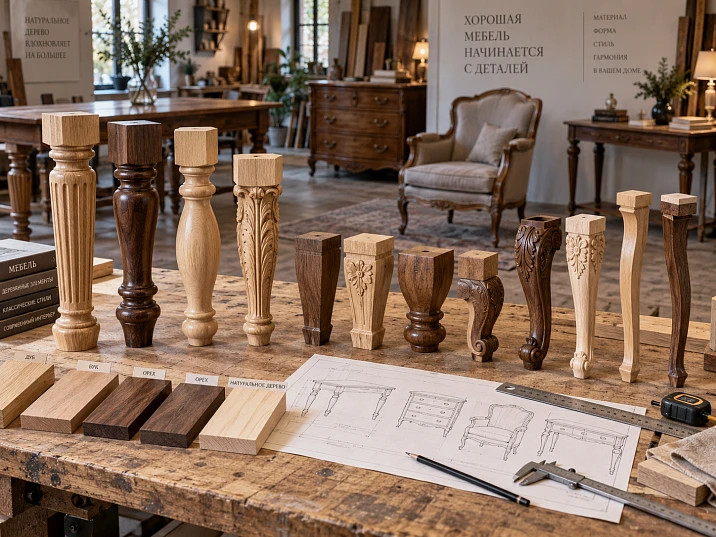
An order for four neo-classical style sideboards: the carcasses are made, the fronts are painted, and only the carved legs remain to be chosen. The workshop opens the catalog and sees forty-six models of carved supports priced from 1,940 to 143,160 rubles apiece. Many of them are beautiful. But only a few are suitable for a specific sideboard, and they can be distinguished only by height, top plate, curve, and mounting method, not by the picture.
A carved leg is chosen in this order: first the support, then the decor. The furniture type determines the required height and load, the carcass construction determines the top mounting zone, and only after that are the shape, carved profile, wood species, and finish selected. Below, the path is broken down step by step: furniture type, height, carcass construction, leg shape, mounting plate, carved profile, beech or oak, finish, SKU, sample, set, purchase. The breakdown uses real STAVROS product cards: cabriole MN-144, table MN-040, sculptural MN-046 with a lion's head, and other models.
Carved leg: first the support, then the decor
First principle: you cannot choose by ornament alone. A leg has height, a top mounting zone, position relative to the carcass, shape, mounting method, and actual contour. The carving pattern matters, but it is third or fourth on the list.
Why this happens. Beautiful carving on a leg of the wrong height makes furniture an inconvenient height. Beautiful carving on a leg whose top plate is wider than the available body area simply won't install at all. And carving that has turned to an inconvenient side spoils the look from the front. All these problems arise not from a bad leg, but from the wrong order of selection.
So first comes the furniture design: heights, loads, mounting points, position of supports. And only then the carving and style. This order narrows the catalog from dozens of items down to a few, among which you just have to choose to taste.




What's in the catalog today
Section Carved legs for furniture at the time of checking contains 46 items. The filters let you select products by application (bar counter, sofa, coffee table, chest of drawers, wardrobe and cabinet, console table, armchair, bed, table, chair, stool and bench), sizes A, B and C, collections ("Art Deco", "Classic", "Modern"), type of ornament (floral) and availability in Moscow and Saint Petersburg. The legs are supplied unpainted, which allows you to finish them together with the rest of the furniture.
The price range is wide: from 1,940 rubles (MN-044, marked as a "bestseller") to 143,160 rubles (carved support MN-244, "new"). Prices at the time of checking; before ordering, check the current price in the product card.
Our factory also produces:
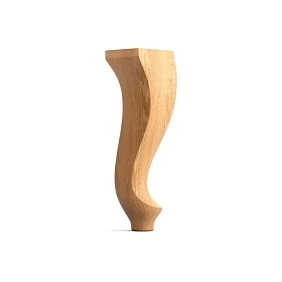
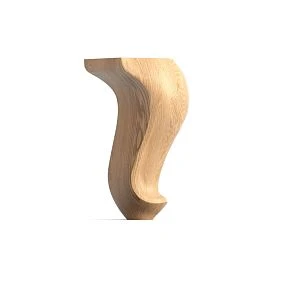
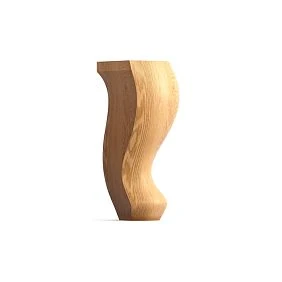
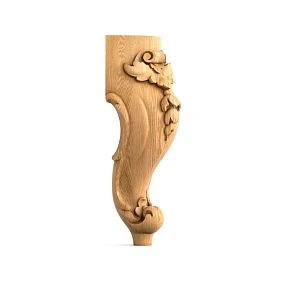
First determine which furniture the carved leg is for
A leg that is identical in style does not necessarily suit a table, chest of drawers, sofa and armchair. The reason is that these items have different heights, loads, mounting points and proportions.
A table needs a height coordinated with the thickness of the tabletop and the chairs, space for the legs and a rigid connection between the supports. A chest of drawers needs a low leg that lifts the heavy body and does not protrude beyond the front. A sofa and armchair need a support that sets the seat height and works under the load of a seated person. A console needs a tall, narrow support that is sensitive to lateral load. A stool and bench need a leg that withstands dynamic loads.
The "Application" filter in the catalog reflects precisely these differences. The "sofa, armchair" or "table" mark in the product card means that the manufacturer permits such use, but it does not replace checking the dimensions for your design.
Get Consultation
Total declared load
The manufacturer states a vertical load capacity of at least 100 kg for all its furniture legs. This is the general minimum across the catalog. For tall, thin, and strongly curved shapes, actual stability depends on the mounting point and construction, so for each model confirm the allowable load with a manager, especially if the furniture is heavy.
How to write down the task
Before choosing, write down: the type of furniture, the required final height, the weight of the item with load, the construction (with or without a stretcher), the number of supports, and the finish. These six points turn the choice from "I like it" into selection by parameters.
Carved table legs
Commercial demand for carved table legs is pronounced, and that is understandable: a table stands on four prominent supports that define its character. For a table, check the final height, tabletop thickness, presence of a stretcher, legroom, and the distance between supports.
Height is calculated as follows: leg plus tabletop plus mounting point. If you need a table height of 770 mm and the tabletop is 30 mm, the leg should be about 740 mm. In a standard scheme, the stretcher does not add height, but check the mounting point against the drawing.
Example MN-040
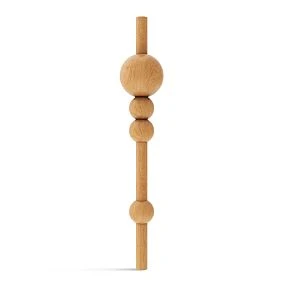
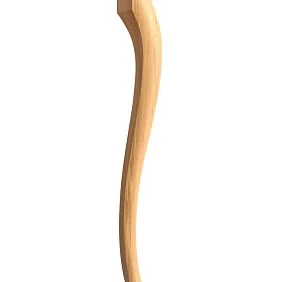
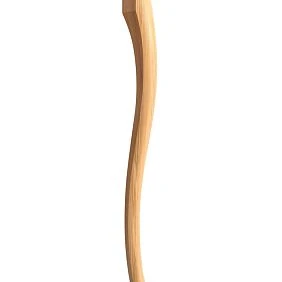
Carved furniture leg MN-040 is categorized under tables in the product card. According to the description, it has a curved shape and is available in three heights: 650, 740, and 900 mm, in oak or beech, unfinished. In the list, the price starts at 7,020 rubles per piece, availability "in stock." Recommended glides: round FUR-022 (d=30 mm, 170 rubles) and felt FUR-028 (d=28 mm, 70 rubles).
This example shows the pattern of a separate support: item code, four identical legs, and its own base construction. Four MN-040 legs will cost at least 28,080 rubles. A height of 650 mm suits a bench or low table, 740 mm a dining table, and 900 mm a high table or counter. For each option, recalculate the final height with the tabletop.
Remember the limitations. A 740 mm leg under a 30 mm countertop gives 770 mm. If you need exactly 750 mm, you'll have to either change the goal or look for another option. The manufacturer does not perform trimming of products, so cutting is your risk.
The fork "four separate legs or a ready-made base" is covered in detail in a separate article, so we won't repeat it here.
Carved legs for a dresser, sideboard, and cabinet
A completely different height logic applies here. The leg raises the body by a small distance rather than forming the height of the work surface. Check five things.
-
Body height: the leg is added to it.
-
Desired clearance: the ability to clean under the furniture.
-
Number of supports: four or an additional central one for a long body.
-
Whether the leg protrudes beyond the front and sides.
-
Whether it interferes with the first drawer when opening.
The formula is simple: body plus leg equals the total height. For a 700 mm body and a 240 mm leg, we get 940 mm. The difference between 200 and 270 mm legs (two possible sizes of MN-144) gives a total difference of 70 mm, which noticeably changes the proportions and ergonomics.
Examples from the cabinet furniture catalog
For chests of drawers, buffets, and wardrobes, the description of MN-144 explicitly states its application. The list of carved legs includes, for example, MN-005 (from 2,310 rubles), MN-041 (from 2,400), MN-078 (from 2,750), MN-076 (from 3,480), MN-075 (from 4,020), MN-077 (from 4,530), MN-079 (from 5,970). Prices at the time of checking. A set of four MN-005 costs at least 9,240 rubles, and four MN-076 at least 13,920 rubles.
Regarding the number of supports and bottom deflection, the general principle is this: for a long or heavy cabinet, the designer checks whether a central support is needed. Carved legs look good in the four corners, but the central support must be the same height, otherwise the cabinet wobbles. General principles for selecting height and supports for cabinet furniture are covered in the material about wooden furniture legs for a chest of drawers, nightstand, and console.
The cabriole leg as a distinct geometry
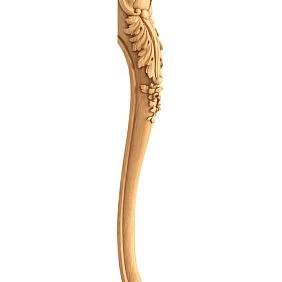
A cabriole is not just a “carved leg.” It is a shape with a pronounced S-shaped curve, where the contour differs at the top and bottom, and there is a visual overhang and direction. For placement under a cabinet, this matters: the lower part extends beyond the projection of the upper part.
MN-144
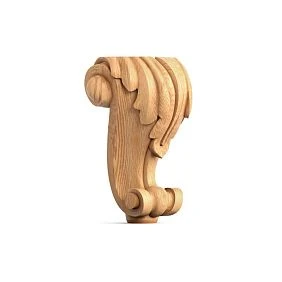
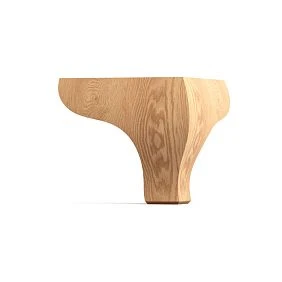
Carved furniture leg MN-144 described as an elegant cabriole leg made of solid wood in a neoclassical style. Its S-shaped form with a double curve, according to the description, blends harmoniously with both classic and modern furniture. The manufacturer states that the model is intended for legless (apron-free) constructions and is designed for high loads. Application: ottomans, benches, sofas, chests of drawers, buffets, wardrobes. The price in the list starts at 3,140 rubles per piece, “in stock.” In the promotional text of the product card, three sizes are mentioned: 200, 240, and 270 mm; verify them against the size table hidden behind the “All sizes and prices” button.
For mounting, a metric stud or M8x60 self-tapping screw is recommended (FUR-001-1, 72 rubles), along with kits FUR-001 (117 rubles) and FUR-012 (152 rubles). For this leg, a felt glide FUR-027 (55 rubles) or glide FUR-021 (130 rubles) from the SUPER GLIDE series with a sliding coating is additionally recommended, allowing heavy constructions to be moved easily without damaging the floor.
What an apron-free construction means
The leg is held only by its own mounting point, without connection to neighboring supports via an apron. This gives a lightweight appearance but increases the requirements for the mounting point: the stud, the thickness of the base, possible reinforcement. Check that there is enough cabinet material under the leg.
Calculation for chests of drawers
Four MN-144 legs cost at least 12,560 rubles. For a series of ten chests of drawers, 40 legs are needed, that is, at least 125,600 rubles, plus hardware: a stud (72 rubles) and a glide (55 rubles) per leg give 127 rubles, that is, 5,080 rubles for 40 legs. Figures are based on "from" prices.
Carved legs for sofas and armchairs
Upholstered furniture has a different scale and a different construction. Take into account the seat height, the frame, the upholstery, the difference between the front and rear legs, and the actual mounting area. Seat height is made up of the frame, the seat base, the cushioning, and the leg. This calculation is discussed in more detail in the material about chair legs; here it is enough to remember: the leg height cannot automatically be equated with the height by which the seat will rise.
MN-071
Carved furniture leg MN-071 in the list it costs from 3,230 rubles and has the status "in stock." According to the project plan, the product page directly indicates use for a sofa and an armchair. We did not open this page for the article, so see the height, dimensions, and mounting features there. A set of four legs will cost at least 12,920 rubles.
Sofa and armchair: difference in load
A sofa bears more weight than an armchair, and the number of supports is often more than four. A leg suitable for an armchair may be insufficient for a three-meter sofa. Therefore, the label "sofa, armchair" does not remove the need to check the load for a specific item.
Carved legs for a console
A console is usually taller than a chest of drawers, narrower than a regular table, and visually lighter. Therefore, the leg must match not only the height but also the depth of the furniture. A tall, narrow console is especially sensitive to lateral load: the higher the leg, the greater the moment on the mounting joint.
MN-189
Carved furniture leg MN-189 in the list it costs from 13,640 rubles, lead time "5–10 days." According to the project plan, the product page relates to a console. We did not open the page, so check the dimensions yourself. A set of four legs costs at least 54,560 rubles.
Pay attention to the price: carved legs for a console are noticeably more expensive than legs for a chest of drawers because they are longer and require more material and labor. Before budgeting for such a leg, calculate the budget of the entire item and compare it with simpler turned supports. The general principles for choosing console legs by tabletop height are covered separately in the material about console legs.
Carved legs for chairs, stools and benches
A small separate block. A chair and a stool work under dynamic load: a person sits down, rocks, stands up. Therefore, you cannot automatically transfer a furniture leg for a table to a chair just because it fits in height. The cross-section, the joint and the rigidity of the connection for a chair are different.
MN-039
Carved furniture leg MN-039 in the list it costs from 4,300 rubles, "in stock". According to the project plan, the card relates to a chair and stool. We have not opened it, so see the dimensions and mounting features in it. In the related products block, it is named alongside MN-040, MN-041, MN-005 and MN-077.
For benches and poufs, models like MN-144 are applicable, in the description of which poufs and benches are directly indicated. For a chair, check that the manufacturer allows such use, and clarify the load.
Rule
Do not choose a leg for a chair by height and appearance. Make sure that the card permits such use, and check the joint with the seat. For chairs with a backrest, the rear legs are often integral with the backrest, and a separate carved leg is not suitable here at all.
Height of the carved leg: a dimension that cannot be changed "by eye"
The main formulas are as follows.
-
General: the body plus the leg equal the new overall height of the furniture.
-
Table: leg plus tabletop plus mounting joint.
-
Dresser: body plus leg.
-
Armchair: frame plus upholstered seat plus leg.
Therefore, the final piece of furniture is designed first, and then the leg is selected. You cannot first buy a leg because you liked it and then calculate the height.
Example numbers
Dresser: body 700 mm, leg 240 mm, total 940 mm. Table: leg 740 mm, tabletop 30 mm, total 770 mm. Armchair: target seat height 450 mm, body with upholstered seat 330 mm, a leg of about 120 mm is needed. In all cases, set a tolerance for the final height, for example ±10 mm, and select models from the catalog that fall within the range.
Catalog range
According to the general text of the section, the height of legs in the catalog varies from 30 to 2100 mm, and the diameters of round legs from 20 to 100 mm. For carved shapes, the range is narrower: product cards show heights from a few centimeters for low supports to 900 mm and above for dining tables. Therefore, among carved legs, the required height may simply not be available, and then the project will have to be changed.
About glides
A glide adds height and protects the floor. Felt ones (FUR-027 for 55 rubles, FUR-028 for 70) are suitable for parquet, round ones (FUR-021 for 130, FUR-022 for 170) for other surfaces. Check the thickness of the glide in its product card and take it into account in the calculation.
The same height does not make two legs interchangeable
Two 200 mm legs can have completely different top plates, widths, curves, offsets, shapes, and ornamentation. The 200 mm size is only one parameter. So a “leg of the same height” does not mean a “leg that will fit.”
Let’s take two carved legs from the catalog. The cabriole MN-144 has a double S-shaped curve, and its lower part is offset relative to the upper part. A straight carved support of the same height stands strictly vertical. Under the same cabinet, the cabriole will extend beyond the cabinet’s projection more, and the side view will be different.
What to compare
The top plate: its size and shape. Overall width and depth. Offset: how far the lower part extends beyond the upper part. Center of gravity height: it is different for curved legs. Mounting method: stud, plate, tenon.
Practical conclusion
Do not replace a leg with one “of the same height.” Check all parameters against the product card table and the drawing. If something does not match, assess whether it will affect the structure and appearance.
The upper mounting part matters more than the lower beauty
The lower part of the leg is visible, the upper part is hidden, but it is the upper part that determines whether the leg will fit at all. Before purchasing, check the width of the upper part, the depth, the contact plane, the fastening, and the available space on the cabinet.
Pay especially close attention if the cabinet is narrow, there is a rail, or the front is close to the edge. A leg with a 60 mm top plate will not fit into a 50 mm wide area. A leg whose top is wider than the rail will not sit flush.
Regarding mounting, the general text of the section says that legs are available with mounting by tenon, bolt, sleeve, or mounting plate. In the product cards of verified models, a stud or M8x60 self-tapping screw and kits are recommended. A length of 60 mm means the cabinet must have sufficient thickness. If the material is thinner, reinforcement or another method is needed.
Base material
Fasteners hold better in solid wood than in particleboard and MDF. For panel materials, a block or anchor plate is placed under the leg. The load is transferred to the reinforcement, not to the thin panel.
Image error
You cannot choose a fastener from a photo. It does not show the top diameter or the hole position. Always check against the size chart.
Contour of a carved leg: why you need a 1:1 template
A carved leg is rarely a simple rectangle. It may curve forward, angle to the side, widen toward the bottom, and have a sculpted protrusion. A rectangular diagram on a drawing does not convey this.
That is why this sequence is useful: contour, 1:1 template, test fit under the cabinet. Draw or print the leg contour at full size, front view and side view. Cut templates out of cardboard. Place them in the positions of the future legs under the cabinet or under the mockup. Check whether the contour protrudes beyond the side panel, whether it interferes with the drawer, and whether the offsets are symmetrical.
What is visible on the template
The overhang of the lower part beyond the cabinet projection. The position relative to the front. The ratio of the leg mass to the cabinet. The distance to neighboring objects and the wall. None of this is visible on a drawing with axes.
About lighting
Relief of a few millimeters almost disappears in diffused light. Evaluate a carved leg under the lighting in which the furniture will stand. A leg in a shadowed lower area often reads weaker than in a photograph.
Symmetry and orientation of four carved legs
This is especially important for cabriole legs, asymmetrical carving, and sculptural pieces. Four identical SKUs still need to be oriented correctly relative to the front.
Check three things. Which way the curve faces: outward from the center, forward, or to the side. Where the front face is: on a carved leg, the front and back differ. Whether the rotation angles match: all four legs should be positioned identically relative to their angles.
For corner cabriole legs, the curve is usually directed outward diagonally. If the leg is symmetrical about the vertical plane, all four can be installed with a 90-degree rotation. If the leg is asymmetrical, symmetrical furniture requires pairs of left and right. To see whether such pairs are available in your model, check the product page and confirm with the manager.
How to check
Place the four legs on the table in their intended positions, rotating them into the position they will occupy. Step back three meters and look at the overall appearance. The symmetry should be immediately apparent. Take a photo and save the layout as a reference for assembly.
Position mark
During serial assembly, mark the legs with a pencil on the hidden side: "front left," "rear right." Otherwise, on the production line, they will end up rotated arbitrarily.
When a carved leg should be the main decorative element
If the leg is complex and sculptural, there is no need to add a massive overlay, a complex capital, rich molding, and several rosettes at the same time. Otherwise, the piece loses its hierarchy.
Principle: the main carving plus supporting elements, not everything competing with everything else. If a leg with a lion's head draws attention, the other elements should be calmer and echo its motif only softly.
How to tell it's overloaded
Photograph the piece with templates of all the decorative elements and remove half. If the composition improves, keep removing. If it loses meaning, then the right ones were removed. Sometimes the best result is one expressive leg on a calm, smooth body.
Coordination with other decor
The leg's motif should work with the facade, apron, tabletop, and overlays. If the body is decorated with an acanthus ornament, a leg with a plant motif will support it. A leg with an animal motif will create a different accent that must be consciously supported by the rest of the design.
Sculptural legs: a separate category
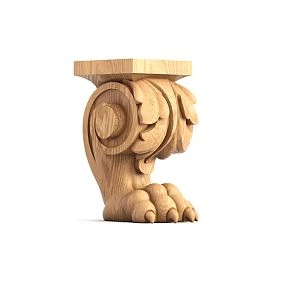
Some models already become the compositional center themselves. Example: a carved furniture leg MN-046 with a lion's head. According to the description, it is handmade, with graceful curves and a carved lion's head, made of oak or beech, and supplied unfinished. Fasteners are not included. The price in the list starts at 16,100 rubles per piece, "in stock." Recommended round glide FUR-022 (d=30 mm, 170 rubles). The related products block shows bracket KR-034 (from 10,660 rubles), carved mascarons M-002 (from 1,980) and M-014 (from 4,520), legs MN-045 (from 28,120) and MN-006 (from 3,480).
The dimensions of MN-046 are in the table hidden behind the "All sizes and prices" button; check the height and overall dimensions there. In the product card's promotional text, the application is described very broadly (armchairs, chairs, tables, consoles, beds), so do not rely on this and check the load capacity and mounting point for your furniture.
For a sculptural leg, scale, orientation, free space around it, and the finish of the deep relief are especially important. The lion heads on all four legs should face the same direction relative to the facade. A set of four MN-046 costs at least 64,400 rubles.
About adjacent mascaroons
Mascaroons M-002 and M-014 in the related products block show that you can carry the leg motif onto other parts of the furniture. But remember the hierarchy principle: don't repeat the lion on every surface.
Beech or oak for a carved furniture leg
We won't repeat the entire article. Beech is a dense, non-porous wood that the manufacturer calls the most commonly used in items under enamel. It is rational for enamel, dense opaque paint, and patinated furniture. Oak is a dense, porous wood with a pronounced natural texture, often used with a semi-transparent finish that emphasizes the grain. It is chosen when the wood grain is preserved and oil, stain, clear lacquer, or tinting are used.
What matters for carving
On a carved surface, oak's texture can compete with the relief: the fibers cross the carving and create an additional pattern. For fine carving, beech with its calmer structure allows the relief to read more clearly. For large carving with broad planes, oak looks advantageous.
Glue-up grade and sanding
For opaque finishing, choose "under enamel"; for semi-transparent, "under tinting." "Standard" is machine sanding at a more attractive price; "Prestige" is detailed hand sanding, after which items require no additional work. For carved parts, "Prestige" is often justified: relief is harder to finish on your own.
Other wood species
Made to order, if you need more than a one-off item, the manufacturer can produce products from other species, including from the customer's blanks according to technical specifications. For single furniture items, expect oak and beech.
A carved surface requires a different approach to finishing
Deep relief has recesses, corners, shadow areas and fine transitions. Mistake: applying the finish the same way as on a flat board. You need to control build-up, evenness, penetration of the recesses and preservation of the readability of the relief.
Thick enamel clogs fine carving, so apply thin coats and watch the recesses. Stain collects in deep areas and produces dark spots if it is not wiped off. Patina works when the dark compound is laid into the recesses and the raised areas are wiped, and it requires clear relief. Lacquer runs into the hollows and forms drips.
Recommended sequence
The manufacturer gives four steps for lacquer and enamel: dust removal after sanding, even priming, sanding after the primer has fully dried, and a topcoat in two layers with drying between layers. For relief, add dust control in the recesses before priming: it shows through under the coating.
Test swatch
Do a test on a whole leg sample, not on a flat offcut. Relief behaves differently from a flat surface. Check how the coating sits in the recesses, whether the pattern gets clogged, and how the result looks in side light.
Who paints
The manufacturer paints products when ordering goods worth 150,000 rubles or more. For a single piece of furniture, such an amount is achievable only with a large batch of expensive legs, so usually you plan your own finishing.
Unpainted carved leg for a furniture workshop
The main advantage of an unpainted leg: it can be included in the project's own finishing system. For example, coat the facade, frame and legs with the same enamel. Or finish a oak body and oak legs with the same tint.
Section Unpainted legs contains the main part of the catalog, including all verified carved models. There is a separate section for legs with a ready-made finish, but it has fewer carved models.
How to achieve a uniform tone
Paint the parts using one system in a single pass. A carved leg and a flat apron absorb the material differently, so compare on a sample rather than by the color name. The tone on the ends and in the recesses may differ.
About storage
Most of the items are stored in the warehouse unsanded; shipping from the warehouse takes up to three business days. So don't expect to get the legs tomorrow and paint them today: allow for the lead time.
One sample before buying four or twenty legs
For production, the order is as follows: item code, sample, installation, paint test, approval, set or batch. Skipping any step turns the series into an experiment.
Check six things: actual height, geometry, orientation, installation, finish result, and scale relative to the cabinet. For a carved leg, add a sixth and seventh: the readability of the relief after coating and how the joint behaves under lateral pressure.
The price of a sample can be significant. One MN-046 costs from 16,100 rubles, MN-189 from 13,640, MN-114 from 12,850. But a mistake in a series of twenty legs would cost hundreds of thousands. The catalog ships items from a single piece, so you can take a sample without any commitment to a volume. Plan ahead for items with a 5–10 day lead time.
What to keep
The sample with the tag, photos, a record of the finish, and the inspection result. This is the batch reference and the basis for a repeat order.
When a sample is not needed
For an article already used in your workshop in the same construction, a repeat sample is unnecessary. It is also not needed for a single leg in a single piece.
How to document a carved leg in a furniture specification
The entry "carved leg, 4 pcs." is useless. You need an entry that allows the order to be repeated: code, manufacturer, article, material, finish, quantity.
Example: LEG-01, STAVROS, MN-144, oak, unfinished, 4 pcs. If the front and rear pairs differ, document them as separate line items: LEG-F and LEG-R.
| Code | Article | Position | Material | Quantity |
|---|---|---|---|---|
| LEG-F | MN-144 | FRONT | Beech | 2 |
| LEG-R | MN-144 | REAR | Beech | 2 |
What to add
Dimensions from the table, glue-up grade, sanding level, finish system with number of coats, hardware (hanger bolt FUR-001-1, glide FUR-027), orientation, status (SAMPLE or APPROVED), revision, inspection date.
Series calculation
Ten chests of drawers with four legs each require 40 legs. At MN-005 (from 2,310 rubles) that is 92,400 rubles, at MN-144 (from 3,140) 125,600 rubles, at MN-075 (from 4,020) 160,800 rubles. Hardware consisting of a hanger bolt and a glide comes to 127 rubles per leg, that is 5,080 rubles for 40 legs. The "from" prices are as of the time of checking; actual prices depend on size, species, and sanding.
Reserve and availability
Determine the reserve based on risk, recording it as a separate line. Some items are in stock, some take 5–10 days: plan so that the entire batch arrives in one delivery and is painted with one system.
Where to buy carved furniture legs
Main product point: section Carved legs for furniture. Additionally:
-
Wooden furniture legs: general catalog of supports.
-
Unpainted legs: for your own finishing.
-
Furniture legs and supports in the carved decor section: alternative selection.
Order conditions
Items are shipped from one piece. Delivery is available across Russia and to CIS countries via CDEK and DPD; pickup is also possible. Showrooms are located in St. Petersburg and Moscow, production is in St. Petersburg. Cutting items to size is not performed. Custom items and required sizes are made only for bulk orders. Before ordering, the manufacturer recommends preparing a design project: drawings can be downloaded on the website, and for a small number of elements a manager will help. Before placing an order, check the current price and availability in the product card.
What to clarify with the manager
Availability of the complete set in a single delivery. Exact top dimensions and height. Whether asymmetric models have left and right pairs. Allowable load for tall and curved legs. Mounting method and hardware set.
Craftsmen's questions
Which carved legs are suitable for furniture?
Those that match your structure in height, top plate, and load capacity. The furniture type determines the requirements: a table, chest of drawers, armchair, console, and chair need different supports. The label "for sofa, armchair" in the product card permits use, but does not replace checking dimensions.
Where to buy carved wooden furniture legs?
In the STAVROS catalog in the section Carved legs for furniture. At the time of checking, there are 46 items, and orders are possible from one piece.
How to choose the height of a carved leg?
Start with the final height of the furniture, subtract the body, tabletop or upholstered pack, and mounting unit. For example, a 700 mm body and a 240 mm leg give 940 mm. Set a tolerance and select models that fall within it.
Which carved legs are suitable for a table?
Those whose height, including the tabletop, gives the required size: for MN-040 this is 650, 740 or 900 mm. Check the legroom, the distance between the supports and the connection with the apron.
Which legs should I choose for a chest of drawers or a cabinet?
Low ones, with a top plate that fits under the bottom and an overhang that does not protrude beyond the front. For chests of drawers and sideboards, MN-144 is explicitly stated in the description. For long carcasses, check whether a central support is needed.
Are carved legs suitable for a sofa and an armchair?
Yes, if the product page allows such use and the dimensions suit your frame. For MN-071, the project plan specifies use for a sofa and an armchair, but check the product page yourself. Assess the load and seat height separately.
What is a cabriole leg?
It is a leg with a double S-shaped curve. It has a different contour at the top and bottom and a noticeable overhang. In the catalogue, an example is MN-144 in the neoclassical style for constructions without aprons.
Which is better for a carved leg: beech or oak?
Beech for enamel and patina, oak for oil, stain, varnish and tinting with visible texture. For carving, beech shows fine relief better, while oak wins on large flat surfaces.
Can carved legs be painted together with the furniture?
Yes, unfinished legs are designed for this. Apply thin coats so as not to clog the relief, and do a test on a whole leg. Paint separately from the carcass and install after drying.
Should I buy a sample before ordering a set?
For a new SKU, yes: the sample verifies height, orientation, joint, and finish. For an already verified SKU, a sample is not needed.
Prices, the composition of the carved legs section, specifications of MN-144 and MN-046, recommended hardware, ordering terms, glue-up grades, sanding levels, and finishing sequence were verified against the STAVROS catalog at the time of preparation. Data for MN-040 is taken from a previous review of its product page. Calculations are illustrative.