Article Contents:
- When R-031 can be used instead of a capital
- Why a rectangular element is called a socket
- A socket is not equal to a ceiling medallion
- A socket is not related to electrical work
- A socket is not equal to a long overlay
- Narrow furniture portal
- Trim near the ceiling
- Repeat on multiple sections
- Caisson with rectangular cells
- Decor above the furniture stand
- R-031 100 × 57 × 14 mm
- R-031 120 × 68 × 16 mm
- R-031 140 × 80 × 19 mm
- R-031 170 × 97 × 23 mm
- Field 120 mm and R-031 width 80 mm
- Field 105 mm and R-031 width 97 mm
- Field 90 mm and R-031 width 68 mm
- Field 150 mm and R-031 width 97 mm
- What to do with the height remainder
- Why depth affects style
- One socket above the opening
- Two sockets on vertical casings
- When there is little free space above the door
- Pilaster of a built-in wardrobe
- Showcase pilaster
- Kitchen portal
- Rhythm of identical sockets
- Central section as accent
- Repeat in each cell
- Accent only in part of coffers
- Relief lighting
- Beech for enamel
- Oak for tinting
- When to consider "Standard"
- When to consider "Prestige"
- One color with the base
- Tone-on-tone with wood
- Contrasting decorative accent
- Example request
- What is R-031?
- Why is R-031 called a socket?
- Can R-031 be used instead of a capital?
- What sizes are available?
- What do A, B, and C mean?
- What size to choose for a field 120 mm wide?
- Will R-031 fit for a door casing?
- Can it be installed on a furniture pilaster?
- Is R-031 suitable for a ceiling coffer?
- Is this a ceiling rosette for a chandelier?
- Can R-031 be rotated horizontally?
- What to choose — beech or oak?
- What is the difference between "Standard" and "Prestige"?
- What is included in the order?
- How does R-031 differ from a real capital?
- How does R-031 differ from N-031?
- How to calculate the side margins?
- Do I need to order one sample?
- Can beech and oak be mixed?
- Where can I see other rosettes?
- When is a full capital needed instead of R-031?
- How many sockets to order for two doors?
- Can R-031 be installed without finishing?
- Where to check the price of R-031?
- Can R-031 be trimmed?
- How to check the depth of 23 mm?
- What to do if the 140 mm size is too small and 170 mm is too large?
- Is R-031 suitable for a series of identical cabinets?
- How to connect the socket to the cornice?
- Why should R-031 be looked for in the sockets section rather than capitals?
- Narrow casing with an 85 mm field
- Furniture post 110 mm wide
- Wide pilaster with a 150 mm field
- Caisson measuring 240 × 180 mm
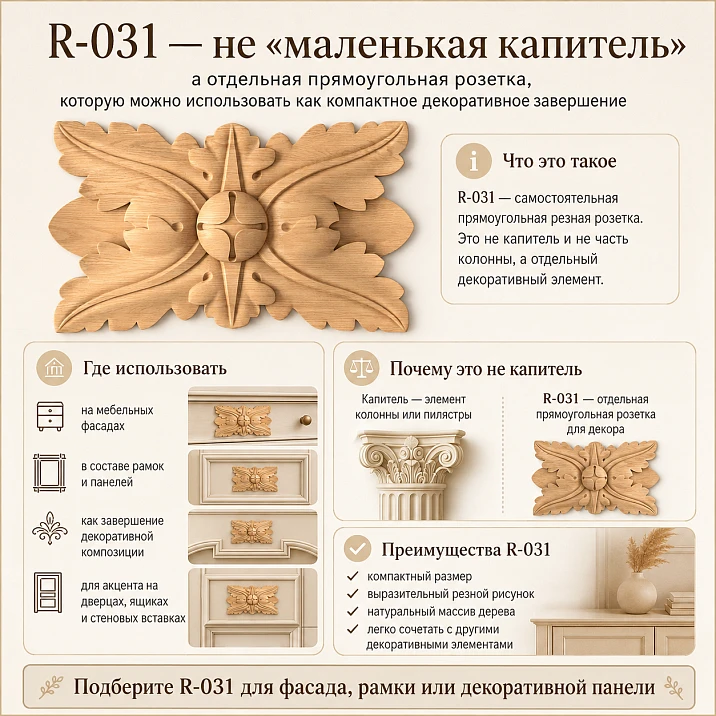
You need a small carved element for the top of a wide casing, furniture post, or pilaster. A full capital seems too large: it extends beyond the edges, conflicts with the cornice, and requires a more developed architectural composition. Searching in the capitals section yields nothing, although a suitably scaled part exists. It is simply called differently — wooden decorative rosette R-031.
The word "rosette" often misleads the buyer. It evokes an image of a round ceiling medallion under a chandelier or a small symmetrical ornament in the center of a facade. R-031 is designed differently. It is a rectangular carved element with acanthus leaves and a central bud. The product card allows its use on wide architraves and pilasters instead of the usual capital, as well as on furniture and in ceiling coffers. Therefore buy a wooden decorative rosette R-031 can be used not only for a flat central accent, but also for completing a vertical composition.
However, the word "instead" should not be taken literally. R-031 does not become an architectural capital just because it is installed at the top of a pilaster. It has no base, shaft, developed lateral projection, or structural function. It works as a compact applied detail: it emphasizes the top of the vertical, adds an acanthus motif, and helps to decorate an area where a real capital does not fit or looks excessive.
The model has four sizes: 100 × 57 × 14 mm, 120 × 68 × 16 mm, 140 × 80 × 19 mm, and 170 × 97 × 23 mm. As the height increases, the width and depth of the relief also increase. Therefore, the choice cannot be reduced to the question "which rosette will fit in height." You need to measure the flat field, check the side margins, adjacent molding, cornice, door, and opening trajectory. Only after such a fitting does it become clear whether R-031 will really replace a large capital in a specific project.
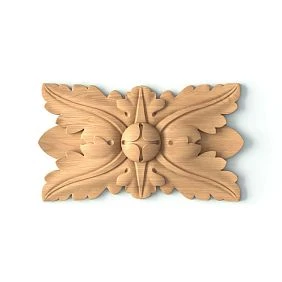
When R-031 can be used instead of a capital
R-031 is suitable for the role of a compact top accent when there is a flat rectangular field on an architrave, furniture post, or pilaster, and a full capital turns out to be too wide, deep, or complex in shape. The rosette does not assemble the order system, but visually completes the vertical and connects it with the cornice, molding, or adjacent carved decor.
This option is especially appropriate if:
-
a wide door architrave is being decorated;
-
the top of a furniture post remains empty;
-
the pilaster has a small width;
-
a repeating acanthus motif is needed;
-
a full capital extends beyond the field boundaries;
-
the facade is located next to an opening door;
-
the project needs a small protrusion above the plane;
-
the same detail must be repeated on several sections;
-
the coffered ceiling requires a rectangular module, not a central ceiling rosette.
If the project is built as a full pilaster with a base, shaft, cornice, and a pronounced architectural finish, it is more correct to buy a wooden capital for the pilaster and match it to the width of the entire vertical. R-031 should not mask the absence of the required structural or compositional element.




Why is a rectangular element called a rosette?
In the decorative catalog, a rosette is not necessarily round. The name describes a separate applied ornamental element, not a single geometric shape. Wooden rosettes can be round, square, oval, and rectangular. They are installed on furniture facades, walls, ceilings, casings, pilasters, and other surfaces.
R-031 belongs to this group based on several characteristics:
-
it is an independent applied part;
-
the pattern is assembled around a central motif;
-
the element is not a long molding;
-
it does not need to be assembled from multiple parts;
-
it can be repeated as a module;
-
it is used on various flat bases.
Therefore, looking for R-031 only among capitals means limiting the search by name, not by actual function. in the catalog of carved wooden rosettes forms of different geometries are collected, and a rectangular model may be more accurate for the task than a large architectural detail.
Our factory also produces:
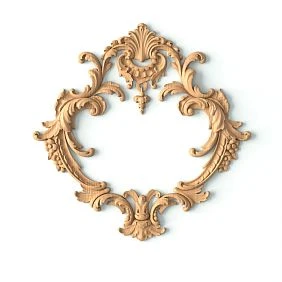
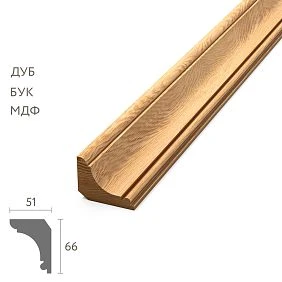
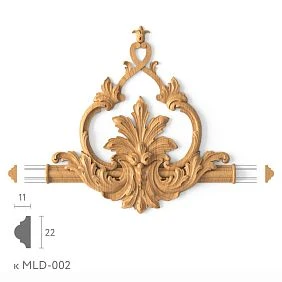
A rosette is not equal to a ceiling medallion
R-031 is not a central ceiling rosette for a chandelier. It has a rectangular elongated contour and a different scale. In a coffered ceiling, it works as a repeating decorative module, not as the center of the entire ceiling composition.
Get Consultation
The rosette is not related to electrical work
The article is about wooden carved decor. The query "rosette R-031" is not related to wiring, switches, or mounting frames. The word "decorative" helps separate the product from electrical topics.
A rosette is not equal to a long overlay
R-031 is a compact rectangular accent. The longitudinal overlay creates an elongated line and takes up much more space. The difference is especially important to consider due to the similar article number N-031.
Confirmed characteristics of R-031
| Parameter | Confirmed data | What this changes when choosing |
|---|---|---|
| Article number | R-031 | Do not confuse with N-031 |
| Type | Wooden rectangular carved rosette | Suitable for flat decorative field |
| Ornament | Acanthus leaves and central bud | Supports classical and floral composition |
| Size 1 | 100 × 57 × 14 mm | Most compact scale |
| Size 2 | 120 × 68 × 16 mm | Medium small accent |
| Size 3 | 140 × 80 × 19 mm | For a wider field |
| Size 4 | 170 × 97 × 23 mm | The largest and deepest option |
| A | Height | Checked against the vertical field |
| B | Width | Checked against the plane of the casing or pilaster |
| C | Depth | Affects the overhang and proximity to the door |
| Material | Beech or oak | Connects with future finishing |
| Preparation | "Standard" or "Prestige" | Determines the scope of further refinement |
| Application | Casing, pilasters, furniture, ceiling coffers | Requires a different fitting scheme |
| Completeness | One selected R-031 | Pilaster, trim, base, capital, and mounting system are not included automatically |
Dimensions are arranged in ascending order so the buyer can see the sequential change in scale. In the card, first you need to view four sizes of R-031, then compare not only height A, but also width B with depth C.
What the buyer receives, and what is selected separately
R-031 is sold as an independent decorative item. Purchasing one rosette does not mean that trim, pilaster, base, cornice, adhesive, or finished finish are automatically included in the order.
| Purchased | Not included automatically |
| One carved rosette R-031 | Full capital |
| Selected size A × B × C | Pilaster trunk |
| Beech or oak | Pilaster base |
| "Standard" or "Prestige" | Door casing |
| Acanthus ornament | Top cornice |
| Separate overlay element | Mounting system |
| Part for further finishing | Finished finish of the entire portal |
| Specific number of outlets | Drawing of the entire composition |
If the buyer needs not just one accent but a complete portal, it is better to immediately assemble a vertical composition and determine all elements before ordering. Then R-031 becomes a meaningful part of the system, not a random detail added at the end.
How R-031 differs from a full capital
The capital completes a column or pilaster as an architectural element. Its form is related to the shaft, base, width of the vertical, and the overall style. It may have a pronounced lateral projection, a multi-layered profile, and a more complex volumetric structure.
R-031 works differently. It is a flat applied rosette with a compact relief. It does not bear load and does not form an order. Its task is to mark the top, fill an empty field, and repeat a plant motif.
| Criterion | R-031 | Full capital |
| Type | Applied rectangular rosette | Architectural termination |
| Function | Decorative accent | Termination of a pilaster or column |
| kit | One separate piece | Often part of a system with a base and shaft |
| Lateral projection | Limited by the width of the rosette | May noticeably deviate from vertical |
| Size range | 100–170 mm in height | Depends on the specific series |
| Base | Flat, even field | Related to the pilaster profile |
| Application | Architrave, furniture, coffered ceiling, pilaster | Portal, column, developed pilaster |
| When to choose | Little space, need a compact motif | Need a full architectural composition |
A detailed comparison of the logic of the two groups provides guidance on How a full wooden capital differs from R-031. For purchasing, this means a simple rule: first determine whether an architectural system is needed or only a small upper accent.
When a rosette looks more convincing than a capital
A large capital does not always make the composition richer. On a narrow furniture portal, it can extend beyond the edges, overlap the cornice, and visually weigh down the top. R-031 works more precisely when space is limited.
Narrow furniture portal
The posts of a built-in wardrobe or bookshelf have a small width. A full capital widens the silhouette, while a rectangular rosette remains within the plane.
Trim near the ceiling
There is little space between the top of the door and the ceiling. A tall capital does not fit. The compact R-031 can occupy the free field without rebuilding the portal.
Repetition on multiple sections
On a long bookshelf, large capitals will create too active a rhythm. A small rosette repeats more calmly and does not compete with the facades.
Caisson with rectangular cells
Inside each cell, a uniform ornament is needed. The capital is not intended for this, but R-031 can be used as a module.
Decor above the furniture stand
The vertical is already formed by the body, and only a finishing sign is needed. The rosette fulfills this role without a separate base and shaft.
When a real capital is necessary
A compact replacement should not become a universal solution. A full capital is needed if:
-
the pilaster is built from the base to the top finish;
-
the project requires a pronounced lateral projection;
-
the vertical must correspond to the architectural order;
-
the portal has a large scale;
-
the cornice is designed for a developed upper part;
-
the pilaster shaft has its own profiling;
-
the decorative top must overlap the width of the post;
-
the composition is already linked to capitals of a specific series.
In such cases, it is better compare R-031 with capitals of the KL-series, and not try to force a small rosette to perform a foreign function. The capital and the rosette can be placed side by side in the same interior, but they solve different tasks. The former forms the architectural top, the latter works as an applied accent.
Four sizes of R-031: how the scale changes
The increase occurs proportionally. A taller rosette simultaneously becomes wider and deeper. Therefore, each option is designed for its own field, and the size cannot be chosen by a single number.
R-031 100 × 57 × 14 mm
The most compact option. It can be tried on a small furniture post, a narrow casing, a display facade, or a small coffered ceiling. The depth of 14 mm creates relief but does not make the piece too massive.
On a wide pilaster, such a size may get lost. It should not be chosen just because it fits exactly. The proportion between the rosette, the flat field, and the entire vertical is important.
With a field width of 90 mm, the side margins will be:
(90 − 57) ÷ 2 = 16.5 mm
Geometrically, the piece is positioned freely. After that, the shaped contour and the distance to the adjacent profile need to be assessed.
R-031 120 × 68 × 16 mm
The next scale is more noticeable but remains compact. It can be considered for a medium furniture vertical, a wide door casing, or a cabinet section.
A width of 68 mm requires an even field with side margins. On a casing 80 mm wide, only 6 mm will remain on each side. Formally, the rosette will fit, but visually it will appear cramped. A field of 100–110 mm will provide more freedom, although the exact decision is made not by a formula but by a template.
A depth of 16 mm usually aligns more easily with a door than larger versions, but the opening trajectory still needs to be checked.
R-031 140 × 80 × 19 mm
This size is designed for a wider surface. In the floral pattern, the leaves and the central bud are better readable. A depth of 19 mm creates a more noticeable shadow.
This option can be tried on a furniture pilaster, a wide casing, a portal, or a large library section. With a field of 120 mm, 20 mm will remain on each side:
(120 − 80) ÷ 2 = 20 mm
This is a convenient starting point for a mockup. But if a convex molding runs nearby, the actual flat field may turn out to be narrower.
R-031 170 × 97 × 23 mm
The largest version. The height of 170 mm, width of 97 mm, and depth of 23 mm require a free field. On large furniture and a wide casing, the rosette becomes an independent accent.
Due to the depth of 23 mm, you need to check the adjacent door, handle, and distance to the wall. A paper mockup of just the outline is not enough — a side mockup will be needed.
With a field width of 130 mm, the following will remain:
(130 − 97) ÷ 2 = 16.5 mm
The part fits, but its visual weight will be much higher than that of the 140 × 80 × 19 mm size. The two templates need to be compared simultaneously.
The size cannot be chosen based only on height A
The buyer sees four numbers — 100, 120, 140, and 170 mm — and compares them with the free space above the door. This approach is incomplete.
When moving from small to large size:
-
width increases from 57 to 97 mm;
-
depth increases from 14 to 23 mm;
-
the ornament occupies most of the plane;
-
the shadow becomes more expressive;
-
side margins decrease;
-
the detail competes more strongly with the cornice;
-
the risk of contact with the door increases;
-
the distance from which the pattern is read as a whole changes.
If a place with a height of 180 mm allows installing an R-031 of 170 mm, this does not mean that a width of 97 mm fits on the stand. Dimensions A, B, and C are always checked together.
Calculation of side margins
Let us denote:
-
W — width of the flat field of the casing or pilaster;
-
B — width of the selected R-031;
-
M — free field on each side when installed centrally.
Formula:
M = (W − B) ÷ 2
Field of 120 mm and R-031 with a width of 80 mm
M = (120 − 80) ÷ 2 = 20 mm
20 mm will remain on the left and right. Geometrically, the part fits. Next, you need to check the shaped edge, the adjacent molding, and how these 20 mm look on a real vertical.
Field of 105 mm and R-031 with a width of 97 mm
M = (105 − 97) ÷ 2 = 4 mm
Formally, the size fits, but the fields almost disappear. The ornament will be visually squeezed, and the slightest shift will become noticeable. Probably, it is better to try the size 140 × 80 × 19 mm.
Field 90 mm and R-031 width 68 mm
M = (90 − 68) ÷ 2 = 11 mm
Eleven millimeters may be sufficient on a small furniture stand, but they are not a universal norm. The result is evaluated on a full-size template.
Field 150 mm and R-031 width 97 mm
M = (150 − 97) ÷ 2 = 26.5 mm
The large rosette gets air on the sides and will probably look calmer. But it needs to be compared with the cornice and the height of the entire pilaster.
Checking the height of the decorative field
Let us denote:
-
H — free height of the decorative area;
-
A — height of R-031;
-
R — remainder.
Formula:
R = H − A
If the field has a height of 190 mm, and R-031 140 mm is selected:
R = 190 − 140 = 50 mm
The remainder can be distributed at the top and bottom, or the part can be shifted closer to the cornice. The decision depends on the entire vertical. There is no universal mandatory offset.
On the casing, the height is related to the top joint and the cornice. On the furniture post, it is related to the facade and the top rail. In the coffer, it is related to the inner frame.
What to do with the height remainder
The free space can be distributed in three ways:
-
symmetrically at the top and bottom;
-
raise the rosette closer to the cornice;
-
lower it closer to the center of the post.
Symmetry looks calm. The upper offset emphasizes the completion of the vertical. The lower position can connect the rosette with the panel or facade. The solution is checked on the general drawing.
Depth C: a parameter that is not visible on paper
A flat template shows height and width, but does not demonstrate the overhang above the surface. Between 14 and 23 mm there is a noticeable difference.
Depth is checked if nearby:
-
a door opens;
-
a sash passes;
-
a handle is located;
-
a cornice protrudes;
-
a side wall approaches;
-
a curtain hangs;
-
the lamp is located;
-
another decorative strip runs through.
For fitting, cut a small strip of the required thickness and temporarily apply it to the spot. Such a mock-up shows the real shadow and distance to moving parts.
Why depth affects style
A flat relief is perceived as calmer and connects more easily with a small trim. A deeper rosette creates a strong shadow and requires a larger surrounding. If the cornice barely protrudes above the plane, R-031 with a depth of 23 mm may become the most voluminous element and disrupt the hierarchy.
Full-size template before purchasing the series
One of the most reliable checks is a 1:1 scale mock-up. The A × B rectangle gives a first impression, but it is better to transfer the outer shaped contour according to the drawing.
Procedure:
-
select the intended size;
-
make a rectangular base A × B;
-
apply the shaped contour;
-
mark the central axis;
-
apply the template to the casing or pilaster;
-
add paper contours of the cornice and molding;
-
open the adjacent door or facade;
-
check the depth with a separate mockup;
-
view the composition from a distance;
-
photograph the result;
-
record the size and quantity;
-
only then order the series.
If the design includes several elements, it is useful to study in advance, how to assemble a pilaster, base, capital, and decorative rosetteThis helps to see R-031 not in isolation, but within the full composition.
What to show on the template
A good layout contains more than just a rectangle.
On it, mark:
-
full outline contour;
-
central axis;
-
dimensions A and B;
-
extreme points of the leaves;
-
cornice;
-
adjacent moldings;
-
top of the facade;
-
handle;
-
opening line;
-
free margins;
-
selected direction of the ornament.
For several identical sections, the template turns into a mounting jig. It helps to repeat the height and axis without constant measurements.
Check from a distance
A socket that looks large in your hands can get lost on a three-meter library. Conversely, a small detail on a narrow casing can become too active.
The mockup is evaluated:
-
up close;
-
from the main entry point;
-
from a distance of two to three meters;
-
in daylight;
-
under evening lighting;
-
next to finishing samples.
A photo is useful for comparison, but should not replace a live assessment of scale.
R-031 on a wide door casing
The platband must have a sufficient flat area. You cannot rely on the overall width if half of it is taken up by a profile or a sharp transition. Only the area where the socket will actually sit with its back side is measured.
Checked:
-
width of the flat field;
-
top joint of vertical platbands;
-
position of the cornice;
-
distance to ceiling;
-
the door opening;
-
presence of an extension;
-
symmetry of paired openings;
-
finish of adjacent parts;
-
direction of the acanthus pattern;
-
possibility to repeat the layout on the second side.
One socket above the opening
R-031 is located on the central axis of the upper part of the casing. This option ties the entire doorway together and is suitable when there is a separate rectangular field above the door.
The composition is checked together with the upper cornice. If the rosette almost touches the profile, the details merge. If the distance is too large, the accent looks detached.
Two rosettes on vertical casings
Each detail completes its own post. This method is closer to the logic of a compact capital, but remains decorative. The installation height, size, and orientation must match.
On paired doors, even a difference of a few millimeters is especially noticeable. Therefore, one common template is needed.
When there is little free space above the door
Sometimes there is little space left between the top of the opening and the ceiling. The 170 mm size may not fit in height, although the width is suitable. Then 120 and 140 mm are compared, rather than trying to trim the finished ornament.
R-031 on a furniture pilaster
A furniture pilaster can be part of a wardrobe, kitchen, library, dressing room, or display case. It already has a top rail, bottom base, and adjacent facades. R-031 is added to this system as an overlay accent.
Before purchasing, measure:
-
the width of the post;
-
height of the free top field;
-
distance to the facade;
-
handle position;
-
cornice depth;
-
lower decorative element;
-
repeatability on adjacent sections;
-
the opening direction;
-
base material;
-
future finishing.
If the rosette is wider than the flat area, it cannot be moved to a bevel or profile. A flat support is needed.
Built-in wardrobe pilaster
On tall furniture, a small R-031 100 × 57 × 14 mm may get lost. The size is chosen not only by the width of the post, but also by the height of the entire structure. For a cabinet up to the ceiling, 140 or 170 mm often looks more convincing if the field allows.
Showcase pilaster
The showcase is viewed from a close distance. Here, the precision of the relief and coordination with handles are important. A depth of 23 mm may interfere with opening a narrow door.
Kitchen portal
The socket can finish a decorative post next to the hood or tall cabinet. Kitchen conditions require coordinated covering and maintenance. The source data does not provide universal confirmation of moisture resistance, heat resistance, or acceptability of installation near the cooking zone.
R-031 on the built-in library
There are many verticals in the library, so size and quantity are especially important. The large R-031 170 × 97 × 23 mm on each post can overload the top row. A more compact option creates rhythm without competing with books and the cornice.
First, make one test module:
-
post;
-
top socket;
-
cornice;
-
facade;
-
color;
-
backlight.
After evaluating from a distance, repeat the size on all furniture.
Rhythm of identical sockets
On a series of six or eight sections, random differences in installation height are immediately noticeable. All parts are marked from one baseline. You cannot rely on the top of each individual door if the facades have slight deviations.
Central section as an accent
Sometimes a large R-031 is placed only on the central post, while the side ones are left without decoration or use a smaller size. This hierarchy should be shown on the overall facade before ordering.
R-031 on a wardrobe and walk-in closet
A built-in walk-in closet often has narrow vertical panels between doors. A full capital does not fit there, but a rectangular rosette can finish the post.
Check:
-
whether the part covers the technological gap;
-
whether the relief falls under the opening door;
-
whether there is space between the rosette and the upper cornice;
-
whether the finish matches the facades;
-
whether the size is repeated throughout the wardrobe.
If the posts have different widths, you do not need to automatically take different sizes of R-031. Sometimes the same compact rosette creates a more cohesive rhythm.
R-031 in the ceiling coffer
In a coffer, a rectangular rosette becomes a repeating module. It can be placed in the center of a cell, at the intersection of frames, or in an elongated field.
Here, the following are especially important:
-
cell size;
-
ornament direction;
-
number of repetitions;
-
distance to the frame;
-
depth 14–23 mm;
-
lighting;
-
symmetry of the entire grid;
-
overhead mounting method.
R-031 cannot be considered a central ceiling rosette for a chandelier. Its scale and shape are designed for a different scenario.
Repeat in each cell
Identical rosettes create a grid rhythm. The size is chosen so that the ornament does not completely fill the coffer. The free field helps to see the shape.
Accent only in the caisson area
R-031 can be used in the central group of cells, while the rest can be left calm. This solution requires a symmetrical layout and an exact quantity.
Relief lighting
Side light enhances the shadow from a deep recess. The size 170 × 97 × 23 mm may look much more active than on a table. The mock-up should be evaluated under the intended lighting.
Can R-031 be rotated horizontally
Physically, a rectangular part can be rotated. But the possibility of rotation does not equal guaranteed compositional appropriateness.
Vertical orientation emphasizes a pilaster, casing, or column. Horizontal orientation can work on a facade, in a caisson, or above a drawer. Before a series order, the pattern of leaves and the central bud should be checked in the chosen position.
Both options are compared on a template. If horizontal rotation disrupts the direction of the entire composition, it is better to choose another rosette from the category.
How to connect R-031 with adjacent decor
A rosette rarely exists alone. Nearby there may be molding, cornice, base, panel, or another carved element. Success depends not on the amount of decor, but on hierarchy.
A good scheme answers three questions:
-
which element is the main one;
-
which one supports;
-
where the free plane remains.
If the cornice already has an active carved frieze, a large R-031 may become redundant. If the post is smooth, the rosette gains more visual weight.
To find combinations, you can buy carved decor made of beech or oak and compare adjacent elements by scale, material, and style. The link should be perceived as a selection route, not as advice to fill every free surface.
Beech or oak
Both materials are confirmed by the card. The choice is linked not only to the base species but also to the finish.
Beech for enamel
Beech is suitable for opaque painting, when the rosette must match MDF, trim, or furniture body. After enamel, the relief becomes the main feature: leaves are read through light and shadow.
Decorative treatment of the painted surface is possible, but the specific system must be checked by a craftsman. The article does not prescribe a universal enamel, primer, or patina.
Beech is chosen if:
-
the furniture is painted;
-
the trim is made of MDF;
-
a single opaque color is needed;
-
the natural texture is not part of the design intent;
-
the entire batch will be finished together.
Oak for tinting
Oak is chosen when the texture needs to be preserved. A transparent or tinted coating highlights the wood grain and makes the rosette part of a natural composition.
The tone is coordinated with oak trims, pilasters, facades, and cornice. The same color looks different on different wood species.
Oak is appropriate if:
-
adjacent elements are made of oak;
-
visible wood is required;
-
toning is planned;
-
the relief should match the natural grain;
-
the finish is checked on a sample.
| Criterion | Beech | Oak |
| Main Scenario | Covering enamel | Toning and visible texture |
| Combination | Painted MDF, colored furniture | Oak trims and pilasters |
| Main effect | Relief and color | Relief, tone, and wood grain |
| Control | Test swatch | Trial tinting |
| Serial order | One color for the entire batch | One batch and one tone sample |
Why you cannot mix beech and oak without a project
After opaque painting, the difference between wood species may be less noticeable, but the surface behavior during preparation and material application still differs. With transparent finishing, the difference becomes obvious.
If one R-031 is made of beech and the adjacent one is made of oak, the same shade is not guaranteed. Therefore, the material is fixed in the specification for the entire series.
'Standard' or 'Prestige'
The two levels of surface preparation cannot be reduced to advertising words. The choice depends on viewing distance, future coating, the number of identical parts, and the amount of manual finishing.
When to consider "Standard"
-
the workshop plans its own preparation;
-
the finish is opaque;
-
there is time for manual inspection;
-
quantity is small;
-
project requirements allow additional finishing.
When to consider "Prestige"
-
the relief will be viewed closely;
-
a thin or transparent coating is used;
-
there are many elements;
-
repeatability is important;
-
need to reduce the volume of manual preparation;
-
adjacent decor is ordered in the same quality.
Even "Prestige" does not cancel inspection before finishing. The relief, edges, and back side are checked on a specific part.
Viewing distance affects the quality of preparation
A rosette in a ceiling coffer is viewed from afar. Minor traces of preparation may be less noticeable than on a display facade at eye level. But this does not mean that quality can be ignored for the ceiling.
In serial furniture, the difference between elements is more important than the absolute smoothness of a single sample. All parts must undergo the same preparation.
The finish should unite the rosette with the base
R-031 can become part of a casing, pilaster, furniture, or ceiling. In each case, it should look not like a randomly glued piece, but like a continuation of the composition.
One color with the base
The rosette is painted in the color of the casing or facade. The relief is revealed through light and shadow. This method suits beech under enamel.
Tone-on-tone with the wood
Oak is tinted together with adjacent wooden elements. A sample is needed before the entire batch, because texture affects color.
Contrasting decorative accent
The socket stands out with color or decorative treatment. The solution requires a neat border and repetition in other details. Without support, one contrasting element looks random.
Before final finishing, a dry layout should be checked. Color can enhance or reduce the visual scale.
Test paint-out before finishing the series
One sample helps to evaluate:
-
color saturation;
-
leaf readability;
-
depth of shadows;
-
match with the trim;
-
oak's reaction to staining;
-
appearance in daylight and evening light.
For oak, it is better to use a piece or sample of the same species. Testing on other wood does not show the final tone.
Dry layout before ordering multiple elements
A batch for a library, door portal, or coffered ceiling requires a general check. First, choose one size and make several paper templates. Place them in all intended positions.
This makes it visible:
-
Is the rhythm too frequent?
-
Do the axes align?
-
Is the top overloaded?
-
Is decor needed on every post?
-
Is one accent enough?
-
Are the distances to the cornice the same?
Only after this check is the quantity calculated.
What to buy together with R-031
The socket itself only solves a local decorative task. For a finished portal or furniture composition, neighboring elements may be needed, but they cannot be added automatically. First, the function of R-031 is determined, then the rest is selected.
| What to open | Why | When required | Link | |||||||||||||||||||||||||||||||||||||||||||||||||||||||||
| R-031 | Choose size and material | For the main order | buy a wooden decorative rosette R-031 | |||||||||||||||||||||||||||||||||||||||||||||||||||||||||
| Socket category | Compare other shapes | If R-031 does not fit in scale | Buy wooden decorative sockets | |||||||||||||||||||||||||||||||||||||||||||||||||||||||||
| Category of capitals | Choose a complete finish | When an architectural system is needed | to buy a wooden capital for the pilaster | |||||||||||||||||||||||||||||||||||||||||||||||||||||||||
| Pilasters and columns | Assemble a vertical composition | For a portal or furniture | Choose a wooden pilaster for a decorative top | |||||||||||||||||||||||||||||||||||||||||||||||||||||||||
| Article about pilasters | Check the combination of parts | Before a comprehensive order |
general category of carved decor and choose the shape based on the actual function. Changing the product is better than trying to install R-031 where it does not match the scale.
Checklist for ordering R-031Before sending the request, fill in the data:
Example requestWe need a wooden rectangular rosette R-031 for the upper part of a furniture pilaster. The width of the flat field is 120 mm, the free height is 190 mm. We are considering the size 140 × 80 × 19 mm. Quantity — 8 pieces. Material — beech, prepared for opaque enamel, quality "Prestige". Please confirm the current parameters, price, availability or production time, and the possibility of receiving the entire batch in one finish. A layout template is attached to the request. How to order R-031 on STAVROS
For a broad query like "buy decorative wooden rosette," the correct route remains Catalog of carved wooden rosettes, and the R-031 card covers the specific choice of size and material. Questions and answers about R-031What is R-031?It is a rectangular carved wooden rosette with acanthus leaves and a central bud. It is used as a separate applied decorative element. Why is R-031 called a rosette?Because it belongs to the group of independent ornamental details. Wooden rosettes can be not only round, but also rectangular, square, or oval. Can R-031 be used instead of a capital?Yes, as a compact decorative top on a wide casing or pilaster, if a full capital is not needed. R-031 does not become a structural capital and does not replace an architectural system. What sizes are available?100 × 57 × 14 mm, 120 × 68 × 16 mm, 140 × 80 × 19 mm, and 170 × 97 × 23 mm. What do A, B, and C mean?A is height, B is width, C is product depth. All three parameters are checked simultaneously. Which size should I choose for a field 120 mm wide?For example, R-031 with a width of 80 mm will leave 20 mm on each side. The final decision is confirmed by a 1:1 scale template. Will R-031 fit a door casing?Yes, if there is a flat field of suitable width and the depth does not interfere with the door opening. The overall width of the casing by itself does not guarantee compatibility. Can it be installed on a furniture pilaster?Yes. You need to check the width of the stile, the adjacent facade, the cornice, the handle, and repeatability on other sections. Is R-031 suitable for a ceiling coffer?The card allows such use. In a coffer, the part works as a repeating rectangular module. Is this a ceiling rosette for a chandelier?No. R-031 has a different format and purpose. For the central point of a light fixture, a specialized ceiling rosette is chosen. Can R-031 be rotated horizontally?Physically yes, but the direction of the ornament and composition need to be checked on a template. Horizontal rotation is not suitable for every casing or facade. What to choose — beech or oak?Beech is chosen for opaque enamel, oak — when you need to preserve the wood texture and perform tinting. What is the difference between "Standard" and "Prestige"?The volume of surface preparation and subsequent manual finishing. The choice depends on the finish, quantity, and viewing distance. What is included in the order?One R-031 of the selected size, material, and quality of preparation. Pilaster, capital, casing, and mounting system are not included automatically. How is R-031 different from a real capital?The rosette is a compact applied piece, while the capital completes the architectural vertical and is connected to the shaft and base. How is R-031 different from N-031?R-031 is a compact rectangular rosette with a height of 100–170 mm. N-031 is a long carved overlay of significantly larger scale. How to calculate side margins?Subtract the width of the rosette from the width of the flat field and divide the remainder by two. Do I need to order one sample?For a large series, complex casing, or transparent finish, a control sample is useful. It shows the actual scale, relief, and behavior of the material. Can beech and oak be mixed?Without a special project, it is not recommended. The species differ in texture and behavior under finishing. Where can I see other rosettes?In the category you can compare rectangular and square rosettes and choose a different scale or shape. When is a full capital needed instead of R-031?When the project is built as an architectural pilaster with a base, shaft, cornice, and a pronounced top finish. How many rosettes should I order for two doors?The quantity depends on the layout. With two elements per opening, four pieces will be needed plus an agreed reserve. Can R-031 be installed without finishing?The wooden part requires an agreed protective and decorative finish. The specific technology is determined by the material and the place of application. Where can I check the price of R-031?The current price is indicated in the product card before ordering. Do not fix it based on an old screenshot or a saved price list. Can R-031 be trimmed?The source data does not confirm a standard trimming of the ornament. Changing the contour may damage the leaves and symmetry, so the size should be chosen from the ready-made grid. How to check the depth of 23 mm?Make a side mock-up of the corresponding thickness, attach it to the place, and open the adjacent door. What to do if the 140 mm size is too small and 170 mm is too large?Compare other sockets or change the composition. Do not order a large part without a full-size fitting. Is R-031 suitable for a series of identical cabinets?Yes, if the size, material, preparation quality, and marking are the same. For a series, one template and a single order are useful. How to connect a socket to a cornice?Keep a free field between the parts and check their depth. The cornice should remain the main top element, unless the project provides for a different hierarchy. Why should R-031 be looked for in the socket section, not the capitals section?Because by design it is a separate applied ornamental module. The ability to place it above a pilaster does not change the product group. Additional check before ordering several door portalsWhen R-031 is repeated in different rooms, one size is not enough. Openings may differ in height, trim, and distance to the ceiling. Before ordering, a common table is compiled.
The same size on all doors creates a unified rhythm, but may not fit the narrowest trim. Different sizes are acceptable if they follow the scale of the rooms and maintain a single compositional logic. Checking R-031 in the finished interiorIf the trim is already painted and installed, the risk of error is higher. The socket is added to a finished surface, so you need to consider:
First, use a paper template and temporary fixation that does not damage the coating. Only after approval is the final technology chosen. Four typical size selection scenariosThe size chart becomes clearer when applied to a specific task. Below are not universal assignments, but examples of preliminary selection. Each option is still checked against the template and drawing. Narrow casing with a field of 85 mmA field width of 85 mm does not allow freely placing R-031 with a width of 80 or 97 mm. For the size 140 × 80 × 19 mm, only 2.5 mm will remain on each side. Even with precise marking, the ornament will be cramped. A more reasonable candidate is 100 × 57 × 14 mm: (85 − 57) ÷ 2 = 14 mm The size 120 × 68 × 16 mm will leave 8.5 mm on each side. On the template, both options need to be compared. The small one will be calmer, the medium one more expressive. Furniture post with a width of 110 mmFor a field of 110 mm, the first three sizes can be considered.
A large R-031 with a width of 97 mm will leave only 6.5 mm each. Therefore, the choice will more often be between heights of 120 and 140 mm. The final decision depends on the overall height of the cabinet and the depth of the cornice. Wide pilaster with a field of 150 mmOn a field of 150 mm, all four options fit in width. The task changes: you need to choose the scale. The smallest rosette may look lost. The size 170 × 97 × 23 mm will leave 26.5 mm each and give a deep relief. The size 140 × 80 × 19 mm will leave 35 mm each and will be calmer. If the pilaster is tall, a large option can support its proportions. If an active cornice is already nearby, a medium scale will maintain the hierarchy. Coffered ceiling cell measuring 240 × 180 mmInside such a cell, R-031 can be oriented vertically or horizontally. In a vertical position, the size 170 × 97 mm will leave a noticeable field around the contour. When rotated horizontally, you need to check whether the direction of the acanthus conflicts with the frame. For repetition in dozens of cells, a large size can create too dense a rhythm. Therefore, first, several paper templates are laid out on the ceiling plan, rather than evaluating one detail separately. What the customer should see after a full-size fittingThe template is not needed for a formal "fits" mark. After fitting, the customer should answer specific questions:
If answers remain unclear, ordering the series is premature. One control sample or an additional drawing costs less than replacing several already finished parts. Why compact decor requires no less design workA small detail seems safe: it is easy to apply, takes up little space, and does not change the furniture's construction. But it is precisely compact decor that sits near edges, handles, and profiles. An error of a few millimeters becomes noticeable. R-031 works well not because it 'fits everywhere,' but because it has four scales and clear geometry. The buyer only needs to correctly measure the field, choose the function—rosette or capital—and check the entire composition before ordering. Bottom line: you should search not by section name, but by part functionR-031 is among wooden rosettes, but it can solve the problem that brings a buyer to the capital section. The rectangular acanthus element completes a wide casing, furniture post, or small pilaster where a large capital does not fit or looks heavy. Before ordering, compare three parameters: height A, width B, and depth C. Measure the flat field, not the overall casing size. Calculate side offsets, check door opening, and make a full-size template. If the project requires a base, shaft, and developed architectural top, choose a full capital. STAVROS allows you to open the R-031 card, compare four sizes, choose beech or oak, select the surface preparation level, and navigate to related categories of rosettes, capitals, and pilasters. This route helps you order not just a beautiful carved detail, but an element that truly matches the scale and function of a specific casing, piece of furniture, or portal. |