Article Contents:
- What changes when a single profile is needed for hundreds of rooms
- What must stay the same from batch to batch
- Which parameters must not be left to the discretion of the next order
- What to lock in before launching a series
- Why a single article number is sometimes not enough
- How to turn a sample into a benchmark for the entire series
- How to agree on acceptable tolerances
- Why strips, overlays and ornaments are calculated differently
- How to create a unified set for standard rooms
- How a production batch differs from a project batch
- What to compare in the first and subsequent batches
- How to account for natural variations in wooden moulding
- Who is responsible for replicating the finished finish
- What to check on the first assembled section
- What to do if the next batch differs
- How to prepare a reorder after several months
- When polyurethane moulding is suitable for a serial project
- Why the price of a single plank does not show the cost of the solution
- What stock helps preserve the interior
- What to send the manufacturer to calculate a series
- What to check before launching stucco and moulding into a series
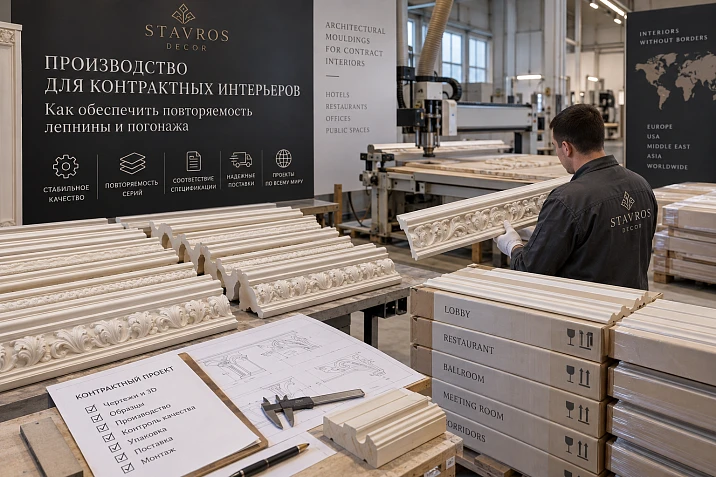
Imagine a 120-room hotel: the first building is being finished now, the second in four months. Every room has identical frames on the walls. If a similar but different moulding is ordered for the next building, the frame widths, shadow pattern and joints will change. An entire group of rooms would have to be corrected.
That is why production for contract interiors begins with the question: how can the chosen product be preserved across all repetitions? To do this, its dimensions, material and finish must be fixed, a sample approved, and records kept that allow the next batch to be checked.
Here we call contract interiors those of hotels, restaurants, offices and other facilities created according to common project requirements. Let us look at what helps achieve a consistent result when stucco and moulding are used in series.
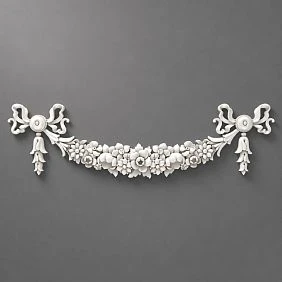
What changes when one profile is needed for hundreds of rooms
In a single room, an unsuitable strip can sometimes be replaced before the rest of the work begins. On a large site, a decision is quickly repeated: material is ordered based on it, panels are made, door surrounds are prepared and installers are trained. An error in the chosen product affects several project participants at once.
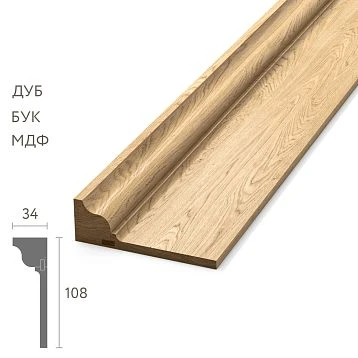
A moulding is a decorative strip that forms a frame or divides a surface. Moulding (pogonazh) is the general name for long products of constant cross-section: mouldings, cornices, skirting boards, battens. The cross-section shows the shape of the strip in transverse cut. It is this shape that determines the relief and how the profile joins with adjacent parts.
For serial rooms, reproducibility matters: the ability to obtain the product again with agreed characteristics. It does not mean that any product will be produced indefinitely. The project's task is to describe the chosen item precisely, ensure batch verification and find out the reorder conditions in advance.




What must remain consistent from batch to batch
Repeatability consists of several attributes. The product retains the required shape, dimensions, material, surface preparation, and agreed finish appearance. It can be unambiguously identified by its documents and marking.
For example, the same width alone does not make two moldings interchangeable. One may be semicircular, the other may have a step. Under side lighting they will cast different shadows. Matching color does not resolve the issue either: matte and glossy surfaces look different.
В catalog of polyurethane decor STAVROS the selection begins with a specific product. Once it is approved, the project needs a stable link between the product, the sample, and the application conditions. A photograph helps identify the part, the specification lists its parameters, and the production batch information allows the supplied product to be linked to a specific production run.
A specification is a list of products with characteristics and quantities. For repeatability, the accuracy of each line is especially important, not the volume of the document.
Our factory also produces:


Which parameters must not be left to the discretion of the next order
Different elements have their own critical dimensions. For a molding, these are width, projection from the wall, cross-section shape, and installation position. An asymmetrical profile turned the other way already changes the pattern of the composition.
For a ceiling cornice, record separately the height on the wall and the projection onto the ceiling — the distance it extends from the wall. Additionally, check the inside and outside corners. For a skirting board, height, thickness, and the connection to the architrave, that is, the door opening trim, are important.
For wooden linear trim, the wood species, cross-section, commercial length, and surface preparation are fixed. Commercial length is the length of a whole plank as supplied before cutting.
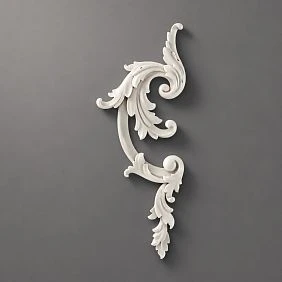
For individual mouldings, record the overall dimensions, relief and handing: left, right or symmetrical. For ornament, record the pattern direction and the repeat — the distance over which its motif recurs. A subtle difference in a single part can become obvious on a long assembled run.
Get Consultation
What to lock down before the series launch
"Freezing the decision" means agreeing on a set of parameters and changing it only through a new approved version. It is not a ban on changes, but a way to avoid working simultaneously from different data.
Below is the content of the item control card. Such a card can be included in an existing project schedule without creating a separate document for every field.
| What we record | What information is needed |
|---|---|
| Manufacturer | STAVROS for the selected product of this brand |
| Article number | Exact manufacturer designation and size variant |
| Project code | Short designation in drawings, e.g. ML-01 |
| Material | Polyurethane, oak, beech or MDF — the specific option |
| Geometry | Section, main dimensions, orientation, drawing reference |
| commercial length | Length of the supplied strip; for individual parts — overall dimensions |
| Surface and finish | What is supplied and what finish is required in the finished interior |
| Sample | Its number, approval date and storage location |
| solution version | The revision number under which release is authorized |
| Application | Room type, cabinet, work stage |
| Quantity | Strips or pieces, kit composition, separately agreed reserve |
The article number identifies the product at the manufacturer. The project code links it to the drawings of a specific site. Both are needed at the same time: the designation ML-01 alone does not explain to the supplier which product is required.
Why one article number is sometimes not enough
At STAVROS, molding MLDPU-027 is available in two variants: 14 × 9 × 2600 and 20 × 12 × 2600 mm. The first two dimensions describe the cross-section, the third is the length of the strip. An entry of just "MLDPU-027" leaves the question of the selected size open.
For a hypothetical project, the full line might look like this: "ML-01, STAVROS, MLDPU-027, polyurethane, 20 × 12 × 2600 mm". Next, specify the surface preparation, the required finish and the approved sample. The specific variant is checked against the MLDPU-027 product page.
If a different size is proposed instead, this is a change to the design solution. The frames and connections must be re-checked, even when the product name is the same.
The drawing of the selected version is also kept together with the project version. Available STAVROS technical materials help to record the shape and dimensions. A link to the catalogue is useful for searching, but the saved approved drawing shows what the decision was based on.
How to turn a sample into a reference for the entire series
A reference sample is a physical item that has been agreed upon as the basis for comparing subsequent products. It must have a designation, a date and a clear status: which characteristics exactly have been approved.
An unpainted fragment can confirm the shape and surface preparation. It does not confirm the colour and gloss of the finished finish. For these, a separate painted sample or an approved fragment of the finished assembly is needed — the place where the parts are joined.
A computer image of the interior shows the concept. The product card describes the range. A photograph of the sample helps with correspondence, but depends on the light, the camera and the screen. These materials complement the physical sample without replacing it in all checks.
Keep the chain: the article and version, the sample number, the project code, the solution version, the associated batch. If the manufacturer uses a master model — the original model for making the mould — it is also not the same as a sample of the finished product. Production tooling, that is, moulds and other fixtures, serves manufacturing; the approved sample serves the comparison of the result.
How to agree on permissible deviations
Nominal size is the value specified in the drawing or product card. The tolerance defines the permitted deviation from it. These concepts must not be substituted for one another: an entry of "width 20 mm" does not by itself establish the limits of acceptable variation.
Before releasing a series, agree with the manufacturer which dimensions are critical for the project, where they are measured, and how the result is assessed. For a profile with a complex relief, it is important to choose identical measurement points. For a surface, it is the inspection conditions and the signs that are considered non-conformity.
There is no universal tolerance here that suits all mouldings, materials, and joints at once. The same applies to the number of items to be inspected: the inspection procedure is established for a specific order rather than assigned as an arbitrary percentage.
If a criterion has not been agreed, it cannot be considered automatically met. The matter must be resolved before the solution is replicated. Changing the permissible deviations retroactively in order to accept a discrepancy that has already occurred means quietly changing the project itself.
Why strips, overlays, and ornaments are calculated differently
Linear moulding is produced and ordered as strips of a specific cross-section and length. The total length shows the overall requirement, but for repeatability it is necessary to understand exactly which strips the solution is assembled from. A change in the commercial length can change the location of the joints.
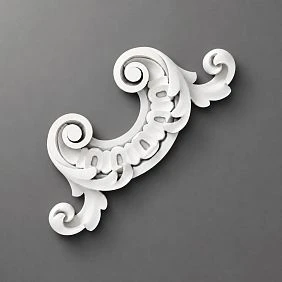
Piece mouldings are counted as individual parts and sets. If a composition includes left and right overlays, you cannot record only the total quantity: ten left-hand parts do not make five mirrored pairs.
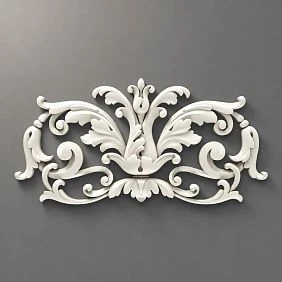
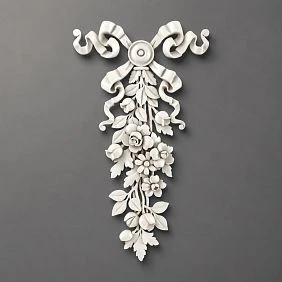
For an ornament, the start of the pattern, the direction, and the repeat of the motifs are additionally important. Joining two elements that match in overall dimensions does not yet guarantee a continuous pattern. The compatibility of the selected decoration for moldings is checked against the specific profile and its size variant.
Therefore, the line "moulding — 280 metres" does not describe the series. For linear products, the cross-section, length, and number of strips are recorded; for piece items, the designation, finish, and set composition; for an ornament, also the pattern-joining rules.
How to create a unified set for standard rooms
A room standard is an agreed set of products and rules for their application. For a conventional hotel, several sets can be defined. The codes below are provided as an example only and are not STAVROS article numbers.
| Room Type | Product set | What may vary |
|---|---|---|
| Number A | Molding ML-01, cornice KR-01, skirting PL-01 | Frame sizes according to the approved layout |
| Number B | The same ML-01, KR-01 and PL-01 | Number of frames and lengths of sections |
| Corridor | ML-01 and PL-01 | Design rhythm relative to doors |
| Lobby | ML-01 and a separate accent set | Scale of the central composition |
A different room area does not necessarily require a new profile. Sometimes it is enough to change the frame sizes and the distances between them. A new code is needed where the product or its execution actually changes.
This reduces the number of nearly identical items that are easy to confuse when reordering. At the same time, the product standard and the installation standard remain different things: identical strips can be installed at different heights. Both solutions must comply with the project.
How a production batch differs from a project batch
A production batch relates to the manufacture of products. The manufacturer determines how it is identified and recorded: it may be linked to information about the material, the production order and the finish. For the project, the available batch designation is requested rather than inventing a separate release number for the manufacturer.
A project batch is part of an object's requirement: for example, products for the first building or a specific work stage. A shipment is the products sent together. These three concepts do not have to coincide.
One shipment may contain several production batches, and one release may be distributed across floors. Therefore, both links are retained in the records: which products were received from the manufacturer and where they are planned to be used.
The article number itself is not changed when moving to another floor. The size variant, the agreed execution and the solution version are also retained. If a different finish is required for the second building, this is recorded as a change of execution rather than concealed under a new supply number.
What to compare in the first and subsequent batches
The first batch is compared with the approved sample and documents. Subsequent ones — with the same reference points. If the previous batch is taken as the new standard every time, small changes can gradually move the result away from the original solution.
| Check | What is compared | Which discrepancy requires clarification |
|---|---|---|
| Designation | Item number, size variant, project code | Similar name with a different finish |
| Material | Ordered and confirmed details | A different wood species or a material substitution |
| Geometry | Cross-section and agreed control dimensions | Change in width, overhang, or joint shape |
| Ornament | Texture, direction, pattern repeat | A different motif or a disrupted pattern joint |
| Surface | Agreed preparation for finishing | A condition requiring unplanned rework |
| Ready-made coating | Color, gloss, and texture of the approved sample | Deviation from the agreed execution |
| Link to the batch | Marking and available batch information | It is impossible to determine which batch the product belongs to |
Visual comparison is carried out under identical lighting and with the parts in the same position. The reference sample is stored protected from contamination, damage, and conditions that alter its appearance. If it has yellowed, faded, or been repainted, its suitability as a color reference must be reviewed.
Photographs are kept alongside the inspection results. They help demonstrate the problem, but a dimensional discrepancy is confirmed by measurement, and a disputed shade by an agreed method of comparing the coating.
How to account for natural variations in wooden mouldings
Wood is chosen when a project needs a natural texture and a connection with wooden panels, furniture or door portals. Texture is the visible grain pattern. It differs between blanks even within the same species and the same cross-section.
for wooden trim geometry and acceptable appearance are agreed separately. A natural difference in pattern does not mean that dimensions, shape and surface preparation quality can go unchecked.
At STAVROS, the designations “for enamel” and “for tinting” describe the requirements for wood selection for subsequent finishing. Enamel provides an opaque coating that hides the pattern; tinting changes the shade while keeping it visible. These designations do not mean that the product has already been painted. In the description of materials and quality the manufacturer also allows tonal differences in wood within a “for tinting” order.
The material cannot be determined from the product card title alone. For example, MLD-019.1 has a cross-section of 17 × 12 mm, but the oak and beech options are listed at a length of 2400 mm, while the MDF option is 2600 mm. MDF is a board made of pressed wood fibres; it is a different material, not a solid wood species. For a repeat order, keep the selected option in full.
Who is responsible for matching the finished finish
The manufacturer may supply a prepared profile, while the contractor applies the paint on site. In that case, the consistency of the finished surface depends on both stages. It is incorrect to require the manufacturer to match a colour applied by another organisation without an agreed shared task.
Record who prepares the surface, who applies the coating, and who approves the finished appearance. Each stage needs a clear handover result: for example, a profile with a specific preparation, then an approved coating system.
A coating system is the combination of substrate preparation, primer, paint, and application method. A single color code does not describe the entire system. Gloss and texture of the coating also affect the impression. If a second cabinet is painted by a different crew, they need a sample and a description of the finish, not just the shade name.
This is how production for contract interiors connects with finishing work. Geometrically identical products must go through agreed preparation and coating stages so that the finished rooms look as expected.
What to check on the first assembled section
Before repeating the solution in all rooms, assemble the most critical joint. This could be the corner of a wall frame, the transition of a skirting board to a door casing, or the connection of a cornice at a turn. The size of the test section is chosen so that the joint being checked is clearly visible.
for ceiling cornices it is useful to check the height, projection, and joint in the position specified by the project. For a frame, check whether the profile pattern aligns in the corner, and for an ornament, whether the motif continues.
Define in advance what such a test should confirm: compatibility of parts, the ability to achieve the required joint, the appearance of the coating, or the position relative to adjacent elements. Record the result and the decision made. The phrase "I like it overall" will not explain to the next crew what exactly was approved.
A successfully assembled section demonstrates that a specific solution works. It does not replace checking subsequent products and does not prove that every room will automatically be installed the same way.
What to do if the next batch differs
First, separate the disputed products from the accepted ones and keep their markings. Until the cause is identified, it is not worth distributing them among rooms in the hope that the difference will become less noticeable. After installation, it is harder to determine the boundaries of the problem.
Check whether the item code, size, material and order version match. Then record the discrepancy: where it was found, which products were checked, and what they were compared against. Discuss with the manufacturer or the responsible person how to determine the scope of the affected batch and how to resolve it.
The cause may be a mix-up, that is, a mixture of different product variants, a change in finish, or work based on an outdated version of the documents. A single photograph cannot determine the cause in advance.
If the project accepts the modified version, the decision is formalized as a new version and states where it applies. At the same time, related parts and remaining stock of the previous variant are checked. The terms of correction or replacement are agreed for the specific order; the mere discovery of a difference does not yet describe the settlement procedure.
How to prepare a reorder after several months
A repeat order must restore the entire agreed item. A message like "we need that white molding we got in the spring" leaves the size, material and coating unknown.
Provide the manufacturer with the item code including the size variant, the material, the surface preparation, the required finish and the sample number. Attach the previous order number, the current version of the decision, the required quantity and the project stage. If information about the previous production batch is available, add it.
Then confirm whether the selected version is currently in production, whether its characteristics have been retained, and which changes may require a new approval. A permanent product designation makes searching easier, but it does not replace confirmation of the current terms.
The original requirements are retained for the second body. The new batch is compared with a suitable control sample, not only with the already installed decor, which may have changed during use. If a damaged area is to be replaced in an existing interior, its proximity to the old coating is additionally assessed: matching the original sample and matching the aged surface are different tasks.
When polyurethane molding is suitable for a serial project
Polyurethane is a polymer material used to make, among other things, decorative profiles and relief parts. It is considered when the project requires the selected shape and an agreed painted surface: for example, repeating wall frames or compositions of overlays.
The decision to buy polyurethane mouldings is made after checking a specific product. The cross-section, dimensions, components, finishing method and requirements of the application area must all be suitable. Belonging to a category does not by itself confirm that any item is suitable for any area of a public facility.
If a purchase is planned Moldings made of polyurethane in several stages, agree on the contents of the first order and the procedure for confirming subsequent ones. Separately clarify what surface condition is included in the delivery and what work is performed on site.
The basis for a series is a verified execution of a specific product code. A general description of the material is not sufficient for this.
Why the price of one strip does not show the cost of the solution
When comparing options, consider more than the cost of the product. A project involves samples, approval, trial assembly, surface preparation and repeat checks. If the profile changes after approval, new detail drawings may be required and already prepared parts may need to be redone.
The number of different executions also affects the work. Ten nearly identical mouldings mean more separate approvals and a higher chance of mixing up items. Therefore, a minimal sufficient set of profiles is usually easier to manage for a series than many differences without a project need.
This does not mean that an expensive strip is automatically more advantageous than a cheap one. You need to compare options with equally described requirements: what is included in the delivery, what additional work is needed, and how the next batch is confirmed.
If one option already matches the approved solution and the second requires changing the joints, this work must be present in the comparison. Otherwise, the difference in product price hides part of the future costs.
What stock helps preserve the interior
The cutting and installation allowance covers the needs of current work: offcuts, complex joints, possible damage. The operational reserve is intended for repairs after the facility opens. These are two different tasks, so their quantity and purpose are best recorded separately.
There is no universal percentage. For a standard smooth profile and a rare paired overlay, the consequences of a shortage differ. The decision depends on the number of repetitions, the availability of a repeat production run, and the possibility of replacing a part without reworking adjacent areas.
Stored products are labeled with: item code, size, material, finish, link to the order and project code. Storage conditions are specified for the specific material and coating.
Even a reserve from the original batch does not guarantee an invisible repair years later: the installed finish may change. Therefore, along with the parts, information about the coating and the agreed methods for restoring it is kept.
What to send to the manufacturer for a series calculation
Assemble a short but unambiguous package: a list of item codes and project codes, selected materials, sizes, commercial lengths, the number of strips and piece parts. Specify the composition of paired sets and the finish.
Add the distribution by room types and stages. For our hypothetical hotel, this means showing the first and second buildings separately while keeping a single master product card. The required dates allow discussion of production and confirmation of subsequent orders.
Attach information about the approved samples and the current version of the solution. Clearly flag unresolved issues: for example, the preparation for the selected paint or the procedure for comparing wooden parts by tone needs to be confirmed.
A preliminary calculation can be requested even before final approval. But before launching the series, issues affecting the product characteristics must be closed. If the input data has changed after the calculation, confirm the updated conditions so that the cost and the production order refer to the same finish.
What to check before launching stucco and moldings into series
Before confirming the order, go through the entire chain for each item:
- The manufacturer, exact article number, material, and size variant are specified.
- The cross-section, product length, orientation, and composition of the linked parts are saved.
- It is clear which sample has been approved and which characteristics it confirms.
- Surface preparation, finishing, and those responsible for each stage have been agreed upon.
- Critical dimensions, permissible deviations, and the inspection procedure have been defined.
- The trial assembly confirmed the solution where such a check was required.
- The project version, quantity, rooms, and application stages are recorded.
- It is clear how to link the products to the available information about the production batch.
- Current stock and repair stock are separated, and the reorder conditions are clarified.
With this dataset, you can request the price and availability of selected STAVROS products according to the project specification. If the basis of the design is Polyurethane moldings, provide specific items from the catalog along with approved finishes and the sequence of work. Then the discussion of the series will be based on verifiable product characteristics — from the first sample to the repeat order.