Article Contents:
- What is baroque furniture: character, history, logic
- How baroque furniture differs from ordinary classic furniture
- Where baroque furniture is appropriate: from living room to country house
- Living room: solemnity without pretension
- Bedroom: luxury of sleep
- Entryway: First Impression
- Study: dignity and history
- Country house: full expression of style
- Carved legs are the main feature of baroque furniture
- Main leg shapes for Baroque style
- How to choose legs correctly
- Handles and fittings for Baroque furniture
- Handle formats for Baroque style
- Consistency rule
- Carved overlays and decorative elements for Baroque furniture
- Types of overlays for Baroque style
- The 'one motif' principle
- How to choose Baroque furniture color
- Dark wood
- Light and white furniture
- Natural light wood
- About gold — be careful
- How not to overload an interior with Baroque furniture
- Principle of a single accent
- Air around furniture
- Support through finishing
- About 'a lot of gold'
- What to pair Baroque furniture with: interior system
- Stucco and cornices
- Wall moldings
- Mirror frames
- Wooden baseboard
- Doors and door casings
- Baroque furniture for different rooms: detailed breakdown
- Baroque style chest of drawers
- Baroque style console table
- Baroque style display cabinet
- Baroque style bed
- Mistakes when choosing baroque furniture
- What to buy for a baroque interior: a complete list
- How to buy baroque furniture without mistakes: an algorithm
- About the Company STAVROS
- FAQ: Answers to Popular Questions
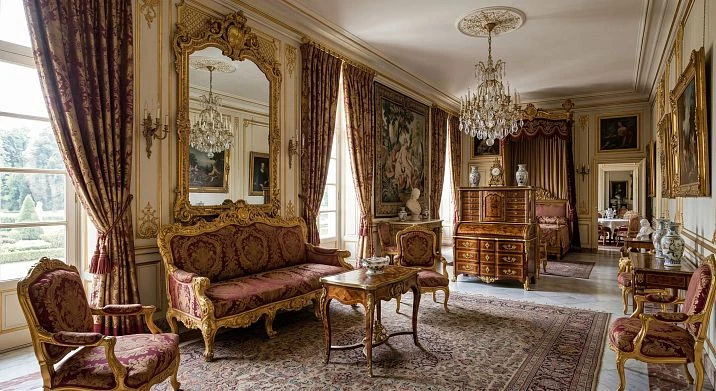
There are styles that whisper. Baroque speaks at full volume. It is an aesthetic of excess elevated to a principle: curved legs that bear weight with visible lightness, facades with carved garlands, chests of drawers with convex fronts, mirrors in frames resembling architectural portals. Baroque furniture is not just "rich classic". It is a separate language in which beauty is a function.
But here is the paradox: baroque style furniture scares many precisely because of its expressiveness. It seems to require a palace scale — high ceilings, enfilades, Versailles herringbone parquet. In reality, baroque enters a modern interior through details: through carved furniture legs, through a chest of drawers with decorative overlays, through a console table by the mirror in the hallway, through a dressing table with curved supports. One strong piece — and the tone of the space changes.
Let's break it all down: from the character of the style to a specific purchasing algorithm.
What is Baroque furniture: character, history, logic
Baroque as a style emerged in Europe in the 17th century and quickly became the language of power, wealth, and theatricality. Architecture, painting, music, and furniture — everything followed one rule: form must make an impression. Not just be beautiful, but captivate, surprise, and demonstrate mastery and generosity.
Baroque furniture carries this principle in every detail. Legs are not straight — they are curved into a characteristic "saber" profile or twisted into a spiral. Facades are not flat — they are convex, profiled, with applied ornaments. Surfaces are not uniform — they are inlaid, covered with carvings or gilded details. This is not excess for the sake of excess: it is an architectural program where every detail works for the whole.
The main thing to understand: baroque furniture — is not "heavy furniture." It is visually light precisely because of the curved legs, which create a sense of movement and lift. A cabinet on straight legs stands. A cabinet on curved legs seems to dance.




How Baroque furniture differs from ordinary classical furniture
This question is important practically: if you don't understand the difference, it's easy to buy something "similar" and get a completely different look.
| Parameter | Classical furniture | Baroque furniture |
|---|---|---|
| Legs | Straight tapered or turned | Curved, saber-shaped, carved |
| Facades | Straight, with molding frame | Convex, with applied ornament |
| Lines | Calm, rectilinear | Dynamic, curved, S-shaped |
| Decor | Moderate | Expressive, rich |
| Handles | Restrained, functional | Prominent, with decorative character |
| Interior context | Wide — from neoclassical to modern | More specific, requires support |
Classics can be strict and minimalist within their style. Baroque is almost always expressive. If classic is architecture, then baroque is sculpture.
That is why Carved furniture decor и Decorative Inserts are mandatory attributes of the baroque style: without them, furniture is simply "classic," but not "baroque."
Our factory also produces:
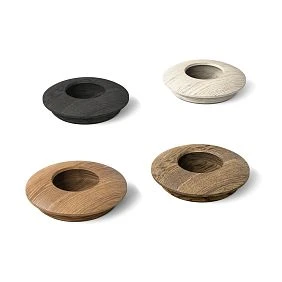
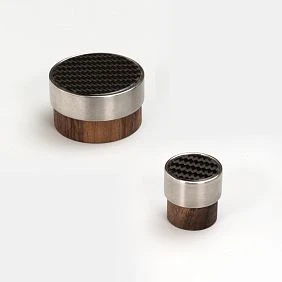
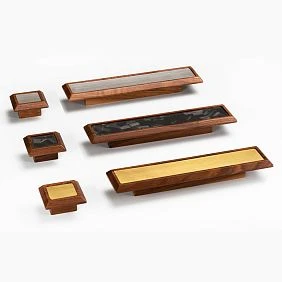
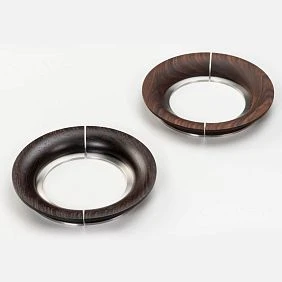
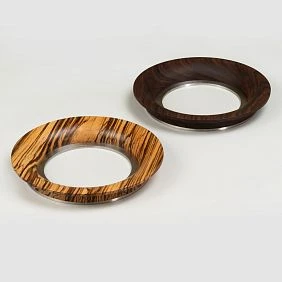
Where baroque furniture is appropriate: from the living room to a country house
Get Consultation
Living room: solemnity without pretension
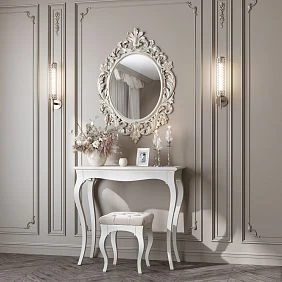
In the living room, baroque furniture works as an accent piece — not as a full set. A baroque-style chest of drawers with convex fronts and carved inlays against the wall opposite the sofa is the visual dominant of the room. A console with curved legs made of solid wood under a mirror in a carved the frame is an architectural accent at the entrance area.
Work well in the living room:
-
Baroque-style display cabinet with glazed doors in a profiled frame and curved legs.
-
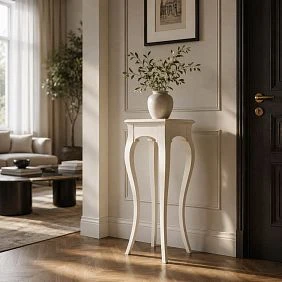
Console — a narrow, elegant piece with decorative legs, fitting well by a mirror or in a wall niche.
-
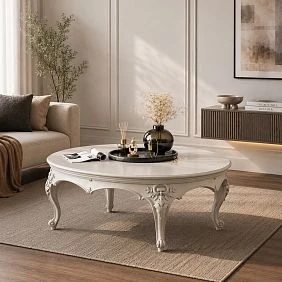
Coffee table with carved supports.
-
A mirror in a carved wooden frame — one of the most affordable ways to introduce a baroque note into the living room without a complete overhaul of the space.
Bedroom: luxury of sleep
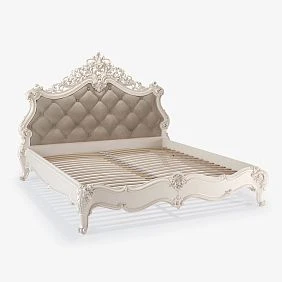
A baroque-style bedroom is perhaps the most organic scenario. The sleeping space has historically been a space for displaying status: think of royal bedrooms with canopies and carved beds.
In a modern interpretation:
-
Bed with a high headboard and wooden frame with carved inlays.
-
Dressing table with curved legs, drawers on wooden handles and a mirror in a frame — the most feminine and most baroque item of the bedroom.
-
Bedside tables with curved legs, coordinated with the bed in color and decorative character.
-
A chest of drawers with convex fronts and carved details — instead of a faceless wardrobe.
-
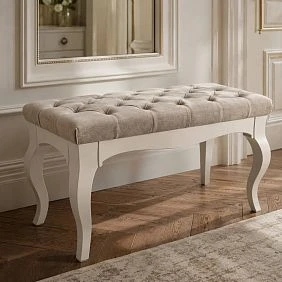
A bench at the foot of the bed with turned or carved legs.
Entryway: first impression
The hallway is an ideal place for one bright baroque item. A console with curved legs against the wall and a mirror above it in a wooden frame with carved decor — this is the image of a hallway that makes the right first impression even in minimal spaces.
A baroque hallway does not require large investments: one piece of furniture + the right frame + coordinated wooden molding — and the atmosphere is created.
Study: dignity and history
A study with Baroque furniture is a space for a person with character. A writing desk with cabriole legs, an armchair with carved details, a bookcase with profiled fronts, high-profile wooden baseboard — all of this creates the image of a study where serious thinking is customary.
Country house: full expression of style
A country house with high ceilings, massive doors, and wooden staircases is a place where baroque furniture it is fully revealed. Here, a rich system is appropriate: large chests of drawers and display cabinets with carved fronts, consoles at mirrors in solid wood frames, a canopy bed, a dining set with massive chairs on turned legs.
Carved legs are the main feature of Baroque furniture
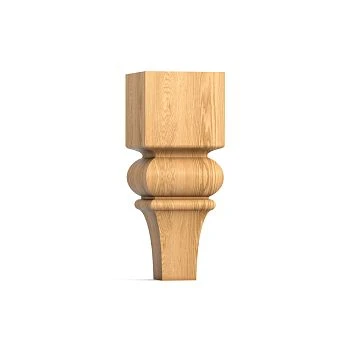
If you had to choose a single element that makes furniture Baroque, it would be the legs. Solid wood furniture legs with a curved or carved profile transform any piece of furniture: a cabinet, chest of drawers, console, table, bench.
Main leg shapes for the Baroque style
Cabriole. An S-shaped curved leg, tapering downwards and ending in a "paw" (ball, claw, acanthus leaf). This is the most characteristic leg of Baroque and Rococo. It creates a sense of movement and lightness — the object seems ready to move from its place.
Twisted legs. Spiral carving on a straight shaft. A more austere option, characteristic of the early Baroque period. Works well on beds, tables, coffee tables.
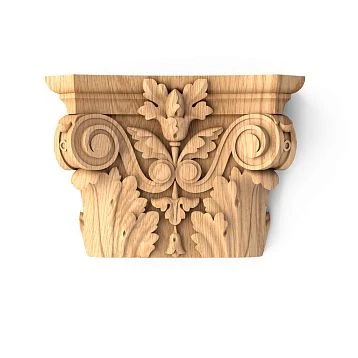
Carved legs with acanthus. Straight or slightly curved legs with carved acanthus leaf ornamentation — a classic Baroque decorative motif. Suitable for a more monumental, "palatial" interpretation.
Bulbous legs. A characteristic "bulb" in the upper part of the leg — a more massive option, working well on large wardrobes, chests of drawers, beds.
How to choose legs correctly
The scale of the leg should match the scale of the furniture. Furniture legs 8–10 cm high for a small cabinet is correct. The same legs for a large chest of drawers 120 cm wide are too small. The leg must visually "support" the object.
The height of the legs also affects the appearance: short legs (5–8 cm) create a more stable, grounded character. High legs (15–20 cm) create a lighter, airier look for the object.
Unpainted legs convenient for those who want to independently choose the color and tint for a specific piece of furniture and interior.
Handles and fittings for Baroque furniture
Handles are a detail that is seen up close. Every time a drawer of a chest or a cabinet door is opened, the handle is in focus. That is why its choice influences the overall perception of the furniture more than it seems.
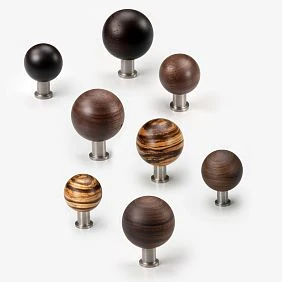
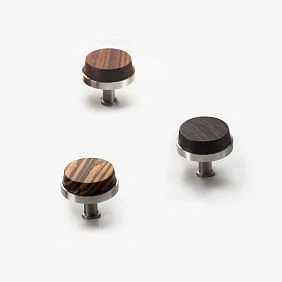
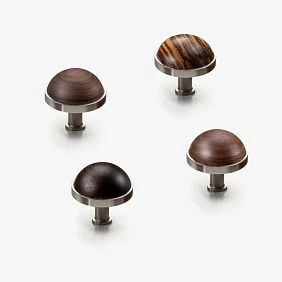
Wooden furniture handles for a Baroque interior:
Handle formats for the Baroque style
Carved pull handles. An arch of wood with carved decoration at the attachment ends. A classic Baroque motif — rich but not ornate.
Teardrop-shaped carved handles. A three-dimensional drop with ornamentation. Works well on cabinets and chest drawers.
Spherical knob handles. A round convex shape with a carved pattern on the surface — for small drawers.
Shell-shaped handles. A characteristic Baroque motif: the shell is one of the main symbols of Baroque and Rococo. Handles with this motif instantly create a stylistic atmosphere.
Rule of consistency
All Furniture Handles in one room should be from the same family. Carved wooden handles on cabinets, wooden brackets with the same ornament on the chest of drawers, similar knob handles on the display case — a unified decorative language of hardware.
You cannot put modern metal handles on a Baroque chest of drawers. It's like wearing sneakers with a tailcoat — technically possible, but the image is ruined.
Carved overlays and decorative elements for Baroque furniture
This is the block that is most often forgotten when buying furniture — and it is what creates "that very" difference between just a beautiful chest of drawers and a genuine piece in the Baroque style.
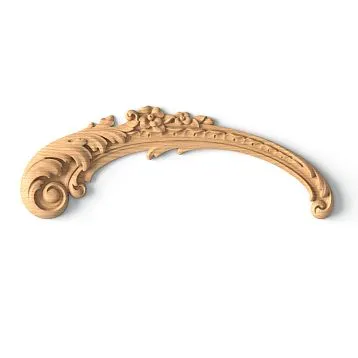
carved wooden inlays — decorative elements that are attached to furniture facades, enhancing their plastic expressiveness. In a Baroque interior, they are the main decorative tool.
Types of overlays for the Baroque style
Central overlays. Installed in the center of the door facade or drawer front. Cartouche, floral rosette, shell, heraldic motif — the main forms.
Corner overlays. Placed in the corners of the facade, creating a visual frame. Acanthus leaves, floral garlands, geometric inserts.
Frieze overlays. A horizontal decorative strip along the top facade of a chest of drawers or display cabinet. A characteristic Baroque technique.
Garlands and wreaths. Decorative overlays in the form of curved branches with flowers and leaves — a symbol of abundance and celebration, one of the main motifs of the Baroque.
Also used for furniture decoration carved solid wood decor — richer, sculptural elements for large items.
The "one motif" principle
The most common mistake in Baroque decor is mixing different ornamental motifs. Acanthus leaves on a chest of drawers, shells on a wardrobe, geometric inserts on nightstands — three different languages on three items. Choose one ornamental motif and use it consistently on all items in the room.
How to choose the color of Baroque furniture
Color is mood. In a Baroque interior, color works differently than in a minimalist one: here it does not "recede" or "blend into the background," but participates in creating the image.
Dark wood
Dark walnut, wenge, oak with chocolate tint, cherry — these are solemnity and dignity. Dark Baroque furniture in a spacious room with good lighting creates the most powerful image. It requires either light walls (warm milky, cream color) or a deep colored background (burgundy, emerald, dark blue) with proper lighting.
Dark furniture should be coordinated with wooden skirting board the same or slightly lighter tint.
Light and white furniture
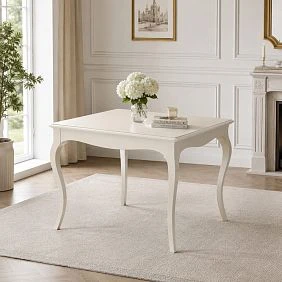
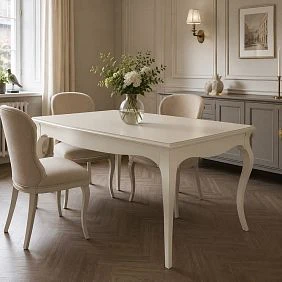
White and milky Baroque furniture is "soft Baroque," closest to neoclassicism. This approach works well in apartments: Baroque forms are preserved but do not overwhelm. Light Baroque furniture for the bedroom is one of the most popular requests, and it is justified: curved legs and carved details in white lacquer look elegant but not heavy.
Natural light wood
Golden oak, warm ash without tinting — a versatile and "homey" choice. It looks good in a country house and in spacious apartments with natural finishing materials.
About gold — be careful
Gilded details — handles, overlays, outlines — are pure Baroque. But they should be used sparingly: one or two gilded details per item, no more. Otherwise, the interior turns into carnival props.
How not to overload the interior with Baroque furniture
This is perhaps the most honest and practically important section. Because this is where mistakes most often occur.
The principle of one focal point
One strong Baroque-style piece—a chest of drawers, console, vanity table, or bed—creates the right atmosphere. Five pieces simultaneously in a small room create the feeling of a theater warehouse.
Ask yourself: which piece will be the main one? The answer is only one. All other pieces in the room should be more neutral and support the main accent, not compete with it.
Air around furniture
Baroque furniture requires space. A console squeezed between two cabinets loses all its character—its legs are not visible, its forms are not readable. Around a piece with expressive forms, there needs to be empty space—at least 50–80 cm on the sides.
Support through finishing
Baroque furniture in an empty 'Euro-renovation' is a mismatch. It requires support through architectural elements: high-profile wooden baseboard, moldings on walls, a cornice under the ceiling, frames for mirrors. Without this context, Baroque furniture looks like a random piece.
About 'a lot of gold'
Gilded handles + gilded frames + gilded cornices + gilded stucco—too much. One or two gilded zones in an interior create an accent. Five create fatigue.
What to pair baroque furniture with: interior system
Baroque furniture does not exist in a vacuum. It requires a supporting architectural and decorative system.
Stucco molding and cornices
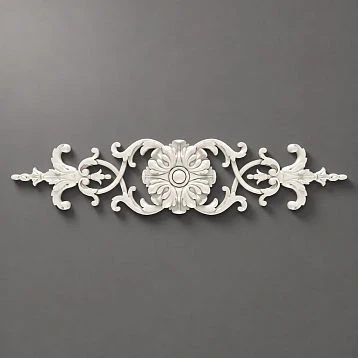
Polyurethane Items — cornices, rosettes, overlays — create an architectural context for baroque furniture. A ceiling cornice with an expressive profile, a ceiling rosette under a chandelier, decorative overlays on walls — this is the "air" in which baroque furniture feels natural.
Wall moldings
Wooden moldings on walls — molding frames, horizontal bands, door and window casings — create the architectural structure of the space. Baroque furniture in a room with molding frames looks like part of the system, not like an alien object.
Frames for mirrors
wooden frames with carved decor — an essential element of a baroque interior. A mirror in a carved frame above a chest of drawers or console completes the look like nothing else.
Wooden skirting board
Skirting made of solid wood 10–15 cm high with an expressive profile — the lower architectural line. It should be coordinated with the furniture in color and profile "weight."
Doors and door casings
Classic doors with profiled panels and wooden architraves — the right frame for baroque furniture. Flat doors without decoration next to a richly decorated chest of drawers — a mismatch.
Baroque furniture for different rooms: detailed breakdown
Baroque style chest of drawers
A chest of drawers is one of the main pieces of a Baroque interior. It is through chests of drawers that the Baroque style is most fully revealed: a convex pediment, three or four drawers with carved inlays, curved legs cabriole, decorative wooden handles with ornament — this is the visual architecture of the horizontal surface.
Baroque style chest of drawers for the living room: width 100–130 cm, height 85–100 cm. The surface of the chest of drawers is for a framed mirror, a pair of candlesticks, or a decorative object.
Chest of drawers for the bedroom: width 80–100 cm, more compact forms.
Baroque style console
A console is a narrow table against the wall, a classic piece for hallways, living rooms, and formal areas. In the Baroque style, the console has curved or carved legs and a decorative frieze along the lower edge of the tabletop.
Console width — 100–140 cm, depth — 35–45 cm. A mirror above the console is a must wooden frame with carved decor.
Baroque style display cabinet
Display cabinet with glazed doors, profiled cornice on top and curved legs — an expressive piece for the living room. It both stores and displays.
Baroque style bed
Bed with a high wooden headboard with carved inlays, on curved legs, with wooden footboard rails — the centerpiece of a baroque bedroom. Size: 160×200 or 180×200 for a double bed.
Mistakes when choosing baroque furniture
An honest list — no embellishments.
-
Buying furniture without considering room size. A large carved chest in a 12 sq. m room leaves no space physically or visually.
-
Choosing overly massive furniture for an apartment. Baroque in an apartment requires editing: choose more compact and lighter options.
-
Mixing different wood tones without a system. Dark dresser + light nightstands + walnut legs — three different colors without a single theme.
-
Installing modern metal handles. Chrome handles on a Baroque dresser is a mistake that no decor can fix.
-
Baroque furniture in an interior without support from finishes. A Baroque dresser against flat walls without moldings, baseboards, and frames — an object in a vacuum.
-
Overloading facades with overlays. carved appliqués on every centimeter of every facade — this is not "rich," it's chaotic.
-
Not considering ceiling height. A tall Baroque display case under a 2.5 m ceiling creates a feeling of pressure. The scale of the furniture should match the height of the room.
-
Confusing Baroque with "any rich classic." Heavy dark cabinets with straight lines are not Baroque. Baroque is precisely curved forms, dynamics, plasticity.
What to buy for a Baroque interior: a complete list
-
Classic Baroque furniture — chest of drawers, console, display cabinet, bed, dressing table, bench.
-
Solid wood furniture legs — curved cabriole, twisted, carved.
-
Unpainted Legs — for self-staining to the desired color.
-
Wooden furniture handles — carved, drop-shaped, ornamental brackets.
-
Carved decorative inserts for furniture — central, corner, frieze.
-
carved solid wood decor — sculptural decorative elements for facades.
-
Solid wood frames — for mirrors above the console and chest of drawers.
-
Wooden moldings and cornices — for wall and ceiling decoration.
-
Wooden baseboard — lower architectural line.
-
Furniture and interior items — additional decorative items.
-
Solid Wood Items — complete catalog of wooden elements for a Baroque interior.
How to buy Baroque furniture without mistakes: an algorithm
1. Determine the room: living room, bedroom, hallway, study, or country house.
2. Choose one main piece: a chest of drawers, console, bed, vanity table, or display cabinet.
3. Measure the room. Check the ceiling height and the wall width for the main piece.
4. Decide on the color scheme: dark wood, natural tone, or light/white furniture.
5. Select Legs — curved, carved, matching the scale of the furniture.
6. Choose Wooden handles in a unified style for all furniture in the room.
7. Add carved appliqués — one central motif, consistently used.
8. Select the mirror frame in a consistent style.
9. Select Wooden baseboard и Moldings to create an architectural context.
10. Go to the catalog of Baroque furniture and classic STAVROS furniture и of solid wood — assemble the system to fit your interior.
About the company STAVROS
Baroque furniture is a system of elements that must speak the same language. STAVROS creates such a system: Classic Furniture, Solid wood furniture legs, Wooden handles, carved appliqués, carved solid wood decor, Frames, Moldings and the entire range of solid wood — everything consistent, all made of natural wood, all produced by one enterprise in St. Petersburg.
STAVROS has been operating since 2002. Own production facilities — a milling workshop, joinery production, quality control at every stage. In the catalog of furniture and interior items — items for classical and baroque interiors, as well as all details for creating a cohesive decorative system. Shipment from 1 piece. Contact us to confirm shipping to your destination. Custom production.
FAQ: Answers to popular questions
What is baroque furniture?
Baroque furniture is expressive classical furniture with curved legs, carved overlays on facades, decorative handles, and rich plastic detailing. Characteristic features: S-shaped cabriole legs, acanthus leaf ornament, shells, garlands, convex pediments.
How does baroque furniture differ from regular classical furniture?
Classical furniture can be strict and restrained. Baroque furniture is more decorative, dynamic, and richer in details. Main differences: curved legs, carved overlays, convex facades, and more expressive hardware.
Is baroque furniture suitable for an apartment?
Yes, with the right approach. In an apartment, it's better to choose one accent piece — a chest of drawers, console, vanity table, or bed — and support it with baseboards, moldings, frames, and decorative handles. A full baroque set is not needed in a standard apartment.
What details are important for baroque furniture?
Carved legs, decorative overlays on facades, wooden handles with ornament, mirror frames. All these elements should be from the same decorative family.
How not to overload an interior with baroque furniture?
Choose one main item. Do not mix different ornamental motifs. Support the furniture through trim — baseboards, moldings, cornices. Leave space around objects.
Which color is best for Baroque furniture?
For a grand effect — dark wood with good lighting and light walls. For an apartment — natural wood tone or light shades. White Baroque furniture — for "soft Baroque," close to neoclassicism.