








































































Article Contents:
- Determine exactly what needs to be restored
- Create a record sheet for the surviving fragment
- For linear trim, record the cross-section
- Measure width and projection from a single reference base
- For ornamental linear trim, measure the full repeat
- Measure individual decorative pieces along axes and characteristic points
- Identify the material and the role of the old coating
- Separate losses and deformations from the original geometry
- Check the serial product range before developing a new item
- Overlay the sections at real scale
- Compile a table of candidates without premature approval
- Divide the comparison results into four classes
- Discuss custom manufacturing when the need is confirmed
- Hand over a linked source data package to the manufacturer
- Choose the digitization method based on the complexity of the shape
- Test the prototype in a typical joint
- Keep the reference sample and replacement history
- Recalculate the quantity based on the new supply length
- Eliminate the mistakes that turn a replica into a new problem
- Order a confirmed solution for a specific area
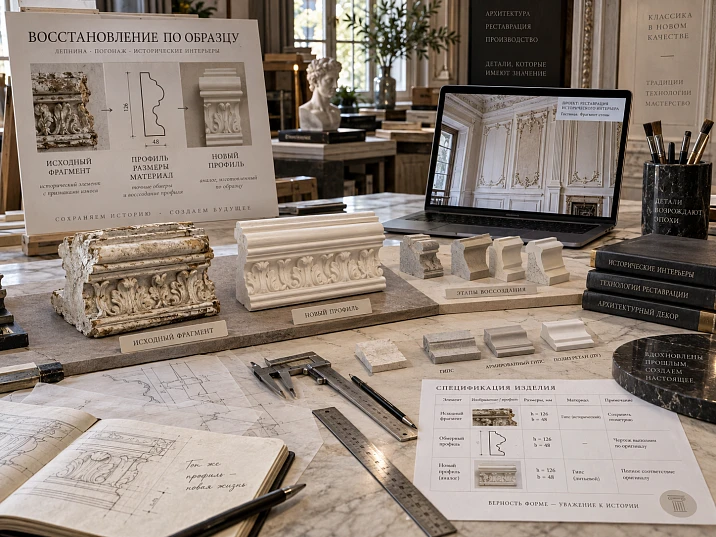
A piece less than a palm's length has survived from the old molding. A raised bead is visible on the front face, one edge is chipped, and traces of mounting compound remain on the back. There is no article number. A photo search turns up several similar products, but it is unknown which one will continue the line without a step and preserve the wall's pattern.
Ordering a new part to be made is premature at this stage. First, the shape of the original product must be separated from the damage, dimensions obtained, and the serial range checked. Producing a replica from a sample becomes a justified decision when a ready-made profile does not meet confirmed requirements and the composition cannot or should not be changed.
The result should be a clear link between the surviving fragment and the new product: what was measured, what was restored as an assumption, which differences are acceptable, and against which sample the delivery is accepted.
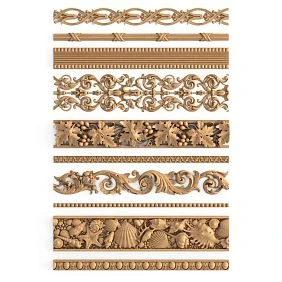
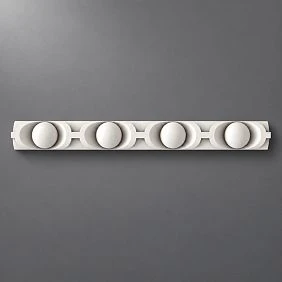
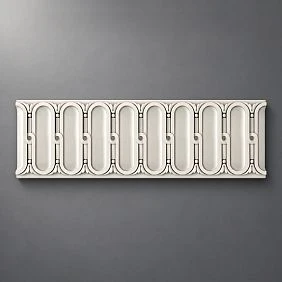
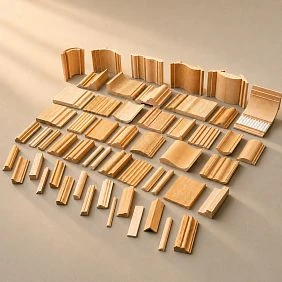
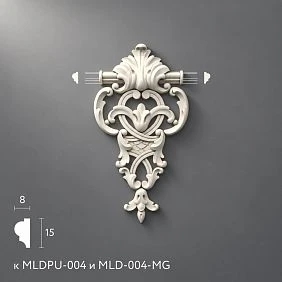
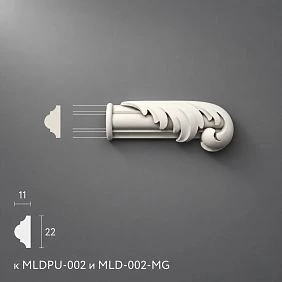
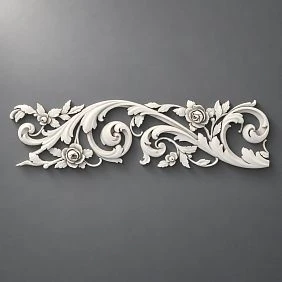
Determine exactly what is to be restored
The same fragment can lead to different solutions. For an insert between two surviving sections, precise joining at both ends is essential. When replacing the entire frame, the acceptability of a new cross-section is assessed based on the composition, the inner field, and adjacent parts. For finishing another room, a profile of a similar character may be sufficient.
Record the scope of work: a local insert, replacement of an entire band, reproduction of a single overlay, or creation of a new composition inspired by the existing one. Without this, the similarity requirements will remain undefined.
If a specific historical pattern must be preserved, it cannot be replaced with a similar ornament just because the width matches. For a new composition, by contrast, such a difference may be acceptable after approval.
Selecting a replica begins with the installation location. Photos of adjacent sections, junctions, and the overall wall are needed. A separate sample shows the product but does not explain which of its properties are critical for the interior.




Create a record for the surviving fragment
Assign the sample a designation, for example И01, and link all photographs and measurements to it. Several similar fragments from different rooms should not be grouped under a common name such as "old molding": they may belong to different profiles or finishing stages.
| What to fix | What information is needed | What it is used for |
|---|---|---|
| Origin | Room, wall, position on it | Relation to the surviving composition |
| General view | The detail as a whole and the interior area | Function, orientation, adjacent elements |
| Geometry | Dimensions, accessible end, rear side | Comparison with standard products |
| Condition | Chips, deformations, losses, coatings | Separating form from damage |
| Material | Installed or not yet known | Replacement scenario assessment |
| Requirement | Square footage or number of parts, scope of work | Preliminary order estimate |
Photograph the part with a scale ruler in the same plane you are measuring. An angled shot is useful for understanding volume, but it does not replace a dimensional drawing.
If the sample is handed over to the supplier, save its images before dispatch along with a condition inventory. It is better to agree in advance on the packaging and the method of handing over the fragile fragment.
Our factory also produces:
For linear moulding, record the cross-section
The main source of information about linear moulding is its cross-section across the length. It shows the overall width, thickness, position of the bead, steps, hollows, roundings and the mounting side. A frontal photograph conceals some of these differences.
Use an accessible undamaged end or an agreed measuring method. There is no need to saw off part of a valuable fragment just for a convenient photograph. If the end is damaged, the shape is clarified from other areas, adjacent parts and documents, noting the degree of reliability.
The cross-section is referenced to the mounting plane and a clear side boundary. For an asymmetrical profile, label the top and bottom or the side facing the inner field of the frame.
A short piece may show the cross-section well, but not the straightness of a long strip. Its length also says nothing about the original commercial length of the product. This data cannot be reconstructed by simple assumption.
If several ends are available, measure them separately. A difference may be due to damage, coating or a change in shape along the length. Do not average the results before establishing the cause: for a future joint, the geometry of the specific surviving end matters, not the average value across all fragments.
Get Consultation
Compare width and projection from the same base
Two mouldings 40 mm wide may have different projections — for example, 8 and 25 mm. This conditional example shows why matching one dimension does not confirm that a substitute is suitable. The side view, the adjacency to the architrave and the character of the shadow will also differ.
Record from which surface the projection is measured. The thickness of the product itself, the distance from its back to the highest point, and the total projection from the wall after installation are related but not identical values.
Residues of glue on the reverse side should not automatically be included in the profile geometry. At the same time, they must not be removed arbitrarily if this could damage the sample: the original mounting plane is first established from the surviving support areas and the installation context.
If the new element will sit on a backing or panel, the corresponding thickness is added to the cut. Matching cross-sections will not ensure a flush joint when the bases of the old and new parts are at different levels.
For ornamental moulding, measure the full repeat
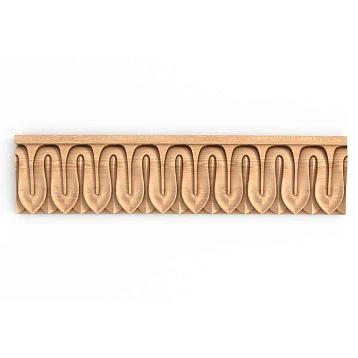
For a smooth profile, a constant cross-section describes the basic shape. Ornamental moulding also requires the repeat — the distance over which the pattern repeats. Mark the start of the motif, the direction, the characteristic peaks and the point of transition to the next repeat.
It is desirable to have at least one full motif, and preferably several repeats and their junction. If the sample is shorter than the repeat, the missing part is sought on the surviving section or in a photograph. A single leaf of ornament cannot reliably restore the entire band.
In a conditional example, the original pitch is 120 mm, while a similar product has 125 mm. After eight full pitches, the difference in the positions of identical points will reach 40 mm. On a short fragment the similarity may look convincing, but it will no longer be possible to continue the existing pattern without a mismatch.
When viewing ornamental trim compare the cross-section and the pattern independently. A match in one attribute does not compensate for a mismatch in the other.
Measure piece decor along axes and characteristic points
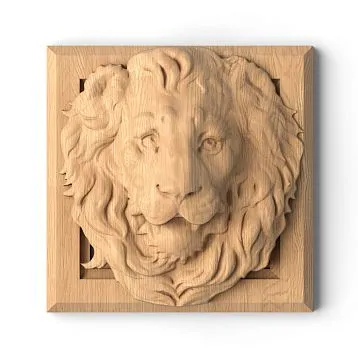
For an overlay, medallion or rosette, the width, height and maximum thickness are needed, but these dimensions do not complete the description. Record the position of the main protrusions, the boundaries of the mounting side and the distances from the axes to the characteristic details of the pattern.
For an asymmetrical element, orientation is especially important. Right- and left-hand versions may look identical in individual photographs if one of them was accidentally mirrored. Keep the original orientation of the images and note the position of the part in the interior.
When selecting Decorative Inserts, check not only the footprint but also the fit with the frame. A thicker central relief can change the perception even when the outer contour matches.
If the element is assembled, draw up a parts diagram. One rosette in a photograph may include several repeating details; the number of compositions and the quantity of supplied elements are then counted separately.
Determine the material and the role of the old coating
A white painted surface does not allow the material to be reliably determined. The original may be plaster, wood, polymer, or composite. If the origin is unknown, record it as such; a visual guess must not become an established characteristic.
The material is verified using documents, accessible undamaged areas, and inspection. Do not destroy a fragment for a self-check. For a valuable piece, the method of investigation is chosen with the participation of a specialist responsible for its preservation.
Replacing the material requires a separate decision on mass, base, fastening, finish, and place of application. The ability to buy a similar polyurethane molding does not yet confirm that it is suitable for continuing a specific old element.
Several layers of paint can smooth out grooves and change the visible contour. In the brief, specify what must be reproduced: the agreed original shape or the surface condition that must visually connect with the retained part. These are different goals.
Separate losses and deformations from the original geometry
A chip on the edge is not a feature of the profile, and the sagging of a removed strip does not necessarily reflect the design intent. But you also cannot automatically straighten every irregularity: the element may have been designed for a curved surface.
Compare several available sections. A repeating cross-section helps restore the damaged area; an adjacent complete motif clarifies the lost ornament. Measured and restored parts of the drawing are designated separately.
If half of a symmetrical overlay has survived, mirror construction can serve as a reconstruction hypothesis. It is verified against photographs, installation traces, and similar complete parts. The lost half must not be presented as directly measured.
Three reliability designations are useful: "measured," "restored from a confirmed repeat," and "assumed." The last group requires separate approval. This way, inaccurate source information does not imperceptibly turn into mandatory geometry for a future batch.
Check the serial range before developing a new product
For a smooth linear fragment, start with of polyurethane moldings. For an extended decorative band, check Polyurethane trim. The search is conducted by function, material, dimensions, and cross-section character.
A serial candidate allows you to check the possibility of replacement without separate development. However, its presence in the catalog is not proof of a match with an unknown original. Even a very similar profile must pass a comparison of cross-section, joints, and surface.
В decor for moldings the mating corners and ends are checked separately. A new straight strip may match in width and yet not connect with the corner piece being retained.
If the origin of the item can later be established, the old article number will become an additional source of data. The approach to a known product is covered in the material on replacing imported moldings; here the fragment itself remains the main evidence.
Overlay the cross-sections at real scale
The outline of the original and the drawing of the candidate are aligned along one mounting plane and a selected reference line. The scale is kept identical. One image must not be stretched until it visually matches: such an overlay hides the differences for the sake of which it is performed.
Check the extreme points, the positions of the steps, beads and hollows. Two profiles of the same width and thickness can have a completely different distribution of relief within these dimensions.
At the point where the old band continues, the alignment of the face lines is additionally checked. A matching back does not guarantee the absence of a step on the upper bead. For an insert between two sections, both ends and the total length of the gap are checked.
If the left and right sections differ, a single constant profile may not connect to them in the same way. This is a separate joining task: the bases, the shape of the retained parts and the permissible limit of intervention are clarified. The average cross-section must not be fitted to both ends without an agreed decision — the mismatch will remain on the object.
Permissible deviations are set according to the task, the accuracy of measurement and the joining conditions. There is no universal tolerance of "one millimeter for any stucco molding." If the original measurement is approximate, it is pointless to confirm a match to hundredths of a millimeter using only a digital drawing.
Compile a table of candidates without premature approval
Suppose the conditional fragment I01 has measured dimensions of 22 × 11 mm. Two actual STAVROS products were selected for an initial comparison. The source data below is for training purposes; no actual measurement or testing of such a fragment was performed.
| Parameter | Fragment I01 | MLDPU-002 | MLDPU-027, selected version |
|---|---|---|---|
| Width | 22 мм | 22 мм | 20 мм |
| Thickness | 11 мм | 11 мм | 12 мм |
| Material | Not set | Polyurethane | Polyurethane |
| Delivery length | Unknown; fragment length 180 mm | 2600 мм | 2600 мм |
| Full section | Requires fixation | Requires overlay on the source | Requires overlay on the source |
| Preliminary result | Source data | Dimensions matched | Width is 2 mm less, thickness is 1 mm greater |
Sizes MLDPU-002 and the selected MLDPU-027 are confirmed by the product cards. The second one also comes in a 14 × 9 × 2600 mm version, so the item code is written together with the size.
MLDPU-002 cannot yet be called an exact copy: only two dimensions matched. MLDPU-027 cannot be automatically rejected for a full frame replacement, but the possibility of a local insert requires separate justification.
Divide the comparison results into four classes
It is convenient to use the project designations M0–M3. They describe the consequences of the decision, not the quality of the product or the degree to which its origin is proven.
| Class | What is confirmed | Next action |
|---|---|---|
| M0 | According to the documents and measurements, the serial product meets the critical requirements | Confirm the conclusion on a sample and approve the application |
| M1 | The geometry and joints are suitable, but the pattern or surface character differ | Agree on the acceptability of the visual change |
| m² | The function is preserved after changing the composition or nodes | Issue the revised drawings and recalculate the order |
| M3 | No suitable standard solution found | Submit data for a custom manufacturing assessment |
This is a working classification, not an industry standard. Until the measurement and comparison are complete, the candidate may remain unclassified: "insufficient data" does not equal M0.
For local continuation of the ornament, option M1 may be unacceptable, although in a separate new frame it will solve the problem. Option M2 is compared with custom manufacturing across the full scope of changes. Class M3 indicates the direction of further work, not a manufacturer's promise to reproduce the part.
Discuss custom manufacturing when the need is confirmed
Such a need arises if a specific profile must be continued, a rare motif preserved, a missing part of the composition reproduced, or a joint made for which no standard solution exists. The tighter the boundaries of the preserved part, the less freedom the analogue has.
Before requesting, separate the mandatory from the variable: the exact pattern of the front surface, the mounting back, the material, the projection length, the joining method. The manufacturer must assess these requirements together with the condition of the original and the quantity.
The feasibility of manufacturing polyurethane mouldings based on a specific fragment is confirmed in advance. It is not possible to promise in advance an exact copy, a specific technology, price or lead time for any sample. General material ab molded decoration production helps you get oriented on the topic, but does not replace a conclusion for an individual order.
If a modified form is being developed instead of a literal reproduction, it is documented as a standalone solution. The preparation of such a task is covered in the article on custom decor based on a sketch.
Provide the manufacturer with a linked package of source data
For the first substantive discussion, you need a general view of the part, photographs of the front and back sides, an accessible end, a dimensional diagram, and information about the material and condition. For an ornament, add the pattern repeat; for a one-off part, add the axes and direction.
The second part of the package consists of the application conditions: installation location, adjacent elements to be preserved, required finish, and the limits of acceptable differences. The third covers the order volume and the desired delivery sequence.
One overlay and 300 linear meters require different assessments of production preparation. A preliminary quantity is acceptable, but its status should be indicated. The manufacturer needs to understand whether a single replacement or a repeatable batch is being evaluated, rather than learning this after the sample has been developed.
Agree on whether the original needs to be handed over, who performs the measurement and restoration of the missing form, what is included in the development, and how many variants are expected to be tested. This way, the photographs, the drawing, and the physical fragment will describe one task rather than three unrelated ideas about the result.
Choose the digitization method based on the complexity of the form
For a straight molding with a constant cross-section, an accurate flat drawing and information about the length can serve as the basis. A complex overlay with irregular relief requires a description of the volume; spatial measurements and, if necessary, 3D scanning are useful here.
The scan captures the available surface of the existing item, including chips, paint and deformations. It does not automatically restore the lost design intent. The invisible back and closed areas also do not become reliable just because a three-dimensional model has been created.
After digitisation, dimensional checks and separate designation of measured and reconstructed geometry are required. Smoothing the model can remove both a random defect and an important profile edge, so the result is compared against the source.
For serial candidates, the available STAVROS 3D models and drawings. For a custom item, the file set and the method of obtaining the geometry are agreed separately; the availability of a catalogue model does not mean that scanning is included in any order.
Check the prototype in a representative joint
Before releasing a batch, determine how the result will be confirmed: by a prototype part, a trial fragment of the assembly, or the first item. The prototype itself receives the status "under review". It cannot be considered an approved reference just because it has been manufactured.
| What is being checked | What it is compared against | What is recorded during approval |
|---|---|---|
| Overall dimensions and cross-section | Dimensional drawing and source fragment | Matches and coordinated differences |
| Mounting side | Actual base and design joint | Fit and position of the face surface |
| Ornament | Full motif and adjacent repeat | Step, direction, pattern connection |
| Junction of old and new | Typical installation location | Steps, line breaks, seam position |
| Surface after finishing | Coordinated coating and lighting | Acceptable appearance of the edge and surface |
To evaluate a serial candidate, the appropriate format is specified product sample. A catalog demonstration set and a prototype part for an individual order serve different purposes.
If the model is made from a material different from that of the future product, it can confirm the shape but not all properties of assembly and finishing. These limitations are recorded before final approval.
Geometry approval and finish approval can be recorded separately. For example, the cross-section has already been approved, while the trial coating is still being refined. In this case, the sample does not receive an overall status of readiness for production: the record retains the specific open issue and indicates which check will complete the approval.
Keep the reference sample and replacement history
The approved control sample is labeled with: project, item, version, material, finish, date, and the list of confirmed properties. Earlier versions are stored with a different status so that, when reordering, they are not mistaken for the current result.
The master model, production tooling, and control finished product are different objects. Specify which of them remains with the manufacturer, which is available to the customer, and how the repeat batch will be identified. The mere fact that the mold was developed does not describe the conditions for its further use.
The project history retains the source I01 and the link to replacement A01. A01 is a project designation, not a fabricated supplier item number. For a serial product, the actual item number and configuration are added; for an individual one, the agreed order designation and drawing version.
A photograph of the approved part supplements the physical reference but does not replace it when checking the cross-section and fit. If the sample is passed between participants, the storage location and the responsible person are specified. The designation and version must be legible in the photograph so that the file can be unambiguously linked to the current documentation.
If the cross-section, material or finish changes, a new record is issued indicating the differences. The control sample helps compare batches but does not replace the check of completeness, dimensions and damage upon receipt.
Recalculate the quantity based on the new supply length
The old strip schedule cannot be transferred to a new equivalent without verification. The length of the surviving fragment does not determine the supply length, and a custom-made profile may be produced in a format different from the previous calculation.
Illustrative example: six parts of 1700 mm and six of 700 mm are needed. With 2000 mm strips, the long parts take six strips, and the short parts are placed two per each of three more strips. That is nine strips in total before the reserve.
With a length of 2600 mm, 1700 and 700 mm can be placed together. Six strips will be needed if the 200 mm remainder on each is sufficient for all the anticipated process losses. The useful length of the parts in both cases is 14.4 m, while the purchased length is 18 and 15.6 m respectively.
For ornament, the layout is additionally checked against the motif. The reserve is assigned after cutting. Individual mouldings and left- and right-hand parts are counted separately, preserving the distribution by installation location.
Eliminate the mistakes that turn an equivalent into a new problem
The most significant mistake is taking a similarity in the photograph as a confirmed match. Next come comparison by width only, an unknown mounting plane and the absence of a complete ornamental repeat. These gaps will show up precisely at the boundary with the decor being retained.
Do not copy damage without a decision to preserve it, and do not conceal parts of the model that are presumed to have been restored. Do not substitute a confident name for an unknown material. Do not treat a preliminary sample as permission to produce the entire batch.
Another group of errors relates to the specification: the quantity is not defined, the new size has not been added to the drawings, the old length remains in the cutting list, and the approved sample is not signed. With such record-keeping, an externally similar product can easily be ordered in a different finish.
If there is no data for the mandatory check, keep the status "not confirmed". It is more useful than a premature promise of identity: it shows which issue must be closed before manufacturing or purchasing.
Order a confirmed solution for a specific area
If the serial variant has passed comparison, you can buy an analogue of the moulding by the agreed article, size, material and calculated quantity. Mating parts and approved finishing conditions are added to the order.
If custom moulding is required, first confirm the feasibility of manufacturing the decorative elements according to the submitted data, the scope of development and the procedure for checking the result. Then the prototype, the current documentation and the release of the required volume are agreed. Custom polyurethane decor is treated as a specific production task, not as a promise to replicate any fragment found.
Provide the installers with the installation diagram and the boundaries of the agreed replacement. The surviving part, its measurement and the new analogue must remain linked in the documents. Then, during installation and reordering, you can verify not an abstract similarity, but exactly the result that was accepted for this interior.