
























Article Contents:
- The portal looks unfinished not because it has too little decor
- The top piece should complete the post, not exist separately
- The side overhang formula for a preliminary mockup
- The size almost matches the post
- The size is noticeably larger than the post
- Size smaller than the stand
- Start with the size closest to the stand
- Then take one size larger
- And be sure to try one size smaller
- Width of each stand
- Distance from the stand to the edge of the wall
- Distance from the stand to the doorway
- Clear height above the stand
- Depth of the existing vertical part
- Distance between the top of the post and the horizontal element
- 60 mm: very compact finish
- 83 mm: the next step without a sharp increase
- 108 mm: mid-range
- 125 mm: more pronounced top part
- 141 mm: the capital becomes an independent architectural accent
- 158 mm: the largest option in the considered line
- Look at the percentage, but don't turn it into a rigid norm
- Inner side
- Outer side
- The top molding is very thin
- The top molding is large
- The sizes are similar in character
- Depth matters next to the casing
- Depth matters in a narrow corridor
- Depth matters near a horizontal molding
- The post visually continues above the capital
- There is too much empty space at the top between the two sides of the portal
- The horizontal part is stronger than both capitals
- The carved pattern is barely readable from a normal distance
- The top is so much wider than the post that it almost collides with neighboring elements
- Two capitals visually eat the central lintel
- The top seems heavier than the entire vertical
- The capital almost touches the ceiling or wall decor
- Order two capitals from a photo
- Measure the opening, not the post
- Look only at A
- Choose the closest size and not compare the adjacent one
- Don't check two capitals at the same time
- Forget about the distance to the wall
- Don't account for the horizontal molding
- Buy one part for a double-sided portal
- Choose two different widths to compensate for unevenness
- Consider 158 mm the "most beautiful" because it is larger
- Add overlays until the base proportion is resolved
- Use KLPU-004 as a bracket
- What is KLPU-004?
- How many sizes does KLPU-004 have?
- What is the smallest size of KLPU-004?
- What is the largest size of KLPU-004?
- What size should you start choosing from?
- Should the capital be exactly the same width as the post?
- Can KLPU-004 be narrower than the post?
- How to calculate the lateral overhang of the capital?
- What overhang is considered correct?
- How to choose KLPU-004 for a 100 mm post?
- What to choose for a 125 mm rack?
- Which option should I try for a post around 150 mm?
- Do I need to buy two KLPU-004?
- Can I use different sizes on the left and right?
- Can KLPU-004 be installed on only one side?
- Do I need to consider the height of the capital?
- Does the depth matter?
- Can KLPU-004 be selected only by the width of the doorway?
- What should I do if the post is wider than 158 mm?
- Is a molding needed between two capitals?
- Where to select a molding for the portal?
- Can a carved overlay be added in the center above the door?
- Do I need to make a mockup of all six sizes?
- Can I choose based on a product photo?
- Can a capital be installed on an already painted post?
- What Adhesive to Use?
- Can KLPU-004 be painted to match the color of the post?
- What is better — a capital in the color of the wall or a contrasting one?
- How to avoid overloading the top of the portal?
- Will KLPU-004 suit a pilaster?
- Will KLPU-004 suit a doorway without a door?
- Can KLPU-004 be used on several portals of different sizes?
- Where can I buy KLPU-004?
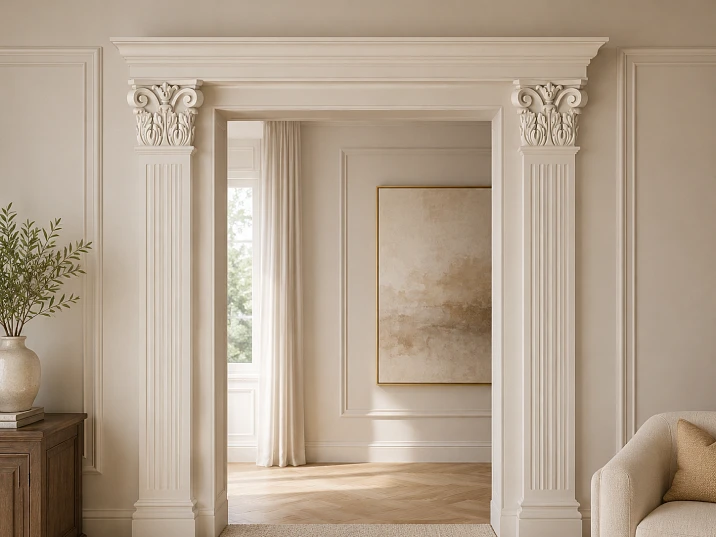
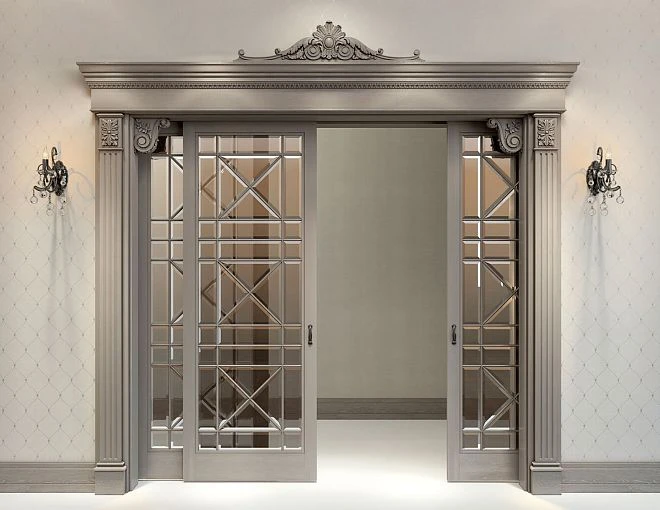
The portal may be neatly assembled, the side posts already brought to height, the opening symmetrically framed, yet the top part still seems unfinished. The reason is often not a lack of one more long profile, but that the vertical posts break off without an expressive finish. In such a situation, what is needed is not a random overlay or an extra strip of molding, but a carved polyurethane capital that completes the top of the post and connects the vertical part of the portal with the horizontal decoration above the opening.
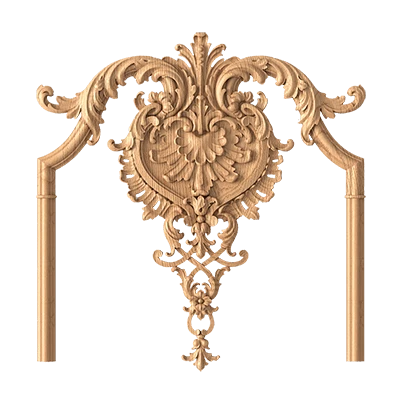
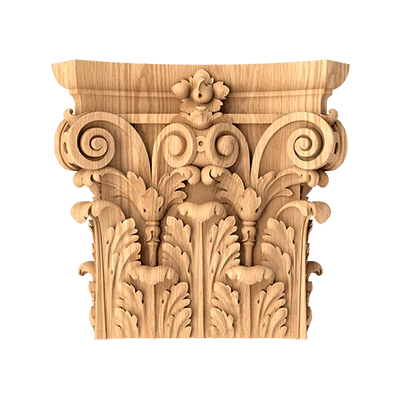
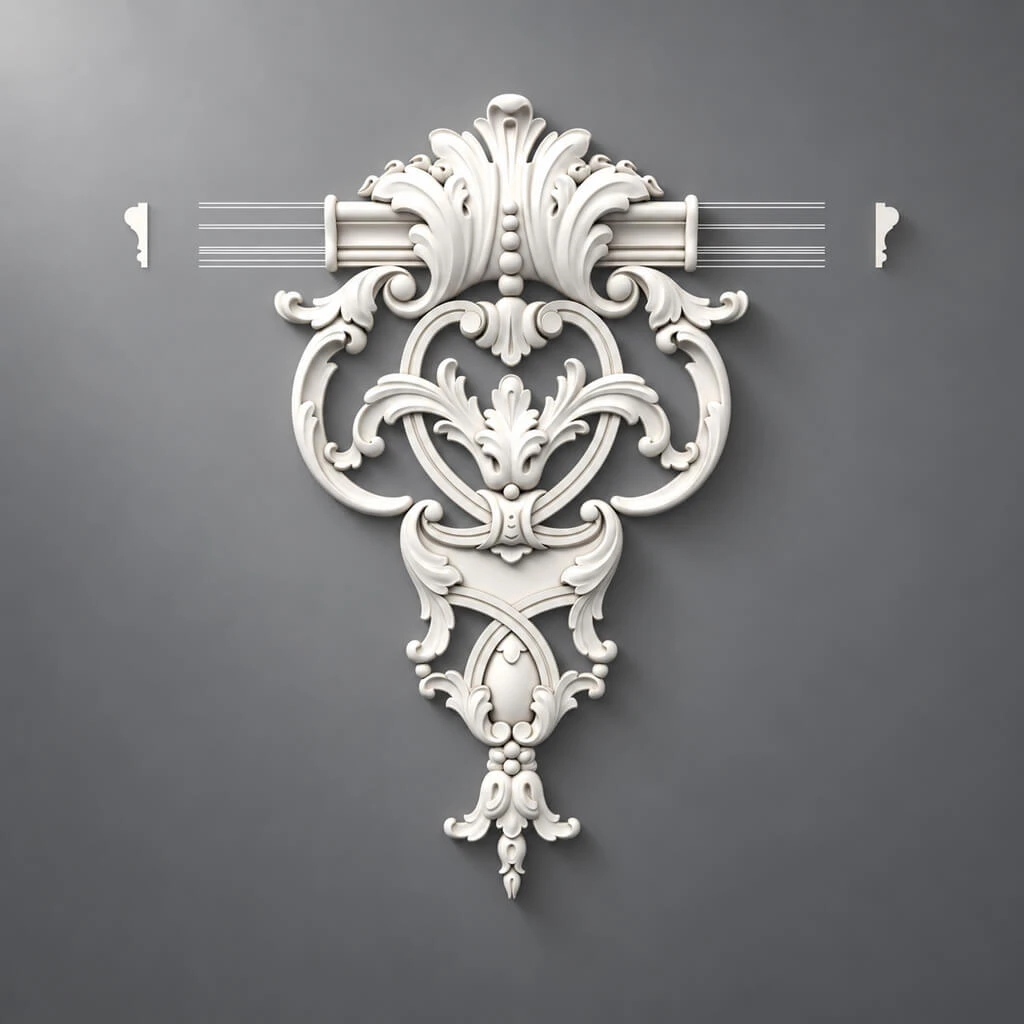
For such a task, KLPU-004 is interesting. One model provides six width sizes A: 60, 83, 108, 125, 141, and 158 mm. This is a fundamentally important feature. The buyer does not have to choose between several completely different ornaments just because the width of an already installed post differs. You can keep the KLPU-004 pattern but adjust its scale to the actual architecture of the existing portal.
It is the width of the post that should be the starting point. Not the door height, not the room size, and not a close-up photo of the capital. If the vertical part of the portal is already ready, it cannot be mentally "fitted" to a decorative element you like. First, measure the post, then compare this size with the six KLPU-004 options, calculate the expected side projection, and only then make a decision.
For two symmetrical posts, a paired top decor is usually needed. Therefore, an error in size doubles: a too-small capital on both sides makes the portal visually incomplete, while a too-large one creates a heavy upper part that can overwhelm the posts themselves.
If you are not yet choosing a specific item but the entire architectural design system, you can first You can buy ready-made stucco matching the Baroque style. Calculate the quantity: linear meters of cornices and moldings, number of rosettes, pilasters, consoles, corner elements. Add a ten to fifteen percent allowance for trimming. and compare different groups of elements. When the task is formulated more precisely — you need to finish pilasters or portal posts from above — you should go to the section where you can buy polyurethane capitals.
For a ready-made portal, the selection path is even shorter: measure the vertical part, check the available space above and on the sides, compare the six sizes, and buy the carved capital KLPU-004 already for specific dimensions, not just because the ornament appealed.
The portal looks unfinished not because it has little decor
There is a temptation to fix any emptiness with a quantity of details. If the top of a door portal seems plain, moldings, overlays, horizontal strips, and additional frames start being added there. Sometimes the design becomes more complex after that, but the problem remains: the vertical posts still do not get a clear completion.
A capital works differently.
It is located exactly at the point where the vertical should end and transition into the upper part of the portal. Therefore, even one correctly selected pair can change the perception of the entire structure more than several randomly added elements.
Imagine two vertical posts of equal width. They reach the top of the doorway and end with a straight cut. The eye sees two strips, but does not read them as completed architectural supports.
Now a decorative extension appears on top of each. The post gets a logical finish. The horizontal lintel above the opening is no longer perceived as a separate bar, but as a continuation of the overall structure.
This is why a capital is needed in a finished portal.
The top piece should complete the post, not exist separately.
An incorrectly chosen capital often looks like a decorative object glued on top.
A properly matched one looks like the upper part of the same vertical line.
The difference arises primarily from proportion.
If the width of the capital is too close to the size of a small local ornament and does not relate to the post, the transition becomes weak.
If the capital is significantly wider than the post, but the portal itself is small, the top begins to seem heavy.
Therefore, the question 'which KLPU-004 is prettier' is secondary in this situation. The pattern is the same. The main question is which size matches the existing post.
Our factory also produces:
KLPU-004: one carved capital, six scales
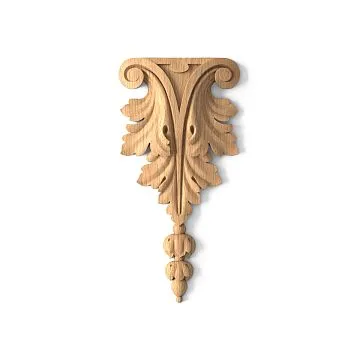
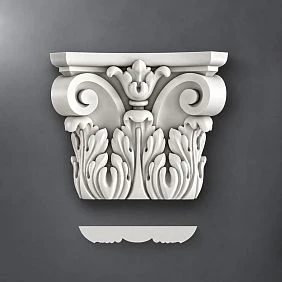
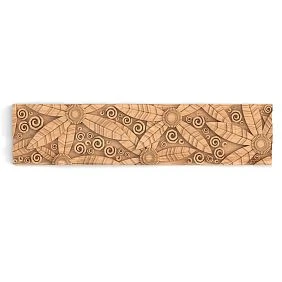
KLPU-004 is a carved polyurethane capital for the top of columns, pilasters, and doorways. In the task at hand, it is used as the top finish for two vertical posts of an existing portal.
The model has six sizes.
| Option | Size A, mm | Full size A × B × C, mm | What to check before choosing |
|---|---|---|---|
| KLPU-004 | 60 | 60 × 72 × 19 | Will the part be too small relative to the column |
| KLPU-004 | 83 | 83 × 99 × 27 | Correlation with the pilaster and available top field |
| KLPU-004 | 108 | 108 × 130 × 35 | Side overhang relative to the vertical |
| KLPU-004 | 125 | 125 × 150 × 40 | Is there enough space between the column and the adjacent decor? |
| KLPU-004 | 141 | 141 × 170 × 46 | Doesn't the top become too massive? |
| KLPU-004 | 158 | 158 × 190 × 51 | Does the large scale match the entire portal? |
The material of all options is polyurethane.
The price depends on the selected size and starts from 1,030 RUB. Before placing an order, the current cost of a specific modification should be checked in the product card.
This size range is what makes KLPU-004 especially interesting for an existing portal. If the capital were produced in only one size, you would have to either rework the columns to fit it or look for a different pattern. Here you can first measure the architecture and then choose the appropriate scale of one model.
Get Consultation
What does size A mean and why should you start with it?
In this article, width A is the main comparison parameter, because it allows you to quickly match the capital with the vertical post.
Suppose the column width is 100 mm.
The closest KLPU-004 options by A:
-
83 mm;
-
108 mm;
-
125 mm.
If you choose 83 mm, the decorative top part will be narrower than the post itself.
With A = 108 mm, it will be 8 mm wider overall.
With A = 125 mm, it will be 25 mm wider.
But this difference does not automatically indicate which option is correct.
You need to understand how the capital is positioned relative to the post, what lateral overhang is compositionally acceptable, and how much free space is nearby.
Formula for lateral overhang for a preliminary mockup
If the capital is centered relative to the post and its width A is greater than the post width W, the preliminary symmetrical overhang on one side can be estimated as follows:
(A − W) ÷ 2.
For example, the stand has a width of 100 mm.
For KLPU-004 A = 108 mm:
(108 − 100) ÷ 2 = 4 mm.
We get approximately 4 mm of protrusion on each side.
For A = 125 mm:
(125 − 100) ÷ 2 = 12.5 mm.
For A = 141 mm:
(141 − 100) ÷ 2 = 20.5 mm.
These numbers do not establish a universal standard. They are needed for the layout. One portal easily accepts a side offset of about 20 mm, while in another even 10–12 mm turn out to be too noticeable due to a nearby casing, wall, adjacent molding, or the small scale of the structure.
Why you cannot choose KLPU-004 only by the closest width match
Let's say the rack has a width of 110 mm.
The closest size A is 108 mm.
It seems the choice is obvious.
But the capital is not a continuation of the post in the form of a simple rectangular strip. It is a carved top piece with its own height, depth, and plasticity.
Therefore, you need to consider the entire shape.
The size almost matches the post
This option creates a more composed transition.
The capital differs slightly from the vertical in width and works discreetly.
The size is noticeably larger than the post.
A more pronounced upper expansion appears.
This could be exactly the effect the portal was missing.
But if the flare is too strong, the capital begins to be perceived as a separate heavy block.
Size smaller than the post
This option requires particularly careful checking.
If the top element visually narrows the post instead of completing it, the architectural logic may be disrupted.
Therefore, the nearest size is only the first candidate, but not the final answer.
A paper mockup of six sizes is better than choosing from a photo
KLPU-004 is sold as a finished part, but you can choose it before purchasing using a simple mockup.
You need to cut out six rectangles from paper or cardboard with width A and corresponding height B:
-
60 × 72 mm;
-
83 × 99 mm;
-
108 × 130 mm;
-
125 × 150 mm;
-
141 × 170 mm;
-
158 × 190 mm.
This will not convey the carved relief and depth, but it will show the main thing — the scale of the top part relative to the stand and the portal.
Start with the size closest to the post
If the rack is about 105–110 mm wide, first apply the 108 mm template.
Look from afar.
The capital should be perceived as the completion of the vertical, not as a random plaque on top.
Then take one size larger
After 108 mm, try 125 mm.
Don't try to convince yourself in advance that it's "too big."
On a tall portal, additional side overhang sometimes looks more convincing than almost perfect alignment with the post.
And be sure to try one size smaller
For example, 83 mm.
This creates a visual scale.
A person stops choosing between numbers in the product card and starts seeing real proportions.
You need to measure not only the width of the post
One width is an insufficient initial parameter.
Before ordering capitals, it's useful to take a whole set of measurements.
Width of each post
Measure the left and right separately.
Do not automatically assume they are absolutely identical just because the portal looks symmetrical.
Distance from the post to the edge of the wall
If the portal is located near a corner, a large capital may physically or visually press against the adjacent plane.
Distance from the post to the doorway
The inner projection must also fit into the composition.
Free height above the counter
For KLPU-004, not only A changes, but also B.
The larger the size, the higher the decorative element.
Depth of the existing vertical part
For different sizes of KLPU-004, C also changes.
This affects the volume of the upper part.
Distance between the top of the counter and the horizontal element
If there is already a molding or another lintel above the counter, you need to understand whether there is space for the selected size.
Six sizes of KLPU-004: how to read them not as a catalog, but as a scale ladder
It is more useful to perceive the line not as six independent products, but as a sequential enlargement of one shape.
60 mm: very compact finish
The size 60 × 72 × 19 mm makes sense to consider for thin vertical parts and small decorative constructions.
On a massive rack, it may be too small.
If the vertical width noticeably exceeds 60 mm, be sure to make a mockup before purchasing.
83 mm: the next step without a sharp increase
Size A = 83 mm is already more noticeable, but remains relatively compact.
It may be suitable for small pilaster posts where 60 mm seems too delicate, and 108 mm already creates excessive protrusion.
108 mm: medium range
A = 108 mm is in the center of the size line.
For portals with posts around 100 mm, it is especially interesting as a starting point for fitting.
But "average size" does not mean "universal."
125 mm: more pronounced top part
The size 125 × 150 × 40 mm already forms a noticeable expansion compared to thin posts.
On a large portal, this can add the necessary weight to the upper part.
141 mm: the capital becomes an independent architectural accent
With A = 141 mm, not only the post but also the entire opening should be evaluated.
If the portal is small, the detail may turn out to be too dominant.
On wide or tall structures, on the contrary, such a scale can look more convincing than smaller options.
158 mm: the largest option in the considered line
The size 158 × 190 × 51 mm cannot be chosen only by the principle "the portal is large — we take the largest one."
First, you need to check the width of the post, the free space, the height of the horizontal design, and the overall character of the structure.
How to choose a capital for a post of 60–70 mm
Let's take a narrow vertical part.
If its width is approximately in the range of 60–70 mm, the first candidate naturally becomes KLPU-004 A = 60 mm.
But don't stop at it automatically.
Also try 83 mm.
Why?
Because the capital may be intentionally wider than the vertical shaft. It is this expansion that creates the sense of completion.
If 83 mm looks too heavy or almost touches the adjacent element, return to 60 mm.
Post about 80–90 mm: compare 83 and 108 mm
Here a classic fork appears.
83 mm gives a width close to the post.
108 mm is a more noticeable upper expansion.
Which option is better?
Look at the height of the post.
A tall vertical can comfortably accommodate a more pronounced capital.
On a short decorative element, the same size can appear too large.
Then assess the horizontal top.
If there is already a massive molding above the posts, a larger capital may better connect the verticals to it.
If the horizontal part is thin and calm, 83 mm may be more precise.
Post around 100–110 mm: 108 or 125 mm
This is one of the most understandable scenarios for the layout.
The nearly matching 108 mm version provides a neat transition.
125 mm creates a more pronounced lateral projection.
Here the formula is especially useful:
overhang on one side = (A − rack width) ÷ 2.
For a 105 mm rack:
A = 108 mm:
(108 − 105) ÷ 2 = 1.5 mm.
That is, the width almost matches.
A = 125 mm:
(125 − 105) ÷ 2 = 10 mm.
A pronounced expansion is already appearing.
A = 141 mm:
(141 − 105) ÷ 2 = 18 mm.
Such a capital will be noticeably wider.
There is no universally correct value here. This is the essence of fitting.
A post about 120–130 mm: don't blindly choose 125 mm
If the post is 125 mm wide, it seems that capital A = 125 mm must fit.
The match in frontal width is indeed obvious.
But the full size of this version is 125 × 150 × 40 mm.
Therefore, you need to check height B and depth C.
If there is little space above, a different scale of the entire part may be undesirable.
Additionally, sometimes a small side overhang is architecturally needed. Then it's worth looking at A = 141 mm.
Post about 140 mm: choice between 141 and 158 mm
On a sufficiently large portal, 141 mm can almost continue the width of the post.
158 mm will create a more pronounced finish.
Here, the size of the entire door structure is especially important.
If the opening is tall and wide, the largest version may look natural.
If the post is wide, but the portal itself is not tall, the additional height and depth of the capital can make the top too heavy.
Wide jamb over 158 mm: what to do
You don't need to automatically take the largest KLPU-004 just because it's the maximum model variant.
If the jamb is significantly wider than 158 mm, the large KLPU-004 may still appear visually narrower than the vertical.
Sometimes this is acceptable.
Sometimes — no.
First, you need to make a mockup of 158 × 190 mm.
If it looks too small, it's better to consider other capitals in the category rather than trying to force a specific item to work where its size range has already ended.
For this, you can buy polyurethane capitals after comparing other models.
Side overhang: how many millimeters should be correct?
This is one of those questions where it's dangerous to invent a universal number.
There is no single mandatory overhang for KLPU-004 for all portals.
Why?
Because the same 15 mm look completely different:
-
on a 60 mm wide post;
-
on a 150 mm stand;
-
in a narrow doorway;
-
on a wide main portal;
-
next to a massive architrave;
-
on a completely free wall.
Therefore, millimeters need to be converted into visual proportion.
Look at the percentage, but don't turn it into a rigid norm.
Let's say the post is 100 mm, the capital is 125 mm.
The difference is 25 mm.
This is a quarter of the post width in total, or 12.5 mm per side when centered.
Now let's compare a 140 mm post with a 158 mm capital.
The difference is 18 mm.
9 mm per side.
Although the capital itself is larger, the relative projection is smaller.
This is why choosing based only on absolute width is misleading.
Internal and external projection are not always perceived the same way.
The portal stands in real space.
On one side of the post is a doorway, on the other — a wall.
Even with a perfectly symmetrical capital, the two edges are perceived under different conditions.
Inner side
The projection is directed toward the doorway.
It needs to be checked how it relates to the horizontal lintel and the open space of the door itself.
Outer side
The projection is on the wall.
If there is a corner, furniture, switch, another decorative panel, or molding nearby, the available space may be limited.
Therefore, one formula is not enough.
After calculation, always attach a full-size mockup.
If the portal is already painted and assembled, fitting is especially important.
When the structure exists only on paper, proportions can be changed freely.
A finished portal does not allow such freedom.
The posts already have:
-
a certain width;
-
a certain height;
-
a specific position;
-
distance to the opening;
-
the distance to the wall;
-
own finishing.
The capital must fit exactly into these conditions.
Here the principle is useful: do not redo the portal for KLPU-004, but select KLPU-004 for the portal.
Are the posts the same on the left and right? Do not trust your eye
For a symmetrical portal, you want to buy two identical capitals.
This is a normal and logical scenario.
But first, measure both verticals.
For example:
left post — 108 mm;
right — 110 mm.
The difference is small, but it's useful to know when centering.
If the discrepancy is larger, the problem is no longer about choosing the capital. You need to decide how the paired installation on two unequal bases will be perceived.
Don't order two different KLPU-004 just to compensate for a small construction error without an overall project. Different sizes on the left and right will almost certainly be more noticeable than the difference in the posts themselves.
Why a pair of identical capitals is usually needed for two posts
The portal is built around the central opening.
The left and right verticals work as two sides of one system.
If identical carved capitals are installed on them, the top gets a symmetrical structure.
Therefore, the quantity is most often counted in pairs:
-
one portal with two posts — 2 pcs.;
-
two identical portals — 4 pcs.;
-
three openings — 6 pcs., if all are designed the same way.
But before ordering, the actual number of posts is still verified.
Sometimes a portal has only one decorative vertical due to its location near a wall or other architecture. Then the paired scheme is not applied automatically.
Why buying one KLPU-004 as a sample is sometimes wiser than buying the whole set at once
If one portal is being designed and the dimensions are clear, the pair can be determined right away.
If the project includes several doors or a long corridor with repeating portals, the cost of a mistake increases.
Imagine five door openings.
For each, you need two capitals.
That makes ten pieces in total.
If the size is chosen only based on the screen, one mistake repeats ten times.
Therefore, for a large project, the following are especially useful:
-
a paper mockup;
-
size verification;
-
if necessary, a test fitting of one selected size;
-
then the main order.
The capital and the horizontal part of the portal must speak the same language
The posts are finished, the capitals are chosen. What is above them?
If the top of the portal is already decorated with a horizontal profile, their interaction needs to be checked.
The capital should not exist in isolation.
It works as a transition from vertical to horizontal.
The top molding is very thin
A large KLPU-004 may turn out to be stronger than the horizontal part.
Then the portal looks as if two heavy parts support a too-thin line.
The top molding is large
A too-small capital may get lost between the vertical post and the massive lintel.
The sizes are close in character
Then the top looks assembled.
If an additional horizontal line is needed to tie the portal together, you can buy polyurethane moldings, but the profile should be chosen after deciding on the capital, not the other way around.
Molding above the capitals: when it is really needed
Not every portal requires another detail.
If the horizontal top part is already done and connects the two posts well, adding a new molding just for extra decoration is unnecessary.
It is useful when:
-
there is an empty top zone left between two capitals;
-
the horizontal line of the portal is too weak;
-
the vertical parts need to be connected into a single rectangular outline;
-
the profile is already used in adjacent wall frames.
In other cases, a pair of KLPU-004 may be a sufficient accent on its own.
Decorative overlays above the door: a second level, not a mandatory purchase
The central zone between two capitals sometimes remains empty.
The thought arises to add a carved overlay.
This could be a good solution for a richer classical portal.
But the logic must be consistent.
First:
-
uprights;
-
correct capitals;
-
horizontal structure.
And only then is the central decor evaluated.
If after this the top already looks finished, an additional overlay is not needed.
If the central part is really too empty, you can Buy decorative polyurethane overlays and select a separate element to match the scale of the lintel.
Wall decor around the portal: when the door itself is already part of a large composition
Sometimes the portal occupies not a separate section, but the central part of an architecturally designed wall.
There are frames on the sides.
Pilasters stand between the openings.
Vertical elements are repeated on the wall.
Then KLPU-004 should be evaluated not only relative to one rack, but also relative to the entire surface.
If you need to extend the system beyond the opening, you can Buy polyurethane wall decor and assemble a broader architectural composition.
But here it is especially easy to cross the line between architecture and overload.
The capital already has a carved pattern. If there are too many active details around it, KLPU-004 itself stops being readable.
One portal in a small hallway and a portal in a spacious living room are different tasks
Let's imagine the same rack with a width of 108 mm in two rooms.
In the hallway, the distance to the opposite wall is small. A person views the portal almost up close.
In the living room, the opening is visible from several meters away.
The physical width of the rack is the same.
But the visual context is different.
In the hallway, KLPU-004 at 108 mm can look quite expressive.
In a large living room, the same size sometimes seems too modest, and it's worth comparing 125 mm.
Therefore, the final choice depends not only on the base but also on the viewing distance.
Ceiling height doesn't choose the size for you, but it affects the impression
A high ceiling makes verticals more elongated.
On a tall column, a too-small capital can look like a weak finish.
But this doesn't mean that for a 3 m ceiling, KLPU-004 158 mm is automatically needed.
First, the column is still measured.
Then large sizes are checked as a possible reinforcement of the upper part.
Room height is an additional factor, not a substitute for measurement.
Narrow doorway: a large capital can visually compress the top
On a small door, the space between the two upper elements is limited.
If both capitals have a significant inward projection, the free horizontal zone above the opening becomes narrower.
Sometimes this looks expressive.
Sometimes the portal starts to seem too heavy.
Therefore, with a narrow opening, it is useful to make a mockup of two capitals at once, rather than one.
This is fundamental.
A single detail may seem suitable on its own, but two symmetrical ones at the actual door width create a completely different scale.
Wide opening: small capitals may be spaced too far apart
The opposite situation is a large double-door passage or a wide portal.
Two small KLPU-004 units stand far apart from each other.
Between them there is a huge lintel.
Each capital looks neat individually, but the top does not come together.
Then a larger size can better mark the transition points from verticals to the horizontal.
But you cannot endlessly enlarge the capital without enlarging the overall system. Sometimes the problem is solved not by the maximum KLPU-004, but by a more expressive molding between the two posts.
Portal without a door: KLPU-004 works just as well, but you need to look at the opening itself
An architectural portal can frame a passage without a door leaf.
Then the whole structure is seen even more clearly.
There is no leaf, hardware, or other details that distract attention.
The size of the capitals becomes especially noticeable.
For such a scenario, a paper mock-up is mandatory.
Look not at a single post, but at the entire rectangle of the opening.
Portal with a massive door: door decor influences the choice of top size
If the leaf itself has pronounced paneling, carved details, or large hardware, a too-small capital risks getting lost.
But that is not a reason to take the largest one.
You need to compare the saturation of two parts:
-
of the door itself;
-
the architectural framing.
A good portal supports the door, rather than trying to outshout it.
Portal next to a ceiling cornice: check the free height
In some apartments, the top of the door is close to the ceiling.
A cornice already runs above the portal.
Then a large KLPU-004 may physically fit, but leave too narrow a gap to the top line.
Measure the distance from the top point of the stand to the nearest horizontal element.
Compare it with the height B of the selected capital.
This is especially important for large sizes:
-
125 × 150 × 40 mm;
-
141 × 170 × 46 mm;
-
158 × 190 × 51 mm.
If there is not enough free space, reducing A simultaneously reduces other dimensions.
Capital depth: why you can't look only at the facade
Size C increases from 19 mm for the most compact KLPU-004 to 51 mm for the largest.
In the front photo, this is easy to forget.
But in a real portal, the part has volume.
Depth matters near the trim.
If the post itself is flat, a large capital can protrude noticeably forward.
Depth matters in a narrow corridor.
Details are closer to the person.
Volume is perceived more strongly.
Depth matters near a horizontal molding
Profiles should match not only in width, but also in relief.
Therefore, after a paper front mockup, it is useful to look at the drawing of the selected modification in the card.
Is it necessary for the capital to be exactly wider than the post?
No.
This is not a universal rule.
There are compositions where the capital almost coincides with the post.
There are those where it noticeably widens.
But if the chosen option is already vertical, you need to check especially carefully whether the transition looks intentional.
The main thing is not to turn the formula "the capital must protrude" into a dogma.
The real criterion is the consistency of the entire upper part.
Too small KLPU-004: four signs of an error
The post visually continues above the capital
That is, the upper element does not complete the vertical, but seems like a small applique on it.
There is too much empty space at the top between the two sides of the portal
Two small capitals do not create sufficient termination points.
The horizontal part is stronger than both capitals
The massive top "presses down" on the small decorative details.
The carved pattern is barely readable from a normal distance.
Then the point of buying a carved capital specifically diminishes.
KLPU-004 is too large: a different group of symptoms
The top is so much wider than the post that it almost collides with neighboring elements.
This is especially noticeable in narrow piers.
The two capitals visually eat up the central lintel.
On a small opening, little free space remains between them.
The top seems heavier than the entire vertical
The posts look like thin legs under massive blocks.
The capital almost touches the ceiling or wall decor
The composition lacks space between levels.
Comparison of six sizes for the finished portal
| Width A | Impression in the portal system. | Where to check especially carefully. |
|---|---|---|
| 60 мм | Very compact ending | Narrow pillars, small openings |
| 83 мм | Restrained small scale | Transition from narrow post to top part |
| 108 мм | Medium range | Posts about 100 mm, standard door portals |
| 125 мм | More pronounced expansion | Free space on sides and height |
| 141 мм | Large architectural accent | Wide pillars and large openings |
| 158 мм | Maximum scale of the line | High and wide portals, sufficient free zone |
This table is not a ready compatibility table.
It helps decide which two or three sizes to include in the layout for a specific post.
What to buy together with KLPU-004
Since the portal is already assembled, the additional purchase should be minimal and clear.
| What to consider | Why | When it is really needed | Link |
|---|---|---|---|
| KLPU-004 | Top termination of posts | When a specific capital size is selected | buy the carved capital KLPU-004 |
| Polyurethane capitals | Compare other models and scales | If no KLPU-004 size fits | buy polyurethane capitals |
| Moldings | Connect two capitals with a horizontal line | If the top lintel of the portal requires reinforcement | buy polyurethane moldings |
| Wall decor | Extend the portal to the adjacent wall | If the entire architectural zone is being designed | Buy polyurethane wall decor |
| Decorative overlays | Add a central top motif | If a separate accent is truly needed between the capitals | Buy decorative polyurethane overlays |
| Polyurethane molding | Coordinate the portal with other zones | If the project extends beyond a single doorway | You can buy ready-made stucco matching the Baroque style. Calculate the quantity: linear meters of cornices and moldings, number of rosettes, pilasters, consoles, corner elements. Add a ten to fifteen percent allowance for trimming. |
You don't need to buy all these groups at once.
In a finished portal, the sensible order is different: capitals → evaluate the result → only then additional elements, if there really remains a compositional problem without them.
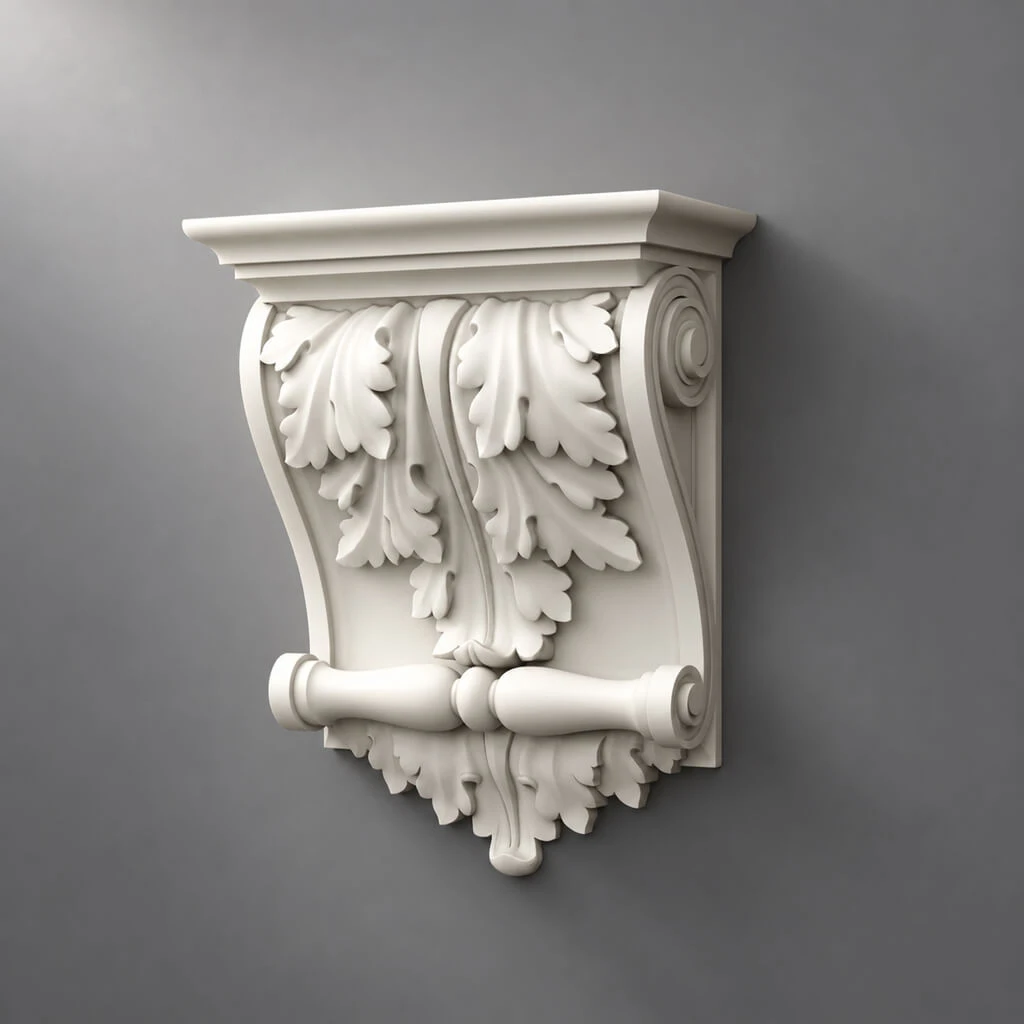
How not to confuse a capital with a bracket
A category may include several types of stucco decor, so it's useful for the buyer to understand the functional difference.
A capital completes the top of a vertical element.
A bracket is usually read as a supporting or console decorative form.
If the task is: "two vertical portal posts must have the same top finish," a capital is exactly what is needed.
KLPU-004 should be selected as a carved capital, not as a random element of suitable width.
How not to confuse a capital with a decorative overlay
The overlay is applied to the surface as a local ornament.
It can decorate the center of a lintel, a door panel, or a wall field.
But it does not necessarily create an architectural transition from the vertical post to the upper part.
Therefore, replacing KLPU-004 with an overlay just because they have similar width is incorrect.
Pilaster and portal post: are they the same in this article
Not necessarily.
If the portal is already assembled, its vertical part can be a full-fledged pilaster or a decorative post of a different design.
For choosing KLPU-004, the key question is practical: is there an upper vertical platform that needs to be completed, and does the selected capital match its scale.
There is no need to artificially rename any post into a pilaster.
When it is better to leave the portal without a carved capital altogether
An honest choice sometimes means refusing the product.
KLPU-004 may be unnecessary if:
-
the posts already have their own finish;
-
the top of the portal is fully assembled with other decor;
-
the interior is deliberately very minimalist;
-
even a size of 60 mm looks too active;
-
there is too little free space nearby;
-
the KLPU-004 ornament does not match the other details.
You should not add a capital just because it can technically be installed.
Who KLPU-004 is especially suitable for
&practical scenario No. 5: 115 mm stand
Here, 108 mm is a bit narrower.
125 mm is slightly wider.
This range especially shows why you shouldn't choose based on the "nearest number" principle.
One option creates an almost direct continuation.
The other — a slight expansion.
The comparison is done on the portal itself.
Practical scenario #6: 130 mm stand
125 mm is almost identical.
141 mm gives 5.5 mm of additional width per side.
Both look like quite realistic candidates even before trying them on.
Now the height and depth of the capital decide.
Practical scenario No. 7: 150 mm stand
Two large options remain in the lineup.
141 mm is slightly narrower.
158 mm is 8 mm wider.
If you center A = 158 mm on a 150 mm stand, the frontal overhang will be approximately 4 mm on each side.
This is a good example of how the largest KLPU-004 may not look excessive on a wide vertical.
How many KLPU-004 to order for one portal
If the portal has two identical vertical posts and the composition is symmetrical, two capitals of the same size are usually considered.
For example:
- 2 × KLPU-004 A = 108 mm;
- or 2 × KLPU-004 A = 125 mm.
There is no need to order one capital of different sizes for the left and right sides just because one post differs by a few millimeters.
First, you need to understand the reason for the difference.
Several portals in an apartment: first make a reference one
If identical openings repeat in a corridor, hall, or enfilade of rooms, it is useful to first fully solve one.
Algorithm:
- measure the posts of the first portal;
- choose two or three KLPU-004 candidates;
- make mockups;
- determine the size;
- check the upper horizontal part;
- only then transfer the solution to the remaining openings.
After that, all other portals are measured separately.
Even if the builders used the same project, the actual width may differ slightly.
Can different KLPU-004 sizes be used on different portals in the same apartment
Yes, if the portals themselves differ in scale.
For example:
the main wide opening of the living room — A = 141 mm;
small corridor doors — A = 108 mm.
One design remains common, while the size adapts to the architecture.
This approach is analogous to using one decorative language at different scales.
But on one symmetrical portal, the left and right capitals must be coordinated with each other.
White capital or matching the wall color: first decide on the size
Finishing affects perception but should not hide a proportion error.
The contrasting KLPU-004 looks larger and more active.
A capital close in color to the post and wall reads softer.
Therefore, after choosing the size, it is useful to check the future color scheme.
But you don't need to choose a smaller capital just because contrast is intended, or a larger one because everything will be monochrome. This is already the second stage.
Compatibility of specific finishing materials should be checked separately before work.
Installation on an already finished portal: first the base, then the method of fixation
In the article, it is impossible to honestly assign one universal adhesive for any structure.
We do not know:
- what the post is made of;
- what it is painted with;
- what surface is behind the capital;
- how level the base is;
- how the horizontal part is arranged.
Therefore, before final installation, you need to check the compatibility of the chosen fixing system with polyurethane and the specific base.
The KLPU-004 itself is selected based on geometry and composition, and the attachment technology is refined for the actual object.
Dry fitting before fixation is mandatory for paired installation.
The two capitals must be at the same height.
Even a small difference becomes noticeable because the door between them creates a strong horizontal axis.
Before installation, it is useful to:
- mark the top of the posts;
- draw a reference horizontal line;
- attach both capitals;
- check the distance to the opening;
- compare the external projections;
- look at the portal from the center of the room.
If everything looks correct, you can proceed to the selected mounting system.
Why the level of the top point matters more than local fitting of each post
Suppose the left post is a few millimeters higher than the right one.
If you set each capital strictly according to its local top, the two parts may end up on different horizons.
The eye will notice this.
Therefore, with existing portal deviations, preliminary marking of the entire composition is needed.
Do not try to solve construction geometry with just a decorative element.
Mistakes when buying KLPU-004 that are discovered too late
Order two capitals based on a photo
The photo shows the pattern, but not the scale relative to your portal.
Measure the opening, not the post
The width of the door does not replace the width of the vertical base.
Look only at A
After the first selection, check B and C.
Choose the closest size and do not compare the adjacent one
Sometimes a slight expansion looks better than an almost exact match.
Not checking two capitals at once
A paired composition is significantly more active than a single detail.
Forgetting about the distance to the wall
The outer edge of a large capital may end up too close to the corner.
Not accounting for the horizontal molding
The capital should connect with the upper part, not argue with it.
Buying one piece for a double-sided portal
If the project involves two posts, the set should be calculated as a whole.
Choosing two different widths to compensate for unevenness
Mismatched paired decor often makes asymmetry more noticeable.
Calling 158 mm the "most beautiful" because it is larger
A larger size is not higher quality and not automatically more expressive.
Add overlays until the base proportion is resolved
First the capitals, then additional accents.
Use KLPU-004 as a bracket
The function of the part is different.
What does not need to be redone if the portal is already assembled
The main advantage of this scenario is that the architecture already exists.
There is no need to disassemble the posts just to add a top carved accent, if the dimensions and installation conditions allow installing a suitable KLPU-004.
There is no need to manually carve a complex capital from a random blank.
There is no need to look for two similar but different parts for the left and right sides.
There is no need to enlarge the entire column just because you liked a large capital.
There is no need to turn a light refinement of a finished portal into a full reconstruction.
The ready-made size range allows you to focus on what matters most:
measurement → scale selection → pair fitting → coordination with the upper molding → order.
Where to buy the KLPU-004 capital after taking measurements
When measurements are ready, it is useful to write them down separately.
For example:
Portal No. 1
- left column — 104 mm;
- right column — 105 mm;
- candidate № 1 — KLPU-004 A = 108 mm;
- candidate № 2 — KLPU-004 A = 125 mm;
- quantity — 2 pcs.;
- horizontal molding — existing;
- additional overlay — not required.
With such a record, you can order KLPU-004 of the required size already consciously.
If none of the six options fits, return to the category and compare other capitals without reworking the finished portal for one specific article.
FAQ: questions about KLPU-004 for a finished door portal
What is KLPU-004?
KLPU-004 is a carved polyurethane capital that can be used as an upper decorative finish for columns, pilasters, and door portal posts.
How many sizes does KLPU-004 have?
The model has six width A options: 60, 83, 108, 125, 141, and 158 mm.
What is the smallest size of KLPU-004?
The most compact option measures 60 × 72 × 19 mm.
What is the largest size of KLPU-004?
The largest of the considered options is 158 × 190 × 51 mm.
What size should you start with when choosing?
Start with the width of the existing post. Find the two nearest A sizes — one close to the measured value and another adjacent one — and compare them using full-size templates.
Should the capital be exactly the same width as the post?
No. Exact matching is not mandatory. The capital can be slightly wider and create an upper extension if this proportion suits the portal.
Can KLPU-004 be narrower than the post?
Physically, such a variant is possible, but compositionally it needs to be checked especially carefully. The upper part should not look randomly reduced relative to the vertical.
How to calculate the lateral projection of the capital?
For a preliminary symmetrical layout, you can use the formula (A − post width) ÷ 2, if the capital is wider than the post and is centered relative to it.
What projection is considered correct?
There is no universal value. The projection is evaluated relative to the post width, opening size, distance to the wall, and neighboring decorative elements.
How to choose KLPU-004 for a 100 mm post?
The first candidate will be A = 108 mm. It is also useful to compare A = 125 mm to understand whether the portal needs a more pronounced top.
What to choose for a 125 mm rack?
Version A = 125 mm gives a close match in width. For a more pronounced expansion, you can compare A = 141 mm.
Which option to try for a rack around 150 mm?
It is useful to compare A = 141 and A = 158 mm. The final decision depends on the overall scale of the portal.
Do I need to buy two KLPU-004?
If the portal has two symmetrical racks and both should receive an upper finish, a pair of identical capitals is usually required.
Can different sizes be used on the left and right?
For a symmetrical portal, this is undesirable without a special design. A small difference between the racks should first be analyzed rather than compensated with two different capitals.
Can KLPU-004 be installed on only one side?
Yes, if the portal architecture itself is asymmetric and has only one decorative vertical. For a typical two-post portal, a paired solution is more logical.
Do I need to account for the height of the capital?
Yes. Size B increases along with A. A large capital requires more free space above the post.
Does depth matter?
Yes. Size C varies from 19 to 51 mm, so you need to check the part's volume relative to the post, wall, and adjacent profiles.
Can KLPU-004 be selected only by the width of the door opening?
No. The main initial dimension in this task is the width of the vertical post. The opening is used as an additional scale for the composition.
What to do if the post is wider than 158 mm?
Make a mock-up of the maximum KLPU-004. If it looks too small, it's better to compare other Polyurethane capitals, rather than automatically selecting the maximum size.
Is a molding needed between two capitals?
Not always. It is needed if the upper part of the portal requires a horizontal connecting element. If the lintel is already designed, an additional profile may be unnecessary.
Where to choose a molding for the portal?
If the horizontal part needs to be supplemented, you can buy polyurethane moldings after the size of the capitals has been selected.
Can a carved overlay be added in the center above the door?
Yes, if after installing the capitals the central field really requires a separate accent. For this, you can Buy decorative polyurethane overlays, having previously checked their scale relative to the portal.
Is it necessary to make a mockup of all six sizes?
Not necessarily. Usually, the size closest to the post, one smaller, and one larger are sufficient. But if doubts remain, paper templates of all six options will help to see the entire scale.
Can you choose based on a product photo?
The photo helps evaluate the design, but not the size in your interior. For an already assembled portal, a natural fitting is needed, even if it's just a paper template.
Can a capital be installed on an already painted column?
The possibility of installation depends on the base, existing finish, and the chosen fixing system. These parameters need to be checked before installation.
Which glue should I use?
A specific mounting compound cannot be chosen based only on the article number. It must be compatible with polyurethane and the actual base of the portal.
Can KLPU-004 be painted to match the color of the column?
The color scheme can be built in a single tone with the portal or contrastingly, but the compatibility of the specific finish with the product and the existing coating needs to be checked before work.
What is better — a capital in the color of the wall or a contrasting one?
In a single tone, the relief is usually perceived more softly through light and shadow. Contrast enhances the size and pattern. Therefore, the color option is better evaluated after the correct physical size has been determined.
How to avoid overloading the top of the portal?
First, install only two capitals in the layout. Then assess whether the molding and the central overlay are really needed. Do not add all categories of decor at once.
Will KLPU-004 fit a pilaster?
Yes, the logic of the capital itself is related to the top finish of the pilaster. The selection is still made based on the actual dimensions of the specific vertical element.
Will KLPU-004 fit a doorway without a door?
Yes, if the opening has vertical elements that need to be finished at the top and the dimensions of KLPU-004 match the architecture.
Can KLPU-004 be used on multiple portals of different sizes?
Yes, it can. If necessary, one size is used on a large opening, and another on a more compact one, while maintaining the overall pattern of the model.
Where can I buy KLPU-004?
After measuring the posts, you can buy the carved capital KLPU-004 in the selected size and required quantity.
The finished portal does not need to be redone — you just need to properly finish its verticals
The most common mistake when refining an already assembled door portal is starting not with measurement, but with choosing a beautiful detail. A person sees a carved capital up close, selects it by ornament, orders a pair, and only then applies it to the posts. If the size doesn't match the architecture, there are two bad options: accept the disproportion or redo the already finished structure.
With KLPU-004, the logic can be reversed and much more precise.
First, measure both posts.
Don't limit yourself to one number. Check the free height, distance to the wall, opening width, and the existing horizontal part.
Then find the nearest options among 60, 83, 108, 125, 141, and 158 mm.
Make full-size paper mockups.
Apply both parts at once.
Look at the portal not up close, but from a normal viewing point.
Compare the side projection.
Check whether the capital looks too small or too heavy.
And only after that proceed to the order.
If the selected pair already completes the portal, you can stop there. If there is not enough horizontal connection between the capitals, the next level becomes Moldings made of polyurethane. If the entire wall is built as an architectural system, you can additionally Buy polyurethane wall decor. If a central carved motif above the door is required, only then does it make sense to move on to decorative polyurethane overlays.
The STAVROS KLPU-004 is interesting precisely as a size series of one carved capital: the buyer does not have to change the ornament with each change in the width of the post. You can preserve the overall decorative character and select the scale for a specific portal.
Before ordering, it is enough to reduce the solution to four questions: what is the actual width of the post, what side projection looks convincing, is there enough space in height, and does the portal need only a top accent or also a horizontal connection.
When there are answers to these questions, the choice ceases to be guesswork. The carved capital becomes not just another stucco detail above the door, but a precise completion of an existing vertical — exactly the element that the assembled portal was missing.