































































Article Contents:
- Flat balusters: what is their nature and strength
- When flat balusters are the right solution
- Wooden houses with rich carving and decor
- Open verandas, terraces, porches
- Stairs in country and garden houses
- Railings of balconies in wooden houses
- Interior stairs in country, Provence, Scandinavian style
- How a flat baluster differs from a turned and carved one: three angles of view
- From an aesthetic point of view
- From a technical point of view
- From a spatial perception perspective
- Where flat balusters are used: a complete overview of applications
- Interior stairs in private homes
- Exterior stairs and porch
- Open and glazed verandas
- Balconies of wooden houses
- Mezzanine level railing
- How to choose the shape of a flat baluster: four selection parameters
- First parameter: silhouette drawing
- Second parameter: width
- Third parameter: height
- Fourth parameter: thickness
- What handrails are needed for flat balusters
- Handrail with groove for flat baluster
- Handrail on bottom plate
- Handrail Profile
- Overlays, plates and fasteners for flat balusters: what to buy in a set
- Bottom mounting plate
- Decorative appliqués
- Fasteners
- Posts
- Complete purchase list for one flight
- How to calculate the number of flat balusters: an accurate method
- Step one: measure the length of the railing horizontally
- Step two: determine the installation spacing
- Step three: calculate the quantity
- Step four: adjust the spacing
- Step five: landing and balcony
- Step six: allowance
- Summary calculation table
- Price of wooden flat balusters: what affects the cost
- Wood species
- Pattern complexity
- Baluster size
- Order volume
- Estimated prices (2026)
- Mistakes when buying flat balusters: real scenarios and how to avoid them
- Mistake one: buying only balusters, without strips and overlays
- Mistake two: not measuring the working height, relying on eye
- Mistake three: handrail with a groove for a turned baluster
- Mistake four: not calculating the spacing, placing by feel
- Mistake five: choosing balusters only by picture, without considering the style of railings and posts
- Mistake six: buying pine balusters for outdoor use without proper treatment
- Mistake seven: ordering from multiple places
- Fastening flat balusters: overview of main methods
- Bottom rail method
- Overlay method using self-tapping screw
- Glue and dowel method
- Coating flat balusters: for painting, stain or varnish
- For enamel or paint
- For stain and varnish
- For oil
- Where to buy flat wooden balusters: how not to make a mistake with the supplier
- STAVROS: flat balusters and a complete set for your railing
- Frequently Asked Questions
- Where to buy flat wooden balusters?
- What are flat balusters suitable for?
- What must be purchased together with flat balusters?
- Are flat balusters suitable for outdoor use?
- How to attach flat balusters to handrails and steps?
- What height of flat baluster should I choose?
- How to avoid mistakes with the installation spacing?
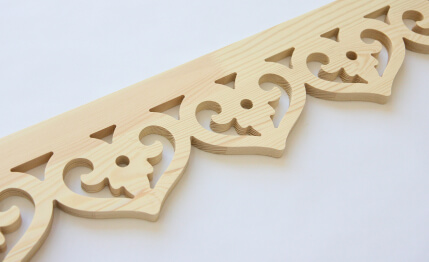
When people say "baluster," most imagine a rounded turned post — the kind drawn in old architecture textbooks. But wooden railings have long moved beyond this stereotype. A flat baluster is a completely different story: it is a silhouette cut from a board with a pattern that repeats at equal intervals in a row, creating a rhythmic decorative band along a flight of stairs or a terrace.
Buy flat balusters — means choosing an element that is both functional and decorative. The flat shape allows you to create a pattern in the railing that cannot be achieved with square or turned counterparts. This article is about flat balusters: where they are appropriate, how to choose, what to buy as a set, and how to avoid mistakes in calculation and installation.
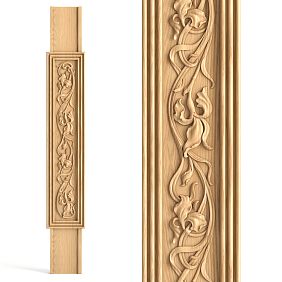


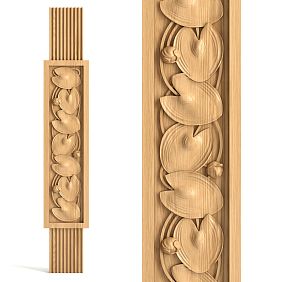


Flat balusters: their nature and strength
A flat baluster is not a simplified version of a turned one. It is a fundamentally different type of product. It is not made on a lathe but is cut from a board or panel: a contoured shape with cutouts, curves, and a symmetrical pattern. Thickness — 20–40 mm, width — 70–120 mm, height — from 900 to 1,200 mm.
It is the thickness and width of a flat baluster that determine its visual character. It is not rounded — it is silhouette. When you look along the row, you see a rhythm of repeating forms, almost like in a decorative grille or stained glass. When you look from the end, you see a thin vertical line. This is a completely unique aesthetic tool.




When flat balusters are the right solution
The question is not whether flat balusters are "good" in principle. The question is where they work best.
Our factory also produces:

Wooden houses with rich carving and decor
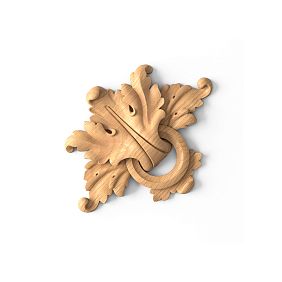
Trim, cornices, gables with fretwork ornament — and flat balusters with a matching pattern. This is the very organic nature of style, when every element of the house speaks the same language. Buy flat baluster with a fretwork pattern — means integrating a staircase or terrace into the unified decorative context of the house.
Get Consultation
Open verandas, terraces, porches
In the open air, a flat baluster looks especially organic. A wooden veranda lattice with a repeating baluster pattern is a classic of country architecture. Such railings were built in 19th-century wooden estates and are still built today — because it works.
wooden balusters for terrace in a flat design give the railing lightness: light passes between the balusters, shadow plays on the pattern, the structure does not visually overload the veranda space.
Staircases in country and garden houses
An external staircase to the porch is a place where a flat baluster looks especially appropriate. Easy to install, affordable, and expressive in design. For a country house, this is often the optimal solution: both beautiful and requiring no special tools for installation.
Railings for balconies of wooden houses
A balcony is a zone visible from the outside. Flat balusters with a pattern create a decorative band that is visible from the street and gives the facade character. In this sense, buy flat balusters for balcony is not only a function but also an architectural statement.
Interior stairs in country, Provence, Scandinavian style
Soft, warm interiors with textiles, wood, natural materials. Flat balusters painted white are a classic tool of country style. A row of white silhouette balusters under a wooden handrail is an image that never goes out of style.
How a flat baluster differs from a turned and carved one: three perspectives
From an aesthetic point of view
A turned baluster is volume in space. It looks the same from all sides. A flat one is a silhouette. It is most expressive strictly from the front, while in profile it almost disappears, turning into a thin vertical line.
A carved baluster is a sculpture that works from all angles. A flat one is graphics. The first presses with material, the second with drawing.
From a technical point of view
A turned baluster is a product of lathe production. A flat one is of milling or jigsaw production. These are different technologies, different equipment, different price ranges.
A flat baluster is simpler to install: its position in a row is unambiguously set by the orientation "face to the flight". The installation angle does not require precise cylindrical trimming — a straight cut along an oblique template is sufficient.
From the perspective of space perception
A row of flat balusters is visually lighter than a row of turned ones. The through pattern — cutouts and contour bends — lets the gaze pass through without creating a "fence" feeling. This is especially valuable on small staircases and in compact interiors, where a solid railing would make the space heavier.
Where flat balusters are used: a complete overview of applications
Interior staircases in private houses
A staircase flight to the second floor is the main place for flat balusters. They work well on straight flights, on U-shaped staircases with a landing, and on staircases with winder steps.
Exterior staircases and porch
Steps at the entrance to the house, a porch with a canopy — here flat balusters create a complete exterior look. Important: for outdoor use, choose oak or other durable species treated with oil for exterior work.
Open and glazed verandas
Veranda railing is a classic place for flat balusters with carved ornamentation. The pattern of the balusters on the veranda often echoes the pattern of the architraves and cornices.
Balconies of wooden houses
A wooden balcony with a railing made of flat balusters is an image familiar from country architecture from Karelia to Altai. Antiseptic treatment and regular coating renewal are important here.
Mezzanine level railing
In double-height houses — the railing of the second level overlooking the common space. Flat balusters with a pattern turn this railing into a decorative interior element, visible from below and creating a feeling of "lace" at height.
How to choose the shape of a flat baluster: four selection parameters
Parameter one: silhouette pattern
This is the main thing in a flat baluster. The pattern determines the character of the entire railing. Main options:
Lyre-shaped pattern — smooth curves, narrowed middle part, widened base and top. Soft, romantic, well-suited for country and Provence style interiors.
Geometric pattern — straight cutouts, trapezoidal and rectangular slots. More strict, more modern, compatible with minimalism and Scandinavian style.
Carved ornament — complex cut-out patterns: leaves, diamonds, curls. The most decorative option for houses with rich carving in the exterior and interior.
Combined pattern — a combination of straight and curved lines. The most versatile: not too strict, not too fancy.
How to choose: look at the pattern of the row, not the individual baluster. Place 5–7 silhouettes on paper with the desired spacing — you will see the rhythm the railing creates.
Second parameter: width
The width of a flat baluster is 70, 80, 100, 120 mm. The choice depends on the installation spacing and the desired visual density of the railing.
With a width of 80 mm and a clear spacing of 80 mm — the gap equals the width of the baluster. The railing looks evenly rhythmic.
With a width of 100 mm and a clear spacing of 60 mm — the balusters dominate the gaps, the railing is more enclosed.
With a width of 70 mm and a clear spacing of 120 mm — the railing is light, airy, but less dense in terms of safety.
Safety rule: the clear gap between balusters must not exceed 150 mm. For homes with children, it must not exceed 100 mm.
Parameter three: height
The working height of a flat baluster (from the top surface of the step or bottom rail to the bottom edge of the handrail) is 900–950 mm for most residential staircases. Standard: working height of the railing is 900 mm from the step.
The baluster itself is longer than the working height — it has upper and lower insertion parts that go into the rails or are attached to them. Total baluster length: working height + 40–80 mm for fastenings.
Parameter four: thickness
Thickness of a flat baluster: 20, 25, 28, 32, 40 mm. This is a parameter of strength and rigidity.
For interior staircases: 25–28 mm is sufficient.
For outdoor railings: 32–40 mm is more reliable, more resistant to deformation due to humidity changes.
For railings with wide spacing: the fewer balusters are placed, the thicker each one should be.
What handrails are needed for flat balusters
A handrail is not just a "top rail." For flat balusters, the issue of handrail compatibility is fundamental.
Handrail with a groove for a flat baluster
A standard handrail has a longitudinal groove on the bottom for the baluster tenon. For turned balusters, the tenon is round; for flat ones, it is rectangular, matching the baluster thickness.
Handrail groove width for flat balusters: typically 22–30 mm (for thickness 20–28 mm). Groove depth: 15–20 mm.
It is important to check with the manufacturer: the handrail groove width must match the thickness of the upper part of the flat baluster.
Handrail on the bottom rail
In many designs with flat balusters, a bottom horizontal rail is used, to which the baluster bases are attached. The handrail is on top, the bottom rail is below, and the balusters are clamped between them. This scheme is easier to install and does not require precise marking of tenons on each step.
Handrail profile
Suitable for flat balusters:
-
Rectangular handrail — strict, geometric
-
Handrail with a rounded top edge — comfortable in hand, compatible with any style
-
A wide "flat" handrail — especially good in a system with flat balusters: all elements follow the same planar logic
Railings for flat balusters — a topic covered in a separate article analyzing stylistic and technical aspects.
Overlays, strips, and fasteners for flat balusters: what you need to buy as a set
This is the most common area for mistakes. Balusters are purchased, but the mounting system is not. Or the wrong one is bought.
Bottom mounting strip
A horizontal board or bar to which the lower ends of the balusters are attached. It is fixed to the steps or to the floor of the landing. Balusters are inserted into the grooves of the strip or attached to it with screws through hidden holes.
Strip dimensions: thickness 40–50 mm, height 50–80 mm. Length — along the length of the flight.
Decorative appliqués
They conceal the attachment points of the balusters at the top and bottom. For flat balusters, overlays are especially important: the end edges are less neat than those of turned balusters and need to be covered.
Overlay for a flat baluster — a separate element in the railing system, purchased together with balusters.
Fasteners
For fastening flat balusters, the following are used:
-
Self-tapping screws 4×50 mm or 4×60 mm — for fastening through the end of the baluster into the rail. Pre-drill 3 mm holes.
-
Countersunk self-tapping screws 5×70 mm — for concealed fastening through the rail from below upward into the body of the baluster.
-
Wooden dowels 8×50 mm — for a tenon joint between the end of the baluster and the rail.
-
PVA-M glue — for fixation in the grooves of the handrail and bottom rail.
For methods of concealed fastening — details in the article about concealed installation of flat balusters, where current methods for 2026 are discussed.
Columns
Flat balusters require support posts at the beginning and end of each flight — the same as for turned and square ones. Important: the post must be compatible with the railing style. For flat balusters with cut-out ornamentation, posts with decorative elements or chamfers are better suited, rather than smooth prisms.
Buy balusters and posts for a wooden staircase One manufacturer ensures a unified style and consistent dimensions.
Complete purchase list for one flight
| Position | Purpose |
|---|---|
| Flat balusters (estimated quantity + 10%) | Main vertical railing elements |
| Handrail with groove (flight length + 300 mm) | Upper horizontal rail to hold onto |
| Lower mounting strip (flight length) | Base for attaching balusters |
| Decorative covers (per number of balusters) | Concealment of attachment points |
| Posts (2 pcs per flight) | Support elements at the beginning and end of the flight |
| Self-tapping screws (1.5 times the number of balusters) | Mounting |
| PVA-M glue | Fixation in grooves |
How to calculate the number of flat balusters: the exact method
Flat balusters are calculated differently than turned ones. The width of a flat baluster is significant in itself — it forms the railing pattern.
Step one: measure the length of the railing horizontally
For a flight, this is the horizontal projection of the flight — from the axis of the first post to the axis of the second. Example: 3,400 mm.
Step two: determine the installation step
Step in the clear (gap between balusters) + width of one baluster = center-to-center spacing.
Example: baluster width 90 mm, clear opening 90 mm → center-to-center spacing = 180 mm.
Step three: calculate the quantity
N = (railing length / center-to-center spacing) − 1
For example: N = (3,400 / 180) − 1 = 18.9 − 1 ≈ 18 balusters.
Step four: adjust the spacing
If the result is not a whole number, adjust the spacing. It is better to slightly reduce the gap (make the railing denser) than to have different gaps on the first and last balusters.
Step five: landing and balcony
They are calculated separately using the same principle. Landing balusters may have a different working height (the landing is horizontal, the stair is inclined), but this does not affect the quantity calculation.
Step six: allowance
10% of the calculated number. For 18 balusters — take 20. For 30 — 33.
Summary calculation table
| Flight length | Baluster width | Gap | Center-to-center spacing | Number of balusters | With 10% spare |
|---|---|---|---|---|---|
| 2,800 mm | 80 мм | 80 мм | 160 мм | 17 | 19 |
| 3,200 mm | 90 мм | 90 мм | 180 мм | 17 | 19 |
| 3,600 mm | 100 мм | 80 мм | 180 мм | 19 | 21 |
| 4,000 mm | 80 мм | 100 мм | 180 мм | 21 | 24 |
Price of flat wooden balusters: what affects the cost
The money talk should be honest. The price of a flat baluster is the result of several specific factors.
Tree species
Beech and pine are the most affordable wood species for flat balusters. Oak is more expensive but more durable and beautiful under clear varnish.
For painting: beech is optimal — a uniform structure without a pronounced pattern, the enamel will lay evenly.
For transparent coating: oak with its expressive texture will reveal itself better.
Buy flat wooden balusters — the catalog specifies the wood species and parameters of each model.
Pattern complexity
A simple geometric pattern with minimal cutouts is cheaper. A complex carved ornament with curved cutouts is more expensive: more time for milling, higher tool wear.
Baluster size
Height 900 mm is standard. Non-standard height (1,100, 1,200 mm) — on request, more expensive. Thickness 40 mm is about 30–40% more expensive than 25 mm.
Order volume
As with any wood production, a large batch gives a better price. Optimal: order the entire railing in one order, not in parts.
Approximate prices (2026)
| Parameters | Species | Price per piece |
|---|---|---|
| 80×25×900 mm, simple pattern | Beech | 280–420 rub. |
| 90×28×900 mm, medium pattern | Beech | 380–560 rub. |
| 100×32×900 mm, complex ornament | Beech | 520–780 rub. |
| 90×28×900 mm, medium pattern | Oak | 600–900 rub. |
| 100×32×900 mm, complex ornament | Oak | 800–1,200 rub. |
For 20 beech balusters with medium pattern: 7,600–11,200 rubles — a quite affordable budget for equipping one flight of stairs.
Mistakes when buying flat balusters: real scenarios and how to avoid them
First mistake: they buy only balusters, without rails and overlays
Balusters purchased. The question "how to attach them" remains open. No bottom rail, no overlays, handrail with a groove for a flat baluster not selected. Installation stops. Rule: flat wooden balusters to buy — this is the first step. The second is the set of fasteners and accompanying elements.
Second mistake: they do not measure the working height, relying "by eye"
"Approximately 900 mm" — and they order standard balusters. But the working height turned out to be 870 mm: the lower end rests against the step, the upper does not fit into the handrail groove. Rule: measurement is done with a tape measure, at several points, the maximum value is taken.
Third mistake: handrail with a groove for a turned baluster
They bought a handrail with a round groove of 32 mm — for a standard turned tenon. But the balusters are flat, thickness 28 mm, tenon rectangular. The groove does not fit. Rule: the handrail is ordered simultaneously with flat balusters, specifying the required groove shape to the manufacturer.
Fourth mistake: they do not calculate the spacing, but arrange "by feel"
Marking is done "approximately evenly" — and by the end of the flight they discover: the last gap is twice as large as the others, or the last baluster does not fit. Rule: the spacing is calculated in advance, with adjustment for an integer number of balusters.
Fifth mistake: they choose balusters only by picture, without considering the style of the railing and posts
A baluster with a delicate lyre-shaped pattern — and heavy, square posts without decoration. The handrail has a rough rectangular profile. Together, it looks like a random collection from different ensembles. Rule: stylistic unity is not an option, it's a requirement.
Mistake six: buying pine balusters for outdoor use without proper treatment
Pine is a soft, affordable wood. For interior use under paint — it's fine. For a terrace or porch without a canopy — risky: it quickly turns blue, deteriorates from moisture, and requires annual coating renewal. Rule: for outdoors — oak or pine with deep antiseptic impregnation and exterior oil.
Mistake seven: ordering from multiple places
Some balusters from one seller, some from another. The pattern is 'roughly similar' but not identical. After installation, the difference is clearly noticeable. Rule: the entire volume from one manufacturer, from the same batch.
Fastening flat balusters: overview of main methods
Bottom rail method
The bottom horizontal rail is attached to the steps with screws. Grooves are milled in the rail for each baluster, width = baluster thickness + 0.5 mm, depth 15–20 mm. Balusters are inserted into the grooves with glue. The handrail is on top, with a groove for the top end of the baluster.
Pros: reliable, neat, balusters stand strictly vertical.
Cons: requires a milling tool to make grooves in the rail.
Self-tapping screw overlay method
The baluster is placed against the step with its end. The decorative overlay covers the base. A 5×70 mm self-tapping screw is driven through the overlay and the end of the baluster into the step at an angle. The top end is similarly attached to the handrail.
Advantage: no bottom rail needed, faster installation.
Disadvantage: less reliable under lateral loads.
Glue and dowel method
An 8×50 mm dowel is inserted into the bottom end of the baluster and into a pre-drilled hole in the step. The joint is made with PVA-M glue. The top end is similar.
Advantage: completely hidden fastening, monolithic joint.
Disadvantage: practically non-removable. Replacing a baluster if necessary requires effort.
Detailed step-by-step instructions for all methods are in the article about installing wooden railings and balusters, and about fastening of flat balusters — in a special practical material.
Coating of flat balusters: for painting, stain or varnish
A flat baluster is an ideal object for painting. Smooth flat edges are easy to paint with a brush, there is no complex profile, no deep grooves that need to be "pulled through" with a brush.
For enamel or paint
Priming with acrylic primer → sanding 220 → final coat of enamel. For white color — two final coats. Beech under white paint is an ideal base: no resin, no stains, no knotiness.
Important: paint before installation, ends — especially carefully: they absorb moisture first.
For stain and varnish
Applying stain to a sanded surface → holding → sanding 320 → two coats of parquet varnish. Stain gives an even tone without emphasizing the texture. For beech — excellent, for oak — the texture is still visible.
For oil
Only for oak and hardwoods. The oil penetrates the wood structure without creating a film. Renew every 1–2 years. For flat balusters: oil is easily applied to flat edges with a rag or brush, absorbs well into end grains.
Where to buy flat wooden balusters: how to avoid mistakes with the supplier
Flat balusters are a specialized product. In the nearest hardware store, you can only find a few standard models with no choice of pattern, wood species, or size. For proper selection, a professional manufacturer is needed.
What to look for when choosing a supplier:
-
Assortment of patterns — not just one or two types, but several dozen models with different silhouettes
-
Selection of wood species — at least beech and oak, both in stock
-
Moisture content of products — kiln drying 8–12%, specified for each item
-
Compatibility with handrails and posts — the manufacturer can select a handrail with the required groove
-
Availability of components — bottom rail, covers, fasteners: in one order
A good supplier answers the question 'which handrail fits these balusters?' immediately, without 'checking with the technologist'.
Buy flat balusters and railings — in the catalog with a full range of flat models and related elements.
buy staircase components — in a single section: balusters, handrails, posts, overlays, fasteners in one order.
STAVROS: flat balusters and a complete set for your railing
STAVROS is a Russian manufacturer of wooden components for stairs and railings. Specialization: a wide range of balusters of all shapes: turned, square, carved, and flat.
The STAVROS catalog features several models of flat balusters with different silhouettes: from strict geometric to decorative cut-out. Beech and oak, kiln-dried, moisture content 8–12%, precise dimensions for compatible handrails and bottom rails.
wooden balusters for stairs buy in flat design — with consultation on quantity calculation, handrail and fastener selection.
balusters for staircase to buy in a full range of shapes: in one catalog — flat, square, turned, and carved.
Wooden stair posts — in compatible sizes and styles for each group of balusters.
STAVROS manufactures and ships from the warehouse. Contact us to confirm shipping to your destination. A manager will help calculate the set for your dimensions and railing style.
STAVROS — это когда между задумкой и готовым ограждением нет разочарований.
Frequently asked questions
Где купить плоские балясины из дерева?
В каталоге STAVROS — несколько моделей плоских деревянных балясин с разными рисунками, из бука и дуба, с постоянным складским наличием и доставкой по России.
Для чего подходят плоские балясины?
Для внутренних лестниц в домах с декоративной отделкой, для открытых террас и веранд, для крыльца, балконных ограждений и антресольных уровней. Отлично смотрятся в интерьерах кантри, прованс, скандинавский стиль, а также в домах с пропильным декором фасадов.
Что обязательно купить вместе с плоскими балясинами?
Поручень с пазом под плоскую балясину, нижнюю монтажную планку, декоративные накладки, опорные столбы и крепёж (саморезы, клей). Идеально — весь комплект у одного производителя в одном заказе.
Плоские балясины подходят для уличного применения?
Да, при правильном выборе породы и покрытия. Для открытых террас и крыльца — дуб с маслом для наружных работ. Бук под покраску атмосферостойкой эмалью также возможен, но требует более частого обновления защитного слоя.
Как крепить плоские балясины к перилам и ступеням?
The most reliable method is a bottom mounting plate with grooves and glue. The top end goes into the handrail groove with glue. For concealed mounting, use 8×50 mm dowels with PVA-M. More details in the professional article on baluster installation.
What height should a flat baluster be?
The working height of the railing is 900 mm from the step surface. Measure the actual distance from the step to the bottom edge of the handrail at several points — this is the working height of the baluster. The total length of the product = working height + 40–60 mm for fasteners.
How to avoid mistakes with the installation spacing?
Spacing on centers = baluster width + clear gap. The clear gap should be no more than 150 mm, and for homes with children, no more than 100 mm. Calculate the number of balusters so that the spacing is equal along the entire length of the railing.