








































































Article Contents:
- When ready-made balusters are needed, and when custom ones
- Scenario one: standard staircase in a private house
- Scenario two: non-standard task
- The boundary between scenarios
- What is more cost-effective: an honest talk about money
- Why ready-made balusters are cheaper
- Why custom balusters are more expensive
- Price benchmarks
- Ready-made balusters from the catalog: five compelling arguments
- Argument one: instant understanding of the result
- Argument two: stylistic system
- Argument three: immediate delivery
- Argument four: ability to add on
- Argument five: transparent pricing
- Custom balusters: when custom manufacturing is justified
- Restoration of a historic staircase
- Non-standard sizes
- Custom project
- Intricate carving
- How to choose material: wood species and cost
- Beech: a versatile choice for painting
- Oak: open grain and durability
- Array and its variants
- How material affects the decision: ready-made vs custom
- Which shapes to choose: overview of current assortment
- Turned balusters
- Carved and turned-carved balusters
- Square balusters
- Flat balusters
- What to buy with balusters: logic of a complete order
- Handrail: profile and compatibility
- Posts: accents and load-bearing logic
- Components: what is invisible but holds everything together
- The principle of everything from one manufacturer
- How to calculate the number of balusters before purchasing
- Basic formula
- Step along axes: how to choose
- Rule of two balusters per step
- Landing and turns
- Reserve
- Custom wooden balusters: how the process works
- Stage one: shape development
- Stage two: prototype
- Stage three: serial production
- Mistakes when ordering balusters: what they don't warn you about
- Mistake one: ordering only balusters without handrails and posts
- Mistake two: choosing a shape without considering the handrail style
- Mistake three: not checking the height
- Mistake four: mixing different styles
- Mistake five: not counting the full set
- Mistake six: choosing only by price
- Mistake seven: ordering custom-made what is already in the catalog
- Wooden balusters: how price becomes value
- Where to buy wooden balusters: guidelines for the right choice
- What distinguishes a good supplier
- STAVROS: manufacturer of wooden balusters and components
- Frequently Asked Questions
- What is cheaper: ready-made balusters or custom-made?
- When is it better to order balusters individually?
- Can I buy balusters and railings as a set?
- Which balusters are best for a wooden staircase?
- Where to buy wooden balusters with delivery?
- How much do wooden balusters for stairs cost?
- How to correctly calculate the number of balusters?
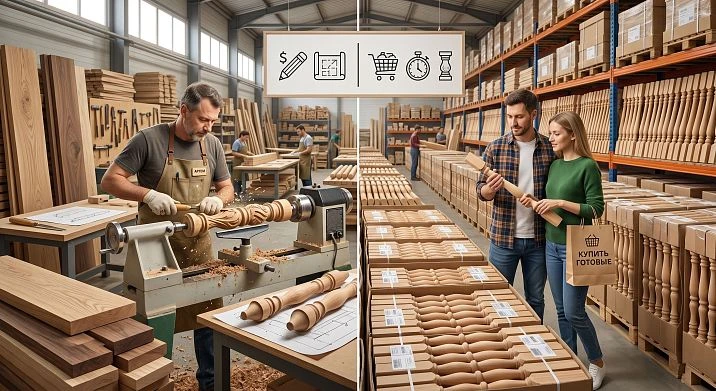
This question arises for everyone who has seriously taken on a wooden staircase for the first time. Because the market offers two paths — and both seem logical until you start looking into the details. The first: go to the catalog, choose a suitable model, order the required quantity, and in a few days receive ready-made balusters at the warehouse or with delivery. The second: describe or draw what you need, submit it to production, and wait for manufacturing according to your parameters.
Which path is correct? The honest answer: it depends on the specific situation. But for 80–85% of cases, ready-made Wooden balusters from the catalog is faster, cheaper, and more convenient. The remaining 15–20% are situations where a custom order is truly justified. The goal of this article is to help you understand which group your case falls into and make the right choice without unnecessary expenses and regrets.
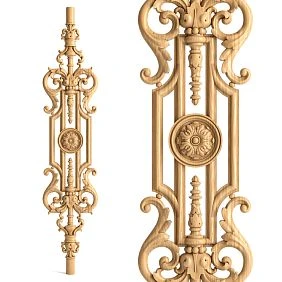
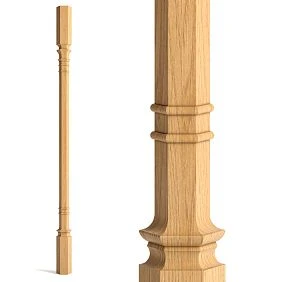
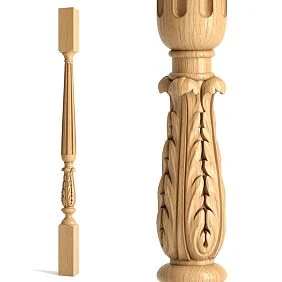
When ready-made balusters are needed, and when — custom-made
Let's start with the most honest distinction. Two scenarios — two different paths.




Scenario one: standard staircase in a private house
You are building or finishing a staircase in a new house. The staircase is single- or double-flight, straight or with a turn. The flight height is standard — 2.7–3.2 m. The interior style is classic, modern, country. You need beautiful, durable, professionally made balusters that will match the handrail and posts of the same style.
This is the scenario for which catalog solutions were created. buy balusters for the staircase from the ready-made assortment means choosing from dozens of proven forms, already coordinated with handrails and posts in size and style.
Our factory also produces:
Scenario two: non-standard task
You have a staircase with a non-standard step height. Or you need to replicate the pattern of old balusters when restoring a historic house. Or you want a unique design that is not in any manufacturer's catalog. Or a staircase in a mansion with an individual project, where everything is made to order by the architect.
This is the scenario for custom wooden baluster. Custom production is justified precisely when the standard assortment objectively does not solve the task.
Get Consultation
Boundary between scenarios
The problem is that many people think their situation is the second scenario, when in fact it is the first. "I need balusters 950 mm high, but the catalog only has 900 and 1000." Solution: 900 mm considering installation tolerance — or a handrail slightly below standard. "I need dark balusters." Solution: light balusters plus tinting during finishing. "I need something special." Solution: a special design in a wide catalog that covers most decorative needs.
Before ordering custom manufacturing — check the catalog of a good manufacturer. The required shape is likely already there.
What is more profitable in terms of price: a frank conversation about money
Price is what people think about first. Let's talk honestly.
Why ready-made balusters are cheaper
Production of catalog balusters is serial production. The program of the lathe or milling machine is set once and for all. A batch of 500 balusters of one article is produced without equipment changeover. There is no time for shape development, no approvals, no trial products.
All this reduces the unit cost — and allows offering a competitive price. buy balusters from the catalog with constant warehouse availability — this also means no surcharge for urgency.
Why custom balusters are more expensive
Individual order includes:
-
Development of a 3D model or program for the machine — this is paid for
-
Trial run and approval — time and material
-
Small batch: if you need 25 balusters, but the minimum batch for setup is 10 units, overhead costs are spread over a small number of products
-
Longer production — meaning no guarantee of fast delivery
Result: an individual baluster of the same wood species and similar quality costs 40–120% more than a catalog one, depending on the complexity of the shape.
Price Benchmarks
| Product type | Species | Estimated price (per piece) |
|---|---|---|
| Ready turned baluster, beech, 900 mm | Beech | 400–650 rub. |
| Ready square baluster, beech, 900 mm | Beech | 380–600 RUB |
| Ready-made turned baluster, oak, 900 mm | Oak | 700–1100 RUB |
| Ready-made carved baluster, beech | Beech | 900–1500 RUB |
| Custom turned baluster (batch of 20 pcs.) | Beech | 900–1400 RUB |
| Custom carved baluster (batch of 20 pcs.) | Oak | 1800–3500 RUB |
For a staircase with 25 balusters, the difference between ready-made and custom products can be 15,000–50,000 RUB. This is real money that makes no sense to spend on a standard task.
Ready-made balusters from the catalog: five compelling arguments
Catalog products are not 'mass-market consumer goods.' They are proven solutions that have passed production control and earned their place in the assortment due to demand and quality.
First argument: instant understanding of the result
You see a photo of the finished product, its actual dimensions, and profile shape. You can order a sample. No surprises: what you see in the catalog is what you get. With a custom order based on a sketch, there is always a risk of discrepancy between expectations and reality.
Second argument: stylistic system
A good manufacturer forms the assortment as a system, not as a random set. wooden balusters for staircases in the catalog, they are already coordinated with handrails and posts in terms of tenon sizes, grooves, and style. You are not buying individual products—you are taking a system that has already been tested for compatibility.
Third argument: immediate delivery
Catalog items with constant stock availability are shipped within one to two business days. For those whose construction is happening 'right now,' this is crucial. A custom order means waiting from two to six weeks, depending on complexity and production load.
Fourth argument: ability to buy more
If during installation it turns out that three more balusters are needed, catalog items from the permanent range can be purchased at any time. The item is from the same batch and has the same article number. With a custom order, buying "a few more" often means restarting production and paying for setup.
Fifth argument: transparent pricing
The price is listed in the catalog. You can immediately calculate the budget, compare options, and plan the purchase. No "we'll calculate and call you back." Buy balusters price — is a clear, predictable process.
Custom balusters: when individual production is justified
Honesty requires admitting: there are situations when the catalog does not help. And then a custom order is the only right path.
Restoration of a historical staircase
If an old house or mansion has preserved balusters with a unique historical ornament, and missing ones need to be replaced, only individual manufacturing based on a sample or measured drawing is suitable.
A good manufacturer will take measurements from the preserved baluster, create a program for the machine, and reproduce the shape with millimeter precision. This is work that a catalog cannot replace.
Non-standard sizes
A staircase with a railing height of 1,200 mm (for example, with very high ceilings or on a balcony with great height). Standard balusters with a height of 900–1000 mm are not suitable. Balusters with a working part of 1,100–1,150 mm are needed — custom order.
Or a staircase with a non-standard stringer cross-section, where the lower tenon of a standard baluster will not fit. A baluster with an extended tenon is needed — custom order.
Author's project
The architect designed a staircase with a unique baluster ornament, which is part of the author's concept. This ornament does not exist in any catalog. Only custom manufacturing.
Complex carving
Buy carved wooden balusters Ready-made ones are quite realistic. But if you need deep hand carving of a complex ornament, only custom order. Machine carving on a 3D router reproduces complex shapes, but hand work gives a different result.
How to choose material: wood species and cost
Material is a variable that affects price as much as shape. And when choosing between ready-made and custom balusters, this factor must be considered separately.
Beech: a universal choice for painting
Beech is a dense, hard wood with a neutral texture. It is ideal for tinting and painting: stain applies evenly, paint holds without drips. Buy beech balusters from a ready-made catalog is usually the most convenient option: a wide range of shapes, reasonable price, fast delivery.
Beech turns and mills well: the profile is sharp, the sanding is smooth. Density 680–750 kg/m³, service life with good treatment 25–35 years under normal operating conditions.
Oak: open texture and durability
Buy oak balusters is an investment in quality. Oak with an open texture under clear oil or varnish gives a result that is unmistakable: deep tone, expressive grain, tactile "liveliness" of the surface.
Oak is stronger and more durable than beech, contains natural antiseptic substances, and is less sensitive to humidity fluctuations. The price is higher, but the service life is 50 years or more without loss of quality.
Solid wood and its options
The word "solid" means that the baluster is made from a single piece of wood, without gluing. This is an important quality parameter: a solid baluster will not delaminate along the glue line, holds its shape, and behaves consistently across the entire cross-section.
Detailed information on how to choose railing baluster sizes for staircases depending on the type and design of the staircase is a separate topic that will help you avoid mistakes with parameters when ordering.
How material influences the decision 'ready-made vs custom'
If you need beech or oak balusters in standard sizes, they are available in a good manufacturer's catalog. If you need a rare species (walnut, cherry, ash in non-standard sizes), it may only be custom-made. But in most cases, beech and oak are choices that can be resolved with catalog items.
Which shapes to choose: an overview of the current assortment
The shape of the baluster is the style of the staircase. And it is the variety of shapes that makes a good manufacturer's catalog truly valuable: you don't need to order 'something special' when the special is already in stock.
Turned balusters
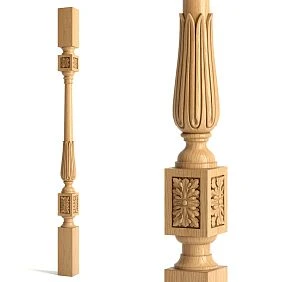
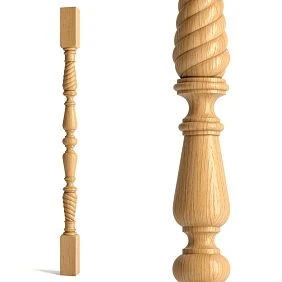
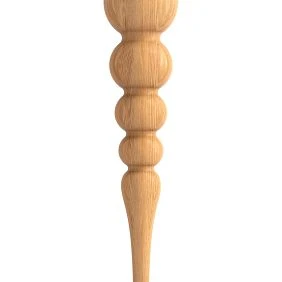
Turned balusters for staircase to buy means choosing the classic of turning production. A profile with rollers, necks, smooth diameter transitions. This is the most recognizable, most proven type of wooden baluster.
Turned balusters are organic for any staircase with a wooden character: from a traditional country house to modern classics. A wide range of shapes — from strict and geometric to elegant and complex profiles.
Dimensions: working part height 900–1200 mm, diameter 40–60 mm.
Carved and turned-carved balusters
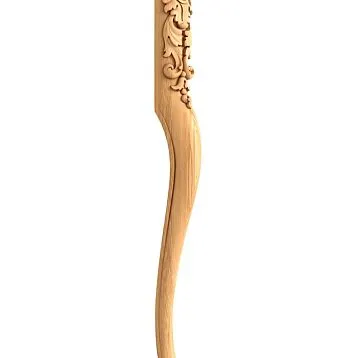
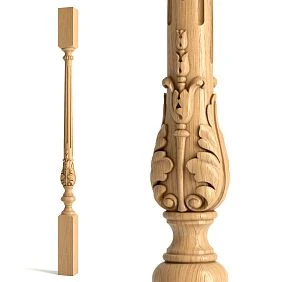
Buy carved wooden balusters — means choosing a product with three-dimensional decor: applied elements, through reliefs, ornaments on a turned base. This is the top level of decorativeness that turns the railing into a work of art.
Ready-made carved balusters in the catalog are already developed, mass-produced shapes that do not require a custom order. You get complex decor at the price of a mass-produced item, not at the cost of manual production.
Square balusters
Buy square balusters for stairs — a choice for a modern or minimalist interior. Straight edges, clear chamfers, geometric strictness. Paired with a rectangular handrail and square posts, they create a railing with the character of modern classics.
Square beech balusters under white paint are an ideal option for Scandinavian interiors and modern country houses.
Flat balusters
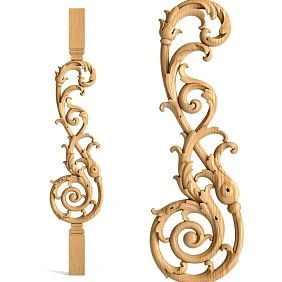
Buy flat balusters — means choosing a product with a decorative contour silhouette cut from a board. A tradition of folk wooden architecture, "cut-out" carving. Organic for houses with an ethnic character, wooden houses made of timber, country estates.
There are other options for flat balusters — for example, Buy flat baluster with a different decorative contour, creating a lighter, openwork silhouette of the railing.
What to buy together with balusters: the logic of a complete order
Balusters without accompanying elements are a set of vertical posts without context. A staircase is assembled from a system: balusters, handrail, posts, fasteners, decor. And it's better to order all of this together — for several fundamental reasons.
Handrail: profile and compatibility
The handrail sits on top of the balusters. The groove in the lower part of the handrail must exactly match the diameter of the upper tenon of the baluster. This is not intuition — it's a matter of size. If you take balusters and a handrail from the same manufacturer within the same system — compatibility is guaranteed. If from different ones — you need to check it yourself.
Posts: accents and load-bearing logic
Buy balusters and posts for a wooden staircase in one order — means ensuring unity of style. Carved wooden staircase posts must be of the same wood species as the balusters and from the same product line. The cross-section of the post should be 2–2.5 times larger than the cross-section of the baluster: it should visually stand out.
For special aesthetic solutions — carved wooden balusters with volumetric decor: they become the architectural accent of the entire railing system.
Components: what is invisible but holds everything together
buy staircase components means taking care of fasteners, sub-balusters, post caps, and transition elements. Without them, installation is either impossible or yields unreliable results.
How professional wooden component systems are manufactured and what they consist of is described in detail in the article production of stair components. This is useful reading before ordering.
The principle of "everything from one manufacturer"
Ordering buy staircase components from one manufacturer is not just convenience. It is a guarantee that all dimensions are coordinated, the style is unified, and installation will go without surprises. Three suppliers for three different elements are three sources of potential compatibility issues.
How to calculate the number of balusters before purchasing
Without an accurate calculation, you'll either have too few or too many. Both options are bad.
Basic formula
Number of balusters for a straight flight:
N = (L / S) + 1
where L is the length of the flight (in mm) along the horizontal projection, S is the spacing along the axes of the balusters (in mm).
Example: a flight 3,200 mm long, spacing along axes 150 mm:
N = (3,200 / 150) + 1 = 22.3 → round down to 22 balusters + adjustment for end posts.
Spacing along axes: how to choose
Spacing along axes = desired clear gap + baluster thickness.
With a 45×45 mm baluster and a desired gap of 110 mm: spacing = 110 + 45 = 155 mm.
With a 50×50 mm baluster and a gap of 100 mm: spacing = 100 + 50 = 150 mm.
The standard maximum clear gap for homes with children is 120 mm. Recommended is 100–110 mm.
Rule of two balusters per step
In a classic wooden staircase, two balusters are traditionally installed per step. This automatically sets a spacing of about 130–160 mm depending on the step width (270–300 mm). If the staircase has 16 steps, 32 balusters are needed along the flight.
Landing and turns
A horizontal landing is a separate section of railing with its own calculation. The length of the landing railing is divided by the selected spacing to get the number of balusters.
Important: a baluster of a different height may be required for the landing if the floor level of the landing differs from the step level.
Reserve
Add 5–10% to the calculated quantity for trimming, installation defects, and unforeseen situations. For 30 balusters, take 33. This is a minor expense but insurance against a "just a little short" situation.
Custom wooden balusters: how the process works
If you have decided on custom manufacturing, it is important to understand how it works internally. So as not to be surprised by timelines and costs.
Stage one: design development
Either you provide a drawing or sample, or the manufacturer creates a design based on your description. The design is approved before production begins. At this stage, you can see a 3D visualization or computer model.
The cost of design development is typically included in the order price for volumes above a certain quantity. For small batches (5–10 pieces), it may be charged separately.
Stage two: trial sample
For complex shapes, the manufacturer makes one trial sample for approval. You look at it, touch it, measure it. You make corrections — a new trial is launched.
This is an important stage that cannot be skipped: making 30 balusters with an incorrect neck means losing the entire batch.
Stage three: serial production
After approving the trial sample, serial production begins. Timeline: 2–5 weeks depending on the complexity of the shape and production load.
About how professional wood baluster manufacturing — with technological details on turning and milling production — a detailed article will help you understand what happens behind the door of the production workshop.
Mistakes when ordering balusters: what they don't warn you about
Experience shows: most problems when buying balusters arise not because of poor quality, but because of incorrectly made decisions at the ordering stage.
Mistake one: ordering only balusters without handrails and posts
"I'll buy the balusters now, the rest later." "Later" means a different batch, a different shade, a different tenon size, incompatible with the handrail. Correct: buy balusters and handrails simultaneously, in one order, from one system.
Mistake two: choosing a shape without considering the handrail style
A beautiful turned baluster + a square handrail with sharp edges. Or a square baluster + a figured ornamental handrail. These combinations break the stylistic logic of the railing. Rule: the shape of the baluster and the profile of the handrail are a single "vocabulary" of style.
Mistake three: not checking the height
They take balusters of a "standard" height of 900 mm without measuring the distance from the step to the bottom plane of the handrail. The tenons barely fit into the grooves, or the baluster turns out to be taller than needed. Rule: first measure the required working height, then choose the article.
Mistake four: taking different styles
Balusters from one catalog, posts from another, handrail from a third. Each element is not bad on its own — together they look like a random collection. Rule: one product line, one manufacturer.
Mistake five: not counting the full set
We counted the balusters — forgot about the posts, handrail, fasteners, and under-baluster supports. During installation, it turned out: more and more were needed. Rule: make a complete list of everything needed before the first order.
Mistake six: choosing only by price
"I'll buy the cheapest pine ones, they'll do." After 5–7 years — cracks, darkening, loose joints. Full replacement costs more than initially choosing beech or oak. Rule: price is recalculated over service life, not at the moment of purchase.
Mistake seven: ordering "custom" what is available in the catalog
"I want something carved and beautiful." They look at the custom production price — and are horrified by the cost. But the catalog has dozens of ready-made carved models at a reasonable price. Rule: first the catalog, then — if you didn't find it — custom.
Wooden balusters: how price becomes value
Speaking honestly about money means admitting: a cheap baluster made of raw pine, which swelled after three years and required replacement of the entire railing, cost more than an oak baluster from a good catalog. Not because oak is cheaper than pine. But because the total cost of ownership is the price of the product plus the costs of repair and replacement over the entire service life.
buy wooden balusters with the right parameters, this is:
-
Kiln drying, moisture content 8–12% (not "future deformation")
-
Hardwood (not "future scratches")
-
Precise profile (not "future gap")
-
Compatible tenon sizes (not "future rework")
That's why the question "how much do wooden balusters for stairs cost" is always about the total cost, not just the cost of the product at the time of purchase.
Where to buy wooden balusters: guidelines for the right choice
The market for wooden balusters in Russia is wide. From market stalls with unclear product origin to professional manufacturers with a full range and quality control.
What distinguishes a good supplier
-
Manufacturer, not reseller: controls quality at every stage
-
Kiln drying: documented
-
Full range: balusters, handrails, posts, components — all from one system
-
Constant warehouse availability: not "made to order in a month"
-
Real photos of products: not renders or illustrations
-
Selection consultation: manager helps with calculation and choice
STAVROS: manufacturer of wooden balusters and components
STAVROS is a Russian manufacturer of solid wood products. Specialization: components for wooden stairs: balusters, posts, handrails, under-baluster strips, finials, and fasteners.
In the Stavros catalog — wooden balusters for staircases in all current shapes: turned classic, square balusters for stairs, Carved wooden balusters, Flat balusters. All made from kiln-dried wood with 8–12% moisture content, beech, oak, ash.
buy balusters and handrails at STAVROS means ordering the entire set from one manufacturer, getting a stylistically consistent system and fast delivery from the warehouse. Delivery across all of Russia. Wholesale terms for construction companies and carpenters.
STAVROS knows: a good staircase starts with the right choice. And this choice should be simple, clear, and profitable.
Frequently asked questions
What is cheaper: ready-made balusters or custom-made?
Ready-made balusters from the catalog are 40–120% cheaper compared to custom manufacturing of a similar shape. The reason is serial production without costs for development and setup. For standard staircases, ready-made ones are more profitable.
When is it better to order balusters individually?
Custom ordering is justified for restoration with reproduction of historical shapes, non-standard railing height, unique author's ornament, or rare wood species not available in the catalog.
Can I buy balusters and handrails as a set?
Yes, and that is exactly what is recommended. Ordering a complete set of balusters, handrails, posts, and fasteners from one manufacturer guarantees size compatibility and style consistency.
Which balusters are best for a wooden staircase?
For a classic staircase, turned balusters made of beech or oak. For a modern interior, square ones. For a traditional wooden house, flat or turned-carved ones. Species: beech for painting, oak for an open texture.
Where to buy wooden balusters with delivery?
In the STAVROS catalog, a full range of ready-made wooden balusters with constant warehouse stock and Contact us to confirm shipping to your destination.
How much do wooden balusters for stairs cost?
Turned beech balusters from 400 to 650 rubles per piece, oak from 700 to 1,100 rubles. Carved ones from 900 rubles. The cost depends on the species, shape, and height of the product. For custom orders, 40–120% more expensive.
How to correctly calculate the number of balusters?
Divide the length of the flight in millimeters by the selected center-to-center spacing (usually 150–160 mm) and add 1. Account for landings and turns separately. Add 5–10% reserve. Detailed calculation considering the specific parameters of your staircase.