Article Contents:
- If PLT‑005 is painted with opaque enamel, what does the buyer actually get from oak or beech
- When wood texture should remain visible
- When texture is completely covered
- Why you can't say 'oak under enamel is pointless'
- MDF, moisture-resistant MDF, beech, or oak: how the four bases of PLT‑005 differ
- Moisture-resistant MDF PLT‑005: when the prefix 'moisture-resistant' is really needed
- PLT-005 skirting board in the color of walls and doors: what to order under opaque enamel — MDF, moisture-resistant MDF, beech, or oak
- When regular MDF is enough
- When a moisture-resistant option is more logical
- Wooden skirting board PLT-005 made of beech under enamel: in which projects the choice is justified
- Oak PLT-005: when natural wood is worth choosing for texture, not the name of the material
- Wall 2450 mm
- Wall 2550 mm
- Wall 3100 mm
- Wall 5100 mm
- Example: room 18.4 linear meters — why simple division is not enough
- Mathematical minimum for MDF 2600 mm
- Математический минимум для бука/дуба 2400 мм
- Почему 8 × 2400 мм нельзя автоматически считать готовой спецификацией
- Почему 8 × 2600 мм тоже не гарантируют идеальный раскрой
- Как составить карту раскроя PLT‑005, а не просто посчитать метры
- Когда дополнительные 200 мм у PLT‑005 из МДФ реально уменьшают число стыков
- Плинтус в цвет стены: красить PLT‑005 до монтажа или после
- Основной финиш до монтажа
- Finishing after installation
- Комбинированный сценарий
- PLT‑005 в цвет дверей: зачем заранее согласовать плинтус и наличник
- Can I order an MDF baseboard and make the PLT-005 casing from oak?
- Is it worth buying an oak PLT-005 if you need a completely solid white baseboard?
- Example: all options require 8 planks
- Example: MDF is enough for 8 planks, but wood needs a 9th
- Why one extra plank can change the choice of material
- Visible natural texture is needed
- A maximally smooth solid covering enamel is needed
- There is increased humidity load
- The entire joinery package is already specified in oak or beech
- Regular MDF or moisture-resistant MDF: calculate the surcharge for the entire order
- How to assess moisture load before choosing PLT-005
- Ends after cutting: why the material is visible even under opaque enamel
- MDF
- Beech and oak
- External corner: where PLT-005 material shows itself most strongly
- PLT-005 as trim: how the material affects the overall joinery set
- MDF moldings: when one material system simplifies painting
- Practical scenario: white PLT-005 in a dry bedroom
- Practical scenario: hallway and front door
- Practical scenario: all woodwork made of oak, but painted in one color
- Practical scenario: walls 2500–2580 mm across several rooms
- When PLT-005 made of MDF is better not to choose
- When moisture-resistant MDF PLT-005 is premature to buy
- When beech or oak under enamel may turn out to be an overpayment
- How to match the color of PLT-005 with the wall and door
- Can different materials be painted with the same composition as PLT-005
- How to accept PLT-005 before painting
- How to mark planks before cutting
- When a spare PLT-005 plank is justified
- Control sample PLT-005: what to check before running the entire batch through enamel
- PLT-005 near the door: how to avoid getting three different shades of the same white
- Wet cleaning and enamel damage: what happens after several years of use
- Why moisture-resistant MDF does not exempt you from coating repair
- If the wall color changes after a few years
- Mixed project: MDF in rooms, moisture-resistant MDF in hallway
- Mixed project: oak architraves and MDF skirting board
- Packaging, delivery and storage: why the length of 2400/2600 mm matters here too
- Control calculation: 10 strips of one profile in four materials
- Control calculation: when moisture-resistant MDF is needed only in one zone
- Mistake 1. Thinking that only MDF is always needed under enamel
- Mistake 2. Buying oak just because it is "more premium"
- Mistake 3. Not recalculating 2400 and 2600 mm separately
- Mistake 4. Calculating cost only by the price of one piece
- Mistake 5. Buying moisture-resistant MDF "just in case"
- Mistake 6. Considering moisture-resistant MDF to be waterproof
- Mistake 7. Painting the entire batch before a test sample
- Mistake 8. Not preparing the edges separately
- Mistake 9. Mixing MDF and oak in the same line without testing
- Mistake 10. Using total footage without a wall map
- Mistake 11. Not approving PLT-005 as a trim
- Mistake 12. Ordering without a reserve for tight cutting
- Checklist before payment
- What is the size of PLT-005?
- What materials are available?
- What is the length of PLT-005 made of MDF?
- What is the length of oak PLT-005?
- What is the length of beech PLT-005?
- How does regular MDF differ from moisture-resistant?
- Can PLT-005 made of MDF be painted with enamel?
- Is there any point in choosing oak for covering paint?
- Can you paint oak or beech PLT-005?
- What is better under white enamel — MDF or beech?
- Do you need to choose moisture-resistant MDF for a hallway?
- Why does the material affect the number of planks?
- How to calculate PLT-005 2400 and 2600 mm?
- Can one PLT-005 be used as both a baseboard and a casing?
- Can you mix MDF and oak in one room?
- Which material is cheaper according to the current card?
- Where to buy PLT-005?
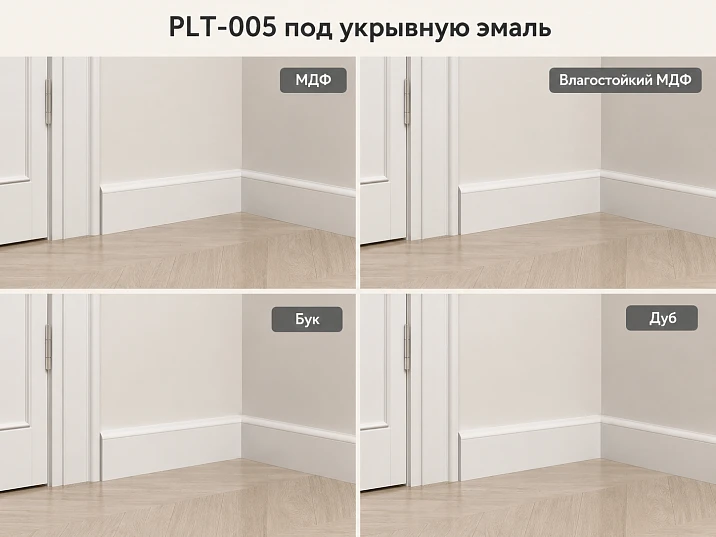
The design is already approved: walls are painted or prepared for painting, doors and trim must be in the same color, and the tall baseboard will also be solid-colored. In the PLT-005 card, the buyer sees four versions of the same 120×16 mm profile — regular MDF, moisture-resistant MDF, beech, and oak. A logical question arises: if the covering enamel will cover the natural texture anyway, why pay for solid wood? And conversely — is MDF always the most rational choice?
There is no universal answer like "always MDF under enamel." For a project requiring a smooth opaque color, MDF often does turn out to be the most straightforward and economical base. But the decision is changed by plank length, number of joints, moisture load, joinery workshop requirements, a unified material specification for doors and trim, end treatment method, and future usage. Beech or oak can be justified even under a covering finish if the entire joinery set is already specified in one wood species or if the project requires a wooden base specifically. But choosing oak just because of the material's name, when the texture is completely covered by paint, also makes no sense.
PLT-005 has a useful feature for such a comparison: the geometry is the same for all versions — 120×16 mm. The difference starts not in the profile pattern, but in the material and standard length. MDF comes in 2600 mm, beech and oak in 2400 mm. Therefore, you cannot first calculate "need 10 planks" and then simply change the material in the cart. After changing the material, the cutting layout must be recalculated.
If the model has not been finally selected yet, you can first to buy wooden baseboard after comparing the entire category. But if PLT-005 has already been chosen by height, profile, and role in the interior, the article helps answer a narrower commercial question: which version to put in the cart for a solid covering finish and why.
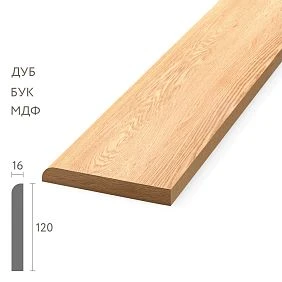
Baseboard / trim PLT-005 120×16 mm: four versions of one geometry
The current card confirms four versions of PLT-005. All have the same height A=120 mm and thickness C=16 mm, but the material and length differ.
| Execution | Size | Price at the time of check | What is important before ordering |
|---|---|---|---|
| Moisture-resistant MDF | 120 × 16 × 2600 mm | 2 550 ₽ | In the card, the "Under enamel" option is selected; length 2600 mm |
| MDF | 120 × 16 × 2600 mm | 2 050 ₽ | Base for covering finish; length 2600 mm |
| Beech | 120 × 16 × 2400 mm | 5 140 ₽ | Wood base; length 2400 mm |
| Oak | 120 × 16 × 2400 mm | 7 030 ₽ | Wood base; length 2400 mm |
The price changes, so it needs to be rechecked before payment. More importantly: four lines cannot be considered one product in four colors. They have the same cross-section, but different material and different length. This affects cutting, batch weight, end grain character, finishing preparation, and the cost of the entire project.
The card is called plinth / architrave PLT-005. This is useful for the project "plinth + door framing in one color": the same geometry can participate in horizontal and vertical lines, but the material and finish must be agreed upon in advance.




If PLT-005 is painted with opaque enamel, what does the buyer actually get from oak or beech
This is the main question of the entire article. Under transparent varnish or oil, the answer is obvious: the buyer sees natural wood, its grain, and shade. Under dense white, gray, or colored enamel, the grain can be completely hidden. Then the value of the wood base should be sought not in external texture, but in project logic.
Our factory also produces:

When wood texture should remain visible
If the designer wants to see oak or beech, this is no longer about a fully opaque system. A transparent, semi-transparent, or tinting finish is needed that preserves the natural grain. In such a scenario, the comparison "MDF vs. solid wood under white enamel" ceases to be central: the choice of material is determined by the visual effect itself.
Get Consultation
When the texture is completely covered
With a true opaque finish, the visibility of the wood grain is reduced. Then the choice of oak or beech should be justified by other reasons:
- the entire joinery package is already made of one type of wood;
- the workshop works with a single material for baseboards and trim;
- the project requires a wooden base regardless of the finish;
- there is a specific fastening or processing technology;
- the length of 2400 mm fits better into the already approved cutting plan;
- future restoration or finish change assumes a wooden base.
If none of these conditions apply, and the goal is to achieve an absolutely uniform white profile and minimize the cost of the finished set, MDF naturally becomes the first candidate. But this is a conclusion for a specific project, not a universal rule for all interiors.
Why you can't say "oak under enamel is pointless"
In carpentry projects, the material is often set by the entire system: doors, casings, decorative panels, baseboards. If the workshop already produces a set in oak, switching one element to MDF can complicate the technology, coating behavior, and acceptance. Saving on the material of a single strip does not always equal saving on the entire project.
MDF, moisture-resistant MDF, beech, or oak: how the four bases of PLT-005 differ
MDF baseboard PLT-005: when it makes sense to order it for solid-color painting
For opaque enamel, regular MDF is often the most straightforward scenario. The geometry of PLT-005 remains 120×16 mm, length — 2600 mm. The manufacturer's card describes MDF as a base for enamel coatings with appropriate preparation.
Practical advantages specifically in such a project:
- no need to preserve the natural texture;
- a homogeneous base is convenient for an even opaque finish;
- 2600 mm provides an additional 200 mm compared to beech/oak;
- you can build a single color system with the wall or doors;
- the price of one strip is lower than wood versions.
But MDF does not exempt you from preparing the edges. After cutting, the exposed edge differs from the face surface in absorption. The outer corner, the straight end at a doorway, and the joint area need to be primed and finished so that after painting they do not read as a different material.
If this scenario is chosen, it is logical buy MDF skirting board after comparing models and lengths in the relevant section.
Moisture-resistant MDF PLT‑005: when the prefix "moisture-resistant" is truly needed
The moisture-resistant version has the same dimensions of 120×16×2600 mm, but costs more than regular MDF. The buyer must understand which operational task they are paying extra for.
More demanding areas are not only "wet rooms." Real relevance may arise where the lower part of the wall regularly receives increased load from cleaning or periodic moisture:
- entryway;
- entrance zone;
- wall section next to the balcony door;
- area of frequent wet cleaning;
- a room where the designer expects increased moisture load.
Moisture-resistant MDF does not mean a waterproof baseboard. Cuts, ends, damaged coating, and junction areas still require proper finishing. The material cannot be installed in areas of regular direct contact with water just because the name contains the word "moisture-resistant."
When regular MDF is sufficient
In a dry bedroom, study, or living room, where the baseboard is not subjected to specific moisture load, regular MDF can fully fulfill the task of a solid-color painted profile. Buying the moisture-resistant version "just in case" makes sense only if the additional cost matches the real risk.
When the moisture-resistant option is more logical
If the entire lower perimeter of the hallway constantly comes into contact with wet cleaning, water is brought in at the door, and the finishing system is designed for such use, moisture-resistant MDF gains a clear practical advantage. But the entire assembly is still evaluated: the base, finish, and joints.
Wooden baseboard PLT-005 made of beech under enamel: in which projects the choice is justified
Beech retains the same geometry of 120×16 mm, but the standard length is reduced to 2400 mm. The price is higher than MDF, so the choice must have a design reason.
Beech can be rational if:
- doors and trim are already made of beech;
- the joinery workshop handles the entire set in one wood;
- the project allows for changing the covering material to a more open finish in the future;
- end nodes or manual processing are designed specifically for wood;
- the material is specified by the object's specification.
With a fully opaque enamel, beech does not give the buyer a visible texture. Therefore, the argument "it's natural wood, so it's automatically better" is too weak. The entire specification and cutting layout need to be evaluated.
Oak PLT‑005: when natural wood should be chosen for its texture, not the material's name
Oak is the most expensive of the four options in the current card. If its natural texture remains visible, the choice is clear: the material works as part of the design. If the oak is completely covered with opaque enamel, the value needs to be explained by the project, not by the prestige of the species.
Demand for natural wood baseboards reflects a separate user intent: the buyer cares specifically about the wood base. But for PLT‑005 under an opaque white finish, it's worth honestly distinguishing between two situations.
| Scenario | What oak provides | What to check before purchasing |
|---|---|---|
| Texture is visible | Natural pattern and wood system | Tinting, sorting, batch matching |
| Texture is completely covered | The wood base of the project | Why it is needed here and whether it justifies the budget |
If the design requires a perfectly smooth white baseboard, and the doors and trim are also painted and not tied to the oak base, MDF may be more rational. If all interior moldings and joinery are built on oak, replacing one element with MDF just for the price is not necessary either.
One PLT-005, but 2400 or 2600 mm: the material changes not only the finish, but also the number of slats
The cross-section is the same for all four options — 120×16 mm. This creates the illusion of full interchangeability: as if you could first make an estimate and then simply choose the material in the card. In practice, the standard length changes the joint layout.
For MDF and moisture-resistant MDF:
L = 2600 mm.
For beech and oak:
L = 2400 mm.
The difference is 200 mm on each full plank. On one piece it seems like a trifle. On long walls and several rooms, an additional 200 mm can eliminate an entire joint or, conversely, create a more convenient remainder.
Wall 2450 mm
MDF 2600 mm covers it with one plank with a nominal remainder of about 150 mm before accounting for finish cuts. Beech or oak 2400 mm do not cover the full length: an additional piece of at least 50 mm plus a technological allowance is needed. If there is no suitable remainder nearby, one wall may require a second blank.
Wall 2550 mm
For MDF, about 50 mm of allowance remains. For 2400 mm wood, 150 mm is missing. Here the advantage of 2600 mm is especially obvious, although both versions have the same cross-section.
Wall 3100 mm
Both MDF and wood require a joint. MDF can be assembled as 2600 + 500 mm, wood as 2400 + 700 mm. The number of full planks for one wall may be the same, and only the remainders will differ.
Wall 5100 mm
Two MDF planks give 5200 mm — only 100 mm of nominal total reserve. Two wooden planks give 4800 mm and no longer cover the wall: a third fragment of at least 300 mm is needed. If there is no suitable remainder from an adjacent wall, it is here that 2600 mm can reduce the number of blanks used.
Therefore, material PLT‑005 is not chosen separately from the room geometry. First, two maps are created — for 2600 and 2400 mm, then the final budget is compared.
Cutting PLT‑005 2400 and 2600 mm: practical calculation instead of dividing the perimeter
Example: room 18.4 linear meters — why simple division is not enough
Let's take not a conditional rectangle, but a set of real wall sections:
- 4300 mm;
- 3700 mm;
- 3150 mm;
- 2650 mm;
- 1800 mm;
- 1600 mm;
- 1200 mm.
Sum:
4300 + 3700 + 3150 + 2650 + 1800 + 1600 + 1200 = 18,400 mm.
Mathematical minimum for MDF 2600 mm
18 400 ÷ 2600 ≈ 7,08.
That is, by total length, a minimum of 8 slats is needed. Eight slats give:
8 × 2600 = 20,800 mm.
Total nominal reserve — 2400 mm.
Mathematical minimum for beech/oak 2400 mm
18 400 ÷ 2400 ≈ 7,67.
Also a minimum of 8 slats. Eight wooden slats give:
8 × 2400 = 19,200 mm.
Nominal reserve — only 800 mm.
At first glance, both options require eight pieces each. But the length margin differs by three times. In the 2400 mm option, the layout is much more sensitive to corner cuts, finish trims, and awkward offcuts. Therefore, eight oak slats may be mathematically sufficient, but practically too tight.
Why 8 × 2400 mm cannot automatically be considered a ready specification
The total reserve of 800 mm is not distributed as one convenient piece. After long walls, fragments of 100, 250, 400 mm may remain, which do not fit the next sections. If an external corner eats extra length or a solid view segment without a joint is needed, a ninth slat becomes a real possibility.
Why 8 × 2600 mm also do not guarantee perfect cutting
2400 mm of total reserve looks comfortable, but incorrect cutting sequence can turn it into a set of short useless scraps. First, distribute the longest and species-specific sections, then short ones.
How to create a cutting map PLT‑005, not just count meters
For each wall, record the length, type of corners, and acceptability of a joint. Then assign specific parts to each whole plank.
| Wall | Net length | Can it be joined | Priority |
|---|---|---|---|
| A | 4300 мм | Yes, one joint | High |
| B | 3700 мм | Yes | High |
| C | 3150 мм | Yes | Medium |
| D | 2650 мм | Preferably minimize the joint | High |
| E | 1800 мм | Better as a whole | Medium |
| F | 1600 мм | Better as a whole | Medium |
| G | 1200 мм | Solid | Low |
After that, options are compared. For example, for MDF, a wall of 2650 mm is almost equal to the length of one plank, but still exceeds it by 50 mm. This shows that even 2600 mm does not solve all problems automatically. If there is a leftover of 500–600 mm nearby, it can be used for an additional piece. If not, a new joint appears and the map changes.
When ordering, it is convenient to use the exact product anchor buy PLT-005 120×16 mm already after the quantity is calculated separately for the selected material.
When the extra 200 mm of PLT‑005 made of MDF really reduces the number of joints
The advantage of the 2600 mm length only shows on certain segments. If almost all walls are shorter than 2300 mm, there may be no difference between 2400 and 2600 in the number of solid pieces. If there are many walls of 2450–2580 mm, the situation changes.
| Section length | MDF 2600 mm | Beech/oak 2400 mm | Practical conclusion |
|---|---|---|---|
| 2200 мм | One plank | One plank | No difference in joints |
| 2450 мм | One plank | Need an extension piece | 2600 mm is stronger |
| 2550 мм | One plank | Need an extension piece | 2600 mm is noticeably more convenient |
| 3100 мм | Joint | Joint | Difference in leftover length |
| 4800 мм | Two strips with a large reserve | Exactly two by sum | Wooden map is denser |
| 5100 мм | Two strips almost to size | A third fragment is needed | 2600 mm can be removed by a separate extension |
From this, one cannot conclude that "MDF always requires fewer strips." For example, in a room with sections of 2000, 2100, 2200, and 2300 mm, both formats will cover the walls with solid pieces, and the quantity will be the same. The additional 200 mm is only useful where it matches the geometry of the object.
PLT-005 in the color of walls and doors: how to assemble a unified painted joinery belt
Baseboard in wall color: paint PLT-005 before installation or after
Covering enamel allows combining the baseboard and wall with color, but the technological sequence depends on the project. There is no universal rule of "paint only before" or "only after."
Main finish before installation
Advantage — convenient to work on a horizontal surface, easier to control layer uniformity, and no need to mask the floor. Disadvantage — after cutting, fresh edges, corners, and joints will appear, which will still require finishing.
Finish after installation
You can achieve a single continuous line, especially if the baseboard and wall are the same color. However, the volume of painter's protection for the floor, doors, and other surfaces increases. For wooden options, the preparation method also needs to be coordinated with the finishing system.
Combined scenario
Often the main layer is applied in advance, then after installation, joints, edges, external corners, and attachment points are locally treated. This approach is especially useful for long linear elements.
Whichever method is used, you cannot leave an open MDF edge or fresh wood cut without the protection specified in the project just because it is "barely visible."
PLT‑005 in door color: why coordinate the baseboard and casing in advance
The card calls PLT‑005 both a baseboard and a casing. This allows building a unified system: the horizontal line at the floor and the vertical lines of the doorway have the same profile of 120×16 mm.
But the same article number does not exempt you from checking the joint. You need to determine:
- how the vertical casing meets the horizontal baseboard;
- does the door have a plinth block or a direct joint;
- does the direction of the decorative profile match;
- is the material of the horizontal and vertical elements the same;
- are the elements coated with the same batch of enamel;
- is it necessary to sort oak/beech by shade if some wood remains exposed.
If the entire system is completely white, the material mismatch is less visually noticeable, but the difference in the base may show up in the preparation and behavior of the finish. Therefore, the workshop must know in advance that the baseboard and the casing should look like a single set.
Can I order a baseboard made of MDF and the PLT-005 casing made of oak
Nominally, this is possible in terms of geometry: both versions have 120×16 mm. But the same cross-section does not mean that after painting the joint will automatically become indistinguishable.
Differences include:
- base structure;
- end preparation;
- priming method;
- possible movement of wood;
- length of workpieces;
- nature of coating repair.
If the project truly requires a mixed system, first make two samples in the final color and compare them side by side. If there is no difference and the technologist confirms compatibility, mixing can be rational. If a difference in gloss or texture is visible, it is better to switch to a single material system.
Is it worth buying oak PLT-005 if an absolutely solid white baseboard is needed
The answer depends on the reason for choosing oak. If the only reason is the feeling that "oak is better than MDF," and all the texture is covered by white enamel and the rest of the joinery does not require an oak base, such a choice should be reconsidered. If the entire project is already in oak, the workshop works with oak, and the material is fixed by the specification, switching to MDF just to save on one item may be unjustified.
| Project task | MDF | Moisture-resistant MDF | Beech | Oak |
|---|---|---|---|---|
| Absolutely opaque white enamel | First candidate | Assess by humidity | Per project requirements | Per project requirements |
| Increased moisture load | Assess conditions | strong candidate | Requires its own protection system | Requires its own protection system |
| Needs visible natural texture | Does not solve the problem | Does not solve the problem | Suitable | Suitable |
| Many walls 2450–2550 mm | 2600 mm is convenient | 2600 mm is convenient | 2400 mm requires an extension | 2400 mm requires an extension |
| All joinery from one wood species | May disrupt the system | May disrupt the system | Logical for a beech system | Logical for an oak system |
This table does not replace calculation. It shows which questions should be resolved before purchase.
How to calculate the PLT‑005 budget correctly: compare not the price of one plank, but the complete set
The most common mistake when comparing materials is to take the price of one plank and draw conclusions about the project. For PLT‑005 this is especially inaccurate because MDF and wood have different standard lengths.
Based on current prices, the approximate cost of one linear meter of material without cutting is:
- regular MDF: 2050 ÷ 2.6 ≈ 788 ₽/m;
- moisture-resistant MDF: 2550 ÷ 2.6 ≈ 981 ₽/m;
- beech: 5140 ÷ 2.4 ≈ 2142 ₽/m;
- Oak: 7030 ÷ 2.4 ≈ 2929 ₽/m.
These numbers are only useful for rough orientation. The actual order is made up of whole planks, so the correct budget formula is:
profile cost = number of whole planks × current price of the selected finish.
After that, finishing, end preparation, installation, packaging, and delivery are added. If different materials are compared, these additional works may also differ.
Example: all options require 8 planks
| Material | 8 planks |
|---|---|
| MDF | 16 400 ₽ |
| Moisture-resistant MDF | 20 400 ₽ |
| Beech | 41 120 ₽ |
| Oak | 56 240 ₽ |
Here the difference is clear: if all finishing is covering and the project does not require a wood base, the economic advantage of MDF is noticeable.
Example: MDF is enough with 8 planks, but wood needs a 9th
If a 2600 mm map is covered by eight planks, and a 2400 mm map requires a ninth, the comparison becomes:
- MDF: 8 × 2050 = 16,400 ₽;
- moisture-resistant MDF: 8 × 2550 = 20,400 ₽;
- beech: 9 × 5140 = 46,260 ₽;
- oak: 9 × 7030 = 63,270 ₽.
That is why 200 mm of difference in standard length cannot be considered a technical trifle. In a large project, it can change the entire basket.
Why one extra plank can change the choice of material
Let's imagine three options after cutting:
- regular MDF — 8 planks;
- moisture-resistant MDF — 8 planks;
- oak — 9 planks.
If the buyer compared only the price of one piece, they saw 2050 ₽ versus 7030 ₽. After the map, they see 16,400 ₽ versus 63,270 ₽. This is a more honest basis for a decision.
But the opposite effect is also possible. For example, the entire room consists of walls of 2000–2300 mm. Then both 2400 and 2600 mm cover them with solid pieces, and the number of planks matches. In such a project, length ceases to be the main argument, and the choice returns to material, finish, and maintenance.
When to buy a wooden skirting board PLT‑005, and when to choose MDF
Here, a material rating is less useful than a decision tree.
Visible natural texture is needed
Look at beech or oak and agree on a transparent or tinting finish. In this scenario, an opaque white enamel contradicts the original task — it will hide what natural wood is purchased for.
A maximally smooth, solid-color opaque enamel is needed
Regular MDF becomes the first candidate. Then compare the 2600 mm length, joint map, and operating conditions.
There is an increased moisture load
Compare regular and moisture-resistant MDF. The moisture-resistant option does not become waterproof, so a system for protecting ends and finish remains mandatory.
The entire joinery package is already specified in oak or beech
Do not automatically change one element on MDF. First ask the workshop whether it affects preparation, color, installation, and warranty of the result. If the entire project is done by one manufacturer, a unified material base may be more important than local savings.
For a project where the wood base is specifically required, you can buy a wooden baseboard after comparing beech, oak, and other available profiles.
Regular MDF or moisture-resistant MDF: calculate the surcharge for the entire order
The difference in current price between the two versions of PLT-005 is 500 ₽ per plank. On one piece it is a small amount, on a large order it is already a separate sum.
| Number of planks | MDF | Moisture-resistant MDF | Difference |
|---|---|---|---|
| 6 | 12 300 ₽ | 15 300 ₽ | 3 000 ₽ |
| 8 | 16 400 ₽ | 20 400 ₽ | 4 000 ₽ |
| 10 | 20 500 ₽ | 25 500 ₽ | 5 000 ₽ |
| 12 | 24 600 ₽ | 30 600 ₽ | 6 000 ₽ |
Therefore, it is better to pay extra for moisture resistance consciously. If it is a dry bedroom with regular cleaning, 4000–6000 ₽ on a large contour can be directed to finishing or a reserve. If it is an entry area with regular moisture load, this surcharge may be justified.
How to assess the moisture load before choosing PLT-005
Instead of the room name, ask specific questions:
- does water get on the baseboard during cleaning;
- is there wet footwear nearby;
- are there local leaks or condensation;
- how often is the floor washed;
- is there a doorway to a balcony or terrace;
- what finishing system will be used on the ends and joints.
For example, the hallway may be dry and tidy, while the living room with access to the terrace is much more demanding. Therefore, the formula "hallway = moisture-resistant, bedroom = regular" is too rough.
Ends and external corners: where PLT-005 primer remains important under enamel
Ends after cutting: why the material is visible even under opaque enamel
Opaque paint covers the color and pattern, but does not eliminate differences in the substrate. After cutting, MDF and wood behave differently.
MDF (740–760 kg/m³, emission class E1/E0) provides ideal geometry, uniformity, and better base for enamel: high adhesion, smooth surface, absence of knots and cracks.
The end surface is more absorbent. Without proper preparation, it may look duller, rougher, or darker after painting. Therefore, straight ends and external corners need to be prepared separately.
Beech and oak
The end shows a cross-section of the fibers. Under an opaque system, it can be covered, but the preparation must still match the wood. One cannot assume that the same primer will automatically give the same result on MDF and oak.
This is especially important if PLT-005 is used simultaneously as a skirting board and a casing: doors have more open and joinable ends.
External corner: where PLT-005 material performs at its best
At the internal corner, small differences in preparation are partially hidden by the geometry. At the external corner, two visible edges converge at a single point. Here, the quality of the end cut and the durability of the finish are especially important.
If the room has many external corners — bay windows, columns, protrusions, portals — the choice of material should be discussed with the finisher before ordering. Perhaps it is the corner processing technology, not the price of the plank, that will be the decisive argument.
PLT-005 as a casing: how the material affects the overall joinery set
If one profile is used both at the floor and around doors, the quantity is calculated as a single total linear footage package. This allows reallocating leftovers: a 900–1200 mm fragment after the skirting board can be useful for the top or side part of the door frame, if the geometry and profile direction are suitable.
But when mixing materials, such exchange disappears. An MDF leftover cannot be automatically used in an oak casing, even if both are 120×16 mm. Therefore, a unified material system sometimes reduces waste.
If the project includes several types of linear molding, it is useful to check in advance Wooden trim and compare the available lengths and materials of the entire system, not just one model.
MDF linear molding: when one material system simplifies painting
If doors, casings, moldings, and baseboards are built around an opaque enamel, a unified MDF system can simplify preparation. The workshop gets more uniform substrates and a predictable work sequence.
This does not mean that all interior parts must be made of MDF. But if the visual goal is an absolutely uniform color, it is useful to compare MDF Molding as a separate system and only then decide whether expensive oak is needed in the part hidden under the enamel.
Practical scenarios for choosing PLT‑005 material for a solid-color finish
Practical scenario: white PLT‑005 in a dry bedroom
Baseboards and casings are completely white, natural texture is not needed, walls are dry, regular wet cleaning. In such a project, regular MDF looks like the most logical first candidate: opaque finishing matches the task, the 2600 mm length is convenient, and the extra cost for moisture resistance and wood requires separate justification.
Practical scenario: hallway and entry door
The color is the same white, but the lower zone gets regular wet cleaning, and wet footprints near the entrance are possible. Here, comparing regular and moisture-resistant MDF becomes meaningful. Beech or oak do not get an automatic advantage just because they are solid wood: the entire finishing system must still be designed for operation.
Practical scenario: all millwork made of oak, but painted in one color
Doors, casings, and built-in furniture are already made of oak. The baseboard is part of one millwork order. Switching to MDF can save material but create a separate technological branch. Here, it is worth asking the workshop for two estimates: a complete oak set and a mixed set with an MDF baseboard. The decision is made based on the final cost, not the price of one strip.
Practical scenario: walls 2500–2580 mm across multiple rooms
This is geometry where 2600 mm MDF excels. Several walls are covered with solid panels, whereas 2400 mm wood requires extensions and additional joints. Even if oak is initially chosen, the map may show that its cost rises not only due to price but also due to the number of parts.
When the selected material PLT‑005 is better to reconsider before purchase
When PLT‑005 made of MDF is better not to choose
MDF should not become the "default" answer just because the article is about covering enamel. It should be avoided or at least reconsidered if:
- the project fundamentally specifies a natural wood base;
- the entire joinery system is already agreed upon in oak or beech;
- future transparent restoration is anticipated;
- operating conditions do not match the selected MDF version;
- the workshop is not ready to guarantee a uniform finish on mixed substrates;
- The cutting map unexpectedly makes the 2400-millimeter option more rational.
Expert comparison should allow not buying a product if it does not solve a specific task.
When it is premature to buy moisture-resistant MDF PLT-005
If the only argument is "it is better than the regular one," it is worth stopping. The moisture-resistant version makes sense where the additional property is actually used. In a dry room, it can only increase the budget without changing the external result.
Before payment, record the reason in the specification: "moisture-resistant MDF due to increased humidity load in the entry area" is much more useful than "moisture-resistant just in case."
When beech or oak under enamel may be an overpayment
If all conditions are met simultaneously:
- the texture is completely covered;
- the rest of the joinery does not require one wood species;
- the workshop works equally well with MDF;
- The wood base does not provide a separate operational advantage in the project;
- 2400 mm worsen the cutting layout;
then oak or beech should be compared with MDF especially carefully. The price difference can be significant, and the visual result after enamel coating is similar.
Color, primer, and control sample before serial painting PLT‑005
How to match the color PLT‑005 with the wall and door
The same color code does not guarantee the same perception. Wall, MDF, beech, and oak have different bases; in addition, the result is affected by primer, number of layers, and degree of gloss.
It is better to make three samples:
- a fragment of the painted wall;
- a piece of PLT‑005 in the selected material;
- a fragment of the door casing or facade.
And compare them side by side in daylight and evening light. If the goal is a single white contour, not only the shade temperature but also the gloss is especially important. A matte baseboard next to a semi-matte door can be perceived as a different color, even though the code is the same.
Can different materials be painted with the same PLT-005 composition?
Such a conclusion cannot be made automatically. The finish enamel may be common, but the preparation systems may differ. MDF requires its own treatment of absorbent edges, wood requires its own primer and surface stabilization.
The right question for a painter or technologist:
"How to achieve the same hiding color and gloss on MDF and on specific PLT-005 wood, and what primer layers are needed for this?"
If the contractor cannot show a sample, mixing materials in one visible room is risky.
Acceptance, marking, reserve, and storage of long PLT-005
How to accept PLT-005 before painting
Before starting a batch for painting, check:
- article number;
- the material;
- length of each plank;
- profile integrity;
- straightness;
- damage to ends;
- compliance of quantity with the cutting map.
If the order is mixed, materials need to be marked separately. The error "oak plank went into the MDF batch under primer" may be discovered too late.
How to mark planks before cutting
A simple system is convenient: A1, A2, B1, B2 for walls; D-L and D-R for door trim; R — reserve. After the first cut, the length and intended purpose are preserved on the remainder.
This way, short elements near doors and partitions get material from suitable leftovers, and long solid planks are not used up accidentally.
When a reserve plank PLT-005 is justified
An additional whole piece is useful if:
- many external corners;
- several doors with the same profile;
- oak or beech needs to be kept in one batch;
- cutting 2400 mm is very tight;
- the object is located far from the warehouse;
- Repair should not stop because of a single mistake.
But buying "plus 10%" automatically is not necessary. If the card leaves a large remainder of 1500–1800 mm, it can serve as a reserve for most short repairs.
Control sample PLT‑005: what to check before launching the entire batch into enamel
One of the cheapest ways to avoid an expensive mistake is to make a full test sample in the chosen material. A small flat paint swatch does not show how the finish will behave on a profiled surface, edge, and miter cut.
On the control fragment, it is useful to perform four
PLT‑005 near the door: how not to get three different shades of the same white
A typical situation: one crew paints the walls, doors arrive painted from the factory, and PLT‑005 is finished by a joinery workshop. The specification lists one color code everywhere, but after installation, the wall, door, and baseboard look slightly different.
The reason is different substrates, primers, and gloss levels. Therefore, for a "everything in one color" project, you need to agree not only on the code but also on a physical reference. It is best to have one approved sample that all contractors check against.
If PLT‑005 is also used as a casing, the task is simplified: the horizontal and vertical parts can be painted in one batch. But the door leaf still needs to be compared physically.
Wet cleaning and enamel damage: what happens after several years of use
The choice of material matters not only on the day of installation. Floor plinth receives impacts from vacuum cleaners, mops, furniture, shoes, and children's toys. In the covering system, the first line of defense is the paint coating. If it chips, the base is exposed.
For MDF, it is especially important to quickly repair a damaged end or edge in areas prone to moisture. For wood, a local chip also requires repair, but the nature of the damage will be different. Therefore, at the end of the project, it is useful to keep a small amount of paint and one offcut of PLT‑005.
Why moisture-resistant MDF does not eliminate the need for coating repair
Increased moisture resistance reduces the sensitivity of the base, but does not make a damaged profile invulnerable. A chip in the enamel still worsens the appearance and exposes the edge to dirt. Operational discipline remains the same.
If the wall color changes after a few years
Painted PLT‑005 can be included in a future repair scenario, but the original material affects the preparation for repainting. Before changing the color, the condition of the old coating, adhesion, chips, and the need for sanding are assessed.
If oak was initially chosen only for its material status, and then it remains under several layers of enamel for decades, the natural texture is never used. This is another argument for understanding in advance what exactly the wooden version is being purchased for.
Mixed material schemes: where PLT‑005 finishes can be combined
Mixed project: MDF in rooms, moisture-resistant MDF in the hallway
It is not necessary to choose one material for the entire apartment. If the profile and color are the same, regular MDF can be used in dry rooms, and moisture-resistant MDF only in the more demanding entry area. The geometry and length of both versions are the same, so cutting remains compatible.
But finishing batches need to be controlled. If one material is painted separately, there may be a slight difference in gloss. It is better to make one color standard and the same finishing system.
Mixed project: oak architraves and MDF baseboard
This option is possible if oak is needed at doors as part of the joinery, and the lower baseboard should only be a painted architectural band. The 120×16 mm section helps visually tie the elements together.
Before a series order, one real joint is checked. If after enamel the materials read the same and the technology is agreed upon, the project can be more economical than a fully oak one. If the surface difference is noticeable, a single material is better.
Packaging, delivery, and storage: why the 2400/2600 mm length matters here too
The PLT‑005 card specifies a rigid packaging frame for safe transportation. Long-length trim must be received before painting begins: check the quantity, profile damage, and straightness.
2600-mm MDF requires more space for bringing in and storage than 2400-mm wood. On a site with a small elevator, this can be a separate logistics issue. Before ordering, it is worth checking how the strips will get into the room and where they will lie until installation.
Long profiles need to be stored so they do not get accidental damage on the construction site. A strip placed vertically in a passage easily gets a chip on the end—exactly the section that later needs to become the finished external corner.
Control cost calculations for the finished PLT‑005 kit
Control calculation: 10 strips of one profile in four materials
If after the cutting map all executions require the same 10 planks, the current profile cost is:
| Execution | 10 planks |
|---|---|
| MDF | 20 500 ₽ |
| Moisture-resistant MDF | 25 500 ₽ |
| Beech | 51 400 ₽ |
| Oak | 70 300 ₽ |
The difference between regular MDF and oak is 49,800 ₽ only at the current profile price. If the natural texture is completely hidden, the project must have a clear reason for such a surcharge. If oak is part of the entire joinery system, the full estimate is compared, not this local gap.
Control calculation: when moisture-resistant MDF is needed only in one area
Suppose the apartment needs 12 planks of PLT‑005: 9 for dry rooms and 3 for the entry area. The "all moisture-resistant" option costs:
12 × 2550 = 30 600 ₽.
Mixed option:
9 × 2050 + 3 × 2550 = 18 450 + 7 650 = 26 100 ₽.
The difference is 4,500 ₽. If the project allows using two versions with the same geometry and finish, local use of moisture-resistant MDF may be more rational than buying the expensive version for the entire apartment.
Mistakes when ordering PLT‑005 under covering enamel
Mistake 1. Assuming that only MDF is always needed under enamel
Sometimes the project requires a wood base for the entire joinery. The solution is to compare not the material in a vacuum, but the complete set.
Mistake 2. Buying oak just because it is "more premium"
If the texture is fully covered and there are no other reasons, the extra cost may not provide visible value.
Mistake 3. Not recalculating 2400 and 2600 mm separately
The number of joints and whole planks changes. The solution is two cutting maps.
Mistake 4. Calculating cost only by the price of one piece
The ninth plank changes the budget more than a difference of a few percent in price.
Mistake 5. Buying moisture-resistant MDF "just in case"
The extra cost is not related to actual load. First assess the usage conditions.
Mistake 6. Treating moisture-resistant MDF as waterproof
Cuts and damaged finish still require protection.
Error 7. Painting the entire batch before a test sample
Color and gloss may differ from the wall and doors.
Error 8. Not preparing the edges separately
After enamel, the edge becomes noticeably different in texture.
Error 9. Mixing MDF and oak in one line without a test
Different substrates can produce different gloss and micro-relief.
Error 10. Using total footage without a wall map
The mathematical minimum does not account for awkward leftovers and joints.
Error 11. Not coordinating PLT-005 as a casing
The baseboard and door frame meet without a well-thought-out joint.
Error 12. Ordering without reserve for tight cutting
One incorrect cut stops the entire installation.
Decision tree: which PLT-005 finish to add to cart
| Question | If yes | If no |
|---|---|---|
| Need a visible natural texture? | Look at beech/oak and don't cover it with opaque enamel | Proceed to the next question |
| Is the finish fully opaque? | MDF becomes a strong candidate | Compare wood systems |
| Is there increased moisture load? | Compare moisture-resistant MDF | Regular MDF may be sufficient |
| Is all the joinery already in oak/beech? | Check the unified wood kit | Don't overpay without a reason |
| Are there many sections 2450–2550 mm in the project? | 2600 mm gets an advantage | Length may not be decisive |
| Does a 2400 mm sheet require an extra strip? | Recalculate the full budget | Compare material and finish |
What to send to the manager before ordering PLT-005
To get not a general answer like "there are four materials," but a correct specification, prepare:
- article number PLT-005;
- selected material or two compared options;
- size 120×16 mm;
- color code;
- finish type — opaque or transparent;
- lengths of all walls;
- number of internal and external corners;
- number of doors;
- whether PLT-005 is used as a trim;
- cutting map 2400/2600 mm;
- number of whole planks;
- need for moisture-resistant version;
- size of repair reserve;
- delivery city.
Where to buy PLT-005 after material selection
If the decision has already been made, the final configuration can be order PLT-005 skirting board for enamel on the product page. Before payment, you need to re-check the current price, availability, and production time.
If the doubt remains between MDF and solid wood, you should return not to general words like "natural is better," but to four things: finish, 2400/2600 mm map, operating conditions, and a unified material system of doors/trim.
Final specification of PLT-005 for covering enamel
| Parameter | What to fix |
|---|---|
| Article number | PLT‑005 |
| Cross-section | 120×16 mm |
| Material | MDF / moisture-resistant MDF / beech / oak |
| Length | 2600 mm for MDF / 2400 mm for beech and oak |
| Finish | Covering enamel, specific system |
| Color | Code + approved physical sample |
| Baseboard / trim | Specify both roles if used |
| Quantity | By full plank map |
| Reserve | By corners and cutting density |
| Moisture resistance | Only if operational necessity is confirmed |
| Ends | Post-cutting preparation system |
| Delivery | Check before payment |
Checklist before payment
- section 120×16 mm suits the project;
- material chosen not only by name;
- covering finish confirmed by sample;
- Regular and moisture-resistant MDF were compared under real conditions;
- Oak/beech have a design reason if the texture is covered;
- 2600 and 2400 mm are calculated separately;
- Ends and external corners are taken into account;
- Baseboard and trim are coordinated;
- The price is compared based on the complete set;
- The reserve is determined by the map, not by an automatic percentage.
FAQ about PLT-005 for enamel
What is the size of PLT-005?
All four versions have a cross-section of 120×16 mm.
What materials are available?
Regular MDF, moisture-resistant MDF, beech, and oak.
What is the length of PLT-005 made of MDF?
2600 mm for the regular and moisture-resistant versions.
What is the length of the oak PLT-005?
2400 mm.
What is the length of the beech PLT-005?
2400 mm.
How does regular MDF differ from moisture-resistant MDF?
The moisture-resistant version is designed for more demanding conditions but is not waterproof. The choice depends on the actual moisture load.
Can PLT-005 made of MDF be painted with enamel?
Yes, the card describes MDF as a base for enamel coatings; the moisture-resistant configuration is directly shown with the "Under enamel" preparation. The specific primer and finish system is agreed upon separately.
Is there any point in choosing oak for opaque painting?
Yes, if a wood base is needed for the entire joinery system or specified by the project. If the texture is fully covered and there is no such reason, it is worth comparing MDF.
Can oak or beech PLT-005 be painted?
Project painting is possible only after agreeing on a suitable preparation system for the specific wood. It cannot be considered identical to MDF in terms of technology.
What is better under white enamel — MDF or beech?
If natural texture is not needed and there is no requirement for a wood base, MDF is usually the first candidate. Beech is chosen for a specific project reason.
Do I need to choose moisture-resistant MDF for the hallway?
Not by the name of the room, but by the actual moisture load, cleaning, and risk of water exposure.
Why does the material affect the number of planks?
Because MDF has a length of 2600 mm, while beech and oak are 2400 mm. On walls around 2450–2600 mm, this changes the number of joints.
How to calculate PLT-005 2400 and 2600 mm?
Create a separate map of all walls, corners, and doors for each standard size, rather than dividing the total perimeter by the length.
Can one PLT-005 be used as both a baseboard and a casing?
The card positions the profile as a baseboard / casing. But the vertical and horizontal joint, material, and finish need to be coordinated in the project.
Can MDF and oak be mixed in the same room?
Can only be considered after a physical test of the same color and coordination of the technology. The same cross-section does not guarantee the same surface after enamel.
Which material is cheaper according to the current card?
At the time of the check — regular MDF. But the final budget depends on the number of whole planks and the finish.
Where to buy PLT-005?
In the current product card after selecting the material and calculating the quantity.
Summary: for covering enamel, the PLT-005 material is chosen based on the project, cutting, and operation, not on the prestige of the wood species.
PLT-005 is convenient for honest comparison: all versions have the same cross-section of 120×16 mm. This allows separating form from material. If the profile still becomes monochromatic, the main question is not "which wood species is prettier," but why a specific project needs this particular base.
For a dry interior with a fully opaque finish, regular MDF often becomes the first rational candidate. Under increased humidity load, it makes sense to compare moisture-resistant MDF. Beech and oak are justified when a wood base, a unified joinery system, or a visible natural texture is needed — the latter, of course, requires not a fully opaque finish.
Lengths need to be recalculated separately. MDF comes in 2600 mm, oak and beech in 2400 mm. On one room the quantity may match, but on another, a 200 mm difference removes or adds a whole plank. Therefore, the decision is made after the cutting map and comparison of the final budget.
The correct sequence: approve an opaque or transparent finish → determine the actual operating conditions → decide whether a wood base is needed → build 2600 and 2400 mm maps → count whole planks → make a color sample → coordinate ends and architraves → place the order.