Article Contents:
- What is KPU-004 and how do the 14 and 22 mm variants differ on real furniture
- First, measure exactly the front edge, not the shelf thickness from the catalog
- 14 or 22 mm: what happens on an edge of different heights
- A 30 mm edge: why the choice is especially noticeable here
- The second cross-section dimension — 7 or 14 mm — also cannot be ignored
- When the 14-millimeter KPU-004 looks more convincing
- The front edge itself is not very tall
- There are many shelves
- There are many items on the shelves
- Need to preserve the lightness of the structure
- Almost complete filling
- Decorative strip with small margins
- Thin ornamental band
- KPU-004 14 × 7 × 2000 mm
- KPU-004 22 × 14 × 2000 mm
- In the color of the shelf
- A close shade
- Strong contrast
- If the furniture is still being finished
- If the shelving unit is already painted
- If the decor will be contrasting
- The edge is too narrow
- The front line constantly receives impacts
- The shelving unit is already visually complex
- Absolutely minimalist geometry is required
- 1. Measure the height of the visible front edge
- 2. Measure the actual decorative length of each shelf
- 3. Compare 14 and 22 mm relative to the edge height
- 4. Consider the second cross-section dimension
- 5. Make full-size strips
- 6. Determine the color
- 7. Choose the pattern principle
- 8. Record the length of each part
- 9. Create the cutting layout for each 2000 mm strip
- 10. Decide whether joints are acceptable
- 11. Calculate the number of strips
- 12. Calculate the cost of both options
- 13. Verify the leftovers
- 14. Conduct a dry fit
- 15. Only after this, place the full order
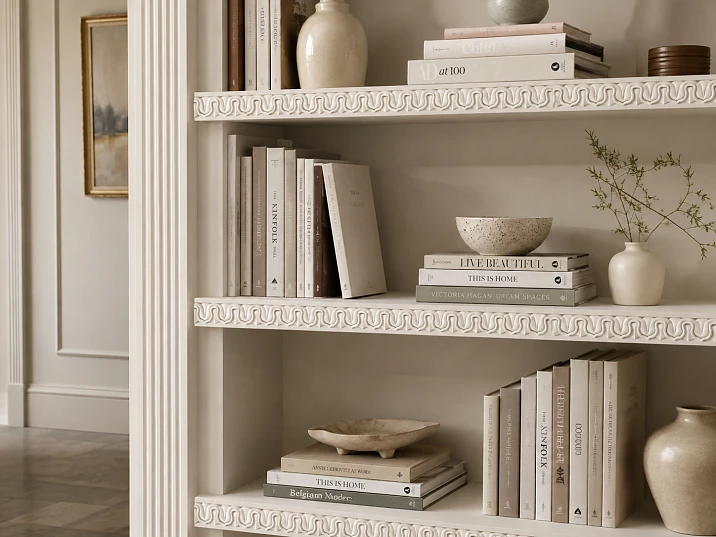
An open shelf can be well assembled, precisely painted, and convenient to use, but still look too simple. This is especially noticeable when several identical horizontal shelves are in front of you: their front edges repeat one above the other and turn into the most visible lines of the entire structure.
Completely redoing such a shelf for decoration usually makes no sense. If the width, depth, and position of the shelves already suit you, you can change the character of the furniture only through the visible front line. One option is to cover or complement the front edges with carved polyurethane molding KPU-004.
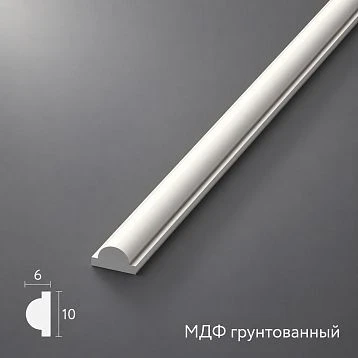
KPU-004 has two relevant sizes: 14 × 7 × 2000 mm and 22 × 14 × 2000 mm. At the time of checking, the 14 × 7 × 2000 mm option costs 2,730 ₽ per strip, and the 22 × 14 × 2000 mm option costs 6,880 ₽. Both products have a length of 2000 mm and are made of polyurethane. The STAVROS card directly indicates the use of KPU-004 for decorating furniture, as well as doors and interior surfaces.
But you cannot choose between 14 and 22 mm based only on a photo. The larger KPU-004 differs not only in width: the second cross-section increases from 7 to 14 mm. Therefore, the scale of the ornament, its volume on the edge, the visual mass of each horizontal line, and the cost of the entire project change at once.
For a shelving unit, another factor is important: the molding is purchased in two-meter strips. Therefore, after choosing the size, you need not just add up the length of the shelves, but create a cutting plan. Sometimes 5.1 m of decor really means three two-meter strips, but sometimes a total of 3.3 m is not enough for calculating the quantity: from two strips you cannot get three solid segments of 1100 mm each without a joint.
Let's break down the selection from measuring one shelf to the final quantity of KPU-004 in the order.
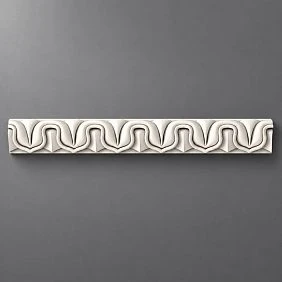
What is KPU-004 and how do the 14 and 22 mm variants differ on real furniture
KPU-004 belongs to the STAVROS carved polyurethane molding. It is a long decorative element with a repeating ornament that can be used as linear furniture decor. Unlike a separate carved overlay, molding does not aim to create a single central medallion: it forms a continuous decorative line.
On an open shelving unit, this feature is especially useful. If KPU-004 runs along the front edge of each shelf, several separate horizontal boards begin to be perceived as parts of one composition.
The current parameters of the two variants look like this:
| KPU-004 variant | Material | Length of one strip | Price per 1 pc. at the time of check |
|---|---|---|---|
| 14 × 7 × 2000 mm | Polyurethane | 2000 мм | 2 730 ₽ |
| 22 × 14 × 2000 mm | Polyurethane | 2000 мм | 6 880 ₽ |
Dimensions, material, and current prices are confirmed by the KPU-004 card.
The first mistake is to perceive these options as the same ornament that simply became 8 mm wider.
The cross-section changes from 14 × 7 to 22 × 14 mm. This means that the larger option gets not only a greater face width, but also a significantly larger profile depth dimension.
On one shelf, the difference may seem small.
On six identical shelves, the effect multiplies six times.
The 14 mm option creates a thinner repeating band. The 22 mm option makes each horizontal line more noticeable and more strongly separates one tier of the shelving unit from another.
Therefore, the main question is not "which KPU-004 is more beautiful," but:
what scale of ornament corresponds to the height of your specific face edge and the overall rhythm of the entire shelving unit?




First, measure exactly the face edge, not the shelf thickness from the catalog
Before purchasing, you will need to take several real measurements.
Even if a board of a certain thickness was used to make the shelf, the visible front part may have a different size. It may have:
-
an additional overlay strip;
-
a thickening;
-
chamfer;
-
rounding;
-
a bottom edge;
-
lining;
-
an already installed smooth profile.
Therefore, measure with a tape measure or caliper exactly the vertical surface where you plan to install the KPU-004.
For each standard shelf, at least two values are needed:
H — the available height of the front edge;
L — the length of the visible part of the edge.
If all shelves are identical, it is enough to carefully measure one, and then check the rest for matching.
If the shelving unit was assembled by hand or stands in a niche, it is better to go through each shelf separately. Even a difference of a few millimeters can affect the cutting of long decorative strips.
In addition to dimensions, inspect the ends.
The trim can run:
-
from side to side;
-
only along the open central section;
-
between vertical uprights;
-
with a slight indentation from the edges.
These are three different order lengths.
For example, the width of the entire shelving unit is 900 mm, but only 850 mm remains between the side uprights. If KPU-004 should end between the uprights, 850 mm is used in the calculation, not the overall 900.
With six shelves, an error of 50 mm on each already turns into 300 mm of extra or missing linear footage.
Our factory also produces:
14 or 22 mm: what happens on edges of different heights
The most visual way to compare two options is to determine what part of the face edge height the ornamental strip occupies.
Suppose KPU-004 is positioned in the center of the surface and its size A — 14 or 22 mm — occupies the corresponding height of the visible face zone.
This is the picture we get:
| Face edge height | KPU-004 14 mm | Free when centered | KPU-004 22 mm | Free when centered |
|---|---|---|---|---|
| 18 мм | occupies 77.8% | by 2 mm | does not fit within the plane | — |
| 20 мм | 70% | by 3 mm | wider than the plane by 2 mm | — |
| 22 мм | 63,6% | by 4 mm | takes up the full height | 0 мм |
| 25 мм | 56% | by 5.5 mm | 88% | by 1.5 mm |
| 30 мм | 46,7% | by 8 mm | 73,3% | by 4 mm |
| 35 мм | 40% | by 10.5 mm | 62,9% | by 6.5 mm |
| 40 мм | 35% | by 13 mm | 55% | by 9 mm |
The table does not establish a universal design standard. It shows the physical difference between two solutions.
On an edge of 18–20 mm, a 22 mm wide option no longer fits within the plane limits without an intentional protrusion. Here, the 14 mm KPU-004 looks significantly more logical.
On an edge of 22–25 mm, both sizes can be used, but the visual result is completely different. The 22 mm profile almost covers the entire surface, while the 14 mm leaves visible strips of the base.
On an edge of about 30 mm, a particularly interesting choice appears: 14 mm takes up less than half of the surface, 22 mm — almost three quarters.
At a height of 35–40 mm, the smaller option becomes a thin decorative line, while the 22 mm one retains a noticeable scale.
Therefore, instead of the rule “for thin shelves — 14, for thick ones — 22,” it is better to use a more precise formulation:
the larger the share of the edge height that the molding occupies, the more it is the ornament, rather than the shelf material, that shapes the appearance of the horizontal line.
Get Consultation
Edge 30 mm: why the choice is especially noticeable here
Let's take a front part with a height of 30 mm.
With KPU-004 width of 14 mm, what remains is:
30 − 14 = 16 mm.
When centered, that's about 8 mm of calm field on top and bottom.
The ornament occupies 46.7% of the height.
Visually, the original shelf surface remains clearly distinguishable. The carved molding works as a decorative strip applied over it.
Now the 22 mm option:
30 − 22 = 8 mm.
When centered, 4 mm remains on each side.
The molding already occupies 73.3% of the height.
Now the viewer perceives the front part of the shelf primarily as a carved belt. The base itself becomes a background at the edges.
This is why two strips of the same length give such different results. The solution changes not the eight millimeters as such, but the ratio of decor to free surface.
For a shelf with six levels, the difference becomes even more noticeable: instead of one strip of 14 or 22 mm, six repeating horizontal lines appear before the eyes.
If you are specifically unsure about an edge around 30 mm, a full-size trial of both sizes is especially useful.
The second cross-section dimension — 7 or 14 mm — also cannot be ignored.
For KPU-004, not only size A changes.
The smaller variant has a cross-section of 14 × 7 mm, the larger one — 22 × 14 mm.
Consequently, the larger version is twice as big in the second cross-section dimension.
On a wall panel, this could be primarily a matter of light and shadow. On furniture, an operational aspect appears.
The front edge of the open shelf is where the user:
-
takes books;
-
places boxes;
-
moves decor;
-
runs a hand;
-
approaches the furniture closely.
The more the relief protrudes forward relative to the original plane, the more important it is to check it not only with your eyes, but also with your hand.
Pay special attention to the lower shelves. At a person's eye level, the upper tiers are perceived mainly visually, while the lower ones are more often in the direct contact zone.
If there is a narrow passage in front of the shelving unit, and the furniture almost touches clothing or bags even without decor, a large cross-section may be less convenient.
Conversely, on a deep stationary shelving unit that is approached only for access to books or displays, additional relief may not create a practical problem.
You can't choose 22 mm just because "for big money it should look richer." A more voluminous molding makes sense where that volume matches the furniture.
When the 14-millimeter KPU-004 looks more convincing
The smaller KPU-004 should first be tried in four situations.
The face edge itself is not tall
If the available surface is about 18–25 mm, the 14 mm option leaves the base visible and does not require extending the decor beyond its boundaries.
There are many shelves
Imagine nine horizontal shelves.
Even a very thin ornamental line will repeat nine times. Therefore, the overall decorative effect can be quite strong without increasing each individual profile.
There are many items on the shelves
Books, collections, dishes, and decorative objects already create visual information.
Too powerful carving along each horizontal line can start competing with the shelf contents.
The lightness of the structure needs to be preserved.
If the furniture is built on thin posts, has an open back, and should look airy, a narrow carved belt is easier to integrate into its original geometry.
Choosing 14 mm does not mean "saving money and going with a simpler option."
On suitable furniture, this may actually be a more precise scale.
When it makes sense to first try KPU-004 with a width of 22 mm
The larger option becomes especially interesting when the structure itself is visually more massive.
For example, the front edge has a height of 30–40 mm or more. A 14 mm strip in such a case occupies a relatively small part of the surface, so the ornament may read as too thin.
22 mm should be considered if:
-
the shelves are massive;
-
the vertical posts are also large;
-
the furniture already features pronounced classical details;
-
the shelving unit stands in a fairly large room;
-
the typical viewing distance is great;
-
the decor should be noticeable not only up close.
There is another factor — the coloring.
If both the shelving unit and the carved molding are painted in one calm color, part of the relief visually dissolves. Light and shadow show the ornament, but there is no contrasting outline.
In such a finish, the 22-millimeter option may be perceived as calmer than it seems when examining a separate unpainted sample.
But it is better not to check this with imagination.
Make strips of the corresponding width from cardboard, paint them at least approximately in the color of the furniture, and temporarily attach them to several shelves.
Should the trim cover the full height of the edge?
Not necessarily.
There are at least three different ways to use KPU-004 on the front side of the shelf.
Almost full coverage
For example, KPU-004 22 mm on a 25 mm edge.
The carved pattern becomes the main surface of the front line.
This option reads well and looks intentionally decorative, but requires very careful fitting.
Decorative strip with small margins
For example, 22 mm on a 30–35 mm edge.
The relief dominates, but the base still creates a contour around it.
Thin ornamental band
For example, 14 mm on an edge of 35–40 mm.
Here, the molding does not try to imitate the entire shelf facade. It works as an independent line.
No option is automatically correct.
The decision depends on what effect is needed: turning the entire edge into a carved belt or only adding an ornament to it.
Why you should try several shelves at once
Placing the KPU-004 sample on one shelf is useful, but not enough.
A shelving unit differs from a dresser or a single console in its repeatability. The main effect occurs not on one edge, but on the entire vertical series.
If the furniture has six shelves, make six paper strips 14 mm wide and temporarily attach them at all levels.
Then repeat the check with 22 mm strips.
Step back to the distance from which the furniture is usually seen.
You may discover a paradoxical result:
on one shelf, 14 mm seems too thin, but on six, it looks expressive enough;
or conversely, on one sample 22 mm looks striking, but after repeating it on all tiers, the shelving becomes visually heavy.
This is an example of a problem that cannot be solved by merely comparing sizes in the product card.
Furniture needs to be perceived as a whole.
How to choose the position of the molding along the height of the face edge
The most obvious option is centering.
If the edge is 30 mm and KPU-004 is 14 mm, there are 8 mm left at the top and bottom.
But strict centering is not the only possibility.
Sometimes the molding can be visually linked to the top line of the shelf, or conversely, leave more free space at the top.
Before shifting, you need to understand which line is more important.
If the top plane of the shelf is clearly visible, a decorative strip that comes too close to its upper edge may visually blend with the horizontal line.
If there is a shadow zone below, a slight upward shift can make the ornament more noticeable.
However, such decisions are better made after fitting the actual profile.
For serial finishing of all shelves, something else matters more: the chosen position must be repeated identically.
A random deviation of one strip by a few millimeters will be more noticeable precisely because the other horizontals set a strict rhythm.
Make a marking template and use it for each shelf instead of independent "by eye" measurement.
Total length is the first calculation, but not yet the final quantity
Suppose an open shelving unit has six identical shelves of 850 mm each.
Visible decorative length:
850 × 6 = 5100 mm, or 5.1 m.
Each KPU-004 plank has a length of 2000 mm.
Simple preliminary calculation:
5100 ÷ 2000 = 2,55.
Rounding up gives three planks.
For six shelves of 850 mm, this result indeed works, because from one two-meter plank you can get two whole pieces:
850 + 850 = 1700 mm.
300 mm remains.
Three planks give exactly six required pieces of 850 mm.
We get:
-
ordered — 6000 mm;
-
used — 5100 mm;
-
total remainder — 900 mm;
-
material usage — 85%.
Here, dividing the total length by 2000 gives the correct result.
But this is not always the case.
Why you can't always use the formula "total length ÷ 2000"
Let's imagine a different shelving unit: three shelves of 1100 mm each.
Total length:
1100 × 3 = 3300 mm.
At first glance:
3300 ÷ 2000 = 1.65, so two strips.
But let's try to cut without visible seams.
From the first 2000 mm strip, you can get one solid 1100 mm piece. That leaves 900 mm.
From the second one — another 1100 mm segment. Again, 900 mm remains.
A third solid segment of 1100 mm is needed, but such a remainder is no longer available.
Therefore, if each front edge requires one solid piece without a joint, then not two but three two-meter strips are needed.
It turns out:
-
total required length — only 3.3 m;
-
order with solid pieces — 6 m;
-
total leftovers — 2.7 m.
That is why professional linear footage calculation is done not only by length.
We need to answer the question:
how many segments of a specific length can physically be obtained from one 2000 mm strip?
Four cutting schemes for a typical shelving unit
Let's compare several options.
| Shelves | Required length | Solid segments from a single 2000 mm plank | Planks without joints | Ordered | Remainder |
|---|---|---|---|---|---|
| 4 × 800 mm | 3200 мм | 2 | 2 | 4000 мм | 800 мм |
| 6 × 850 mm | 5100 мм | 2 | 3 | 6000 мм | 900 мм |
| 7 × 1000 mm | 7000 мм | 2 | 4 | 8000 мм | 1000 мм |
| 3 × 1100 mm | 3300 мм | 1 | 3 | 6000 мм | 2700 мм |
The fourth row looks uneconomical, but it shows the real limitation of the two-meter format.
A product 1100 mm long leaves 900 mm from a two-meter plank, and two separate 900 mm remnants do not turn into one solid 1100 mm piece.
This is where the question of the joint arises.
Can you save on three 1100 mm shelves by making one joint?
Theoretically, four meters of material in total is enough for three 1100 mm sections.
After two solid pieces, two 900 mm sections remain.
The third decorative belt can be composed, for example, of:
900 + 200 mm.
Then two two-meter planks provide the necessary total length with a remainder.
But an arithmetically possible cut does not yet mean a good decorative result.
KPU-004 is carved molding with an ornament. At the joint, you need to consider not only the alignment of physical ends but also the continuation of the pattern.
If aligning the pattern requires additionally trimming both parts, the actual consumption will increase.
Moreover, the visible seam on the front edge of the open shelf is directly in front of the eyes.
Therefore, the savings of one plank should be compared with the price of the compromise:
one additional two-meter plank or one potentially noticeable seam on one of the three shelves.
For an expensive open shelving unit, it is often more reasonable to keep all three front strips intact.
For a project where the seam can be moved to the side post or is practically invisible, a different logic is possible.
Where the seam on the shelf is least noticeable
If a seam cannot be avoided, its location cannot be chosen randomly.
The weakest solution is to join two sections directly in the geometric center of a long open shelf. The central zone is usually best lit and in the field of view.
It is preferable to look for a place:
-
closer to the vertical post;
-
near the structural division;
-
in a less noticeable part of the rack;
-
where the joint line does not become the main visual event.
But the position of the seam should take into account the ornament.
Before cutting, join the two strips dry and find the point where the continuation of the pattern looks most natural.
One should not assume in advance that any remainder of 300, 500, or 900 mm can be attached to the next section without loss.
For a smooth strip, only the length matters.
For carved molding, both length and pattern matter simultaneously.
The ornament repeat changes the actual cutting layout.
The repeating carved decor has another task: where exactly the pattern begins on each shelf.
Suppose all six shelves have the same length of 850 mm.
Physically, you can simply cut six identical sections.
But if each segment starts with a different part of the ornament, adjacent shelves may not look completely identical.
On one, there will be a whole decorative motif on the left.
On the next one, its middle.
On the third, another fragment.
If the ornament is noticeable and the shelving unit is symmetrical, this can disrupt the rhythm.
Therefore, before mass cutting, you need to decide whether pattern synchronization is important for the project.
If yes, first choose one control point of the pattern and start identical shelves with the same phase of the ornament.
This may increase material leftovers.
However, all horizontal lines will look like parts of one system.
The exact consumption for such a layout cannot be determined only by the total length without actually matching the pattern. Therefore, you should not order material 'to the last millimeter.'
What matters more: minimal leftovers or the same pattern on all shelves
For a utilitarian batten, the answer is obvious: reduce waste.
For decorative molding, the criteria may be different.
Imagine two layouts.
In the first, almost all material is used, but each shelf starts at a different point of the ornament.
In the second, more short sections remain, but all six shelves have the same start and end of the pattern.
On open furniture, the second option sometimes looks significantly more professional.
This especially applies to:
-
symmetrical shelving;
-
classic interiors;
-
furniture with a small number of items;
-
shelving that is viewed frontally.
If most of the shelves are filled with books and decor is visible only as a thin line between them, perfect pattern synchronization may be less critical.
The cutting layout should support the real visual task, not an abstract record of material savings.
How to calculate the cost of six shelves of 850 mm
Let's return to the original example.
Six shelves:
6 × 850 = 5100 mm.
For solid sections, three strips of 2000 mm length are needed.
KPU-004 14 × 7 × 2000 mm
The price of one strip at the time of check is 2,730 ₽.
Set:
3 × 2 730 = 8 190 ₽.
KPU-004 22 × 14 × 2000 mm
The price of one strip is 6,880 ₽.
Set:
3 × 6 880 = 20 640 ₽.
The difference:
20 640 − 8 190 = 12 450 ₽.
This is already a significant difference in the cost of the same shelving unit.
Therefore, the size should be chosen before ordering the entire set, not after purchase.
Here, a preliminary fitting is especially reasonable: an error in choosing the profile can cost not just one part, but the cost of three two-meter strips at once.
The price per linear meter helps compare options, but does not determine the project budget
If you divide the price of a plank by two meters, you get an approximate cost per purchased meter:
KPU-004 14 mm: 2,730 ÷ 2 = 1,365 ₽/m.
KPU-004 22 mm: 6,880 ÷ 2 = 3,440 ₽/m.
The difference is 2,075 ₽ per purchased meter.
But you cannot use this figure as a final calculator.
Orders are placed in whole planks, so the actual budget depends on cutting.
For example, for three shelves of 1100 mm without joints, you need to buy 6 m of material, although only 3.3 m will end up on the furniture.
In other words, there are two different indicators:
net decorative length — how much KPU-004 is actually installed on the furniture;
purchase length — how many two-meter planks had to be bought.
For the budget, a second indicator is needed.
The remaining linear footage is not necessarily waste.
After cutting six shelves of 850 mm each, three sections of approximately 300 mm remain.
You shouldn't automatically discard them.
Before ordering, think about whether the same furniture has short lines where repeating the pattern would be justified:
-
a small upper crosspiece;
-
a decorative base zone;
-
a side furniture part;
-
a separate short shelf.
But here you shouldn't fall into the other extreme and invent a new place for decor just because material is left over.
It makes sense to use remnants only where they support composition.
If a short strip of KPU-004 suddenly appears in one random place, material savings can ruin the appearance of the entire piece of furniture.
Design first — then use remnants.
Why buying one strip for a trial fit is sometimes the most cost-effective option
If the shelving unit is already assembled, but there is no certainty between 14 and 22 mm, there is a simple commercial approach: do not order the entire set blindly.
One two-meter strip allows you to check several things at once:
-
the actual scale of the ornament;
-
the position on the edge;
-
depth of the relief;
-
the combination with the shelf thickness;
-
color;
-
the character of shadows;
-
possibility of neat cutting;
-
contact with books and other objects.
If the shelves are short, one test strip may be enough even for several temporary samples.
This method is especially useful for the large 22 × 14 mm option, because the difference in the cost of the set is noticeable.
First make sure that the profile really suits the furniture, and then order the missing strips — this is more reasonable than buying the entire volume based only on a photo.
If the project is carried out by a furniture workshop and the KPU-004 sample is already familiar, the stage of a separate trial purchase can be skipped.
What to choose for a shelving unit with six identical shelves
If you remove all stylistic details and leave only practical logic, the algorithm turns out like this.
For an edge of about 18–20 mm, first consider the 14-millimeter KPU-004. The 22 mm option physically exceeds such a height if it needs to remain entirely within the front plane.
For an edge of 22–25 mm, both options need to be compared with a template. 22 mm turns almost the entire front surface into an ornament; 14 mm leaves a noticeable free field.
At 30 mm, the choice especially depends on the desired effect: 14 mm takes up 46.7% of the height, 22 mm — 73.3%.
At 35–40 mm, the smaller profile becomes more delicate, while 22 mm retains a strong decorative role.
But the number of shelves can change the decision. The more repeating horizontals, the stronger even a narrow option looks.
Therefore, do not choose a profile based on one edge separately from the entire shelving unit.
How furniture color affects the choice of 14 or 22 mm
Size is not the only regulator of visibility.
Let's imagine two identical shelving units.
On the first, KPU-004 is painted exactly in the color of the body.
On the second, the relief contrasts with the base.
In the first case, the viewer mainly notices shadows and shape. In the second, also a clear color stripe.
Therefore, 22 mm in a monochrome finish can look calmer than 14 mm with strong contrast.
Before making the final choice, decide what the decor should be.
In the color of the shelving unit
The most versatile way for a built-in look.
The trim is perceived as part of the furniture, not as an attached tape.
A close shade
The relief becomes slightly more active, but the overall composition remains calm.
Strong contrast
Each shelf gets its own graphic line.
On six or eight shelves, this technique is very noticeable, so with the large 22 mm option, it should be used especially deliberately.
It is better to test the combination on one fragment before painting the entire set.
Light also changes the appearance of the carved profile.
Carved molding works not only with its contour, but also with shadows.
On a front-lit shelf, the relief looks calmer.
If light comes from the side, protruding parts create more pronounced shadows, and the decorative line becomes visually deeper.
Therefore, the same plank should be viewed:
-
in daylight;
-
in the evening;
-
with the main light on;
-
with shelf lighting, if available.
Pay special attention to the 22 × 14 mm option. A more voluminous cross-section under side lighting may look significantly more active than in the product card photo.
This is not a drawback.
Just the final decision should be made in the conditions of a real interior.
What to do if the shelf already has LED lighting
If the lighting runs near the front face of the shelf, the decorative profile cannot be considered in isolation.
First, determine:
-
where the LED profile runs;
-
where the light exits;
-
whether KPU-004 blocks the light output;
-
whether the relief creates an unwanted sharp shadow;
-
whether access to lighting maintenance remains.
Sometimes a narrower KPU-004 14 mm is easier to place near the technical zone.
In other cases, a large profile can hide part of the structure and simultaneously create a nice bottom line.
But this is already a matter of the specific shelf cross-section.
Do not use decorative trim as a random cover for wires if it disrupts cooling, access, or the structure of the existing lighting.
First, the technical scheme is decided, then the decorative one.
Paint the molding before installation or together with the shelving unit
The KPU-004 card presents the product as polyurethane interior decor, used among other things for furniture.
The practical sequence depends on the condition of the shelving unit.
If the furniture is still being finished
It is convenient to first do a dry fitting and cutting, then mount all parts and form a single coating according to the chosen finishing system.
This makes it easier to achieve the feeling that the ornament was originally part of the furniture.
If the shelving unit is already painted
The work becomes point-specific.
You need to check the compatibility of the mounting compound with polyurethane and the existing coating of the body. You should not automatically sand or degrease finished furniture with an aggressive agent without considering the specific paint or varnish.
If the decor is contrasting
Pre-painting individual segments can make working with the relief easier, but joints and subsequent final touch-ups require special attention.
The general principle is simple: don't turn a finished expensive shelving unit into an experimental surface. Test the material system on a sample.
How to mark six shelves so that the trim doesn't "wander"
Repeatability is the main advantage of shelf decoration and at the same time a source of errors.
If on the first shelf the decorative stripe is 7 mm from the top edge, on the second — 9 mm, on the third — 5 mm, each individual error seems small.
But when all the horizontals are visible at once, the difference starts to show.
It's better to make a simple template.
For example, a stop is cut from thin cardboard, which automatically sets the same position of KPU-004 relative to the edge.
With it, each shelf is marked according to one system.
This is faster than re-measuring a few millimeters with a tape measure on all tiers, and reduces the risk of error accumulation.
Separately check the horizontal level on long sections.
Before final fixing, it is useful to look at the rack from a few meters away. At a large distance, small details disappear, but the overall rhythm of lines is especially visible.
Installation: first a full dry layout, then glue
Do not start with the first shelf using the principle "cut — glued — moved on."
For repeating carved moldings, it is safer to first prepare the entire set of parts.
The sequence is as follows:
-
number the shelves;
-
record the actual length of each;
-
create a cutting map;
-
prepare the segments;
-
sort them onto their shelves;
-
check the orientation of the pattern;
-
check the beginning and end of the ornament;
-
do a dry fit of the entire shelf unit;
-
only after that proceed to installation.
This order allows you to spot a problem before the first piece is already fixed.
For example, it may turn out that on the fifth shelf the pattern starts differently or one of the sections is accidentally shorter.
Before glue, it's just an adjustment.
After installation, it's rework.
How to choose an adhesive compound
KPU-004 is polyurethane decor, but the specific shelf base can be completely different: painted MDF, wood, veneer, plywood, or other furniture coating.
Therefore, it is impossible to formulate a safe rule like "take any mounting adhesive."
The composition must be compatible:
-
with polyurethane;
-
with the surface of the specific shelf;
-
with its paint or varnish coating, if it has already been applied.
The current KPU-004 card classifies the product as mountable interior decor; in the STAVROS catalog, moldings are presented as a separate category of polyurethane products.
Before working, refer to the instructions of the specific mounting material.
If the shelf already has an expensive finish, first conduct a test in an inconspicuous spot or on a separate sample with the same coating.
When KPU-004 should not be installed on face edges at all
A good product article should also help to refuse a purchase.
The edge is too narrow
If the selected profile physically does not fit on the available surface, there is no need to force it to fit.
The front line constantly receives impacts
In a work or children's shelving unit, the lower shelves may regularly come into contact with boxes, toys, and equipment.
Protruding carved decor in such an area requires a more careful solution.
The shelving unit is already visually complex
Carved side panels, a colored back panel, a large number of exhibits, decorative lighting — sometimes six more ornamental strips are already superfluous.
Absolutely minimalist geometry is required
In such an interior, the problem may not be that the shelving unit is "too simple," but in
KPU-004 or smooth furniture edge
Carved molding should not be used just because a smooth edge seems "not expensive enough."
The solutions have different tasks.
A smooth edge emphasizes:
- geometry;
- the material;
- color;
- the delicacy of the construction.
KPU-004 emphasizes:
- the repetition of horizontals;
- ornament;
- chiaroscuro;
- the decorative character of the furniture.
If an open shelving unit stands in a modern minimalist interior and is filled with bright books, a smooth line can be the best background.
If the furniture is in a classic study, library, or interior with carved details, repeating molding can tie the shelving unit to the rest of the decor.
In other words, the choice starts not with the product, but with the function of the decor.
Can you decorate only part of the shelves?
Yes, and sometimes that's better than mechanically repeating KPU-004 on every tier.
For example, a shelving unit has nine shelves, but the bottom three are closed with doors, and the top six are open.
The decorative line can be used only in the open area, if that's the part that should get a unified rhythm.
Another scenario is one larger central tier. You can highlight it separately without turning the entire shelving unit into a continuous system of carved strips.
But partial decoration should look intentional.
A random pattern like "there was enough material for these four shelves, but not for the other two" usually reads exactly as a shortage of material.
First set the rule of composition, then count the quantity.
Should you mix KPU-004 14 and 22 mm on the same shelving unit?
Technically, two sizes exist within one model, but that does not mean it is necessarily useful to combine them on a single piece of furniture.
If identical shelves unexpectedly receive bands of different scales, the rhythm is disrupted.
A combination can be justified when the furniture zones themselves are fundamentally different.
For example:
- a massive lower base and thin upper shelves;
- a central accent shelf and secondary side shelves;
- two structurally independent blocks.
Then 22 mm can mark the main line, and 14 mm the secondary ones.
But for a standard open shelving unit with six identical shelves, one chosen size usually creates a more cohesive result.
Why the price of the 22-millimeter option requires especially precise layout
For six shelves of 850 mm, the difference between the sets is 12,450 ₽.
With a larger rack, it grows along with the number of planks.
For example, if the cutting requires four two-meter planks:
KPU-004 14 mm:
4 × 2 730 = 10 920 ₽.
KPU-004 22 mm:
4 × 6 880 = 27 520 ₽.
The difference:
16 600 ₽.
With five planks:
- 14 mm — 13,650 ₽;
- 22 mm — 34,400 ₽;
- the difference is 20,750 ₽.
Therefore, choosing a larger option just because it is "more expressive in a small photo" is unreasonable.
Need to make sure that on real furniture this additional scale is really needed.
How to place an order without shortage and without extra planks
Before buy carved molding KPU-004, make a small packing list.
Don't limit yourself to writing:
"shelf — about 5 meters".
Write down each shelf separately.
For example:
| Shelf | Required piece |
| 1 | 850 мм |
| 2 | 850 мм |
| 3 | 850 мм |
| 4 | 850 мм |
| 5 | 850 мм |
| 6 | 850 мм |
Then form the cutting layout next to it:
Plank No. 1: 850 + 850 + remainder 300 mm.
Bar No. 2: 850 + 850 + remainder 300 mm.
Bar No. 3: 850 + 850 + remainder 300 mm.
Now the quantity of three pieces is confirmed not only by the footage, but also by the actual cutting layout.
This is exactly the scheme that needs to be created for complex lengths.
Practical algorithm for selecting KPU-004 for a finished shelving unit
To avoid returning to each section separately, the entire process can be reduced to a single sequence.
1. Measure the height of the visible front edge
Do not rely only on the nominal thickness of the material.
2. Measure the actual decorative length of each shelf
Between the boundaries where the KPU-004 should actually start and end.
3. Compare 14 and 22 mm relative to the edge height
Calculate not only the remainder in millimeters, but also the surface fraction.
4. Consider the second cross-section dimension
14 × 7 and 22 × 14 mm differ in volume.
5. Make full-size strips
Check the entire rack at once, not just one shelf.
6. Determine the color
Matching the body or contrasting.
7. Choose the pattern principle
Whether the same start of the ornament is needed on all shelves.
8. Write down the length of each part
As a separate list.
9. Create a cutting layout for each strip 2000 mm long
Do not limit yourself to a general division of linear meters.
10. Decide whether joints are acceptable
If not, each face line must be made from a single piece.
11. Count the number of strips
Only after cutting.
12. Calculate the cost of both options
Sometimes the difference changes the decision.
13. Check the balances
Perhaps some can be reasonably used in the same project.
14. Do a dry fit
Before applying the mounting material.
15. Only after this place the full order
This way, the chance of buying the wrong size or an insufficient quantity is significantly lower.
What to choose in the end: 14 or 22 mm
There is no universal winner among the two KPU-004 options.
14 × 7 mm makes more sense to start trying on when the face edge is thin, there are many shelves, the furniture should retain lightness, or the ornament is needed as a neat line.
22 × 14 mm is worth checking when the shelves are visually more massive, the edge height allows leaving a normal margin, and the carved belt should noticeably contribute to the appearance of the shelving unit.
For a 30 mm edge, the difference is especially telling:
- 14 mm takes up about 46.7% of the height;
- 22 mm is about 73.3%.
These are already two different designs.
After choosing the size, an equally important part begins — cutting.
Six shelves of 850 mm require three two-meter strips and leave a clear remainder. Three shelves of 1100 mm, when a solid decor is required, already need three strips, although the total length is only 3.3 m.
Therefore, the final purchase formula looks like this:
edge height → profile scale → number of shelves → length of each shelf → allowance for joints → cutting of two-meter strips → quantity → cost.
If KPU-004 fits this chain, you can proceed to the product card and order KPU-004 made of polyurethane in the calculated quantity.
If 14 and 22 mm do not fit proportionally, there is no need to adapt the shelves to a specific article. In the section carved polyurethane molding you can compare other sizes and profiles. And for a broader task of furniture styling, a general catalog is available, where you can You can buy ready-made stucco matching the Baroque style. Calculate the quantity: linear meters of cornices and moldings, number of rosettes, pilasters, consoles, corner elements. Add a ten to fifteen percent allowance for trimming..
The main thing is to first solve the shelving task, and only then purchase decorative material.
FAQ
What to do if the upper and lower shelves have different thicknesses?
Do not calculate the entire shelving unit based on one standard edge.
Divide the shelves into groups by actual height and do a separate fitting. If the difference is significant, the same KPU-004 may occupy a different share of the surface on the lower and upper tiers.
Sometimes this is acceptable, especially if the structure itself has a pronounced lower base. If the difference looks random, it is better to adjust the composition before ordering.
Do I need to take into account the thickness of the paint layer when choosing between 14 and 22 mm?
For a regular visual choice, the decisive factors are the dimensions of the edge and profile themselves, not an attempt to calculate the decorative composition down to fractions of a millimeter.
But when fitting almost flush, the problem lies in the choice itself. For example, if a profile 22 mm wide is placed on a surface exactly 22 mm, there is no free space at all. In such a situation, it is better to do a real fitting rather than rely on theoretical size matching.
Can KPU-004 be installed only on the three central shelves?
Yes, if the three central shelves form a separate compositional group.
First, mark the future lines with painter's tape. If the selected shelves are perceived as a deliberately highlighted block, the solution works. If it seems that the decor on the other tiers was simply forgotten to be installed, it's better to reconsider the scheme.
What should be considered the length of a shelf if it fits between two side posts?
Count only the section that will actually be covered by the molding.
If the external width of the furniture is 900 mm, and the open line between the posts is 850 mm, and KPU-004 should end at the posts, then 850 mm goes into the cutting plan.
Do I need to buy extra stock beyond the calculated strips?
First, create an actual cutting plan.
If it uses the strips almost completely, and the alignment of the carved pattern has not yet been verified, the minimal mathematical order may turn out to be too rigid. The decision about an additional strip depends on the specific scheme, the required synchronization of the ornament, and the acceptability of joints.
Do not add arbitrary "10% extra" without understanding what problem this extra solves.
If it turned out to be 5.1 m, do you definitely need three planks?
For six segments of 850 mm each — yes: each two-meter plank gives two solid sections of 850 mm.
But the total length of 5.1 m itself is not sufficient proof. For a different set of parts with the same total footage, the cutting layout may differ.
Why do three shelves of 1100 mm require three planks, even though only 3.3 m is needed in total?
Because when a solid front strip is required, a two-meter plank yields only one 1100 mm segment.
The remaining 900 mm is insufficient for a second solid piece of the same length.
Three shelves — three solid segments — three planks.
Two planks become possible only when using a composite section with a joint, and provided that the pattern allows it to be done neatly.
Do the joints need to be made strictly in the center of the shelf?
No. On the contrary, central placement often makes the connection as visible as possible.
If a joint is unavoidable, its location is chosen considering the shelf construction and pattern repetition.
Can leftovers from one shelf be used on the next one?
In length — sometimes yes.
In appearance — you need to separately check the continuation of the pattern. For carved moldings, two pieces that match in millimeters do not yet guarantee a neat decorative joint.
Should you choose 22 mm just because the shelf has a 30 mm edge?
No.
22 mm does fit and takes up about 73.3% of its height, but that is only a geometric fact.
If the shelf has many shelves or should remain light, 14 mm may look better. Check the entire furniture facade as a whole.
Can KPU-004 be used on a shelf with books?
The very use of KPU-004 for decorating furniture corresponds to the product's purpose as stated by STAVROS.
But the profile should not interfere with freely placing and removing books. Especially check the lower and upper edges if books fit close to the front of the shelf.
What to choose for a 20 mm edge?
If the decor must be completely inside the surface, 14 mm looks significantly easier to place: 6 mm of total free margin remains.
The 22 mm option is 2 mm wider than such an edge and already requires a deliberate extension beyond its boundaries or a different installation scheme.
And for a 40 mm edge?
Both options physically leave a free margin.
14 mm will take up 35% of the height, while 22 mm will take up 55%.
Therefore, here the question is mainly not physical but visual: you need a thin band or a more noticeable ornament.
Is it possible to install both molding and lighting simultaneously?
Only possible after checking the specific shelf design.
The molding must not overlap the light profile, wiring, access for maintenance, or alter the operation of an already planned technical system.
First, the lighting is designed or checked, then the free space is used for decor.
Where to buy KPU-004 14 or 22 mm?
Both options are presented in the product card carved molding KPU-004.
As of the current check of the product card, sizes 14 × 7 × 2000 mm and 22 × 14 × 2000 mm are available in polyurethane; the published prices are 2,730 ₽ and 6,880 ₽ per two-meter strip, respectively.
If neither of the two sizes matches the front edge of your shelving unit, it is better to go to the general section polyurethane molding and compare other profiles. The current section features a wide range of molding products in various sizes.